UMCC_DLSI-(SA): Using a ranking algorithm and informal features
to solve Sentiment Analysis in Twitter
Yoan Gutiérrez, Andy González,
Roger Pérez, José I. Abreu
University of Matanzas, Cuba
{yoan.gutierrez, roger.perez ,jose.abreu}@umcc.cu, [email protected]
Antonio Fernández Orquín,
Alejandro Mosquera, Andrés
Montoyo, Rafael Muñoz
University of Alicante, Spain
[email protected], {amosquera, montoyo,
rafael}@dlsi.ua.es
Franc Camara
Independent Consultant USA
info@franccamara .com
Abstract
In this paper, we describe the development and performance of the supervised system UMCC_DLSI-(SA). This system uses corpora where phrases are annotated as Positive, Negative, Objective, and Neutral, to achieve new sentiment resources involving word dictionaries with their associated polarity. As a result, new sentiment inventories are obtained and applied in conjunction with detected informal patterns, to tackle the challenges posted in Task 2b of the Semeval-2013 competition. Assessing the effectiveness of our application in sentiment classification, we obtained a 69% F-Measure for neutral and an average of 43% F-Measure for positive and negative using Tweets and SMS messages.
1
Introduction
Textual information has become one of the most important sources of data to extract useful and heterogeneous knowledge from. Texts can provide factual information, such as: descriptions, lists of characteristics, or even instructions to opinion-based information, which would include reviews, emotions, or feelings. These facts have motivated dealing with the identification and extraction of opinions and sentiments in texts that require special attention.
Many researchers, such as (Balahur et al., 2010; Hatzivassiloglou et al., 2000; Kim and Hovy, 2006; Wiebe et al., 2005) and many others have been working on this and related areas.
Related to assessment Sentiment Analysis (SA) systems, some international competitions have taken place. Some of those include: Semeval-2010 (Task 18: Disambiguating Sentiment Ambiguous
Adjectives 1 ) NTCIR (Multilingual Opinion
Analysis Task (MOAT2)) TASS3 (Workshop on
Sentiment Analysis at SEPLN workshop) and Semeval-2013 (Task 24 Sentiment Analysis in
Twitter) (Kozareva et al., 2013).
In this paper, we introduce a system for Task 2 b) of the Semeval-2013 competition.
1.1 Task 2 Description
In participating in “Task 2: Sentiment Analysis in Twitter” of Semeval-2013, the goal was to take a given message and its topic and classify whether it had a positive, negative, or neutral sentiment towards the topic. For messages conveying, both a positive and negative sentiment toward the topic, the stronger sentiment of the two would end up as the classification. Task 2 included two sub-tasks. Our team focused on Task 2 b), which provides two training corpora as described in Table 3, and two test corpora: 1) sms-test-input-B.tsv (with 2094 SMS) and 2) twitter-test-input-B.tsv (with 3813 Twit messages).
The following section shows some background approaches. Subsequently, in section 3, we describe the UMCC_DLSI-(SA) system that was used in Task 2 b). Section 4 describes the assessment of the obtained resource from the Sentiment Classification task. Finally, the conclusion and future works are presented in section 5.
2
Background
The use of sentiment resources has proven to be a necessary step for training and evaluating systems that implement sentiment analysis, which also
1 http://semeval2.fbk.eu/semeval2.php
2 http://research.nii.ac.jp/ntcir/ntcir-ws8/meeting/ 3 http://www.daedalus.es/TASS/
4http://www.cs.york.ac.uk/semeval-2013/task2/
include fine-grained opinion mining (Balahur, 2011).
In order to build sentiment resources, several studies have been conducted. One of the first is the relevant work by (Hu and Liu, 2004) using lexicon expansion techniques by adding synonymy and
antonym relations provided by WordNet
(Fellbaum, 1998; Miller et al., 1990) Another one is the research described by (Hu and Liu, 2004; Liu et al., 2005) which obtained an Opinion Lexicon compounded by a list of positive and negative opinion words or sentiment words for English (around 6800 words).
A similar approach has been used for building WordNet-Affect (Strapparava and Valitutti, 2004) which expands six basic categories of emotion; thus, increasing the lexicon paths in WordNet.
Nowadays, many sentiment and opinion messages are provided by Social Media. To deal with the informalities presented in these sources, it is necessary to have intermediary systems that improve the level of understanding of the messages. The following section offers a description of this phenomenon and a tool to track it.
2.1 Text normalization
Several informal features are present in opinions extracted from Social Media texts. Some research has been conducted in the field of lexical normalization for this kind of text. TENOR (Mosquera and Moreda, 2012) is a multilingual text normalization tool for Web 2.0 texts with an aim to transform noisy and informal words into their canonical form. That way, they can be easily processed by NLP tools and applications. TENOR works by identifying out-of-vocabulary (OOV) words such as slang, informal lexical variants, expressive lengthening, or contractions using a dictionary lookup and replacing them by matching formal candidates in a word lattice using phonetic and lexical edit distances.
2.2 Construction of our own Sentiment Resource
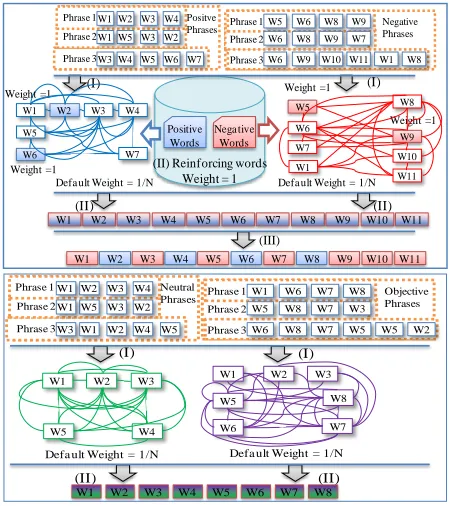
Having analyzed the examples of SA described in section 2, we proposed building our own sentiment resource (Gutiérrez et al., 2013) by adding lexical and informal patterns to obtain classifiers that can deal with Task 2b of Semeval-2013. We proposed the use of a method named RA-SR (using Ranking Algorithms to build Sentiment Resources)
(Gutiérrez et al., 2013) to build sentiment word inventories based on senti-semantic evidence obtained after exploring text with annotated sentiment polarity information. Through this process, a graph-based algorithm is used to obtain auto-balanced values that characterize sentiment polarities, a well-known technique in Sentiment Analysis. This method consists of three key stages:
(I) Building contextual word graphs; (II) Applying a ranking algorithm; and (III) Adjusting the sentiment polarity values.
[image:2.612.315.540.282.535.2]These stages are shown in the diagram in Figure 1, which the development of sentimental resources starts off by giving four corpora of annotated sentences (the first with neutral sentences, the second with objective sentences, the third with positive sentences, and the last with negative sentences).
Figure 1. Resource walkthrough development process.
2.3 Building contextual word graphs
Initially, text preprocessing is performed by applying a Post-Tagging tool (using Freeling (Atserias et al., 2006) tool version 2.2 in this case) to convert all words to lemmas5. After that, all
obtained lists of lemmas are sent to RA-SR, then divided into four groups: neutral, objective, positive, and negative candidates. As the first set
5 Lemma denotes canonic form of the words.
Phrase 3 Phrase 2
W1 W2 W3 W4 W5 W3 W2
W3 W4 W5 W6 W1
W7 Phrase 1 Positve
Phrases W5 W6 W8 W9 W8 W9 W7 W6 W9 W10 W11 W6
W1 W8 Negative Phrases
Phrase 3 Phrase 2 Phrase 1
Positive Words
Nega tive Words
W1 W2 W3 W4
W5
W6 W7
W5 W6 W7
W8
W9 W10 W11
(I)
(II) Reinforcing words Weight = 1
(II) (II)
(I)
Weight =1
Weight =1 Weight =1
Weight =1
W1 W2 W3 W4 W5 W6 W7 W8 W9 W10 W11
W1 W2 W3 W4 W5 W6 W7 W8 W9 W10 W11
(III)
W1
Default Weight = 1/N Default Weight = 1/N
W1 W2 W3
W4 W5
Phrase 3 Phrase 2
W1 W2 W3 W4 W5 W3 W2 W3 W1 W2 W4 W1
W5 Phrase 1 Neutral
Phrases W1 W6 W7 W8 W8 W7 W3 W6 W8 W7 W5 W5
W5 W2 Objective Phrases
Phrase 3 Phrase 2 Phrase 1
(II)
W1 W2 W3 W4 W5 W6 W7 W8
(II)
W1 W2 W3
W5
W6 W7
W8
Defa ult Weight = 1/N (I) (I)
of results, four contextual graphs are obtained: 𝐺𝑛𝑒𝑢, 𝐺𝑜𝑏𝑗, 𝐺𝑝𝑜𝑠, and 𝐺𝑛𝑒𝑔, where each graph includes the words/lemmas from the neutral, objective, positive and negative sentences respectively. These graphs are generated after connecting all words for each sentence into individual sets of annotated sentences in concordance with their annotations (𝑃𝑜𝑠, 𝑁𝑒𝑔,
𝑂𝑏𝑗, 𝑁𝑒𝑢 ).
Once the four graphs representing neutral, objective, positive and negative contexts are created, we proceed to assign weights to apply graph-based ranking techniques in order to auto-balance the particular importance of each vertex 𝑣𝑖 into 𝐺𝑛𝑒𝑢, 𝐺𝑜𝑏𝑗, 𝐺𝑝𝑜𝑠 and 𝐺𝑛𝑒𝑔.
As the primary output of the graph-based ranking process, the positive, negative, neutral, and objective values are calculated using the PageRank algorithm and normalized with equation (1). For a better understanding of how the contextual graph was built see (Gutiérrez et al., 2013).
2.4 Applying a ranking algorithm
To apply a graph-based ranking process, it is necessary to assign weights to the vertices of the graph. Words involved into 𝐺𝑛𝑒𝑢, 𝐺𝑜𝑏𝑗, 𝐺𝑝𝑜𝑠 and 𝐺𝑛𝑒𝑔 take the default of 1/N as their weight to define the weight of 𝑣 vector, which is used in our proposed ranking algorithm. In the case where words are identified on the sentiment repositories (see Table 4) as positive or negative, in relation to their respective graph, a weight value of 1 (in a range [0 … 1] ) is assigned. 𝑁 represents the maximum quantity of words in the current graph. After that, a graph-based ranking algorithm is applied in order to structurally raise the graph vertexes’ voting power. Once the reinforcement values are applied, the proposed ranking algorithm is able to increase the significance of the words related to these empowered vertices.
The PageRank (Brin and Page, 1998) adaptation, which was popularized by (Agirre and Soroa, 2009) in Word Sense Disambiguation thematic, and which has obtained relevant results, was an inspiration to us in our work. The main idea behind this algorithm is that, for each edge between 𝑣i and 𝑣jin graph 𝐺, a vote is made from
𝑣i to 𝑣j. As a result, the relevance of 𝑣j is
increased.
On top of that, the vote strength from 𝑖 to 𝑗 depends on 𝑣𝑖′𝑠 relevance. The philosophy behind
it is that, the more important the vertex is, the more strength the voter would have. Thus, PageRank is generated by applying a random walkthrough from the internal interconnection of
𝐺, where the final relevance of 𝑣𝑖represents the random walkthrough probability over 𝐺 , and ending on 𝑣𝑖.
In our system, we apply the following configuration: dumping factor 𝑐 = 0.85 and, like in (Agirre and Soroa, 2009) we used 30 iterations. A detailed explanation about the PageRank algorithm can be found in (Agirre and Soroa, 2009)
After applying PageRank, in order to obtain standardized values for both graphs, we normalize the rank values by applying the equation (1), where 𝑀𝑎𝑥(𝐏𝐫) obtains the maximum rank value of 𝑷𝒓 vector (rankings’ vector).
𝐏𝐫𝑖= 𝐏𝐫𝑖/𝑀𝑎𝑥(𝐏𝐫) (1)
2.5 Adjusting the sentiment polarity values
After applying the PageRank algorithm on𝐺𝑛𝑒𝑢,
𝐺𝑜𝑏𝑗, 𝐺𝑝𝑜𝑠 and 𝐺𝑛𝑒𝑔, having normalized their ranks, we proceed to obtain a final list of lemmas (named 𝐿𝑓) while avoiding repeated elements.
𝐿𝑓 is represented by 𝐿𝑓𝑖 lemmas, which would have, at that time, four assigned values: Neutral, Objective, Positive, and Negative, all of which correspond to a calculated rank obtained by the PageRank algorithm.
At that point, for each lemma from 𝐿𝑓, the following equations are applied in order to select the definitive subjectivity polarity for each one:
𝑃𝑜𝑠 = {𝑃𝑜𝑠 − 𝑁𝑒𝑔 ; 𝑃𝑜𝑠 > 𝑁𝑒𝑔0 ; 𝑜𝑡ℎ𝑒𝑟𝑤𝑖𝑠𝑒 (2)
𝑁𝑒𝑔 = {𝑁𝑒𝑔 − 𝑃𝑜𝑠 ; 𝑁𝑒𝑔 > 𝑃𝑜𝑠0 ; 𝑜𝑡ℎ𝑒𝑟𝑤𝑖𝑠𝑒 (3)
Where 𝑃𝑜𝑠 is the Positive value and 𝑁𝑒𝑔 the Negative value related to each lemma in 𝐿𝑓.
In order to standardize again the 𝑃𝑜𝑠 and 𝑁𝑒𝑔 values and making them more representative in a [0…1] scale, we proceed to apply a normalization process over the 𝑃𝑜𝑠 and 𝑁𝑒𝑔 values.
From there, based on the objective features commented by (Baccianella et al., 2010), we assume the same premise to establish an alternative objective value of the lemmas. Equation (4) is used for that:
𝑂𝑏𝑗𝐴𝑙𝑡 = 1 − |𝑃𝑜𝑠 − 𝑁𝑒𝑔| (4)
As a result, each word obtained in the sentiment resource has an associated value of: positivity (𝑃𝑜𝑠, see equation (2)), negativity (𝑁𝑒𝑔, see equation (3)), objectivity(𝑅𝑒𝑎𝑙_𝑜𝑏𝑗, obtained by PageRank over 𝐺𝑜𝑏𝑗 and normalized with equation (1)), calculated-objectivity (𝑂𝑏𝑗𝐴𝑙𝑡, now cited as 𝑜𝑏𝑗_𝑚𝑒𝑎𝑠𝑢𝑟𝑒𝑑) and neutrality (𝑁𝑒𝑢, obtained by PageRank over 𝐺𝑛𝑒𝑢 and normalized with equation (1)).
3
System Description
The system takes annotated corpora as input from which two models are created. One model is created by using only the data provided at Semeval-2013 (Restricted Corpora, see Table 3), and the other by using extra data from other annotated corpora (Unrestricted Corpora, see Table 3). In all cases, the phrases are pre-processed using Freeling 2.2 pos-tagger (Atserias
et al., 2006) while a dataset copy is normalized using TENOR (described in section 2.1).
The system starts by extracting two sets of features. The Core Features (see section 3.1) are the Sentiment Measures and are calculated for a standard and normalized phrase. The Support Features (see section 3.2) are based on regularities, observed in the training dataset, such as emoticons, uppercase words, and so on.
The supervised models are created using Weka6
and a Logistic classifier, both of which the system uses to predict the values of the test dataset. The selection of the classifier was made after analyzing several classifiers such as: Support Vector Machine, J48 and REPTree. Finally, the Logistic classifier proved to be the best by increasing the results around three perceptual points.
The test data is preprocessed in the same way the previous corpora were. The same process of feature extraction is also applied. With the aforementioned features and the generated models, the system proceeds to classify the final values of Positivity, Negativity, and Neutrality.
3.1 The Core Features
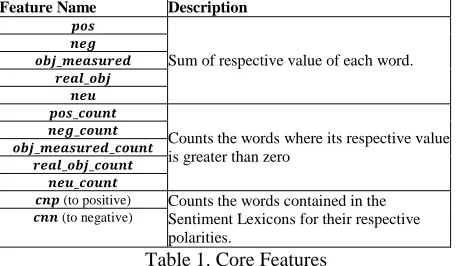
The Core Features is a group of measures based on the resource created early (see section 2.2). The system takes a sentence preprocessed by Freeling 2.2 and TENOR. For each lemma of the analyzed sentence, 𝑝𝑜𝑠, 𝑛𝑒𝑔, 𝑜𝑏𝑗_𝑚𝑒𝑎𝑠𝑢𝑟𝑒𝑑 , 𝑟𝑒𝑎𝑙_𝑜𝑏𝑗,
6 http://www.cs.waikato.ac.nz/
and 𝑛𝑒𝑢 are calculated by using the respective word values assigned in RA-SR. The obtained values correspond to the sum of the corresponding values for each intersecting word between the analyzed sentence (lemmas list) and the obtained resource by RA-SR. Lastly, the aforementioned attributes are normalized by dividing them by the number of words involved in this process.
Other calculated attributes are: 𝑝𝑜𝑠_𝑐𝑜𝑢𝑛𝑡 , 𝑛𝑒𝑔_𝑐𝑜𝑢𝑛𝑡 , 𝑜𝑏𝑗_𝑚𝑒𝑎𝑠𝑢𝑟𝑒𝑑_𝑐𝑜𝑢𝑛𝑡 , 𝑜𝑏𝑗_𝑟𝑒𝑎𝑙_𝑐𝑜𝑢𝑛𝑡 and 𝑛𝑒𝑢_𝑐𝑜𝑢𝑛𝑡. These attributes count each involved iteration for each feature type ( 𝑃𝑜𝑠 , 𝑁𝑒𝑔 , 𝑅𝑒𝑎𝑙_𝑜𝑏𝑗 , 𝑂𝑏𝑗𝐴𝑙𝑡 and 𝑁𝑒𝑢 respectively, where the respective value may be greater than zero.
Attributes 𝑐𝑛𝑝 and cnn are calculated by counting the amount of lemmas in the phrases contained in the Sentiment Lexicons (Positive and Negative respectively).
All of the 12 attributes described previously are computed for both, the original, and the normalized (using TENOR) phrase, totaling 24 attributes. The Core features are described next.
Feature Name Description
𝒑𝒐𝒔
Sum of respective value of each word. 𝒏𝒆𝒈
𝒐𝒃𝒋_𝒎𝒆𝒂𝒔𝒖𝒓𝒆𝒅 𝒓𝒆𝒂𝒍_𝒐𝒃𝒋
𝒏𝒆𝒖 𝒑𝒐𝒔_𝒄𝒐𝒖𝒏𝒕
Counts the words where its respective value is greater than zero
𝒏𝒆𝒈_𝒄𝒐𝒖𝒏𝒕 𝒐𝒃𝒋_𝒎𝒆𝒂𝒔𝒖𝒓𝒆𝒅_𝒄𝒐𝒖𝒏𝒕
𝒓𝒆𝒂𝒍_𝒐𝒃𝒋_𝒄𝒐𝒖𝒏𝒕 𝒏𝒆𝒖_𝒄𝒐𝒖𝒏𝒕
𝒄𝒏𝒑(to positive) Counts the words contained in the Sentiment Lexicons for their respective polarities.
𝒄𝒏𝒏(to negative)
Table 1. Core Features
3.2 The Support Features
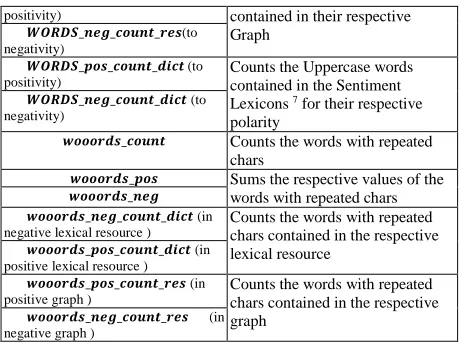
The Support Features is a group of measures based on characteristics of the phrases, which may help with the definition on extreme cases. The emotPos
and emotNeg values are the amount of Positive and Negative Emoticons found in the phrase. The
exc and itr are the amount of exclamation and interrogation signs in the phrase. The following table shows the attributes that represent the support features:
Feature Name Description
𝒆𝒎𝒐𝒕𝑷𝒐𝒔
Counts the respective Emoticons 𝒆𝒎𝒐𝒕𝑵𝒆𝒈
𝒆𝒙𝒄 (exclamation marks (“!”))
Counts the respective marks 𝒊𝒕𝒓 (question marks (“?”))
𝑾𝑶𝑹𝑫𝑺_𝒄𝒐𝒖𝒏𝒕 Counts the uppercase words
𝑾𝑶𝑹𝑫𝑺_𝒑𝒐𝒔 Sums the respective values of the
Uppercase words 𝑾𝑶𝑹𝑫𝑺_𝒏𝒆𝒈
[image:4.612.315.543.350.483.2]positivity) contained in their respective Graph
𝑾𝑶𝑹𝑫𝑺_𝒏𝒆𝒈_𝒄𝒐𝒖𝒏𝒕_𝒓𝒆𝒔(to negativity)
𝑾𝑶𝑹𝑫𝑺_𝒑𝒐𝒔_𝒄𝒐𝒖𝒏𝒕_𝒅𝒊𝒄𝒕 (to positivity)
Counts the Uppercase words contained in the Sentiment Lexicons 7 for their respective polarity
𝑾𝑶𝑹𝑫𝑺_𝒏𝒆𝒈_𝒄𝒐𝒖𝒏𝒕_𝒅𝒊𝒄𝒕 (to negativity)
𝒘𝒐𝒐𝒐𝒓𝒅𝒔_𝒄𝒐𝒖𝒏𝒕 Counts the words with repeated
chars
𝒘𝒐𝒐𝒐𝒓𝒅𝒔_𝒑𝒐𝒔 Sums the respective values of the
words with repeated chars 𝒘𝒐𝒐𝒐𝒓𝒅𝒔_𝒏𝒆𝒈
𝒘𝒐𝒐𝒐𝒓𝒅𝒔_𝒏𝒆𝒈_𝒄𝒐𝒖𝒏𝒕_𝒅𝒊𝒄𝒕 (in negative lexical resource )
Counts the words with repeated chars contained in the respective lexical resource
𝒘𝒐𝒐𝒐𝒓𝒅𝒔_𝒑𝒐𝒔_𝒄𝒐𝒖𝒏𝒕_𝒅𝒊𝒄𝒕 (in positive lexical resource )
𝒘𝒐𝒐𝒐𝒓𝒅𝒔_𝒑𝒐𝒔_𝒄𝒐𝒖𝒏𝒕_𝒓𝒆𝒔 (in positive graph )
Counts the words with repeated chars contained in the respective graph
[image:5.612.70.301.52.223.2]𝒘𝒐𝒐𝒐𝒓𝒅𝒔_𝒏𝒆𝒈_𝒄𝒐𝒖𝒏𝒕_𝒓𝒆𝒔 (in negative graph )
Table 2. The Support Features
4
Evaluation
In the construction of the sentiment resource, we used the annotated sentences provided by the corpora described in Table 3. The resources listed in Table 3 were selected to test the functionality of the words annotation proposal with subjectivity and objectivity. Note that the shadowed rows correspond to constrained runs corpora: tweeti-b-sub.dist_out.tsv 8 (dist),
b1_tweeti-objorneu-b.dist_out.tsv 9 (objorneu),
twitter-dev-input-B.tsv10 (dev).
The resources from Table 3 that include unconstrained runs corpora are: all the previously mentioned ones, Computational-intelligence11 (CI)
and stno12 corpora.
The used sentiment lexicons are from the WordNetAffect_Categories13 and opinion-words14
files as shown in detail in Table 4.
Some issues were taken into account throughout this process. For instance, after obtaining a contextual graph 𝐺, factotum words are present in most of the involved sentences (i.e., verb “to be”).
This issue becomes very dangerous after applying the PageRank algorithm because the algorithm
7 Resources described in Table 4.
8Semeval-2013 (Task 2. Sentiment Analysis in Twitter,
subtask b).
9Semeval-2013 (Task 2. Sentiment Analysis in Twitter,
subtask b).
10 http://www.cs.york.ac.uk/semeval-2013/task2/ 11A sentimental corpus obtained applying techniques
developed by GPLSI department. See
(http://gplsi.dlsi.ua.es/gplsi11/allresourcespanel)
12NTCIR Multilingual Opinion Analysis Task (MOAT)
http://research.nii.ac.jp/ntcir/ntcir-ws8/meeting/
13 http://wndomains.fbk.eu/wnaffect.html
14 http://www.cs.uic.edu/~liub/FBS/sentiment-analysis.html
strengthens the nodes possessing many linked elements. For that reason, the subtractions 𝑃𝑜𝑠 −
𝑁𝑒𝑔 and 𝑁𝑒𝑔 − 𝑃𝑜𝑠 are applied, where the most frequent words in all contexts obtain high values. The subtraction becomes a dumping factor.
As an example, when we take the verb “to be”, before applying equation (1), the verb achieves the highest values in each subjective context graph (𝐺𝑝𝑜𝑠 and 𝐺𝑛𝑒𝑔) namely, 9.94 and 18.67 rank values respectively. These values, once equation (1) is applied, are normalized obtaining both
𝑃𝑜𝑠 = 1 and 𝑁𝑒𝑔 = 1 in a range [0...1]. At the end, when the following steps are executed (Equations (2) and (3)), the verb “to be”
achieves 𝑃𝑜𝑠 = 0 , 𝑁𝑒𝑔 = 0 and
therefore 𝑂𝑏𝑗𝐴𝑙𝑡 = 1. Through this example, it seems as though we subjectively discarded words that appear frequently in both contexts (Positive and Negative).
Corpus N P O Neu Obj or Neu Unk T C UC
dist 176 368 110 34 - - 688 X X
objorneu 828 1972 788 1114 1045 - 5747 X X
dev 340 575 - 739 - - 1654 X X
CI 6982 6172 - - - - 13154 X
stno15 1286 660 - 384 - 10000 12330 X
T 9272 9172 898 1532 1045 10000 31919
Table 3. Corpora used to apply RA-SR. Positive (P), Negative (N), Objective (Obj/O), Unknow (Unk), Total
(T), Constrained (C), Unconstrained (UC).
Sources P N T
WordNet-Affects_Categories
(Strapparava and Valitutti, 2004)
629 907 1536
opinion-words
(Hu and Liu, 2004; Liu et al., 2005)
2006 4783 6789
Total 2635 5690 8325
Table 4. Sentiment Lexicons. Positive (P), Negative (N) and Total (T).
Precision (%) Recall (%) Total (%) C Inc P N Neu P N Neu Prec Rec F1
Run1 8032 1631 80,7 83,8 89,9 90,9 69,5 86,4 84,8 82,3 82,9
Run2 19101 4671 82,2 77,3 89,4 80,7 81,9 82,3 83,0 81,6 80,4
Table 5. Training dataset evaluation using cross-validation (Logistic classifier (using 10 folds)). Constrained (Run1), Unconstrained (Run2), Correct(C),
Incorrect (Inc).
4.1 The training evaluation
In order to assess the effectiveness of our trained classifiers, we performed some evaluation tests. Table 5 shows relevant results obtained after applying our system to an environment (specific domain). The best results were obtained with the
15NTCIR Multilingual Opinion Analysis Task (MOAT)
restricted corpus. The information used to increase the knowledge was not balanced or perhaps is of poor quality.
4.2 The test evaluation
The test dataset evaluation is shown in Table 6, where system results are compared with the best results in each case. We notice that the constrained run is better in almost every aspect. In the few cases where it was lower, there was a minimal difference. This suggests that the information used to increase our Sentiment Resource was unbalanced (high difference between quantity of tagged types of annotated phrases), or was of poor quality. By comparing these results with the ones obtained by our system on the test dataset, we notice that on the test dataset, the results fell in the middle of the effectiveness scores. After seeing these results (Table 5 and Table 6), we assumed that our system performance is better in a controlled environment (or specific domain). To make it more realistic, the system must be trained with a bigger and more balanced dataset.
Table 6 shows the results obtained by our system while comparing them to the best results of Task 2b of Semeval-2013. In Table 5, we can see the difference between the best systems. They are the ones in bold and underlined as target results. These results have a difference of around 20 percentage points. The grayed out ones correspond to our runs.
Precision (%) Recall (%) Total Runs C Inc P N Neu P N Neu Prec Rec F 1
1_tw 2082 1731 60,9 46,5 52,8 49,8 41,4 64,1 53,4 51,8 49,3
1_tw_cnd 2767 1046 81,4 69,7 67,7 66,7 60,4 82,6 72,9 69,9 69,0 2_tw 2026 1787 58,0 42,2 42,2 52,2 43,9 57,4 47,4 51,2 49,0 2_tw_ter 2565 1248 71,1 54,6 68,6 74,7 59,4 63,1 64,8 65,7 64,9 1_sms 1232 862 43,9 46,1 69,5 55,9 31,7 68,9 53,2 52,2 43,4
1_sms_cnd 1565 529 73,1 55,4 85,2 73,0 75,4 75,3 71,2 74,5 68,5 2_sms 1023 1071 38,4 31,4 68,3 60,0 38,3 47,8 46,0 48,7 40,7 2_sms_ava 1433 661 60,9 49,4 81,4 65,9 63,7 71,0 63,9 66,9 59,5
Table 6. Test dataset evaluation using official scores. Corrects(C), Incorrect (Inc).
Table 6 run descriptions are as follows: UMCC_DLSI_(SA)-B-twitter-constrained
(1_tw),
NRC-Canada-B-twitter-constrained (1_tw_cnd),
UMCC_DLSI_(SA)-B-twitter-unconstrained (2_tw),
teragram-B-twitter-unconstrained (2_tw_ter),
UMCC_DLSI_(SA)-B-SMS-constrained
(1_sms),
NRC-Canada-B-SMS-constrained
(1_sms_cnd),
UMCC_DLSI_(SA)-B-SMS-unconstrained (2_sms),
AVAYA-B-sms-unconstrained (2_sms_ava).
As we can see in the training and testing evaluation tables, our training stage offered more relevant scores than the best scores in Task2b (Semaval-2013). This means that we need to identify the missed features between both datasets (training and testing).
For that reason, we decided to check how many words our system (more concretely, our Sentiment Resource) missed. Table 7 shows that our system missed around 20% of the words present in the test dataset.
hits miss miss (%)
twitter 23807 1591 6,26%
sms 12416 2564 17,12%
twitter nonrepeat 2426 863 26,24%
sms norepeat 1269 322 20,24%
Table 7. Quantity of words used by our system over the test dataset.
5
Conclusion and further work
Based on what we have presented, we can say that we could develop a system that would be able to solve the SA challenge with promising results. The presented system has demonstrated election performance on a specific domain (see Table 5) with results over 80%. Also, note that our system, through the SA process, automatically builds sentiment resources from annotated corpora.
For future research, we plan to evaluate RA-SR on different corpora. On top of that, we also plan to deal with the number of neutral instances and finding more words to evaluate the obtained sentiment resource.
Acknowledgments
This research work has been partially funded by the Spanish Government through the project
TEXT-MESS 2.0 (TIN2009-13391-C04),
"Análisis de Tendencias Mediante Técnicas de Opinión Semántica" (TIN2012-38536-C03-03) and “Técnicas de Deconstrucción en la Tecnologías del Lenguaje Humano” (TIN2012-31224); and by the Valencian Government through
the project PROMETEO
References
Agirre, E. and A. Soroa. Personalizing PageRank for Word Sense Disambiguation. Proceedings of the 12th conference of the European chapter of the Association for Computational Linguistics (EACL-2009), Athens, Greece, 2009.
Atserias, J.; B. Casas; E. Comelles; M. González; L. Padró and M. Padró. FreeLing 1.3: Syntactic and semantic services in an opensource NLP library. Proceedings of LREC'06, Genoa, Italy, 2006.
Baccianella, S.; A. Esuli and F. Sebastiani. SENTIWORDNET 3.0: An Enhanced Lexical Resource for Sentiment Analysis and Opinion Mining. 7th Language Resources and Evaluation Conference, Valletta, MALTA., 2010. 2200-2204 p.
Balahur, A. Methods and Resources for Sentiment Analysis in Multilingual Documents of Different Text Types. Department of Software and Computing Systems. Alacant, Univeristy of Alacant, 2011. 299. p.
Balahur, A.; E. Boldrini; A. Montoyo and P. Martinez-Barco. The OpAL System at NTCIR 8 MOAT. Proceedings of NTCIR-8 Workshop Meeting, Tokyo, Japan., 2010. 241-245 p.
Brin, S. and L. Page The anatomy of a large-scale hypertextual Web search engine Computer Networks and ISDN Systems, 1998, 30(1-7): 107-117.
Fellbaum, C. WordNet. An Electronic Lexical Database. University of Cambridge, 1998. p. The MIT Press.
Gutiérrez, Y.; A. González; A. F. Orquín; A. Montoyo and R. Muñoz. RA-SR: Using a ranking algorithm to automatically building resources for subjectivity analysis over annotated corpora. 4th Workshop on
Computational Approaches to Subjectivity,
Sentiment & Social Media Analysis (WASSA 2013), Atlanta, Georgia, 2013.
Hatzivassiloglou; Vasileios and J. Wiebe. Effects of Adjective Orientation and Gradability on Sentence
Subjectivity. International Conference on
Computational Linguistics (COLING-2000), 2000.
Hu, M. and B. Liu. Mining and Summarizing Customer Reviews. Proceedings of the ACM SIGKDD International Conference on Knowledge Discovery and Data Mining (KDD-2004), USA, 2004.
Kim, S.-M. and E. Hovy. Extracting Opinions, Opinion Holders, and Topics Expressed in Online News Media Text. In Proceedings of workshop on sentiment and subjectivity in text at proceedings of the 21st international conference on computational
linguistics/the 44th annual meeting of the association for computational linguistics (COLING/ACL 2006), Sydney, Australia, 2006. 1-8 p.
Kozareva, Z.; P. Nakov; A. Ritter; S. Rosenthal; V. Stoyonov and T. Wilson. Sentiment Analysis in Twitter. in: Proceedings of the 7th International Workshop on Semantic Evaluation. Association for Computation Linguistics, 2013.
Liu, B.; M. Hu and J. Cheng. Opinion Observer: Analyzing and Comparing Opinions on the Web. Proceedings of the 14th International World Wide Web conference (WWW-2005), Japan, 2005.
Miller, G. A.; R. Beckwith; C. Fellbaum; D. Gross and K. Miller. Five papers on WordNet. Princenton University, Cognositive Science Laboratory, 1990.
Mosquera, A. and P. Moreda. TENOR: A Lexical Normalisation Tool for Spanish Web 2.0 Texts. in: Text, Speech and Dialogue - 15th International Conference (TSD 2012). Springer, 2012.
Strapparava, C. and A. Valitutti. WordNet-Affect: an affective extension of WordNet. Proceedings of the 4th International Conference on Language Resources and Evaluation (LREC 2004), Lisbon, 2004. 1083-1086 p.
Wiebe, J.; T. Wilson and C. Cardie. Annotating Expressions of Opinions and Emotions in Language. Kluwer Academic Publishers, Netherlands, 2005.