Short Text Understanding by Leveraging Knowledge into Topic Model
Shansong Yang, Weiming Lu∗, Dezhi Yang, Liang Yao, Baogang Wei Zhejiang University
Hangzhou, Zhejiang 310000, China
{yangshansong,luwm,deathyyoung,yaoliang,wbg}@zju.edu.cn
Abstract
In this paper, we investigate the challenging task of understanding short text (STUtask) by jointly considering topic modeling and knowl-edge incorporation. Knowlknowl-edge incorporation can solve the content sparsity problem effec-tively for topic modeling. Specifically, the phrase topic model is proposed to leverage the auto-mined knowledge, i.e., the phrases, to guide the generative process of short tex-t. Experimental results illustrate the effective-ness of the mechanism that utilizes knowledge to improve topic modeling’s performance.
1 Introduction
The explosion of online text content, such as twitter messages, text advertisements, QA community mes-sages and product reviews has given rise to the ne-cessity of understanding these prevalent short texts.
Conventional topic modeling, like PLSA (Hofmann, 1999) and LDA (Blei et al., 2003) are widely used for uncovering the hidden topics from text corpus. However, the sparsity of content in short texts brings new challenges to topic modeling. In fact, short texts usually do not contain suf-ficient statistical signals to support many state-of-the-art approaches for text processing such as top-ic modeling (Hua et al., 2015). Knowledge is
indis-pensable toSTUtask, where knowledge-based topic
model (Andrzejewski et al., 2009; Hu et al., 2011; Jagarlamudi et al., 2012; Mukherjee and Liu, 2012; Chen et al., 2013; Yan et al., 2013) has attracted more attention recently.
∗Corresponding author
We consider, in the STU task, the available
knowledge can be divided into two classes: self-contained knowledge and external knowledge. Self-contained knowledge, which is focused in this paper, is extracted from the short text itself, such as key-phrase. External knowledge is con-structed without special purpose, such as WordNet (Miller, 1995), KnowItAll (Etzioni et al., 2005),
Wikipedia (Gabrilovich and Markovitch, 2007),
Yago (Suchanek et al., 2007), NELL
(Carlson et al., 2010) and Probase (Wu et al., 2012). PLSA and LDA are the typical unsupervised topic models, that is non-knowledgeable model. In con-trast, Biterm topic model (BTM) (Yan et al., 2013) leverages self-contained knowledge into semantic analysis. BTM learns topics over short texts by mod-eling the generation of biterms in the whole corpus. A biterm is an unordered word-pair co-occurring in short contexts. BTM posits that the two words in a biterm share the same topic drawn from a mixture of topics over the whole corpus. The major advantage of BTM is that BTM explicitly model the word co-occurrences in the local context, which well captures the short-range dependencies between words.
External knowledge-based models incorporate expert domain knowledge to help guide the mod-els. DF-LDA (Andrzejewski et al., 2009) model
in-corporates domain knowledge in the form of
must-linkandcannot-link.Must-linkstates that two
word-s word-should belong to the word-same topic, while
cannot-linkstates that two words should not be in the same
topic. GK-LDA (Chen et al., 2013) leverages lexi-cal semantic relations of words such as synonyms, antonyms and adjective attributes in topic models. A
] , 1 [ M m
] , 1
[ Nm
n
] , 1 [ Nm,n
l
! "m
n m z
,
l n m w,,
s m,
#
s
m,
$
] , 1 [ Sm s ]
, 1 [ K k
%
k
[image:2.612.100.275.60.218.2]&
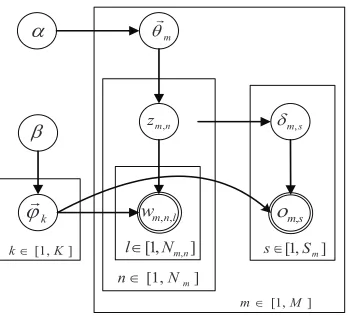
Figure 1: The phrase topic model proposed in this paper.
vast amount of lexical knowledge about words and
their relationships, denoted asLR-sets, available in
online dictionaries or other resources can be exploit-ed by this model to generate more coherent topics.
However, for external knowledge-based model-s, the incorporated knowledge is too general to be consistent with the short text in the semantic space. On the other hand, BTM, as a typical self-contained knowledge-based model, makes rough assumption on the generated biterms. The generated biterms are inundated with noise, for not any two terms in short text share same topic. Based on the above anal-ysis, we first identify key-phrases from short text, which can be deemed as self-contained knowledge, then propose phrase topic model (PTM), which con-strains same topic for terms in key-phrase and sam-ple topics for non-phrase terms from mixture of key-phrase’s topic.
2 Phrase Topic Model
2.1 Model
A phrase is defined as a consecutive sequence
of terms, or unigrams. In this paper, we
fo-cus on self-contained knowledge in short text, i.e., the key-phrases. Key-phrase extraction is a
fundamental component in our work. We use
CRF++1 to identify key-phrases in a short text.
The training data is built manually, and the fea-tures contain the word itself, the part of speech tagged by Stanford Log-linear Part-Of-Speech
Tag-1http://crfpp.googlecode.com/svn/trunk/doc/index.html
ger (Toutanova et al., 2003). Sample identified key-phrases are shown in Table 2.
In this paper, our phrase topic model is proposed based on three assumptions:
• Key-phrases are the key points of interest in the
short text, which should be the focus.
• Terms consisting of the same key-phrase will
share common topic.
• Non-phrase term’s topic assignment should
de-pend on that of key-phrases in the same text. Our assumptions is indeed similar to other mod-els (Gruber et al., 2007), for example each sentence is assumed to be assigned to one topic, however this assumption is too general, in many cases, differen-t words should be assigned differendifferen-t differen-topics even in short text. Our model is more refined to distinguish key-phrase and non-phrase. In addition, if two or more key-phrases exist in the same short text, they are probably assigned different topics.
The graphical representation of PTM is
illustrat-ed in Figure 1.αandβare hyper-parameters, which
are experienced tuned. φis corpus-level parameter,
while θ is document-level parameter. The hidden
variables consist ofzm,n and δm,s. The generative
process of phrase topic model is presented as fol-lows.
• For each topick∈[1, K]
– draw a topic-specific word distribution
φk∼Dir(β)
• For each documentm∈[1, M]
– draw a topic distributionθm∼Dir(α)
– For each key-phrasen∈[1, Nm]
∗ draw topic assignment zm,n ∼
Multi(θm)
∗ For each wordl∈[1, Nm,n]
· drawwm,n,l ∼Multi(φzm,n)
– For each non-phrase words∈[1, Sm]
∗ draw a topic assignment δm,s ∼
Uniform(zm,1, . . . , zm,Nm)
∗ draw wordom,s∼Multi(φδm,s)
2.2 Inference By Gibbs Sampling
Similarly with LDA, collapsed Gibbs sampling (Griffiths and Steyvers, 2004) can be utilized to per-form approximate inference. In our model, the
hid-den variables are key-phrase’s topic assignment z
and non-phrase word’s topic assignmentδ. To
per-form Gibbs sampling, we first randomly initialize the hidden variables. Then we sample the top-ic assignment based on the conditional distribu-tion p(zm,n = k|z¬(m,n),w,o, δ) and p(δm,s = k|z,w,o, δ¬(m,s)).
We can derive the conditional probability for
zm,n following Equation 1, where nkm,¬(m,n)
de-notes the number of key-phrases whose topic
assign-ment arekin documentmwithout consideration of
key-phrase {m, n}, which is similar to nk′
m,¬(m,n). nwm,n,l
k,¬(m,n) denotes the number of times key-phrase
term wm,n,l assigned to topic k without
consid-eration of key-phrase {m, n}, which is similar to
nw
k,¬(m,n). nok,m,s¬m denotes the number of times
non-phrase termom,sassigned to topickwithout
consid-eration of documentm, which is similar tonw
k,¬m.
Similarly, we can derive the conditional probabil-ity for δm,s following Equation 2, where nok,m,s¬(m,s)
denotes the number of times non-phrase term om,s
assigned to topic k without consideration of
non-phrase term {m, s}, which is similar to nw
k,¬(m,s).
Lm denotes the number of topics assigned to
key-phrases in documentm.
Finally, we can easily estimate the topic
distribu-tionθm,kand topic-word distributionφk,wfollowing
Equation3and4.
θm,k = n
k m+α
∑K
k′=1nk
′
m+Kα
(3)
φk,w= n
w k +β
∑V
w′=1nw
′
k +V β
(4)
3 Experiments and Results
Online reviews dataset (Chen et al., 2013), which consists of four domains, is utilized to evaluate our
model, where each domain collection contains 500
reviews. Each review’s average length is20.42. The
statistics of each domain are presented in Table 1.
It’s worth noting that the Phrase is auto-identified
by the key-phrase extraction method. And theWord
represents the whole distinct words for those identi-fied key-phrases.
In our paper, we assumed each domain has a sin-gle topic model. For different domain, we think the semantic space is quite different. So we performed the proposed topic model with respect to different domain. The number of topics is usually determined by experience, in our experiment, each domain
col-lection contains500reviews, we think the number
of topics ranging from 2 to 20 is appropriate, and
these reviews are sufficient to train a topic model.
Table 1: Statistic information of the dataset.
Dataset Phrase Word Vocabulary
Computer 1439 1423 5109
Cellphone 1110 1109 4184
Camera 2962 2620 8366
Food 1235 1350 4488
Recent research (Chang et al., 2009;
Newman et al., 2010) shows that the models which achieve better predictive perplexity often
have less interpretable latent spaces. So the Topic
Coherence Metric (Mimno et al., 2011) is utilized to assess topic quality, which is consistent with human labeling.
We compare our model with four baseline mod-els: non-knowledgeable model LDA, self-contained knowledgeable model BTM, external knowledge-based model GK-LDA (Chen et al., 2013) and DF-LDA (Andrzejewski et al., 2009). Those identified
key-phrases are used asmust-linksin DF-LDA and
LR-setsin GK-LDA. This can ensure the incorporat-ed knowlincorporat-edge upon different models are equal.
Table 2 illustrates the auto-identified phrases from cellphone dataset. From this result, we can see key-phrase extraction method can efficiently identi-fy mostly phrases. More than one phrase, for exam-plewarranty serviceandandroid phone, may appear in a single sentence, and their topic assignments are probably different. Our proposed phrase topic mod-el(PTM) can well handle this case, which is more well-defined than the assumption of all words within a sentence share one topic. Our phrase topic model assumes non-phrase term’s topic assignment should depend on that of key-phrases in the same text. This assumption can be clearly confirmed by Table 2, for
US-p(zm,n =k|z¬(m,n),w,o, δ) = nk
m,¬(m,n)+α ∑K
k′=1nk
′
m,¬(m,n)+Kα
·
∏Nm,n
l=1 (nwk,m,n,l¬(m,n)+β) ∏Nm,n
l=1 (∑Vw=1nwk,¬(m,n)+V β)
·
∏Sm
s=1(nok,m,s¬m+β)
∏Sm
s=1( ∑V
w=1nwk,¬m+V β)
(1)
p(δm,s=k|z,w,o, δ¬(m,s)) =
nom,s
k,¬(m,s)+β ∑V
w=1nwk,¬(m,s)+V β
· 1
Lm (2)
B charge cable, the same ascompanyandwarranty service.
For all models, posterior inference was drawn
af-ter 1000Gibbs iterations with an initial burn-in of
800iterations. For all models, we set the
hyperpa-rametersα = 2andβ= 0.5.
The evaluation results overTopic Coherence
Met-ric are presented in Figure 2 and Figure 3. This
figure indicates our model and BTM can get high-er topic cohhigh-erence score than GK-LDA and DF-LDA, which means the self-defined knowledge and the mechanism of knowledge incorporation are ef-fective to topic model. LDA’s performance is ac-ceptable but not stable. Our model performs better than BTM, which is probably because the rough as-sumption of BTM on generated biterms. From the above analysis, we can see our proposed model can get the best performance.
T-test results show that the performance improve-ment of our model over baselines is statistically
sig-nificant onTopic Coherence Metric. All p-values for
[image:4.612.111.541.71.210.2]t-test are less than0.00001.
Figure 4 presents the fluctuation of topic
coher-ence when tuning the hyper-parameterαandβ. We
can see that the performance fluctuates within a
lim-ited range as we varyαandβ. The topic coherence
fluctuates between−550and−950other than food
dataset, which gets less fluctuation range.
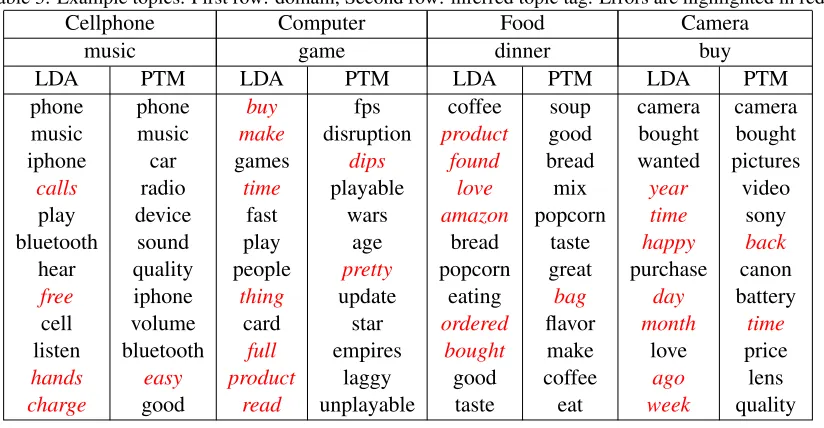
Table 3 shows example topics for each domain, where inconsistent words are highlighted in red. From this results, we can see the number of errors in phrase topic model(PTM) is significantly less than LDA, which indicates our proposed topic model is more suitable than LDA for short text.
4 Conclusions and Future Work
In this paper, we present a topic model to achieve
STU task starting from key-phrases. The terms in
key-phrases identified from the short texts are sup-posed to share a common topic respectively. And those key-phrases are assumed to be the central fo-cus in the generative process of documents. In the future work, the self-contained knowledge, such as those identified key-phrases, and the external knowledge-base should be integrated to guide top-ic modeling.
Acknowledgements
This work is supported by the National Natu-ral Science Foundation of China No.61103099, the Fundamental Research Funds for the Cen-tral Universities(2014QNA5008), Chinese Knowl-edge Center of Engineering Science and Tech-nology(CKCEST) and Specialized Research Fund for the Doctoral Program of Higher Educa-tion(SRFDP)(No.20130101110136).
References
[Andrzejewski et al.2009] David Andrzejewski, Xiaojin Zhu, and Mark Craven. 2009. Incorporating domain knowledge into topic modeling via dirichlet forest pri-ors. InProceedings of the 26th Annual International Conference on Machine Learning, ICML 2009, pages 25–32.
[Blei et al.2003] David M Blei, Andrew Y Ng, and Michael I Jordan. 2003. Latent dirichlet allocation.
the Journal of machine Learning research, 3:993– 1022.
Table 2: Identified Key-phrase in Cellphone dataset
[1] Both sites list compatible devices including theSamsung Galaxy Tab.
[2] My Dell Streak needed more power than any normalUSB car adaptercould give me.
[3] This actually comes with a microUSB charge cablewhich fits and works perfectly
for my Nokia N97 mini.
[4] I contacted the company forwarranty service. On myandroid phoneI paired . . .
[5] Everything from pulling it out of the box to syncing it with both my IPhone and
Ipod touch4g were effortless.
!1400.000 !1200.000 !1000.000 !800.000 !600.000 !400.000 !200.000
2 4 6 8 10 12 14 16 18 20
T
o
p
ic
C
o
h
e
re
n
c
e
NumberofTopics
TopicCoherencevs.NumberofTopics
OurModel
LDA
BTM
GK!LDA
DF!LDA
Figure 2: Average Topic Coherence score of each model.
!2500
!2000
!1500
!1000
!500 0
Computer Cellphone Camera Food
OurModel LDA BTM GK!LDA DF!LDA
Figure 3: Detailed Topic Coherence score ofT = 15.
1150 1050 950 850
0.5!1.5!2.5!3.5!4.5!
,UUJ
0.1! 0.6!
!
9
8
9 950 850
1050
950
1150
1050 5
950 850 750 650 550
0.5!1.5!2
)
2.5!3.5!4.5
! )GSKXG
0.1!
0.6!
!
650
550
750
650
850
750
950
850
6
950 850 750 650
0.5!2.0
! )
0 3.5! 5.0
! )KRRVNUT
0.1! 0.6!
!
TK
650 600 750 650 850 750 950 850 0 0 0 0 0 0 0 0
950 850 750 650 550
0.5!1.5!2.5!3.5!4.5!
Compu
0.1!
0.6!
!
ter
650 550
750 650
850 750
950 850
[image:5.612.102.514.482.696.2]Figure 4: Parameter influences with fixed topic numberT = 15.
Table 3: Example topics. First row: domain, Second row: inferred topic tag. Errors are highlighted in red.
Cellphone Computer Food Camera
music game dinner buy
LDA PTM LDA PTM LDA PTM LDA PTM
phone phone buy fps coffee soup camera camera
music music make disruption product good bought bought
iphone car games dips found bread wanted pictures
calls radio time playable love mix year video
play device fast wars amazon popcorn time sony
bluetooth sound play age bread taste happy back
hear quality people pretty popcorn great purchase canon
free iphone thing update eating bag day battery
cell volume card star ordered flavor month time
listen bluetooth full empires bought make love price
hands easy product laggy good coffee ago lens
and Tom M. Mitchell. 2010. Toward an architecture for never-ending language learning. InProceedings of the Twenty-Fourth AAAI Conference on Artificial In-telligence, AAAI 2010.
[Chang et al.2009] Jonathan Chang, Jordan L. Boyd-Graber, Sean Gerrish, Chong Wang, and David M. Blei. 2009. Reading tea leaves: How humans interpret topic models. In23rd Annual Conference on Neural Information Processing Systems 2009, pages 288–296. [Chen et al.2013] Zhiyuan Chen, Arjun Mukherjee, Bing Liu, Meichun Hsu, Malu Castellanos, and Riddhiman Ghosh. 2013. Discovering coherent topics using gen-eral knowledge. InProceedings of the 22nd ACM in-ternational conference on Conference on information & knowledge management, pages 209–218. ACM. [Etzioni et al.2005] Oren Etzioni, Michael J.
Cafarel-la, Doug Downey, Ana-Maria Popescu, Tal Shaked, Stephen Soderland, Daniel S. Weld, and Alexander Yates. 2005. Unsupervised named-entity extraction from the web: An experimental study. Artif. Intell., 165(1):91–134.
[Gabrilovich and Markovitch2007] Evgeniy Gabrilovich and Shaul Markovitch. 2007. Computing tic relatedness using wikipedia-based explicit seman-tic analysis. InProceedings of the 20th Internation-al Joint Conference on ArtificiInternation-al Intelligence, pages 1606–1611.
[Griffiths and Steyvers2004] Thomas L Griffiths and Mark Steyvers. 2004. Finding scientific topics. Pro-ceedings of the National academy of Sciences of the United States of America, 101(Suppl 1):5228–5235. [Gruber et al.2007] Amit Gruber, Yair Weiss, and Michal
Rosen-Zvi. 2007. Hidden topic markov models. In
Proceedings of the Eleventh International Conference on Artificial Intelligence and Statistics, AISTATS 2007, San Juan, Puerto Rico, March 21-24, 2007, pages 163–170.
[Hofmann1999] Thomas Hofmann. 1999. Probabilis-tic latent semanProbabilis-tic indexing. In Proceedings of the 22nd Annual International ACM SIGIR Conference on Research and Development in Information Retrieval, pages 50–57.
[Hu et al.2011] Yuening Hu, Jordan L. Boyd-Graber, and Brianna Satinoff. 2011. Interactive topic modeling. In
The 49th Annual Meeting of the Association for Com-putational Linguistics: Human Language Technolo-gies, pages 248–257.
[Hua et al.2015] Wen Hua, Zhongyuan Wang, Haixun Wang, Kai Zheng, and Xiaofang Zhou. 2015. Short text understanding through lexical-semantic analy-sis. InInternational Conference on Data Engineering (ICDE).
[Jagarlamudi et al.2012] Jagadeesh Jagarlamudi, Hal Daum III, and Raghavendra Udupa. 2012.
Incorporating lexical priors into topic models. In
13th Conference of the European Chapter of the Association for Computational Linguistics, pages 204–213.
[Miller1995] George A. Miller. 1995. Wordnet: A lexical database for english. Commun. ACM, 38(11):39–41. [Mimno et al.2011] David M. Mimno, Hanna M.
Wal-lach, Edmund M. Talley, Miriam Leenders, and An-drew McCallum. 2011. Optimizing semantic coher-ence in topic models. InProceedings of the 2011 Con-ference on Empirical Methods in Natural Language Processing, EMNLP 2011, pages 262–272.
[Mukherjee and Liu2012] Arjun Mukherjee and Bing Li-u. 2012. Aspect extraction through semi-supervised modeling. InThe 50th Annual Meeting of the Associ-ation for ComputAssoci-ational Linguistics, pages 339–348. [Newman et al.2010] David Newman, Youn Noh,
Ed-mund M. Talley, Sarvnaz Karimi, and Timothy Bald-win. 2010. Evaluating topic models for digital li-braries. InProceedings of the 2010 Joint International Conference on Digital Libraries, pages 215–224. [Suchanek et al.2007] Fabian M. Suchanek, Gjergji
Kas-neci, and Gerhard Weikum. 2007. Yago: a core of semantic knowledge. InProceedings of the 16th Inter-national Conference on World Wide Web, WWW 2007, Banff, Alberta, Canada, May 8-12, 2007, pages 697– 706.
[Toutanova et al.2003] Kristina Toutanova, Dan Klein, Christopher D. Manning, and Yoram Singer. 2003. Feature-rich part-of-speech tagging with a cyclic de-pendency network. In HLT-NAACL 2003, Human Language Technology Conference of the North Ameri-can Chapter of the Association for Computational Lin-guistics.
[Wu et al.2012] Wentao Wu, Hongsong Li, Haixun Wang, and Kenny Qili Zhu. 2012. Probase: a probabilistic taxonomy for text understanding. In Proceedings of the ACM SIGMOD International Conference on Man-agement of Data, SIGMOD 2012, Scottsdale, AZ, US-A, May 20-24, 2012, pages 481–492.