warwick.ac.uk/lib-publications
A Thesis Submitted for the Degree of PhD at the University of Warwick
Permanent WRAP URL:
http://wrap.warwick.ac.uk/97342
Copyright and reuse:
This thesis is made available online and is protected by original copyright.
Please scroll down to view the document itself.
Please refer to the repository record for this item for information to help you to cite it.
Our policy information is available from the repository home page.
b y
J.K. CANNELL B.E. (Adel.) M.Sc. (Birm.)
A thesis submitted at the University of Warwick
for examination for the degree of
Doctor of Philosophy
School of Engineering Science
Facial nerve
Cochlear
y ¥ ]
• ‘f 7 ;
Middle ppr cavity
... ~ w '
. ■ ^ Eustachian
' . t u b e
Round v ' r y
w in d o w ' v
, Y v ^ llfe o -
! 'V i^ p arynx
$ U - r e
1
-1
. A composite drawing of the earCOCHLEAE HÖDELS
L y
J.K. CANNELL B.E. (Adel.) H.Sc. (Birm.)
A thesis submitted at the University of Warwick
for examination for the degree of
Doctor of Philosophy
School of Engineering Science
This research activity was initiated and supported h y The University
of Warwick from October 19
65
for a period of 3£ years. In January1969
I received an award from The James Clayton Fund of The Institution of
Mechanical Engineers, without which I could not have continued with this
resoarch, and since April I
969
I have been grateful for support as aSenior Research Follow provided by a Soience Research Council Crant.
I acknowledge the support given to me for the execution and completion
of this programme of research by The University of Warwick and b y the
School of Engineering Science and the Head of the School, Professor J.A.
Shercliff, in particular. I am grateful for the confidence in my ability
to organize and perform this work shown b y m y supervisor, Dr.V.Marples,
to whom I am also grateful for encouragement and support and for comments
on and corrections to thesis manuscripts.
I am indebted to the University Workshops and to senior technicians
Mr.Howard Fowkes, for his steadfast efforts and ingenuity during the period
of manufacture of cochlear models, and Mr.John Darmon, for his enthusiastic
and able assistance with experiments in his metrology room, and for help
offered and interest shown b y those and m a n y other technicians of the
School cn many occasions. I thank M r .A.Whitehead for his willing and
competent photographic services and Miss C.Phillips for her care in
preparing many of the enclosed drawings. I also wish to record a
particular debt of gratitude to Ur.Michael Bevir for the interest he
showed in these researches and for opportunities to discuss my work w i t h him.
Senior 3.N.T. Consultant Surgeons Mr.P.Roland and Mr.G.Rice both gave
up many hours answering q.uerios concerning anatomy and surgery of the ear.
Thanks are also due to the staff of The University of Warwick Computer
Unit for their efficient handling of more than 400 jobs,which occupied the
Elliot 4130 computer for a total of some 37 hours, and for their generous
assistance with certain programming difficulties.
Finally,I thank m y wife for her cheerful patience, and for her
competent typing of most of the thesis.
Tha intention of the research activity described in this thesis
is to contribute to tha dynamical theory of tho cochlea of the human inner
ijcll* •
The Science of Hearing, being disseminated in a wide range of
frequently independent or unco-ordinated disciplines, i
3
advancing farin the fields of subjective human acoustics, middle ear restorative surgory,
medical diagnostic electro-encephalography and cochlear-nuclaus-to-thalamus
neural communications research. At the same time, exploitation, in
auditory research, of the techniques and resources of modern engineering
science, which m a y be particularly appropriately applied to analyses of the
peripheral hearing system, has not been manifest to any great degree.
It was therefore hoped that a first-principles engineering approach to
the subject of cochlear action -would demonstrate the need for a mathem
atical and quantitative type of analysis of tho response of this key organ
of hearing and also indicate tha extent to wh i c h cochlear science is at
present to be found in a state of disarray.
The writer's principal thesis i
3
that a considerably greaterpotential for discrimination of the frequencies and intensities of pure
and complex tones is attributable to the mechanical action of tho cochlea
than is generally supposed. That thesis will be more fully proven (it is
expected) when current research is considerably extended and improved to
permit the computation of spatial arrays of cochlear hair cell cilia shearing
force patterns and electrical responses. Tha studies reported herein
are relevant and fund oriental to this aim and are limitad to considerations
of the dynamical response of the cochlear partition a
3
a whole.This research has included approximately equal parts of review,
physic.1 cochlear model experimentation and mathematical analysis. The
first two chapters end sections of most of the other chapters concentrate
or. defining the system and reviewing the literature. Chapters 3 and 4
being essential to tho subsequent design of both physical and mathematical
models of the cochlea in Chapters 5 and
6
respectively. The finalchapter adds to th_- comments in other chapters on the credibility of the
physical constants previously deduced in the thesis and tested in the
models, the performance of the models, the particular problems clearly
requiring further research effort and the relevance of the work to a
mor.. complete comprehension of human auditory theory.
TOT ,h OF TK ' FCRIAT 01' ThhSIS
A s some chapters of this thesis have been prepared for
publication, and the writer's programme of research has involved a number
oi different reviews, experimental t e c h n i c s and separate theoretical
analyses, each chapter i3 generally independent of the others, and cross-
referencing between chapters i
3
rare.E a c h chapter contains its own table of contents, page, figure,
table and reference numbering systems, introduction, bibliography, and
usually, conclusions, and where required an appendix. Considering the
•extent of the thesis, and the necessity for frequent excursions into the
fields of biology and physiology as well as various engineering sciences,
it is h o p e d that by preserving clarity, the one-thome-at-a-time approach
will assist the reader aa caich a
3
it has tho writer.included in the rear cover pooket are print outs of two I.C.S.
Elliott 4130 Fortran computer programmes.
The first programme is typical of some of the computation
involved in Chapter 3 on soala media effective masses, and the second
is representative of a great many similar programmes involved in the
baing essential to tho subsequent design of both physical and mathematical
models of the cochlea lr\ Chapters 5 and
6
respectively. The finalchapter adds to the comments in other chapters on the credibility of the
physical constants previously deduced in the thesis and tested in the
models, the performance of the models, the particular problems clearly
requiring further research effort and the relevance of the worlc to a
mor.. complete comprehension of human auditory theory.
TOT.S
or
Til' FCRihAT Of1 TiiESISAs some chapters of this thesis have been prepared for
publication, and the writer's programme of research has involved a number
of different reviews, experimental t e c h n i c s and separate theoretical
analyses, each chapter i
3
generally independent of the others, and cross-referencing between chapters is rare.
Sach chapter contains its own table of contents, page, figure,
table and reference numbering systems, introduction, bibliography, and
usually, conclusions, and where required an appendix. Considering the
extent of the thesis, and the necessity for frequent excursions into the
fields of biology and physiology as well as various onginoaring sciences,
it is hoped that by preserving clarity, the one-thame-at-a-time approach
will assist the reader as much as it has the writer.
Included in the rear cover pocket ar
3
print outs of two I.C.S.Elliott 4130 Fortran computer programmes.
The first programme is typical of some of the computation
involved in Chaptsr 3 on scila media effective masses, and the second
is representative of a great many similar programmes involved in the
HALL E WEDNESDAY. AUGUST 16. AFTERNOON________________
SESSION 24 SPEECH AN D HEARING
24-6
Physical and Mathematical Cochlear Models
J. K. Canned V. Marples
School of Eng.neoring Science School of Engineering Science Univereity of W arw ick University of W erwick Coventry, Englsnd Coventry. Eng lend
Quantitative effects of varying certain physicals Mechanical and geometric properties of the liman cochlea have been investigated.
It is considered that this work is required in an effort to establish the critical properties and conditions of the cochlea which have to be nest carefully reproduced in the design of a Mathemati cal modal to yield accurate and realistic "mean huaan" cochlear nicrophonics. A contribution tow ards the understanding of the processes by which the property of sharp frequency discrimination is achieved by subsequent neuron codings, thenselves elicited by uniquely spatially distributed and time /phase dependent hair cell responses is the final intention of this and associated research. It is, of course, realized that suggested and anticipated mathematical co-relations between cochlear sígnala and neuron action may be seriously masked by incom- plete data in the arrangement of cochlear electri cal activity. Hence every attempt is made to in clude the usable, relevant physiological lnformatlm available in the design of the theoretical digital computer)cochlea model.
Such an intention is by no Means new. However, by-products of these studies have included the Means to cheek on whether skull-vibration in some nodes can give rise to this type of bone-conducted hearing, and also the naans, not yet fully exploi ted, to make comparative quantitative checks of the effects of changing certain Middle ear bone, nuaola, and stiffness properties, and oval window notions, on theoretical aicrophcnica generated in the codilea.
PHYSICAL HOC EL STUDIES. The refinement of the theoretical Model has been supported by a program me of examination of eleven physleal Models of the cochlea aealae,each of twelve tines full sise and as nearly dynamically sialiar to the huaan cochlea as possible.
These Models have been Manufactured in perspex, contain glycerol solutions Modelled on perilymph, and permit undistorted viewing of their inter-aca lme elastic partitions, for which were used several impermeable latex aaabranes. Bach nodal has been used to introduce a single boundary variable but with two or three changes of neabrane stiffness and/or taper width, one change per test.
Model 1. An "unwound", straight nodal, it cantatas no seals Media, the vestibular and tyapanlo soalae separated by a latex neabrane of sealed width, taper and stiffness. This is seat*d(as in all Models) across a Joint with a very snail, parallel sided inset either side of the mem- brane for » d i s t o r t e d external viewing through the polished perspex sides of the cavity. The duets are geometrically alailar in cross
sae-Longitudinally the ducts also display charact eristic scalae necking and tapers.
Model 2. was of simplified design, consisting of two equally sized, circular section, uniformly tapering channels, separated again by a single elastlo membrane of variable (scaled) width and stiffness.
Models J and A. were similar to model 2, but with duet section disasters proportionately increas ed and decreased respectively.
Models 5 and 6. were similar to model 2, but with basal end disaster increased for model 5, and apical end disaster decreased for model 6, both with the same taper as model 2.
Model 7. contains two equally sized, circular, duets of constant diameten
Model 8. is similar to model 2 but with a non- u n i f o m changing taper which more closely ap proximates Model 1 scalae.
Model 9 includes the seals media, and, using the ducts of Model 1, contains a model basilar neabrane and a Relssner's Membrane. The seals Media contains gelatinous glycerol.
Model 10 was east froa Moulds Made of Model 1 and,
as nearly as was possible, simulates the spiral fora of the huaaa cochlea.
Model 11, the final physical oochlea model, is a spiral fern of model 9.
Bach nodal contains a helicotrema, aeabranous round window, and an electromechanical vibrator set variably in an oval window. A wavefora gen erator and amplifier drive the vibrator, Models are isolated, and oscilloscopes and asters check vibrator head aaplltudea and notions via an (inte grated) accelerometer signal. Stroboscopic illu- alnation of Membranes and insertion of Metallic powders have assisted photographic Methods of recording neabrane responses, sad aleroaeter a c e permitted sene Measurement of aenbrane amplitude a.
MATOBiATICAL MOD E L . The computer p r o g r a m calculation is based on the laws of fluid(wave) notion and on force equations linking wave pres cures above and below the partition to local in r- tia and distributed elastic nenbrane forces. Seals sectional areas and their variations have been introduced la detail,but sectional shapes have not. The programme has been used with sent success to check basilar nenbrane displacements concurrently with physical aodel testing of cor responding boundary variations. This has resul d in see» quite Important Improvements to the pro* remme. In particular, the aathenptieal model ha temporarily overtaken physleal aodel work in se< te lng to demonstrate the ability of the Mechanics: part of the inner ear to considerably sharpen frequency discrimination in the cochlea,by oalcv latlag effects relative to sliding between oilli and the tectorial aeabrane. The assumed direct! a of martmum sensitivity of hair cell shearing fot release of electric stimuli is towards kinocilia
COCHLEAR MODELS
Contents
Acknowledgements
Abstract of thesis
Notes on the Format of thesis
Conference Papor :- Physical and Mathematical
Cochlear Models
Table of Contents
Chapter 1 The Ear and Hearing
I. The Anatomy of the Ear Pago 1- 1
II. The Inner Ear Page 1- 5
III. Motions within the Cochlea Page 1-10
IV. Auditory Nervous System Pago 1-15
V. Hearing Page 1-18
VI. References Page 1-22
m o t o r 2 Theories of Hear in« and
Coohlear Experimental Data
I. Historical Development Page 2- 1
II. Recent Development Page 2- 4
III. Cochlear Experimental Response Data Pago 2- 9
IV. Current Cochlear Theories Page 2-19
V. References Page 2-28
Chaptor 3 Effective Mass of the Coohloar Partition
I Formulation of the Model Pago > 4
II. Effective Mass Calculation Pago > 1 3
III. Diooussion of Theoretical Effective Mass Ratio.Page > 2 4
IV. Discussion of Typical Cochlear Effective Mass. Page > 2 7
V. Conclusions Page > 3 0
VI. References Page > 3 1
App.I. Theory of Incompressible Potential Flow
App.II. Solution of the Field for Spooified Membrane
Page > 3 2
Displac omenta Page > 3 4
X. Cochlear Partition Stiffnoss Data Pago 4-6
II. Analysis of Pressure— Deflected Mjmbr'nos Pago 4-20
III. Analysis of Pin-Doflooted. Membranes Page 4-28
IV. Application of Frossura-Stiffness Data Pngo 4-41
V. Application of Point-Load Stiffnoss Data Page 4-51
VI. Discussion of Partition and Basilar Membrane
Elasticities Pago 4-57
VII. Conclusions Page 4-60
VIII. References Page 4-62
Charter 5 Physical Models of the Cochlea
I. Review of Previous Cochlear Model Investigations Page 5-6
II. Design of Cochlear Models Page 5-14
III. Detailing, Manufacture, Assembly A Experimentation Pago 5-27
IV. Results of Cochlear Modol Experimonts Page 5-39
V. Discussion of Results of Modal Tests Pago 5-43
VI. Conclusions Pago 5-53
VII. References Page
5-56
Chapter
6
. Mathematical Modol of the CochleaI. Equations of Fluid Motion Page
6-5
II. Fluid Boundary Conditions Pago 6-10
III. Non Linear Partition Dynamics Pago 6-11
IV. Numerical Solution of Differential Equations Pago 6-17
V. Computer Programming Pago 6-19
VI. Discussion of Results Pago 6-22
VII. References Pago 6-29
A p p . 1. Rayleigh Motion of a Viscous Fluid Pago 6-30
Chant.-r 7 Conclusions
I. Physical Models Page 7-1
II. Mathematical Model Page 7-3
III. Phyaioal Properties of tho Coohlea Page 7-7
Chapter X
Contents
1. The Anatomy of the Ear
la. General
lb. The Outer Ear
lc. The Middle Ear
2. The Inner Ear
2a. Bony Labyrinth
2b. Membranous Labyrinth
2c. The organ of Corti
3. Motions within the Cochlea
3
a. General3b. The Hair Cells
4. Auditory Hervous System
4
a. Neuro anatomy4b. Relevance of neurophysiology to Cochlear Theories
5. Hearing
5a. The Analysis of Sound
5b. Principal Phenomena of Hearing
1. Pitch
2. Loudness
3. Interaction of Tones
Page 1
Page 1
Page 2
Page 2
Page 5
Page 5
Page
6
Page
8
Page 10
Page 10
Page 11
Page 15
Pagi- i5
Page 17
Page l
8
Page 18
Page 19
Page 19
Page 19
Page 20
Page
11
1 .THE ANATOMY OF THE EAR
la. Genera^
All the higher vertebrates, and many more primitive animals,
possess a specialized organ for the reception of sound waves. The
ear of vertebrates is by definition the organ in which are centred the
sensors of hearing and equilibrium. In its simpler forms the organ
of hearing has a particular biological value in mating, as it enables
the sexes to find one another, but its most general adaptive function
lies in its servioe in warning of impending danger. In man, considering
the remarkable precision b y which he can discriminate frequency and
intensity differences, his binaural sense of hearing sometimes overtakes
his other senses in locating distant objects and in orienting himself
with respect to such objects. In birds and manuals, hearing is
particularly developed for communication, and in man it attains its
highest utility in articulate speech and the art of music.
The ear is considered in three parts; the outer, middle and
inner ear. (See Figs. 1 and 2) The outer or external ear intercepts
and receives airborne sound pressure waves; the middle ear c o n d ^ c t
them inwards; and the internal ear, through its curious fluid/membrane
anatomy and its intricate arrangements of receptor cells, translates the
effects of these pressure waves from a mechanical domain into patterns
of electrical nerve impulses that are sent through the auditory nerve,
from the inner ear, to the brain centres, where they finally give rise
to auditory perceptions.
In this chapter the characteristics of the hearing organs are
considered, sosMtlmes originally, from an engineering system viewpoint
pinna
semicircular canal
utricle
ccule
auditory nerve
_ ductus endoli/mphatieu.'i
subdural sac
intermediate sc a l a oí
cochlea
periti/m p h
lb.The Outer Ear
Thle consists of the fleshy, cartilagenous outer flap (auricle
or pinna) and the opening and its inwardly directed tube (external
auditory meatus). The auricle is formed b y a yellow fibrocartilage
covered b y skin. Round the margin in its upper three-quarters is a
rim called the helix, concentric with which is a secondary rise the
antihelix. Surrounded by the antihelix is a deep depression known
as the concha, from whose anterior part the meatus passes inward into
the skull. A protective flap called the tragus overlaps the moatus
in front. The lower part of the auricle, the lobule, contains no
cartilage.
The auricle can be m o v e d slightly by the anterior, superior
and posterior auricular muscles, but even with this limited facility,
it is too small in man to serve any .important acoustical purpose,
although it does assist in directionally localizing high frequency
sounds.
The external auditory meatus is about 2^cm long, 0.7cm mean
diameter, its outer third being cartilaginous and its inner two-thirds
bony. It is lined in its whole length with skin, the secretory glands
of which are modified to produce a waxlike substance, oerumen, and it
is closed by the generally impermeable tympanic membrane or eardrum.
The meatus undoubtedly imparts its own characteristic
frequency response to that o f the ear, responding most naturally to
sounds of 3 to 4 kHz
lo.The Middle Bar
Beyond the eardrum is the middle ear, or tympanum, a small,
irregularly shaped, air-filled cavity in the temporal bone. Prom it.
the Eustachian tube, runs forward, Inward and downward to open w o the
wall of the middle ear an opening leads backward into the air cells of
the mastoid process. Lower down is a little pyramid containing the
stapedius muscle, and at the base of this is a small opening allowing
passage of the chorda tympani branch of the facial nerve.
The roof (attic) of the tympanum is formed by a very thin plate
of bone which separates the cavity from the middle depression (fossa) of
the skull. The inner wall of the cavity shows a promontory caused by
the spiral shaped cochlea. Above and behind the inner wall is the oval
window (area
3
to4
mm");
below and behind lies the round window (area 2 to 3 mm ), closed by a membrane. Curving round above and behind thewindows and the cochlea promontory is a ridge caused b y the Fallopian
canal, in which is carried the facial nerve.
The outer wall is largely occupied by the tympanic membrane, which
is circular (about
9
nun. dia.) and so placed that it slopes downward andinward from above. It is broadly conical in form with its apex, or umbo,
of height about
2
mm., directed Inward. Externally the eardrum is linedby skin, internally by mucous membrane and between these two layers is
a firm, fibrous tissue.
The whole tympanum is about one and a half cms long from front
to back and its volume is about 2 c m \ It is spanned from side to side
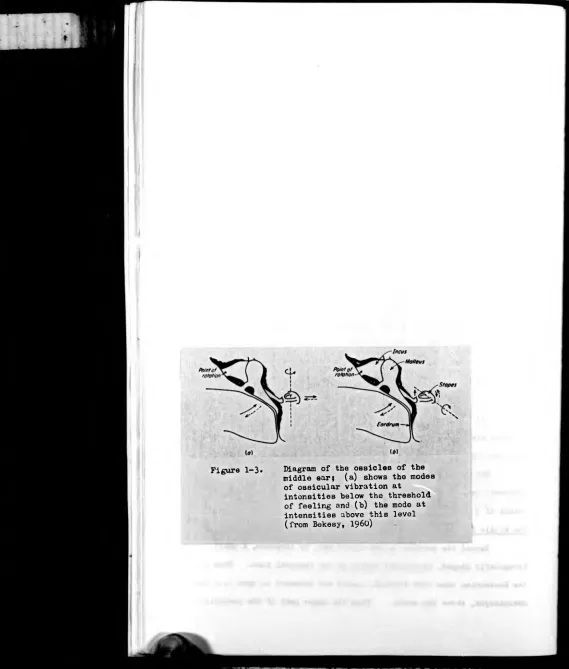
by three small bones (ossicles), of which the malleus (or hammer) is
external. (See Figs.2, 3) The malleus Is attached by its long process
(or handle) (about
6
mm in length) to the eardrum, and lies radially onthe upper portion of the eardrum from the apex almost to its outer fold.
The head of the' malleus lies in the attic and articulates posteriorly
with the bulbous upper part of the next ossicle, the incus or anvil.
The long projection of the incus (some 7mm) runs downward and terminates
in a lens-shaped nodule which is Jointed to the third ossicle, ihe stapes
describes its shape. The two branches of the stirrup are anterior and
posterior, and its elliptically shaped footplate ( major axis by l^iam
minor) fits into the oval window to which it is bound b y an annular
ligament. The stapes lies nearly at right angles to the long process
of the incus, and for all but the most severe movements, tends t o rock
about the footplate-ligament attachment at the anterior end, the
ligament being less restricting and slightly folded at the opposite,
lower end. The ossicles are suspended in the tympanum by a number
of ligaments. When the handle of the malleus is pushed inward b y the
tympanic membrane, its head moves outward; the head of tho incus,
attached to it, also moves out; and the end of the long process of
the incus moves in, pressing the posterior side of the stapes
footplate into the oval window.
Two minute muscles act upon the ossicular chain; one, the tensor
tympani, when it contracts, tends to pull the head of the malleus outward,
and the other, the tensor stapedius, acts so as to rotate the stapes outward
in the opposite direction to that stimulated by tensor tympan: response.
As a response for one tensor cannot normally be elicited without the
other also contracting, one effect of contractions is to tighten the
ossicular linkage, thereby probably inhibiting the low frequency response
of the stapes. The most commonly reported funotion of the two muscles
is to protect the ear against excessive impulses, for example, explosions.
However they are not ideally suited to this role since their latency
(response) time is so relatively large that an unexpected explosion
has occurred before they have had time to contract fully. Their
response la involuntary, they are innervated by the facial n e r v e rather
than the auditory nerve, and they help to change and limit the overall
locus of motion of the ossicles during continuous exposure to v e r y loud
The function of the middle ear is the efficient transmission
of sound energy to the inner ear b y matching the high impedance of the
cochlea with the very low impedance of the eardrum. The tympanic
membrane presents a large surface on which air pressure waves impinge,
whose foroe is applied through the ossicular chain to the small
surface covered b y the stapes footplate, and the result may be a
magnification in pressure of about 10 to 25 times. This pressure
magnification is a function of both amplitude and frequency.
The efficiency of middle ear sound transmission varies from
about
15
Jl at extreme frequencies to30
$ at frequencies approaohing1 kHz, which may be compared with an efficiency of perhaps O.ljl
obtaining with no middle ear mechanism.
Being a system of elastic elements, each with a characteristic
mass distribution, linked by joints with real stiffness and damping
components, the middle ear constitutes a non-linear mechanism whose
frequency response is not fully chartered either theoretically or
experimentally.
2.THE IHHER BAR (Hefs. 1 to 7)
2a.Bony Labyrinth
This is composed of the vestibule, semicircular canals, both of
which sections are concerned with sense of balance, and the oochlea
(Fig.4). The vestibule lies just internal to the rear part of the
tympanum, and there would be oonmunicatlon between the two were it not
for the stapes footplate. At the rear the three semi-circular canals
open into the vestibule. Anteriorly the vestibule leads into the coohlea
which is twisted about
2
§ times round a central pillar called themodiolus - the whole oochlea forming a rounded cone similar to the shell
though only about 5<nm from base to apex. Projecting from the
modiolus is a horizontal bony plate, the shelf-like, osseus spiral
lamina, which runs helically round the modiolus from base to apex.
This bony shelf stretches about halfway across the canal of the
cochlea and oarries branches of the auditory nerve. If it could
be unwound and straightened out, the adult human cochlea would be
about cm«, long.
2
b.Membranous Labyrinth (See Pig.5)The membranous labyrinth lies in the bony labyrinth but does
not fill it; between the two is the fluid perilymph, which is watery
and saline, whereas inside the membranous labyrinth is the liquid
endolymph, of different chemical composition and having slightly
greater viscosity than p e r i l y m p h / ^
In the bony vestibule lie two membranous vesicles, one of
which, the saccule, is in front, and the other, the utriole, behind;
each has a patch of sensory epitheluim called macula to which fine
branches of the auditory nerve are supplied, terminating around
specialized sensory hair oells.
The bony semiciroular canals are considerably larger i n section
than their membranous enclosures, and each membranous semiciroular
canal contains a ridge made up of modified epitheluim containing sensory
hair oells resembling those in the maculae. All the canals open into
the utriole.
From the lower part of the saccule runs a small oanal called the
endolymphatio duct. Anteriorly the saooule communicates w i t h the
membranous oochlea, or scala media, by a short connecting duot.
(See P i s .
6
) A section through any part of each turn of the coohlea'shows the bony spiral lamina whioh is continued right across the canal
(perilvmph)
Figure 1-6 Sectional diagram of the second turn of a cochlea showing the organ of Corti (after Davis, 1953)*
Figure l-7a Experimentally determined shapes and dimensions of the human cochlea as a function of length along the cochlea. A referB to the basilar membrane a n d bony spiral lamina and B refers to the sectional
[image:23.606.91.568.9.681.2]a lower half, and connected with the outer wall b y a strong spiral
ligament. Hear the free end of the bony shelf the membrane of Re:saner
Is attached and runs outweird and upward to the outer wall, taking a
triangular slioe out of the upper half of the canal.
Three canals may thus be Been in section s the upper is the
scale vestibulij the middle, scala media, is the cochlea duct or true
membranous cochlea} and the lower is the scala tympani. At the base
of the cochlea, the perilymph in the scala vestibuli is continuous with
that in the vestibule, whereas the perilymph in the scala tympani bathe*-
the round window membrane on its inner surface, the outer surface of which
is in communication with the air of the tympanum. Perilymph in the
scala tympani also communicates through a capillary system called the
cochlear aqueduct with the space between brain covering layers, in the
posterior cranial fossa.
The scala tympani and the scala vestibuli also communicate at
the apex of the cochlea, in which region, known as the helicotrema, the
basilar membrane is absent and the scala media is closed, so that here
perilymph c a n pass from one canal to the other. At the opposite, basal
end, the soala media, containing endolymph, communicates with the saccule
through the fine connecting canal of Hensen.
The cross sectional area of the two perilymphatic channels, the
scalae vestlbuli and tympani, reduces at sections closer to the apical
or helicotrema end, and their overall variation is frequently described
as approximating a linear diametral taper. In fact the scala vestibuli
displays a less regular section than the tympani duct, presenting an
effective oross section of at least
3
mn inmediately inward from the2
stapes, reducing to about
1
mm halfway along the first turn, thenwidening aga i n to l£mm a few millimetres further along, to continue in
a more uniformly decreasing taper until at the apex (
3
icms. along thecochlear passages. s.v. refers to scala vostibuli, s.t. to scala tympani and c.d. to cochlear duct or scala media, (from Wever, 1949)
[image:25.609.23.555.13.680.2]The most striking variation in the membranous labyrinth,
however, is the space between the limit of thdjoony shelf and the
opposite wall of the duct, which is occupied by the basilar membrane,
on which is mounted the organ of Corti. The span of the basilar
membrane increases remarkably uniformly from about
0.10
to0
.l8
mmvery near to the stapes to O
.49
to0.65
nm just before the helicotrema,a normal variation of 4 to 4 ^ times. This variation gives rise to a
large variation in stiffness, or resistance to fluid pressures of the
cochlear partition, decreasing some several hundred fold from the basal
end towards the apex. Similarly, because of the integral nature of
the scala media and the basilar membrane, the scala media becomes
more massive as the helicotrema is approached.
2c.The organ of Corti
The scala media contains the essential organ of hearing, the
organ of Corti, which lies upon the vestibular side of the basilar
membrane; it consists of a tunnel bounded on each side by the inner
and outer rods of Corti. Some researchists believe that unlike the
remainder of the scala media, the tunnel of Corti contains perilymph.
On either side of this arch of Corti are the inner and outer hair cells
numbering about
20
,000
, and the outer hair cells are supported withintheir rows by heiter's cells, and externally by the larger Henson's
cells. (See Pig.
8
)A delicate membrane called the reticular lamina covers the top
of all of these cells, and iB pierced by the cilia of the hair cells.
Above this lies the tectorial membrane which is loose enough to follow,
with some inherent damping, any up and down movements of the active
cochlear partition, but which is rather stiff in either transverse
direction. The tips of the longest cilia in eaoh bundle of 90 to 120
cilia sustained by any one outer hair cell are believed to be lightly
embedded in the lower side of the tectorial m e m b r a n e / ® * * 8 *
10
*18,26)
The tectarium is attached, to the osseus spiral lamina near to
its outer tip, and within the attachment of Reissner's membrane.
Thus the soala media, or cochlear partition, is hounded by
the three principal sides. The roof of this triangular, endolymph-
filled enclosure, in contrast with the floor, is very thin, for
Reissner's membrane is composed of only two layers of epithelial cells,
and is electrically insulating. The outer wall of the duot is made
up of the spiral ligament, already mentioned, contained an the inner side
of whioh is the stria vascularis. This is rich in blood vessels, and
is thought by some investigators 14,21,24,27,28) t0 prov^ a
source for the endolymphatic electrical potentials known as cochlear
microphonics, which by means of two fine electrodes, one applied to
the endolymph of the scala media and the other adjacently to either
of the perilymph oanals, can be easily measured at any section along the
coohlea where the coohlear partition is responding to sound excitations.
Bekesy demonstrated a resting d.o. potential of more than +80 m.v.
in the endolymph of guinea pigs. The third boundary of the scala media,
the basilar membranefwith its organ of Corti, tunnel, Belter's, Henson's
and hair cells complex is also eleotrically non-conducting as a partition.
The basilar membrane itself is the only one of these membranous and
oellular elements whioh appears to contain any mechanioally-definable
elasticity or stiffness. Its histology is uniquely characterised by
definite layers of apparently elaatio transverse fibres, which are
believed to impart its elastio nature, embedded in a dense mat of
oollagenio fibres and homogeneous material. A s is discussed in
Chapter
4
, ultra-mioroaoopio studies during the last few y e a r s ^ ® * ^ ' 1' ’1^ ’1^have confirmed the belief held by anatomists ainoe the last century
with the basilar membrane at every section. It is now clear that the
inner or arouate zone, of the basilar membrane, projecting outwards from
its medial attachment at the limbus, and supporting the pillars of Corti,
is a relatively thick complex of densely packed, irregular fibrous
bundles. Hear the base of the outer pillar, a discontinuity exists,
outwards from w h i c h the pectinate zone reaches to the spiral ligament.
In this outer zone two regular fibrous stratum are to be found, the
membrane being thinner and more elastic, and, in addition, displaying
an increase in the transverse fibrous area in sections taken from the
apical end towards the basal (stapes) end. Fibrillary arrangement
as regular and parallel as that found in the lower fibrous layer of
the pectinate zone is considered to indicate that this part of the
membrane must be influenced b y direct tension forces. This observation
is developed in the appropriate chapter.
3.M0TI0HS WITHIN THE COCHLEA
la.General
When un d e r the influence of, for example, an airborne sound
of constant amplitude and of low frequency, the footplate of the
3
tapesis momentarily (cyclically) pressed inward, the pressure exerted on the
perilymph of the inner ear is relieved mainly by a corresponding outward
bulging of the round window membrane. - As the footplate moves outwards,
the round window membrane is similarly sucked inward, and as the
frequency of the exciting tone increases, a small phase difference
appears between these motions due mainly to the fluid of the scalae not
being wholly inoomprsssible. Varying pressures thereby induced in
the liquid of the two adjacent scalae result in cyclic pressure
differences aoross the cochlear partition, and the magnitude and
phase of these pressure differences will vary from section to ee^iicn
Also varying along the cochlea, mainly because of the four
fold variation in width of the basilar membrane, are the mass ana
stiffness properties of the scala media partition, and so it is to
be expected, as has been observed e x p e r i m e n t a l l y , t h a t
the scala media, and in particular the basilar membrane, vibrates
in response to the main scalae cyclic pressure differentials, and
that for sounds in the normal human audio frequency range, from 20,000 Hz
to about 50 Hz, only a limited part of the soala media, being best
tuned to the input sound, undergoes any appreciable vibration.
3b.The Hair CellB
The mechanics of the processes by which the sensory cells
are excited, generate partially encoded electrical voltages, give
rise to endolymphatic microphonic potentials and ennervate their
various interconnected nerve fibres, is not well understood, and has
become a major research activity for many neuro-anatomists, neuro
physiologists and sensory cell morphologists, and is mainly outside
the scope of this thesis.
Y-
However, so much has very recently been discovered^®*^8 * ^ ^ lno . ) f ^he cilated protrusions, likegroups of mioroscopic hairs, supplied by each outer hair cell, are
all oriented in very much the same relative direction in relation
to the axis of the cochlea. An outer hair cell bundle crosscut
close to and above the cell surface (cuticular plate) and the
retioular lamina is usually the shape of a V, formed b y three rows
of sensory hairs (called stereocilia), with a total number of up to
120
of these fine hairs (0.15
micron mean diameter and of heightfrom
1
to8
miorons, erect, stiff and brittle) on eaoh oell.Synmetrlc with the base of the V and just outside it lies a small
basal body or oentriole, whloh has been compared with the slngl
in vestibular end organ sensory cells and in several other sensory
%
receptor mechanisms. Whether or not the basal body is an evolusionary
atrophication of a kinocilum is debatable, but this basal body does
provide a measure of the orientation of c i l i a bundles, and all outer
hair cell bundles are oriented with their basal bodies pointing
towards the Hensen's cells, across the cochlea. The longest
stereocilia are invariably found in the central, lower region of
the W and cilia behind these uniformly reduce in height until at the
extreme ties of the W they are quite short. In side view, a bundle
or tuft of oilia having roots deeply embedded in the cuticle and tips
stiffly mutually supporting, and with the tips of the longest hairs,
near to the basal body, embedded in the lower lamina of the tectorium,
rather resembles an abutment, or triangular bracket, which is well
jjilK,
t t t t r t r n r / i f l f f t
suited for the transmission of shearing forces with minimum
deflect!ant for example, shearing forces induced b y relative
parallel motions of the tectorial membrane w i t h respect to the x.
reticular lamina and basilar membrane. This particular point appears
to have escaped mention or attention in the discussions of the research
workers involved.
In one of his many famous series of experiments, von Bekesy^® (an<l
others( 28) )
’ " studied the cochlea microphonia effect obtained b y induoing
slight shearing motions between the tectorial and reticular membranes
using vibrating needle probles applied to "in vivo" guinea pig cochlaas.
He showed that, at a given spot on the tectorial membrane which had been
carefully exposed, movements of the needle in only one certain direction
gave a maximum microphanic output.
The sensitivity was greatest in the radial direction (that is,
for an "unwound" cochlea, in a transverse direction) and minimal n the
the tectorial membrane. When the vibrating tip was placed on the
inner edge of the membrane, the direction of maximum sensitivity was
changed and was more nearly in the direction where the minimum was
previously.
This experimentally observed direction of sensitivity
corresponds very closely with the direction of orientation of the
outer hair cell tufts for maximum shear force transmission. It
has also been stressed by the group of Swedish physiologists
(Refs. 12,13,16,18,20,22,25) wbo8a raCent outstanding researches
have thrown much light on this subject, that in both human
vestibular mechanism organs, and in fish and mammals, the
orientation of sensory hair bundles in relation to the kinocilium
in the bundle is certainly indicative of the direction of maximal
sensitivity of these organs.
The difference in arrangement of the hairs on the inner and
outer hair celle is one of the many striking differences between these
two sets of auditory sensory elements. Cilia supplied by the single
row of inner hair celle, which number less than half as many per inner
hair cell as do the cilia of outer hair cells, are » r a n g e d roughly
in two lines parallel to the row of cells. Inner hair oell cilia
are also considerably coarser (
0.35
micron mean diameter) shorter,and, presumably, stiffer, than outer cilia, and their straight
alignment, lengthwise parallel to the basilar membrane, suggests they
only respond to shearing movements in the radial direction.
( 2 1 23 )
It has also been demonstrated' ’ v i a further micro-
electrode studies that inner hair cells are less sensitive to normal
aooustic sound levels than are outer hair cells, and also that, in th>?
event of disorientation and destruction of cochlea structures caused
by violent sound levels, lesions develop among the sensitive outer cells
Concluding the discussion on physiology and morphology of hair
calls, It is considered^®*"" that while inner hair cells have a very
limited direction-of-shearing (and amplitude-of-shearing) sensitivity,
the V shaped bundle of outer hair cell oilia indicates an adaptation
which, while providing one direction of maximum sensitivity, also
increases their outer hair cell sensitivity to movements in several
directions, oblique as well as radial and longitudinal.
It is only fairly recently that theories of hair cell excitation
by shearing forces h a v e been advanced, and, usually, accepted, to the
exclusion of former widely held theories of hair cell and cilia
bending, in which the cilia themselves were suspected of an
initiating transducer action. Another theory whose abandonment
has taken a long time in some professional ciroles in this country
assumed a simple cyclic tugging and bumping of half cells as the
basilar membrane vibrated towards and away from the tectorial
membrane.
The most acceptable modern-day theory is that cilia bundles
passively transmit the energy of the relative shearing movements of
the tectorium to the outioular plate and, thus, to the basal body and
its associated organelles, and it is the basal body which may be
regarded as the component essential to the excitation and polarization
of the hair cell.
It is feasible to calculate the amount of sliding occuring in
both transverse and longitudinal directions between the teotorial
membrane and the reticular lamina when the instantaneous deflected
shapes of the basilar membrane are known, provided, of oourse, that
the geometry of the organ of Corti, the spatial relationships between
(rflf
26
)The work of Rhode and Geisler' *
'
outlines a simple approach which it is intended to develop in the future.A.
AUDITORY NERVOUS SYSTEMAa.Heuro Anatomy
Before continuing with the relevance of this theory of
hair cell excitation h y shearing forces to a dynamical analysis of
cochlear partition response to sound excitation h y the stapes, which
is the subject of this thesis, a brief summary of the auditory
nervous system, as it Innervates the cochlea sensory hair cells,
is o f f e r e d . ^ 3 * 3,4,5,7,27 to 30)
The various spira] and radial nerve fibres from the hair cells c.ll
connect to att bodies in what is known as the spiral ganglion of Corti,
which is situated within the modiolis. The basic units of the nervous
system are nerve cells or neurons, and they are made up of a central
structure, the cell body, with one or more processes (two in the
auditory system). One and only one of these processes, the axon,
acts as a transmitter, conveying information in the form of nerve
impulses, called action potentials, as high as 30mV, at a speed of
about 9,000 cm/sec. away from the cell body. The other processes
are receptors, and are called dendrites, conveying other nerve impulses
into the oell body. Both dendrites and axons may have several terminal
branches. There are two general classifications of nerves:- efferent,
conveying instructions from the brain, and afferent, conveying, for
example, sensory information to the brain. In the course of a neural
pathway, the fine terminal branches of an axon may each communicate with
one of the dendrites of the oell body of another neuron across an apparent
discontinuity known as a synapse, or synaptic junction. This synapse
imparts a variable time delay, of the order of
0.5
m.sec., which, afterCC
across a synapse can only occur in one direction (for ¿Afferent fibre's
this is towards the cortex). An "all-or-nothing" principle describes
nerve conduction« providing a stimulus delivered to a dendrite at a
synapse is of sufficient magnitude, the size of the inevitable
response and its speed of propagation are independent of the size
of the stimulus. Also, following the discharge of a n impulse, a
nerve remains for a very short period in a state of exhaustion.
This refractory period is usually about 1 m.sec., but may increase
when the nerve is repeatedly or continuously stimulated. Thus
auditory nerves do not normally respond continuously beyond 300 or
so times per second, although the refractory time m a y then be
somewhat reduced by greater stimuli. Thus, other than for a
sensory meohanism which invokes more neurons when intensities being
sensed increase, the only gradation which can be taken to represent
intensity of stimulus of a single nerve is the number of impulses per
second.
There are about 30,000 nerve cells in the cochlea, forming
what is known as the spiral ganglion, more densely distributed m
the basal than in the apical region. The innervation of the two
types of hair cell is seen in Fig. 9 to be different. Each inner
hair cell is innervated b y one of two radial fibres and each radial
fibre is connected to one or two hair cells, whereas the outer hair
cells have numerous innervations. In some regions the multiple
connections of a single outer fibre extend to many hundred outer hair
cells, over about half a turn of the oochlea. This multiple
innervation of the outer hair cells should be noted in association
with morphologloal differences in the two types of cells already
with mfloy others, and vice versa. Two common effects of multiple
connection at synapses may be mentioned; summation, when a series
of stimuli, each of which would be incapable of singly exciting a
nerve, can do so jointly, a n d inhibition, which is known to occur in
the auditory nucleus, when spontaneous, natural nervous activity can
be checked by additional stimuli occurring at synaptic junctions due to
an added sound.
4b.Relevance of Neurophysiology to Cochlear Theories
Prom the brief physiological summary above, it is apparent
that the performance of the auditory nervous system, at least as
regards all the separate afferent nerves, which number the great
majority of cochlear nervous fibres, is a time domain process but
depends entirely upon the frequency, place, phase and intensity
performance of the 20,000 separate sensory cells of the cochlea.
Consequently the ability to perceive and to accurately discriminate
frequency and amplitude a n d time components of the sounds in which
man lives depends upon the ability of his cochlear sensory mechanism
to present to the adjacent neural complex all the information defining
and describing the sounds intercepted. Therefore, in any theoretical
attempt to seek a better understanding of cochlear dynamics, whether
as a preparation for work for the relief of peripheral hearing defects,
or in order to provide the neurophysiologist with much-needed information
concerning cochlear sensory cell response, it is imperative that the
aim should be to deduce the nature and patterns of hair cell -
tectorial membrane - basilar membrane mechanical shearing action.
Co-relations between hair cell action and neuron actions are slowly
being developed, but are a s yet admitted to be fragmentary and confused.
However it is d e a r that every part of the hair cell dynamic response
Many clues to the characteristics of the three parts of the
ear, and of the auditory nervous system can he gleaned from what is
called subjective experimentation;- an immense subject which, at the
neural end of its spectrum, becomes less subjective, and tends towards
experimental psychology. A few commonly accepted principles and laws,
derived from subjective hearing test data, are categorized below,
these being undoubtedly relevant to an appreciation of the properties
required of theoretical ear models.
‘ja.The Analysis of Sound
A general definition, not necessarily acceptable beyond the
world of science, is that basically periodic sounds are heard as
tones and aperiodic ones as noises. Periodic sounds may vary in
frequency, intensity, phase and wave-form. In simple tones, the
phase is not perceived except when a difference in phase of lower
frequency tones is detected between the two ears and the directional
localization of the source thereby discovered. For a single ear,
when two or more pure tones interact their phase relations are
perceived and sustained by the hearing system.
The resolution of a compound tone into a fundamental and
a series of overtones, with indications of the relative magnitudes
and phase relations of the components, may be accomplished both
mathematically and in the laboratory using oscilloscopes and
harmonic analysis apparatus, and this type of analysis can also be
achieved by the ear. On this remarkable analytic capacity depends
much of the peculiar value of the sense of hearing. The ear
follows Ohm's law in a general way, but by no means exactly.
Acoustic impedances of the various seetlons of the ear, or of the
as well as resistive, depending upon the frequency of the sound,
and to a lesser degree upon its intensity«
The changes in the sound patterns produced within the ear
take two forms, frequency distortion and non linear amplitude
distortion.
The former is a reflection of the fact that the sensitivity
of the ear, and its separate sections, varies greatly over the audio
frequency range, and that the hearing system does not respond tc
sounds below and above certain limits. Hence, certain components
of a complex sound will be favoured more than others.
Non linear distortion represents a failure of the ear's
response to correspond in a simple way to the energy of the
stimulating sound. For example, a pure tone, if it stimulates the
ear at greater than a relatively moderate intensity, will produce
a compound effect and be heard as a fundamental with a series of
overtones, and it has been indicated b y innumerable animal
dissective and subjective tests that these overtones mostly
have their origin within the inner ear.
9b.Principal Phenomena of Hearing
1. Pitch
The normal range of audibility for man covers 9 or 10
octaves, from 19 to 40 Hz up to perhaps 23,000 Hz for children,
or 10,000 Hz for normal hearing persons over 60 years of age.
2. Loudness
The subjeotive loudness of a sound is a function of both
its frequency and its energy (that is, power or intensity, or, as
is used most commonly, its pressure). Sensitivity to loudness is
greatest for sounds in the middle high frequency range, from
1 kHz to about 4 kHz, and it appears that man has developed, for
(if ears were any keener they would respond to natural molecular
motions of air particles). The power range from this level of
threshold of hearing to the loudness level at which pain intrudes
12
and where damage may result is about 10 times.
The perceived loudness, however, is less extensive,
according to the interpretations made of subjective data. The
ear may be said to follow the other senses in compressing the
Intensity dimension. The ear generally adheres to a principle
of sensation known as Weber's law, which states that an energy
change, in order to be perceptible, must be a constant fraction
of the former energy level rather than a simple increment of it.
Thus the perceived magnitude of a sound varies as the logarithm of
its energy.
3. Interaction of Tones
Two pure tones of similar intensity, differing only
slightly in frequency, Induce a subjective periodic loudness
variation known as beating. This effect is discernable up to a
frequency differential of about 20 Hz.
Two tones with dominant fundamentals and fairly great
intensity, different in frequency by 50 to about 1,500 Hz, generate
subjective combination tones, which m a y be difference tones or
summating tones. For example, it is not difficult to hear a tone
of 500 Hz when two strong tones of 2,000 and 2,500 Hz are presented
to the ear, and with great care, a tone of 4,500 He may be recognized
if it is not wholly masked by the original sounds.
A loud tone of
1,000 Hz will seriously mask another quieter tone of close frequenoy,
for example, of 900 Hz, but will have practically no effect on an
100 Hz tone. Overtones resulting from the original will also mask
All of these effects are said to originate principally In
the Inner ear, although careful engineering analyses of middle ear
action, which have not yet been reported, may show the middle ear to
be less linear than hitherto assumed. Other subjects, equally vast,
and sometimes alluded to in the script include types of deafness,
the localization of sounds, modern psychologic, medioal and
surgical practice, and hearing and sensory system research
techniques, both subjective and anatomical, as well as neurological,
but these subjects must remain outside the scope of the present
1. The Surgical Anatomy of the Temporal Bone and Ear.
B. J. Anson and J. A. Donaldson
W. B. Saunders. Co., Philadelphia 1967
1A. The Vestibular and Cochlear Aqueducts
B. J. Anson et al
3rd Symposium on the role of the vestibular
organs in space exploration N.A.S.A. SP-152, 1967.
2. Foundations of Experimental Psychology - Hearing
H. Hartridge and H. Banister
Carl Murchison 1929
3. The Physics of the Ear
T. S. Littler
Oxford, Pergamon Press Ltd., 1965, 1st Edition.
4. Physiological Acoustics
E. G. Wever and M. Lawrence
Princeton N.J., Princeton University Press, 1954.
5. The Physiology of Hearing
I. C. Whitfield
Progress in Biophysics; Vol 8, 1957, pp 2-47
Also:The Auditory Pathway
Physiol. Soc. Monograph No. 17, Arnold, 1967, Autumn
6. Histology - Ch. 31 - The Ear
A. W. Ham
Pitman Medical Pub. Co. Ltd., London. Edition 5, 1965.
7. The Encyclopaedia Brittannica 1968 Republication
"Ear" and "Hearing"
8. Experiments in Hearing
G. v o n Bekesy
9
. Measurement of baBilar membrane vibration with theMossbauer technique
A.J.F. Boyle and B.M. Johnstone.
Proc. of Physiol. Soc. November
1967
.Jnl. Physiol. 194, No.
86P.
As the text was withheld b y request of authors, a privately
obtained abstract from the relevant meeting (courtesy of
Dr. E.F. Evans, Dept. Communications, Univ. of Keele) is available.
Also: Science; Vol 158, 20th Oct 1967, pp 389-390.
10. Hairs of the Cochlear Sensory Cells and their Attachment
to the Tectorial Membrane.
H.S. Kimura.
Acta Otolaryngologica Vol. 61. Fasc. 1-2. January
1966
PP. 55-72.
11. Fine Morphology of the Sensory Cells in the Organ of Corti
in Man.
R.S. Kimura, H.F. Schukneoht, I. Sands.
Acto Oto-laryngologica, Vol.
58
. Faso. 5« November1964
.PP.390-408
12. Morphological Basis of Directional Sensitivity of the Outer
Hair Celle in the Organ of Corti.
A. Flock et al I
Jnl. Acoust. Socy. Am. Vol.34. No.9* Sept.
1962- Part 2.
pp. 1351-1355.
13. Structure and Functions of the Sensory Hairs of the Inner Ear.
H. Engstrom, H.W. Ades, J.E. Hawkins
Jnl. Acoust. Socy. Am. Vol.34. No.9 September 1962
1 - 2 4
21.
A Model for Transducer Action In the Cochlea
H. Davis.
Symposia on Quantitative Biology, Cold Spring Harbour,
Vol. XXX, 1965, pp. 181 - 190.
22.
Morphological Polarization and Orientation of Hair Cells in
the Labyrinth and Lateral Line Organ.
A. Flock, J. Wersall.
Jnl. Cellular Biology. Vol. 15« 1962.
23.
Effect of High Intensity Boise on Inner Ear Senaory Epithelia
H. Engstrom and H.V. Ades.
Aota Oto-Laryngologica. Suppl.
15 8. i
960. p.219.
24
.
Exploration of Cochlear Potentials in Guinea Pig with a
Microelectrode.
I. Tasaki, H. Davis, D.H. Eldredge
Jnl. Acoust. Sooy. Am. Vol. 26. 1954* PP» 765 - 773»
25
.
Lea Mecanismef Fondamentaux... de L'Epithelium
Neuro-Sensoriel des Recepteurs Vestibulaires - Symposium August I960.
Acta Oto-Rhino-Laryngologioum Suppl.
16 3.
26.
Model of the Displacement between Opposing Points on the
Tectorial Membrane and Reticular Lamina
W.S. Rhode and O.D. Geisler.
Jnl. Acoust. Sooy. Am. Vol. 42. July
19 6 7«
27.
Coohlear Response to Acoustic Transients.
D.C. Teas, D.H. Eldredge, H. Davis.
Jnl. Acoust. Socy. Am. Vol. 34, ®o.9, Sept.
1962.
ft. Davis,
included in, and including
Neural Mechanism/ of the Auditory and Vestibular Systems
G.L. Rasmussen and V.F. Vindle.
Thomas: Springfield, Illinois, U.S.A. i
9 6 0.
Auditory-Evoked Potentials from Cochlea to Cortex.
J.E. Desmedt.
Jnl. Aooust. Socy. Am. Vol.39* Vo.
9. September
19 6 2.
Part
2. pp.1478 - 1496
Auditory Intensity - Perception and Neural Coding.
R.A. Campbell
AND
COCHLEAR EXPERIMENTAL DATA
Chapter 2
Contents
I Historical Development Page
II Recent Development Page
Ila. Place Theory Page
lib. Frequency, Volley and Place-Volley Theories Page
III Cochlear Experimental Response Data Page
Ilia. Georg Von Bekesy Page
1) Cochlear Window Response Page
2) Cochlear Partition Response Page
(i) Place of Maximum Vibration Page
(ii) Distribution of Amplitude vs Place Page
(iii) Distribution of Amplitude vs Frequency Page
(iv) Phase Changes Page
(v) Non Linearities Page
Illb. Boyle and Johnstone Page
IV Current Cochlear Theories Page
IVa. Ranke Page
IVb. Zwislocki Page
IVc. Peterson and Bogert Page
References Page
2-1
THEORIES OF HEARING
I His-orical Development
With the beginnings of experimental research and human cadaver
dissection in the Renaissance, the first anatomy-based theories of
hearing were formulated, and it was as early as the 17th century
that the inner ear was considered as the section of the ear
appropriate to frequency discrimination. In the succeeding period
the osseus spiral lamina, being still recognizable after the
dissection techniques of the day, was attributed with the powers of
a frequency selective mechanism, being hard, slender and brittle,
and being a broad shelf at the basal end of the cochlea and narrower
at the apical end. The locus of frequency response this implied, of
low frequency tones causing a response at the basal end of the
cochlea, is opposite in sense to modern theory, but as a theory of
the peripheral analysis of sounds by resonance in the inner ear it
is remarkable in that it was formulated two centuries before the
revolutionary theory of cochlear resonance advanced in 1857 by
Helmholtz.
For a comprehensive survey of theories of hearing up to
Helmholtz' time, and beyond, Wever's book (Ref. 1) is recommended.
Helmholtz was particularly affected by the observation made
by Ohm in 1^43 that the ear was able to analyse complex sounds into
a series of pure tones similar to the mathematical postulate by
Fourier (1822). Having only meagre anatomical information on which