Selection of Willows (Salix sp.)
for Biomass Production
Original scientific paper
Davorin Kajba
1, Ivan Andrić
1Background and Purpose: Willows compared with other species are the most suitable for biomass production in short rotations because of their very abundant growth during the first years. Nowadays, in Croatia, a large number of selected and registered willow clones are available. The main objective of the research should be to find genotypes which, with minimum nutrients, will produce the maximum quantity of biomass.
Material and Methods: Clonal test of the arborescent willows include the autochthonous White Willow (Salix alba), interracial hybrids of the autochthonous White Willow and the English ‘cricket’ Willow (S. alba var. calva), interspecies hybrids (S. matsudana × S. alba), as well as multispecies hybrids of willows.
Average production of dry biomass (DM∙ha-1∙a-1) per hectare was estimated in regard to the clone, survival, spacing and the number of shoots per stump.
Results: The highest biomass production as well as the best adaptedness and phenotypic stability on
testing site was shown by clones (‘V 374’, ‘V 461’, ‘V 578’ from 15.2 - 25.0 t∙DM∙ha-1∙a-1) originated from backcross hybrid S. matsudana × (S. matsudana × S. alba) and by one S. alba clone (‘V 95’, 23.1 - 25.7
t∙DM∙ha-1∙a-1). These clones are now at the stage of registration and these results indicate significant potential for further breeding aimed at biomass production in short rotations.
Conclusions: Willow clones showed high biomass production on marginal sites and dry biomass could be considerably increased with the application of intensive silvicultural and agro technical measures. No nutrition or pest control measures were applied (a practice otherwise widely used in intensive cultivation system), while weed vegetation was regulated only at the earliest age.
Keywords: Salix clones, short rotation forestry, marginal lands, Croatia
Abstract
1 Faculty of Forestry, Department of Forest Genetic, Dendrology and Botany, Svetošimunska 25, HR-10000 Zagreb, Croatia
Corresponding author: e-mail: [email protected]
Citation:
KAJBA D, ANDRIĆ I 2014 Selection of Willows (Salix sp.) for Biomass Production. South-east Eur for 5 (2): 145-151. DOI: http://dx.doi.org/10.15177/seefor.14-14
IntRoDuCtIon
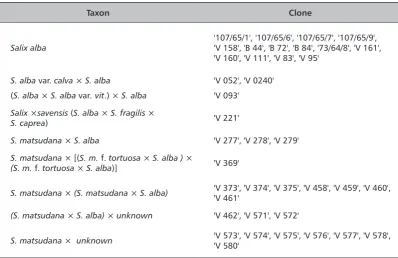
Biomass for energy purposes could be produced by fast growing tree species such as willows, poplars, alder, birch, black locust and others. Such a manner of biomass production is known as Short Rotation Forestry. In previous studies in Croatia, arborescent willow clones have shown greatest potential for biomass production in short rotations. Therefore, testing of arborescent willows continued aiming at identification of clones with greatest production potential, particularly on the so called marginal sites i.e. abandoned agricultural soils and/or sites that are not suitable for growing more valuable tree species (Table 1). According to the results of the field and laboratory research, the genetic differentiation of tested clones with respect to biomass production in fresh and dry matter has been determined [1, 2].
The strategic interest of every country is to increase the level of its energy independence. The only path towards achieving this goal is to
test the possibilities of using alternative energy sources. Among alternative energy sources, the so-called renewable energy sources and their advantages in terms of environment protection and sustainable development attract particular attention. By signing certain agreements (e.g. the Kyoto Protocol), the majority of European countries have committed themselves to taking concrete steps in increasing the share of renewable energy sources of the total energy balance.
Biomass is a renewable energy source with the highest potential in Croatia. The national BIOEN program [3, 4] was initiated with the aim of promoting the use of bioenergy for energy purposes. Both Europe and Croatia are faced with the problems of agricultural production of low profitability on marginal and abandoned soils. More recently, such production has additionally been aggravated by adverse climatic changes, soil and water pollution, lack of energy and depopulation in areas with dominant extensive agricultural
taxon Clone
Salix alba '107/65/1', '107/65/6', '107/65/7', '107/65/9', 'V 158', 'B 44', 'B 72', 'B 84', '73/64/8', 'V 161', 'V 160', 'V 111', 'V 83', 'V 95'
S. alba var. calva × S. alba 'V 052', 'V 0240' (S. alba × S. alba var. vit.) × S. alba 'V 093'
Salix ×savensis (S. alba × S. fragilis ×
S. caprea) 'V 221'
S. matsudana × S. alba 'V 277', 'V 278', 'V 279'
S. matsudana ×[(S. m. f. tortuosa × S. alba ) ×
(S. m. f. tortuosa × S. alba)] 'V 369'
S. matsudana × (S. matsudana × S. alba) 'V 373', 'V 374', 'V 375', 'V 458', 'V 459', 'V 460', 'V 461' (S. matsudana × S. alba) × unknown 'V 462', 'V 571', 'V 572'
[image:2.476.32.431.369.627.2]production. Short Rotation Forestry (SRF) and biomass production follow world trends and aim to put renewable energy sources to better use without generating additional quantities of CO2, otherwise largely present in fossil fuels.
Biomass of forest tree species can also be produced by intensive cultivation of fast-growing species in SRF. The basic function is the production of biomass as a renewable and ecologically acceptable energy source. However, these species can also be an alternative “agro” culture (in poorer sites), or they can act as agricultural soil diversifiers, as well as provide the possibility of ecologically more acceptable methods of waste water and phytoremediation. In addition, they sequester increased quantities of atmospheric carbon dioxide [5, 6].
In recent research, clones of arborescent willows manifested the highest biomass production potential in short rotations of up to ten years on marginal (clay type of soil, reed habitat), but particularly on optimal soils [1, 7-13]. Tests of different arborescent willow clones continued with the purpose of identifying those with the highest biomass production potential, quality and calorific value, especially on so-called marginal soils [14-17].
MAtERIALS AnD MEtHoDS
A field trial with ten White Willow (Salix alba
L.) clones and hybrids with Chinese Willows (Salix matsudana Koidz.) was established with cuttings in the area of Valpovo Forest Office, in the eastern part of Croatia (FT1) on a more optimal site within the nursery. At ramets age at 2/3 and 2/5 years, breast diameters and heights were measured, survival and the number of shoots per tree stump was identified.
Tests were established according to the randomized block system design in four repetitions. Each clone is represented with at least 30 ramets planted in 1.3 × 0.8 m spacing. The offshoots were cut, biomass was measured and evaluated on two-year-old sprouts, and the survival of the tested clones was determined. In the year of test establishment, as well as
after the first cutting, weed vegetation was mechanically regulated.
All two-year-old shoots from the same stump were cut in each repetition and their weight in fresh condition was measured. Mass samples of 0.5 kg were collected randomly from the cut shoots, separately for each clone. The samples were dried at 105 ºC until constant mass was achieved. The ratio between fresh and dried matter sample was used to determine the average shares of moisture in the wood of each clone. These were then used to assess dry
biomass of cut shoots (t∙DM∙ha-1∙a-1). Breast
diameters and dry biomass of cut shoots were equalized by means of a non-linear regression method. Then, using the obtained regression models (for each clone separately) and the previously measured breast diameters, dry biomass of each particular shoot in the tests was assessed. The production of clone biomass per hectare was assessed in relation to the value of dry biomass of mean shoot, survival, distance between the ramets and the average number of shoots per root.
The data obtained from the measurements were processed by means of descriptive statistical analysis to determine the average, minimal, and maximal values, as well as standard deviations for the investigated properties. All statistical analysis and analysis of variance were performed using the software package Microsoft Office Excel.
Non-linear regression analysis was used to assess dry biomass of particular shoots according to the following equation [18]:
W = a + bD1.3c;
where:
W - dry biomass of shoots
D1.3 - breast diameter of shoots
a, b, c - parameters assessed on the basis of the shoot sample cut in one repetition.
Rank correlation was calculated by formula:
rs= 1– ———
n(n2-1)
6 D2
i
n
RESuLtS AnD DISCuSSIon
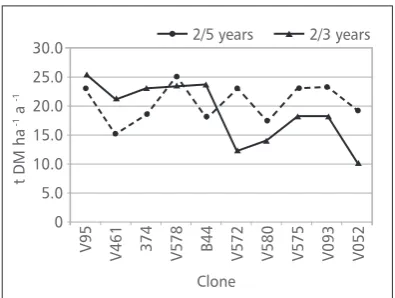
Figure 1 and Table 2 shows total biomass production of the investigated clones of arborescent willows in the Valpovo test in first and second successive two-year rotations. In the first years of research (at age 2/3 years), the mean biomass production amounted to
19.1 t∙DM∙ha-1∙a-1, with values ranging from
10.4 (clone ‘V 052’) to 25.7 t∙DM∙ha-1∙a-1 (clone
‘V 95’). In the following rotation (age 2/5 years),
the mean production was 20.6 t∙DM∙ha-1∙a-1
and ranged from 15.2 (clone ‘V 461’) to
25.0 t∙DM∙ha-1∙a-1 (clone ‘V 578’).
Value of rank correlation for two successive rotation period (2/3 and 2/5 years) was negative (r = -1.08) indicating that there is no clonal phenotypic stability of the biomass production. It also confirms that the production of each clone after the first and second rotation period differs significantly. Four clones which are in the process of DUS testing (‘V 374’, ‘V 461’, ‘V 95’, ‘V 578’) demonstrated the highest
biomass productivity and consistency in the production during the tested of two rotation periods.
Analysis of variance showed that biomass production in both rotation periods (age 2/3 and 2/5 years) didn’t show significant genotypic
no. Clone Botanical name
Average dry biomass
(t∙DM∙ha-1∙a-1)
2/3 years 2/5 years
1 'B 44' Salix alba 23.8 18.2
2 'V 093' (S. alba × S alba var. vitellina) × S. alba 18.5 23.5
3 'V 052' S. alba var. calva × S. alba 10.4 19.3
4 'V 374' S. matsudana × (S. matsudana × S. alba) 22.9 18.8
5 'V 461' S. matsudana × (S. matsudana × S. alba) 21.1 15.2
6 'V 95' Salix alba 25.7 23.1
7 'V 580' S. matsudana × unknown 14.3 17.4
8 'V 572' (S. matsudana × S. alba) × unknown 12.2 23.0
9 'V 578' S. matsudana × unknown 23.3 25.0
10 'V 575' S. matsudana × unknown 18.3 23.0
[image:4.476.30.437.372.627.2]Average 19.1 20.6
tABLE 2. Average biomass production of tested willow clones (Valpovo test)
30.0 25.0 20.0 15.0 10.0 5.0 0
V95 V461 374 V578 B44 V572 V580 V575 V093 V052
t DM ha
-1 a
-1
Clone
2/3 years 2/5 years
differences in biomass production (F = 1.93, F = 1.94). Greater clonal differentiation can be expected at older plantation ages (e.g. at the third or fourth rotation). According to earlier investigations biomass production of all the investigated willow clones shows a different trend in proportion with the test age, except in few clones, in which, after the initial increase, a decrease in the production was recorded between the second and the third rotation [9, 12, 13].
Among all the studied clones, the clones ‘V 374’, ‘V 461’, ‘V 95’, ‘V 578’ are singled out in terms of their excellent adaptedness to the habitat and to developmental conditions. In addition, they display above-average values of dry biomass of the mean shoot, or total biomass production, as well as sprouting ability. In these experiments and in two rotations, the best phenotypic stability and steady production were manifested by clones, ‘V 374’ and ‘V 461’, which originated from backcross
hybrids S. matsudana × (S. matsudana ×
S .alba), ‘V 578’ (S. matsudana × unknown) and by White Willow clone ‘V 95’ (S. alba). With their average production in two-year rotations
varying between 15.2 and 25.7 t∙DM∙ha-1∙a-1,
they manifested considerable potential for dry wood biomass production on heavy clay type of soils and marginal lands. These clones, with regard to the partial application of agro technical measures could achieved exceptional production and phenotypically represent highly unstable clones of high productivity with specific adaptability to optimal sites. Highly productive pioneer species are grown as monoculture plantations in short rotations. Short duration rotation coppice (SRC) system with willow and short duration rotation single stem (SRSS) systems with poplar species on very suitable soils in Eastern Europe at the age of 5 years results with the productivity of 13.8
to 18.1 t∙ha−1∙DM for willow and poplars and
from 17.7 - 21.8 t∙ha−1∙DM for Miscanthus
[19].
ConCLuSIonS
Short rotation coppices with clones of arborescent willows were established on so-called marginal sites, i.e. on abandoned agricultural soils or soils not suitable for the cultivation of more valuable forest tree species. No nutrition or pest control measures were applied (a practice otherwise widely used in intensive cultivation system), while weed vegetation was regulated only at the earliest age. Despite this, the results showed relatively high biomass production of the studied clones. Average dry biomass production of the studied clones at age 2/3 years was 19.1 and in the second two-year rotation at the age
2/5 years it was 20.6 DM∙ha-1∙a-1. The highest
production was manifested by the clones that taxonomically belong to different crossing combinations of Chinese and White Willow and perspective and phenotypically more unstable clones showed average production
of more than 20.0 t∙DM∙ha-1∙a-1.
REFEREnCES
1. KoMleNoVIĆ N, KRStINIĆ A, KAJBA D 1996 Selection of Arborescent Willow clones suitable for biomass production in Croatia. In: Bach I
(ed) Proceedings of the International Poplar Commission, Sess. 20, Environmental and social issues in poplar and willow cultivation and utilization, Budapest, Hungary, 1-4 October 1996, pp 297-308
2. KRStINIĆ A, KAJBA D 1997 Improvement of Chinese Willow (Salix matsudana Koidz.) and White Willow (Salix alba L.) by hybridization and selection. In: Jurc M (ed) Znanje za gozd. Zbornik ob 50. obletnici obstoja in delovanja GIS 1, Ljubljana, Slovenija, 26-27 May1997. Slovenian Forestry Institute, Ljubljana, Slovenia, pp 341-350 3. DoMAc J, BeRoNJA M, DoBRIčeVIĆ N, ĐIKIĆ M,
GRBešA D, JelAVIĆ V, JuRIĆ Ž, KRIčKA t, MAtIĆ S, oRšANIĆ M, PAVIčIĆ N, PlIeStIĆ S, SAloPeK D, StANIčIĆ l, toMIĆ F, toMšIĆ Ž, VučIĆ V 1998 BIOEN - Biomass and waste use programme: Preliminary results and future activities (in Croatian). energy Institute Hrvoje Požar, Zagreb,
Croatia, 180 p
4. DoMAc J, BeRoNJA M, FIJAN S, JelAVIĆ B, JelAVIĆ V, KRAJNc N, KAJBA D, KRIčKA t, KRStuloVIĆ V, PetRIĆ H, RAGuZIN I, RISoVIĆ S, StANIčIĆ l, šuNJIĆ H 2001 BIOEN - Biomass and waste use programme: New findings and implementation (in Croatian). energy Institute Hrvoje Požar, Zagreb,
Croatia, 144 p
5. VERWIJST T 2003 Short rotation crops in the world. In: Nicholas ID (ed) IEA Bioenergy Task 30, Proceedings of the Conference The role of short rotation crops in the energy market,. Mount Maunganui, Tauranga, New Zealand, 1-5 December 2003,, pp 1-10
6. BoRZĐcKA-WAlKeR M, FABeR A, BoReK R 2008
Evaluation of carbon sequestration in energetic crops (Miscanthus and coppice willow). Int Agrophys 22 (3): 185-190
7. KAJBA D, Krstinić A, KoMleNoVIĆ N 1998 Arborescent willow biomass production in short rotations (in Croatian with English summary).
Sumar list 122 (3-4): 139-145
8. KAJBA D, BoGDAN S, KAtIčIĆ-tRuPčeVIĆ I 2004 White willow biomass production in a short rotation clonal test Dravica (in Croatian with English summary). Sumar list 126 (9-10): 509-515.
9. KAJBA D, BoGDAN S, KAtIčIĆ I 2007 Selection of willow clones for biomass production in short rotations (in Croatian). In: Krajač t (ed) Proceedings of the Second Professional Meeting with International Participation “Renewable energy in the Republic of Croatia (biomass, biogas and biofuels)”, Osijek, Croatia, 27-29 May 2007. Croatian Chamber of Economy, Zagreb, Croatia, pp 107-113
10. KAJBA D 1999 Short Rotation Crops in Croatia.
In: Christersson L, Ledin S (eds) Proceeding of the first meeting of IEA, Bioenergy Task 17, Uppsala. Sweden, 4-6 June 1998. Department of Short Rotation Forestry, Faculty of Forestry, Swedish University of Agricultural Sciences (SLU),Uppsala, Sweden, pp 37-40
11. KAJBA D 1999 Arborescent Willow Biomass Production in Short Rotations. In: Overend RP, Chornet E (eds) Proceedings of the fourth Biomass Conference of the Americas, Oakland. California. USA, 29 August - 2 September. Pergamon, Vol. 1, pp 55-60
12. BoGDAN S, KAJBA D, KAtIčIĆ I 2006 Biomass production in willow clonal tests on marginal sites in Croatia (in Croatian with English summary).
Glas šum pokuse 5 (special issue): 261-275 13. KAJBA D, KAtIčIĆ I 2011 Selection and breeding
of willows (Salix spp.) for SRF. Indian J Ecol 38 (special issue): 91-94
14. KlAšNJA B, KoPItoVIĆ š 1999 Quality of wood
of some willow and robinia clones as fuelwood.
Drevarsky vyskum 44 (2): 9-18
15. VOLK TA, VERWIJST T, THARAKAN PJ, ABRAHAMSON LP, WHITE EH 2004 Growing fuel: a sutainability assessment of willow biomass crops. Front Ecol Environ 2 (8): 411-418. DOI: http://dx.doi. org/10.1890/1540-9295(2004)002[0411:GFASAO ]2.0.CO;2
16. SMART LB, VOLK TA, LIN J, KOPP RF, PHILLIPS IS, CAMERON KD, WHITE EH, ABRAHAMSON LP 2005 Genetic improvement of shrub willow (Salix
spp.) crops for bioenergy and environmental applications in the United States. Unasylva 221 (56): 51-55
17. KLAŠNJA B, oRloVIĆ S, GAlIĆ Z 2013 comparison
18. TELENIUS B, VERWIJST T 1995 The influence of allometric variation, vertical biomass distribution and sampling procedure on biomass estimates in commercial short-rotation forests. Bioresource Technology 51 (2-3): 247-253. DOI: http://dx.doi. org/10.1016/0960-8524(94)00133-L