Master thesis
Polypharmacy
Effects of medication reviews on
medication prescription policy in
polypharmacy patients in the
Netherlands
Health Sciences – Health Service and
Management
M.Z.M. Hurmuz (s1389351)
15 August 2016
iii
Preface
For the master Health Sciences at the University of Twente I have ended the specialization track Health Service and Management with a graduation thesis I have conducted from February till August. In this thesis, I have focused on the effect of performing a medication review on the medication list of polypharmacy patients, in terms of number of drugs, appropriateness of drugs, frequently added and stopped drugs, and dose modifications. Additionally, by means of short online questionnaires, the experiences with performing medication reviews of general practitioners and pharmacists are identified. This master thesis is written as a concept journal article.
I would like to thank a number of people for the creation of this thesis for their time and contribution. I could always contact them when I needed help. First, I would like to thank my supervisors Jeannette van Manen and Sarah Janus for their assistance and support from the University. Second, I would like to thank Kim Dorsman and Suzan van Vlieten, general practitioners, for their assistance in the practice. Finally, I would like to thank all the involved pharmacists and general practitioners for providing me the required data for performing my research. Without them, I would not have been able to conduct this master thesis at all.
iv
Table of contents
Preface ... iii
Abstract ... 1
Introduction ... 1
Method ... 7
Study design ... 7
Study population... 7
Data collection ... 7
Data analysis... 8
Ethical consideration ... 9
Results ... 9
Patient characteristics ... 9
Effect evaluation... 9
Experiences of general practitioners and pharmacists ... 19
Discussion ... 22
Interpretation of striking results ... 22
Study limitations... 24
Study strength ... 25
Conclusion ... 25
References ... 26
Appendix 1: STRIP method ... 28
Appendix 2: START/STOPP criteria ... 32
Appendix 3: Form for collecting patient demographics and medical information ... 39
Appendix 4: Questionnaire design ... 42
Appendix 5: Literal registered reasons why some PIDs are continued ... 46
1
Effects of medication reviews on medication
prescription policy in polypharmacy patients in the
Netherlands
Abstract
Background: Polypharmacy, the use of five or more drugs chronically for different therapeutic (sub)groups, is a frequent phenomenon in elderly. It is associated with negative consequences; the risk of having drug-related problems increases with the increase of number of drugs. To reduce this risk, medication reviews have to be performed according to the Dutch guideline ‘Polyfarmacie bij ouderen’. In the Netherlands, little is known about the effect of performing a medication review on the Dutch prescription policy in the Netherlands. This study will focus particularly on this effect.
Methods: Two study designs are used in this study. A prospective longitudinal intervention study with a pre-test/post-test without control group, and a cross-sectional explorative cohort study have been conducted. The study population consisted of a convenience sample of patients, and their general practitioners and pharmacists in five community pharmacies in Twente with polypharmacy, of which the medication has been reviewed. Data of this population is collected through pharmacists’ database and online questionnaires for general practitioners and pharmacists. The collected data has been analysed with the following statistics: descriptive statistics; paired t-test; and Pearson’s correlation coefficient, and analysed through text analyses.
Results: The main finding was that medication reviews have a positive influence (p < 0.05) on the average decrease in number of drugs, and in number of potentially inappropriate drugs that patients use. The average number of drugs a patient used one day before the review was 8.7 (sd = 2.9), which decreased to 8.3 (sd = 2.7) drugs one week after the review, and to 8.4 (sd = 2.6) drugs three months after the review. The average number of potentially inappropriate drugs was first 0.6 (sd = 0.8) drugs per patient. Both one week and three months after the review it was 0.4 (sd = 0.6) drugs per patient. Additionally, there is positive correlation (p < 0.01) between number of drugs before review and (1) difference in number of drugs before review and one week after review (r = 0.324); (2) difference in number of drugs before review and three months after review (r = 0.321); and (3) number of potential inappropriate drugs before review (r = 0.389). Furthermore, according to general practitioners and pharmacists, medication reviews offer added value to lowering the chance of adverse events, and the contact between them and the patients becomes better. However, performing these reviews is very time-consuming and stressful.
Conclusion: This study shows that performing medication reviews in polypharmacy patients is useful to continue. In the short-term and long-term, medication reviews have a positive influence on the prescription policy in the Netherlands.
Keywords: polypharmacy, medication review, effectiveness, experiences, the Netherlands
Introduction
With aging, the risk of developing chronic diseases increases. This is often accompanied by the use of multiple drugs, (Dijk, Verheij & Schellevis, 2009) which can be referred to as polypharmacy. According to the guideline
2
years and older) polypharmacy is a frequent phenomenon. In 2007, almost 45% of the elderly used five or more different drugs. Looking at elderly above 74 years old, even more than half of the population (51%) deals with polypharmacy. (Dijk et al., 2009) It is expected that the amount of elderly with multi-morbidity will continue to increase, which makes polypharmacy an expanding societal issue. (Hurkens et al., 2012)
Drugs are prescribed to patients to treat diseases, relieve symptoms, and prevent complications. However, the use of drugs can also lead to adverse effects, drug-related problems (DRPs). Especially elderly are sensitive to DRPs, due to a high prevalence of polypharmacy, pharmacokinetic and –dynamic changes, and improper medication use because of cognitive or physical limitations. (Drenth-van Maanen, Leendertse, Marum, Egberts & Jansen, 2012) In particular, the use of corticosteroids, anticoagulants, diuretics, RAAS antagonists, NSAIDs, antidiabetic drugs, drugs with an effect on the central nervous system, and opioids is associated with DRPs. (Bemt et al., 2006; Berdot et al., 2009; Bruijne et al., 2014; Leon et al., 2010; Roughead & Semple, 2009)
The more drugs a patient uses, the higher the risk of DRPs for that patient. DRPs include the result of over- and under-treatment, inaccurate dosing, suboptimal choice of drug, incorrect/impractical mode of administration, double medication, drug interactions, an excessive or insufficient effect, side-effects, and the dealing of the patient with the medication.
(Bruijne et al., 2014; Dijk et al., 2009; Passarelli, Jacob-Filho & Figueras, 2005; Rijksinstituut voor Volksgezondheid en Milieu [RIVM], 2013; Rogers et al., 2009) Not only a large number of medication thus leads to DRPs, but, especially in frail elderly, inadequate or inappropriate medication can lead to some serious general health problems, like deterioration of cognitive abilities, incontinence, immobility, and increasing fall risk. (Berdot et al., 2009; Bruijne et al., 2014; Leon et al., 2010; Roughead & Semple, 2009)
Polypharmacy in older patients is also an important risk factor for preventable hospital admissions. (Bemt, Egberts & Leendertse, 2006; Bruijne et al., 2014; RIVM, 2013) The study of Leendertse, Egberts, Stoker & Van den Bemt (2008) showed that in Dutch hospitals 5.6% of the unplanned admissions were related to medication. Of those medication-related admissions 46.5% were potentially preventable. The costs that are associated with avoidable admissions are estimated for the Netherlands at over 85 million euros. (Bemt et al., 2006)
The most important risk factors that increase the chance of unintentional injury due to inappropriate pharmacotherapy for the patient are (Bruijne et al., 2014):
- errors in prescribing;
- insufficient involvement of patient in the pharmacotherapeutic care process;
- insufficient documentation of prescribed drugs and patient history;
3
- inadequate transfer, in particular, the transition from the first to the second line, and vice versa; and
- insufficient directive function, cooperation, and division of responsibilities in cooperation.
To reduce the preventable admissions and the related costs, it is important that medication safety increases. In 2012, the multidisciplinary guideline ‘Polyfarmacie bij ouderen’ was set up, with the goal to optimise the use of drugs by elderly, and to reduce drug-related problems and undesired hospitalizations. (Lambregtse, 2014) Adhering to the guideline will lead to safe and effective pharmacotherapeutic care by a multidisciplinary coordinated treatment and support of elderly with polypharmacy. The guideline is applicable for elderly aged 65 years and older with polypharmacy and with one or more of the following risk factors (NHG, 2012):
- impaired renal function (eGFR < 50 ml/min/1,73 m2);
- impaired cognition (dementia or indications of memory disorders and other cognitive disorders);
- increased risk of falling (patient fell at least one time in the preceding twelve months);
- signals of poor compliance; or
- not living independently (living in care or nursing home).
In this guideline, medication review is the key focus point. Medication review is a systematic assessment of the medication usage of an individual patient, done by a physician,
pharmacists, and patient (and/or informal caregiver or other caretakers) according to a periodic structured, critical evaluation of the medical, pharmaceutical, and user information. Goal of the medication review is a coordinated pharmacotherapeutic treatment which is established by mutual cooperation between physicians, pharmacists and nurses, and is geared to needs (or experiences) and wishes of the patient (and informal caregivers). (NHG, 2012)
The medication review is carried out according to the Systematic Tool to Reduce Inappropriate Prescribing (STRIP) method. The STRIP method is established by Leendertse, Drenth-van Maanen, Verduijn, Jansen & Drenth-van Marum (2012) according to two other medication review methods, namely ‘Gebruik Indicatie Veiligheid Effectiviteit’ (GIVE) and ‘Polyfarmacie Optimalisatie Methode’ (POM). STRIP consists of various steps (see Appendix 1 for a detailed overview in Dutch):
0. Preparation:
a. selection of patients; and b. collection of data.
1. Pharmacotherapeutic anamnesis: gathering information about the actual use, experiences and perception of the drugs by the patient.
4
4. Establishing the pharmacotherapeutic treatment plan: the patient participates in his or her pharmacotherapy and (s)he understands the interventions written in the plan. The participation is tailored to the capabilities of the patient.
5. Follow-up and monitoring: executing and evaluating the intended interventions.
In step 2 (pharmacotherapeutic analysis) the potential problems have to be identified using the established questions and attention areas given in Appendix 1, and the START and STOPP criteria. The START/STOPP is a screening list developed by Irish clinical geriatricians. START stands for Screening Tool to Alert doctors to Right (i.e. appropriate, indicated) Treatment and is a list of 36 evidence based prescribing indicators in frequent diseases/disorders in elderly. STOPP stands for Screening Tool of Older Peoples’ Prescriptions and is a list of 72 clinical significant criteria for potential inappropriate medication in elderly. The START/STOPP is a validated, reliable and practicable screening tool which seems to be the most appropriate in support of choosing the best treatment in elderly patients with multi-morbidity. However, this tool cannot be directly applicable in the Dutch situation. In Appendix 2, an adjusted version is displayed that can be used in the Netherlands. (NHG, 2012)
In the end, it is essential that the result of a medication review will be discussed with the patient, transferred to other involved health care providers, and that a monitoring and evaluation plan will be established to ensure the continuity
of the therapeutic care. (Drenth-van Maanen et al., 2012) Follow-up assessments of outpatient patients have to be carried out minimal once per year. (NHG, 2012)
Looking at the steps of performing a medication review, it can be concluded that this is a considerable workload and therefore hard to carry out for the entire group of patients at once. (Lambregtse, 2014) However, it is very important to adhere to the guideline, because with optimal medication safety, approximately 16,000 acute hospital admissions can be avoided each year. (Inspectie voor de Gezondheidszorg [IGZ], 2010)
5 monitoring, adjust dose, and provide education.
(Chau et al., 2016) The other study includes 58 medication reviews performed by pharmacists and general practitioners (GPs) together. In 54 patients, one or more suggestions for drug adaption is given. On average, there were 2.3 drug adaptions per patient. The most frequent suggestions were quitting (33.8%) and starting a drug (24.8%), and the most common reasons for drug changes were undertreatment (37.7%) and overtreatment (35.6%). Cardiovascular drugs, vitamin D, and proton pump inhibitors were the most frequent drugs that were added, stopped or had a dose modification. (Balen, Damen-van Beek, Nelissen-Vrancken & Verduijn, 2013)
Several studies have been performed regarding to the effectivity of a medication review. In overall, most of the studies showed that the number of drugs per patient, DRPs, emergency department contacts, and inappropriate drugs decreased, (Christensen & Lundh, 2013; Jódar-Sánchez et al., 2015; Lenaghan, Holland & Brooks, 2007; Mudge et al., 2016; Roth et al., 2013; Vinks, Egberts, Lange & Koning, 2009) and little or no effect is shown regarding to the quality of life, mortality, patients’ functioning, (re)admissions, and adverse drug events. (Christensen & Lundh, 2013; Cooper et al., 2015; Frank & Weir, 2014; Geurts, Stewart, Brouwers, Graeff & Gier, 2015; Leendertse et al., 2013; Lenaghan et al., 2007)
However, for three of those types of effects of medication reviews also contradictory literature is found. First, regarding to the number of drugs per patient, three studies are found that showed
a statistically significant reduction in the number of drugs after a medication review, (Lenaghan et al., 2007; Jódar-Sánchez et al., 2015; Mudge et al., 2016) but only one of them had an obvious reduction that could be regarded relevant. (Mudge et al., 2016) The other two studies, one from the United Kingdom and one from Spain, only showed an average reduction of less than 1 drug per patient. (Lenaghan et al., 2007; Jódar-Sánchez et al., 2015) In addition, two Dutch studies did not show a reduction in the number of drugs per patient at all. (Balen et al., 2013; Vinks et al., 2009) The reason for these differences is that the study of Mudge et al. (2016) included only patients with frequent hospital admissions. Those patients have already problems, so the chance of using inappropriate drugs is higher in this population.
6
2013), the Dutch study included patients that use at least six drugs (Vinks et al., 2009), and the review included patients that use at least four drugs. (Cooper et al., 2015)
Third, five studies show contradictory evidence whether the quality of life of patients improves. The review of Cooper et al. (2015), and two Dutch studies concluded that it is not proven that medication reviews are effective in improving the quality of life. (Frank & Weir, 2014; Geurts et al., 2015; Leendertse et al., 2013) The other two studies, one from Spain and one from Sweden, concluded the opposite, because due to medication reviews, more proper drugs will be prescribed. (Jódar-Sánchez et al., 2015; Olsson, Runnamo & Engfeldt, 2011) It is hard to conclude why those studies show contradictory results; all studies used a control group and included a large group of patients. Only the Swedish study used a different population, namely patients that were discharged from the hospital (Olsson et al., 2011)
Besides patient effects, there are also important physician effects, namely the investment time of GPs and pharmacists. Only one study is found that looked at the average time of performing a medication review for GPs and pharmacists. In this study, it appeared that pharmacists invested on average 90 minutes per patient, but the researchers could not conclude how much time GPs invested per patient, due to incomplete registrations. (Balen et al., 2013)
Because of contradictory evidence about the decrease in number of drugs, DRPs, and quality
of life, this thesis will focus on the effect of performing a medication review by GPs and pharmacists on the Dutch prescription policy. It is important that more study will be done in the Netherlands, because studies from other countries cannot be extrapolated directly to GP practices in the Netherlands. The reason therefore is that, in the Netherlands, the GPs have a gatekeeping role, causing restrictive guidelines regarding to drug prescription, additional investment, and referral criteria, (Burgers, 2004) which can probably influence the type of medications in the medication lists of patients. Therefore, the following research question will be tackled in this study: ‘What are the short-term and long-term effects of performing a medication review by general practitioners and pharmacists on the prescription policy in patients aging 65 years and older that use five or more different types of drugs in the Netherlands?’
The sub-questions that help to answer the research question are:
1. Which short-term and long-term effect does a medication review have on the medication list of patients, in terms of number of drugs, appropriateness of drugs, frequently added and stopped drugs, and dose modifications?
2. What are the experiences of general practitioners and pharmacists with medication reviews in polypharmacy patients and ideas for possible
improvements for performing
7
Method
Study design
To answer the research question, quantitative evaluative and qualitative explorative study was needed. The study design that fit best with the first sub-question was a prospective longitudinal intervention study with a pre-test/post-test. First of all, it was a prospective longitudinal study, because the measurements were not done at the beginning of this study and those measurements were done at multiple moments in time. At three points in time measurements are taken: one day before the medication review, one week after the medication review, and three months after the medication review. This is also why this study consisted of a pre-test/post-test. All measurements are done in the same group of patients. Furthermore, this was an intervention study, because the effect of an intervention, namely medication review, has been studied. (Bouter, Dongen & Zielhuis, 2010)
The study design that fit best with the second sub-question was a cross-sectional explorative cohort study. It was an explorative cohort study, because a group of individuals was observed without any intervention. (Twisk, 2014) In this group, each individual was measured once, but these measurements did not have to be at the same moment in time, which made it a cross-sectional study. (Bouter et al., 2010)
Study population
The study population consisted of elderly with polypharmacy that got a medication review in the time period from 2015 until April 2016. The inclusion criteria used in this study are the same
as the criteria used by GPs and pharmacists (NHG, 2012):
- elderly aged 65 years and older that use five or more types of drugs and with one or more of the following risk factors:
o impaired renal function (eGFR < 50 ml/min/1,73 m2);
o impaired cognition (dementia or indications of memory disorders and other cognitive disorders);
o increased risk of falling (patient fell at least one time in the preceding twelve months);
o signals of poor compliance; or
o not living independently (living in care or nursing home).
A sample size calculation was performed, which showed that 156 patients are needed (α = 0.05; β = 0.20), based on the primary outcome, mean difference in number of drugs, of this study. The mean difference in number of drugs (0.28) and related standard deviation (1.25) were found in literature. (Jódar-Sánchez et al., 2015) To include this many polypharmacy patients that underwent a medication review, a convenience sample is used of five community pharmacies in Twente.
Data collection
8
shown in Appendix 3, is made which has been filled in for each patient to get the needed patient demographics and medical information. The Anatomical Therapeutical Chemical (ATC) codes of the medications are used to have an uniform international naming. (World Health Organization [WHO] Collaborating Centre for Drug Statistics Methodology, 2009)
The appropriateness of the drugs are checked with a validated screening tool, the STOPP criteria (shown in Appendix 2). The STOPP criteria are laid down next to the medications that the patients used, so that potential inappropriate drugs (PIDs) could be found. To examine the appropriateness of the medications, a couple of diagnostics were needed: blood pressure, renal function, potassium level, sodium level, non-protein bounded calcium, beats per minute, HAS-BLED score, and respiratory failure (ρO2- and ρCO2-level). These diagnostics were mostly obtained in the pharmacies. Only when the pharmacies did not have this information, the GPs were asked. The diagnostics non-protein bounded calcium and respiratory failure are not included in this study, because these three were not available. This made it impossible to examine STOPP criteria C2 and G4, and partly STOPP criterion B8.
Through short online questionnaires, the GPs and pharmacists are asked whether they think that medication reviews have an added value on reduction of health care costs, reduction in number of drugs, reduction of adverse events, and increase in knowledge of drugs for GPs. They are also asked how much time they spend to perform one medication review and whether
they think that this time put an extra burden on their workload. Furthermore, the GPs and pharmacists are also asked in this questionnaire why sometimes a drug had not been stopped, while the guidelines indicate that the drug has to be stopped, and whether there are any suggestions for improvements. In Appendix 4, an example of the questionnaire is given.
The data collection for the purpose of the analyses in this study took place from 13 April 2016 until 17 June 2016.
Data analysis
Statistical analyses (through SPSS version 23) and text analysis were performed. For answering the first sub-question, paired samples t-tests (with 95% confidence intervals) were performed on the continuous variables ‘number of drugs’ and ‘number of inappropriate drugs’. To test whether there is a correlation between the difference in number of drugs and number of drugs before the medication review; between the number of PIDs before review and number of drugs before the review; and between the difference in number of PIDs and number of drugs before the medication review, the Pearson’s correlation coefficient has been used, because all these variables are continuous. (Baarda, Dijkum & Goede, 2014) Furthermore, descriptive statistics were used to evaluate how many times a type of drug was added, stopped or had a dose modification. Finally, the notes of GPs and pharmacists that are used in the first sub-question, are analysed through the following steps:
9 2. Thematise: the texts with the same
colour is put together.
3. Interpret: the themed text is interpreted and understood.
4. Describe: the results are described and reported.
The completed questionnaires for sub-question two are analysed through descriptive statistics and text analyses. The closed-ended questions are analysed with means and percentages, and the open-ended questions are analysed through the same steps as the notes of GPs/pharmacists.
Ethical consideration
A study belongs to the Law Medical Research when there is a medical scientific study, and when persons are subject to actions or when behavioural rules are imposed on them in the study. (Wet Medisch-wetenschappelijk
Onderzoek). (Centrale Commissie
Mensgebonden Onderzoek [CCMO], z.d.) In this study, only patient data from the pharmacies’ databases are used, so there has been no insight in the full electronic patient records, and the patients did not undergo a special intervention. For these reasons, this study did not belong to the Law Medical Research and no ethical approval was needed from the Ethical Commission. The data that is used in this study is processed anonymously, so that the data could not be traced back to patients. In all five pharmacies a confidentiality agreement is signed, so that the data would not be shared with others.
Results
Patient characteristics
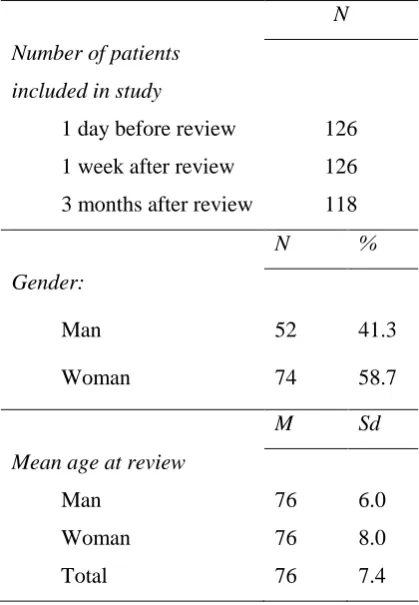
[image:15.595.315.525.285.588.2]One hundred twenty six elderly are included in this study. The patients that still could be included after three months are 118 patients, eight patients were lost to follow up. The population consists of more women than men (58.7% vs. 41.3%) and the mean age of the population is 76 years old (see Table 1).
Table 1: Baseline characteristics of study population
N Number of patients
included in study
1 day before review 126 1 week after review 126 3 months after review 118
N %
Gender:
Man 52 41.3
Woman 74 58.7
M Sd
Mean age at review
Man 76 6.0
Woman 76 8.0
Total 76 7.4
Effect evaluation
10
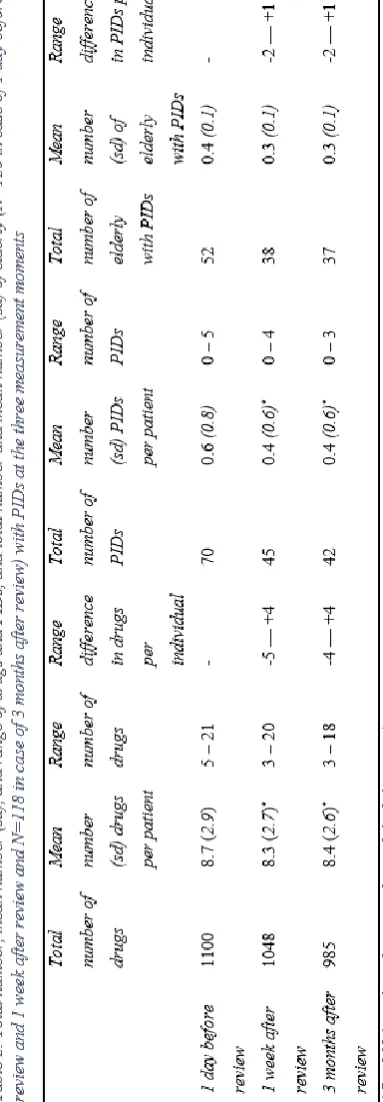
– 5, and 52 to 45, 0.4, 0 – 4, and 38 respectively. Even after three months, the numbers decreased a little bit, except for the mean number of drugs per patient. Performing medication reviews in polypharmacy patients has a significant result (p < 0.05) on the average decrease in number of drugs that patients use one week (from 8.7 to 8.3) and three months (from 8.7 to 8.4) after the review. Furthermore, it also has a significant result (p < 0.05) on the average decrease in number of PIDs one week and three months after the review (both decreased from 0.6 to 0.4).
Looking at the individual level instead of means, one can see that the difference in number of drugs between one day before review and one week after review decreased with a maximum of five drugs , and increased with a maximum of four drugs (see Table 2). The difference between one day before review and three months after review has a maximum decrease, and increase of four drugs on individual level. In case of the PIDs on individual level, both one week and three months after review, the maximum decrease was two drugs, and maximum increase one drug.
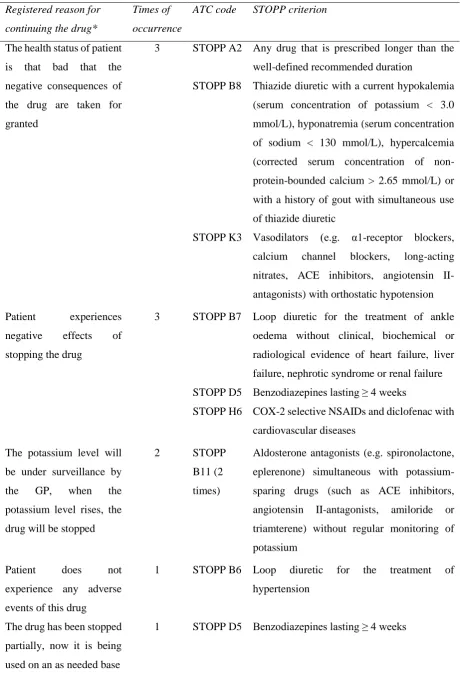
[image:16.595.320.512.86.638.2]One week after the review, not all 45 PIDs are new, some were not stopped during the review. Table 3, lists the reasons for not stopping a PID. The most frequent reasons were that the health status of a patient is so bad that the negative consequences of the drug are taken for granted, and that a patient experiences negative effects of stopping the drug, so it was better to continue the drug.
11
Table 3: Registered reasons why some PIDs are not stopped
Registered reason for continuing the drug*
Times of occurrence
ATC code STOPP criterion
The health status of patient is that bad that the negative consequences of the drug are taken for granted
3 STOPP A2 Any drug that is prescribed longer than the well-defined recommended duration
STOPP B8 Thiazide diuretic with a current hypokalemia (serum concentration of potassium < 3.0 mmol/L), hyponatremia (serum concentration of sodium < 130 mmol/L), hypercalcemia (corrected serum concentration of non-protein-bounded calcium > 2.65 mmol/L) or with a history of gout with simultaneous use of thiazide diuretic
STOPP K3 Vasodilators (e.g. α1-receptor blockers, calcium channel blockers, long-acting nitrates, ACE inhibitors, angiotensin II-antagonists) with orthostatic hypotension Patient experiences
negative effects of stopping the drug
3 STOPP B7 Loop diuretic for the treatment of ankle oedema without clinical, biochemical or radiological evidence of heart failure, liver failure, nephrotic syndrome or renal failure STOPP D5 Benzodiazepines lasting ≥ 4 weeks
STOPP H6 COX-2 selective NSAIDs and diclofenac with cardiovascular diseases
The potassium level will be under surveillance by
the GP, when the
potassium level rises, the drug will be stopped
2 STOPP
B11 (2 times)
Aldosterone antagonists (e.g. spironolactone, eplerenone) simultaneous with potassium-sparing drugs (such as ACE inhibitors, angiotensin II-antagonists, amiloride or triamterene) without regular monitoring of potassium
Patient does not
experience any adverse events of this drug
1 STOPP B6 Loop diuretic for the treatment of
hypertension
The drug has been stopped partially, now it is being used on an as needed base
12
The drug has not been stopped directly, but the patient has a scheme to reduce the drug in steps
1 STOPP H3 Long-term use of glucocorticoids (> 3 months) as monotherapy for rheumatoid arthritis
Indication to stop the drug does not apply in this case, because the patient only has a little superficially ulcer in the duodenum
1 STOPP H7 Oral bisphosphonates in patients with a history or current upper gastrointestinal disorders (dysphagia, esophagitis, gastritis, duodenitis, gastric ulcer or upper gastrointestinal bleeding) or in bedridden patients
Instead of stopping the drug, the dose is lowered
1 STOPP J1 Sulphonylureas with a longer duration and active metabolites, such as glibenclamide and glimepiride, in patients with diabetes mellitus type 2
There is no better alternative
1 STOPP J1 Sulphonylureas with a longer duration and active metabolites, such as glibenclamide and glimepiride, in patients with diabetes mellitus type 2
[image:18.595.87.529.467.623.2]* See Appendix 5 for the literal reasons
Table 4: Spontaneous written notes by general practitioner or pharmacist
General spontaneous written notes by general practitioner or pharmacist* Times of occurrence Patient, pharmacist, and GP agreed to change a drug, but in the end, nothing
happened
12
Patient did not want to undergo any changes 9
Patient asked the pharmacist for a medication review (patient’s own initiative) 2 Better to keep the medication list the same, because of the situation of patient 2
Pharmacist did not get any reaction from the GP 1
Health status of patient was very bad, patient was dying 1
* See Appendix 6 for the literal notes
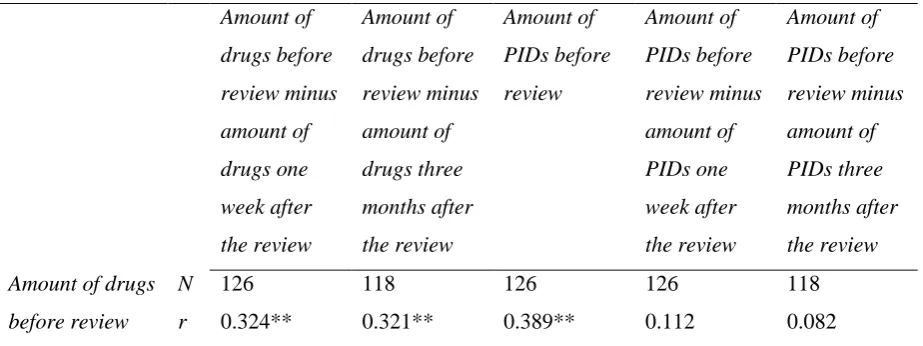
Like shown in Table 5, the number of drugs one day before the review correlates reasonably with (1) the difference in number of drugs before the review and one week after the review (r = 0.324; p < 0.01); (2) the difference in number of drugs before the review and three months after the review (r = 0.321; p < 0.01);
13
Table 5: Pearson’s correlation coefficients
Amount of drugs before review minus amount of drugs one week after the review Amount of drugs before review minus amount of drugs three months after the review Amount of PIDs before review Amount of PIDs before review minus amount of PIDs one week after the review Amount of PIDs before review minus amount of PIDs three months after the review Amount of drugs
before review
N 126 118 126 126 118
r 0.324** 0.321** 0.389** 0.112 0.082
** Correlation is significant at the 0.01 level (2-tailed)
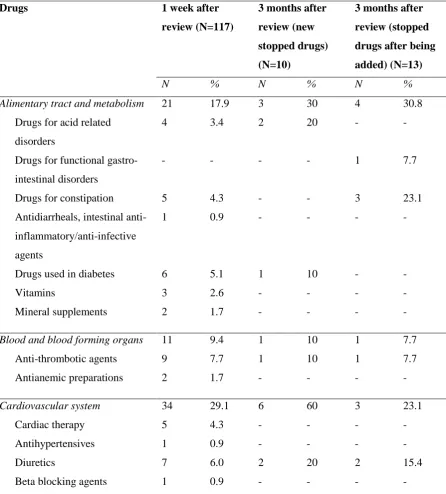
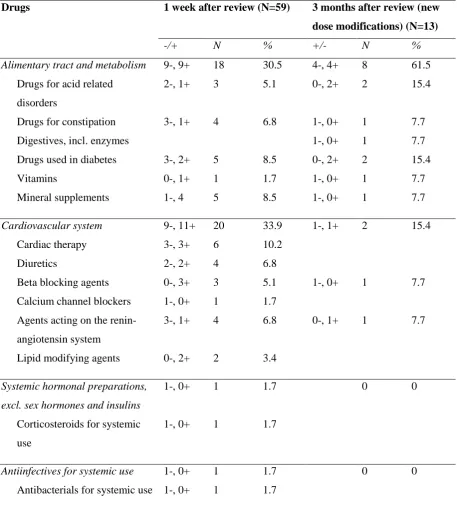
One week after the medication review, 241 changes are made (see Table 6). In 48.5% of the modifications a drug is stopped, in 27% of the modifications a drug is added, and the remaining 24.5% were dose modifications. After three months, changes were still made (see Table 6); sometimes new changes and sometimes the elderly changed back to the initial drug. Three months after the medication review, 314 changes are made in total. Of which 44.6% were stopped drugs, 32.5% were added drugs, and 22.9% were dose modifications. In these percentages also the turning back to the old situations are included, so the stopped drugs after being added by the review, the added drugs after being stopped by the review, and the drugs that returned to their initial dose. In both cases, one week and three months after, the number of elderly that quit a drug is highest.
The most frequently drugs that are added, stopped, and that had a dose modification are from the groups ‘alimentary tract and metabolism’ and ‘cardiovascular system’ (see
Table 7, 8, and 9). Mostly vitamins and minerals of the group ‘alimentary tract and metabolism’ were added, and diuretics, agents acting on the renin-angiotensin system and lipid modifying agents of the other group. For stopped drugs it mostly concerns the same drugs in the ‘cardiovascular system’ group, and drugs for constipation and diabetes in the group ‘alimentary tract and metabolism’. Another group in which relatively many drugs are stopped is the ‘nervous system’. Here, it mostly concerns the analgesics.
14
Table 6: Amount, mean and range of the interventions, and amount and mean of elderly (1 week after review the total N=126, and three months after review the N=118) that underwent the interventions
Number of drugs
Mean number (sd) of drugs
Range of drugs
Number of elderly
Mean number (sd) of elderly Modification of dose compared
to initial dose
1 week after review
59 0.5 (0.7) 0 – 3 48 0.4 (0.1)
3 months after review
70 0.6 (0.8) 0 – 3 51 0.4 (0.1)
Added drug 1 week
after review
65 0.5 (0.8) 0 – 4 48 0.4 (0.1)
3 months after review
95 0.8 (1.1) 0 – 6 56 0.4 (0.0)
Stopped drug 1 week
after review
117 0.9 (1.2) 0 – 6 70 0.6 (0.0)
3 months after review
127 1.0 (1.2) 0 – 6 72 0.6 (0.0)
Drug that first had a dose modification and after 3 months returned to its initial dose
3 months after review
2 0.0 (0.1) 0 – 1 2 0.0 (0.1)
Added drug after being stopped*
3 months after review
7 0.1 (0.3) 0 – 3 5 0.0 (0.1)
Stopped drug after being added*
3 months after review
13 0.1 (0.4) 0 – 2 10 0.1 (0.1)
* The number of drugs that belong to those is not included in the number of added drugs and number of stopped drugs
Table 7: Drugs that are added one week after review and three months after medication review
Drugs 1 week after
review (N=65)
3 months after
review (new
added drugs)
(N=30)
3 months after
review (added
drugs after being
stopped) (N=7)
N % N % N %
[image:20.595.71.529.631.744.2]15 Drugs for acid related
disorders
5 7.7 4 13.3 1 14.3
Drugs for functional gastro-intestinal disorders
1 1.5 - - - -
Drugs for constipation 3 4.6 - - 1 14.3
Drugs used in diabetes 2 3.1 3 10 - -
Vitamins 12 18.5 1 3.3 - -
Mineral supplements 7 10.8 - - - -
Blood and blood forming organs 5 7.7 8 26.7 0 0
Anti-thrombotic agents 3 4.6 8 26.7 - -
Antianemic preparations 2 3.1 - - - -
Cardiovascular system 14 21.5 10 33.3 4 57.1
Diuretics 5 7.7 1 3.3 - -
Beta blocking agents - - 1 3.3 1 14.3
Calcium channel blockers - - 2 6.7 - -
Agents acting on the renin-angiotensin system
5 7.7 4 13.3 1 14.3
Lipid modifying agents 4 6.2 2 6.7 2 28.6
Genito urinary system and sex hormones
3 4.6 0 0 0 0
Urologicals 3 4.6 - - - -
Systemic hormonal preparations, excl. sex hormones and insulins
1 1.5 0 0 0 0
Corticosteroids for systemic use
1 1.5 - - - -
Musculo-skeletal system 0 0 1 3.3 0 0
Anti-inflammatory and antirheumatic products
- - 1 3.3 - -
Nervous system 7 10.8 3 10 1 14.3
Analgesics 3 4.6 1 3.3 - -
Antieleptics - - 1 3.3 - -
Psycholeptics 2 3.1 - - 1 14.3
16
Other nervous system drugs 1 1.5 - - - -
Respiratory system 2 3.1 0 0 0 0
Drugs for obstructive airway diseases
1 1.5 - - - -
Cough and cold preparations 1 1.5 - - - -
Sensory organs 3 4.6 0 0 0 0
[image:22.595.77.524.261.756.2]Opthalmologicals 3 4.6 - - - -
Table 8: Drugs that are stopped one week after and three months after medication review
Drugs 1 week after
review (N=117)
3 months after
review (new
stopped drugs)
(N=10)
3 months after
review (stopped
drugs after being
added) (N=13)
N % N % N %
Alimentary tract and metabolism 21 17.9 3 30 4 30.8
Drugs for acid related disorders
4 3.4 2 20 - -
Drugs for functional gastro-intestinal disorders
- - - - 1 7.7
Drugs for constipation 5 4.3 - - 3 23.1
Antidiarrheals, intestinal anti-inflammatory/anti-infective agents
1 0.9 - - - -
Drugs used in diabetes 6 5.1 1 10 - -
Vitamins 3 2.6 - - - -
Mineral supplements 2 1.7 - - - -
Blood and blood forming organs 11 9.4 1 10 1 7.7
Anti-thrombotic agents 9 7.7 1 10 1 7.7
Antianemic preparations 2 1.7 - - - -
Cardiovascular system 34 29.1 6 60 3 23.1
Cardiac therapy 5 4.3 - - - -
Antihypertensives 1 0.9 - - - -
Diuretics 7 6.0 2 20 2 15.4
17
Calcium channel blockers 4 3.4 - - - -
Agents acting on the renin-angiotensin system
7 6.0 2 20 1 7.7
Lipid modifying agents 9 7.7 2 20 - -
Dermatologicals 2 1.7 0 0 0 0
Emollients and protectives 1 0.9 - - - -
Corticosteroids,
dermatological preparations
1 0.9 - - - -
Genito urinary system and sex hormones
8 6.8 0 0 1 7.7
Sex hormones and modulators of the genital system
2 1.7 - - - -
Urologicals 6 5.1 - - 1 7.7
Systemic hormonal preparations, excl. sex hormones and insulins
1 0.9 0 0 0 0
Corticosteroids for systemic use
1 0.9 - - - -
Antiinfectives for systemic use 1 0.9 0 0 0 0
Antibacterials for systemic use 1 0.9 - - - -
Antineoplastic and immuno-modulating agents
1 0.9 0 0 0 0
Immunosuppressants 1 0.9 - - - -
Musculo-skeletal system 6 5.1 0 0 0 0
Anti-inflammatory and antirheumatic products
4 3.4 - - - -
Antigout preparations 2 1.7 - - - -
Drugs for treatment of bone diseases
4 3.4 - - - -
Nervous system 19 16.2 0 0 4 30.8
Analgesics 9 7.7 - - 1 7.7
Psycholeptics 5 4.3 - - 2 15.4
Psychoanaleptics 5 4.3 - - - -
18
Respiratory system 3 2.6 0 0 0 0
Drugs for obstructive airway diseases
2 1.7 - - - -
Antihistamines for systemic use
1 0.9 - - - -
Sensory organs 6 5.1 0 0 0 0
[image:24.595.75.533.253.765.2]Opthalmologicals 6 5.1 - - - -
Table 9: Drugs that had a dose modification one week after and three months after medication review
Drugs 1 week after review (N=59) 3 months after review (new
dose modifications) (N=13)
-/+ N % +/- N %
Alimentary tract and metabolism 9-, 9+ 18 30.5 4-, 4+ 8 61.5
Drugs for acid related disorders
2-, 1+ 3 5.1 0-, 2+ 2 15.4
Drugs for constipation 3-, 1+ 4 6.8 1-, 0+ 1 7.7
Digestives, incl. enzymes 1-, 0+ 1 7.7
Drugs used in diabetes 3-, 2+ 5 8.5 0-, 2+ 2 15.4
Vitamins 0-, 1+ 1 1.7 1-, 0+ 1 7.7
Mineral supplements 1-, 4 5 8.5 1-, 0+ 1 7.7
Cardiovascular system 9-, 11+ 20 33.9 1-, 1+ 2 15.4
Cardiac therapy 3-, 3+ 6 10.2
Diuretics 2-, 2+ 4 6.8
Beta blocking agents 0-, 3+ 3 5.1 1-, 0+ 1 7.7
Calcium channel blockers 1-, 0+ 1 1.7
Agents acting on the renin-angiotensin system
3-, 1+ 4 6.8 0-, 1+ 1 7.7
Lipid modifying agents 0-, 2+ 2 3.4
Systemic hormonal preparations, excl. sex hormones and insulins
1-, 0+ 1 1.7 0 0
Corticosteroids for systemic use
1-, 0+ 1 1.7
Antiinfectives for systemic use 1-, 0+ 1 1.7 0 0
19 Antineoplastic and
immuno-modulating agents
1-, 0+ 1 1.7 0 0
Immunosuppressants 1-, 0+ 1 1.7
Musculo-skeletal system 1-, 1+ 2 3.4 0 0
Anti-inflammatory and antirheumatic products
1-, 0+ 1 1.7
Antigout preparations 0-, 1+ 1 1.7
Nervous system 1-, 4+ 5 8.5 2-, 1+ 3 23.1
Analgesics 0-, 2+ 2 3.4 1-, 0+ 1 7.7
Psycholeptics 1-, 2+ 3 5.1 1-, 0+ 1 7.7
Psychoanaleptics 0-, 1+ 1 7.7
Respiratory system 6-, 2+ 8 13.6 0 0
Nasal preparations 2-, 0+ 2 3.4
Drugs for obstructive airway diseases
4-, 2+ 6 10.2
Sensory organs 2-, 1+ 3 5.1 0 0
Opthalmologicals 2-, 1+ 3 5.1
Experiences of general practitioners
and pharmacists
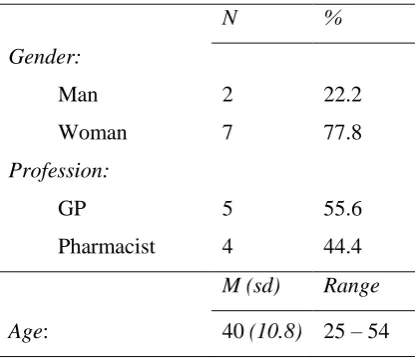
[image:25.595.72.280.580.759.2]The questionnaire for GPs and pharmacists has been filled in by 5 GPs and 4 pharmacists, with a mean age of 40 years old (see Table 10).
Table 10: Characteristics of questionnaire population
N %
Gender:
Man 2 22.2
Woman 7 77.8
Profession:
GP 5 55.6
Pharmacist 4 44.4
M (sd) Range
Age: 40 (10.8) 25 – 54
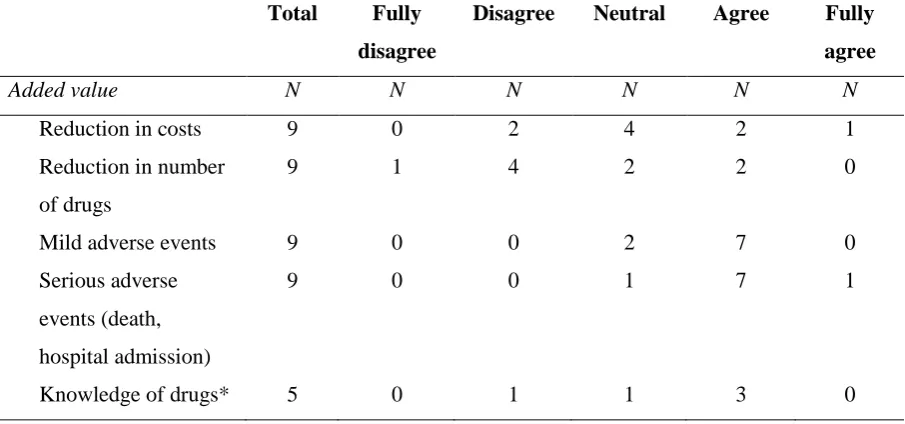
The opinions about whether medication reviews offer added value to the following topics: ‘reduction in costs’, ‘reduction in number of drugs’, and ‘extra knowledge of drugs for GPs’ differ greatly (see Table 11). In general, the GPs and pharmacists think that performing medication reviews offers added value to less adverse events, both mild and serious. Two respondents are neutral towards ‘mild adverse events’, and one respondent is neutral towards ‘serious adverse events’, but no one disagrees.
20
investment time causes a burden when looking at their workload. Pharmacists think that the investment time takes a little bit more effort
[image:26.595.72.525.159.371.2]than GPs, namely a mean of 4.8 and 4.0 respectively, with 0.0 as lowest rate, and 5.0 as highest rate (see Table 12).
Table 11: Added value of medication reviews to different topics
Total Fully
disagree
Disagree Neutral Agree Fully
agree
Added value N N N N N N
Reduction in costs 9 0 2 4 2 1
Reduction in number of drugs
9 1 4 2 2 0
Mild adverse events 9 0 0 2 7 0
Serious adverse events (death, hospital admission)
9 0 0 1 7 1
Knowledge of drugs* 5 0 1 1 3 0
* Only GPs filled in this sub-question
Table 12: Investment time and workload of medication reviews (mean, sd, and range)
N M Sd Range
Investment time (in minutes)
General practitioner 5 21.0 8.9 10 – 30
Pharmacist 4 105.0 17.3 90 – 120
Workload (range: 1 totally no burden – 5 causes a burden)
General practitioner 5 4.0 0.0 4 – 4
Pharmacist 4 4.8 0.5 4 – 5
Sometimes according to a guideline, a patient has to quit or start a drug to improve his/her health status, but that change has not being implemented. The most indicated reason for not adhering to the guidelines, according to GPs and pharmacists (shown in Table 13) is that a patient wants to stick to his/her drugs and does not want to undergo a change. The majority of the respondents that indicated this reason, indicates
[image:26.595.75.522.412.565.2]21 sometimes a patient receives treatment by a
specialist and according to the prescription of the specialist the change has not to be implemented. Two other respondents said that sometimes a patient does not fit to the guideline, due to age and comorbidity, causing to choose for something different than the guideline. The remained respondent said that sometimes the GP does not want to change.
The GPs and pharmacists had the space to give other, not mentioned, pros and cons of medication reviews, and to give suggestions for improving the STRIP method. Seven out of nine respondents gave one or more pro, con or both, and three respondents gave suggestions, shown in Table 14. The most important advantages of performing medication review are that (1) they have “better contact with the patients”, they get to know each other better; (2) patients comply better with the prescriptions, “they are dealing their drugs more consciously”, because they
[image:27.595.71.526.520.770.2]know that their GP and pharmacist are actively looking at their medication list and health status; and (3) patients are more satisfied with the care they receive and with the collaboration between their GP and pharmacist, this collaboration also gets better due to the medication reviews. Examples of mentioned disadvantages of medication reviews are (1) the STRIP method is time-consuming, when the STRIP method becomes less comprehensive and simpler the time-burden reduces; (2) the GP and pharmacist have to “constantly make considerations between adhering to the guideline or not because of the age/comorbidities of the patient, there are regularly different particularities”; and (3) there are more complaints with generic or cheaper drugs, which causes extra work for the patient and GP, and makes the patients more restless. So, it is better to not switch always to those generic or cheaper drugs.
Table 13: Reasons and their occurrence rates for not adhering to the guidelines according to GPs and pharmacists
True or not true If true, what is the occurrence
True Not true Sometimes
(1 – 49%)
Often (50 – 80%)
Very often (> 80%)
N N N N N
Patient does not want to change
8 1 6 2 0
GP thinks that patient does not want to change
3 6 2 1 0
Previous experience with the change, without good outcomes
3 6 2 0 1
Medical exceptions 1 8 0 0 1
22
Table 14: Pros and cons of medication reviews, and suggestions for improving the STRIP method
Pros medication reviews N Cons medication reviews N Suggestions STRIP method N Better contact with patients 2 Time-consuming 1 Simplification of STRIP
method, so that it becomes less comprehensive and time-consuming
1
Better compliance 2 Constant considerations
between guidelines and age/comorbidity
1 Permission for performing
medication review
between patient and pharmacist is lacking in STRIP method
1
Patients more satisfied with
care delivery and
collaboration
GP-pharmacist
2 More complaints with generics or cheaper drugs
1 Do not switch a lot to generics or other cheaper drugs, because mostly it gives complaints and it generates extra work
1
Better collaboration
between GP-pharmacist
1 Some GPs are conservative
towards medication
reviews
1
Better insight into the contra-indication ‘renal impairment’
1 Insufficient reimbursement 1
Discussion
Interpretation of striking results
This effect-analysis aimed to assess the effects of medication reviews on the prescription policy in polypharmacy patients. The overall findings suggest that medication reviews have a positive influence on the decrease in number of drugs, and in number of potentially inappropriate drugs that patients use. The drug groups ‘alimentary tract and metabolism’ and ‘cardiovascular system’ consist of the leading types of drugs that undergo changes due to the medication reviews. In overall, there were more
elderly that stopped one or more drugs than elderly that were prescribed one or more additional drugs.
23 investment time too much, taking in
consideration the workload they already have.
Although there were more drugs stopped than added, which is confirmed by two other Dutch studies (Chau et al., 2016; Balen et al., 2013), the average decrease between before and after the review was still very small. Lenaghan et al. (2007) and Jódar-Sánchez et al. (2015) also showed an average reduction of less than one drug per patient, which confirms this result. There is a chance that the chosen pharmacies and the corresponding general practices already pay much attention to the medication of the patients, because a convenience sample is used, and not a random sample of the Netherlands. Which results in a small difference between before and after the review. However, the ultimate goal of medication reviews is not to reduce the number of drugs, but to improve the medication lists when needed, so that the drug use will be safer, i.e. less PIDs are prescribed. We observed a significant decrease in PIDs from 0.6 per patient to 0.4 per patient, both one week and three months after the medication review. Although this is on average a small difference, it is meaningful on the individual level. The number of PIDs decreased in some patients with two drugs, which can make a huge difference in the health status of a patient.
Possible explanations for the small decreases in means are that in some cases drugs were not stopped, while the guideline indicate stopping. It seems as if the STOPP criteria are not used well, or the GPs and pharmacists do not adhere to those criteria. However, for some specific patients there are other reasons why it is better
to keep using a drug, and to ignore the guidelines, and some patients refused to stop a drug. Chau et al. (2016) gave reasons for this phenomenon. The most frequent reasons were: the specialist rejected the intervention; the patient did not want to stop the drug; and sometimes is decided to monitor the use of the drug by the patient and to intervene when really needed. All those reasons are found in this study as well. Besides those reasons, we also found two other reasons that occurred relatively frequent: the health status of patients is too bad to stop the drug, so the negative consequences of continuing the drug are taken for granted; and patients tried to stop a drug before and experienced negative effects of stopping the drug, so they keep using it.
24
cardiovascular drugs were the most deprescribed drugs. (Balen et al., 2013) Possible explanations for these differences are first, antieleptics are typically being prescribed to patients with epilepsy. When this is the case, the drug will not be stopped frequently. Second, when antieleptics are being prescribed as painkillers, the chance of stopping this drug is higher, however, this is still a very small group of patients in the Netherlands. Third, psychoanaleptics are not frequently being prescribed for elderly in the Netherlands. There is only a very small group of elderly that uses psychoanaleptics.
Finally, looking at the effect of medication reviews on the dose modifications, it can be concluded that there were more dose reductions compared with dose increases. However, the difference was very small. One week after the medication reviews, 52.5% of the dose modifications were reductions, and three months after the reviews, 53.8% were reductions. So, the number of dose reductions and the number of dose increases are almost equal. Balen et al. (2013) also showed an almost equal number between dose reductions and dose increases. In their study, 57.7% of the dose modifications were reductions, which confirms the result found in this study.
Study limitations
This study presents some limitations. First, the underlying limitation that come with a pre-test/post-test study design is that there is no control group. A disadvantage of this absence is that the natural course of the patients’ situation is unknown. For example, sometimes a drug is
added, because the patient has other complaints that were not present when the medication review is executed. It is not completely sure whether this is only due to the medication review. Especially in case of three months after the review, the researcher can never be sure whether the health of the patient has deteriorated or whether something is neglected during the medication review. However, it is assumed that this will not have a strong influence on the outcomes of three months after the review, because the differences between one week and three months after the review are very small.
Second, it is not always written down and known for the researcher when a patient does not want to undergo any changes. When the pharmacist or GP wrote this on paper of in the patient’s file, it is known. But otherwise, qualitative research is needed with interviews to figure this out per patient. So, a limitation of this study is that a special case (i.e. a patient does not want to undergo any changes) is only known when the GP or pharmacist registered this.
Third, the GPs’ and pharmacists’ notes that are used in this study for identifying reasons why some PIDs were not stopped during the medication review, are not the only possible reasons. These are the only known reasons, because they are registered. Besides this, the occurrence rate of all those given reasons could be higher than shown in the results, but only these rates are known.
25 but only 126 patients are included in this study.
However, those 126 patients already showed a significant effect. So, probably it would not have made a difference in the effects if there were 30 more patients included.
Finally, for identifying the experiences about performing medication reviews and wishes for improvements of the performance, short online questionnaires are used. The limitation with questionnaires is that the researcher cannot respond to the given answers. There is no depth like someone can create during an interview. Sometimes it is better when the respondent can clarify his/her answer, so that the meaning of the answer is known better. Which could be helpful in this study. Especially, because the workload of the respondents is already high, they maybe do not want to spend much time on giving comprehensive answers. For example, the open question in the questionnaire where is being asked what the pros and cons are of medication reviews according to them, is answered with short answers. When there is an interview, the interviewer can create depth by asking what the respondent means with that answer, so that more interpretable results can be found. However, we still decided to use online questionnaire because of limited time and hopefully getting a higher response rate, because the questionnaires could be filled whenever they wanted without making an appointment.
Study strength
Despite these limitations, this study is still very important. It adds to the limited and contradictory international literature. For the
Netherlands there was little evidence about the effect of the medication review, this study contributes to more evidence. It is the first Dutch study that looked at the effects of medication review in terms of difference in number of drugs, difference in number of PIDs, number of medication adaptations, most frequently added/stopped drugs, most frequently drugs with dose modifications, and opinions of GPs and pharmacists about medication reviews.
Conclusion
It can be concluded that performing medication reviews in polypharmacy patients is sometimes, despite the enormous workload they bring with it, useful to continue. In the short-term, and also in the long-term, medication reviews have a positive influence on the prescription policy. One shortcoming of the way the medication reviews are being performed now, is that sometimes, after the medication list of the patient has been assessed, that patient does not want to undergo changes. It will be better if the pharmacists tell the patients precisely what the intention of performing a medication review is, and ask whether they are open minded for changes. When patients do not want to have any changes, it is only a waste of time to review their medication list. When only the medication lists of patients that are open for changes are being reviewed, the medication review will have more effect.
26
out of this scope. Therefore, further study is needed in which the quality of life of patients before and after the review will be assessed.
References
Baarda, B., Dijkum, C. van & Goede, M. de. (2014).
Basisboek. Statistiek met SPSS. Groningen:
Noordhoff Uitgevers.
Balen, J. van, Damen-van Beek, Z., Nelissen-Vrancken,
M. & Verduijn, M. (2013). Eindverslag
implementatie- en evaluatieproject polyfarmacie bij
ouderen. Retrieved 20 February 2016, from
<<https://www.nhg.org/sites/default/files/content/nhg
_org/uploads/2013-12-19_rap_polyfarmacie_zonmw_20131210_printversie.
pdf>>.
Bemt, P.M.L.A. Van den, Egberts, A.C.G. & Leenderste,
A.J. (2006). Hospital admissions related to medication
(HARM): een prospectief, multicenter onderzoek naar
geneesmiddel gerelateerde ziekenhuisopnames.
Utrecht: Division of Pharmacoepidemiology &
Pharmacotherapy, Utrecht Institute for Pharmaceutical
Sciences.
Berdot, S., Bertrand, M., Dartigues, J.-F., Fourrier, A.,
Tavernier, B., Ritchie, K. & Alpérovitch, A. (2009).
Inappropriate medication use and risk of falls – A
prospective study in a large community-dwelling
elderly cohort. BMC Geriatrics, 9(1), 30.
Bouter, L.M., Dongen, M.C.J.M. van & Zielhuis, G.A.
(2010). Epidemiologisch onderzoek. Houten: Bohn
Stafleu van Loghum.
Burgers, J.S. (2004). Cultuur en context in richtlijnen: Een
analyse van international verschillen tussen
richtlijnen. Huisarts en Wetenschap, 47(6), 283-287.
Centrale Commissie Mensgebonden Onderzoek [CCMO].
(z.d.). Uw onderzoek: WMO-plichtig of niet. Retrieved
5 March 2016, from <<
http://www.ccmo.nl/nl/uw-onderzoek-wmo-plichtig-of-niet >>.
Chau, S.H., Jansen, A.P.D., Ven, P.M. van de, Hoogland,
P., Elders, P.J.M. & Hugtenburg, J.G. (2016). Clinical
medication reviews in elderly patients with
polypharmacy: a cross-sectional study on drug-related
problems in the Netherlands. International Journal of
Clinical Pharmacy, 38, 46-53.
Christensen, M. & Lundh, A. (2013). Medication review
in hospitalised patients to reduce morbidity and
mortality. Cochrane database of systematic reviews
(Online), 2, CD008986.
Cooper, J.A., Cadogan, C.A., Patterson, S.M., Kerse, N.,
Bradley, M.C., Ryan, C. & Hughes, C.M. (2015).
Interventions to improve the appropriate use of
polypharmacy in older people: a Cochrane systematic
review. British Medical Journal Open, 5(12),
e009235.
Dijk, C. van, Verheij, R. & Schellevis, F. (2009).
Huisartsenzorg in cijfers: polyfarmacie bij ouderen.
Huisarts en Wetenschap , 52(7), 315-316.
Drenth-van Maanen, A.C., Leendertse, A.J., Marum, R.J.
van, Egberts, A.C.G. & Jansen, P.A.F. (2012).
Polyfarmacie bij ouderen: Wat gaat er mis en hoe kan
het beter? Tijdschrift voor Ouderengeneeskunde, 3,
114-119.
Frank, C. & Weir, E. (2014). Deprescribing for older
patients (review). Canadian Medical Association
Journal, 186(18), 1369-1376.
Geurts, M.M.E., Stewart, R.E., Brouwers, J.R.B.J., Graeff,
P.A. de & Gier, J.J. de. (2015). Patient beliefs about
medicines and quality of life after a clinical medication
review and follow-up by a pharmaceutical care plan:
A study in elderly polypharmacy patients with a
cardiovascular disorder. Journal of Pharmaceutical
Health Services Research, 6(4), 171-176.
Hurkens, K.P.G.M., Wit, H.A.J.M. de, Gonzalvo, C.M.,
Kuy, P.H.M. van der, Janknegt, R., Verhey, F., Schols,
J.M.G.A. & Mulder, W. (2012).
Medicatiemanagement bij de oudere patiënt: De
ontwikkeling van SCREEN. Tijdschrift voor
Ouderengeneeskunde, 37(3), 121-125.
Inspectie voor de Gezondheidszorg [IGZ]. (2010).
Medicatieveiligheid voor kwetsbare groepen in de
langdurige zorg en zorg thuis onvoldoende:
Verpleeghuizen en verzorgingshuizen moeten nog
punten verbeteren; gehandicaptenzorg en thuiszorg
moeten snel veiliger. Retrieved 15 February 2016,
from
<<http://www.igz.nl/Images/2010-09%20Rapport%20%20Medicatieveiligheid%20voor
27
Jódar-Sánchez, F., Malet-Larrea, A., Martín, J.J.,
García-Mochón, L., López del Amo, M.P.,
Martínez-Martínez, F., Gastelurrutia-Garralda, M.A.,
García-Cárdenas, V., Sabater-Hernández D., Sáez-Benito, L.
& Benrimoj, S.I. (2015). Cost-utility analysis of a
medication review with follow up service for older
adults with polypharmacy in community pharmacies
in Spain: The conSIGUE Program.
PharmacoEconomics, 33(6), 599-610.
Lambregtse, C. (2014). LHV wil criteria voor gefaseerde
invoering: IGZ gaat handhaven op richtlijn
Polyfarmacie. LHV De Dokter, 5(7), 32-33.
Leendertse, A.J., Drenth-van Maanen, A.C., Verduijn,
M.M., Jansen, P.A.F. & Marum, R.J. van. (2012).
Bijlage 1: Voorbeeld gestructureerde
medicatie-beoordeling.
Leendertse, A.J., Egberts, A.C.G., Stoker, L.J. & Bemt,
P.M.L.A. van den. (2008). Frequency of and risk
factors for preventable medication-related hospital
admissions in the Netherlands. Archives of internal
medicine, 168(17), 1890-1896.
Leendertse, A.J., Koning, G.H.P. de, Goudswaard, A.N.,
Belitser, S.V., Verhoef, M., Gier, H.J. de, Egberts,
A.C.G., Bemt, P.M.L.A. van den. (2013). Preventing
hospital admissions by reviewing medication
(PHARM) in primary care: An open controlled study
in an elderly population. Journal of Clinical Pharmacy
and Therapeutics, 38(5), 379-387.
Lenaghan, E., Holland, R. & Brooks, A. (2007).
Home-based medication review in a high risk elderly
population in primary care – The POLYMED
randomised controlled trial. Age and Ageing, 36(3),
292-297.
Leon, C., Gerretsen, P., Uchida, H., Suzuki, T., Rajji, T. &
Mamo, D.C. (2010). Sensitivity to antipsychotic drugs
in older adults. Current Psychiatry Reports, 12(1),
28-33.
Mudge, A., Radnedge, K., Kasper, K., Mullins, R., Adsett,
J., Rofail, S., Lloyd, S. & Barras, M. (2016). Effects of
a pilot multidisciplinary clinic for frequent attending
elderly patients on deprescribing. Australian Health
Review, 40(1), 86-91.
Nederlands Huisartsen Genootschap [NHG]. (2012). Multidisciplinaire richtlijn ‘Polyfarmacie bij
ouderen’. Retrieved 16 February 2016, from
<<https://www.nhg.org/sites/default/files/content/nhg
_org/uploads/polyfarmacie_bij_ouderen.pdf>>.
Olsson, I.N., Runnamo, R. & Engfeldt, P. (2011).
Medication quality and quality of life in the elderly, a
cohort study. Health and quality of life outcomes, 9,
95.
Passarelli, M.C., Jacob-Filho, W. & Figueras, A. (2005).
Adverse drug reactions in an elderly hospitalised
population: inappropriate prescription is a leading
cause. Drugs and Aging, 22, 767-777.
Rijksinstituut voor Volksgezondheid en Milieu [RIVM].
(2013). Polyfarmacie bij kwetsbare ouderen: Inventarisatie van risico’s en mogelijke
interventiestrategieën. Retrieved 15 February 2016,
from
<<http://www.ephor.nl/media/1158/rivm-
rapport-polyfarmacie-bij-kwetsbare-ouderen-2013.pdf >>.
Rogers, S., Wilson, D., Wan, S., Griffin, M., Rai, G. &
Farrell, J. (2009). Medication-related admission in
older people: A cross-sectional, observational study.
Drugs and Aging, 26(11), 951-961.
Roth, M.T., Ivey, J.L., Esserman, D.A., Crisp, G., Kurz, J.
& Weinberger, M. (2013). Individualized medication
assessment and planning: optimizing medication use
in older adults in the primary care setting.
Pharmacotherapy, 33(8), 788-797.
Roughead, E.E. & Semple, S.J. (2009). Medication safety
in acute care in Australia: Where are we now? Part 1:
A review of the extent and causes of medication
problems 2002-2008. Australia and New Zealand
Health Policy, 6(1), 18.
Twisk, J.W.R. (2014). Inleiding in de toegepaste
biostatistiek. Amsterdam: Reed Business Education.
Vinks, T.H., Egberts, T.C., Lange, T.M. de, Koning, F.H.
de. (2009). Pharmacist-based medication review
reduces potential drug-related problems in the elderly:
the SMOG controlled trial. Drugs and Aging, 26(2),
123-133.
World Health Organization [WHO] Collaborating Centre
for Drug Statistics Methodology. (2009). Purpose of
the ATC/DDD system. Retrieved 21 April 2016, from
<<http://www.whocc.no/atc_ddd_methodology/purpo