John N. Ring. Implementation of Information Technology Infrastructure Library (ITIL)-Informed Change Management Processes in the State of North Carolina: An Exploratory Study. A Master’s Paper for the M.S. in I.S degree. July, 2013. 57 pages. Advisor: Christopher A. Lee
Information Technology Infrastructure Library (ITIL) is a popular information
technology (IT) process standard that has been adopted across private and public sectors with literature detailing a variety of critical success factors. This exploratory study examined the implementation of ITIL-informed processes for IT change management within the State of North Carolina in terms of what step-by-step processes result from ITIL implementation in the context of critical success factors. ITIL implementation is shown to create more complex processes within the state, and the key critical success factor reported is shown to be ITIL training and the communication it facilitates. Practical implications of the findings for professionals are discussed and visual diagrams display the change management processes outlined.
Headings:
IMPLEMENTATION OF INFORMATION TECHNOLOGY INFRASTRUCTURE LIBRARY (ITIL)-INFORMED CHANGE MANAGEMENT PROCESSES IN THE
STATE OF NORTH CAROLINA: AN EXPLORATORY STUDY
by John N. Ring
A Master’s paper submitted to the faculty of the School of Information and Library Science of the University of North Carolina at Chapel Hill
in partial fulfillment of the requirements for the degree of Master of Science in
Information Science.
Chapel Hill, North Carolina July 2013
Approved by
Information technology services, as they mature, have given rise to a coherent field of Information Technology Service Management (ITSM) that aligns information technology with business processes. Information Technology Infrastructure Library, (ITIL) is one of the most popular set of guidelines to inform the transformation of
existing IT service processes for organizations in both the public and private sectors, with maturing implementations across the globe and a steady evolution through three versions from its initial publication. However, rising knowledge about ITIL and still-flourishing implementation of ITIL informed processes coexists with continued uncertainty about both ITIL’s practical meaning for organizations and its effectiveness.12
Disciplines studying information systems continue to fill the gaps between practical implementation on one hand, and practical processes on the other. Successful implementation, in the terms of ITSM, must result not only in real benefits to the organization in terms of efficiency and effectiveness, but in IT service processes that are both suited to an
organization’s business and flexible enough to adapt to changing technology and resource
availability without demanding constant overhaul. Thus, the real processes that ITIL
1
Pollard, C., & Cater-Steel, A. (2009). Justifications, strategies, and critical success factors in successful ITIL implementations in U.S. and Australian companies: An exploratory study. Information Systems Management, 26(2), 164-175.
2
creates are the fruits of the labor of ITIL implementation, and one should consider the two in tandem.
This exploratory study focuses on two experiences during the eight-year-old, still-maturing ITIL-guided service transformation in the State of North Carolina. First, ITIL will be described generally and the ITIL guidelines for one process, change management, will be fleshed out. A review of the literature on ITIL implementation will demonstrate a still small but quickly growing field of work on challenges and critical success factors for ITIL implementation, and suggests that this work should be aligned to examples of real, ITIL-guided practices in an organization. The study has demonstrated the result of critical success factors in the transformation of processes during an overall IT consolidation under a policy mandate to conserve resources in IT in the State, and
compares a department where consolidation has already begun with one that has yet to be consolidated, using the early implementation of ITIL-guided change management
processes in the former to the yet-to-be-transformed change management processes in the latter. The study has investigated the real processes that result from ITIL implementation in change management within the state, with critical success factors during
What is ITIL® Change Management?
Information Technology Infrastructure Library (ITIL) is a popular information technology (IT) process standard originally developed in 1987 for use in United Kingdom government agencies by the U.K.’s Central Computer and Telecommunications Agency
(CCTA).3 ITIL is now maintained as a series of “best practices” documents by the Office of Government and Commerce, with an official user organization, itSMF USA, dedicated to promoting and advancing best practices in IT service management (ITSM).4 ITIL has advanced through versions: its original incarnation, version 2, version 3, and ITIL 2011. Version 2 focused primarily on processes, while Volume 3 augmented this with a perspective on business value.5 In 2004, 30 percent of global companies had adopted ITIL, with expectations that 60 percent would have adopted ITIL-informed practices by 2008.6
ITIL’s best practices, contained in a series of ITIL books maintained by itSMF,
follow a process model-based view of controlling and managing IT operations, describing a continuous lifestyle of processes to organize and improve IT services aligned with business processes.7 ITIL's guidelines describe implementation for IT service
management (ITSM) - simply put, this means that information systems are handled as a service for clients, even when the “clients” are within the same public or private
3
Harris, Michael D. S., David E. Herron, Stasia Iwanicki (2008). The business value of IT:: managing risks, optimizing performance, and measuring results. Boca Raton, FL:: CRC Press.
4
Harris (2008), 83. 5
Harris (2008), 83. 6
Harris (2008), 82. 7
organization as the provider of services.8 ITSM (and ITIL version 2) thus focus on
processes which define the client-customer relationship for a given IT service; ITIL version 3 extends this focus to deliverables expected by the customer. ITIL further distinguishes customers who fund and commission IT services from users who use the services on a day-to-day basis, and categorizes processes based on this distinction.9
Processes primarily concerned with users include (among others) change management, which ensures that changes to the IT system (hardware, software, databases, etc.) are “evaluated, approved, controlled, tracked and implemented safely without side effects to the quality of the service itself,” including segregation of duties,
rollback procedures, and other measures.10 In layman's terms, change management is a process that, if implemented correctly, allows for changes to information technology (hardware, software, etc.) that minimize disruption of business (the work of users) that depends on what is being changed. 11
ITIL-informed Change Management
Change management under ITIL has three main purposes: “to ensure that
standardized methods are used for the efficient and prompt handling of all changes, that all changes are recorded in the Configuration Management System and that overall
8
Pollard & Steel (2009). 9
Tiong, Chee Ing, Aileen Cater Steel, Wui-Gee Tan (2009). Measuring return on investment from implementing ITIL:: a review of the literature. In Cater-Steel, Aileen (Ed.) (2009), Information technology governance and service management:: frameworks and adaptations. Hershey, PA:: Information Science Reference.
10
Tiong (2009). 11
business risk is optimized.”12
ITIL places change management under the heading of service transition, or putting new processes into operational use.13 Implementation requires not just putting an application into play for 'normal' use, but also addressing issues of unusual or negative impact, specifically important for change management. Change management will often be facilitated through a reporting system that retains audit-ready records of approvals and other aspects of implementation. This usually means software that allows authorized IT personnel and managers to report and track information about the change at every step: proposal, approval, implementation, and the means by which controls are satisfied, creating a record that may be reviewed and audited as necessary to analyze both the change and the process.
Here a hypothetical example will be illustrative: a series of “incidents” of
disruption to a business process from a software bug might be reported upward to
information technology specialists who provide IT services to a public sector department, through an incident reporting system (software and corresponding processes that create a ticket for each incident). While each of these incidents will generally have its own process and report under a process of incident management, solid ITSM processes will identify when and where a change to IT might alleviate the problem. When such a change to information technology is identified by IT providers – in this case, perhaps an
enterprise-wide software update – the change management process begins.
The proposed change is submitted as a Request for Change (RFC) evaluated by a change management “owner” (person with responsibility for the process) who uses
12
Cartlidge, A., Hanna, A., Rudd, C., MacFarlane, I., Windebank, J. and Rance, S. (2007). An Introductory Overview of ITIL® V3. itSMF Ltd., London: UK, 25. 13
information provided by the person(s) proposing the change. An approval process can help to ensure buy-in from key stakeholders, as authorized by customers (in the public sector, usually by legislation and policies from executive-branch offices), and by all IT personnel identified in the process as necessary to approve a RFC. As this process uncovers possible effects of the change on impacted systems through a standard and repeatable process of inquiry for each change and requires approval by those with
detailed knowledge of impacted systems, it works to prevent potential security or stability problems during or after the change: those with knowledge of the systems to be impacted can discover potential security or stability problems before they occur, using their prior knowledge, and communicate any problems they foresee to the Change Advisory Board so they may be addressed before the change can be put into production. Usually, the RFC will be reviewed in a weekly meeting by a Change Advisory Board (CAB). Which CAB reviews the RFC depends on its potential effects, scope, risks and urgency, with “urgent” CABs meetings as needed for changes that must be implemented quickly and regular CAB meetings discussing and approving most RFCs. Emergency changes may be implemented immediately as needed – albeit only for RFCs needed to prevent key business processes from being interrupted – and then brought to a CAB for discussion and approval in the following week.
If it is not such an emergency, the change itself will not be immediately
for a weekend period when users will not require access to the system. Other controls include rollback procedures: effective change management will require that every RFC identifies, if possible, how to return the IT system to its previous state if the change proves to be disruptive or otherwise unneeded – here, rollback procedures reported for the change might include how to return the software to a previous version. Changes must also be tested in a controlled environment before full implementation to optimize risk when fully implemented.
Challenges in Implementation and Critical Success Factors
Implementation of new, service-oriented processes, like any large project, requires a sufficient (and ongoing) allocation of resources and may encounter
organizational resistance.14 Success at even partial ITIL implementation in case studies has involved heavy investment in both formal training and spreading awareness of ITIL within the organization.15 The involvement of outside consultants can cause friction between consultants and new processes on one hand, and internal personnel and the existing practice for processes on the other - one private sector organization in a previous study reported that consultants’ “heavy-handed” approach, necessary to ensure proper implementation, led to their identification as “hated” and even “process Nazis” among
staff.16 Challenges persist throughout the ongoing project of implementing new
14
Cater-Steel (2006). 15
Pollard (2009). 16
processes; such comprehensive projects may be in danger of dying out at any point without commitment by managers at different levels.17
The implementation of service-oriented processes carries additional challenges because it usually requires that transition to new processes be carried out while IT offices and departments continue to provide previously-expected levels of service to a number of customers that stays the same or even grows during implementation. ITIL best practices are linked to business-oriented Key Performance Indicators (KPIs) that may be different than internal metrics used by IT departments. Thus, they may require comprehensive changes to existing processes in order to provide both services and metrics to measure them, including the introduction of new software tools and new workflows so that, for instance, change management processes keep track of changes, their proper approval and testing, rollback procedures, success and failure rates, and other parts of repeatable and traceable processes through ticketing systems.
Personnel responsible for these processes may feel that the new procedures, as well as their implementation, interfere with the service they are currently providing; logging and documenting calls and tickets through service-oriented processes may be seen as barriers to efficiency.18 Standardization of processes may disrupt existing
personal relationships between IT service delivery personnel and customers who are used to communicating with each other directly without the involvement of other processes,
17
Iden, J., & Langeland, L. (2010). Setting the stage for a successful ITIL adoption: A Delphi study of IT experts in the Norwegian armed forces. Information Systems Management, 27(2), 103-112.
18
and for that reason result in a temporary drop in customer satisfaction.19 Even with well-defined processes, success in implementation may be circumvented by employees who choose not to follow the new processes of their own accord.20 The challenge is not just to create processes and ensure proper recordkeeping but to effect changes to the culture of an organization that will result in long-lasting changes to the processes supported by that culture and keep them in place.21
Implementation of ITIL practices is an iterative process that must adapt as needed if processes for implementation are ineffective or if the ground shifts underneath
implementation, while also remaining grounded and connected to key stakeholders in the process including both customers and those delivering services. Challenges to these foundations include the policy-driven nature of public sector implementations. A case study of a British government agency implementing new IT and business processes using ITIL best practices concluded that, due to shifting policy objectives external to the organization being established, key original objectives such as electronic data-gathering were “so compromised that the emerging picture was almost diametrically opposed to the
vision and indeed to some of the precepts on which elements of the system design had been based,”22
a stark warning of the perils of challenges and risks that may be overlooked at the start of implementation.
19
Hochstein, A., & Brenner, W. (2006). Implementation of service-oriented IT
management: An empirical study on Swiss IT organizations. Paper presented at the 2006 International Conference on Service Systems and Service Management, 91-97.
20
Iden, J. (2009). Implementing IT Service Management. Lessons from a University IT Department. In A. Cater-Steel (Ed.), Information Technology Governance and Service Management: Frameworks and Adaptations. Hershey, PA: IGI Global.
21
Pollard (2009), Iden (2010). 22
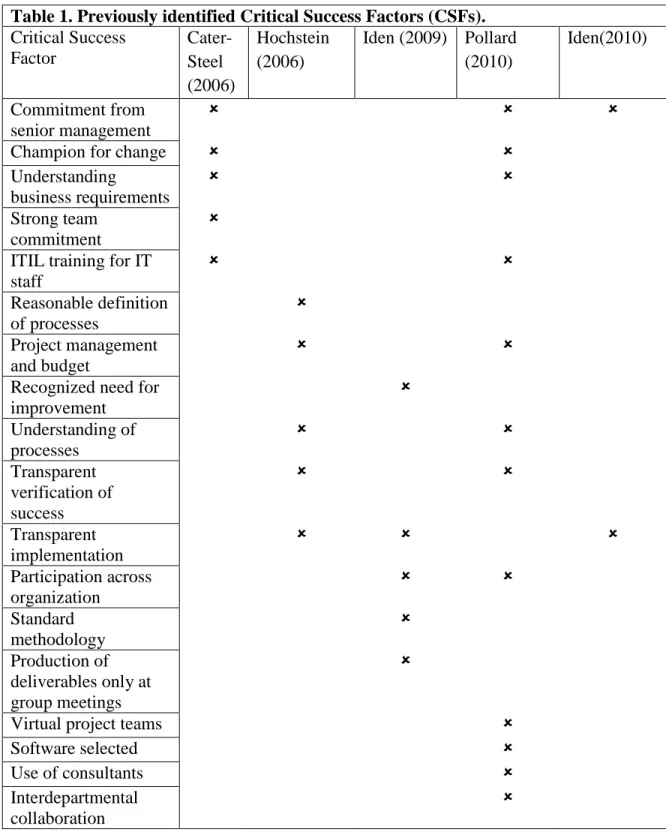
Critical success factors work as the counterbalance to potential challenges that organizations may face. Successful implementation of service-oriented information technology management generally, and implementation of ITIL best practices specifically, depends on a number of factors previously identified in the literature regarding ITIL implementation, which is still small but continues to grow as ITIL implementations outside of ITIL’s ‘home turf’ in the United Kingdom’s government
begin to mature. A 2005 survey of IT-related personnel from organizations from Australian and New Zealand implementing ITIL identified reported success factors: a strong commitment from senior management; an active “champion” for ITIL processes
within the organization; an understanding of business requirements; a strong commitment by an implementation team, and ITIL training provided to IT staff.23 A study of Swiss IT directors and departments identified success factors for implementation of service-oriented IT management as: a definition of IT management processes reasonable for that organization; management attention and acceptance; high-quality project management combined with an adequate budget; good understanding of processes by staff; and transparent verification and tracing of success within the project.24 A longitudinal study of an IT department in an academic setting implementing service-oriented IT
management identified as success factors: a strong recognition beforehand of a need for improving processes; a transparent process of implementation; training and expertise;
Retrieved May 25, 2013 from
http://web.archive.org/web/20100215141050/http://www.ogc.gov.uk/documents/RuralPa ymentsCaseStudyFull.pdf .
23
Cater-Steel (2006). 24
Hochstein, A., & Brenner, W. (2006). Implementation of service-oriented IT management: An empirical study on Swiss IT organizations. Paper presented at the
participation across the organization; a methodology that is both standard and flexible for process change; and the production of deliverables only at group meetings where they could be reviewed and understood by stakeholders.25
On the basis of this work, further success factors have been discovered for service-oriented process implementations that specifically apply to ITIL implementation within the public sector. Four in-depth case studies within both public and private sectors in Australia and the U.S. uncovered additional success factors for ITIL implementation: the use of virtual project teams; careful selection of software to handle processes; use of consultants; interdepartmental communication and collaboration; focus on business processes first before tools are selected and implemented; and metrics that reported success of processes in terms that would be important and understandable to customers (rather than in terms of the implementation of technical solutions).26 Surveys of IT
experts in the Norwegian armed forces regarding success factors for ITIL implementation ranked top choices including: ownership of implementation and decision to implement carried out by senior management; the identification and participation of key personnel; starting with and prioritizing a few ITIL processes where there are opportunities for quick success; and up-front transparency for trained personnel and customers alike about what ITIL is and why it is being implemented.27
25
Iden, J. (2009). Implementing IT Service Management. Lessons from a University IT Department. In A. Cater-Steel (Ed.), Information Technology Governance and Service Management: Frameworks and Adaptations. Hershey, PA: IGI Global.
26
Pollard (2009).. 27
Table 1. Previously identified Critical Success Factors (CSFs). Critical Success Factor Cater-Steel (2006) Hochstein (2006)
Iden (2009) Pollard (2010)
Iden(2010)
Commitment from senior management
Champion for change
Understanding business requirements Strong team commitment
ITIL training for IT staff Reasonable definition of processes Project management and budget
Recognized need for improvement Understanding of processes Transparent verification of success Transparent implementation Participation across organization Standard methodology Production of deliverables only at group meetings
Virtual project teams
Software selected
Use of consultants
Interdepartmental collaboration
Table 1. Previously identified Critical Success Factors (CSFs). (cntd.) Critical Success Factor Cater-Steel (2006) Hochstein (2006)
Iden (2009) Pollard (2010)
Iden(2010)
First focus on business processes
Metrics for customers
Identifying key personnel Prioritizing potential “quick wins”
Many of these success factors can be grouped based on common traits. The
leadership of management at the highest level, such as the chief information officer, from the very beginning of the process has been repeatedly identified as a success factor for implementing service-oriented changes to processes.28 The support of management is necessary to exert pressure to change existing processes and sustain implementation.29 Top-level management provides not just a leadership role but also a perspective
concerned with the potential for long-term benefits; this perspective is necessary for such an organization-wide shift in processes and culture.30 Strong leadership by management may serve to mitigate the lack of other identified success factors: in one organization studied previously, risks related to continuity for ITIL implementation arose because of a lack of a project manager, but were “overcome . . . through very strong and explicit direction from senior management.”31
Comments by IT experts involved in ITIL implementation in the Norwegian public sector emphasized that committing resources
28
needed for successful implementation depended on a formal and binding decision by senior management to formalize the goals for the implementation and see it through.32 Overall, as reviewed above, those studied in the literature tended to identify
organizational success factors more often than technical aspects such as choice of software, and strong leadership by top management was among the most commonly identified factors.
Clear channels for communication is another grouping suggested by success factors that encompasses both communication within the organization and proper pedagogy, that is, the introduction of ITIL best practices through effective training that allows for the creation of concrete processes through shared language. The creation of intellectual capital, representing the knowledge and knowing capability of an
organization, depends on both shared knowledge and shared narratives33; strategic alignment about information systems within an organization depends on shared organizational understanding, which, in turn, depends on shared language.34 These findings suggest that factors such as education and clear communication between an organization’s departments cannot be wholly separated: communication happens
simultaneously with establishment of a baseline of shared knowledge and shared ways to discuss it, with each contributing to the other. A 2009 study showed that even as ITIL processes continue to mature, there is ongoing confusion as to the definition of IT
32
Iden (2010). 33
Nahapiet, J., & Ghoshal, S. (1998). Social capital, intellectual capital, and the organizational advantage. The Academy of Management Review, 23(2), 242-266. 34
services among IT systems managers.35 It is therefore unsurprising that broad training works in favor of ITSM framework implementation when combined with enforcing
personnel development through required training.36 Success can be attributed not just to clear communication of what IT service management processes are and what they will mean for future practice, but also to clear communication and transparency for how new processes will be implemented37, clear communication of the impetus for
transformation38, the transparent creation of work products in full view of those involved with them39 and ongoing communication between different departments and offices.40 The nature of ITIL as an iterative, cyclical process necessarily means that to realize the benefits of communication during the process, there cannot be a beginning or end to effective communication.
Research Design
Research question: How has ITIL-informed change management transformed IT
service processes within the case of the State of North Carolina in the context of
critical success factors for implementation?
35
Winniford, M., Conger, S., & Erickson-Harris, L. (2009). Confusion in the ranks: IT service management practice and terminology. Information Systems Management, 26(2), 153-163.
36
Hochstein (2006). 37
Iden (2010). 38
Ibid. 39
Iden (2009). 40
This case study of ITIL-informed service process implementation in the State of North Carolina sought to provide a concrete review of on-the-ground practices: the actual day-to-day service (business) processes that result from a structured implementation of ITIL best practices in a single process, described in detail and in the context of success factors for ITIL implementation. As reviewed above, much of the existing academic literature consists of studies of IT managers and others regarding what they perceive as success factors in ITIL implementation, with steady progress toward a refined common set of critical factors for success. There is less to be found that demonstrates business processes, step-by-step, that result from implementation of these best practices, comparing them to prior processes, while considering implementation critical success factors (CSFs) as the historical context for the transformation of those processes (as has been assumed in literature to date), especially in English-language literature. ITIL is not a prescriptive body by definition41 and thus implementation will best proceed along the lines and pace of existing business needs (and processes to be transformed), with varying needs resulting in varying implementation across different organizations. However, deep understanding of business processes still depends on the continuing codification of tacit or hidden knowledge into concrete understanding.42 Professional materials for training note that there is no such thing as “ITIL-compliant” because ITIL is not a set of rules,43
but this fact does not diminish the usefulness of practical investigation of what
41
Pollard (2009). 42
Chesbrough, H., Henry Chesbrough, & Jim Spohrer. (2006). A research manifesto for services science. Communications of the ACM, 49(7), 35.
43
Cling, Jim (2009). ITIL V3 and Information Security. Clinch Consulting (white paper). Retrieved June 25, 2013 from
informed processes organizations have wrought in the context of success factors. Replicable ITIL success in particular environments such as state governments may be aided by a combination approach that relates successful implementations in practice to the reported factors for success. Similarly, capturing a comparison of departments within the same larger organization that have mature ITIL-informed processes with those that have yet to implement those processes, but will do so in the context of the same training regime and under the same organization-wide plan, provides a ‘snapshot’ of this dynamic process.
This paper takes the executive-branch Department as its unit of study. The nature of ITIL implementation for business processes within the State’s government offices is
part of a multi-phase, gradual IT Consolidation Plan under a central CIO office with a legislative mandate, with progress broken down by transition to be completed for a set of specified departments and agencies in each phase. Seventeen departments and agencies are covered by previous or current phases, with the rest intended for future
implementation. Of these departments and agencies within the State, twelve were contacted seeking feedback based on the relative maturity of their processes in the Plan; four responded positively, all executive-branch agencies, with three responding within a window of time that allowed for inclusion within this study, including the State’s central IT office which plays a crucial part in implementation. A shifting policy environment due to recent elections may have complicated participation for many departments and
Change management was selected as the process to study because of its ubiquity as a goal for process transformation in even the earliest stages of ITIL implementation for many organizations found in the literature.44 Change management was also one of four ITIL-informed processes that were specifically outlined in the ITIL portion of the IT Consolidation Plan for the state.
Information was gathered by conducting interviews with IT managers in each department and office using semi-structured interviews to stimulate open discussion about change management process implementation and discover the day-to-day processes that were implemented. An interview with a former state official involved in the earliest stages of ITIL implementation regarding its genesis and high-level strategy within the State was also conducted. Potential participants were identified through online research and consultation with faculty at the University of North Carolina’s School of
Government, within the scope of IT managers and administrators who were involved with change management processes as “point persons” or who had been involved with ITIL implementation for those processes. Participants were contacted by phone or email using a script preapproved by a University of North Carolina Institutional Review Board (IRB) and consented to in-person or telephone interviews. All of the interviews except one were conducted one-on-one; the exception included the researcher and two IT office administrators in an in-person interview. Documents were either offered in print form by interview participants or retrieved from the Web sites of departments and offices; the State’s government maintains repositories of publicly available documents on its website.
Interview subjects were asked the following questions:
44
1) Were you working in your current role during any of the ITIL training and implementation in business processes for change management over the last few years?
What parts were already completed when you first entered your role? What parts of the process had yet to be implemented/trained?
How did implementation begin, and how did it proceed?
Have business processes for change management been revised over your tenure? Have you provided input for any such changes?
What did you consider the most important thing to achieve in implementation?
What did you consider necessary or indispensable to achieve for successful implementation?
2) When was the most recent time that your agency worked through the change management process (to update software, begin using new equipment, etc.)?
Describe how you perceived the change management process for this particular change from beginning to end.
Describe how you communicated with the help desk/IT services during the process.
What type of change was it (emergency, planned, etc.)?
Was it linked to a reported problem from your department that went through the help desk?
Did your department utilize help desk services during that time? Was this use by management, yourself or others within the department?
3) Describe the structure within your department for initiating and implementing a change to information technology.
Who usually initiates such changes? Agency/department management? State ITS? A combination of the two?
Who usually introduces changes to information technology as potential solutions? State ITS? Those within the department?
Is input sought from those in the department using the technology that is undergoing the change management procedure, whether for minor or major changes? If so, how has this affected the efficiency and
effectiveness of change?
4) Do you have any other thoughts about ITIL implementation or change management?
for qualitative research offered in Saldana (2009).45 Coding is described therein as a way of codifying the content of qualitative data such as interview notes and documents for categorization and further investigation. A preliminary set of 15 alphanumeric codes was created based on a consolidated list of Critical Success Factors (CSF) from the literature as identified in Pollard (2009) and supplemented by additional CSFs identified in Iden (2009). These codes were designed to capture mentions of previously identified CSFs in the literature within interviews and documents.
Saldana (2009) recommends manual coding for research projects with a relatively small number of participants and limited resources for the researcher and a cyclical process where codes are refined and documents are recoded as patterns are discovered. Documents and interview notes were coded by hand by the researcher immediately following the interview or document retrieval, and then recoded by hand after codes were revised to better identify common traits that emerged under the categories of leadership and management and education/communication as described above. Because the number of interview participants was small, offering a deep but not broad look at ITIL
implementation and processes, potentially misleading statistical analysis of codes and categories was eschewed – the sample of participants was small, not representative and potentially subject to selection bias. Nevertheless, common patterns emerged from counts of codes that appeared and are presented below in deeper discussion.
The emphasis in this study was on uncovering the details of change management processes as step-by-step business processes, and it is not intended to be a representative or conclusive survey of Critical Success Factors (a goal achieved elsewhere by broader,
45
multi-organization surveys). Rather, coding and review of documents and interviews for CSFs based on those broader studies is intended to connect the findings of those studies to facts on the ground in the government of the State of North Carolina and provide implementation as a context for the processes portrayed in the study. Opportunities still exist for broader studies that may confirm or disprove the preliminary discoveries made regarding Critical Success Factors for ITIL implementation in the state.
ITIL Implementation in the State of North Carolina
The State of North Carolina is a public-sector (government) organization with a central IT office, State ITS, whose services reach over 6,000 devices, including PCs and mobile devices. According to respondents in interviews, ITIL implementation began in 2005 – its specific intended effects regarding change management was an attempt to improve communication regarding changes and their impact across the organization and within particular departments. Implementation has occurred to date under a multi-phase, statewide IT Consolidation Plan under the State Chief Information Officer (CIO) based on enabling legislation. According to interview participants, ITIL implementation has been identified by the State not as a finite project but as part of the business of IT throughout the state, with continual service improvement as the goal, recurring to keep processes up to date, efficient given shifting resource constraints and properly
On July 6, 2003, the Governor of North Carolina signed into statute Session Law 2003-284, an appropriations bill enacted as the 2003 Budget Act.46 It tasked the Office of State Budget and Management (OSBM) with conducting a study designed to identify deficiencies and recommend efficiencies in information technology for State agencies47:
SECTION 21.1. The Office of State Budget and Management (OSBM) shall conduct a study of information technology (IT) expenditures across all of State government, with focused attention to identification and elimination of
duplicative IT expenditures, operations, and inventory, to identify and recommend potential cost savings and efficiencies in State agency IT operations. In this study, OSBM should address the following questions:
(1) Is State government's IT budgeting and organizational structure the most efficient approach?
(2) What alternative IT budgeting and organizational structures could help North Carolina realize cost savings?
This law was preceded by S.L. 2003-172, ‘Study IT Legacy Systems’, which amended the State’s General Statutes to direct the State’s Information Technology Services office (ITS) to ‘develop a plan to ascertain the needs, costs, and time frame required for State agencies to progress to more modern information technology systems.’48
Enabling legislation for consolidation of information technology was passed in 2004 with S.L. 2004-129, ‘Improve State IT Efficiency & Proj. Mgm't’49 with a follow-up report on progress issued from the Office of State Budget and Management in 2006
46
2003 Budget Act, 2003 N.C. Sess. Laws 284. Retrieved May 25, 2013 from
http://www.ncleg.net/gascripts/BillLookUp/BillLookUp.pl?Session=2003&BillID=H397. 47
2003 Budget Act, 2003 N.C. Sess. Laws 284.. Retrieved May 25, 2013. 48
Study IT Legacy Systems, 2003 N.C. Sess. Laws 172. Retrieved May 25, 2013 from http://www.ncleg.net/gascripts/BillLookUp/BillLookUp.pl?Session=2003&BillID=H941. 49
Improve State IT Efficiency & Proj. Mgm't, 2004 N.C. Sess. Laws 129. Retrieved May 25, 2013 from
outlining the to-date consolidation of infrastructure, business processes, contract
management, and IT department management and future plans for further consolidation.50 Finally, and most significantly for current ITIL implementation, in 2009, S.L. 2009-451, "Current Operations and Capital Improvements Appropriations Act of 2009", was passed, with continuing consolidation defined thus:51
SECTION 6.19.(a) The Office of State Budget and Management (OSBM), in conjunction with the State Chief Information Officer (State CIO), shall continue to consolidate State government's information technology infrastructure where a statewide approach would be more economical, reduce security risks, or minimize potential disruption to services. In carrying out the consolidation, the Office of Information Technology Services shall utilize the authority set out in G.S. 147‑33.83.
(General Statute 147-33.83 “gives ITS the authority to establish and operate information resource centers and services to serve two or more departments on a cost-sharing basis if State CIO, in consultation with OSBM, decides it would be more efficient and
economical.”)52
The State CIO (SCIO) office directly identifies Section 6.19.(d) of the Act as the Strategy for its current IT Consolidation Plan.53 The section reads as follows:
SECTION 6.19.(d) In setting consolidation priorities, OSBM and the State CIO shall target IT infrastructure issues that pose significant risk to agency operations or data, or that provide opportunities for immediate cost savings to the State.
50
North Carolina Office of State Budget and Management (2006). Information
Technology Systems: Consolidation and Management Since Senate Bill 991. Retrieved June 1, 2013 from http://www.osbm.state.nc.us/files/pdf_files/SB991Report.pdf. 51
Current Operations and Capital Improvements Appropriations Act of 2009, 2009 N.C. Sess. Laws 451. Retrieved May 25, 2013 from
http://www.ncga.state.nc.us/enactedlegislation/sessionlaws/html/2009-2010/sl2009-451.html .
52
North Carolina Office of Information Technology Services (2008). IT Consolidation Program Frequently Asked Questions. Retrieved May 25, 2013 from
http://www.itc.scio.nc.gov/library/pps/Website%20FAQ.pps . 53
North Carolina Office of the State of North Carolina Chief Information Officer. IT Consolidation Program. Retrieved June 1, 2013 from
In practice, this translated into a multi-phase plan to gradually consolidate the multiplicity of systems and related help desk services across different State agencies into a more centralized, responsive customer service-oriented system; 5 agencies were
targeted for Phase I, 7 agencies for Phase II, and 5 agencies for Phase III, with
subsequent phases to follow to continue consolidation across remaining agencies.54 In-scope areas for the plan include PC environment (including hardware, peripherals and software), hosting (server) environment, network environment (WAN, LAN, etc.), IT security, and service desk “including 24x7 coverage for all ITS-related incidents and changes”.55
According to a former state officer responsible for implementation of recommendations to update IT systems and improve the efficiency of State IT services,
there was a clear mandate from the legislature to consolidate IT services across the board. There were the same issues with service delivery. The conversation around service had to be improved, and there was a need for customer service language to be standardized.
According to the former state officer, IT service as it existed then was focused primarily on metrics concerning technology and IT systems instead of those most intelligible to agencies and departments as customers seeking IT services. There was, for instance, no standard definition of or requirements for service-level agreements (SLAs) across agencies, which led to potential inconsistencies between IT services.
According to a high-level source then within the office of the State of North Carolina Chief Information Officer (CIO), the office selected ITIL Version 2 as the set of best practices for the service desk to adopt in order to fulfill three internal goals: 1) to
54
Ibid., Retrieved June 1, 2013. 55
provide a basis for repeatable processes of service delivery; 2) to bring customer focus
into service-delivery organization; 3) to provide common language to discuss requirements and the value of performance for IT services. The ITIL set of best practices, at this point, was based in the 2000-released ITIL Version 2, which was focused on business processes (and led to the development of UK national (BS 150000) and international (ISO/IEC 20000) standards).56 The discipline of service-level
management in ITIL Version 2 focuses on the service level agreement (SLA) as the basis for delivery of IT services in quantity, quality, performance and availability57, addressing the gaps the office of the CIO identified in the State’s IT service processes
pre-consolidation.
As the ITS Office would provide IT services for many different agencies within the State under the IT Consolidation Plan, service level agreements required definition to provide consistent standards for the delivery of services and the definition of value. For example, expectations for the time in which services would be delivered were not
previously standardized across departments - whether a change might be implemented in two days, three days, or more. Interview participants from both State departments and those who had been involved from the office of the CIO stressed that before such standards could be realistically set, there needed to be a common conversation to define metrics of performance. ITIL training and implementation provided a ‘vehicle’ for this
conversation that would result in measureable and accountable standards against which IT service delivery could be measured, fulfilling legislative mandate. A participant from the State CIO office noted that there was also an attempt to “change the culture” of IT
56
Harris (2008), 82. 57
services, and the discourse centered on ITIL training would provide both common language and a venue in which to use it to achieve tangible results across ITS and agencies.
The implementation was top down - the chief operating officer (COO) led a coordinated training program that trained from 1400 to 1500 ‘customer’ agency
personnel in ITIL processes during the first two years of ITIL implementation. Services for training and consultation were provided by contractors from a global supplier of IT service management education and consulting services that specializes in ITIL
frameworks and has provided services for ITIL implementation since its initial publication in 1989. As previously discussed, implementation of ITIL-informed best practices as actual processes proceeded as part of a multi-phase consolidation plan spearheaded by high-level officials within the State CIO’s office, according to a specific legislative mandate. The official within the CIO’s office stated that ITIL implementation for change management and other processes was portrayed in training not as a one-time project, but as a continuous process of service improvement that would persist and revise processes when needed.
Participants reported that ITIL training for the State of North Carolina provides an opportunity to develop both a shared language and shared understanding regarding IT services among the CIO, ITS, and consolidating IT offices from State agencies, and a chance to use that language in a formal setting to achieve concrete goals. Within the State of North Carolina’s ITIL implementation, this shared understanding included
ITIL training, according to a former CIO official. For the State CIO office, metrics also allowed for measurement of success in putting best practices into play at the two-year mark, including measurement of preapproval of IT changes by managers of IT processes and success in implementation of individual changes to IT systems. Common language also helped define processes such as change management in a common way that aided communication with vendors both internal and external. When implementing a new ticketing system to flag service needs and track changes to software and hardware, the State was able to provide information about system requirements needed by the software vendor in less than a third of the time the vendor estimated would be needed to gather the information.
The Story of a Change: ITIL-informed Change Management as Practiced by Two State of North Carolina Offices
The first Department studied was a State Department under the executive branch that had implemented ITIL-informed change management processes as part of Phase III of the IT Consolidation Plan. Implementation thus occurred after two previous groups, totaling 12 State agencies, carried out their initial phases of the IT Consolidation Plan and offered feedback to the State CIO’s office. The dedicated IT offices for the Department
cover more than 200 servers in the Raleigh area and employ more than 500 full-time equivalencies (FTE), including more than 100 contractors. Multiple IT divisions are organized under a Department CIO who reports to the Department’s Chief Operating
Department for implementing ITIL-informed processes for Incident Management, Problem Management, Service Level Management and Change Management, as laid out in a 2008 biennial IT plan (following the schedule for Phase III of the IT Consolidation Plan). The project resulted in a detailed document58 used by the Department for
submission and review of requests for change with detailed business processes outlined for the consolidated change management process.
As this Department’s change management processes are being integrated under
the IT Consolidation Plan, studying the Department also required study of document and interview notes for the State ITS office. Under the IT Consolidation Plan, for each agency, applications, web and database servers are hosted at ITS data centers, while infrastructure that remains with the agency is remotely monitored and managed, and incidents and change requests for ITS-related services and ITS-managed hardware is handled through ITS policies. Processes for change management and other services are required to adhere to ITS’s published ITIL standards, while implementation of IT
consolidation is a team effort of ITS and the agency.59 ITIL training for ITS began in 2005 with a foundation course on ITIL Version 2, and every ITS employee went through a 3-day course followed by a comprehensive exam. This was supplemented by 2008 training to bridge to ITIL Version 3 with a 2-day course and exam, which coincided with training for those within the Department that experienced IT consolidation.
For a visual diagram showing the change management process for the Department, see Appendix, Table 2.
58
North Carolina (Department withheld.) (2012) Procedures for Submission and Review of Requests for Change for Services by Infrastructure Services and Submission for Informational Requests for Change, State of North Carolina.
59
Changes in the information technology infrastructure within the Department under consolidated, ITIL-informed processes are divided across two axes: timeline and
impact. 'Timeline' refers to how quickly a change must be migrated into production, based partly on its significance to crucial services and business processes and partly on other changes which might require simultaneous implementation. Changes are sorted into
normal changes, which follow the full change management procedure as outlined below;
urgent changes, which require the scheduling of special Urgent CAB meetings as described below; and emergency changes, which are identified by IT staff as requiring immediate implementation to preserve service delivery, are directly implemented pending approval, and then brought to the CAB meeting for post-implementation approval in the Department60 or, for State ITS, the change owner must submit an emergency change ticket through the Crystal reporting system within 24 hours after the change.
On the axis of 'impact', defined by the number and significance of services that will be impacted by the change, changes are sorted into Level 1 Service or 'minor' Requests - “[p]reauthorized and well defined requests that do not require RFCs”61 (instead substituting a change tracking system internal to an IT help desk); Level 2 or 'normal' Changes – changes with impact so limited that they may be applied on the initiative of a pre-approved Subject Matter Expert (SME) without CAB approval; and Level 3 'significant' Changes, which require CAB approval because of their broad impact and potential complications. There are also 'major' changes, which require executive approval above the CAB level – major infrastructure changes with very broad impact or
60
North Carolina (Department withheld.) (2012) Procedures for Submission and Review of Requests for Change for Services by Infrastructure Services and Submission for Informational Requests for Change, State of North Carolina.
scope that require 20 business days or more of lead time and extensive communication (one recent example was a change of power provider at the State ITS office).
Within the IT offices of the State of North Carolina consolidated under the Plan, RFCs are handled as 'tickets' or documents. Change request tickets originate in the Remedy® ticketing system, the third system used by ITS since ITIL implementation began which was selected for its ITIL friendliness, and change requests are reported to involved parties using software: the SAP Crystal Reporting System®. (For minor and normal requests, some departments and agencies use their own system for RFCs, such as the Department studied herein, which uses the open-source software package OTRS). Reports from the Crystal system pull tickets and communicate information with the following fields: 1) a unique change number for each change request ticket, 2) a service impact assessment (what services the change might affect), 3) a business justification for the change (why the change is needed to improve or repair business processes), 4) a test plan including pre-testing and post-validation testing for the change, 5) a backout plan
that will allow the change to be rolled back following errors or problems in post-testing, 6) an install plan that outlines step-by-step how the change will be implemented, and 7) the name and description of the change.
'business CAB' to discuss and approve significant and major changes as submitted in RFCs. ITS attempts a 10-day-lead time for RFCs, while the Department requires RFCs to be submitted by 12:00 pm of Friday the previous week. This business CAB meeting includes representatives of all pertinent groups identified on each RFC who each speak on their aspect of the change request – for instance, if the change is adding storage to an existing server, the group in charge of the Windows server will ask whether they need to reboot their server at the same time. ITS encourages sharing from various groups before and during this CAB so that RFCs can be approved following the 10-business-day lead that concludes with the business CAB meeting.
Also approved at the Tuesday ITS business CAB meeting are changes that have been marked as 'expedited' changes, which are changes with scope limited to a single department but that still qualify as significant changes in their impact. These changes require only a 3-business-day lead time (similar to the lead time for the Department internal business CAB meeting) and the RFC must contain an explanation as to why the change must be expedited and why its scope is limited enough to justify expedited approval. ITS keeps metrics on expedited RFCs and will inquire if a department or agency has an abnormally high number of expedited changes.
affect both the agency and the department bringing the change and two other
departments. At this meeting, departments and agencies also bring 'change awareness requests' that detail their need for changes to be submitted along a certain timeline based on their business processes. For instance, a Department that works to collect revenue for the State may bring a change awareness request at an ECAB meeting before January asking for notice of any changes that may affect their operation during tax season.
Following this step, there is some departure between the Department studied and State ITS. For those changes approved within the Department for infrastructure that has not been consolidated, the change owner (identified on the RFC) brings the change into production directly without further approval, at any time in the following four days outside of business hours (agreed as 7:00 AM to 6:00 PM during days of business for the impacted service). For changes identified and made within State ITS, the ITS office holds a Thursday Implementation CAB (ICAB) meeting which interview participants describe as the 'goalie' meeting, called such because it is the last chance to 'catch' impact and risk for each change that has been approved by the business CAB. This CAB reviews a report of all changes that are advanced to that level, minor, normal or significant, so that the Implementation CAB can discuss the service outages that will occur in the coming days as changes are implemented.
These changes are compiled into a Projected Service Outage Report that is disseminated internally to ITS and to agencies and departments. This report is created manually rather than automatically through the ticketing system, and its goal is to
unforeseen breakages or emergencies, which in turn may be covered by an emergency change with later approval.
Implementation itself takes place, as stated before, outside agreed-upon 'business hours' of 7:00 AM to 6:00 PM during business days for the service in question, which may be outside Monday through Friday on the weekly calendar depending on the agency or department and service. State ITS targets Thursday, Friday, Saturday and Sunday as the usual days to implement changes, given a lower business load for many services and a schedule that fits within the above described change management process. During this period, the majority of changes approved by State ITS will be implemented by the change owner, including those significant changes approved by a CAB as well as lower-level changes that have been approved by a Subject Matter Expert or are minor enough to implement by the change owner.
quick ability to present improvement in terms of numbers of successfully migrated changes was noted as a reported advantage of the new system over the old system.
The most common reported success factor in both offices was the ITIL training provided through the State ITS office using outside contractors. This was reported as a way not just to spur the exploration of how individual departments’ business processes would be transformed, to “get everyone on board with why things needed to change” for
change management and other processes according to an interview participant within the Department. These needs for change were identified as 1) a reported need for consistent processes over time and 2) proper communication about expectations for when changes would be implemented and who would review them. Resistance to the reported potential onerousness of the new processes was addressed through exploring how they would provide better means to communicate success to key stakeholders in the legislature and the executive-level offices; there was a positive perception of focus on “numbers” that would be meaningful both to those stakeholders and to customers. The classroom
experience of ITIL training allowed for department-level inspection of existing processes with the common perspective of ITIL-informed processes.
Comments within interviews suggest that having a framework and language in common to discuss the change management process and quantify its results was as important or more important than the reported usefulness (before implementation began) of that framework over others in creating efficient and effective processes. Although ‘culture’ was not mentioned directly as it was in the CIO officer interview, the interview
to carry out implementation were reported important to the creation of a change management process that everyone could “live with” and carry out regularly while
improving existing services. Other identified success factors fell under the leadership of management grouping outlined above. All participants were aware of the State CIO’s office as a “champion for change” for ITIL processes through the Plan, and two noted the
creation of an Enterprise Project Management Office for State IT as a positive
development at around the same time that the IT Consolidation Plan was brought into play.
Change Management in a State of North Carolina Department without ITIL Implementation
In another State Department studied, ITIL training had involved two members of staff but ITIL best practices had yet to be implemented for the change management process. This Department was not identified as one of the agencies covered by the IT Consolidation Plan’s three phases to date and thus not included in ITIL implementation
for change management processes to date, and would presumably be included in the ‘subsequent phases’ that the Plan identified to address agencies after Phase III.
Investigation of this Department illustrates practices for change management within a North Carolina State agency under the Executive branch prior to implementation of ITIL best practices. The Department’s IT office handles information technology used by
First, it is important to note that the Department’s current difference from
ITIL-informed processes elsewhere in the State reflects policy external to the department and the intent and practice of a gradual schedule for State-wide implementation within a larger plan. Any deficiencies, compared to ITIL-informed processes, that have been identified here are not presented to pre-judge the true effectiveness of existing processes compared to ITIL-informed ones, which is outside the scope of this study; nor would it make sense to read them as deficiencies of the specific Department, its policies or plans, or as ‘deficiencies’ in any normative sense. They are instead presented here to investigate the needs for process transformation already presented by the State CIO’s office and to
preserve a narrative of pre-transformation processes that may disappear (both processes and narrative) as consolidation continues. Simply put, ITIL does not heavily inform existing processes in the Department because that aspect of the Plan has not yet ‘reached’
the Department. In current published IT Consolidation Plan materials regarding goals for ITIL-informed change management processes, the Department is identified by its
ITIL training for the Department so far has consisted of IT managers’
participation in ITS-offered courses in 2008 and 2009 for ITIL Version 2, and further coursework for recertification when ITS offered it for ITIL Version 3. Interview participants report that their impression was that ITS management was pushing certification initially for Version 2, and that there was some “pushback” against ITIL
coursework and implementation from other departments, corresponding in many ways to challenges for IT offices identified in previous studies as described above. From the interview participants’ perspective, some involved from other Departments were
discouraged by the number of meetings involved, the standardization of format for documentation, the new separation and delegation of responsibilities at different stages and the increased time needed to allow for rollback under new ITIL-informed processes. One interview participant in an administrative role in the Department’s IT office
expressed the belief that “no single plan can cover everything” and stressed the
importance of flexibility when encountering the unexpected. The participant stated that the ITIL best practices and related coursework were a positive development for the Department because previous experience with change and incident management (before ITS-offered coursework) had led them to conclude that they “should be doing something other than what [they] were doing” before ITIL training. Interview participants report that
ITIL training informed current change management processes but stated that no formal revision of processes focused on ITIL best practices had yet occurred (again, this Department was not part of the three phases to date of the IT Consolidation Plan).
Change management context and procedures for the Department are as follows. If hardware service is needed that cannot be carried out by Department representatives in the field, machines are brought into the central office in Raleigh from around the State by representatives. Because of the increased speed of broadband Internet, software issues can usually be initially investigated through use of a remote tool to connect to machines which has reduced travel time. In recent years, the Department has increased rollout of web-based applications and retired less-connected legacy systems, which has in turn allowed for single-spot updates to critical software with click-once Windows deployment that checks server for updates automatically.
Hardware and software change proposals have differing origins and follow different routes, although participants stressed that careful review by system
The window for building and implementing changes is based on the nature of the change, and performed on demand by the IT office. If the IT office recognizes the change as critical to maintaining current systems, changes are put into production immediately after IT personnel consult with the director of the division that will be impacted regarding the risks. Other changes are built and tested ad hoc and implemented during a standard maintenance window for all Department systems on Saturday of each week. IT personnel then test the impacted applications in the field before the beginning of the work week on Monday. Changes are usually moved into production manually by the person writing the code or seeking to apply the patch, and tested by the same both before and after
implementation.
Customers within the department and IT personnel sometimes communicate the need for changes and the tracking of a change into production through a ticketing application, and sometimes through “regular” channels of email, phone and in-person
communication. The Department has used an application for ticketing incidents and changes since before ITIL training (Spiceworks™), and in the last 1 to 2 years has rolled
out a new ticketing application (BOSS Assist™, described by the vendor as “aligned to the 'Best Practices' recommended by the ITIL v3 framework”62
). IT managers within the Department have pushed Department staff to put in tickets for changes using the new software but this process is not yet fully realized or standardized. In addition, tickets from the previous system have been successfully imported into the new system and can be accessed and reviewed to track ongoing issues, but the enhanced search capabilities within the new ticketing system, while effective for searching tickets created within the
62
system, cannot be used effectively to search tickets from previous years due to
incompatibility between the previous application’s SQLite database and the current SQL
Server database. (This has reduced effectiveness somewhat for one benefit of the newer ticketing system - automatically suggesting relevant previous fixes for similar problems when the end user begins to enter information for the subject line of a new ticket.)
Interview participants within the Department recognized limitations of the existing system for change management. A participant in an administrative role who had undergone ITIL training noted the lack of standardized or required rollback procedures for changes. When tickets are used to track changes within the system, rollback
procedures are not required or included within the documentation. Rollback for software changes is mainly done through retention of the last version of the code used before migration, to be placed back into the environment in the event of complications arising from a change, as changes are often published manually by updating the code. Rollback procedures for hardware changes are kept and communicated on paper. Tickets are mainly used for documentation of “what has been done and the time spent on it”, and this
process documentation happens after the change has been put into production.
Testing of proposed changes before they were placed into production was also reported by interview participants as an area for improvement. While changes are tested, there are no standardized procedures for testing, whether before or after the change is implemented in the ‘true’ working environment. Interview participants expressed the
on the spot, or may be restricted to testing done after the fact in the “real” working
environment during the weekend window for implementing changes. Participants reported that they did not feel they had access to a “true test environment” for hardware
or software changes that would reflect possible problems for end users, and expressed the need for more hardware overall for development, testing before the fact and testing after the fact for changes. They reported complications that arose for lack of these
environments and standards. An update to 10 to 15 servers was tested on a server dedicated to development, using virtual servers; when the patch installed did not work, the manual rollback implemented brought down the host server as well, with extra work put in by IT workers to fix the problem.
Interview participants also suggested that improved processes for documentation and communication of changes before their migration into production could help prevent potential incidents where the exact nature of a change was misidentified, carrying
unexpected consequences in extra work time. When an office from another department was integrated into their own, an update to that office’s machines’ encryption software
The difference between ITIL-informed processes elsewhere in the State and processes currently in place in the Department was recognized by interview participants. It must be reiterated that the difference was not for lack of will to change existing
processes nor due to any resistance to ITIL as best practices, but a reflection of
externally-created policy; the Department was not included in the agencies covered by the three phases outlined in the IT Consolidation Plan to date and would presumably fall under future plans for implementation. ITIL training was described as a positive
experience. Interview participants agreed that implementation of ITIL-informed
processes for change management could help address some of the issues that complicated change management. They identified and expressed needs for change management improvements drawn from experience that they felt should be addressed by revised processes. These included: more specific and regular processes for change management overall, dedicated hardware resources for development, pre-migration testing, and ‘sandbox’ testing that would better reflect the work environment and thus save resources
overall, establishing and managing customer expectations, enforcing uniformity in
communication of requests, and standards for specific rollback planning for each change. The greatest reported need for successful implementation of ITIL-informed
processes for change management in the future was that of clear-cut, successful models to follow when planning processes so that improvement could happen efficiently and