8th Conference on Systems Engineering Research March 17-19, 2010, Hoboken, NJ
Paper #nnn (For final camera ready papers use the ID number provided to you in your letter of acceptance)
Leveraging Systemigrams for Conceptual Analysis of
Complex Systems: Application to the U.S. National
Security System
Joel Mehler, Sibel McGee, Ph.D., Robert Edson
Applied Systems Thinking Institute, Analytic Services Inc. Arlington, VA, USA
[email protected], [email protected], [email protected]
Abstract
Systemigrams are useful learning tools for
visually representing natural language
descriptions of complex systems.
Systemigrams are commonly used to engage system stakeholders in conversations that lead to deeper insights into a system’s overall construction and operation. In addition to being effective tools for system description, systemigrams also hold significant potential as tools for iterative system design. This paper examines the effectiveness of systemigrams as tools for creating composite definitions of systems, for assessing system characteristics, and for informing collective decisions by stakeholders about implementing changes within systems. We describe a methodology for incorporating systemigrams into the problem definition and design stages of a system analysis, and we demonstrate the usefulness of this tool as a means of comparing different systems in terms of desired structures and functions. We provide an example from the domain of US National Security to demonstrate how systemigrams can directly aid system design by enabling a side by side comparison of existing and desired systems.
Introduction
Over the past twenty years, multiple Soft Systems Methodologies (SSMs) have been developed for modeling and describing the structure and functionality of complex systems (see (Blair et al. 2007) for a concise summary). Early work in this area reflected a growing understanding that many problems are not amenable to traditional analysis methods that focus exclusively on “ends” and “means.” Rather, these problems – or soft systems – are more accurately modeled as collections of relationships that persist and evolve over time within some system or
framework (Checkland 1999). This
development within systems theory reflects a shift away from positivist or reductionist paradigms, which assume that objective knowledge about a system can always be achieved. Nontraditional methods begin with the assumption that “open-ended” objectives – strategic goals and the needs of users – should be the driving forces behind a system’s design, development, and operation (Blair et al. 2007).
The systemigram is a tool that leverages the objectives of nontraditional SSMs by providing a visualization of an entire system, thus highlighting the complexities of its
functionality and of the relationships between its components (Blair et al. 2007). Previous discussions about the use of systemigrams have focused primarily on contexts in which the primary purpose of the systemigram is to
more fully describe the system under
consideration and to engage the stakeholders in constructive dialog. In this paper, we leverage systemigrams beyond a merely descriptive function to show how they can be used for the design of complex systems – especially for monolithic, institutionalized systems with no clear owner and with ambiguous boundaries. We demonstrate how systemigrams can be used iteratively, both for reaching an agreed-upon definition of a system’s structure and functions and for progressively designing the system toward an articulated desired state.
Application of Systemigrams to
Analysis of Complex Systems
Systemigrams as analytical tools. A growing amount of work has focused on the use of multiple methodologies for analyzing soft systems. Checkland’s SSM is most frequently used in conjunction with other methodologies (Munro and Mingers 2002).
The SSM framework motivated the
development of Boardman Soft System Methodology (BSSM), a methodology that first incorporated systemigrams and that focused the techniques of SSM on the domain
of project management in concurrent
engineering processes and extended
enterprises (Clegg and Boardman 1996). (Boardman and Sauser 2008) describe how BSSM relies on systemigrams to capture strategic intent and to develop consensus
among various system stakeholders. They
provide examples of systemigram use in several domains, including the UK Rail Industry Economic Architecture and the UK Digital Terrestrial TV Strategy. The primary focus of BSSM, and of these applications, is
on the domains of enterprise and technology systems development (Boardman and Sauser 2008).
Systemigrams are generally employed in the early stages of problem formulation, as stakeholders and analysts first conceptualize the system or problem under consideration (Clegg and Boardman 1996, Blair et al. 2007, Boardman and Sauser 2008). Indeed, one of the central uses of systemigrams is presenting stakeholders with a visual presentation of the very words they used to describe the system under consideration. This visual representation depicts system relationships and functions in a more instructive way than natural language
descriptions, since systemigrams allow
stakeholders to view all of their previous descriptions of a system simultaneously (Blair 2007, Boardman and Sauser 2008). This “all-at-once” representation enables recognition
and discussion of specific system
characteristics in the context of the entire system, and in the specific environment in which the system is located.
Systemigrams as iterative description and development tools. The examples and methodologies exhibited in (Blair et al. 2007, Boardman and Sauser 2008) show how
systemigrams provide the basis for
architecting enterprise and technology
systems. Less attention has been given to the use of systemigrams for assessing, critiquing, and proposing alternatives to existing systems. We suggest that systemigrams can be further
applied as analytic tools that enable
conceptual iterations of a system toward some desired goal. Such an approach can be particularly warranted in contexts where there is no clear “owner” of the system and where the boundaries of the system are not clear. In such contexts, systemigrams can be employed to assist system stakeholders in clarifying and agreeing upon boundaries, key relationships, and functions of the system. As an agreed-upon definition of the actual functionality of such a system emerges, insights will also
emerge about the shortcomings of the system. If stakeholders are also able to articulate the key characteristics and functions of a “desired,” ideal system, then systemigrams can be created that enable active comparisons between the current and the desired systems. Systemigrams can therefore also serve as an interactive system design tool by enabling an iterative, “thought experiment” process through which stakeholders can assess the steps necessary to move from the current to the desired system. The following sections describe the iterative use of systemigrams in the contexts of system description and design.
Problem Definition and CATWOE Analysis. A key component of nontraditional systems methodologies is the integration of multiple viewpoints, or perspectives, into the analysis of a system (Munro and Mingers 2002, Blair et al. 2007). Under this framework, as the perspectives of multiple relevant stakeholders are synthesized, a composite picture of the system emerges that is more complete and robust (and more generally accepted) than the individual perspective of any one stakeholder. Yet the synthesis of relevant stakeholder perspectives does not, in itself, guarantee that a complete view of the system has been achieved. Individual stakeholders themselves may not be taking a systems-based approach in their thinking about the system, and may fail to consider relevant aspects that are relevant to the multi-stakeholder perspective of the system.
(Checkland 1999) describes the
importance of establishing a system-based methodology in describing systems. This
methodology is articulated through a
mnemonic, CATWOE, and is useful for ensuring that a description of a system is
complete and robust. The CATWOE
framework considers the different
perspectives of the stakeholders based on their root definitions of a system’s of Customers, Actors, Transformations, Worldview, Owners,
and Environment. CATWOE analysis assists
stakeholders in generating complete
descriptions of the system – yet the resulting descriptions are still from the perspectives of the individual stakeholders. For example, the provision of US foreign aid is an important government function that falls under the jurisdictions of multiple US government agencies. Each of these agencies can use CATWOE to develop a description of the foreign aid process as understood within that agency – but the resulting descriptions may not interface well together. In this case, an additional feedback process is necessary in order to integrate the descriptions of foreign aid from each agency’s perspective into a composite view of the US foreign aid process.
Systemigrams can facilitate the process of integrating stakeholder feedback in order to establish a holistic perspective on a system. As individual stakeholders develop their CATWOE descriptions of the system, systemigrams provide a verification platform to help analysts ensure that all relevant CATWOE aspects have been sufficiently addressed. As the perspectives of individual stakeholders are integrated, a systemigram can be created to model the emerging, composite system. This representation can provide the
basis for further discussions between
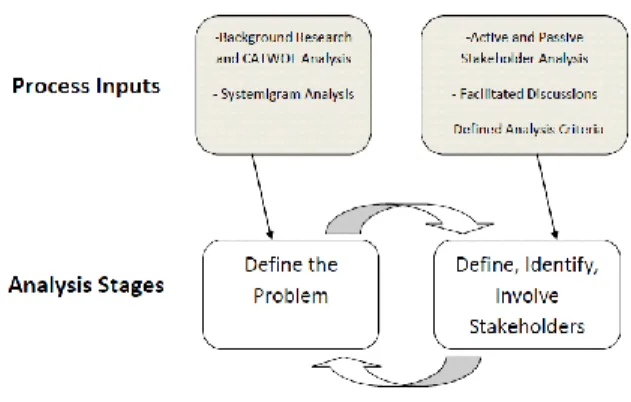
stakeholders about how to (re)define and (re)frame the system or problem under consideration. (Frittman and Edson 2009) demonstrates the incorporation of CATWOE and systemigram analyses into the early stages of analysis. An adaptation of their approach is illustrated in Figure 1. As the process of
defining the problem and involving
stakeholders progresses, a natural feedback loop of information develops in which input
from system stakeholders informs the
refinement of the problem definition. This process leads to greater clarity about the nature of the problems exhibited in the system, and increased stakeholder agreement
about how to model and address these problems.
Figure 1. Early Analysis Stages and Feedback Loop (adapted from (Frittman and Edson 2009))
Articulation and Development of Desired Systems. The usefulness of systemigrams in system analysis does not end with a composite system description. While this development process will yield important insights from multiple stakeholders into the structure and function of a system, the composite system description may not readily offer insights on how stakeholders should modify the system to improve its performance. This is particularly true for systems that have no clear owner to dictate direction for the entire system (such as in the case of U.S. foreign aid, where multiple government agencies have various responsibilities and control over various aspects of the process). For such systems, stakeholder collaboration is needed not only for the description of the system as it currently stands, but also for articulating and developing the characteristics of an improved system. Stakeholder feedback must be generated and integrated to develop a composite understanding of what structures and functions would characterize a “desired
system.” Iterative development of a
composite, “desired system” systemigram allows stakeholders to see a model of a desired system developing in real time, and enables stakeholders and analysts to have
meaningful discussions about the implications of the emerging system’s structure, function, and capabilities.
Once the characteristics of an ideal system have been articulated and mapped in a systemigram, stakeholders and analysts can directly compare the systemigrams of the current, “as-is” system and the desired, “to-be” system. This active comparison of systemigrams has significant potential for advancing systems thinking, since it enables analysts and stakeholders to visualize not only how the current system operates, but also how the current system must change in order to achieve its stated objectives. This point is illustrated in the next section, in which we provide an example of how systemigrams can be used to model and explain the current and desired states of a particularly complex system: the U.S. National Security System.
Application of Systemigrams to US
National Security System
Defining the Current System. Since the terrorist attacks of September 11, 2001, new waves of attention and scrutiny have been directed toward the structure and function of the U.S. National Security System (NSS).
(9/11 Commission 2004) and other
investigative reports describe significant,
systemic failures of U.S. intelligence
community and preparation in the years leading up to the attacks. Now, years after the attacks, significant questions remain about the ability of NSS to effectively address the enduring threat of terrorism against U.S. security.
Despite the prominence of national security as a political and public policy issue, there remains a lack of coherence on what is actually meant by “national security” and “the U.S. National Security System.” There is a common societal understanding that “national security” describes efforts to “keep America safe” (or some similar description), but even
national security domain experts disagree as to what topical and policy components are (or should be) included within the NSS. Political differences, bureaucratic fiefdoms, and overall NSS system complexity all complicate the task of coming to a shared concept of the scope, structure, and functions of the NSS.
We recognized the usefulness of a diagrammatic representation of the NSS system that could be used as a basis for debates and collaborations involving NSS. As
a complex and sometimes ill-defined
construct, NSS is especially suited for systemigram modeling. We developed a systemigram to describe the scope, structure, and function of NSS, as articulated in the most recent presidential statement of the US National Security Strategy (White House 2006). While this document is a product of the previous presidential administration, it is, as of this writing, the most recent official articulation of US strategy.
We followed the standard methodology for constructing systemigrams described in (Blair et al. 2007). Our systemigram was based on a condensed prose description of (White House 2006), which is outlined in terms of nine “essential tasks” needed to address current national security challenges. These tasks (called “objectives” in our systemigram) are defined in terms of operations that support the overall task. For example, (White House 2006) explains the task (objective) of championing human dignity in the operational terms of ending tyranny and promoting effective democracies. In developing a systemigram of the current NSS, we directly adopted this form of describing objectives in terms of supporting operations. We converted the content of the outline into terse prose, and used this prose to develop the current NSS systemigram. Following (Blair et al. 2007), we developed our systemigram around a central goal – in this instance, that of ensuring survival of US vital interests and mitigation of threats against the nation. Where appropriate,
we added links that are implicitly given in the text of (White House 2006) in order to explicitly show the connections between NSS components and the end goal of protecting US vital interests. Figure 2 is the systemigram of the current NSS.1
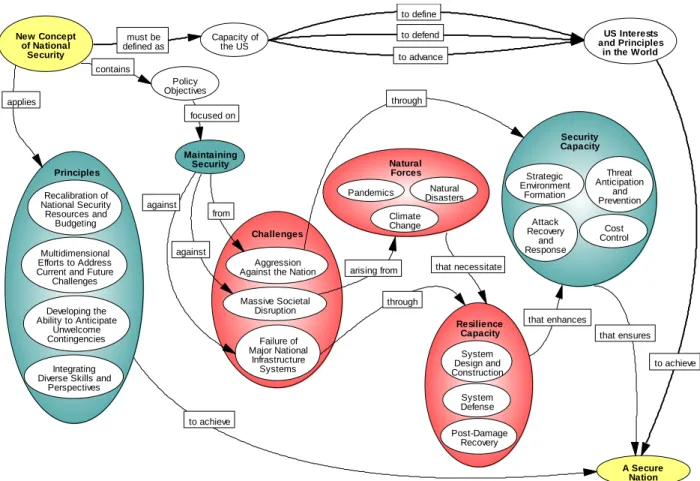
Describing a Desired System. In 2006, Congress tasked the newly created Project on National Security Reform (PNSR) with assessing and recommending changes to the current NSS. (PNSR 2008, pp. vi-vii) articulates how the concept of national security needs to be reframed, and the NSS redesigned, to ensure system effectiveness in the face of new security threats. Again following the methodology given in (Blair 2007), we directly adopted language from (PNSR 2008) that describes a new, “desired” national security paradigm, and used this language as the source text for our systemigram. The central goal reflected in our systemigram remained that of protecting US vital interests. As before, we added links
where appropriate to reflect relational
connections that are implied in the source text.
Figure 3 is the systemigram of the desired NSS (see Note 1).
1
In practice, this systemigram is presented to the stakeholders one thread, or “sentence,” at a time, allowing them to focus upon and discuss each system attribute individually. This type of systemigram presentation allows for a very complex system to be presented in an easily understood manner. Decomposition of the systemigram is not possible here due to paper length limitations. The terse prose and storyboard for this systemigram can be found at
http://www.asysti.org/cser2010submissions.as px
Figure 2. National Security System based on 2006 National Security Strategy. Current Concept of National Security Ability Threats Champion Human Dignity Strengthening Alliances Diffusing Regional Conflicts Preventing WMD Threats Igniting Global Economic Growth Expanding Circle of Development Developing Agendas for Cooperative Action
Transforming US national security institutions Engaging Globalization Tyranny Effective Democracies Networks Attacks Conflict Prevention and Resolution Nuclear Biological Chemical Transformational Diplomacy Effective Democracy More Effective Foreign Assistance Liberty and Rule of Law Ability for Unilateralism International Influence Contextually Realistic Relations Departmental Transformation International/Multilateral Institutions Public Health Illicit Trade Environmental Destruction United States Developing Economies Energy Markets International Financial System Allies US Vital Interests A Secure Nation Objectives of National Security Proliferation Diplomatic Measures US Foreign Policy Agenda Nontraditional National Security Challenges Global Economy Terrorism is defined as by working to end promotingby to defeat to prevent by assisting by addressing by promoting by ensuring by sustaining by addressing by integrating by diversifying by reforming of to survive and mitigate which undermines
that are friendly to
in coordination with with to that threatens in ways that align with that supports that challenge to support
with missions that support to achieve that inform by promoting reforms in is comprised of
System Comparisons. Important insights about the characteristics of the NSS system, and about the nature of the challenge of implementing a robust NSS, become apparent when abstract concepts about the current and desired NSS systems are visually and concretely established through systemigrams. Visually representing the structure and function of the current and desired NSS allows stakeholders to directly compare the current NSS with an ideal system. This comparison highlights areas of needed improvement within the current system, and evidences what types of changes need to occur in order to migrate the system from its current state of operation to a more desirable one.
A significant difference between the current and desired NSS frameworks is the way in which they are conceptualized. The articulation of the current NSS concept is
based on a set of objectives that span several large domains (counter-terrorism, economic
development, international conflict
negotiation, etc.). These objectives are defined in terms of desired outcomes; however, the current NSS articulation does not provide a clear discussion of how these objectives interact with and inform each other. For example, one can imagine ways in which efforts could be coordinated for implementing the dual objectives of “Igniting Global Economic Growth” and “Expanding Circle of Development.” However, the current strategy
does not fully explore how these
complementary objectives interact to advance the ultimate goal of national security. In practice, such an articulation of system objectives can quickly lead to duplication of efforts across a wide set of government agencies, causing increased financial and
Figure 3. Desired National Security System based on PNSR recommendations.
human capital costs as well as potential for information failures between agencies. The prevalence of nodes describing areas of NSS involvement (“Terrorism,” “Proliferation,” “Global Economy,” “Tyranny,” etc.) further underscores the idea that NSS is required to apply across a wide range of domains simultaneously. By defining the application areas of national security in this topical manner, the current NSS tends to reinforce the tendency of agencies to stovepipe efforts and information around specific competency areas. This also leads to increased costs and compromised information flows.
While the current NSS is structured around a large (though arguably not extensive) set of objectives, the ideal (or “to be”) NSS framework would be centered on a focused set of guiding principles. These principles would not be domain specific, as the current NSS objectives are. Rather, the principles would define the types of systemic changes that must
occur for NSS to effectively respond to national security threats. The systemigram representation also highlights the relative simplicity of the desired NSS framework. Within the current system, all NSS objectives – from nonproliferation efforts to stimulation of global markets – appear to receive equal prioritization. By contrast, the ideal system tends to ascribe a high-level prioritization to the development of a national capacity for responding to enemy threats and improving existing response abilities. Notably, the objectives of the current NSS framework are not necessarily at odds with the ideal NSS framework and, while they are not prioritized in the new framework, they may be compatible with it. Still, the implication remains that the current NSS should be reframed in order to more effectively achieve its aims of protecting the U.S. against emerging threats in the 21st Century.
A Secure Nation Capacity of the US US Interests and Principles in the World Aggression Against the Nation
Massive Societal Disruption Failure of Major National Infrastructure Systems Maintaining Security
Pandemics DisastersNatural Climate Change
Multidimensional Efforts to Address Current and Future
Challenges
Integrating Diverse Skills and
Perspectives Recalibration of National Security Resources and Budgeting Developing the Ability to Anticipate Unwelcome Contingencies New Concept of National Security Policy Objectives Strategic Environment Formation Threat Anticipation and Prevention Attack Recovery and Response Cost Control System Design and Construction System Defense Post-Damage Recovery Challenges Natural Forces Principles Security Capacity Resilience Capacity to defend to advance to define against to achieve must be defined as contains focused on to achieve applies through through
arising from that necessitate against
from
that enhances
Discussion
Systemigrams as Descriptive Tools.
High-visibility conceptual systems like NSS are often defined in different ways by various system stakeholders. Stakeholders who bring different presuppositions to their involvement in NSS can be expected to eventually diverge in terms of shared vision, and even to pursue different objectives entirely – all in the name of advancing the goals of the “same” system.
In this context, the explanatory and descriptive power of systemigrams is vital both for clarifying objectives and for providing stakeholders with a broad view of the system’s operation. In the case of the
current NSS, the development of a
systemigram captures the main outline of a national strategy in a way that allows stakeholders to quickly synthesize its content. Systemigrams also allow stakeholders who are focused on a specific aspect of national security to see the integration of that aspect into the overall direction of the national strategy. Even if the overarching strategy document does not explicitly draw links among NSS objectives, systemigrams still enable stakeholders to visualize how different objectives relate to each other. The visual interface enables stakeholders to synthesize the content more readily than when it is in a
more abstract, natural language form.
Furthermore, stakeholders can readily use systemigrams as virtual experimental tools to draw links between system objectives that are not specifically stated in the national strategy. This process can lead to helpful insights about the institutional structures assumed by the strategy, and could initiate stakeholder discussions about how to integrate efforts.
Systemigrams as Iterative Design Tools.
A side by side comparison of the
systemigrams of a current system and an ideal system provides important insights into structural and functional differences between the two systems. However, for complex
systems with no clear owner – such as NSS – the challenge of articulating a desired system is dwarfed by the challenge of instituting systemic changes that will move the system into the desired state. Significant structural and functional changes within large, complex systems often must be achieved incrementally. There exists a significant coordination problem in aligning the efforts and operations of multiple stakeholders – in the case of our example, representing disparate government agencies – in order to iterate in unison toward a desired structural and functional outcome.
Systemigrams can be useful in this context, as a virtual test bed for simulating stakeholder coordination toward a desired systemic goal. While our work has not explicitly demonstrated this application of systemigrams, their use as an iterative design tool is evident. In much the same way that prose descriptions of a current system are used to develop its systemigram, case scenarios can be developed that describe the expected evolution of a system or process over time.
Stakeholders representing different
components of the system can integrate their visions of the evolution of their individual components into a composite systemigram. In this manner, a concept of the evolution of the system can be developed. Systemigrams can be especially useful in this process for demonstrating the evolution of relationships between a system’s components, as the components themselves change. A key
problem in systems design and
implementation is accounting for the
“unexpected results” that occur when the relationships between components change, and as those changes propagate through a system. The development of composite systemigrams based on future case scenarios can inform a discussion about the system-level effects that may emerge when the system is altered, and can provide a basis for developing solutions for them. As the evolution of the relationships between system components
becomes clearer, system designers will have a stronger understanding of the system’s characteristic dynamics and will be better able to propose meaningful changes to implement desired structural and functional system improvements.
An iterative design process using
systemigrams also has the potential to increase stakeholder support for necessary system changes. Developing stakeholder buy-in is an
important task, particularly during
organizational transition periods. Especially important to the process of establishing buy-in is empowering parties that may feel disenfranchised by systemic changes and that are therefore more likely to oppose changes. Since the process of developing iterative systemigrams for design purposes involves receiving multiple iterations of stakeholder feedback, systemigrams can be useful for integrating and empowering stakeholders that might otherwise oppose system changes outright.
Summary
In this paper, we have demonstrated the usefulness of systemigrams as tools for enabling iterative collaborations between stakeholders. We have described a feedback process that integrates the inputs of multiple stakeholders into a composite, holistic perspective of a system. We have explained how systemigrams can enable stakeholders to readily compare the structures of different systems, and to identify functionality gaps between current situations and ideal cases. Finally, we have explored how systemigrams can be used as virtual experimental tools for determining how changes in a system will affect overall system performance. Further
investigation should directly apply
systemigram-based analysis into the
development of processes meant to change the structure of a given system.
Further investigation may directly apply systemigrams in process management and system reform, and should discuss best practices and methodologies for integrating systemigrams in practice.
References
Blair, Charles D., Boardman, John T. and
Sauser, Brian J., “Communicating
Strategic Intent with Systemigrams:
Application to the Network-Enabled Challenge.” Systems Engineering, Vol. 10, No. 4, 2007, pp 309-322.
Checkland, Peter B., Systems Thinking, Systems Practice. Wiley, Hoboken, NJ, 1999.
Clegg, Ben T. and Boardman, John T., “Process Integration and Improvement Using Systemic Diagrams and a
Human-Centred Approach.” Concurrent
Engineering, Vol. 4, No. 2, June 1996, pp. 119-136.
Frittman, Jaime and Edson, Robert. “A Systems Thinking Based Approach to Writing Effective Concepts of Operations (CONOPs).” Submitted, 2009.
Munro, I. and Mingers, J., “The Use of Multi-Methodology in Practice – Results of a Survey of Practitioners.” Journal of Operations Research Society, Vol. 53, No. 4, 2002, pp. 369-378. Cited in Blair et al., 2007.
Forging a New Shield, Executive Summary.
Project on National Security Reform, November 2008.
The 9/11 Commission Final Report. July 2004.
The National Security Strategy of the United States. The White House, March 2006.
Biographies
Joel Mehler is a Senior Associate Analyst in the Applied Systems Thinking Institute (ASysT) at Analytic Services Inc. As a researcher at ASysT, he provides analytic support for the development and application of systems thinking tools and methodologies. His research interests include resilience development in complex systems, and translation of systems methods to multi-stakeholder policy and collective action problems. Joel holds a Bachelor of Science in Electrical Engineering from Wichita State University, a Master of Science in Electrical Engineering from Stanford University, and a Master in Public Policy from Stanford University.
Sibel McGee, Ph.D. is a Senior Analyst for Analytic Services Inc., providing systems and
research analysis for various federal
departments and agencies to include
Department of Homeland Security and Defense. She also conducts case studies and policy analyses utilizing systems thinking concepts and tools for the Applied Systems Thinking Institute (ASysT). She holds a Master’s degree in European Studies from University of Bonn, Germany and a Ph.D. in
Political Science from Texas A&M
University.
Robert Edson is Chief of Corporate Research at Analytic Services Inc., and Director of the Applied Systems Thinking Institute (ASysT). He is responsible for corporate research and development, knowledge management, and technical workforce shaping. In his role as Director of ASysT, he leads an institute whose mission is to advance the application of systems thinking principles in the fields of national security and homeland security. He has over 25 years of experience in dealing with complex systems issues and systems thinking. Robert is an Adjunct Professor at Stevens Institute of Technology and has a BS
in Biology from George Mason University and a MS in Physical Oceanography and Meteorology from the Naval Postgraduate School.