PROJECT PROTOTYPE
Developed by: Gabrielle Le Bon, Project Manager, The Lived Experience Project, Northern Rivers Social Development Council, 2013.
Acknowledgements
The author would like to acknowledge the contributions made by The Lived Experience Project partners, participants and peer workers in designing and delivering an outstanding and innovative project, working together to challenge the status quo of mental health services, and creating new possibilities for people with a lived experience of mental illness and recovery.
Contents
01
INTRODUCTION 6Purpose 6
Background 6
Lived Experience Pilot Project 7
Key Stakeholders 8
02
PEER WORKER PROJECT PROTOTYPE 10Project Description 10
Project Aims 10
Project Phases 11
Coordination and Facilitation 13
Project Delivery Plan 15
03
STAKEHOLDER INVOLVEMENT 20Key Stakeholders 20
Lessons Learned 22
Recommendations 23
04
CONSUMER REPRESENTATION AND PARTICIPATION 24Lessons Learned 26
Recommendations 27
05
EDUCATION 29Certificate IV Courses 29
Training in Peer Work with Peer Educators and leaders 30
Lessons Learned 30
Recommendations 31
06
TRAINING 32Employment partners 32
Work experience placement 33
Lessons Learned 33
Recommendations 34
07
EMPLOYMENT 36Disability Employment Service (DES) Organisations 36
Participant support into employment 37
Lessons Learned 37 Recommendations 37
08
MENTORING 39 Lessons Learned 39 Recommendations 3909
APPROVAL 4110
REFERENCES 4211
APPENDICES 46B. PROTOTYPE TIMELINE 61
C. LIVED EXPERIENCE PROJECT BROCHURES 63
D. POSITION DESCRIPTIONS 69
E. MIND AUSTRALIA’S PEER WORKER TRAINING MODULES 78
F. SAMPLE MEDIA RELEASES 81
G. STEERING COMMITTEE TERMS OF REFERENCE 85
H. MENTORING WORKBOOK 90
I. EMPLOYER EDUCATION RESOURCES 108
01
Introduction
Purpose
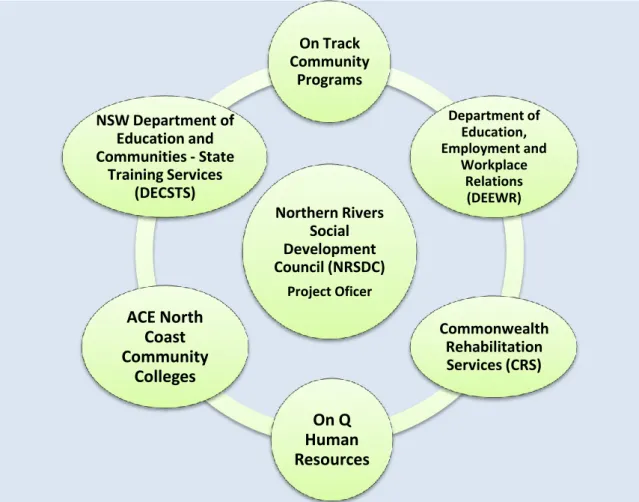
People with experiences of mental illness and recovery working as consumer or peer workers can make a unique contribution to the responsiveness and effectiveness of mental health service delivery. The development of a mental health peer workforce has become a priority in Australia and internationally. This document presents recommendations and strategies based on learning from The Lived Experience Project (LEP) delivered by the Department of Education, Employment and Workplace Relations in partnership with Northern Rivers Social Development Council, ACE Community Colleges, CRS Australia, ONQ Human Resources, On Track Community Programs and NSW Government Department of Education and Communities State Training Services. The LEP was a pilot designed to build the capacity of clinical and non-clinical mental health and community services sector organisations to support the successful integration of peer workers. Run initially as a one year pilot, the project supported people with lived experience of mental illness and recovery to obtain qualifications in peer/mental health/community services work, gain work experience, and make the transition into employment as peer workers in mental health and community workplace settings. The model presented in this prototype is designed to be easily transferred across multiple mental health and community workplace settings in an Australian context.
The LEP Prototype incorporates:
lessons learned from the design, co-ordination, implementation, delivery and evaluation of the LEP in Northern NSW from 2011-2012
feedback and recommendations compiled through independent evaluation conducted with consumers, employers and participants of the LEP, and
a comprehensive literature search of Australian and overseas models of mental health consumer worker development.
Background
The LEP was an initiative developed through the Federal Governments Priority Employment Area (PEA) program, as a strategy under the Keeping Australia Working Regional Employment plan. The success of the LEP pilot resulted in the implementation of a second separate “Making the Lived Experience Count Project” (LECP). The LECP was funded through Building Australia’s Future Workforce under the Local Employment Manager’s Flexible Funding Pool to:
Address the barriers to employment experienced by peer workers and to entrench the sustainability of the model produced under the LEP, and
Research and development of a sustainable, replicable project model.
The research was undertaken by the LEP Project Manager over a 6 month period between July and December 2012. It is anticipated that this document will contribute to the creation of a ‘roadmap’ for similar peer worker initiatives to be implemented across different sectors by community managed organisations throughout Australia.
Lived Experience Pilot Project
The LEP was funded by the Australian Government Department of Education, Employment and Workplace Relations (DEEWR) through the Innovation Fund. This 12 month pilot project was delivered during 2011-2012 in Northern NSW by the Northern Rivers Social Development Council (NRSDC) and ACE Community Colleges in partnership with the New South Wales Department of Education and Communities – State Training Services, On Track Community Programs, CRS Australia and ONQ Human Resources.
The LEP developed, implemented and evaluated a training, coordination and support to facilitate the transition of people with a lived experience of mental illness and recovery into education, work experience and employment as peer workers in mental health and community services sector organisations.
The Project was conceived in respond to the high levels of unemployment experienced by people with mental illness and the identified shortage of skilled staff in mental health services (COAG, 2008). In 2011, the North Coast of New South Wales was identified as an appropriate location, with an average unemployment rate of 6.8%, compared to 5.5% for NSW and 5.3% national average. The regional labour market participation rate was 55.3% in December 2011, compared to 63.7% for NSW and 65.5% nationally (DEEWR, Small Area Labour Markets data). According to the Northern Rivers Regional Economic and Industry Plan (Regional Development Australia, Northern Rivers, 2011), this disparity has trended consistently over at least a decade.
Peer Work: efficacy and policy context in Australia
Current research and literature increasingly recognises the efficacy of peer work as an evidenced based model of accessible and effective mental health support, both nationally and internationally (Mowbray et al., 1997; Campbell, 2005: Cleary, Walter and Escott, 2006; Lawn, Smith & Hunter, 2008; Basset et al., 2010; National Mental Health Consumer and Carer Forum, 2004). Since 1992 consumer participation in mental health service
development and delivery has been embedded in Australian policy frameworks at both a state and federal level.
The Project’s promotion of the value of the expertise of ‘lived experience’ reflects a number of different policy frameworks. The 1991 Mental Health: statement of rights and responsibilities
included the right of consumers to contribute to and participate as far as possible in the provision of mental health care. More recently, the Australian Standards for Mental Health Services 2010
identified an urgent need for mental health organisations to ensure consumers and carers are actively involved in the development, delivery and evaluation of services.
The LEP’s contribution to the development of a peer workforce also aligns with Australia’s Fourth National Mental Health Plan: An agenda for collaborative government action in mental health 2009 – 2014, the National Practice Standards for the Mental Health Workforce 2002, and the
National Mental Health Workforce Strategy 2011 in prioritisation of social inclusion for people with mental illness and the need to expand workforce profiles and career pathways for consumer workers in clinical and community mental health settings.
“A peer worker is someone who has a lived experience of mental illness and recovery, is living well and is able to utilise their experiences to foster hope and assist others with their recovery” (Peer Work Project, 2005)
LEP Project Aims
Identify 20 people with a lived experience of mental illness and link them to local
employment partners in mental health services to access work experience and potentially a continuing job at the completion of the project.
Identify 20 positions of paid employment for project participants. Support participants to successfully complete prevocational training and work experience to meet the
requirement of a Certificate IV in Community Services Work.
Develop an employment education package to inform employment partners to ensure peer workers and employees with a lived experience of mental illness are adequately supported in the workplace.
Provide an evaluation of the project which addresses: project success, sustainability and examples of best practice/lessons learned.
Project Outcomes
The LEP supported up to 30 people with a lived experience of mental illness and recovery to access education and to engage with local employment partners in mental health and community services via mentoring, work experience placements and paid employment. The Project made considerable progress against its expected outcomes including:
30 participants successfully completed prevocational training which included the provision of a 6 week pre-vocational skills course and an audit of participant learning support needs prior to commencement of the Certificate IV course.
30 participants engaged in study and work experience placements designed to meet the requirement of a Certificate IV in Community Services Work.
25 participants completed a Certificate IV in Community Services Work
25 participants engaged in a mentoring relationship with a mental health worker from clinical and non-clinical mental health services.
An education and training package was developed, disseminated and presented to employment partners to enhance their capacity to employ peer workers and assist their identification of reasonable adjustments and adequate support for employees with a lived experience of mental illness and recovery in the workplace.
Identification of 19 positions of paid employment for project participants in 18 months (includes both the initial LEP pilot and the 6-month Making the Lived Experience Count Project).
3 additional participants completed a Diploma in Community Services (Mental Health) and 4 participants commenced further tertiary education upon completing the LEP.
Key Stakeholders
Project participants
LEP participants identified as having a lived experience of mental illness and recovery, unemployed and in receipt of income support payments or eligible for DES assistance.
Participants reported a range of experiences of illness including: Schizophrenia, Bipolar Disorder, Anxiety Disorder, Depression, Eating Disorder, Personality Disorder, Substance Use Disorder and Post Traumatic Stress Disorder. Project data identified the average length of time since
employment related activity as 6 years.
Mental health consumers
Mental health consumers accessing support services from a range of public mental health and community managed organisations interacted with project participants during work experience placements and in the course of participant employment. A number of consumers also attended public education and media events associated with the project and reported inspiration at participant’s stories of recovery from mental illness and successful obtainment of vocational goals. Consumers from a number of different organisations were interviewed by an independent evaluation consultant to identify the impacts of people with ‘lived experience’ working alongside consumers in mental health settings.
Consumer Representatives
An Expression of Interest and recruitment process was undertaken to identify people with a lived experience of mental illness and recovery to perform the role of Consumer Representatives on the project’s Steering Committee. To successfully fulfil the requirements of these two paid positions it was vital that candidates were able to demonstrate their knowledge of the impact of mental illness on people living in the local area, the consumer/survivor movement and the challenges associated with peer workforce development. See Appendix 4 for Consumer Representative Position Description.
Peer Educators
Peer Educators and leaders included people with a lived experience of mental illness and recovery with education and training qualifications or experience who provided training in peer work competencies to project participants.
Funding bodies
The LEP was funded by the Australian Government Department of Education, Employment and Workplace Relations (DEEWR) through the Innovation Fund. The project was also funded by the NSW Department of Education and Communities – State Training Services.
Project partners
The Project was delivered by a consortia including: Northern Rivers Social Development Council (NRSDC), ACE Community Colleges, NSW Department of Education and Communities – State Training Services, On Track Community Programs, CRS Australia and ONQ Human Resources.
Mentors
The project identified a number of mental health and community services workers as suitable mentors to project participants. Mentoring led to the identification of work experience placements and employment opportunities for participants and contributed to increased knowledge among mental health and community workers about the LEP. A number of mentors reported valuing their mentoring relationship and learning new ways of working in mental health from the expertise of lived experience.
Employment partners
Prospective employment partners in public mental health and community managed organisations were targeted throughout the duration of the Project. Employment partners included all staff working in organisations that hosted project participants during work experience placements and
02
Peer Worker Project Prototype
Project Description
The Peer Worker Project (PWP) is a two-year project funded and delivered by agencies and organisations associated with education, training, mental health and disability services. It provides co-ordination and appropriate support to people with a lived experience of mental illness and recovery to facilitate their access to education, training and mentoring to make the transition to paid employment as peer workers in mental health and community services organisations. The Project aligns with the aspirations of the current National Mental Health Plan and Strategy in its prioritisation of the social inclusion of people with mental illness by increasing the employment of consumers in clinical and community mental health settings and the development of a Peer Workforce in Australia.
The PWP project team works alongside a registered training organisation (RTO) and Disability Employment Service Consultant to ensure each participant
has access to specialised individualised assistance to achieve their education and employment goals. As each participant works toward an industry recognised
qualification they are supported by an experienced Peer Worker and mentors from the field. The project team and partners work collaboratively to identify suitable work experience placements and instil employer confidence in the recruitment, training and retention of peer workers. The PWP promotes Peer Work to mental health and community services organisations to support the identification of employment opportunities for peer
workers. It identifies that mental illness, often perceived as a deficit, can be an asset with social and economic value.
When viewed as an asset, the lived experience of mental illness provides consumers with competitive advantage in a growing employment sector.
The PWP also assists employers by offering an education and training package to support the integration of reasonable adjustments and appropriate strategies to support people with lived experience of mental illness in employment.
Project Aims
Support 25 people with a lived experience of mental illness and recovery by linking them to local employment partners in mental health and community services to access mentoring, work experience and a continuing job at the completion of the project.
Develop, implement and monitor a mentoring program to link 25 participants with mentors in the mental health and community services sector.
Support 25 people with lived experience of mental illness and recovery to successfully complete a Certificate IV in Community Services Work/Mental Health/Mental Health Peer Work
“There is a great deal of strength gained in knowing someone who has walked where you are walking and who now has a life of their choosing. In this way peer support is different form support work or clinical work or community work – it comes from a profoundly different philosophical base” (The National Centre of Mental Health Research, Information and Workforce Development, 2010, p 8).
Identify 25 work experience placement opportunities in mental health and community services organisations.
Identify 25 positions of paid employment for project participants in mental health and community service organisations.
Facilitate employment partner training and develop and update existing resources for dissemination to facilitate appropriate support for Peer Workers and people experiencing mental health issues in the workplace.
Provide an independent evaluation of the project which addresses: project success, sustainability and examples of best practice/lessons learnt
Project Timeline
A proposed timeline is presented in Appendix 2. The timeline incorporates lessons learned from the development, implementation and evaluation of the LEP and is designed to be delivered over a two-year period by a project team including a Project Manager and a Peer Worker supported by the lead agency and project steering committee.
Project Phases
Phase 1 – Recruitment and establishment
Establish agreement on project budgets and allocations
Develop memorandums of understanding, contracts and agreements
Employment of project staff
Recruitment of steering committee members, and
Finalisation of tender process for DES organisation and independent evaluation consultant.
Phase 2 – Project implementation
Develop project plan, schedule and risk assessment
Develop communication strategy, and
Steering committee agreement on project plan.
Phase 3 – Community education and capacity building
Develop project logo and promotional materials for steering committee and project partner approval and dissemination
Develop media materials and commence implementing media campaign
Develop and disseminate employer and sector education resources
Deliver employment partner, consumer and community project information sessions
Identify opportunities for traineeships and work experience placements
Recruit and train mentors, and
Phase 4 – Participant recruitment and engagement
Develop participant recruitment strategy and promotional materials
Host information sessions for potential participants
Recruit participants including WRAP/wellness planning
DES Consultant registers participants and commences vocational support
Evaluation consultant commences research with participants
Mentoring induction for participants
Mentoring match up for participants and their mentors
Pre-vocational training commences, and
Commencement of peer support and supervision.
Phase 5 – Participant education and training
Participants complete peer worker training e.g.: Mind Australia/IPS/eCPR
Individual peer support and peer group supervision meetings
Participants commence and complete Certificate IV training
Participants complete story telling workshops
Employer training and education including canvassing to identify work experience placements and peer worker job opportunities
Work experience placements pre, mid and post meetings
Evaluation consultant conducts research with employers and consumers of mental health services
Evaluation consultant submits mid-project evaluation report, and
Project Manager submits mid-project evaluation report.
Phase 6 – Participants transition into employment
Meetings between participants, project team and DES Consultants to develop
employment pathway plan outlining development of job searching skills and strategies for managing a successful return to work.
Review of mentoring program
Employer training and education including canvassing to identify peer worker job opportunities
Consultation to employment partners to develop suitable peer worker job descriptions for their organisations.
Supporting participants with job applications and interview skills
Individual peer support and peer group supervision meetings, and
Phase 7 – Evaluation
Evaluation consultant liaises with project team regarding submission of evaluation report
Participant graduation
Review of mentoring program
Evaluation consultant submits final evaluation report, and
Project Manager completes and submits final evaluation report.
Coordination and Facilitation
Lead organisation
The lead organisation for the PWP would ideally be a community managed organisation with demonstrated mental health expertise and some capacity for community services training and/or sector representation.
It may be possible for the lead organisation to be a registered training organisation (RTO) providing the organisation offers the Certificate IV course in Mental Health Peer Work, Non-clinical Mental Health Work or Community Services Work. To be considered suitable, it would be imperative for an RTO to employ appropriately qualified project staff to ensure the provision of appropriate support to participants.
A mental health peak body operating as an RTO would be exceptionally well placed to deliver the PWP, as it performs a highly influential representative function, employs field experts and
specialises in the dissemination and delivery of innovative evidence based training initiatives in mental health work.
Project manager
The PWP would be best co-ordinated by an experienced mental health worker with project management expertise or an experienced project manager with a history of working in mental health (see Appendix 4 for position description).
The PWP Steering Committee should consider recruiting a Project Manager with a lived
experience of mental illness and recovery as this would enable the project to ‘walk its talk’ by role modelling hope and vocational opportunity to project stakeholders. A Project Manager with ‘lived experience’ demonstrates to the mental health sector and wider community that people who have, had or will have mental health issues are capable of engaging in socially valued roles and contributing positively to society.
The Project Manager would ideally hold a number of qualities and skills including:
Qualifications and demonstrated experience in mental health and/or project management
Lived experience of mental illness and recovery
Knowledge of peer workers and current issues affecting consumer workforce and mental health sector development
Recovery oriented practice framework
Case management, counselling, mentoring, advocacy and group facilitation skills
Experience in community development and capacity building, and
Passion, commitment and drive for innovation and social change.
Supervision and support
It is important that the lead agency provide the Project Manager with appropriate clinical and non-clinical supervision as project development, co-ordination, delivery and evaluation to timelines can be challenging and stressful.
Regular structured supervision with a qualified professional would assist the Project Manager to manage further challenges associated with the implementation of a peer worker project in mental health including:
Mental health sector resistance to innovative and consumer led change
Lack of industry knowledge of peer work and peer worker positions
Industry resistance to consumer identified positions of employment
Staff skills shortages
Inadequate funding for peer worker positions
High support needs of participants, and
Risk of compassion fatigue, vicarious trauma and burn out.
It is also essential for the Project Manager to receive appropriate support and guidance from the active membership and influence of the project’s Steering Committee. It may further assist the Project Manager to consider engaging in a mentoring relationship with a recognised leader in the mental health industry to enhance project delivery, promotion and uptake.
Project Delivery Plan
NOTE: The project timeline in Appendix 2 identified each phase and activity, the durations, scheduled start and end of each activity, and hold points such as Steering Committee approvals.
PHASE OBJECTIVE DURATION ACTIVITIES LEAD
RESPONSIBILITY SUPPORT RESPONSIBILITY OUTCOMES RESOURCES PHASE 1: Recruitment and establishment Establish Implementation Committee
4 weeks Funding bodies and lead agency representatives form an implementation committee to finalise funding allocations, drive project recruitment and establish appropriate membership of an effective steering committee.
Lead agency representatives
Funding body representatives
Confirmed establishment and membership of project’s implementation committee
Administrative Financial
Funding body staff Lead agency staff
Recruit Project Manager and Peer Worker
8 weeks Develop position descriptions Advertise positions
Identify contact for enquiries
Identify suitable applicants for interview
Identify suitable panel members for interview including a consumer representative
Confirm successful applicants
Provide appropriate induction to organisation and to consumer workforce development where required
Lead agency representatives
Partner organisation and sector leader
representatives Consumer representatives
Successful recruitment of a qualified mental health worker/project manager, ideally with a lived experience of mental illness and recovery.
Successful recruitment of a Peer Worker with a lived experience of mental illness and recovery and qualifications or training in mental health and community work
Administrative Financial Lead agency staff Interview panel staff
Recruit Steering Committee representatives
12 weeks Funding body and lead agency representatives invite expressions of interest from education, employment, mental health and consumer sector leaders to establish membership of a steering committee
If multiple applications received complete interview and selection process
Implementation Committee Project Manager
Peer Worker Independent interview and selection panel members comprised of industry and sector leaders
Confirmation of steering committee membership Administrative Financial Project staff Independent interview panel staff
Develop Steering Committee Terms of Reference
4 weeks Develop terms of reference Steering Committee members
Project Manager Steering Committee develops and accepts terms of reference
Project staff Steering Committee representatives
Identify and recruit independent evaluation consultant
8 weeks Compile evaluation proposal including timeframes and budget Distribute EOI to local consultants and invite applications for tendering quotations
Identify appropriate candidate to undertake independent evaluation
Project Manager Lead agency representatives
Steering Committee Independent evaluation consultant is recruited to complete an evaluation of the project
Financial – service fees for the consultant
PHASE 2: Project implementation
Develop project plans 4 weeks Develop project plan Develop project schedule
Develop project risk assessment management plan
Develop project communications strategy, including community education, promotion, media relations, external stakeholder engagement and consultation activities
Communicate project plans and gain approval (Steering Committee)
Project Manager Funding body representatives Steering Committee Peer Worker
Project has specific, deliverable plans to guide best practice implementation
PHASE OBJECTIVE DURATION ACTIVITIES LEAD RESPONSIBILITY SUPPORT RESPONSIBILITY OUTCOMES RESOURCES PHASE 3: Community education and capacity building
Develop project education and promotional material
12 weeks Research and develop project education and promotional material including: Project logo brochures/posters
Clear definitions of peer work Participant recruitment Work experience documents Mentoring information Employer education resource
Project Manager Graphic and/or web designer
Peer Worker Lead agency line management
Completion of brochures and online site relating to project targeting prospective applicants, employers and wider community Project staff Information technology expert/web designer Financial including: printing and photocopying
Conduct sector and community education and information sessions
12 weeks Deliver project information sessions and disseminate associated resources to industry leaders from education, employment and mental health/community services sector
Project Manager Peer Worker Distribution of information related to the project, education and capacity building in the mental health sector in preparation for project delivery
Project staff Graphic Design? Photocopying
Conduct DES Tender Process
8 weeks Facilitate information sessions related to the Project and invite attendance from all local DES organisations
Distribute selection criteria related to tender process and invite DES
organisations to apply to be the project’s partner employment support services provider
Review applications and select appropriate organisations for interview Conduct interviews and recruit appropriate DES organisation as partner employment provider
Develop MOU and welcome DES organisation to steering committee
Project Manager Steering Committee members
Lead agency line management Peer Worker
Commencement of MOU and establishment of working partnership with local DES organisation
Administrative Financial Project staff Steering Committee representatives
Conduct Official Project Launch
4 weeks Develop and co-ordinate an official launch of the project, invite appropriate elected members and education, employment and mental health industry leaders.
Write a media release related to the project and distribute to local media
Project Manager Steering Committee members
Peer Worker Lead agency line management
Confirmation in community of official commencement of project and continuation of project promotion, community education and capacity building process
Financial Project Staff Steering Committee representatives
Conduct community promotion and employer education
24 weeks Research and develop project associated resources for distribution to community / mental health sectors, including expression of interest forms inviting mental health and community workers to become mentors to project participants
Research / develop employer information kit for distribution to prospective employment partners
Facilitate education and information sessions that target community / mental health orgs AND prospective employers
Project Manager Peer Worker
Lead agency representatives Steering Committee
Reps from local community / mental health sector organisation participate in education sessions/workshops Managers, Co-ordinators of prospective employment partners participate in education sessions/workshops Receipt of up EOIs from mental health / community services staff to participate in mentoring program
Project staff Financial resources including: venue hire, tea/coffee and amenities printing and photocopying PHASE 4: Participant recruitment and engagement
Recruit and train mentors 8 weeks Research and develop appropriate mentoring program, including compilation of a mentoring workshop for mentors OR engage services of an external trainer
Collate mentor applications and contact suitable mentors to invite their attendance at a free mentoring training workshop
Facilitate mentoring workshop for mentors
Project Manager Peer Worker External Trainer if required Lead agency representatives
Up to 30 people working in mental health and community services sector are trained as mentors
Up to 25 people complete application forms and become mentors in the project
Project staff Financial including: venue hire, tea/coffee amenities, printing, photocopying and external trainer fees
PHASE OBJECTIVE DURATION ACTIVITIES LEAD
RESPONSIBILITY
SUPPORT RESPONSIBILITY
OUTCOMES RESOURCES
Recruit project participants 12 weeks Disseminate application forms and promotional material including closing date for applications to all mental health related organisations and consumer frequented settings.
Distribute media release and respond to media requests, inviting people from wider community with lived experience of mental illness to apply.
Facilitate applicant information sessions in a number of locations/times to optimise participation
Confirm participant selection panel members including: Project Manager, Peer Worker, Trainer and DES Employment Consultant
Review / cull applications and invite appropriate candidates for interview. Interview process to include focus on capacity for completing training at Certificate IV level including assessment of computer skills. Identify 25 participants to commence. Project Manager Peer Worker DES Consultant Trainer Lead agency representatives
25 participants selected to commence with the project Project staff DES Consultant Trainer Financial including: venue hire, tea/coffee/amenities , photocopying and printing and access to computers
Project participants referred to DES provider
8 weeks Project participants referred to DES provider to ensure appropriate support provided throughout training course and transition into employment
Project Manager Peer Worker DES Consultant
Steering Committee All participants linked to DES Consultant and have engaged in assessment process and employment pathway plan in relation to a successful return to education and work
Project staff DES Consultant
Conduct pre-project commencement evaluation
4 weeks Independent evaluation consultant to interview each participant via individual interviews and/or focus groups (participation in evaluation process is voluntary) prior to their commencement with the project.
Consultative process enquires about: Aims and goals, individual recovery journey, motivations in relation to peer work, education/training and employment
Independent evaluation consultant
Project Manager Peer Worker
Collation of qualitative data to identify common themes and explore comparative analysis against data obtained at various points throughout project to inform project report and to contribute to the research and literature surrounding peer work Financial - Independent evaluation consultant’s fees Provide pre-vocational training to participants
4 weeks Develop and deliver or engage services of external Peer Educator to facilitate storytelling and Intentional Peer Support (IPS), Wellness Recovery Action Plan (WRAP) or Emotional CPR (eCPR) course
Participants to attend and complete IPS/WRAP/eCPR course and storytelling workshops prior to commencing with the project
Identified participants to complete a preparation for employment skills course (computer skills, numeracy and literacy, administration skills etc)
Project Manager Peer Worker
External Peer Educator Trainer
All participants complete both storytelling and IPS or WRAP workshops
Identified participants complete preparation for employment course and/or literacy and numeracy
Financial – venue hire, tea/coffee and amenities, external peer educator training fees, external trainer fees, preparation for employment course fees,
Provide mentoring training, matching and linking
4 weeks Develop and deliver mentoring workshop for mentees.
Ensure all participants have completed mentoring application process Link each participant with an appropriate mentor.
Project Manager External Trainer where required
Peer Worker Steering Committee
Each participant completes mentoring training and is linked with an appropriate mentor from mental health and community services
Financial – external trainer course fees, venue hire, tea/coffee and amenities PHASE 5: Participant education and training Support participants to complete semester 1 of Certificate IV education/training
16 weeks Support participants to enrol and participate in appropriate identified course including: Certificate IV in Mental Health Peer Work, Non-clinical Mental Health Work or Community Services Work
Develop and promote an online support mechanism where participants can virtually connect and support each other.
Peer Worker Trainer DES Consultant
Project Manager All participants complete enrolment process, attend ongoing classes and study until successful completion of Certificate IV
Online support group enables project participants to connect / support each other throughout the project. Subject to consent, this website also becomes a useful mechanism to facilitate effective communication between trainer, project staff and participants
Financial – Certificate IV course fees
Identify work experience placement opportunities
24 weeks Identify appropriate work experience placement opportunities for each project participant
Liaise with manager and/or co-ordinator of each organisation to ensure attendance of all staff at employment partner training
Provide managers and work experience placement supervisors with copies of work placement information and assessment pack and send copies of interested participant’s resumes and criminal record check results to identified
Project Manager DES Consultant
Steering Committee Peer Worker Trainer
Up to 25 work experience placement opportunities identified and all staff at participating agencies complete employment partner training
Financial – criminal record check fees, printing,
photocopying and postage
PHASE OBJECTIVE DURATION ACTIVITIES LEAD RESPONSIBILITY SUPPORT RESPONSIBILITY OUTCOMES RESOURCES Provide support to participants to commence work experience placements 1 to 2 days per week for up to 12 weeks during or upon completion of 2nd semester
Organise and facilitate meetings with managers/co-ordinators of participating host organisations and project participant to ensure communication of expectations and completion of insurance documents
Set dates for reviews of participant’s progress at mid and end point of work experience placements
If any placements unsuccessful or unable to be identified consider work training opportunities via DES organisation
Ensure each participant is linked in with online support from peer advocates and peak peer representative bodies
Peer Worker DES Consultants
Steering Committee Project Manager
Each project participant successfully completes work experience placement in mental health and community sector organisations
Host organisations receive training and support to ensure successful work placement experiences for all stakeholders.
Conduct Mid program evaluation
4 weeks Evaluation consultant to organise and facilitate individual interviews and/or focus groups with each project participant subject to their approval and consent
Evaluation consultant to organise and facilitate individual interviews and/or focus groups with each employment provider subject to their approval and consent
Evaluation consultant to organise and facilitate individual interviews and/or focus groups with mental health consumers in organisations hosting peer workers subject to their approval and consent
Evaluation consultant Project Manager Peer Worker
Collation of qualitative data to identify common themes and explore comparative analysis against data obtained at various points throughout project to inform project report and to contribute to the research and literature surrounding peer work and the consumer workforce
Financial – evaluation consultant fees PHASE 6: Participants transition to employment Provide Employment Partner training
52 weeks Use resources previously developed and researched to support facilitated workshops designed to educate / inform employment partners and sector leaders in employment of peer workers
Provide ongoing consultative services to employment partners on the development of peer worker positions, supervision and support, ethical conduct and changes to policies and procedures
Encourage employment partners to apply for and participate in Sane’s ‘Mindful Employer’ program and complete evaluation process
Project Manager Peer Worker
DES Consultant Steering Committee Project Participants
All employment partners hosting work experience placements or providing consumer worker employment opportunities participate in education / information workshops (it is vital that all staff working alongside peer workers attend at least one information session to ensure they are adequately informed about the benefits associated with the integration of peer workers into mental health services)
Financial – venue hire, tea/coffee and amenities, printing and photocopying
Provide Peer to peer supervision
18 months Facilitate 1 to 1 support meetings where there is an identified need Facilitate peer supervision groups at monthly or bi-monthly intervals
Peer Worker Project Manager Lead agency representatives
Project participants are provided with regular, ongoing adequate support throughout their engagement with project
Financial – venue hire fees, tea/coffee and amenities fees,
PHASE 7: Participant education and training Support participants to complete 2nd semester of Certificate IV education and training
16 weeks Provide individualised support to each project participant to ensure access to effective mentoring, adherence to WRAPs, and workload management through the transition into education and employment
Hold regular progress meetings between project staff, trainer and DES consultant to identify strategies to support participants at risk of non-completion
Peer Worker Trainer
Project Co-ordinator DES Consultant
Each participant has access to individual, strengths based recovery oriented support to ensure successful completion and engagement in employment as a peer worker
Host participant graduation ceremony
4 weeks Design / host graduation ceremony to celebrate achievements participants Write media release and invite media representatives to attend graduation ceremony
Distribute awards to host organisations and employment partners
Project Manager Peer Worker Lead agency representatives Steering Committee members
Celebrate achievements of project participants Media covers the event and provides project promotion
Financial – venue hire fees, tea/coffee and amenities fees, printing of certificates, hire of PA and sound equipment PHASE 6: Participants transition to employment
Provide support for Job seeking to employment
24 weeks Participants to attend job seeking skills groups to develop resume and to begin cold-canvassing and/or applying for employment in mental health and community sector
DES Consultant Project Manager Peer Worker
Up to 25 participants identify appropriate opportunities for employment and commence part-time or full-time work
Support participants making the transition into employment
24 weeks Conduct workplace risk assessments and facilitate the introduction of any reasonable adjustments required
Provide regular contact to both peer worker and employment provider at agreed times to ensure provision of effective ongoing support and sustainable employment outcomes for project participants
Peer Worker DES Consultant
Project Manager Participants experience job satisfaction and increased skills development in their new position of employment.
Employment partners receive ongoing information / support with issues that arise in relation to the employment of a peer worker
PHASE OBJECTIVE DURATION ACTIVITIES LEAD RESPONSIBILITY SUPPORT RESPONSIBILITY OUTCOMES RESOURCES PHASE 8: Evaluation
Conduct Post program Evaluation
8 weeks Subject to consent:
Consultant to organise / facilitate individual interviews and/or focus groups Consultant to organise / facilitate individual interviews and/or focus groups with mental health consumers in organisations hosting peer workers
Evaluation consultant Project Manager Peer Worker
Collation of qualitative data to identify common themes and explore comparative analysis against data obtained at various points throughout project. Contribute to knowledge base of peer work and consumer workforce
Financial – evaluation consultant fees
Complete Evaluation reports
10 4 weeks Compilation of ongoing milestone reports and comprehensive evaluation report to funding bodies to ensure capture of important data and findings related to outcomes
Project Manager Peer Worker Lead agency representatives
Submission of a comprehensive project summary including lessons learned to funding bodies to report of project outcomes and inform future peer workforce development
“I feel confident and comfortable talking with the Peer Worker because they don’t see me as a label or a tag or with a sense of detachment. The Peer Worker understood me better than a worker could have because of their personal experiences of mental illness. The Peer Worker inspired me to believe in myself and to realise that I could one day be a Peer Worker too!” (Participant, LEP, 2012)
03
Stakeholder involvement
Key Stakeholders
Funding body representatives
Funding body representatives steer the project through committed and active membership of the steering committee in addition to promoting and supporting project aims and outcomes in the wider community.
Auspicing body or lead agency
The auspicing body or lead agency delivers the project by committed and active membership of the steering committee, employing and supporting the work and professional development of the Project Manager and Peer Worker, promoting and supporting project aims and outcomes in the wider community and administering project funds.
Project Manager
The Project Manager is employed on a full-time basis to develop, implement, monitor and
evaluate the project. The Project Manager is required to work collaboratively with participants and partners to ensure achievement of project aims. This includes:
Project design and development of resources and promotional material
Community development and sector capacity building
Media liaison and management
Participant recruitment and support
Development of a mentoring program
Delivery of employment partner education and training
Identification and monitoring or work experience placements
Monitoring, quality improvement, evaluation and regular reporting, and
Ongoing liaison with the funding body, project partners and steering committee members.
Project Peer Worker
A Peer Worker is employed to support the work of the Project Manager in the development and
dissemination of promotional material and resources and the delivery of education and training to
prospective employers and community members. The most essential role of the Peer Worker is to role model living well and to inspire hope, and provide peer support to participants. Peer support may be provided through facilitation and review of the Wellness Recovery Action Plan (WRAP) process, individual meetings and group supervision to ensure
Registered training organisation
RTO employees include steering committee representatives, Trainer and administration staff. Some of these stakeholders contribute to steering the PWP by committed and active membership of the steering committee, in addition to supporting/reporting on participant progress through education/training, delivering the designated qualification, tutorial support and mentoring training to mentors and project participants.
Peer Educators
Peer Educators facilitate peer worker training, storytelling workshops and Intentional Peer Support, Emotional CPR (eCPR) workshops/courses in peer worker competencies to project participants as required and dependent upon skill set of project staff.
Peer Educators role model the value of ‘lived experience’ in mental health and community services workplace settings and demonstrate the importance of self-responsibility in recovery. Peer Educators also offer essential inspiration to project participants surrounding the
achievement of their personal education and vocational goals.
DES partner organisation
A DES organisation is selected by competitive tender process at commencement of the PWP. DES organisational representatives may contribute to steering the project by committed and active membership of the steering committee and promoting and supporting project aims and outcomes in the wider community.
The DES identifies a suitable employment consultant to work with project participants and the project team to:
Provide information regarding income support and employment
Ensure participant access to financial support schemes
Support and report on participant progress through education/training and into employment, and
Canvas prospective employers and facilitate access to wage subsidy incentives.
Project Participants
People with lived experience of mental illness and recovery, identifying as unemployed and eligible for DES assistance complete associated education and training and make the transition to employment as Peer Workers in mental health and community workplace settings.
Carers, family members and support networks
Carers, family members and support networks provide vital support to participants through the journey of returning to education and employment and should be considered throughout PWP delivery with consent of Participants.
Consumer representatives
Consumer representatives contribute their experiences of mental illness and recovery in addition to their knowledge of consumer workforce development needs and the issues affecting people with a lived experience of mental illness to guide and steer the project toward appropriate support and achievement of outcomes for PWP Participants.
Clinical and non-clinical mental health and community services sector directors, managers, Managers
Clinical and non-clinical mental health and community services sector directors, managers, coordinators and team leaders are prospective employment partners to the project. These stakeholders may also contribute to steering the project by committed and active membership of the steering committee and promoting the PWP in the wider community.
These stakeholders also participate in education/information sessions, provide work experience opportunities with appropriate levels of supervision and support, and identify positions of employment for PWP Participants.
Clinical and non-clinical mental health and community services sector staff
Clinical and non-clinical mental health and community services sector staff to attend and participate in education/information sessions, offer expertise as mentors to participants, work collaboratively and provide support to PWP Participants in the workplace.
Independent evaluation consultant
An independent evaluation consultant is identified through a competitive tender process. The Consultant conducts research into the effectiveness of the project by analysis of statistical data and pre/post project semi-structured interviews with participants, employment partners and consumers of mental health services to inform the submission of a mid and final independent evaluation report.
Media stakeholders
It is vital to form working relationships with media stakeholders across all forms of radio, print, television and social media. These stakeholders may assist in community education and creating a public profile of the PWP by illustrating and disseminating key project milestones and
achievements, and inspiring the identification of employment opportunities for people with lived experience of mental illness.
Lessons Learned
Despite development of some key relationships with mental health sector organisations, independent evaluation of the LEP identified insufficient time within a 12 month period to
adequately incorporate partnership and stakeholder relationships. Due to inadequate time frames a number of key employment and stakeholder partnerships were omitted or had insufficient time to develop.
Another challenge in relation to stakeholder engagement was the lack of prior knowledge and unanticipated resistance from mental health managers and workers to Peer Workers which sometimes resulted in a lack of acceptance to their inclusion as colleagues in mental health workplace settings.
This resistance may have been amplified due to the regional context in which the LEP pilot was delivered but needs to be taken into consideration as a potential risk associated in any future projects. Mental health sector resistance proved very time consuming for the Project Manager and demonstrated the need for investing time early in the project into building strong employment partner relationship and providing comprehensive training to all staff.
opportunities for project participants.
Recommendations
i. Allocate the first 6 months of PWP schedule to community education and sector capacity building to increase the development of key partnerships with strategically influential mental health organisations including the public health service, mental health community managed and consumer representative organisations, and peak bodies.
ii. Allocate time (at least 8 weeks) from project commencement to meet with key leaders in mental health including influential members of corporate governance from public and community managed organisations and invite them to join the PWP Steering Committee. These relationships increase promotion of the project and contribute to the PWP
achieving its aims of work experience and employment for participants.
iii. Ensure all DES organisations are aware of tender process and informed about project design, timeframes, aims and expected outcomes. DES organisations operate in a competitive environment, it is critical to the success of the PWP that a suitable DES organisation with demonstrated capacity for working effectively with people who experience mental illness is selected in this critical project partnership role.
iv. Develop relationships with media organisations early in the project timeline to ensure accurate documentation of project achievements and widespread dissemination of Participants’ journeys toward employment as peer workers that focuses on important project milestones.
v. Invite Participants to extend invitations to project information sessions to their carers, family members and support networks. Carers, family members and support networks are pivotal support relationships for people who experience mental health issues. Where possible and with consent, it is important that Participant support networks are informed about the design, aims, timeframes, expectations and support needs associated with the project. It is more likely that Participants will have access to the support they need to reach their education and employment goals if their support networks are informed and included throughout project
duration.
“Having a peer worker in our organisation means that consumers can access someone who really
understands. It is also a great perspective check and source of information for staff. Our organisation has been inspired by hosting someone with a lived experience who is in recovery, engaging in study and pursuing a career path – this has been fantastic role modelling to everyone especially other consumers” (Employment partner, LEP, 2012).
04
Consumer representation and
participation
Steering Committee Representation
It is vital that the Implementation Committee conduct a thorough and equitable Consumer Representative recruitment process in line with evidence based best practice approaches to avoid tokenism and ensure inclusion of the expertise of lived experience throughout the project’s design and delivery (Epstein and Shaw, 1997; Department of Health and Family Services, 1998; Consumer Affairs Advisory Council, 2002; Kroschel, 2002; Lloyd and King, 2003; Department of Human Services, 2006; Edan, 2006; Happell and Roper, 2006). The recruitment process for Steering Committee Consumer Representatives is completed during Phase 1 to enable the consumer voice to be an active contributor to project design and achievement throughout the project’s duration.
Best practice identifies the need for two paid Consumer Representative positions to create a safe environment and to ensure consumers on the committee have access to peer support and
opportunities for debriefing. Consumer Representatives should also have access to education and/or training to support their effective representation and contribution to Steering Committee proceedings. For a comprehensive guide to consumer representation see The Little Purple Book of Community Rep-ing published by Adelaide Central Community Health Service and available at:
www.healthissuescentre.org.au/documents/items/2008/08/226726-upload-00001.pdf.
Project Participants
To be eligible to participate in the project, applicants are required to have a lived experience of mental illness and recovery, and be prepared to share aspects of their recovery journey to enhance the well-being of others. It is also necessary for participants to be unemployed and eligible for DES assistance.
Due to the challenges associated with returning to study and work after prolonged absences it is important that Participants are adequately informed about expectations and requirements prior to commencement with the PWP. It is also essential to identify any barriers individual Participants may experience during the project including:
Literacy and numeracy issues
Lack of computer skills and/or access to a computer and internet connection
Housing and homelessness
Physical and mental health issues
Transport, and
Childcare issues.
“People who have experience of using the system and who have done some thinking about this and know other people using the system can offer sensible advice about how to make it better. It’s about being experts by experience” (Anglicare, 2009, p. i).
Participants then work with the project team and DES Consultant to identify strategies to overcome any barriers to participation prior to project commencement.
To ensure Participants have an opportunity to investigate their personal experiences of mental illness and to focus on maintaining wellness in recovery, it is essential for them to work with the Project’s Peer Worker to complete a Wellness Recovery Action Plan (WRAP) or similar course / workshop as part of the initial recruitment process. Information related to the WRAP and how to implement it into a Peer Worker Project is available online at: http://www.mentalhealthrecovery.com/wrap/wellness-recovery.php.
Applicants to the project are also required to demonstrate their capacity to complete study toward the obtainment of a Certificate IV level qualification and to have access to a working computer with an internet connection. Those who lack the necessary computer and associated literacy skills to
complete a Certificate IV level qualification may still participate in the project, provided they are willing to complete a pre-vocational training course and engage in ongoing tutorial support to ensure
successful completion of their qualification. Each Participant should be linked to the DES organisation and to a mentor from mental health and community services prior to education commencement.
Project Peer Worker
The PWP Peer Worker contributes their lived expertise of mental illness and recovery and ideally holds a related qualification in mental health and/or community services (see Appendix 4 for position description). It is important that the Peer Worker has a willingness and ability to share their knowledge and experiences with participants, sector leaders, employment partners and the wider community to successfully emulate and promote the benefits and possibilities of implementing and sustaining a peer based workforce.
The inclusion of a Peer Worker role demonstrates the capacity of
the Project to ‘walk its talk’ which significantly enhances community education and sector capacity building as this commitment role models the benefits of peer work to the mental health and community services sector.
The Project’s Peer Worker should complete a Wellness Recovery Action Plan (WRAP) and an Emotional CPR (eCPR) or Intentional Peer Support (IPS) course in the initial phase of their employment as a large part of their role focuses on the provision of peer support. A combination of the WRAP and one other of these courses will provide the Peer Worker with access to the essential knowledge and skills necessary to incorporate self-care strategies whilst facilitating appropriate support to peers. Further information related to eCPR and accessing further training in this area is available online at: www.emotional-cpr.org.
Further information about IPS and how to access the training is also available online at:
www.intentionalpeersupport.org.
The inclusion of peer support is critical to the achievement of PWP outcomes as it significantly increases the capacity of the project to provide essential support to Participants including:
WRAP development
Accessible, meaningful, holistic support based on shared experiences
Role modelling self-responsibility
“Peer support is based on reciprocity and experiential knowledge – that is, support is provided by and for people with similar conditions, problems, or experiences” (Mead and McNeil, 2006).
Provision of peer supervision, and
Inspiration for the possibility of meaningful employment and encouraging ongoing engagement in study and work placement activities.
Lessons Learned
Consumer Representatives
Two paid Consumer Representatives were recruited post development and design phase of the LEP. Consequently, Consumer Representatives reported role confusion and difficulties in adequately representing issues of concern related to project management.
Participant recruitment
The LEP’s short time frame and span across a large regional area resulted in rushed and inadequate participant recruitment. Despite integrating a thorough application process with a written application form and an informal panel interview, there was a lack of suitable participants recruited in some areas due to lack of time for project promotion and community education.
The application process tested work readiness and capacity for study in accordance with specific eligibility criteria and ensured the majority of applicants possessed the necessary skills and abilities required for successful completion of qualification and transition to employment. However, the application process did not adequately assess literacy and numeracy skills, conduct a computer skills test or verify whether participants had computers and internet access at home. Further, there was no preliminary identification of any further barriers or strategies identified to overcome them.
Consequently, a large number of participants emerged as having higher than anticipated support needs which impacted on their mental health and wellbeing throughout the project and significantly increased the Project Manager’s workload.
Participant support
A number of Participants experienced higher than anticipated support needs during their engagement in the LEP due to:
Short time frame in which the project was delivered
Considerable length of time since engagement in study or work
Literacy and numeracy issues
Impact of medication and/or symptoms of mental illness on cognition
Additional barriers such as poverty, transport, child care and physical health issues, and
Participants declining to engage with DES organisations due to past negative experiences or disinterest, or mental health related symptoms.
Increased Participant support needs resulted in an untenable workload for the Project Manager. A Peer Worker was employed at mid-point in the project timeline to increase the capacity of the project to provide more strategic and effective support to enable participant’s to reach their goals and the project to achieve its outcomes.
Recommendations
i. Consumer Representatives are recruited prior to implementation process and from commencement of Steering Committee.
ii. Consumer Representatives are provided with opportunities for briefing pre meeting and debriefing post meeting to ensure maximisation of genuine participation
iii. Consumer Representatives have access to training related to consumer representation and meeting participation to support engagement and participation in project steering process. iv. A suitably qualified Peer Worker should be employed at commencement of the project to:
Inspire hope and demonstrate that recovery from mental illness and re-entry into education and work is possible
Increase the likelihood of achievement of project outcomes through the facilitation and provision of effective individual and peer support and group peer supervision to participants making the transition to education and employment
Enhance community sector education and capacity building through sharing their
recovery story at project information/promotion sessions and employer partner education sessions, and
Demonstrate that the project ‘walks its talk’ and providing employers with an accessible example of the benefits that peer workers bring to mental health and community services organisations.
v. Allow for adequate time (at least 8 weeks) to promote project to potential participants including development and delivery of participant information and recruitment sessions to clearly convey time, commitment and expectations required to participate in and graduate from the project.
vi. Focus on local media coverage to advertise project recruitment as this is likely to increase the number of appropriate applicants and thereby increase the likelihood of achieving project outcomes.
vii. Participant interviews are conducted by varying combinations of Project Manager, Peer Worker, Trainer and DES Consultant to ensure that a variety of perspectives and observations are taken into consideration regarding the participant selection process. viii. Computer skills assessments are incorporated into recruitment process to identify any need
for further pre-vocational training if commenced with the project
ix. Conduct a review of literacy and numeracy skills with successful applicants and design and develop the pre-vocational training to meet the specific needs of identified candidates. x. Identify any barriers likely to prevent successful achievement of project goals and incorporate
management strategies into support structure.
xi. Link participants with higher educational support needs to tutors at commencement of course to facilitate the development of a positive working relationship
xii. Incorporate individualised management of mental health and wellbeing as each potential Participant is required to complete a WRAP or similar workshop/course prior to
commencement with the project.
organisation prior to commencement with the project.
xiv. Develop and communicate a clear Rights and Responsibilities document to all stakeholders and Participants which includes:
An overview of the project
Participant rights and responsibilities
Roles and expectations role of the Project Manager, Peer Worker and DES Consultant in relation to participant support; and
Informs participants regarding their choice to leave the project or reasons for which they could be asked to leave the project.
It is important to ensure this document is clearly explained to project participants at project information sessions.
xv. Provide all Participants with a copy of a complaints form with accompanying information that clearly details the complaints and appeals processes and policy. Participants should receive this documentation prior to commencement with the PWP.