SAFFRON EXTRACTS AS ENVIRONMENTALLY SAFE
CORROSION INHIBITORS FOR ALUMINIUM DISSOLUTION
IN 2M HCl SOLUTION
T. Y. Soror
[a]*Keywords: saffron; HCl corrosion inhibitor; aluminium; Tafel; LP and SEM
The inhibitive effect of aqueous extract of Saffron leaves toward the corrosion of aluminium in 2 M HCl solution has been investigated by weight loss and electrochemical polarization study. The extract functions as a good inhibitor. The inhibition efficiency increased with extract concentrations. The plant extract behaves as cathodic–type inhibitor. Surface morphology has been analysed using SEM.The adsorption of the extract components on the aluminium surface follows Temkin adsorption isotherm.
* Corresponding Author:
E-mail: [email protected]
[a] Chemistry Department, Faculty of Science, Qassim University, KSA
Introduction
Pure aluminium and its alloys find a tremendous spectrum of technological and industrial applications, especially in aerospace and household industries, owing to the combination of their characteristics of low density (consequently light weight), low cost, mechanical strength, good appearance and corrosion resistance. Therefore, the economic importance of such materials has attracted many researchers to spot light on their corrosion behaviour in different corrosive environments.1-8
Usually, a thin, compact, passive, invisible, non-porous, adherent, and instantly self-renewing film is formed on aluminium surface upon exposure to ambient atmosphere or aqueous solutions.9 In spite of such great walls of
aluminium citadel, corrosion is the silent enemy of such metals, attacks. It is uncontested that the corrosion of aluminium is due to dissolution of such film mainly when exposed to high concentration of acids, bases, or neutral solutions containing pitting agents such as chloride ions. However, improvements in such materials, particularly in the development of suitable methods for the protection was achieved by using inhibitors.
Inorganic inhibitors, which are mainly oxidizing agents, such as chromates, iodates, and tungstates, act as anodic inhibitors and their metallic atoms are enclosed in the film improving its corrosion resistance.10-12 Lanthanide salts,
which have a low toxicity, were used in the inhibition of aluminium corrosion.13, 14 Unfortunately, these compounds
are very expensive. Although many of these tested compounds have high inhibition efficiencies, the usage of them still undesired due to their adverse effects on human beings, environment, as well as their high costs.
In the recent years, there is an increasing awareness of environment and green chemistry. Therefore, many experiments were conducted to use the eco-friendly
substances as corrosion inhibitors, instead of the harmful synthetic chemicals.15-19 Some investigation have in recent
times been made into the corrosion inhibiting properties of natural products of plant origin and have been found to generally exhibit good inhibition efficiencies.20-40 The
signi-ficance of this area of research is primarily due to the fact that natural products are environmentally friendly and ecologically acceptable. Nevertheless, the known hazardous effects of most synthetic organic inhibitors and the need to develop cheap, non-toxic, and environmentally benign processes have now made researchers to focus on the use of natural products.
In fact, the first patented corrosion inhibitors used were either natural products, such as flour, yeast, etc..41 or
bypro-ducts of food industries for restraining iron corrosion in acid media.42 El-Etre43 studied the application of natural honey as
corrosion inhibitor for copper in aqueous solution. Kliskic et al. analyzed aqueous extract of Rosmarinus Officnalis44 as
corrosion inhibitor for aluminium alloy corrosion in chloride solution. El-Hosary et al.19 studied the corrosion inhibition
of aluminium and zinc in HCl solution using Hibiscus Subdariffa extract. Muller45 investigated the effect of
saccharides (reducing sugars, fructose and mannose) on the corrosion of aluminium and zinc in alkaline media. A series of reports have been highlighted on studies of natural products (exudates gums) as corrosion inhibitors of mild steel and aluminium in acidic and basic media.17,18,24, 46
Available, inexpensive, non-toxic, environmentally safe and relatively high inhibition efficiency are conditions that must be satisfied by a good inhibitor. This paper will study the inhibitive effect of aqueous extract of Saffron plant leaves on the aluminium corrosion in 2 M HCl solution using weight loss, open circuit potential (OCP), and electrochemical polarization (Tafel, Linear polarization) measurements.
Experimental section
Plant classification and composition
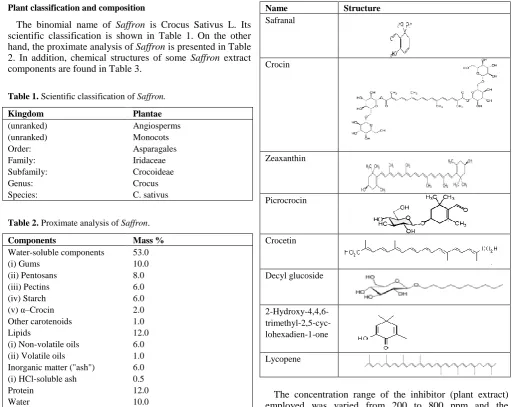
The binomial name of Saffron is Crocus Sativus L. Its scientific classification is shown in Table 1. On the other hand, the proximate analysis of Saffron is presented in Table 2. In addition, chemical structures of some Saffron extract components are found in Table 3.
Table 1. Scientific classification of Saffron.
Kingdom Plantae
(unranked) Angiosperms (unranked) Monocots
Order: Asparagales
Family: Iridaceae
Subfamily: Crocoideae
Genus: Crocus
Species: C. sativus
Table 2. Proximate analysis of Saffron.
Components Mass %
Water-soluble components 53.0
(i) Gums 10.0
(ii) Pentosans 8.0 (iii) Pectins 6.0 (iv) Starch 6.0 (v) α–Crocin 2.0 Other carotenoids 1.0
Lipids 12.0
(i) Non-volatile oils 6.0 (ii) Volatile oils 1.0 Inorganic matter ("ash") 6.0 (i) HCl-soluble ash 0.5
Protein 12.0
Water 10.0
Fiber(crude) 5.0
Preparation of plant extract
A sample from crude Saffron leaves was soaked in triply distilled water and the plant extract was concentrated in 1 L, and found to contain 1 mg ml-1 of the plant compounds
(1000 ppm).
Preparation of specimens
Measurements were made on ultrapure aluminium (99.99%). The samples were polished successively using 1/0 to 6/0 emery papers, degreased with acetone and washed by distilled water before use.
Electrolyte
The solutions used were made of AR grade hydrochloric acid. Appropriate concentrations of acids were prepared by using triple distilled water.
Table 3. Chemical structures of some Saffron extract components.
Name Structure
Safranal
Crocin
Zeaxanthin
Picrocrocin
Crocetin
Decyl glucoside
2-Hydroxy-4,4,6- trimethyl-2,5-cyc-lohexadien-1-one
Lycopene
The concentration range of the inhibitor (plant extract) employed was varied from 200 to 800 ppm and the electrolyte volume used was 100 ml, at 25 ±1 ºC.
Weight loss method
Weight loss of rectangular aluminium specimens of size (5 cm x 3 cm x 0.1 cm) in duplicate immersed in 100 ml of electrolyte with and without addition of different concentrations of plant extract was determined after 30 min at room temperature (25 ±1 ºC). The percentage inhibition efficiency (IE) was calculated from,
where Wun is the weight loss of the sample in the blank
solution and Winh the weight loss of the sample in presence
of the additive.
(%) Wun Winh100 (1)
IE
Wun
Table 4.Variation of polarization parameters for aluminium in 2 M HCl solution at (25 ±1 ºC) with extract addition.
Electrochemical measurements
A three electrode cell assembly consisting of aluminium coupon of the size (1.0 cm x 1.0 cm x 0.1 cm) embedded in specimen holder as working electrode (WE), a platinum sheet as counter electrode (CE) and saturated calomel electrode (SCE) as reference electrode (RE) containing 100 ml of electrolyte was used for electrochemical measu-rements at 25 ±1 ºC.
Open circuit potential (OCP) measurements
The OCP of aluminium electrode/2 M HCl and its potential in inhibited solution was followed as a function of immersion time till steady state values were reached. All potentials were measured referred to saturated calomel electrode (SCE) using EG & G (Princeton Applied Research) Model 352/352 potentiostat/galvanostat interfaced to an IBM ps/3 computer, the software is V, –5.36.
Polarization measurements
(i) Tafel
Tafel polarization curves were recorded by using computer controlled electrochemical system mentioned before. The potential increased with the speed of 5 mV s-1.
Experiments were carried out from –1150 to –450 mV potential ranges. Before recording the polarization curves, the (WE) was maintained at its corrosion potential for 10 min until a steady state was reached.
(ii) Linear polarization (LP)
Polarization resistance (Rp) was measured using the linear
polarization method by potential scanning over the range of Ecorr; ±20 mV at 1 mV/s. The Rp values were obtained from
the current–potential plot, for aluminium in 2 M HCl in the absence and presence of 600 ppm concentrations of the inhibitor at room temperature.
Surface analysis
The test coupons of the size 1 x 1 cm2 were exposed to
100 ml of 2 M HCl having 600 ppm plant extract for 1 h at 25 ±1 ºC and washed with distilled water. After washing, specimens were dried, and examined for their topographical features using scanning electron microscope (SEM).
Results and Discussion
Weight loss measurements
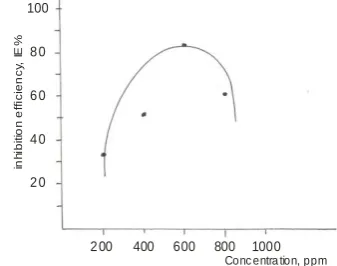
The weight losses (gravimetric measurements) for aluminium in 2 M HCl containing different concentrations of the leaves of Saffron extract ranging from 200-800 ppm indicate that the inhibition efficiency increases as the concentration of the added extract is increased up to 600 ppm that gave 84% efficiency and then decreases after that, Fig. 1. The observed inhibition action of the Saffron extract could be attributed to the adsorption of its components on aluminium surface. The formed layer, of the adsorbed molecules, isolates the aluminium surface from the aggressive Cl– ions medium leading to decrease in weight loss. Fig. 2 represents the variation in inhibition efficiency IE% with immersion time 30-90 min using the optimum dose (600 ppm) of saffron extract. Good performance behaviour of our inhibitor over 11/2 h (90 min) processing.
Figure 1. Variation of inhibition efficiency IE% with inhibitor
concentration
To study the adsorption behaviour of Saffron extract on aluminium surface in 2 M HCl medium, the adsorption isotherm must be defined. The nature of corrosion inhibition has been deduced in terms of the adsorption characteristics of the inhibitor.47 The metal surface in aqueous solution is
always covered with adsorbed water dipoles. Therefore, the adsorption of the inhibitor molecules from aqueous solution is a quasi substitution process.48,49 Therefore, the relation
between the concentration of the extract (c) and the fraction of aluminium surface covered by adsorbed components (Ө) was obtained. Because the inhibition action is postulated as a result of the adsorption, (Ө) is directly related with the inhibition efficiency (IE) and was calculated using the equation: (Ө) =IE/100.
Technique Inhibitor
dose, ppm Ecorr, mV Βa, V/d Βc, V/d Icorr, µA cm
-2 R
p, Ω CR, mpy IE, %
Tafel Blank -847 0,3879 0.2573 1114 — 1.433 x
103 —
600 -793.6 0.3628 0.3159 171.2 — 220.3 84.6
LP Blank -856 0.100 0.100 740.5 14.66 952.9 —
600 -805.2 0.100 0.100 158.8 68.37 204.4 78.5
100
8 0
6 0
4 0
2 0
2 00 400 600 800 1000
in
h
ib
it
io
n
e
ff
ic
ie
n
c
y,
IE
%
Conc entra tion, ppm
Figure 2. Effect of exposure time
Adsorption isotherm analysis
A graphic representation of the relationship between logarithm (extract concentration) and surface coverage (Ө) is given in Fig. 3. Inspection of Fig. 3 reveals that a straight line was obtained fitting Temkin adsorption isotherm.
Figure 3. Temkin adsorption isotherm (θ) vs. logC.
Open circuit potential studies
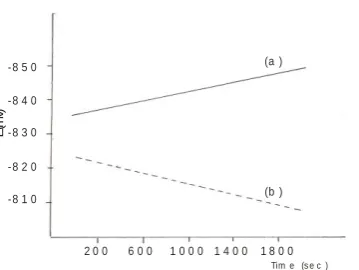
Potential Vs time plots for aluminium in 2 M HCl in absence and presence of (600 ppm) Saffron extract at room temperature (25 ±1 ºC) are shown in Fig. 4, curves (a) and (b) respectively. The curves indicated that in the presence of 600 ppm inhibitor, curve (b), the potential was shifted to less negative values. Whereas, the potential of a blank solution curve (a) was noticed to have more negative magnitudes.
Polarization measurements
Fig. 5 represents the anodic and cathodic Tafel polarization curves of aluminium electrode in solution of 2 M HCl alone and in the presence of 600 ppm inhibitor extracts concentration. Inspection of Fig. 5 reveals that the polarization curves are shifted towards less negative potentials and less current densities with inhibitor addition, curve (b). This behaviour indicates the inhibitive action of the added extract on aluminium corrosion in the acid solution. Various kinetic parameters, such as corrosion current (Icorr), corrosion potential (Ecorr), cathodic Tafel slope
(βc), anodic Tafel slope (βa) and inhibition efficiency (IE %)
are given in Table 4.
Figure 4. Potential vs. time plots for aluminum in 2 M HCl
solution at (25 ±1 oC): (a) blank, (b) 600 ppm inhibitor
The addition of plant extract does not change the value of anodic Tafel slope (βa) significantly. Corrosion current of
aluminium decreases much in the presence of 600 ppm inhibitor addition. Increase in cathodic Tafel slope (βc) with
plant extract dose applied indicates that Saffron inhibitor inhibits corrosion by inhibiting cathodic reaction by simply blocking the available surface area. The inhibitor molecules decrease the surface area of corrosion and cause only inactivation of the part of the surface with respect to the corrosion medium.
The corrosion rate (CR) is directly related to the Rp and
can be calculated from it.50 The R
p value can help us to
assess the relative ability of a material to resist corrosion. Since Rp is inversely proportional to Icorr, so the materials
with highest Rp (and thus the lowest Icorr) have the highest
corrosion resistance. From all these facts, we can discuss and correlate between the data obtained from Rp and those
computed from Tafel plots. Polarization parameters for aluminium corrosion in 2 M HCl and the presence of 600 ppm Saffron extract are shown in Table 3. It is observed that, in the presence of inhibitor, Ecorr shifts to more positive
values. Furthermore, the value of Rp increases, while the
value of Icorr decreases with additive. From the data depicted
in Table 4, it has been found that the addition of Saffron to aluminium in 2 M HCl enhances the corrosion inhibition efficiency (IE %).
Figure 5. Polarization curves for aluminum in 2 M HCl solution:
(a) blank, (b) 600 ppm inhibitor
SEM investigation
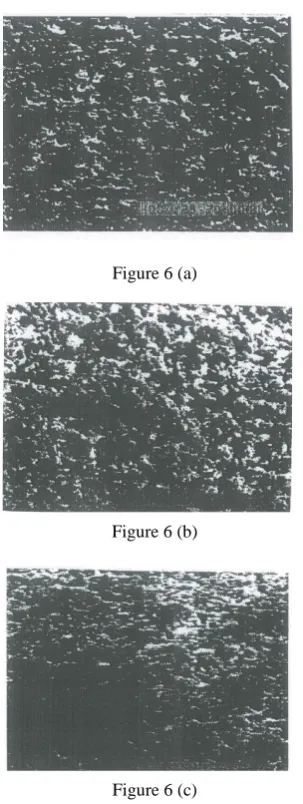
Scanning electron micrographs (SEM) of aluminium surface immersed in 2 M HCl (blank) and 2 M HCl containing 600 ppm plant extract are shown in Fig. 6.
100
80
60
40
20
0
in
h
ib
it
io
n
e
ff
ic
ie
n
c
y,
I
E
%
30 60 90
time (m in)
fig 2. Effect of exposure time.
-8 5 0
-8 4 0
-8 3 0
-8 2 0
-8 1 0
2 0 0 6 0 0 1 0 0 0 1 4 0 0 1 8 0 0
Tim e (s e c )
E
(m
V)
(a )
(b )
A rough surface was noticed for aluminium immersed in 2 M HCl solution. In case of aluminium immersed in 2 M HCl with 600 ppm Saffron extract, a smooth surface was noticed and it is easily comparable with the polished surface. This shows that, this plant extract inhibits corrosion of aluminium in 2 M HCl solution.
Inhibition mechanism
The existing data show that most organic inhibitors get adsorbed on the metal surface by displacing water molecules and form compact barrier film.51 Availability of lone pairs
and π (pi) electrons in inhibitor molecules facilitate electron transfer from the inhibitor to the metal, forming a coordinative covalent bond.52 The strength of chemisorption
bond depends on the electron density on the donor atom of the functional group and also the polarizability of the group. Observation of the chemical structures of Saffron reveals that these compounds can adsorb on aluminium surface via the lone pairs of electrons present on their oxygen atoms.
Figure 6 (a)
Figure 6 (b)
Figure 6 (c)
Figure 6. SEM graphs of aluminium (a) polished clean surface, (b)
immersed in 2 M HCl solution, (c) immersed in 2 M HCl with 600 ppm of plant extract.
The adsorption of such compounds on the aluminium surface make a barrier for charge and mass transfer leading to decrease the interaction of the metal with the corrosive environment (2 M HCl). As a result, the corrosion rate of aluminium is decreased.
Conclusions
From the overall experimental results the following conclusions can be deduced:
The aqueous extract of Saffron (LV) acts as a good inhibitor for corrosion of aluminium in 2 M HCl solution.
The inhibition efficiency increases with increasing extract concentration and attain a maximum value of 84.6 % at 600 ppm.
Saffron acts as a cathodic inhibitor with modifying the hydrogen reduction mechanism.
The inhibitive action of extract was attributed to the adsorption of its components on aluminium surface.
The adsorption of extract components follows Temkin adsorption isotherm.
References
1Rozenfeld, I. L. , Corrosion Inhibitors, McGraw-Hill, New York,
1981
2Tomcsanyi, L.,Varga, K., Bartik, I., Horanyi G. and Maleczki, E.,
Electrochim. Acta, 1989, 34, 855.
3Stevanovic, R. M., Despic, A. R. and Drazic, D. M., Electrochim.
Acta,1988, 33, 397.
4Frers, S. E., Stefenel, M. M., Mayer, C. and Chierchie, T., J. Appl.
Electrochem.,1990, 20, 996.
5Maayta, A. K. and Al-Rawashdeh, N. A. F., Corros. Sci.,2004, 46,
1129.
6Ovari, F., Tomcsanyi, L. and Turmezey,T., Electrochim. Acta 1988, 33, 323.
7Young, L., Anodic Oxide Films, Academic Press, New York, 1961,
p. 4-10.
8Saleh, M. R. and Shams El Din,A. M., Corros. Sci.1981, 12, 688. 9Telegdi, J., Kalman, E. and H. Karman, H., Corros. Sci.1992, 33,
199.
10Mahmoud, S. S., Bull. Electrochem.1995, 11, 366.
11Hiuton, B. R.W., Arnott, D. R. and T. Ryan, Mater. Forum 1986,
9, 162 .
12Bazzi, L., Kertit,S. and Hamani,M., Bull. Electrochem.1998, 14,
34
13Mansfeld, F., Lin, S., Kim, S. and Shih, H., Corros. Sci.1987, 27,
997.
14Macdonald, D. D., Electrochem. Soc.1993, 138, L 27. 15El-Etre, A.Y., Corros. Sci.1998, 40, 1845.
16Bouyanzer, A., Hammouti, B. and Majidi,L., Mater. Lett.2006,
60, 2840.
17El-Etre, A.Y., Corros. Sci.2001, 43, 1031. 18El-Etre, A.Y., Corros. Sci. 2003, 45, 2485.
19El Hosary, A. A., Saleh, R. M. and Shams El-Din, A. M., Corros.
20Ekpe, U. J., Ebenso, E. E., Ibok, U. J. and Afri, W., Sci. Assoc. 1994, 37, 13.
21Ebenso, E. E., Ekpe, U. J. and Afri, W., J. Bio. Appl. Chem.1996,
41, 21.
22Avwiri, G. O. and Igho, F. O., Matter. Lett.2001, 57, 3705. 23Ebenso, E. E., Ibok, U. J., Ekpe, U. J., Umoren, S., Jackson, E.,
Abiola, O. A., Oporka, N. C. and Martinez, S., Trans. SAEST
2004, 39, 117.
24El-Etre, A. Y., Abdallah, M. and El-Tantawy, Z. E., Corros. Sci. 2005, 47,385.
25El-Etre, A. Y. and El-Tantawy, Z. E., Port. Electrochem. Acta 2006, 24, 347.
26Umoren, S. A., Obot, I. B., Ebenso, E. E., Okafor, P. C. , Ogbobe,
O. and Oguzie, V., Anti. Corros. Meth. Mater.2006, 53, 277.
27Oguzie, E. E., Onuchukwu, A. I., Okafor, P. C. and Ebenso, E. E.,
Pigm. Res. Technol.2006, 35, 63.
28Oguzie, E. E., Mater. Chem. Phys.2006, 99, 441. 29Oguzie, E. E., Corros. Sci.2007, 49, 1527.
30Okafor, P. C., Ekpe, U. J., Ebenso, E. E., Umoren, E. M. and
Leizou, K. E., Bull. Electrochem.2005, 21, 347.
31Okafor, P. C., Ekpe, U. J. , Ebenso, E. E., Oguzie, E. E., Umo, N.
S. and Etor, A. R., Trans. SAEST2006, 21, 82.
32Okafor, P. C., Osabor, V. I. and Ebenso, E. E., Pigm. Res.
Technol.2007, 35, 299.
33Okafor, P. C. and Ebenso, E. E., Pigm. Res. Technol.2007, 36,
134.
34Umoren, S. A., Obot, I. B., Ebenso, E. E., Okafor, P. C., Ogbobe,
O., and Oguzie, E. E., Anti. Corros. Methods Mater. 2006, 53, 277.
35Khuzaeu, V. U. and Aripova, S. F., Chem. Nat. Compound2000,
36, 418.
36Sangeetha, M., Rajendran, S., Sathiya Bama, J., Krishnaveni A.,
Santhy, P., Manimaran, N., Shyamaladevi, B., Port. Electrochim. Acta, 2011, 29, 429.
37Sirbharathy, V., Rajendran, S., Sathyabama, J., Int. J. Chem. Sci.
Technol., 2011, 3, 108.
38Syamala Devi, B., Rajendran, S., Int. J. Chem. Sci. Technol., 2011, 1, 79.
39Sangeetha, M., Rajendran, S., Muthu Megala T. S., and
Krishnaveni, K., Zast. Mater., 2011, 52, 35.
40Antony, N., Benita Sherina, H., and Rajendran, S., Int. J.. Eng.
Sci. Technol., 2010, 2, 2774
41Bablwin, J., British Patent 2327, 1895.
42Putilova, N., Balezin, S. A. and Barannik, V. P., Metallic
Corrosion Inhibitors 1960, (Pergamon Press, Oxford, London).
43El-Etre, A. Y. and Abdallah,M., Corros. Sci.2000, 42, 731. 44Kliskic,M., Radosevic, J., Gudic, S. and Katolinic,V., J. Appl.
Electrochem.2000, 30, 823.
45Muller, B., Corros. Sci.2002, 44, 1583. 46El-Etre, A. Y., Appl. Surf. Sci. 2005, 252, 8521.
47Bentiss, F., Lagrenee,M., Traisnel, M., Mernari, B. and El-Attari,
H., J. Appl. Electrochem.1999, 29, 1073.
48Rudresh, H. B. and Mayanna, S. M., J. Electrochem. Soc.1977,
124, 340.
49Bockris, J. O., Devanathan, M. A. V. and Muller, K., Proc. Roy.
Soc. London A1963, 274, 55.
50Uhling, H. H. and Revie, R.W., Corrosion and Corrosion control,
3rd edition, Wiley, New York, 1985.
51Muralidharan, S., Phani, K. L. N., Pitchumani, S., Ravichandran,
S. and Iyer, S. V. K., J. Electrochem. Soc. 1995, 142, 1478.
52Hackerman, N. and Hard, R. M., Proc. Int. Congress. of Metallic
Corrosion, Butterworth, London, 1962.