Wayne State University Dissertations
January 2019
Data-Driven Intelligent Scheduling For Long Running Workloads In
Data-Driven Intelligent Scheduling For Long Running Workloads In
Large-Scale Datacenters
Large-Scale Datacenters
Guoyao XuWayne State University, [email protected]
Follow this and additional works at: https://digitalcommons.wayne.edu/oa_dissertations Part of the Computer Engineering Commons, and the Computer Sciences Commons
Recommended Citation Recommended Citation
Xu, Guoyao, "Data-Driven Intelligent Scheduling For Long Running Workloads In Large-Scale Datacenters" (2019). Wayne State University Dissertations. 2194.
https://digitalcommons.wayne.edu/oa_dissertations/2194
This Open Access Dissertation is brought to you for free and open access by DigitalCommons@WayneState. It has been accepted for inclusion in Wayne State University Dissertations by an authorized administrator of
by
GUOYAO XU DISSERTATION
Submitted to the Graduate School of Wayne State University,
Detroit, Michigan
in partial fulfillment of the requirements for the degree of
DOCTOR OF PHILOSOPHY
2019
MAJOR: COMPUTER ENGINEERING Approved By:
GUOYAO XU 2019
Dedicated to my loving parents, lovers, family and friends for their persistent
encouragement and consistent support.
The study for PhD in the past 6 years and Master for 2 years is full of pressures, adventures, frustrations, obstructions and challenges. The 8-year precious time and experi-ences would be an invaluable wealth in my whole life. I could not have achieved anything without help from many people. I am sincerely grateful to my great advisor, Dr. Cheng-Zhong Xu, for his invaluable guidance, support, and encouragement throughout this work. His devotement, enthusiasm, patience, persistence, abundant knowledges and experiences, rigorous logic and creative thinking for research motivated me in the Ph.D. pursuit. He devotes countless time, energy and resources to train me to become a qualified researcher and a potential scientist.
I would also like to thank Dr. Carol Miller for her support, help and guidence since 2011. I have gained countless research, engineering and industrial experiences from fields like intelligent energy efficiency and environmental protection techniques by working with her. It helps me open fields of vision and think in a macro view. I would also like to thank Dr. Song Jiang for his outstanding contributions on guiding my scientific and logical thinking during my first research project. Under Dr. Jiang’s help, I overcome the most frustrated and dark time of Ph.D period and successfully enter the world of science and research. His integrity, purity, honest, smart, wisdom, rigorous logic and creative thinking have a deep influence on me. I obtained invaluable scientific way of thinking and experiences of research, experiments and paper writings. They have become my powerful weapons to conquer further challenges, and even affect my values and thinking in my daily life. I would also like to thank Dr. Weisong Shi for his guidances and supports during my master degree. With the help of Dr. Shi, I successfully and rapidly transfer my major and background from electronic engineering (EE) to computer science (CS). I learned programming, fundemental CS tech-nique knowledges, operator and maintenance experiences of system and cluster, research, expression and presentation skills from him. He is my first mentor of CS. He helps me not
really my great honour to work with these admired people and intelligent talents.
I am also grateful to my committee members: Dr. Nabil Sarhan, Dr. Carol Miller and Dr. Song Jiang for their time, interest, and helpful suggestions to improve this work. I would also like to thank Mr. Stephen Miller, Mr. Loch McCabe, Dr. Caisheng Wang for helps of projects. I am thankful to my colleagues and friends, Kun Wang, Xingbo Wu, Kejiang Ye, Jianqiang Ou, Yang Wang, Xi Zhang, Bo Peng, Yudi Wei, Yuehai Xu, Xiangping Bu, Dajun Lu, Yun Wang, Jie Cao, Mingyang Xu and so many friends, for their friendship and help.
Finally, I want to give special thanks to my parents and family for their understanding and unconditional support for my study during happy and hard days. They endure the same extent of negative emotions and challenges as me. Without their help and dedication, I would never finish this work.
Dedication ii
Acknowledgements iii
LIST OF FIGURES xi
LIST OF TABLES xii
CHAPTER 1 INTRODUCTION 1
Motivation and Background . . . 3 Evolutions of Resource Management and Scheduling over Decades. . . 3 Challenges, Problems and Scenarios of Scheduling and Resource Man-agement for Long-running Workloads. . . 5 Methodology . . . 9
Inherent Problems and Three Critical Abilities Towards Intelligent Scheduling and Cluster Delicacy Management to Resolve NP-hard Cluster Scheduling Problem . . . 9 Data-driven Intelligent Scheduling Methodology. . . 13 Dynamic Operating Systems Management and Control. . . 15 Optimal Resource Provisioning for Long-running Workloads (Memory) . . . 17 Contention and Interference-Aware Co-Scheduling (Co-locating) for Long-running Workloads (Network and Disk I/O) . . . 20 Datacenter Co-locations Techniques for Long-running Workloads at Large-scale 23 Evaluate the Effectiveness of Long-running Workloads Co-location Techniques by Analysis of Alibaba Datacenter Trace . . . 26 Dissertation Organization . . . 27
CHAPTER 2 RELATED WORK 29
Towards Intelligent Scheduling . . . 29 Optimal Provisioning By Intelligent Scheduling . . . 32 LRA and LRS Scheduling in Large-scale Datacenter . . . 35
CHAPTER 3 MEER: Online Estimation of Optimal Memory Reservations for Long Lived Containers in In-Memory Cluster Computing 40
Introduction . . . 40
Motivation . . . 41
Rationale of Methodology . . . 45
Design of MEER . . . 48
Modeling and Robust Profilings . . . 48
Overview of Workflow and Implementation . . . 51
Histogram Frequency Analysis . . . 53
Recursive Search Loop . . . 56
Evaluation . . . 58
Accuracy of Prediction . . . 59
Performance on the Batches Running . . . 63
Summary . . . 66
CHAPTER 4 Prophet: Scheduling Executors with Time-varying Resources Demands on Data-Parallel Computation Frameworks 67 Introduction . . . 67
Motivation . . . 71
Design ofProphet . . . 76
Prophet’s Scheduling Algorithm . . . 76
Ameliorating Contention with Task Backoff . . . 81
Implementation and Evaluation of Prophet . . . 83
Prophet’s Implementation . . . 83
Experiment Setup . . . 84
Experiment Results . . . 85
Summary . . . 89 vi
Introduction . . . 90
Challenges of Datacenter Inefficiency . . . 90
The Motivation and Feasibility of Colocations . . . 92
Challenges of Co-locations . . . 95
Envolvement of Infrastructure in Alibaba . . . 101
Unified Resource Scheduling at Large Scale . . . 102
Elastic Resource Sharing . . . 103
Priority-based Quota, Overcommitment, Preemption and Reclaimation 104 Discussion and Future . . . 108
CHAPTER 6 Imbalance in the Cloud: an Analysis on Alibaba Cluster Trace109 Introduction . . . 109
The Dataset . . . 112
Imbalances of Machines . . . 113
Imbalances of Workloads . . . 115
Imbalances of Resource Demands . . . 116
Imbalances of Batch Job Durations . . . 122
Discussion . . . 122 Summary . . . 123 CHAPTER 7 CONCLUSION 124 Conclusions . . . 124 Future Directions . . . 125 REFERENCES 151 ABSTRACT 152 AUTOBIOGRAPHICAL STATEMENT 155 vii
1.1 Evolution of Scheduling Problems Over Decades. . . 4
1.2 Spark’s two-level scheduling upon Yarn. . . 6
1.3 Resource management and scheduling temporal workflow. . . 10
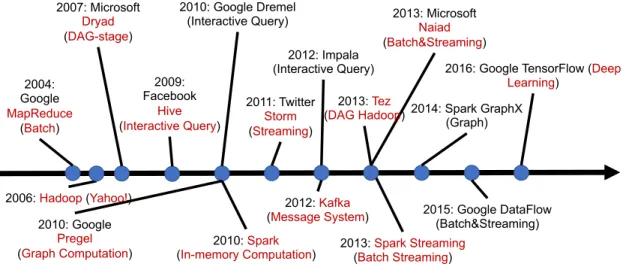
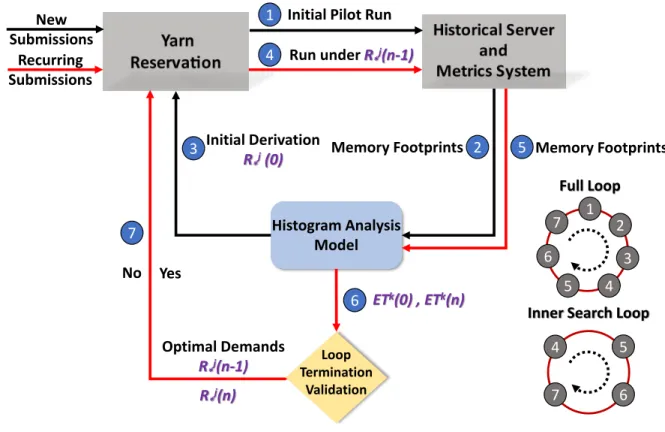
1.4 Intelligent Scheduling for LRAs or LRSs by Prophet and MEER (Prometheus). 16 2.1 15-years Booming Evolution of Datacenter Computation Engines. . . 30
2.2 15-years Booming Evolution of Resource Scheduling in Datacenter. . . 30
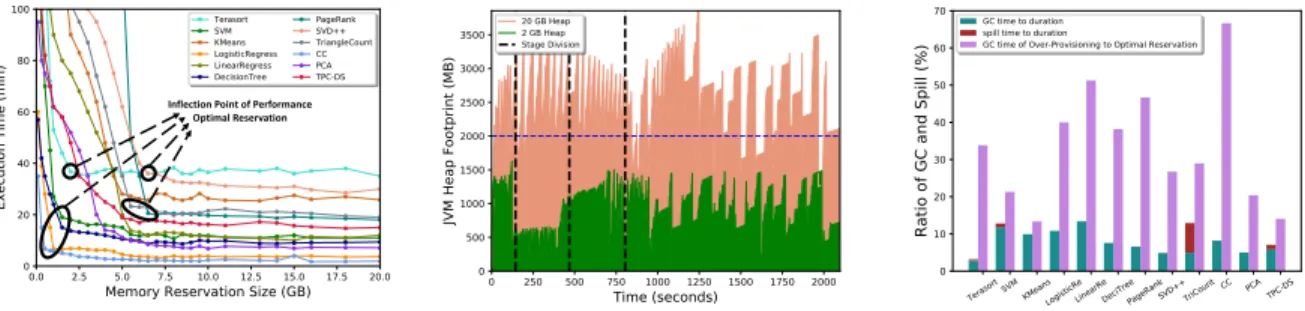
3.1 Long-tail variations of application runtime under degressive reservations. . . 42
3.2 Memory footprints of Terasort under optimal (2 GB) and over-provisioned (20 GB) reservations. . . 42
3.3 The ratio of aggregate GC and spill time to runtime due to optimal reservation and over-provisioning.. . . 42
3.4 MEER’s architecture and workflow.. . . 52
3.5 Footprint and histogram of SVM. . . 54
3.6 Under- and over-estimated errors during recurring executions. . . 59
3.7 Variations of application runtime during recurring executions. . . 59
3.8 Searching overheads of MEER, Elastisizer and SLAMR. . . 59
3.9 Ultimate accuracy of estimations under MEER, Elastisizer and SLAMR. . . 63
3.10 Execution time speedup of default YARN to MEER, and SLAMR to MEER per application. . . 63
3.11 Memory utilization during batches runs under various demands estimators. 63 4.1 Disk bandwidth usages of four Spark benchmarks (K-means, SVM, PageRank, and SVD++). DAG stages are marked with dotted lines. . . 71
4.2 Network bandwidth usages of four Spark benchmarks (K-means, SVM, PageR-ank, and SVD++). DAG stages are marked with dotted lines. . . 72
the five runs of each of 10 benchmarks with different setups on CPU core and
input size. Each run uses a different input dataset. . . 74
4.4 Illustration of predicting available disk bandwidth. With known demands on
disk bandwidth from executors (see (a) and (b), the shaded area in (c) between their combined demand and the disk’s capacity represents the disk bandwidth
to be available. . . 77
4.5 Illustration how fragmentation area (FA) and over-allocation area (OA) of disk
bandwidth are formed for two executors. For each executor (see (a) or (b)), the up graph shows its demand on disk bandwidth, and the bottom graph shows the demand and the available disk resource (shaded area computed in
Figure 4.4) overlap with each other to form FAs, such asA1,A2, andA3, and
OAs, such as B1 andB2. . . 78
4.6 The framework of Spark applications running on a Yarn cluster, in which
Prophet modules are included (shown as shaded boxes). . . 82
4.7 CDF curves for reductions of execution times by Scheduler X over Scheduler
Y, shown as X vs. Y. X can be Prophet and Tetris, and Y can be CS, DRF,
and Prophet. . . 85
4.8 CDF curves for reductions of completion times by Scheduler X over Scheduler
Y, shown as X vs. Y. X is Prophet, and Y can be CS, DRF, and Prophet. . . 86
4.9 Disk utilizations during running 90 applications under various schedulers. . . 87
4.10 Network utilizations during running 90 applications under various schedulers. 88
4.11 CDF curves for reductions of execution and completion times by Prophet over
Prophet without task backoff mechanism. . . 88
5.1 Peak TPS of Double 11 in recent years. . . 91
5.2 QPS comparisons between Double 11 and daily core eCommerce services like
Buy, Cart and TradePlatform (TP). . . 91
Buy, Cart and TradePlatform (TP). . . 91
5.4 Aggragate average CPU utilization (%) of online LRSs (blue dash) and data-intensive workloads (orange dash) of two seperate clusters during one month. 92 5.5 Aggragate average memory utilization (%) of both online LRSs (blue dash) and data-intensive workloads (orange dash) of two seperate clusters during one month. . . 92
5.6 The ratio of memory reservation to quota limit (%) of data-intensive workloads of an offline cluster during one month. . . 92
5.7 A complete shopping process consists of 200+ services. Pentagrams indicate the chain reaction of services time out. . . 96
5.8 The global view of Alibaba technique stack and architecture.. . . 98
5.9 Alibaba unified resource management. . . 103
5.10 CPU elastic management.. . . 108
6.1 The heat maps of CPU and memory utilization of machines in the cluster. The white portion indicates the lack of data in the trace. Red color indicates high utilization while blue color indicates low utilization. . . . 111
6.2 The CPU and memory utilization of machines during execution. The red line indicates the maximum utilization of all machines in the cluster, the blue one indicates the average utilization and green one means minimum utilization of all machines. . . 112
6.3 Job counts by average CPU request numbers (left) and average CPU used numbers (right) per task. Note the log-scale on the plot’s x-axis. . 117
6.4 Task counts by average CPU request numbers (left) and used numbers per instance (right). Note the log-scale on the plot’s x-axis. . . 117
6.5 Task counts by normalized average memory request sizes (left) and used sizes (right) per instance. Note the log-scale on the plot’s x-axis. . . 118
red, blue, green lines indicate the maximum, average and minimum ratio of all service instances respectively. . . 119 6.7 CDF of instances’ average resource utilizations of 12 hours. . . 120 6.8 Hourly average and maximum CPU loads of all service instances (top)
and machines (bottom). The sampling interval is one minute, five min-utes, and fifteen minutes from left to right. The dashed line represents the total capacity of each machine. . . 121 6.9 CDF of job durations. We only count the terminated jobs. . . 122
3.1 Experiment configurations of 12 workloads . . . 41
3.2 Container memory usages summary per stage . . . 47
3.3 Task memory usages summary per stage . . . 49
3.4 Input Parameters Notations . . . 53
3.5 Each set of 15 input sizes for 15 benchmark workloads . . . 58
4.6 Three categories of input dataset sizes for each of 10 benchmarks. . . . 74
4.7 Notations in the Prophet’s scheduling algorithm . . . 79
4.8 Makespans produced by various schedulers for running the 90 applications. . 86
5.9 Workload Characteristics . . . 94
5.10 Priority and QoS Guarantee of Resources and Workloads . . . 105
6.11 Statistics of Batch Jobs . . . 116
CHAPTER 1 INTRODUCTION
With the rapid growth of big data-driven artificial intelligence and cloud based indus-trial innovations, IT techniques are becoming the most critical factors to booming evolutions and future success of various industries, which is named the Fourth Industrial Revolution. Many emerging industries like autonomous cars, blockchain, fintech, new energies, robotics, quantum information, as well as traditional industries (electric power, manufacturing, med-ical, finance, biology, biomedmed-ical, environment, architecture, catering, retail and estates), are deeply affected by data and intelligence era. They inevitablly leverage cloud based big data and artificial intelligence techniques to improve effectiveness, study technological inno-vations, create new business models and replace original industry chain. For a fast rising rocket of society, diverse cloud-based big data distributed computing systems turned to be the engines. Abundant algorithms (machine learning, statistics, control algorithm, game theory...) are the boosters, while the immeasurable accumulated big data become the fuels. Generally, big data are being processed by various computing engines running on the infrastructures of global cloud datacenters, which are becoming fundamental facilities of society. The infrastructure’s role of cloud datacenter to industry is equal to the essential status as electricity to human society. The abundant hardware resources, as well as compu-tation, storage and adatively learning abilities, are most critical for human beings towards big data-driven intelligent era. As fast evolutions of society utility, its scale would be rapidly increasing and incredibly tremendous.
Large-scale public or private cloud datacenters spreading millions of servers, as a warehouse-scale computer [53], are supporting most business of Fortune-500 companies and serving billions of users around the world. Typical infrastructures construction al-ways involves tens of billions of capital investment, which accounts for 60% of total IT budget [53, 56, 66]. Servers purchasing dominate the total cost of ownership (TCO) (50%-70%) [53, 131]. The operating expenditures including energy cost occupy the rest. During the limited life span of 5 and 10 years for both servers and datacenters [53, 56], maximize
resource efficiency is critical to improve return on investments (ROI) and reduce TCO of infrastructures. Unfortunately, recent studies [60, 69, 74, 75, 126, 131, 135, 150, 165, 179, 185] reveal that industry-wide average utilization is as low as 6% [66] to 12% [19]. Low uti-lization not only negatively impacts operational and capital components of cost efficiency, but also becomes the scaling bottleneck due to the limits of electricity delivered by nearby utility. Improve resource efficiency of the large-scale fundamental infrastructure of society would bring unmeasurable values. Our society not only benefits from cost-efficiency and eco-nomic savings, but also from energy efficiency, environmental protection and emancipation of labour.
Recently, with the great commercial success of diverse big data analytics services, enterprise datacenters are evolving to host heterogeneous computation workloads including online web services [39], machine learning [40, 144, 203], streaming processing [13, 116, 176, 204], interactive query [50, 55, 168, 192] and graph computation [93, 119, 133, 138] on shared clusters. Unlike the traditional batch jobs [14, 71, 107] that rely on individual short-lived container (milliseconds to seconds) to run every task, these workloads benefit from long-lived containers (in the order of hours or months) to execute the entire application. These containers stay alive until an application’s all subsequent multitier web or across-DAG-stage tasks scheduled on them are completed, so as to speedup execution by caching iterative intermediate data and avoid repeated container initialization costs. Generally, there are two types of long-running workloads. The data-intensive offline computation workloads are named long-running applications (LRAs) [86, 194, 196]. The online user-facing enterprise services like eCommerce, maps or finances that run inside non-stopped containers are named long-running services (LRSs). Observed from public enterprise cluster traces [11, 26] and analytic results [64, 127, 128, 135, 165, 185], most workloads in modern datacenters are either LRAs or LRSs.
Most previous works focus on maximizing the cluster efficiency for short-lived tasks in batch processing system like Hadoop [14,71] by optimizing scheduling algorithm (reschedule)
or achieving better resource management mechanisms (capacity planning, resource provision, auto-scaling, migration) [57, 58, 69, 72, 73, 75, 77, 78, 94–96, 105, 109, 110, 112, 113, 120, 155, 156, 160,162,163,173,177,184,185,190,196,209,210]. However, most of them are designed for past cluster scenarios and do not work well for modern long-running workloads, which have great spaces to be improved. It is critical and urgent to develop effective scheduling and resource allocation approaches to maximize efficiency in modern large-scale enterprise datacenters.
In the dissertation, we innovatively define the problems and scenarios of scheduling and resource sharing for diverse long-running workloads. As our best knowledges, we are the first of works to abstract and specify the scheduling problems and model of long-running workloads in modern datacenter. We aim to design and implement a cloud datacenter scheduling and management mechanism to maximize modern cluster resource efficiency of multi-dimensions (CPU, Memory, Network, Disk I/O) and strictly guarantee quality of ser-vices (QoS) for LRAs and LRSs.
Motivation and Background
Evolutions of Resource Management and Scheduling over Decades.
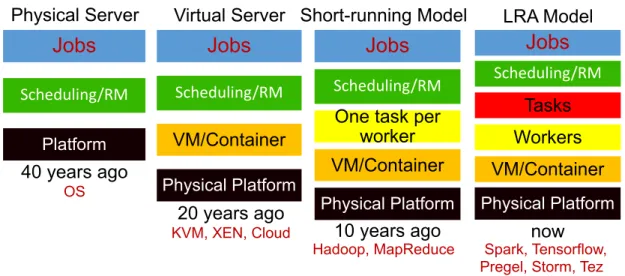
Figure 1.1 demonstrates the evolutions of scheduling problems during decades. Origi-nally, resource management are focus on scheduling of hardware resources in local operating system or distributed system (High-performance Computing, Grid Computing, Cluster Com-puting). Jobs are running inside processes and the scheduling unit is process or threads.
With the emerging of virtualization and conterization techniques, we could achieve better isolations and convenient management. It significantly increases resource efficiency of both local OS and cloud datacenter. It motivates the new commercial infrastructure as cloud computing. In cloud computing era, the scheduling unit are switching to virtual machines (Hadoop). They are always as black box, and cluster operator usually does not know what workloads they are running. The scheduling optimization are mainly relying on historical runtime statistics.
Jobs
Scheduling/RM Platform Physical Server VM/ContainerJobs
Scheduling/RM Physical Platform Virtual ServerOne task per worker VM/Container
Jobs
Scheduling/RM Physical Platform Short-running Model 40 years ago OS 20 years agoKVM, XEN, Cloud 10 years ago
Workers VM/Container
Jobs
Scheduling/RM Physical Platform LRA Model now Spark, Tensorflow, Pregel, Storm, Tez Hadoop, MapReduceTasks
Figure 1.1: Evolution of Scheduling Problems Over Decades.
With the booming evolution of big data analytics systems and techniques, private cloud datacenter are becoming the trends adopted by most IT companies. They always hold a public cloud datacenter as products and services providing for customers, and a private cloud datacenter used for their workloads and applications (Amazon, Alibaba, Microsoft, Google, IBM...). There is not a obvious spatial gap between public and private cloud. They might locate at the same physical global datacenters, just statically segmented by different cluster managers logically.
Datacenter workloads are towards long running ones. Tasks are running inside an-other layer of long-lived workers, which cache intermediate data and enable multiplexed data sharing between tasks from different DAG stages, so as to significantly speedup iter-ative executions (Spark, Storm, Pregel, Tensoflow, GraphX, Impala or user-facing online microservices) [40, 55, 93, 138, 138, 149, 176, 203, 204]. Each long-lasting worker is always running as a process (Java virtual machine) executing multiple concurrent tasks inside a container. It helps reduce the initial costs of container startup if run one task per container as in cloud computing era. Services are packed as a complete package (microservices) run-ning as worker processes inside containers. The scheduling subject and unit of cluster is switching to workers, and tasks scheduling are managed and handled by each application’s
master. Schedulers need to pre-provision workers before task scheduling to minimize startup overheads. Therefore, it needs predictively decide how much resources each worker might need before execution, and where to dispatch those workers to avoid future potential resource contentions and interferences. Demands and interference estimation abilities are becoming Unprecedented important.
As the famous insight that "Any problem in CS can be solved by another layer of indirection, except the indirection itself" by D. Wheeler. Although virtual machine/container techniques greatly improves modern system or datacenter efficiency, it incredibly complicates resource management. Schedulers need to consider and co-tunning different layers together to guarantee smooth executions of workloads. In modern scheduling model, it requires a bundle of predictive behaviors like pre-provision, pre-reserve and QoS-aware (interference-aware) scheduling. It proposes another level requirements for more delicacy Management and refined techniques of profilings, modeling and predictions.
The booming evolution of datacenter computating engines and resource managers over last decades force us to explore predictive scheduling methodology by artificial intelligence technologies, which we named intelligent scheduling.
Challenges, Problems and Scenarios of Scheduling and Resource
Management for Long-running Workloads.
Existing large-scale in-memory computing systems like Spark [203] and Flink [13] rely on a cluster resource manager like YARN [181], Mesos [103] or Borg [185] to effectively perform resources sharing between diverse LRA containers of multi-tenants in shared data-centers. Figure 1.2 exhibits Spark’s two-level scheduling on YARN. It schedules the execution of tasks in a two-level model: ahead of job execution and task scheduling, Yarn creates con-tainers for workers and pre-reserves specific amount of CPU and memory resources for them based on user’s requests (step 1). Every long-lived container only belongs to one application,
6
Prometheus
: Histogram Analysis of Memory Usages for
Online Estimation of Optimal Demands for Containers in
In-memory Computation
Abstract
—Modern resource managers like Yarn or Mesos leave
a non-trivial resource demands declaration problem for users of
data-parallel computation frameworks. A principal challenge is
to determine right amounts of reserved memory capacity to run
applications ahead of execution, so as to avoid over-provisioned
or under-provisioned reservation and minimize both idleness or
insufficient usage of memory. To balance the trade-off between
resource efficiency and application’s performance, and relieve
users’ burden of involvements in resource allocation, we designed
Prometheus
, an automatic memory demands estimation system
for large-scale data-parallel workloads. Prometheus achieves
minimal amount of memory reservations (optimal demands) that
achieve nearly optimal application performance.
It is challenging to identify optimal demands online for
new coming applications with low search overheads. Even for
recurring jobs, their optimal memory demands may change over
time due to variations of input datasets and other parameters.
Prometheus
uses a twp-step approach to deal with the challenge:
1) Do profiling and histogram frequency analysis of job’s runtime
memory footprints from
one pilot run
. It achieves a highly
accurate (over 80% accuracy) online initial estimation of optimal
demands per worker. 2) By exploiting self-decay property of the
analytical results, Prometheus performs recursive search over
recurring executions. We validate our design by implementing
Prometheus atop of Spark and Yarn. The experimental results
show that it achieves an ultimate accuracy of more than 92%.
By deploying
Prometheus
and reserving memory according to the
optimal demands, one could improve cluster memory utilization
by about 40%. It simultaneously reduces individual application
execution time by over 35% comparing to the state-of-the-art
approaches.
I. I
NTRODUCTION
The great commercial success of popular big data analytics
applications is highly depending on the rapid growth of
large-scale data-parallel computation frameworks like Apache
Hadoop [2], Spark [30] and Flink [1]. These frameworks are
designed to hide underlying parallelisms and detail distributed
executions of workloads, letting users focus on the specific
computation logic instead of additional complexity.
Most existing frameworks rely on a cluster resource
man-ager like YARN [23] or Mesos [15] to effectively perform
resources allocation and sharing among users. They solve the
non-trivial allocation problem of determining right amounts of
memory provision for workloads by requiring users to make
explicit reservations. Since the underlying physical executions,
widely varied load or complex codebases of workloads are
invisible, users tend to over-estimate or under-estimate their
memory demands, leading to over-provisioning or
under-provisioning of memory resources. Recent studies [10], [18],
Machine
Machine
Machine
YARN
(Resource Manager)
Pre-allocate Worker schedule Task schedule Task schedule
Idle worker One task runs in a worker
1
2 2 1
Users
Request Resources for WorkersApplication Master
Fig. 1:
Spark’s two-level scheduling upon Yarn.
[20]–[22] revealed that most cloud facilities and commercial
clusters operate at low utilization states due to this problem.
The issue is becoming even more serious in recent popular
in-memory computation frameworks like Spark and Flink.
To achieve timely results and speedup iterative
computa-tions, these frameworks adequately leverage memory resources
to cache intermediate data across multi-stage tasks in
pre-allocated worker processes. Figure 1 shows the resource
management mechanism of Yarn. It schedules the execution
of tasks in a two-level model: ahead of job execution and
task scheduling, Yarn creates containers for workers
1
and
pre-reserves specific amount of CPU and memory resources
for them based on user’s requests (step 1). Every long-lived
container only belongs to one application, and stays alive
until the application’s all subsequent DAG tasks scheduled on
them (step 2) are completed. Since a container is executed
for an entire application and runs multiple batches of tasks
from multi-stages, their memory demands change over time.
Simply adopting a holistic peak memory usage to represent
containers’ widely varying resource demands across stages
would incur extremely large pockets of resource wastes [28].
The problem becomes particularly challenging when users
need to predict and pre-specify future time-varying
across-stage memory demands of runtime instances before execution.
Besides, the effectiveness of in-memory computation
frame-works highly depends on efficient utilization of scarce cluster
memory resources. Since a container (or worker process)
is usually a Java virtual machine (JVM), its over-estimated
1
The worker process is called executor in Apache Spark [3], TaskManager
in Apache Flink [1] and container in Yarn. In this paper, we use the terms of
workers and containers interchangeably.
Figure 1.2: Spark’s two-level scheduling upon Yarn.
and stays alive until the application’s all subsequent DAG tasks scheduled on them (step 2) are completed.
An application of a Spark-like in-memory computing framework, does not expose its tasks to the underlying resource management system, like YARN and Mesos. Instead, the concept of worker is introduced as the scheduling instance in these systems. Once workers of an application are launched on servers by the systemâĂŹs scheduler, the applicationâĂŹs scheduler is responsible for scheduling its tasks to these pre-allocated workers. Specifically, an worker is usually a Java virtual machine (JVM) and tasks are threads running on the JVM. Each Spark application has a set of workers scheduled by the resource manager to different servers and they stay alive until all tasks of the application are completed. This two-level scheduling is adopted for two reasons. One is to cache a subset of data in memory to enable in-memory reuse of data across tasks in an worker in a fault-tolerant manner. The other is to significantly reduce overhead of launching tasks, which is critical for in-memory computing. In contrast, in a Hadoop application each task runs on a dedicated JVM, which is scheduled by the systemâĂŹs resource manager. While there are two levels of scheduling for in-memory computing, the workersâĂŹ scheduling plays a more performance-critical role as it represents the resources allo- cation and sharing between applications.
Traditional batch job releases short-lived container after one task terminates. Task scheduling binds to container dispatching. Job execution is along with numerous container placements. Program workflow is specific during resource reservation. Container provision is relatively easy through profiling [196], and not obtains many attentions since schedulers have numerous opportunities to reschedule and re-provision to achieve better quality.
Cluster scheduling subject is switching from tasks to workers in LRA. Worker schedul-ing binds to container placement, which is seperate from task schedulschedul-ing that managed by application’s master. Cluster schedulers need to predictively pre-reserve resources for containers before task scheduling, which always remain unchanged during long-term DAG execution. Container dispatching per application is one-time at job start, and extremely critical to ensure smooth execution of the whole application. It needs to consider long-time varying demands and colocating placements to avoid future potential contentions and interferences [196].
Tasks per stage are executed in pipeline and multiplexing in container by random scheduling. They always do not start or end at the same time. Multiple colocating tasks’ combined memory usages (container’s demands) in a container are highly uncertain. Mean-while, a computation can involve many different tasks from multiple DAG stages that inhabit a container. The varying number and type of colocating tasks make containers’ memory de-mands greatly change over time. It is non-trivial to accurately estimate just right memory reservation when task placements per container are unknown.
These schedulers solve the non-trivial allocation problem of predictably determin-ing right amounts of memory for workers (containers) by requirdetermin-ing users to make explicit reservations1 ahead of job executions. Users release the controls of their applications af-ter submissions and know little about when their workloads to be scheduled and how they are executed (dataflow, distributed computing, interference, resource contention). Applica-tions’ time-varying demands, complex codebases or workflows are invisible to users. They
1Containers are being killed if their resource usages exceed reservation limits. Others could not use the
tend to over- or under-estimate application’s demands before execution, leading to over- or under-provisioned memory reservations.
A container runs multiple batches of tasks from multi-DAG-stages, their memory demands greatly change over time [194,196]. An insufficient fixed reservation could slow down the application as much as 12 times in multiple stages or even cause job failures as shown in following section. In contrast, overprovisioning (e.g. peaks) would occupy substantial unutilized resources for a long time and leave massive pockets of resource fragmentations. Most cloud datacenters usually operate at an extremely low memory utilization state (ranging between 10% and 50%) due to these mis-provisions [53, 69, 130, 131].
To make matters worse, workers2 of in-memory cluster computing are always Java Virtual Machine (JVM) running inside long-lived containers. Their fixed heap sizes hinder the effectiveness and feasibility of container auto-scaling mechanism [173] to improve memory efficiency. Determine a just right memory reservation for long-lived container is extremely critial to achieve both good performance and memory efficiency in in-memory computing cluster.
For traditional resource management in operating system or batch processing cluster (MapReduce) [14, 71], tasks and their runtime environment like containers or processes are scheduled at the same time. Task runtime demands are specific during resource allocation for their short-lived containers. They have numerous opportunities to dynamic adjust and incrementally re-allocate resources to achieve better quality of scheduling. Nevertheless, long-lived containers of LRAs need to be pre-deployed before task placements to minimize tail latency [70] and overheads. They require predictable reservations that always remain unchanged during future long-term execution. Tasks that satisfying data locality [182, 202] and dependency constraints are random dispatched on these distributed containers later. It is non-trivial to accurately estimate just right reservation when task placements per container are unknown beforehand.
An efficient reservation estimator provided for cluster scheduler to perform effcient resource provison is in urgent need. It is critial to accurately infer how much reservations are just right to achieve the optimal performance for LRAs and LRSs, and which LRA workers should be co-located together to minimize resource fragmentations and avoid over-allocations.
Methodology
Inherent Problems and Three Critical Abilities Towards Intelligent
Scheduling and Cluster Delicacy Management to Resolve NP-hard
Cluster Scheduling Problem
Modern datacenter resource scheduling is an online scheduling problem, which is NP-hard. All of existing works solve the issues by developing heuristic algorithms towards different objectives like resource efficiency [74,75,77,177,194,196], fairness [87,94–96,108,163] and quality-of-services (QoS) [46, 59, 65, 86, 99, 112, 115, 132, 142, 147, 152, 160, 193].
User first submits their jobs to the datacenter with constrained resources, and they release the control of their applications. They fully rely on schedulers to manage and ex-ecute workloads. Afterwhile, schedulers need to judge how much resources per application would need, and where to dispatch them. After they scheduled the workloads, they release the control of jobs and fully rely on local operating system (OS) to run them. However, local OS always do not total understand the concerns, constraints and objectives of sched-ulers. The consequence is that it always occur frequent unexpected resource contentions and intereferences between co-located applications. The runtime results are always out of the expections of both users and schedulers. So the scheduler should have the predictive ability to make allocation and placement decisions, and it should also have the ability to control OS to towards its objectives together.
There are six critical reasons leading to the difficult NP-hard scheduling problems: (1) We do not know when and what new applications would be submitted to the waiting queue.
User Submit Schedule
User could do nothing.
Fully rely on scheduler.
Application Finish
Time
Temporal Gap Temporal Gap
Schedulers could do nothing.
Fully rely on dynamic adjustment of resource manager.
Unexpected
Allocation UnexpectedRuntime
Waiting Queue Interference and contention Constrained
Resource
Figure 1.3: Resource management and scheduling temporal workflow.
(2) We do not know how much resources that each application in the waiting queue is just needed before execution. (3) We do not know which co-located jobs would have resource contentions and interferences with each other on the same machines, so we do not know which jobs are best to co-schedule. (4) We do not know when the running jobs would be completed after scheduled. (5) We do not know if these jobs could be normally executed or might be disturbed by some runtime exceptions like server failures, out-of-power or network faults. (6) Since the unknown knowledges of (1) - (5), we do not have a global view and optimal methodologies to resolve the online scheduling problems.
Scheduling is inherently a predictive behavior. The most critical problems of exist-ing schedulers are lackexist-ing of predictive knowledges and inherent understandexist-ing of regular scheduling patterns and laws, which are the bottlenecks and barriers to resolve above issues. Normally, jobs are out-of-control once uers submitted them and schedulers dispatched them. Neither users or the datacenter operators have sufficient abilities to manage and control work-loads at 100% percentage. Schedulers either do not have a clear judgment if their decisions are perfect or have some obvious drawbacks or trade-offs. There are not enough confidences
even in modern mature industry cluster manager like Borg [185], Fuxi [210] or Apollo [57]. We could only rely on runtime results to evalute our solutions as a feed-back control mecha-nism. Most of the time, we are just performing trial-and-error interaction procedures. Even prior accumulated successful experiences probably be restrictively effective to some specific domains such as High-performance Computing (HPC), Grid Computing, Cloud Computing and Datacenter Computing. When a new field like Edge Computing emerges, our previous experiences and solutions might be useless and need to repeatively develop new approaches for these traditional issues. We fall in an infinite loop during last decades in the scheduling problem field.
We need some general approaches that could be applied to any scheduling scanerio and domain. Once we could have the abundant and adequate knowledges of workloads and status of datacenter in a near future, we could have a global view and fully control of both cluster resource usages and application performance. We are also able to plan ahead to make an global optimal solution. Data-driven artificial intelligence (machine learning) are shown to be a powerful solution to fulfill above goals. It is so-called intelligent scheduling.
We listed three critical abilities that taking advantages of intelligent scheduling:
• (a) Scheduler should have the ability to predict resource-to-performance model be-fore dispatching. The requirements to the ability includes three points: (1) Accurate profiling workloads. (2) Workloads runtime estimations. (3) Quantify the effects of interference on performance. It is critical to know how much runtime would be during interferences.
• (b) Scheduler should have the ability to know which tasks/workers are best to co-locate on the same server to achieve best utilization (operator-oriented). It needs to predict which co-located applications have the minimum interferences, resource con-tentions (utilization, bandwidth, capacity), fragmentations (application performance: user-oriented).
• (c) Scheduler should have the ability to predict the performance and utilization effects of dispatching new coming applications in the existing servers on running workloads. Schedulers should also predictively locate, discover and predict interferences in real time. It should also dynamic and adaptively adjust interferences in a feed-back control format. It should also automatically adjust parameters and setting of operating system such as memory reclaim ratio.
These three abilities are critical to any methodology. Most of the scheduling mech-anism need and would benefit from these abilities. Schedulers could perform predictively scheduling algorithms based on estimated powerful knowledges. For example, auto-scaling needs (a) and (c) to know how much resources it would need to adjust. Rescheduling and migration need (b) and (c) to know when and where (machine and server) running tasks should migrate to, so as to minimize overheads.
Once schedulers have these three abilities, the online NP-hard scheduling problem would be transferred to a resolvable offline problems. Through the predictive knowledges, we could have a global view of near-future resource availability and usages, as well as occupied time. By given any specific objective, we are always capable of offline planning ahead and finding an optimal solution in polyomial time, and make mathematics proof as we did in offline scheduling field over last decades.
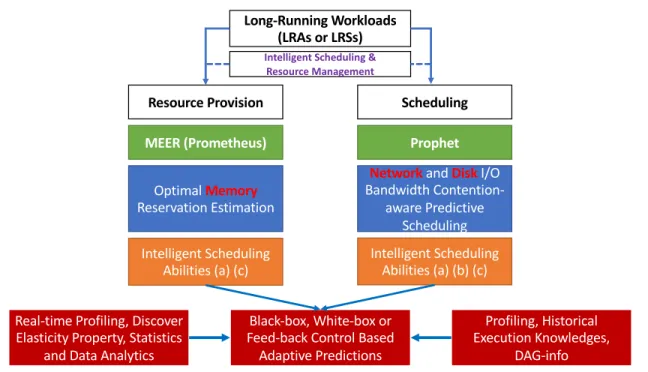
Therefore, we developed several innovated works by leveraging data-driven intelligent methodologies as a general solution to resolve the online NP-hard scheduling problems. We are on the way to rely on sufficient predictive knowledges and general prediction approaches to transfer online scheduling issues to offline scheduling to thoroughly resolve the NP-hard problem in any scheduling and resource management scenario or domain. Prophet leverages the abilities of (a)(b)(c) to perform prediction-based scheduling and develop an optimal algorithm through global view at a limited time window, so as to resolve the (3)(4)(5)(6) problems. MEER (Prometheus) employing the abilities of (a)(c) is designed to solve (2)(5)(6) issues. They make use of intelligent scheduling and resource allocations approaches. They
are great representative works to resolve the NP-hard scheduling problems for long-running applications by tranferring the online scheduling issues to offline scheduling problems through predictive knowledges.
One thing need to be mentioned. Modern artificial intelligence is named weak artificial intelligence. They could only be an automatic and efficient solution to resolve the problems that we already know. We do not impractically expect or fully rely on them to resolve the problems that we do not figure out or understand yet. Above three abilities and six issues are the inherent problems and essenses that we concluded and abstracted from past experiences of decades. We leverage artificial intelligent approaches to perform accurate predictions for specific motivations. That’s why Prophet and MEER work effectively. Intelligent scheduling is only worked as an efficient solution. The problem solver subject is we domain experts. How effectively we exploit artificial intelligence techniques mainly depends on how much we understand the problems and what innovated directions and ideas we could think out to resolve problems.
Data-driven Intelligent Scheduling Methodology.
Most of existing works either rely on pure black-box solution or specific white-box-based prediction. Black-box approaches are general, at the cost of long-term exploration, model adjustment and training. It does not need to figure out the causality of the problem. White-box solutions are always rapidly effective if we study and understand deeply about origins and critical issue of problem. We could model the issue by mathematics method. However, different problems such as capacity planning, scheduling, and runtime migra-tion, reschedule or preemption in distinct contexts (long-running workloads, virtual machine, HPC..) are toally different. We need to design and model distinct problems mannually one by one even for different systems (batch: Hadoop [14], stream: Storm [116, 176]/Flink [13], graph: Pregel [138], ML: Tensorflow [40]) and workloads under the same context. We detail
introduces how modern works leverage prediction or other intelligent approach to perform scheduling in Section .
We developed Prophet annd MEER (Prometheus) to employ above three abilities to perform intelligent scheduling as a good demonstration. They are both designed to resolve the allocation and scheduling problems for long-running workloads in modern datacenter. Prophet predicts resource usages and runtime duration per stage in future execution for both waitting workers in the queue and running workers on the server. It then has the abiliti to know future resource availability of the cluster, as well as network and disk I/O bandwidth usages and capacity. They could prevent over-allocation and perform predictively I/O contention- and interference-aware intelligent scheduling through prediction approaches. The prediction technique of Prophet is fully rely on pure black-box estimations of SVM and logistic regression methods through historical runtime statistics. It works well since most modern datacenter big data analytics workloads are recurring. Morever, all tasks from every DAG stage per application execute the exactly same codes and similar amounts of data. It enables the accurate predictions for repeative tasks by effective profilings. They naturally has the trend to be accurately predicted. Prophet leverages (a)(b))(c) of above three abilities to perform predictive scheduling.
MEER (Prometheus) is mainly designed to resolve the optimal memory provision and reservation problem for long-running workloads. Optimal provision is always motivated to find the just right resource allocations (minimal necessary ones) that could achieve optimal performance. We found this problem is different from intelligent scheduling issue itself since every workload has a unique resource reservation-to-performance model. It is impractical and infeasible to build black-box models for each one. Moreover, since any new-submitted, non-recurring or varied workload (variations of input datasets, source code tweaks or parameters tuning) lacks of aggregated datasets and offline training opportunities, they could not benefit from the black-box based provisioning solutions and would lose the fundamental ability and opportunity to achieve best efficiency.
Additionally, we find a general and critical property for long-running workloads about the provision elasticity. That is LRAs could execute perfectly even under sizable reducations of resource reservations. Based on this property, we are able to find a inflection of point (knee) of the resource-to-performance curve as the optimal reservation that achieves both best efficiency and optimal runtime. Under this property, any type (graph, streaming, batch, ml, ad-hoc query) of LRAs could be modeling by a specific white-box approach and a feed-back control loop to adaptively refine runtime predictions. This property we found for LRAs enables the white-box approach could be generally suitable for any type of workload. MEER performs estimation only based on the collected footprint data through two pilot runs without historical knowledges. It utilizes statistical methods by histogram analysis, expectation and confidence intervals of usages to effectively find the near-optimal allocation.
Through a runtime adjustment mechanism to find the knee of the curve (like stochas-tic gradient descent), we are able to continously provide accurate prediction of optimal reservations in a short recurring executions. MEER leverages (a)(c) of above three abilities to perform estimations for right provisioning.
Figure 1.4 illustrates how Prophet and MEER (Prometheus) support intelligent schedul-ing by predictively network and disk I/O contention-aware schedulschedul-ing and optimal memory reservation estimations. Through this two systems, LRAs could be efficiently scheduled achieving both the best cluster efficiency and optimal performance. These three critical abilities are as three-steps towards eventual intelligent scheduling.
Dynamic Operating Systems Management and Control.
Modern datacenter infrascttructure technique is far more complicated than scheduling and resource management, it also involves in the intelligent control over underlying operating system (OS). There is a gap between cluster scheduler and local OS. OS does not fully un-derstand the objectives, constraints and consideration of upper schedulers. Scheduler could also not dynamic adjust OS mechanism (dynamic memory reclaim, CPU throttle, memory
Networkand DiskI/O Bandwidth Contention-aware Predictive Scheduling Optimal Memory Reservation Estimation Prophet MEER (Prometheus) Intelligent Scheduling
Abilities (a) (c) Intelligent Scheduling Abilities (a) (b) (c)
Black-box, White-box or Feed-back Control Based Adaptive Predictions Scheduling Resource Provision Profiling, Historical Execution Knowledges, DAG-info Real-time Profiling, Discover
Elasticity Property, Statistics and Data Analytics
Long-Running Workloads (LRAs or LRSs)
Intelligent Scheduling & Resource Management
Figure 1.4: Intelligent Scheduling for LRAs or LRSs by Prophet and MEER (Prometheus).
and network bandwidth control, LLC control by CAT...) during runtime when contentions or unexpected interference occur. Schedulers lose the control of workload executions after placements. Current schedulers lack of the ability (c) of intelligent scheduling.
Therefore, we are on the way to abstract another layer of management for local OS, to provide adequate predictive knowledges to support upper intelligent scheduler. It also helps schedulers to effectively manage local OS to fulfill their objectives during runtime to strictly ensure end-to-end objectives achievement. This new layer between local OS and cluster schedulers is significantly critical to enable fully control by schedulers between jobs submitted till job completions.
We detail introduced this new layer of infrastructure in Section as part of an enterprise large-scale datacenter co-location techniques of infrastructure in Alibaba. We are on the way to thoroughly fulfill this layer of this infrastructure.
Optimal Resource Provisioning for Long-running Workloads
(Mem-ory)
In general, the relationship between resource allocation and performance for any workload is inherent non-linear and not easy to model as shown in previous works [58, 162], which have been studied for decades. Nevertheless, for long-running workloads, we found a critical inflection point between resource and performance curve. we discover an important elasticity property that could help us to stably achieve best efficiency and optimal performance at the same time.
Most recent works of capacity planning only consider resource usages instead of its relationship with performance. In our observations, containers of in-memory computing workloads would trigger modest minor garbage collections (GCs) and execute spilling-to-disk operations to effectively reclaim spaces and release memory pressures under insufficient allocation during load spikes or peak usages. Unlike the observations for short-lived batch tasks [82,106,150,151,187], we found the performance of these containers are not sensitive to sizable reductions of reserved memory. It is because the increased GC and spill overheads due to some tasks are only a negligible portion compared to the application’s long-time execu-tions. A moderate decrease of reservation would have little negative impacts on performance, but significantly reduces the wastes of excessive memory usages by 5 to 10 times.
That is, containers are allowed to run with significantly less memory reservation than they would ideally need (peak or average usages) while only paying a moderate performance penalty. We refer to this property as memory reservation elasticity. It is a general property for diverse types of in-memory computing workloads. Consequently, applications are able to achieve nearly optimal performance under a minimum reservation that is just large enough to satisfy their majorities of base demands. We name these capacities asoptimal reservations. They are capacity cut lines to divide the reservation between over-provisioning and
under-provisioning. It also provides opportunities to well balance the trade-offs between memory efficiency and performance.
For recurring applications (periodically run repeated jobs on same or similar newly arriving data), the procedure to explore optimal reservations is essentially a search process over correlated memory allocation and performance. Recent studies [42,57,60,69,83,110,112, 196] revealed that a majority of production applications exhibit recurring execution pattern. The recurrent nature enables the feasibility for searching methods through multiple offline runs. However, recurring jobs usually encounter variations of input datasets, source code tweaks or training parameters tuning. Their optimal reservations would change over time under such variabilities. They need to start all over new searches.
Existing offline searching solutions do not fully address the challenges. For example, Elastisizer [101], Ernest [183], CherryPick [45] and Clipper [68] offline trained performance models based on historical executions to search best cloud configurations for recurring jobs. If simply adopting these model-based searching approaches, we need to retrain models for every type of variability, which is too expensive and impractical for tens of thousands jobs in an enterprise cluster.
Estimation of optimal memory reservations for newly submitted or non-recurring jobs is even more challenging. Due to lack of relevant runtime history information, searching algorithms become ineffective. Online executing a plenty of profiling runs for searching is simply too time-consuming and the results would become useless for online scheduling. Datacenter schedulers are in urgent need for an efficient online estimation approach for optimal reservations.
Through experiement, we found a reservation size that just accommodates the ma-jorities of base demands is the optimal one, which is just large enough without unnecessary wastes. The mathematical expectation of memory usages that implies the average demand at future executions, are accurate enough to represent base demands. This rationale offers
opportunities to find optimal reservation of containers on line in one step, by performing probability density analysis and estimating expectation of footprints in profiling runs.
Due to random scheduling, pipelined executions and staggered aggregate memory usages of concurrent tasks on containers, the profiled footprints of long-lived containers dis-play randomness and its expectation lacks of ability for generalization. In comparison, we observed memory usage patterns per task are highly stable and often in a Gaussian dis-tribution. Since the usages per container is the aggregate ones of its all co-locating tasks, we could obtain robust confidence intervals of containers’ random footprints by aggregat-ing stable confidence intervals of task memory usages. By usaggregat-ing confidence levels for the predictions, we eliminate negative effects of footprints’ randomness on estimations.
We concluded our contributions as followings:
• To our best knowledge, we are the first to specify, identify and demonstrate a general property of memory reservation elasticity for diverse types of workloads in in-memory computing. We studied its origins by performing quantitative analysis of benchmarks’ memory footprints.
• We discovered a long-tail relationship between reservation and performance derived from elasticity, and revealed there exists an optimal reservation for long-lived containers in terms of maximum memory efficiency and optimal application performance.
• We quantified the relationship between footprints and optimal reservation, and demon-strated optimal reservations are able to be efficiently predicted by estimating expecta-tions of memory usages. We use confidence intervals to resolve randomness of container footprints. Through robust profilings in pilot runs, we perform highly accurate (over 80%) initial estimations through only one-step without runtime history. By exploit-ing self-decay property and recursive search, the accuracy was improved to over 95%. MEER should be the first kind of systems to predict optimal memory reservations.
• We implemented MEER as an extension to YARN. It efficiently assisted YARN to on-line make optimal reservations and speed up diverse types of in-memory computations by 2 to 6 times on average, while improving cluster memory utilization by 40%.
Contention and Interference-Aware Co-Scheduling (Co-locating)
for Long-running Workloads (Network and Disk I/O)
Applications running on today’s large-scale data-parallel processing frameworks, such as Apache Hadoop [14], Dryad [107] and Spark [203], usually have DAG of stages in their execution durations, such as map and reduce stages. Each stage consists of a number of tasks conducting the same type of data processing. A task requires multiple resources for its running, including CPU, memory, as well as disk and network bandwidths. While tasks belonging to the same stage are of similar demands on each of the resources, those belonging to different stages can have very different demands on different resources. For example, machine learning applications, such as K-Means and KVM (Support Vector Machine) [34, 123], tasks of their map stage are I/O- and CPU-intensive while tasks of in the following reduce stage are only network-intensive. The frameworks, such as Hadoop and Spark, usually run on the compute platforms, such as YARN [181] and Mesos [103], responsible for resource allocation and sharing. It is critical for task schedulers on the platforms to efficiently schedule the tasks of vastly diverse multi-resource demands onto a cluster of servers, so that both applications’ execution time and the cluster’s throughout can be maximized.
Scheduling tasks with multi-resource demands onto servers of limited amount of re-sources (CPU, memory, disk, and network) is often formulated as a multidimensional bin packing problem. As long as these demands are known a priori or can be accurately es-timated, this problem can be solved heuristically in a polynomial time [94]. A common technique used for this estimation is to profiling tasks by leveraging the fact that jobs of an application are recurring and they âĂIJrepeat hourly (or daily) to do the same computation on newly arriving data [94]âĂİ.
Such a profiling strategy is not sufficient to fully address the issue by itself in practice, as the demands measured during a taskâĂŹs run vary (sometimes dramatically). While it is known that a multidimensional bin packing problem is NP-hard and has to be solved with heuristics, it is almost impossible to accommodate time-varying demands into the model to efficiently produce an effective scheduling decision. A conservative alternative is to use peak usage of a resource to represent the varying demands of a task during running to prevent resource over-allocation [94]], which occurs when aggregate demand from all running tasks exceeds available resources. It often leads to interference between tasks and serious performance degradation. However, this conservative approach generates risk of resource fragmentation, which occurs when resources are idle but tasks with demands on them that ready for scheduling cannot use them.
To achieve high scheduling efficiency, a scheduler has to simultaneously minimize fragmentation and over-allocation of resources [8]. When each application can have a large number of tasks and each task has a relatively short execution time, using peak demand may not create extremely large pockets of fragmentation in terms of wasted resource time. However, this becomes a serious issue with in-memory computing frame- works, such as Spark and Storm, where scheduling units have long execution time with varying demands.
Long-running workloads’ workers pre-reserve specific amount of CPU and memory resources as described in Section . However, the network and disk bandwidth could not be fully isolated. Long-running workloads need a scheduler that could schedule workers by considering the contentions mitigation of network and disk I/O bandwidth. Only few previous works [94] consider network and disk bandwidth isolation for short-lived tasks in Hadoop. Recent work like Tetris [94] exploits the knowledge of future (peak) resource de-mands of tasks to perform bin-packing algorithm. However, it cannot be applied directly on workersâĂŹ scheduling. When an worker becomes the scheduling object, the rationale made by existing schedulers based on peak resource usage to represent the objectâĂŹs varying resource demand is less likely to be valid. A worker runs multiple batches of tasks belonging
to different DAG stages may have (very) different resource demands. Therefore, using the peak demand to represent different demands of a resource during the lifetime of an executor for resource allocation can cause serious resource fragmentation (or wastage).
Additionally, for a smooth run of tasks in an executor without interference from other application executors, it might be desired to have all four major required resources (CPU, memory, disk, and network) pre-allocated or reserved. Users only need to pre-specify their resource demands on CPU (num- ber of cores) and memory (size of memory) for a worker. As these demands usually represent the bottom line of a userâĂŹs requirement on quality of service, the requested resources are pre-reserved at the time of executor scheduling. However, network and disk resources are shared among workers on a server without isolation or reservation. They are more likely to incur over-allocation, and tend to cause disk seeks or network incast that may significantly compromise systemâĂŹs throughput. In addition, neither users nor current cluster managers [181,185] would specify network and disk demands of workers, let alone consider their highly variable demands. This may lead to application performance degradation and poor resource efficiency.
To improve cluster efficiency and speed up individual applicationsâĂŹ performance for in-memory computation, we design an executor scheduler, namely Prophet, which can select an executor whose scheduling would result in the smallest amount of fragmentation and over-allocation of network and disk resources. With the knowledge of an executorâĂŹs future varying (peak) disk and network demands at any stage during its lifetime and of each stageâĂŹs start time and its duration, Prophet can estimate resource availability at any time frame in the near future and make an informed scheduling decision accordingly to minimize resource fragmentation and over-allocation. To deal with unexpected resource contention, Prophet selects task(s) in an executor to back off to adaptively ameliorate the contention.
In summary, we make the following contributions in the paper.
• We identify a performance-critical issue about the ex- ecutor scheduling on in-memory data parallel computing platforms. We show that without considering resource demand
variation within an executor, one can hardly enable an effective scheduling. By showing stability and predicability of resource demands in an executor, we make it possible to take the dynamics on the resource demands into account.
• We design an online executor scheduler, named Prophet, that adopts a greedy approach by choosing the currently optimal executors in terms of expected resource fragmen-tation and over-allocation to dispatch. It also dynamically avoids severe resource con-tention and subsequent dra- matic performance degradation due to unexpected over-allocation with its task backoff mechanism.
• We have implemented Prophet on YARN and Spark 1.5 to support Spark and evalu-ated it on a 16-server cluster. Experiments show that Prophet can minimize resource fragmentation while avoiding over-allocation. It can substantially improve cluster re-source utilization, minimize application makespan, and speed up application comple-tion time. Compared to YarnâĂŹs default capacity and fair schedulers, Prophet re-duces the makespan of workloads in SparkBench [4] by 39
Datacenter Co-locations Techniques for Long-running Workloads
at Large-scale
Besides resource scheduling for LRAs or LRSs as shown in Section and Section , a more effective way to improve resource efficiency in modern datacenter is to co-locate both offline batch jobs, LRAs and LRSs in the unified shared infrastructure. However, it has another higher level of technique requirements from IDC, network, server hardwares, storage, virtulization and containerization, co-locating scheduling and so on. We introduced the background, motivation, feasibility and technique details of an enterprise co-location techniques at large-scale in Alibaba Group, which daily scheduling tens of millions of diverse heterogeneous workloads across tens of datacenters and millions of servers. We mainly introduce how to eliminate or mitigate runtime interferences once contention occurs.
The resource wastes and inefficiency issues are becoming serious in modern internet companies like Alibaba Group. The total utilization was even lower than 9% during several past years. It is due to the over-provisioning of online business services on the dedicated cluster to guarantee service stabilities. However, recent resource management and scheduling studies of datacenters mainly focus on supporting offline workloads of big data processing system, which are data-intensive and naturally have a high average cluster utilization over 60%. Most daily business applications of industry are online long-running services (LRSs) consisting of a long chain of multiple middleware components like web services, memcache, RPC (Remote Procedure Call) and databases. They are sensitive to tiny abnormality of operating system or datacenter network due to resource contentions or faults. One unex-pected fluctuation of system load could block multiple online processes on that server. It causes large-scale time out and failures of downstream services, which become unbearable catastrophes in production environment. How to effectively schedule and run online LRSs to satisfy their strict requirements of Service Level Agreements (SLAs) while maximizing resource efficiency should obtain more attentions.
Recent studies [170,185] reveal that co-locate online services and offline data-intensive workloads on the shared infrastructure is feasible to improve efficiency while guarantee sta-bilities of LRSs. It brings numerous extra challenges and much higher requirements to datacenter techniques. In this paper, we introduce a large-scale enterprise-wide colocation techniques as our solutions to effectively improve datacenter efficiency. It involves in the upgradation and evolutions of full technique stack of infrastructures across the entire group, including layers of idc, network, server hardwares and architecture, operating system, re-source manager and scheduler, containerization and applications.
We concluded contributions of the paper as followings:
• We introduce the evolvement of challenges and architectures of Alibaba including scenes of "Double 11" in the past years, as well as the detail motivations and techniques of large-scale colocations. The diverse workloads of both LRSs and offline jobs including
eCommerce, finance, maps and navigation, digital entertainment and social media are unique. We also introduce the workload characteristics, resource management and scheduling scenes of both online LRSs, real-time applications and offline data-intensive workloads in Alibaba global datacenters and infrastructures.
• We are the first to introduce the characteristics and resource management of on-line LRSs in industry rather than the offon-line data-intensive long-running applications (LRAs) described in recent works [86, 126, 194, 196]. Since online LRSs across 7000+ types of services from 60+ departments in entire Alibaba Group are all containerized, we have one of the largest scale of LRSs scenes in the world.
• We are the first to introduce how to effectively co-locate our unique and diverse online LRSs and offline data-intensive workloads in the large-scale shared industry datacenter in detail. Compared with Borg and Omega [170, 185], we introduce the colocation technique from the view of workload resource management and scheduling instead of technique architectures.
• We believe the unique large-scale industry scenes in Alibaba Group could be a great help to the research field of datacenter architecture and resource management. We would also continuously provide updated open cluster trace of colocations [38] to en-courage more studies in this field. It includes diverse online LRSs and data-intensive workloads running on co-located production cluster of 4000 machines for 8 days [38]. It includes abundant resource usages data of machines and containers, and runtime statis-tics of workloads with DAG information. It could be a good verification of Alibaba co-located datacenter.
We show the colocation techniques could improve utilization from originallly 10% averagely to stably 50%, and guarantee strict SLAs and stabilities for diverse services. It saves billions of costs of TCO for Alibaba and becomes the core infrastructure technique for the next-generation architecture of Alibaba.
Evaluate the Effectiveness of Long-running Workloads Co-location
Techniques by Analysis of Alibaba Datacenter Trace
To evaluate and demonstrate the feasibility and effectiveness of co-location techniques between diverse LRAs, LRSs and other short-running applications on improving cluster efficiecny at large, we perform a deep analysis on a newly released trace dataset by Alibaba Group in September 2017, consists of detail statistics of 11089 online service jobs and 12951 batch jobs co-locating on 1300 machines over 12 hours. We reveal several critical insights for co-location techniques of long-running workloads at large-scale production cluster.
Alibaba Cloud is one of the largest public cloud platforms in the world, on which processing millions of tasks acrossing hundreds of data centers everyday. This trace includes runtime statistics of a hybrid cluster, on which online service and offline batch jobs are co-locating. As we know, it is the unique one having hybrid runtime information among all public traces.
To the best of our knowledge, this is one of the first work to analyze the public Alibaba trace. We explored runtime status of the hybrid cluster, and showed several important insights about imbalanced utilization and resource inefficiency in the cloud.
Our analysis reveals several important insights about different types of imbalance and resource inefficiency in the Alibaba cloud. Such imbalances exacerbate the complexity and challenge of cloud resource management, which might incur severe wastes of resources and low cluster utilization. 1)