MESSAGE DEVELOPMENT FOR A TAILORED TEXT MESSAGE-BASED
SMOKING AND VAPING CESSATION INTERVENTION FOR DUAL
USERS OF CONVENTIONAL AND ELECTRONIC CIGARETTES
Jaya Mathur
A thesis submitted to the faculty at the University of North Carolina at
Chapel Hill in partial fulfillment of the requirements for the degree of
Master of Arts in Interdisciplinary Health Communication in the School of
Journalism and Mass Communication
Chapel Hill
2014
Approved by:
Brian Southwell
Joan Cates
© 2014 Jaya Mathur
ABSTRACT
Jaya Mathur: Message Development for a Tailored Text Message-based Smoking and Vaping Cessation Intervention for Dual Users of Conventional and Electronic Cigarettes
(Under the direction of Brian Southwell)
In recent years, the popularity of electronic cigarettes (e-cigarettes) has grown dramatically, particularly among conventional cigarette smokers. Two surveys were disseminated to independent samples of dual users to understand their e-cigarette intentions and beliefs, pretest cigarette and e-cigarette cessation messages, and solicit message suggestions. Results indicate that most dual users intend to use e-cigarettes to help them quit smoking or help them reduce the number of cigarettes they smoke. Furthermore, the vast majority of dual users believe using e-cigarettes will help them with smoking cessation or reduction. On average, respondents found both cigarette-only and combination cigarette and e-cigarette messages at least somewhat relevant and somewhat effective, though they consistently rated cigarette-only messages as more relevant and more effective than combination messages. The belief “I fear that e-cigarettes may be toxic” was found to significantly predict respondents’ perceived effectiveness of combination messages. Finally, the most popular themes apparent in respondents’ suggestions for e-cigarette cessation messages were mystery (lack of information or scientific consensus regarding e-cigarettes), personal health and
TABLE OF CONTENTS
Chapter 1: Introduction & Background ... 1
Chapter 2: Literature Review ... 7
Chapter 3: Research Questions ... 14
Chapter 4: Methods ... 15
Chapter 5: Results ... 20
Research Question 1 ... 22
Research Question 2 ... 25
Research Question 3a ... 31
Research Question 3b ... 36
Chapter 6: Discussion and Implications ... 38
Chapter 7: Limitations... 42
Appendix A: Phase 1 Survey ... 46
Appendix B: Phase 2 Survey ... 51
Appendix C: Phase 1 Constructs/Messages Table ... 57
Appendix D: Phase 2 Constructs/Messages Table (Additional) ... 58
Appendix E: Informed Consent ... 59
Appendix F: Codebook ... 60
CHAPTER 1: INTRODUCTION & BACKGROUND
Electronic cigarettes – also known as e-cigarettes or electronic nicotine delivery systems (ENDS) – are battery-powered devices that deliver nicotine when users inhale a vaporized mixture of a humectant, such as propylene glycol, and nicotine (King et al., 2013; Etter et al., 2011; FDA, 2009). Nicotine is the addictive chemical found in conventional cigarettes (WHO, 2013). E-cigarettes represent the latest in a string of novel and alternative tobacco products marketed by tobacco companies, among others, to retain customers and maintain profits (Popova & Ling, 2013). Other novel and alternative tobacco products include “dissolvables” (which deliver nicotine as they disintegrate in users’ mouths; Southwell et al., 2012), loose leaf chewing tobacco, moist snuff, and snus (pouches of finely ground tobacco; Popova & Ling, 2013).
Since their introduction in 2004, e-cigarettes have experienced a dramatic increase in attention and popularity (Meier et al., 2013). Between 2010 and 2011, e-cigarette awareness among U.S. adults grew from 40.9% to 57.9% (King et al., 2013). In this same time period, e-cigarette use (often referred to as ‘vaping’) roughly doubled, increasing from 3.3% to 6.2% (King et al., 2013). E-cigarette use has become particularly prevalent among conventional cigarette smokers, with approximately one-fifth of
cigarettes and e-cigarettes indicated they were now trying to quit smoking, and more than 84% indicated they were trying to reduce the number of cigarettes they smoked per day (Etter & Bullen, 2011).
Despite e-cigarettes’ growing popularity, controversy over the devices abounds among public health professionals, regulatory agencies, tobacco industry stakeholders, and smoking cessation advocates. E-cigarette manufacturers have billed the devices as safer alternatives to conventional cigarettes, which are the leading cause of preventable death in the U.S and cause about one in five deaths each year (Washam, 2011; CDC, 2013). Within the public health field, as well, some believe that promotion and adoption of e-cigarette use will reduce conventional cigarette use and associated adverse effects, and they have embraced e-cigarettes as a harm reduction strategy (Bell & Keane, 2012).
However, many public health researchers and experts repudiate e-cigarettes as smoking cessation aids because of concerns about e-cigarette safety (Washam, 2011; Hua et al., 2013; Meier et al., 2013). A U.S. Food and Drug Administration (FDA) study of 18 types of e-cigarettes indicated that e-cigarettes contain small amounts of tobacco-specific nitrosamines, which are carcinogenic (FDA, 2009). The study found that even e-cigarettes claiming not to contain nicotine in fact contain at least low levels of nicotine and that nicotine levels vary widely (FDA, 2009). These findings support claims by the National Institute for Tobacco Research and Policy Studies that, because many
e-cigarettes are imported from China, little is known about their quality control (Washam, 2011). Most stakeholders seem to agree that more data on e-cigarette safety must be collected (Hua et al., 2013).
vapor – undermines efforts to de-normalize conventional cigarettes (Bell & Keane, 2012), particularly among youth. Some fear e-cigarettes may act as a “gateway” nicotine delivery system for adolescents and ultimately lead them to smoke conventional
cigarettes (Pepper et al., 2013). As early as 2011, adolescents were highly aware of cigarettes; in a 2011 online survey of adolescent males, 67% who had not tried e-cigarettes nevertheless reported awareness of them (Pepper et al., 2013). E-cigarette interest and use among youth appears to be growing, as well. Pepper et al. (2013) found that nearly one in five adolescent male respondents were willing to try an e-cigarette and data from the 2012 National Youth Tobacco Survey reveal that 6.8% of students in grades six through 12 reported ever using an e-cigarette, more than double the
percentage in 2011 (Voelker, 2013).
In 2009, the Family Smoking Prevention and Tobacco Control Act granted the FDA authority to regulate e-cigarettes (Meier et al., 2013). In theory, regulation could ensure quality control and safety; however, some experts speculate that lobbying by tobacco and e-cigarette companies will stall regulation (Newman, 2013). In the absence of adequate safety data, several countries – including Canada, Brazil, Turkey, and Uruguay – have banned cigarettes (Henningfield & Zataar, 2010). Banning
e-cigarettes aligns with the recommendation of the World Health Organization (WHO), which states:
In contrast, both the FDA and the WHO endorse other nicotine replacement therapy (NRT) products as smoking cessation aids (Bell & Keane, 2012). These products include Nicorette gum and Nicotrol patches (Bell & Keane, 2012). According to the WHO, e-cigarettes pose unique safety threats when compared to regulated NRT products:
When ENDS are used as cessation aids, they are intended to deliver nicotine directly to the lungs. None of the approved, regulated cessation aids, such as nicotine patches and chewing-gum, delivers nicotine to the lungs. Therefore, the biological mechanism by which smoking cessation might be achieved by delivery of nicotine to the lungs and its effects are unknown. Delivery to the lung might be dangerous. Therefore, independently of the effects of nicotine, it is of global importance to study lung delivery scientifically. (WHO, 2013)
Furthermore, a recent randomized controlled trial suggests regulated NRT products are as effective at helping smokers quit as e-cigarettes (Bullen, 2013; Simon, 2013). At six months follow-up, abstinence from conventional cigarette smoking was achieved by 7.3% of participants who received nicotine e-cigarettes, 5.8% who received nicotine patches, and 4.1% who received placebo e-cigarettes (Bullen, 2013). These results lacked statistical significance, meaning each group had approximately the same chance of quitting smoking (Simon, 2013). Thomas J. Glynn, Director of Cancer Science for the American Cancer Society, stated:
In light of safety and efficacy data as well as regulatory agency recommendations, the public should be dissuaded from using e-cigarettes for smoking cessation until scientific research can demonstrate the safety of these devices or until their safety and quality is regulated. It is recommended, therefore, that existing smoking cessation interventions be adapted to incorporate messages that respond to the unique
motivations, behaviors, attitudes and beliefs of dual smokers of conventional cigarettes and e-cigarettes, and discourage e-cigarette use.
This research study sought to pretest messages targeted to dual users with this population to assess perceived message relevance and effectiveness. Pretested messages were drawn and adapted from QuitNowTXT, a text message-based smoking cessation intervention launched by the National Cancer Institute (NCI) in 2011 (Bailey, 2011). QuitNowTXT is designed for smokers who are ready to quit smoking and relies on evidence-based practices, such as motivational messages, interactive bidirectional messages, and messages both pre- and post-quit date (Smokefree.gov, 2011). When smokers register for the intervention, they indicate a quit date up to one month away (Smokefree.gov, 2011). Participants then receive daily messages intended to aid in smoking cessation for up to two weeks pre-quit date and up to six weeks post-quit date (Smokefree.gov, 2011). The program includes both unidirectional and bidirectional (i.e. interactive) messages, clustered into the following message types:
• Motivation/encouragement: Motivational messages encourage users to keep going on their smoke-free journey despite the difficulty and
struggle they may be facing.
• Information: Informational messages provide users with facts and other salient points about the impact of smoking relevant to their socio-cultural environment.
• Assessment: The assessment messages are built into the
text-messaging program and are designed to collect information about the user’s experience as they are quitting and provide immediate feedback based on the user’s response. Assessment messages fall along three dimensions: mood, craving, and smoking status.
• Reactive messaging (key words): At any point, the user can initiate an interaction with the program that will return a text message relevant to the user’s request for help. In response to the user texting one of the key words, the system will send them unique, automated responses. The key words cover topics relevant to various aspects of cessation. (Smokefree.gov, 2011)
CHAPTER 2: LITERATURE REVIEW
The following section briefly summarizes the relevant academic literature, including the efficacy and utility of text messaging-based health interventions,
personalization as a strategy for increasing message relevance and behavior change, and theories and methods associated with message design and testing.
Text message-based health interventions
This study is predicated upon QuitNowTXT, a text message-based program to help people quit smoking. Although this study tests messages with users online (not via text message), it has been developed as a precursor to a text message-based program similar to QuitNowTXT for both smoking and vaping cessation. It is, therefore, important to understand text messaging and its application for health intervention.
Text messaging (also known as short-message service or SMS) enables people to send and receive 160 character messages via mobile phones. Eighty-five percent of U.S. adults own a mobile phone; of these, 80% send and receive text messages (Fox &
Duggan, 2012). Mobile phones and text messaging have proliferated globally, as well. Sixty-seven percent of people worldwide own a mobile phone (International
cost-effective health intervention tool (Stross, 2008). Furthermore, because text
messages are asynchronous – meaning they can be accessed at the mobile phone user’s convenience – message receivers may view them more positively than messages
delivered via other channels (Cole-Lewis & Kershaw, 2010).
Research suggests that text message-based health interventions are effective, though effects may differ depending on the intervention purpose and health behaviors and outcomes of interest (Head et al., 2013; Cole-Lewis & Kershaw, 2010). Text
messaging may be used as a stand-alone intervention tool or may be combined with other media, such as email, although research shows there are no significant differences in efficacy (Head et al., 2013). Text message-based interventions can also serve many purposes, including enhancing health service provision, mass marketing health education, facilitating disease management, and providing personalized health
messages (Fjeldsoe et al., 2012). In a meta-analysis of 19 randomized-controlled trials, Head et al. (2013) found that smoking cessation and physical activity text message-based interventions were more successful than those targeting medication for prevention, healthy pregnancy, medical appointment attendance, safe sex, and contraceptive use.
Additional studies have demonstrated the effectiveness of smoking cessation text message-based interventions exclusively (Whittaker et al., 2009). Whittaker et al. found that four such interventions (two of which were text message-only and two of which were text message- and internet/email-based) yielded self-reported abstinence from smoking in the short-term, defined as four weeks post-cessation (Free, 2009) or six weeks post-randomization (Rodgers, 2005; 2009). The text message- and
12 months (Whittaker et al., 2009). Researchers speculate that non-significant long-term effects of the text message-only interventions may be attributable to the study’s young population, as other cessation interventions have also struggled to demonstrate long-term effectiveness with youth (Whittaker et al., 2009).
Personalizing health messages
Text message-based interventions like QuitNowTXT enable health researchers and promoters to deliver personalized health messages. Messages intended for a specific individual and personalized to reflect characteristics of that individual are referred to as tailored communication (Kreuter & Skinner, 2000). In contrast, targeted
communication is customized for a specific population based on shared characteristics (Kreuter & Wray, 2003; Noar et al., 2011) and traditional mass communication is designed for and disseminated to a broad audience (Noar et al., 2011). Theoretically, tailored messages are more effective than targeted messages when the target audience varies greatly in terms of the knowledge, beliefs, and behaviors that inform the intended intervention outcome (Kreuter & Wray, 2003). However, some research suggests that well-fitting targeted messages are as effective as tailored messages (Kreuter et al., 2000).
Although health interventions can tailor by message source, content, and channel, most tailoring has pertained to message content (Kreuter & Wray, 2003). Research suggests that tailoring message content may lead the target individual to perceive the message as more personally relevant (Kreuter & Wray, 2003). Relevance, in turn, helps determine whether someone will actively and thoughtfully process a
cognitive responses to various arguments and stimuli (Petty & Cacioppo, 1981).
Research suggests that people are more likely to read and remember tailored messages, rate them as attention catching, and save and discuss them with others (Kreuter & Wray, 2003).
Developing relevant, tailored messages is contingent upon first collecting data on target individuals (Kreuter & Wray, 2003). Data can be collected via many channels, including telephone, mail, local computer, kiosk, Internet, in person, and mobile phone (Noar et al., 2011). Data are then processed either manually or through technology-based algorithms, leading to selection of messages most appropriate for the individual (Noar et al., 2011). These messages are selected from a message library developed for the intervention (Noar et al., 2011).
Although research does not point to one channel as most effective for delivery of tailored communication, channels may be especially appropriate for certain
interventions (Noar et al., 2011). For example, interventions that incorporate interactivity or multimedia may be best suited to technological channels, such as Internet or mobile phones (Noar et al., 2011). Mobile phones also pose an advantage because people tend to carry them most of the time, thereby increasing the possibility of data collection and message receipt (Noar et al., 2011).
The literature supports tailoring as a smoking cessation strategy (Stretcher, 1999; Lancaster & Stead, 2006; Noar et al., 2007). A systematic review of 10 randomized controlled trials of tailored smoking cessation materials revealed that tailored programs tend to be efficacious (Stretcher, 1999). Within the review, results from two trials
trials, Lancaster and Stead (2006) found significant effects only among those that tailored message content. Finally, a meta-analysis of 57 print tailoring studies
addressing various behavior change outcomes found that tailored smoking cessation materials yielded larger significant effects than tailored mammography screening and physical activity materials (Noar et al., 2007).
Message design and evaluation
This study follows an established process for developing and evaluating mobile health (mHealth) interventions (Whittaker et al., 2012). Initial research informs the intervention content and design, while pretesting is used to determine acceptability of the intervention among the target population and to solicit feedback that can inform the intervention’s next iteration (Whittaker et al., 2012). Given time and resource
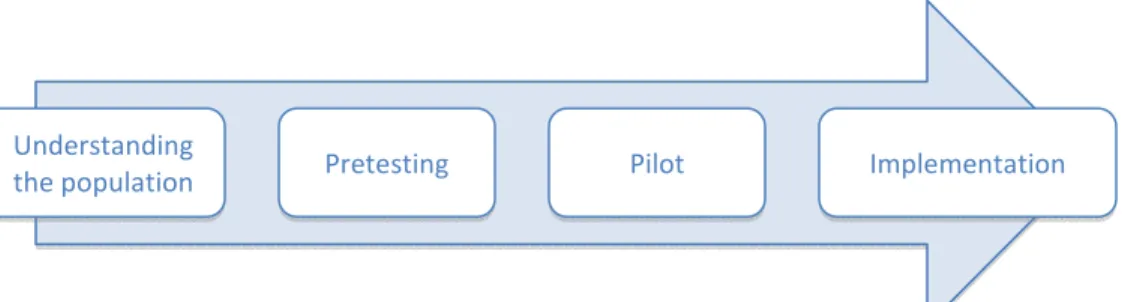
constraints, this study addresses only the first two steps of this process, however a model for comprehensive message development and implementation is proposed below (see Figure 1).
Figure 1: Model for message development and implementation
Adapted from Whittaker et al., 2012
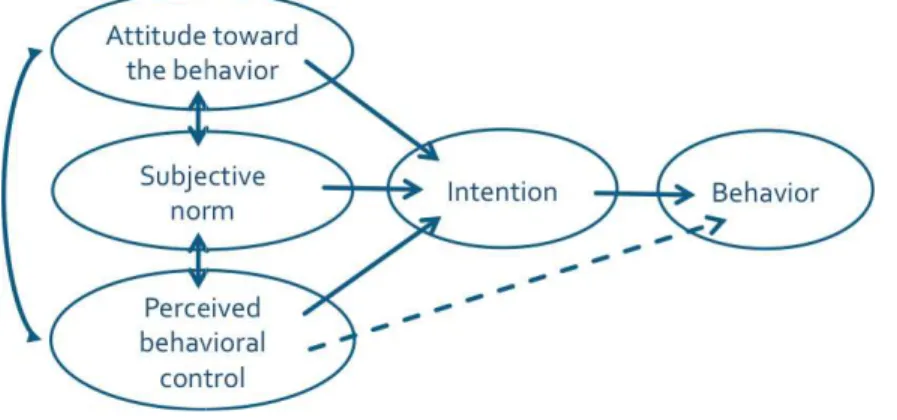
This study is predicated upon Ajzen and Fishbein’s Theory of Planned Behavior (TPB) (Ajzen & Fishbein, 1980; Fishbein & Ajzen, 1975). According to TPB, people’s
Understanding
actual behavior is informed by their intentions to perform that behavior. Furthermore, their intentions are informed
the “degree to which a person has a favorable or unfavorable evaluation or appraisal of the behavior in question”), subjective norms
engage or not engage in the behavior)
perceptions about their ability to perform the behavior)
& Fishbein, 1980; Fishbein & Ajzen, 1975). Each is, in turn, related to behavioral, normative, and control beliefs (Ajzen, 1991).
Figure 2: Theory of Planned Behavior
Pretesting messages is critical to message development for health interventions (Whittaker et al., 2012). Pretesting can occur in two phases: pre
production research (Atkin &
collecting information relevant to the target audience and campaign, while production research entails testing messages with the target audience to assess message
comprehension, liking, and attention (Atkin
actual behavior is informed by their intentions to perform that behavior. Furthermore, informed by three factors: attitudes toward the behavior (meaning the “degree to which a person has a favorable or unfavorable evaluation or appraisal of subjective norms (meaning the perceived social pressure to engage or not engage in the behavior), and perceived behavioral control (meaning perceptions about their ability to perform the behavior) (see Figure 1; Azjen, 1991; Ajzen & Fishbein, 1980; Fishbein & Ajzen, 1975). Each is, in turn, related to behavioral,
normative, and control beliefs (Ajzen, 1991).
: Theory of Planned Behavior
Fishbein & Ajzen, 1975
is critical to message development for health interventions (Whittaker et al., 2012). Pretesting can occur in two phases: pre-production and production research (Atkin & Freimuth, 2013). Pre-production research entails
collecting information relevant to the target audience and campaign, while production research entails testing messages with the target audience to assess message
comprehension, liking, and attention (Atkin & Freimuth, 2013). Production research actual behavior is informed by their intentions to perform that behavior. Furthermore,
toward the behavior (meaning the “degree to which a person has a favorable or unfavorable evaluation or appraisal of (meaning the perceived social pressure to
(meaning (see Figure 1; Azjen, 1991; Ajzen & Fishbein, 1980; Fishbein & Ajzen, 1975). Each is, in turn, related to behavioral,
Fishbein & Ajzen, 1975
is critical to message development for health interventions production and production research entails
collecting information relevant to the target audience and campaign, while production research entails testing messages with the target audience to assess message
also seems ideal for assessing perceived relevance and effectiveness of messages among the target audience.
CHAPTER 3: RESEARCH QUESTIONS
It is clear that e-cigarette use has increased dramatically and that, given the paucity of relevant safety data, health officials do not recommend e-cigarettes as a harm reduction strategy for smoking cessation. Nevertheless, dual users of conventional cigarettes and cigarettes remain somewhat mysterious. To develop a relevant e-cigarette vaping cessation intervention for dual users, we must seek a greater understanding of this population, assess their perceptions of existing e-cigarette
cessation messages, and solicit their suggestions for promoting e-cigarette cessation. To this end, this research study investigates the following research questions:
Research Question 1: What beliefs about e-cigarette use and cessation are common among dual users of cigarettes and e-cigarettes in the U.S.?
Research Question 2: What are dual users’ recommendations for e-cigarette cessation messages?
Research Question 3a: What are dual users’ perceptions of combination e-cigarette and e-cigarette cessation messages compared to e-cigarette-only cessation messages?
CHAPTER 4: METHODS
This study collected data from a sample of the target population via online surveys. Data collection was conducted in two phases, a design intended to develop a comprehensive picture of dual users’ socio-behavioral characteristics and to solicit feedback on both initial and revised e-cigarette cessation messages.
Participant recruitment
In an effort to contribute to our understanding of novel research methods, participants were recruited via the online crowdsourcing platform Mechanical Turk. Mechanical Turk is owned by Amazon and is the most well known crowdsourcing website (Amazon.com, 2010; Behrend et al., 2011). Jeff Howe defined the term crowdsourcing in a 2006 issue of Wired magazine, and described it as a means for institutions to outsource a task once performed by employees to another network;
members of the network may then either perform the task collaboratively or individually (Howe, 2006). Crowdsourcing platforms were initially developed as a tool for for-profit businesses to recruit online workers (Howe, 2006). These businesses would present a problem to members of an online network, who in turn presented solution ideas (Brabham, 2008).
research participant pools – notably, undergraduate university students. First,
crowdsourcing respondents tend to be older and more ethnically diverse than university students (Behrend et al., 2011). According to Behrend et al., crowdsourcing responses may better represent target populations with diverse ages and ethnicities. Also, data collected through crowdsourcing appears to be as reliable as data collected from undergraduates through an online questionnaire (Behrend et al., 2011). Researchers assessed data quality by including Likert scale items that should have opposite or identical responses (Behrend et al., 2011). They then flagged cases if responses to such items were inconsistent. Furthermore, a systematic review of 21 studies that
crowdsourced for health research suggests that crowdsourcing can be used as a survey tool (Ranard et al., 2013).
Sample
Mechanical Turk enables requesters – i.e. the researchers and businesses who create human information tasks (HIT) – to specify certain criteria for the sample
eligibility (i.e. that they smoke cigarettes, use e-cigarettes, and are aged 18 or older). Although the two study phases relied on identical Mechanical Turk recruitment methods, independent samples of participants were recruited for each phase.
All respondents who completed both the Phase 1 screener and survey were compensated $0.50 (funds were transferred into workers’ Amazon payment accounts 8 hours following HIT completion; MTurk.com, 2013). Because several additional items were added to the Phase 2 survey, respondents were compensated $0.75 to account for their time. Funds for compensation were secured through the Roy H. Park Fellows Program at the School of Journalism and Mass Communication at the University of North Carolina at Chapel Hill. Workers were notified that compensation was contingent upon survey completion but not the content of their responses.
Procedure
Data collection was conducted in two phases. The Phase 1 Mechanical Turk HIT linked to a Phase 1 Qualtrics survey (see Appendix A); the HIT remained open until the survey garnered 100 responses. The Phase 1 survey asked respondents to provide data on their demographics, conventional cigarette and e-cigarette use, and intentions to quit smoking and/or reduce the number of cigarettes they smoke. Respondents also
In addition, respondents were asked to rate their perceived relevance and
effectiveness of validated text message-based smoking cessation messages from the NCI QuitNowTXT library as well as draft messages intended to help dual users with
conventional cigarette and e-cigarette cessation. Messages related to e-cigarette cessation corresponded to relevant attitude and belief constructs identified by other studies (for example, the utility of e-cigarettes as smoking cessation aids, enjoyment from e-cigarette use, and e-cigarette safety) (see Appendix B; Dockrell et al., 2013; Etter & Bullen, 2011). Finally, respondents were asked the following open-ended questions: “What would you say to a friend whom you’re trying to convince to quit smoking
cigarettes?” and “What would you say to a friend whom you’re trying to convince to quit using e-cigarettes?”
Phase 1 open-ended responses were analyzed prior to dissemination of the Phase 2 survey and used to inform new smoking cessation and e-cigarette cessation messages for Phase 2 pretesting. Phase 1 respondents’ message suggestions were flagged if they addressed a new theme (i.e. one not addressed in Phase 1 messages, see Appendix C) or if they addressed an existing theme in a new and compelling way. The Phase 2 survey (see Appendix B) included the same questions regarding demographics, behaviors, intentions, beliefs, attitudes, and message perceptions as in the Phase 1 survey, as well as several additional items: seven new smoking cessation messages, six new e-cigarette cessation messages, and attitudes pertaining to cigarette smoking and e-cigarette use that correspond to these new messages (see Appendix D). Like the Phase 1 survey, the Phase 2 survey remained open until 100 dual users responded.
Workers were required to provide consent before they could begin the online survey (see Appendix E). The online survey preview page displayed a statement explaining the purpose of the study, risks and benefits of the research, and means by which workers could contact the researcher about problems or concerns (Mason & Suri, 2011). However, workers were notified that, should they choose to contact the requester via Mechanical Turk for any reason, their email address would no longer be confidential (Mason & Suri, 2011). As another means of protecting privacy, respondents’ Mechanical Turk worker IDs were not linked to survey responses.
Quality assurance
The online survey included an unrelated verifiable question (“What is 2 + 2?”) in order to verify participants as human and reduce the number of invalid responses. Previous research indicates that including a captcha or additional questions with verifiable answers significantly increases the quality of data obtained (Kittur et al., 2008). A disclaimer was included explaining the purpose of this question.
Data analysis
CHAPTER 5: RESULTS
Demographic/socioeconomic characteristics
Two independent samples of 100 participants each completed the Phase 1 and Phase 2 surveys (total=200). All respondents were aged 18 or older, with 27% aged 18-24 (n=54), 39.5% aged 25-34 (n=79), 19.5% aged 35-44 (n=39), 7.5% aged 45-54 (n=15), 4.5% aged 55-64 (9), and 2% aged 65 or older (n=4). Approximately 60% of all
respondents (n=121) were male. Nearly 85% of respondents reported their race as White/Caucasian (n=169), 8% as Black/African-American (n=16), 7.5% as Asian/Pacific Islander (n=15), 2% as Native American/Alaska Native (n=4), and 1.5% as other (n=3; respondents could select all race categories that applied). Roughly 10% of respondents reported their ethnicity as Hispanic/Latino (n=19).
The complete sample was comprised of respondents from 38 states in the U.S. Thirty-seven percent reported completing some college, 33% reported graduating from college (n=66), 16% reported graduating from high school (n=32), 5% reported
household income, approximately 28% of respondents reported $20,000-$39,999 (n=55); 18% reported $40,000-$59,999 (n=35); 16% reported $10,000-$19,999
Research Question 1
The study posed the following first research question: What beliefs about e-cigarette use and cessation are common among dual users of conventional e-cigarettes and e-cigarettes in the U.S.? Most survey respondents reported an intention either to quit smoking (46.5%, n=93) or to cut down on the number of cigarettes they smoke (42.5%, n=85) in the next year. Approximately half of all respondents (51%, n=102) indicated they intend to use e-cigarettes to help them quit smoking in the next year and 38.5% of all respondents (n=77) indicated they intend to use e-cigarettes to help them cut down on the number of cigarettes they smoke in the next year. Respondents largely demonstrated a belief in the effectiveness of e-cigarettes as a smoking cessation and smoking reduction tool. Of those who intend to use e-cigarettes to help them quit smoking, 94.12% (n=96) either agreed or strongly agreed with the statement, “I believe using cigarettes will help me quit smoking.” Similarly, of those who intend to use e-cigarettes to help them cut down on the number of e-cigarettes they smoke, 93.5% (n=72) either agreed or strongly agreed with the statement, “I believe using e-cigarettes will help me cut down on the number of cigarettes I smoke.”
Respondents expressed greater ambivalence regarding the belief that e-cigarettes are recommended for smoking cessation and reduction. Sixty-one and a half percent of respondents who intend to use e-cigarettes to help them quit smoking in the next year (n=62) agreed or strongly agreed with the statement, “E-cigarettes are recommended to help people quit smoking,” while 15.84% (n=16) disagreed or strongly disagreed with this statement and 22.77% (n=23) neither agreed or disagreed. Among respondents who intend to use e-cigarettes to help them cut down on the number of cigarettes they
recommended to help people cut down on the number of cigarettes they smoke,” 14.28% (n=11) disagreed or strongly disagreed with this statement, and 31.17% (n=24) neither agreed nor disagreed.
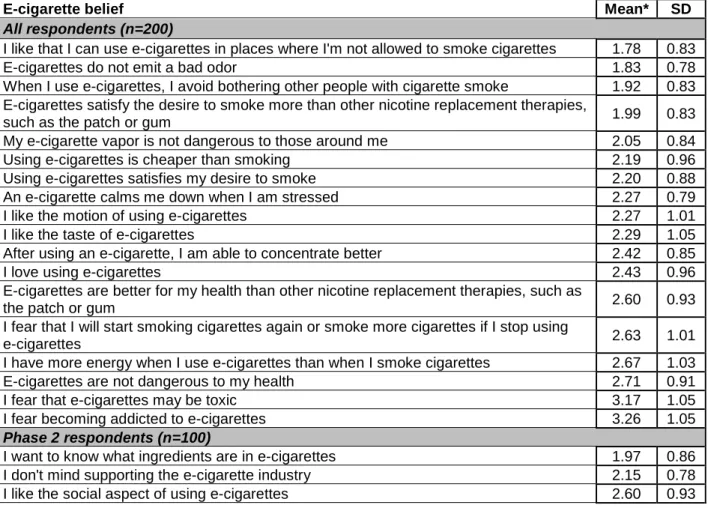
In addition to providing smoking cessation/reduction intentions and general beliefs about e-cigarettes as a smoking cessation/reduction strategy, participants shared specific beliefs about e-cigarettes’ implications for personal health and wellbeing, others’ health and wellbeing, relationships, finances, stress management, nicotine dependency, and cigarette smoking. Respondents rated each belief statement on a 5-item Likert scale, where 1=strongly agree and 5=strongly disagree (see Table 1).
Table 1: E-cigarette beliefs
E-cigarette belief Mean* SD
All respondents (n=200)
I like that I can use e-cigarettes in places where I'm not allowed to smoke cigarettes 1.78 0.83
E-cigarettes do not emit a bad odor 1.83 0.78
When I use e-cigarettes, I avoid bothering other people with cigarette smoke 1.92 0.83 E-cigarettes satisfy the desire to smoke more than other nicotine replacement therapies,
such as the patch or gum 1.99 0.83
My e-cigarette vapor is not dangerous to those around me 2.05 0.84
Using e-cigarettes is cheaper than smoking 2.19 0.96
Using e-cigarettes satisfies my desire to smoke 2.20 0.88 An e-cigarette calms me down when I am stressed 2.27 0.79
I like the motion of using e-cigarettes 2.27 1.01
I like the taste of e-cigarettes 2.29 1.05
After using an e-cigarette, I am able to concentrate better 2.42 0.85
I love using e-cigarettes 2.43 0.96
E-cigarettes are better for my health than other nicotine replacement therapies, such as
the patch or gum 2.60 0.93
I fear that I will start smoking cigarettes again or smoke more cigarettes if I stop using
e-cigarettes 2.63 1.01
I have more energy when I use e-cigarettes than when I smoke cigarettes 2.67 1.03
E-cigarettes are not dangerous to my health 2.71 0.91
I fear that e-cigarettes may be toxic 3.17 1.05
I fear becoming addicted to e-cigarettes 3.26 1.05
Phase 2 respondents (n=100)
I want to know what ingredients are in e-cigarettes 1.97 0.86 I don't mind supporting the e-cigarette industry 2.15 0.78
I like the social aspect of using e-cigarettes 2.60 0.93
On average, respondents strongly agreed or agreed with the belief statements presented. Only two beliefs (“I fear becoming addicted to cigarettes” and “I fear that e-cigarettes may be toxic”) had means leaning toward disagreement (3.26 and 3.17,
respectively). The three beliefs highest in agreement were:
• I like that I can use e-cigarettes in places where I'm not allowed to smoke cigarettes (mean=1.78)
• E-cigarettes do not emit a bad odor (mean=1.83)
• When I use e-cigarettes, I avoid bothering other people with cigarette smoke (mean=1.92)
Research Question 2
This study posed the following second research question: What are dual users’ recommendations for e-cigarette cessation messages? To answer this question,
participants were asked to respond to the following question: “What would you say to a friend whom you're trying to convince to stop using e-cigarettes?” Responses were
analyzed and coded by theme (see Appendix F). Percent agreement was calculated for all codes; the average agreement equaled 96.41% (with a minimum agreement of 90% and a maximum agreement of 100%). Thirteen of 16 codes yielded a Krippendorff’s alpha coefficient greater than or equal to 0.8, an acceptable level of agreement. These results, considered highly reliable, are described below.
Mystery was the most common theme associated with respondents’ suggestions for e-cigarette cessation messages (n=49). Responses were included in this category if they referenced a lack information, scientific evidence, or consensus regarding e-cigarette ingredients, risks, safety, or effects.Examples of mystery-related responses include:
You don’t even know what’s in those.
The technology is still new and we don’t know what kind of side effects they may cause.
You may think it’s safer than cigs but it hasn’t been proven by science yet.
Many respondents addressed the personal health and wellbeing in their
The e-cig may be just as dangerous to your health as a regular cigarette.
I would tell them that nicotine is not only a drug but is classified as a poison and that long term ingestion of any poison cannot be good for the body.
They are scary, there have been a lot of bad reports of them catching fire and exploding. They haven’t determined yet if the vapor is just as harmful to your lungs as the smoke is.
The theme of dependency was also common among many respondents (n=28). Responses were included in this category if they referenced the addictive nature of e-cigarettes or nicotine as an ingredient in e-e-cigarettes. Examples of participants’ dependency-related responses include:
The nicotine addiction is still going to be there.
It’s good that you’re off the smokes, but you gotta cut back the nicotine in those e-cigs now, for the win.
E-cigarettes are just a Band-Aid; they cover up the real problem, which is the addiction. You need to separate yourself from all cigarettes, whether they’re “real” or electronic.
Many respondents reported that they would discuss the expense associated with e-cigarettes as way to convince others to quit (n=21). Examples of these responses include:
Even by smoking ecigarettes instead of traditional ones it can still be a lot of money.
Why are you wasting your money on something that we don’t even know the effects of?
Several respondents (n=20) discussed e-cigarettes as an ineffective smoking cessation method, acknowledged or proposed e-cigarette alternatives to aid with cigarette smoking cessation, or proposed resources and methods to help e-cigarette users quit or wean themselves off of vaping. Examples of these responses include:
Step down your nicotine levels and then vape 0 mg for a week. You should be able to quit pretty easily.
I know you like smoking, but switch to the gum. Its just safer.
I would advise them to start an exercise routine to kill cravings for cigarettes.
In light of the question phrasing (i.e. a hypothetical scenario in which the respondent must talk to a friend), a few respondents (n=10) alluded to the theme of friendship and support. These respondents discussed personally providing friends who smoke cigarettes and/or use e-cigarettes with cessation support or proposed quitting cigarettes or e-cigarettes together. Examples of responses in this category include:
Lets quit. It will be easier if we do it together.
I wouldn’t know what to say to them other than that I would support them in their decision and be there for them if they ever needed me.
I am here for you and I believe you can quit!
A few respondents (n=10) mentioned superficial aspects of e-cigarette use. Specifically, responses were included in this category if they referenced e-cigarettes producing a bad odor, having a bad taste, or projecting a negative image onto users. Examples of these responses include:
Those things taste really bad and just make you want to smoke a real cigarette. I would tell them that it just looks bad and smoking is unattractive.
Although less common than the themes described above, several other notable themes emerged from participants’ responses, including: government regulation of e-cigarettes (n=5; e.g., “I’d remind them that they’re not regulated so who knows what kind of garbage might be in it”); concern for those exposed to second-hand e-cigarette vapor (n=2; e.g., “I would try to tell them that even though they are NOT cigarettes, it still can affect those people who they are around, even if its just someone in a restaurant or bar”); satisfaction, including happiness gleaned from quitting cigarettes or
e-cigarettes as an unsatisfying substitute for conventional e-cigarettes (n=2; e.g., “They won’t give you the same satisfaction you had before with regular cigarettes”); e-cigarette alternatives to coping with stress (n=2; e.g., “I wouldn’t solely rely on that for stress, everything in moderation man”); and the tobacco industry (n=1; “The big tobacco companies are already starting to manufacture e-cigarettes so you’ll just be supporting them by using e-cigarettes”).
The question (“What would you say to a friend whom you’re trying to convince to quit using e-cigarettes?”) assumed that respondents would, in fact, want to convince others to quit using e-cigarettes. Several respondents (n=20), however, indicated that they would not try to convince a friend to quit. Examples of these responses include:
I wouldn’t try to get them to stop as I do it.
While some respondents explicitly stated that they would not convince others to quit e-cigarettes, others implied this by expressing or alluding to favorable views toward e-cigarettes (n=26). Examples of such responses include:
Don’t quit.
I don’t think there is anything wrong with any kind of vapor. It’s not smoke. They are ok I like e smokes.
A subset of respondents reported that they would not try to convince a friend to quit vaping explicitly because they regard e-cigarettes positively (e.g. “I WOULD NOT try to stop some one from using them, they are a safer alternative to cigarettes.”)
Although low-reliability data (i.e. codes with a Krippendorff’s alpha coefficient less than 0.8) do not provide definitive evidence, they may shed light on relevant phenomena and inform future exploration into e-cigarette cessation messaging. A few respondents (n=2) addressed the theme of satisfaction/happiness/enjoyment in their responses. Responses in this category reference e-cigarettes as a product that does not provide satisfaction or discuss the potential for greater happiness by not using e-cigarettes. Examples of these responses include:
They won’t give you the same satisfaction you had before with regular cigarettes. You will be free and much happier without it.
Why don’t you try something different than smoking all the damn time. Something that would stress the benefits they would receive if they quit or cut back.
You really should think about quitting.
Research Question 3a
This study sought to answer the following third research question: What are dual users’ perceptions of combination e-cigarette and cigarette cessation messages
compared to cigarette-only cessation messages? Respondents were asked to evaluate one series of messages intend to help people quit smoking (cigarette cessation-only messages) as well as a second series of messages intended to help people quit smoking and vaping (combination e-cigarette and cigarette cessation messages). Respondents rated the messages according to perceived relevance (the extent to which they believe the message is relevant to them) and perceived effectiveness (the extent to which they believe the message will help them quit smoking or cut down on the number of
cigarettes they smoke) on a 4-item Likert scale (1=extremely relevant/effective, 2=moderately relevant/effective, 3=somewhat relevant/effective, 4=not at all relevant/effective).
Paired t tests were conducted to compare perceived relevance and perceived effectiveness of cigarette cessation-only and combination messages among all
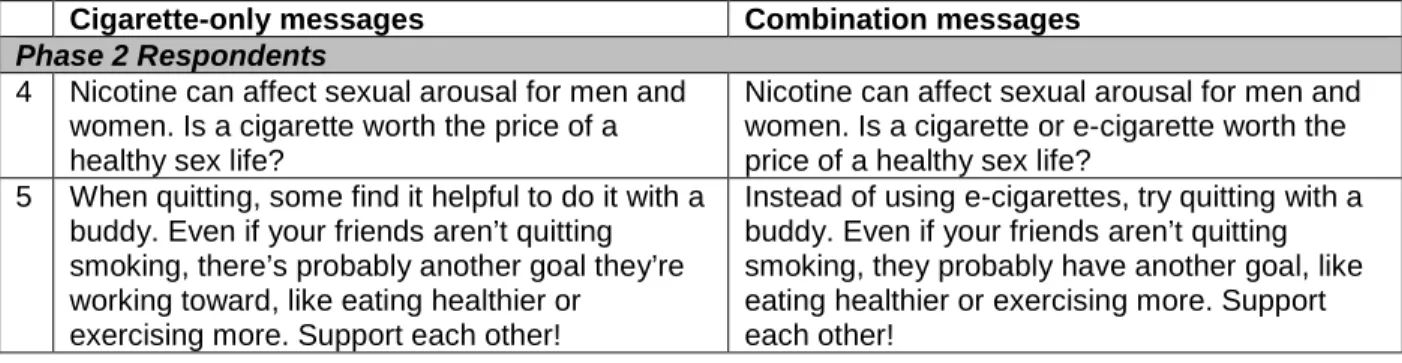
respondents and, for messages specific to the Phase 2 survey, Phase 2 respondents (see Table 2). The following sets of messages were included:
Cigarette-only messages Combination messages
All Respondents
1 Many people use cigarettes to deal with stress or boredom. Try going to the gym, taking a jog, or walking the dog instead of smoking.
Instead of using cigarettes or e-cigarettes to deal with stress or boredom, try going to the gym or walking the dog.
2 Find out how much money you spend on
cigarettes: smokefree.gov/reasons-to-quit. Think about what else you could do with that money!
Cigarettes and e-cigarettes are expensive. Think about what else you could do with that money!
3 Quitting is not about what you are giving up, but what you are gaining. Confidence, pride, improved health, and investment in your future.
Cigarette-only messages Combination messages
Phase 2 Respondents
4 Nicotine can affect sexual arousal for men and women. Is a cigarette worth the price of a healthy sex life?
Nicotine can affect sexual arousal for men and women. Is a cigarette or e-cigarette worth the price of a healthy sex life?
5 When quitting, some find it helpful to do it with a buddy. Even if your friends aren’t quitting smoking, there’s probably another goal they’re working toward, like eating healthier or
exercising more. Support each other!
Instead of using e-cigarettes, try quitting with a buddy. Even if your friends aren’t quitting smoking, they probably have another goal, like eating healthier or exercising more. Support each other!
Results indicate that, for most messages evaluated, respondents perceive cigarette-only cessation messages as significantly more relevant and effective than combination e-cigarette and cigarette cessation messages. The greatest statistical difference for both perceived relevance and perceived effectiveness occurs within message set two, which addresses the expense associated with cigarettes and/or e-cigarettes. Nevertheless, respondents rated the second cigarette cessation-only message as more relevant and effective than other cigarette-only messages and rated the second combination message as more relevant and effective than other combination messages. On average, respondents found both cigarette-only and combination messages at least somewhat relevant and somewhat effective (mean<3).
Table 2: Perceived relevance and perceived effectiveness of cigarette-only v. combined messages
Perceived Relevance Perceived Effectiveness
Cigarette-only (Mean)
Combined
(Mean) t p-value
Cigarette-only (Mean)
Combined
(Mean) t p-value All Respondents (n=200)
1 2.26** 2.62** 5.5730 0.0001 2.53 2.70 1.9237 0.1009 2 1.63** 2.18** 6.3611 0.0001 1.80** 2.21** 4.3348 0.0001 3 1.93** 2.46** 6.1575 0.0001 2.23** 2.49** 2.7273 0.0090 Phase 2 Respondents (n=100)
4 2.17 2.34 1.7844 0.0775 2.15** 2.42** 3.0888 0.0026 5 2.30** 2.74** 3.5797 0.0005 2.52** 2.82** 3.1305 0.0023
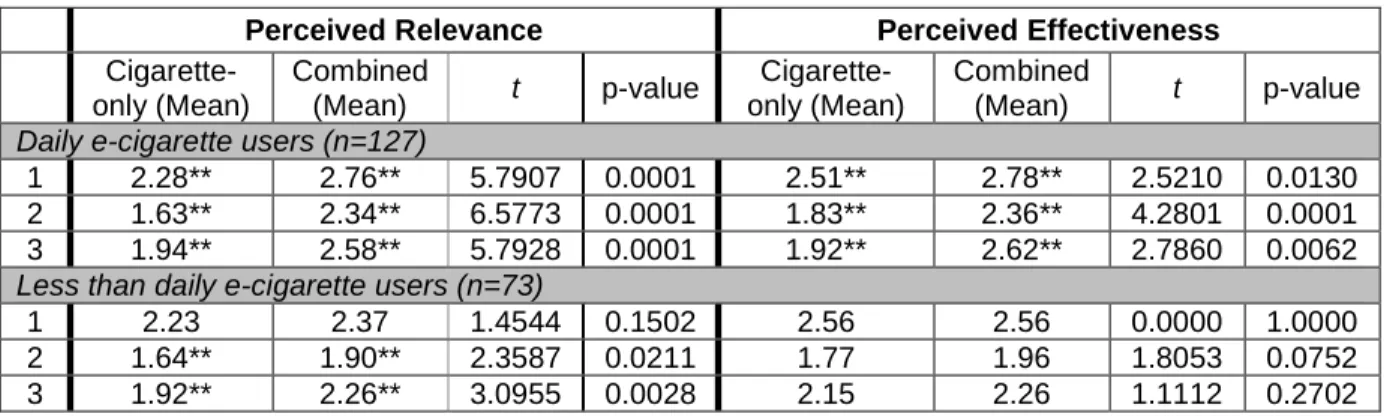
For messages included in both surveys, message perceptions were stratified by frequency of e-cigarette use (daily v. less than daily within group comparisons, see Table 3). Daily e-cigarette users rated all cigarette cessation-only messages as more relevant and effective than all combination messages, with significant differences between message types. Among respondents who use e-cigarettes less than daily, cigarette cessation-only messages were deemed more relevant than combination messages only for message sets two and three. Within this group, no statistical difference in perceived message effectiveness existed for any message set.
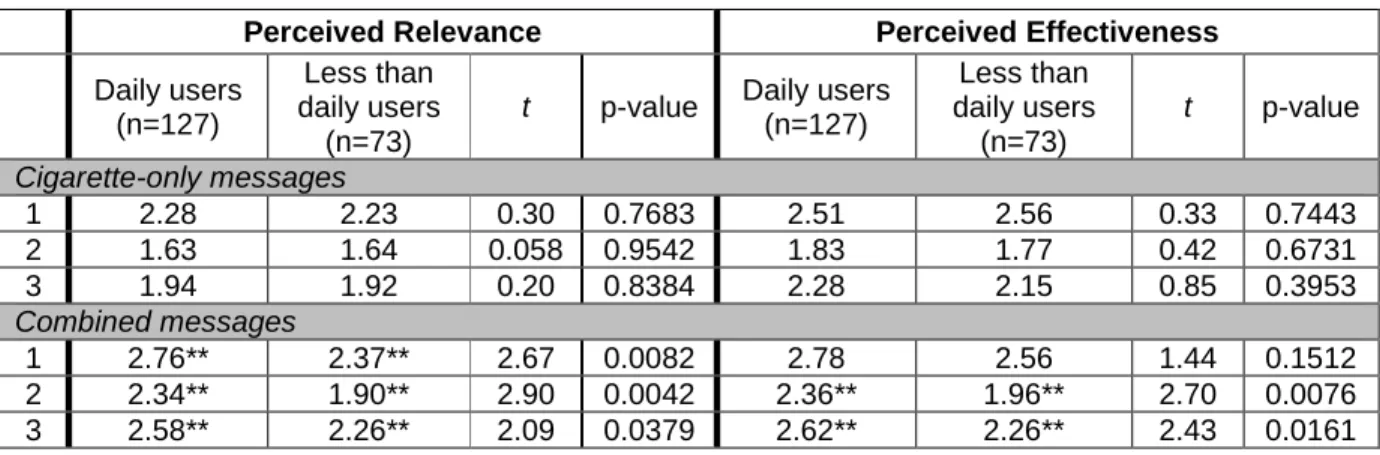
Unpaired t tests were conducted to compare message perceptions of daily e-cigarette users and less than daily e-e-cigarette users (daily v. less than daily between group comparisons, see Table 4). The analysis revealed no statistical difference in perceived message relevance or effectiveness for cigarette-only messages. However, less than daily e-cigarette users, when compared to daily e-cigarette users, rated
combination messages as significantly more relevant and effective for message sets two and three.
Table 3: Perceived relevance and perceived effectiveness of cigarette-only v. combined messages among daily and less than daily e-cigarette users
Perceived Relevance Perceived Effectiveness
Cigarette-only (Mean)
Combined
(Mean) t p-value
Cigarette-only (Mean)
Combined
(Mean) t p-value Daily e-cigarette users (n=127)
1 2.28** 2.76** 5.7907 0.0001 2.51** 2.78** 2.5210 0.0130 2 1.63** 2.34** 6.5773 0.0001 1.83** 2.36** 4.2801 0.0001 3 1.94** 2.58** 5.7928 0.0001 1.92** 2.62** 2.7860 0.0062 Less than daily e-cigarette users (n=73)
1 2.23 2.37 1.4544 0.1502 2.56 2.56 0.0000 1.0000 2 1.64** 1.90** 2.3587 0.0211 1.77 1.96 1.8053 0.0752 3 1.92** 2.26** 3.0955 0.0028 2.15 2.26 1.1112 0.2702
Table 4: Perceived relevance and perceived effectiveness between daily e-cigarette users and less than daily e-cigarette users
Perceived Relevance Perceived Effectiveness
Daily users (n=127)
Less than daily users
(n=73)
t p-value Daily users (n=127)
Less than daily users
(n=73)
t p-value
Cigarette-only messages
1 2.28 2.23 0.30 0.7683 2.51 2.56 0.33 0.7443
2 1.63 1.64 0.058 0.9542 1.83 1.77 0.42 0.6731
3 1.94 1.92 0.20 0.8384 2.28 2.15 0.85 0.3953
Combined messages
1 2.76** 2.37** 2.67 0.0082 2.78 2.56 1.44 0.1512 2 2.34** 1.90** 2.90 0.0042 2.36** 1.96** 2.70 0.0076 3 2.58** 2.26** 2.09 0.0379 2.62** 2.26** 2.43 0.0161
**Indicates statistical significance
For messages included in both surveys, message perceptions were also stratified by the extent to which respondents believe e-cigarettes are recommended to help people quit smoking or cut down on the number of cigarettes they smoke (high belief v. low belief within group comparisons, see Table 5). Respondents high and low in this belief rated all cigarette cessation-only messages as significantly more relevant than
combination messages. High belief respondents also rated all cigarette-only messages as significantly more effective than combination messages.
Table 5: Perceived relevance and perceived effectiveness of cigarette-only v. combined messages among respondents high and low in the belief that e-cigarettes are recommended to help people quit/cut down on cigarettes
Perceived Relevance Perceived Effectiveness
Cigarette-only (Mean)
Combined
(Mean) t p-value
Cigarette-only (Mean)
Combined
(Mean) t p-value High belief (n=105)
1 2.00** 2.50** 5.1661 0.0001 2.34** 2.63** 2.0937 0.0387 2 1.47** 2.19** 5.6674 0.0001 1.69** 2.20** 4.6736 0.0001 3 1.78** 2.39** 5.5308 0.0001 2.07** 2.40** 3.4603 0.0008 Low belief (n=74)
1 2.49** 2.74** 2.7204 0.0081 2.73 2.81 0.7362 0.4640 2 1.68** 2.10** 3.5232 0.0008 1.82** 2.14** 2.3601 0.0210 3 2.09** 2.52** 2.7892 0.0068 2.38 2.59 1.4018 0.1653
Unpaired t tests conducted between high belief and low belief groups indicate no significant difference in perceived relevance or perceived effectiveness of combination messages (see Table 6). Respondents high in the belief that e-cigarettes are
recommended rated cigarette-only messages one and three as significantly more relevant and effective than did respondents low in this belief.
Table 6: Perceived relevance and perceived effectiveness between respondents high in the belief that e-cigarettes are recommended and respondents low in the belief that e-e-cigarettes are recommended
Perceived Relevance Perceived Effectiveness
High belief (n=105)
Low belief
(n=74) t p-value
High belief (n=105)
Low belief
(n=74) t p-value Cigarette-only messages
1 2.00** 2.49** 3.39 0.0009 2.34** 2.73** 2.51 0.0129
2 1.47 1.68 1.80 0.0730 1.69 1.82 0.96 0.3364
3 1.78** 2.09** 2.29 0.0230 2.07** 2.38** 2.02 0.0445 Combined messages
1 2.50 2.74 1.54 0.1255 2.63 2.81 1.08 0.2810
2 2.19 2.10 0.60 0.5520 2.20 2.14 0.39 0.6969
3 2.39 2.52 0.78 0.4343 2.40 2.59 1.23 0.2212
Research Question 3b
In concert with research question 3a, which investigates how respondents perceive cigarette cessation-only versus combination messages, this study sought to answer the following: What beliefs explain respondents’ perceived effectiveness of combination e-cigarette and cigarette cessation messages? An ordered logistic
regression was conducted to assess which, if any, relevant beliefs predicted respondents’ perceived effectiveness of each combination message (see Table 7). It was hypothesized that beliefs about e-cigarette safety and toxicity would be most potent; therefore, these beliefs were evaluated as predictors for each message. Additional variables were also selected based on the content or theme of the message. For all messages, only one belief (“I fear that e-cigarettes may be toxic”) significantly predicted perceived effectiveness.
Table 7: Existence of effect between perceived message effectiveness and e-cigarette beliefs (n=200)
Combination message 1: Instead of using cigarettes or e-cigarettes to deal with stress or boredom, try going to the gym or walking the dog.
Belief Coefficient Std Error p-value 95% CI
E-cigarettes are not dangerous to
my health -0.0543068 0.1635335 0.740 -0.3748267 0.266213 I fear that e-cigarettes may be toxic 0.4357623 0.1441602 0.003** 0.1532136 0.7183111 An e-cigarette calms me down
when I am stressed -0.1125298 0.1591075 0.479 -0.4243748 0.1993152
Combination message 2: Cigarettes and e-cigarettes are expensive. Think about what else you could do with that money!
Belief Coefficient Std Error p-value 95% CI
E-cigarettes are not dangerous to
my health 0.0838906 0.1588422 0.597 -0.2274344 0.3952157 I fear that e-cigarettes may be toxic 0.4666691 0.1432919 0.001** 0.1858221 0.747516 Using e-cigarettes is cheaper than
smoking -0.0211827 0.1380639 0.878 -0.2917829 0.2494175
Combination message 3: Quitting cigarettes and e-cigarettes is not about what you are giving up, but what you are gaining. Confidence, pride, improved health, and investment in your future.
Belief Coefficient Std Error p-value 95% CI
E-cigarettes are not dangerous to
my health -0.0099378 0.1664876 0.952 -0.3362475 0.3163718 I fear that e-cigarettes may be toxic 0.485759 0.1465546 0.001** 0.1985172 0.7730009 I love using e-cigarettes 0.1657241 0.16345 0.311 -0.1546321 0.4860803 Using e-cigarettes satisfies my
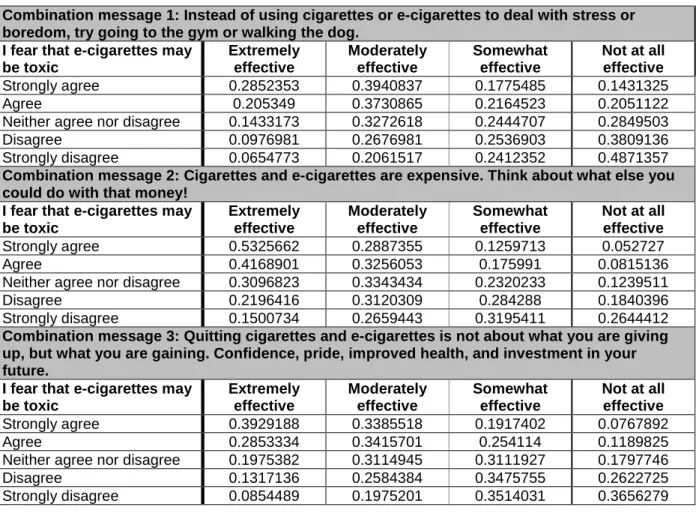
Predictive probabilities were generated to understand better how respondents’ level of belief agreement predicted message effectiveness ratings (see Table 8).
Generally, a higher message effectiveness rating appeared more probable among
respondents who agree or strongly agree with the fear that e-cigarettes may be toxic and a lower message effectiveness rating appeared more probable among those who disagree or strongly disagree with this fear.
Table 8: Effect size between perceived message effectiveness and e-cigarette beliefs (n=200)
Combination message 1: Instead of using cigarettes or e-cigarettes to deal with stress or boredom, try going to the gym or walking the dog.
I fear that e-cigarettes may be toxic Extremely effective Moderately effective Somewhat effective
Not at all effective
Strongly agree 0.2852353 0.3940837 0.1775485 0.1431325
Agree 0.205349 0.3730865 0.2164523 0.2051122
Neither agree nor disagree 0.1433173 0.3272618 0.2444707 0.2849503
Disagree 0.0976981 0.2676981 0.2536903 0.3809136
Strongly disagree 0.0654773 0.2061517 0.2412352 0.4871357
Combination message 2: Cigarettes and e-cigarettes are expensive. Think about what else you could do with that money!
I fear that e-cigarettes may be toxic Extremely effective Moderately effective Somewhat effective
Not at all effective
Strongly agree 0.5325662 0.2887355 0.1259713 0.052727
Agree 0.4168901 0.3256053 0.175991 0.0815136
Neither agree nor disagree 0.3096823 0.3343434 0.2320233 0.1239511
Disagree 0.2196416 0.3120309 0.284288 0.1840396
Strongly disagree 0.1500734 0.2659443 0.3195411 0.2644412
Combination message 3: Quitting cigarettes and e-cigarettes is not about what you are giving up, but what you are gaining. Confidence, pride, improved health, and investment in your future.
I fear that e-cigarettes may be toxic Extremely effective Moderately effective Somewhat effective
Not at all effective
Strongly agree 0.3929188 0.3385518 0.1917402 0.0767892
Agree 0.2853334 0.3415701 0.254114 0.1189825
Neither agree nor disagree 0.1975382 0.3114945 0.3111927 0.1797746
Disagree 0.1317136 0.2584384 0.3475755 0.2622725
CHAPTER 6: DISCUSSION AND IMPLICATIONS
This study aimed first to identify dual users’ beliefs about e-cigarette use and cessation. Results indicate that the majority of dual users intend to use e-cigarettes to help them quit smoking or help them cut down on the number of cigarettes they smoke. Furthermore, the vast majority of dual users believe using e-cigarettes will help them with smoking cessation or reduction. Although dual users expressed slightly more ambivalence regarding the belief that e-cigarettes are recommended for smoking cessation or reduction, more than half reported agreement or strong agreement with this belief. Respondents reported strong to moderate beliefs about several advantages of e-cigarette use, including: “I like that I can use e-cigarettes in places where I’m not allowed to smoke cigarettes,” “E-cigarettes do not emit a bad odor,” and “When I use e-cigarettes, I avoid bothering other people with cigarette smoke.” These results suggest that dual users may be exposed to information promoting e-cigarettes as a smoking cessation or reduction aid or touting the benefits of e-cigarettes. Such scenarios seem probable in light of e-cigarettes’ vast media coverage and aggressive marketing (Carr, 2014). It is recommended that future research investigate sources of e-cigarette-related information among this population in order to understand the messages to which they are exposed and how public health professionals may intervene.
recommendations were mystery (lack of information, scientific evidence, or consensus regarding e-cigarette ingredients, risks, safety, or effects), personal health and wellbeing (actual or possible negative health effects of e-cigarette use or implications of e-cigarette use on quality of life), and dependency (the addictive nature of e-cigarettes or nicotine as an ingredient in e-cigarettes). These results largely stand in contrast to respondents’ belief that e-cigarettes are not dangerous to health (on average, respondents leaned toward agreement), fear of e-cigarette toxicity (on average, respondents leaned toward disagreement), and fear of becoming addicted to e-cigarettes (on average, respondents leaned toward disagreement). It is worthwhile to consider that respondents first rated agreement with belief statements, then viewed and rated existing e-cigarette cessation messages, and, finally, provided their own suggestions for e-cigarette cessation
messages. It is possible, therefore, that the existing e-cigarette cessation messages in and of themselves educated respondents about the disadvantages of e-cigarette use, which then informed their message suggestions.
The final purpose of this study was two-fold: to assess dual users’ perceptions of cigarette cessation-only messages compared to combination e-cigarette and cigarette cessation messages and to elucidate associations between dual users’ beliefs and their perceptions of combination messages. On average, respondents found both cigarette-only and combination messages at least somewhat relevant and somewhat effective, though they consistently rated cigarette-only messages as more relevant and more effective than combination messages. Respondents who use e-cigarettes less than daily rated combination messages as significantly more relevant for all messages and
rated cigarette-only messages one and three as significantly more relevant and effective than did respondents low in this belief. These results suggest that certain characteristics, such as frequency of e-cigarette use and beliefs about e-cigarettes, may affect dual users’ receptivity to messages critical of e-cigarettes. In fact, the belief “I fear that e-cigarettes may be toxic” was found to significantly predict respondents’ perceived effectiveness of combination messages, with a higher probability of high perceived message
effectiveness among those with stronger fear and a higher probability of low perceived message effectiveness among those who disagree with this fear.
This phenomenon may be informed by the psychological concepts of cognitive dissonance (Festinger, 1957) and defensive processing (Liberman & Chaiken, 1992; Kessels et al., 2010). Cognitive dissonance theory posits that, when people experience a threat to their self-image, they are inclined to reduce dissonance caused by the threat (Festinger, 1957). People reduce such dissonance by processing the threatening information defensively and, for example, rejecting the undesirable information or adhering to their original conclusions (Liberman & Chaiken, 1992). It is possible, therefore, that e-cigarette users who believe strongly in e-cigarette safety defensively process messages that threaten that belief and, in turn, their own self-image.
These conclusions indicate challenges ahead for public health professionals
CHAPTER 7: LIMITATIONS
Intervention for e-cigarette cessation
To date, no other interventions have been developed specifically to dissuade smokers from using cigarettes. Therefore, it is not possible to draw on existing e-cigarette cessation interventions that have been evaluated and validated as a way to inform development of this intervention. Although this study and intervention rely on relevant literature, theory, methods, it is possible that the QuitNowTXT program is not appropriate for dual users of conventional cigarettes and e-cigarettes.
Crowdsourcing
Message channel
Study participants viewed messages on a computer rather than a mobile phone (the intended delivery channel). It is possible that the target audience may have, as a result, perceived the messages differently than if they had viewed them on a mobile phone in an everyday context. Although outside the scope of this study, it is
recommended that the final tailored messages be piloted through mobile phones before wide-scale implementation of the intervention.
Framing and priming
This study did not control for several variables that could have affected respondents’ message perceptions. Messages included in this study were not standardized by message frame or tone. For example, gain-framed messages (for example, messages that convey the advantages of quitting smoking) and loss-framed messages (for example, messages that convey the disadvantages of continuing to smoke) may have varying effects on message persuasiveness (Toll et al., 2007).
Messages were not randomized when presented to study participants. Therefore, it is possible that the message order may have influenced respondents’ message
Study sample
The QuitNowTXT text message-based intervention, the foundation for this study, is a smoking cessation program designed for people who have decided they want to quit and taken action to achieve that goal (i.e. signed up for QuitNowTXT). The
transtheoretical model, which delineates the various stages of readiness to change behavior, would identify QuitNowTXT users as in the action phase (Noar & Van Stee, 2012). In contrast, this study’s participants likely exist along the stages of change spectrum. While some may be researching smoking cessation methods (preparation phase), others may not yet have acknowledged smoking as a problem (precontemplation phase) or may have only begun to consider the possibility of quitting smoking
(contemplation phase). Also, because the study was conducted online among a convenience sample of Mechanical Turk workers, dual users who are not Mechanical Turk workers were ineligible to participate. Therefore, study respondents may have provided message feedback and recommendations that would differ from those
provided by QuitNowTXT’s target population or from a random sample of dual users. Additionally, this study had a relatively small sample size (Phase 1 N=100, Phase 2 N=100). Therefore, inferences about dual users of conventional cigarettes and e-cigarettes and their message perceptions are less reliable than if the study had been conducted with a larger sample. The sample size also limited the extent to which results could be stratified by subgroup.
Coding
APPENDIX A: PHASE 1 SURVEY
Captcha Question
Thank you for agreeing to participate in a survey about smoking cigarettes and using e-cigarettes. Please confirm that you are not a robot by answering the following question: What is 2 + 2? ____
If participant responds with an answer other than 4, he/she is considered a robot and, therefore, deemed ineligible to participate in the online survey.
Screening Questions
1. Do you currently smoke tobacco cigarettes on a daily basis, less than daily, or not at all?
o Daily
o Less than daily
o Not at all
1. Do you currently use electronic cigarettes (also known as e-cigarettes) on a daily basis, less than daily, or not at all?
o Daily
o Less than daily
o Not at all
2. What is your age? ____
If participant responds (a) or (b) to both questions (1) and (2) and indicates that he/she is aged 18 or older, he/she is considered a dual user of conventional cigarettes and e-cigarettes and, therefore, deemed eligible to participate in the online survey.
Main Questions
You are eligible to complete the survey. Please click the arrow button to continue on to the survey.
1. Do you intend to quit smoking cigarettes or cut down on the number of cigarettes you smoke in the next year?
o I intend to quit smoking in the next year
o I intend to cut down on the number of cigarettes I smoke in the next year o I do not intend to quit smoking or cut down on the number of cigarettes I
smoke in the next year
2. Please indicate to what extent you agree or disagree with the following statement: I believe I can quit smoking in the next year.
o Agree
o Neither agree nor disagree o Disagree
o Strongly disagree
3. Please indicate to what extent you agree or disagree with the following statement: I believe I can reduce the number of cigarettes I smoke in the next year.
o Strongly agree
o Agree
o Neither agree nor disagree
o Disagree
o Strongly disagree
4. Do you intent to use e-cigarettes to help you quit smoking or help you cut down on the number of cigarettes you smoke?
o I intend to use e-cigarettes to help me quit smoking
o I intend to use e-cigarettes to help me cut down on the number of cigarettes I smoke
o I do not intend to use e-cigarettes to help me quit smoking or help me cut down on the number of cigarettes I smoke
5. Please indicate to what extent you agree or disagree with each of the following statements:
a. I believe using e-cigarettes will help me quit smoking. b. E-cigarettes are recommended to help people quit smoking.
6. Please indicate to what extent you agree or disagree with each of the following statements:
a. I believe using e-cigarettes will help me cut down on the number of cigarettes I smoke.
b. E-cigarettes are recommended to help people cut down on the number of cigarettes they smoke.
7. Please indicate to what extent you agree or disagree with the following statements about tobacco cigarettes.1
a. Smoking is extremely dangerous to my health. b. My cigarette smoke leaves an unpleasant smell. c. Smoking gives me very bad breath.
d. I spend too much money on cigarettes.
e. My cigarette smoke bothers other people a great deal. f. My second-hand smoke is dangerous to those around me. g. It bothers me to be dependent on cigarettes.
h. I would have more energy if I did not smoke. i. A cigarettes calms me down when I am stressed. j. After a cigarette, I am able to concentrate better.