Inter-limb coordination in swimming: Effect of speed
and skill level
Ludovic Seifert
a,*, Hugues Leblanc
b, Didier Chollet
b, Didier Delignières
c aFaculty of Sport Sciences, CETAPS Laboratory, University of Rouen, Boulevard Siegfried, 76821 Mont Saint, Aignan Cedex, France b
CETAPS, EA 3832, University of Rouen, Faculty of Sport Sciences, France c
Motor Efficiency and Deficiency EA 2991, University of Montpellier, Faculty of Sports Sciences, France
a r t i c l e
i n f o
Article history:
Available online 27 November 2009 PsycINFO classification: 2330 3720 Keywords: Motor control Biomechanics Swimming Skill
Continuous relative phase
a b s t r a c t
The aim of this study was to examine the effects of swimming speed and skill level on inter-limb coordination and its intra-cyclic variability. The elbow–knee continuous relative phase (CRP) was used as the order parameter to analyze upper–lower limbs cou-pling during a complete breaststroke cycle. Twelve recreational and 12 competitive female swimmers swam 25 m at a slow speed and 25 m at maximal speed. Underwater and aerial side views were mixed and genlocked with an underwater frontal view. The angle, angular velocity, and phase were calculated for the knee and elbow by digitizing body marks on the side view. Three cycles were analyzed, filtered, averaged, and normalized in percentage of the total cycle duration. The competitive swimmers showed greater intra-cyclic CRP variability, indicating a combination of intermediate phase and in-phase knee–elbow coupling within a cycle. This characteristic was more marked at slow speed because more time was spent in the glide period of the stroke cycle, with the body completely extended. Conversely, because they spent less time in the glide, the recreational swimmers showed lower intra-cyclic CRP variability (which is mostly in the in-phase coordination mode), resulting in superposition of contradictory actions (propul-sion of one limb during the recovery of the other limb).
Ó2009 Elsevier B.V. All rights reserved.
0167-9457/$ - see front matterÓ2009 Elsevier B.V. All rights reserved. doi:10.1016/j.humov.2009.05.003
*Tel.: +33 232107784; fax: +33 232107793.
E-mail address:[email protected](L. Seifert).
Contents lists available atScienceDirect
Human Movement Science
j o u r n a l h o m e p a g e : w w w . e l s e v i e r . c o m / l o c a t e / h u m o v1. Introduction
Swimming the breaststroke appears to be a complex cyclic sport activity, for which the challenge is to tightly organize the inter-limb coupling in order to overcome the environmental constraints (aqua-tic resistance, which increases with velocity squared; for a review, seeToussaint & Truijens, 2005).
First, the swimmers have to manage the transition of underwater and aerial movements, showing a variety of strategies in response to the FINA rules. For example, the FINA rules require that the elbows remain underwater, while the shoulders and hands can break the surface of the water at each cycle; some elite breaststrokers therefore make an aerial recovery of the hands to minimize the aquatic resistance.
Second, the swimmers must favour a hydrodynamic body position and propulsive continuity to avoid high intra-cyclic velocity variation (Colman, Persyn, Daly, & Stijnen, 1998). The breaststroke has the highest intra-cyclic velocity variation because the recovery times of the two pairs of limbs pro-voke strong forward resistances in the opposite direction of movement. For this reason, arm and leg recoveries should not be performed in isolation: expert breaststroke coordination is characterized by synchronized recovery times to diminish this negative time (Chollet, Seifert, Leblanc, Boulesteix, & Carter, 2004; Seifert & Chollet, 2005; Takagi, Sugimoto, Nishijima, & Wilson, 2004). Thus, the pro-pulsion of one set of limbs should be performed while the other set is in hydrodynamic position, as when the limbs are extended to glide (Chollet et al., 2004; Seifert & Chollet, 2005). This part of the cycle shows alternating arm and leg propulsions to ensure propulsive continuity.
Last, a breaststroke cycle is composed of three arm phases and three leg phases (propulsion, recov-ery, and glide). Depending on the time spent in the glide, three coordination modes can be observed in the breaststroke (Maglischo, 2003): (i) glide coordination in which the body stays fully extended and streamlined before the arm catch, usually used for the 200-m event; (ii) continuous coordination in which arm propulsion takes over just as leg propulsion is completed, destined for the 100-m event; and (iii) superposition coordination in which the arms start their propulsion before the completion of leg propulsion, used in the 50-m event.
Given that a breaststroke cycle lasts about 2 s, efficient motor organization is difficult to achieve, particularly with regard to two points: (i) combining two contrasting modes of coordination within the same cycle, the alternation of the arm and leg propulsions and the synchronization of the recov-eries, and (ii) managing the glide time. For this reason, the beginner’s coordination is quite different from that of the expert. Two types of superposition coordination, both often arising spontaneously, are seen in the beginner (Seifert & Chollet, 2008): (i) the superposition of two contradictory phases (leg propulsion during the arm recovery and arm propulsion during the leg recovery), and (ii) the superposition of two propulsions (arm and leg propulsions).
(i) The superposition of contradictory actions can be characterized as an ‘‘accordion-like” coordina-tion and results in in-phase muscle contraccoordina-tion (i.e., simultaneous arm and leg flexion or arm and leg extension corresponding to an iso-contraction; Baldissera, Cavalleri, & Civaschi, 1982; Baldissera, Cavalleri, Marini, & Tassone, 1991; Swinnen, Jardin, Meulenbroek, Douskaia, & Hofkens-van den Brandt, 1997). This superposition coordination is ineffective because each propulsive action is thwarted by a recovery action. The superposition of contradictory actions can also be partial, occurring at two points in the cycle: the beginning of leg recovery can overlap the end of arm propulsion, and the end of arm recovery can overlap the beginning of leg propulsion (Leblanc, Seifert, Baudry, & Chollet, 2005).
(ii) The complete superposition of propulsions resembles the movement of ‘‘windscreen wipers”, with anti-phase muscle contraction (i.e., simultaneous arm flexion and leg extension or arm extension with leg flexion), and results in a preference for moving the limbs in the same direction (iso-direction principle) (Baldissera et al., 1982, 1991; Swinnen et al., 1997). The superposition of the propulsions of the arms and legs can be partial, with the body in an X position with arms and legs in complete exten-sion (Leblanc et al., 2005).
All of these studies (Chollet et al., 2004; Leblanc et al., 2005; Seifert & Chollet, 2005) analyzed the arm to leg coordination in breaststroke by calculating time gaps between the key points marking the beginning and the end of arm and leg stroke times. As outlined byGlazier, Wheat, Pease, and Bartlett
(2006)andHamill, Haddad, and Mc Dermott (2000), this discrete method was based on time data and could be completed by spatial data (like the angular positions of the limbs) to enable spatial–temporal analysis. Thus, the calculation of the continuous relative phase (CRP) would provide information on the inter-limb coordination from angle and angular velocity data to facilitate the examination of coor-dination dynamics through a complete cycle (Hamill, Haddad, & Mc Dermott, 2000; Kelso, 1995). Moreover, using the CRP, inter-limb coordination could be captured with only one macroscopic order parameter, whileChollet et al. (2004), Leblanc et al. (2005), and Seifert and Chollet (2005)assessed the time gaps at four key points of the cycle.
The aim of this study was to analyze how swim speed and skill level affect upper–lower limbs cou-pling during a complete breaststroke cycle using the elbow–knee continuous relative phase (CRP). Swimmers with a higher skill level were expected to combine in-phase and intermediate phase cou-pling within a cycle, with this characteristic more marked at slow speeds because of a longer time spent in the glide period of the stroke cycle with the body completely extended. Conversely, because they spend less time in the glide, the lower skilled swimmers were expected to show a longer in-phase mode of inter-limb coordination (due to simultaneous flexion of the knee and elbow or simultaneous extension of these two joints).
2. Materials and methods 2.1. Participants
Twenty-four female swimmers were separated into two groups according to their performance le-vel (best time on 50-m: recreational group: 52.05 ± 6.70 s; competitive group: 37.77 ± 2.90 s) and swimming skill (respective percentages of female world record for the short course on January 1, 2007: recreational group: 58.2 ± 6.5%; competitive group: 79.6 ± 6.1%). The 12 recreational swimmers were 16.5 ± 1.9 years old, had a body mass of 57.1 ± 7.2 kg, and were 162.5 ± 6.3 cm tall. The 12 com-petitive swimmers were: 15.7 ± 1.5 years, 52.4 ± 4.8 kg, and 166.0 ± 7.0 cm. All the swimmers were able to perform a symmetric leg kick and partially or completely immerse their head during the arm extension, as required by the FINA rules. The two groups showed no significant differences in age, weight, and height. Six markers were placed on the anatomical landmarks of the shoulder, elbow, wrist, hip, knee, and ankle on the right side of the body.
2.2. Protocol
The protocol was fully explained to the participants and they provided written consent to partic-ipate in the study, which was approved by the university ethics committee. In the case of minors, in-formed written consent was obtained from the participants and their parents.
One week prior to the experimental trials, the recreational swimmers swam a preliminary breast-stroke trial to establish their performance levels during a 25-m swim with an in-water start. The per-formance levels of the competitors were based on their best competitive times of the current season and were provided by their coaches. The trials consisted of swimming at two speeds over a set of 225-m, with 5 min of rest between laps: one trial at maximal speed and one trial at 80% of the max-imal speed. The order in which swimmers performed their trials was randomly assigned. After each trial, all swimmers were informed of their performances. The swimmers were asked to swim within ±5% of their targeted time. If this was not the case, the participant had to repeat the trial. The trials were monitored by two experienced timers who assessed the stroke rate and velocity with a stop-watch and a Seiko Base 3-frequency-meter in order to validate each trial.
2.3. Video analysis and stroking parameters (velocity, stroke rate, stroke length)
Two Samsung SC107 digital camcorders were connected via an AV/DV analogical input to two cus-tom-made underwater cameras. One camera filmed the swimmers from a frontal view, the other from a side view (distance 11 m). A third camcorder (Canon Obtura) placed on the pool deck videotaped and
timed the swimmers over a distance of 12.5 m (between the 10-m and 22.5-m marks on the pool edges), which enabled us to calculate the average swimming velocity and stroke rate. Using the aver-age velocity and the stroke rate, the stroke length could be calculated: stroke length = (veloc-itystroke rate)/60. Underwater and above-water views were mixed and synchronized for data processing. A flashing light was used to synchronize the pictures. After being digitized, the images of the underwater side view (sagittal plane) were analyzed with Dartfish Prosuite 4.0Ò software
(Atlanta, GA) to assess the elbow and knee angles. The acquisition rate was 66 frames s1. The
under-water cameras had a 500-line definition.
2.4. Arm to leg coordination
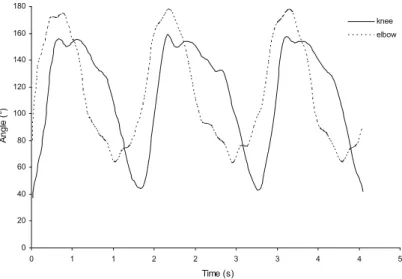
Persyn, Hoeven, and Daly (1979)were the first to observe synchronization between the 90°of flex-ion of the elbow and knee. Then,Colman et al. (1998)used these angles to distinguish the flat and undulating styles in breaststroke. Through four laps increased in speed,Chollet et al. (2004), Leblanc et al. (2005), andSeifert and Chollet (2005)determined the arm to leg coordination changes from the elbow and knee angles during the propulsion, glide, and recovery times. Based on these studies, which suggested that the elbow and knee angles in the sagittal plane could be used to analyze arm-to-leg coordination, it was checked that the time-series of elbow and knee angles possess a periodic qua-si-sinusoidal form (Fig. 1) that is obviously not perfectly harmonic but could be modeled by the fol-lowing function:
y¼aþbsin½ð2
P
=ðdþcÞ ð1ÞThus, the continuous relative phase (CRP) between the elbow (shoulder–elbow–wrist) and knee (hip– knee–ankle) angles was analyzed from two or three cycles, taken in the central part of the pool to avoid start and turn effects; these cycles were averaged by normalizing the duration of each cycle in percentage. A cycle began from a position of maximal leg flexion (feet at the butt) and ended at the return to this position. The curves of elbow and knee angles during an entire cycle were smoothed by Fourier analysis using a Butterworth low-pass filter (cut-off frequency 6 Hz) by OriginPro 7.5714Ò
software (1991–2003, OriginLab Corporation, Northampton, MA, USA). In accordance with Hamill et al. (2000), the data on angular displacements and angular velocities were normalized in the interval [1, +1] as follows: 0 20 40 60 80 100 120 140 160 180 0 1 1 2 2 3 3 4 4 5 Time (s) A ngl e ( °) knee elbow
Angular position :hnorm¼ 2h hmaxhmin hmaxþhmin hmaxhmin ð2Þ
wherehmaxis the maximum angular position within one complete cycle andhminis the minimum
angular position within one complete cycle.
Angular velocity :
x
norm¼ 2x
x
maxx
minx
maxþx
minx
maxx
minð3Þ
where
x
maxis the maximum angular velocity within one complete cycle andx
minis the minimumangular velocity within one complete cycle. Angular velocity was obtained through differentiating dis-placement data.
Phase angles were calculated using the following formula:
Phase angle :/¼tan1ð
x
norm=hnormÞ ð4Þ
Finally, the continuous relative phase (CRP) for a complete cycle was:
CRP¼Elbow phase angleKnee phase angle ð5Þ
Theoretically, two coordination modes are possible: in-phase (0°) and anti-phase (180°); however, followingBardy, Oullier, Bootsma, and Stoffregen (2002), Diedrich and Warren (1995), andSeifert, Delignières, Boulesteix, and Chollet (2007), a lag of ±30°was accepted in this study for the determina-tion of a coordinadetermina-tion mode. Therefore, an in-phase mode was assumed to occur for30°< CRP < 30°, while the anti-phase mode was taken to be between180°< CRP <150° and 150°< CRP < 180°. Beyond this step, a coordination mode of intermediate phase was also taken into account.
The time spent in in-phase mode indicates how the swimmers synchronize the propulsion of one pair of limbs with the glide of the second pair of limbs, as well as the time spent in glide with the body fully extended. The CRP value at the beginning and end of the cycle indicates the swimmer’s capability to keep the arms extended forward while the legs are starting their propulsion from knee flexion. The maximum CRP value is the greatest positive CRP value, which is distinct from the CRP value reached at the beginning and end of the cycle, and it indicates the presence or lack of the glide. The minimum CRP value is the greatest negative CRP value, which again is distinct from the CRP value reached at the beginning and end of the cycle, and it indicates how the arm recovery (elbow extension) and leg recov-ery (knee flexion) are synchronized.
2.5. Statistical analysis
Mean and standard deviation of angles, phases, and CRP are presented. The normality of the distri-bution (Ryan Joiner test) and the variance homogeneity (Bartlett test) were checked before using para-metric statistics. Two groupstwo speeds ANOVA, with swim speed as a repeated measures factor, compared (i) the stroking parameters (velocity, stroke rate, stroke length), (ii) the mean CRP, (iii) the standard deviation (SD) of CRP within a cycle, (iv) the time spent in in-phase mode, (v) the CRP at the beginning and at the end of the cycle, (vi) the maximum and minimum CRP values, and (vii) the times at which the maximum and minimum CRP occurred in the two skill levels and at the two swimming speeds.
In accordance withCohen (1988), the between-factor effect size was calculated from
g
2as thedif-ference between the sum of squares between groups and the total sum of squares. The effect size ex-plained the variance, i.e., indicated the amount of association between groups that was due to skill level and swimming speed.
g
2= .2 is small,g
2= .5 is moderate,g
2> .8 is large differences (Cohen, 1988). All tests were conducted with Minitab 15.1.0.0Òsoftware (Minitab Inc., Paris, France, 2006)with a conventional significance level ofp< .05.
3. Results
3.1. Stroking parameters
The effects of skill level and swim speed on velocity, stroke rate, and stroke length are presented in Table 1.
The relative value of velocity for the slow speed was not significantly different between the recre-ational and competitive groups (respectively, slow speed equalled 75.7% and 82.5% of the maximal speed) and thus imposed the same task constraint on both groups.
3.2. Nature of the arm to leg coordination
The time spent in in-phase mode (30°< CRP < 30°) was not significantly different between the two skill levels (34.8 ± 21.1% of the cycle for the recreational swimmers and 42.0 ± 12.8% for the com-petitive swimmers). However, on the mean of the two speeds, the mean CRP of the recreational swim-mers was close to the in-phase mode (24.1°), whereas the mean CRP of the competitive swimmers was in the intermediate mode (43.7°),F(1,33) = 15.75,p< .05,
g
2= .26, due to the greater intra-cyclicvariability of CRP (SDCRP = 56.5°and ranged from167.9 ± 29.5°to 138.5 ± 27.3°through a complete cycle) compared with the recreational group (SD CRP = 36.1° and ranged from 83.8 ± 34.3° to 22.9 ± 32.7°through a complete cycle),F(1,33) = 30.65,p< .05,
g
2= .39 (Fig. 2). The small effect sizeconcerning the differences in mean CRP andSDCRP between the two groups required further analysis. An analysis of CRP at several key points of the cycle was thus undertaken and indicated that the two groups had some common coordination features, as well as significant differences: (i) for both groups, the maximum value of CRP indicated in-phase coordination (range from 0.7 ± 20.4°to 22.9 ± 32.7°) while the minimum value of CRP revealed intermediate coordination (range from83.8 ± 34.3°to 77.3 ± 22.6°); (ii) the CRP of the recreational swimmers remained between in-phase and intermedi-ate mode (80°) while the CRP of the competitive swimmers varied greatly, alternating between in-phase and a pronounced intermediate in-phase mode (mostly close to anti-in-phase at the start and end of the cycle). Indeed, the ANOVA indicated a significant difference in the CRP of the recreational and com-petitive swimmers at the beginning of the cycle (respectively, CRP =47.6 ± 32.7°and164.9 ± 27.1°;
F(1,33) = 176.44, p< .05,
g
2= .80) and the end (respectively, CRP = 15.2 ± 26.5° and 132.2 ± 26.9°;
F(1,33) = 232.89,p< .05,
g
2= .83). The time at which the minimum CRP occurred also significantlydif-fered,F(1,33) = 33.79,p< .05,
g
2= .41, at 66.1 ± 10.6% of the cycle for the recreational swimmers and at80.3 ± 5.4% for the competitive swimmers. Finally, it is interesting to note that the CRP of the recrea-tional swimmers started to decrease (at slow speed, their CRP decreased from45.8 ± 29.3°at the start of the cycle to62.6 ± 22.0°at 4% of the cycle; at maximal speed, their CRP decreased from 49.4 ± 37.1°at the start of the cycle to70.2 ± 35.6°at 5% of the cycle), whereas the CRP of the com-petitive swimmers increased from the start of the cycle (Fig. 2).
Concerning the speed effect, the time spent in in-phase mode (0°< CRP < 30°) significantly de-creased between the slow (43.1 ± 17.1% of the cycle duration) and maximal speeds (33.7 ± 17.3% of the cycle duration), F(1,33) = 33.79, p< .05,
g
2= .13. The maximum value of CRP significantlyde-creased between the slow (18.1 ± 16.4°) and maximal speeds (4.5 ± 21.2°), F(1,33) = 5.08, p< .05,
Table 1
Effect of skill level and swim speed on the stroking parameters,p< .05;M: mean,SD: standard deviation.
Group Swim speed Velocity (m s1) Stroke rate (stroke min1) Stroke length (m stroke1)
M SD M SD M SD
Recreational Slow 0.78 0.10 33.1 5.4 1.44 0.22
Maximal 1.03 0.10 45.6 8.7 1.38 0.18
Competitive Slow 1.04 0.08 34.4 4.3 1.85 0.26
Maximal 1.26 0.09 48.4 4.6 1.58 0.20
Statistics Group effect F(1,33) = 78.23;g2
= .41 F(1,33) = 22.27;g2 = .29 Speed effect F(1,33) = 68.05;g2 = .36 F(1,33) = 55.40;g2 = .53 F(1,33) = 7.71;g2 = .12
-180 -140 -100 -60 -20 20 60 100 140 180 0 10 20 30 40 50 60 70 80 90 100 Time (%) R e la ti v e P has e ( °)
Maximal speed of the recreational group Slow speed of the recreational group Slow speed of the competitive group Maximal speed of the competitive group
Fig. 2.Continuous relative phase between elbow and knee through a complete cycle for the slow and maximal speeds of the recreational and competitive groups.
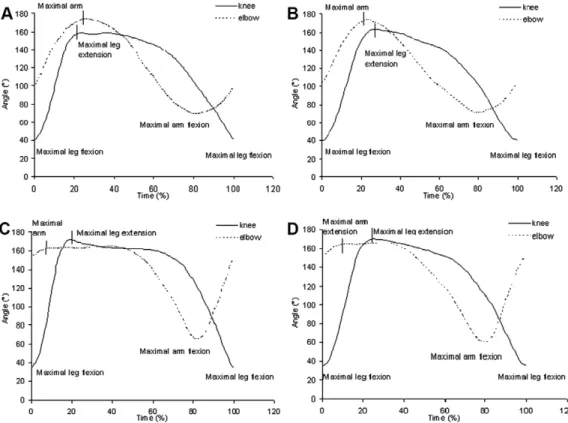
Fig. 3.Variations of the elbow and knee angles through a complete cycle: 3A: slow speed for the recreational group, 3B: maximal speed for the recreational group, 3C: slow speed for the competitive group, 3D: maximal speed for the competitive group.
g
2= .12, particularly in the recreational group (g
2= .25). Indeed, the significant interaction betweenskill level effect and swimming speed effect,F(1,33) = 4.40,p< .05, and the post-hoc Tukey test indi-cated a decrease in the maximum value of CRP for the recreational group from the slow speed (max-imum CRP = 22.9 ± 32.7°) to the maximal speed (maximum CRP = 0.7 ± 20.4°).
The coordination differences between groups and between speeds resulted from differences in the angles and angular velocities of the elbow and knee (Fig. 3), which led to differences in the phases (Fig. 4). At the start of the cycle, both groups began their leg propulsion from maximal leg flexion (35°at 0% of the cycle) and continued up to maximal leg extension (170°at 25% of the cycle). Con-jointly, the recreational swimmers spent 20% (at maximal speed) and 25% (at slow speed) of the cycle start finishing their arm recovery from a maximal flexion to attain an extended position (elbow angle close to 170°), whereas the competitive swimmers spent only 10% of the cycle start to complete their arm recovery.
Even though the two groups of swimmers started the arm recovery at the same relative moment in the stroke cycle (on average: 80%), the data indicated that at the end of the cycle, the arms of the rec-reational swimmers were still only half-extended (mean arm/forearm angle: 100°), whereas the com-petitive swimmers had them stretched almost completely forward (153°).
The between-group difference in the time at which the minimum CRP occurred was related to the greater time the competitive swimmers spent gliding with the arms extended forward. Indeed, the recreational swimmers started their arm propulsion directly from the extended position (at 20% of the cycle at maximal speed and 25% at slow speed) and continued up to the maximal flexion (elbow angle close to 70°at 80% of the cycle). Conversely, the competitive swimmers glided with the arms
Fig. 4.Variations of the elbow and knee phase angles through a complete cycle: 4A: slow speed for the recreational group, 4B: maximal speed for the recreational group, 4C: slow speed for the competitive group, 4D: maximal speed for the competitive group.
extended forward at 165°from 10% of the cycle start up to 30% of the cycle at maximal speed and 50% at slow speed. Only after this glide time did they propel with their arms until the maximal elbow flex-ion (60°at 80% of the cycle).
The between-speed difference in maximum CRP concerned the recreational group and was related to their inadequate maximal arm extension, which occurred after the maximal leg extension at slow speed and before the maximal leg extension at maximal speed. Therefore, the elbow and knee phases showed a difference in time value (Fig. 4) that led to greater in-phase coupling at maximal speed than at slow speed.
4. Discussion
The results indicated significant swim speed and skill level effects on the upper–lower limbs cou-pling during a complete breaststroke cycle.
4.1. Nature of the arm to leg coordination: effect of skill
The first hypothesis was that competitive swimmers would show a combination of in-phase and intermediate phase coordination modes. The finding of greater intra-cyclic variability in the elbow– knee coupling (SDof CRP) of these swimmers confirmed this hypothesis. The second hypothesis, regarding the prevalence of the in-phase mode in the recreational swimmers, was partially confirmed: (i) they spent less time in in-phase mode than the competitive swimmers due to the absence of glide time and, conversely, (ii) they adopted a superposition of contradictory actions, which oscillated be-tween in-phase and an intermediate phase coupling that did not reach the high values of intermediate phase observed in the competitive swimmers.
The first hypothesis concerned the competitive swimmers. The combination of the in-phase and intermediate phase modes confirmed their skill in monitoring their coordination over a 2-s cycle. The first part of the cycle in intermediate phase coordination was devoted to propelling with one pair of limbs while the other pair remained in extended position, indicating that these highly skilled per-formers released the degrees of freedom not useful to the task (as previously shown for moving on a ski-simulator byVereijken, van Emmerik, Whiting, & Newell, 1992). Therefore, during leg propulsion, the swimmers switched from anti-phase coupling (legs maximally flexed/arms maximally extended) to in-phase (legs maximally extended/arms maximally extended). Conversely, during arm propulsion, the swimmers switched from in-phase coupling (legs maximally extended/arms maximally extended) to anti-phase (legs maximally flexed/arms maximally extended). Between arm and leg propulsions, a second part of the cycle was devoted to glide time, which varied from 20% to 40% of the cycle (vs. 0% for the recreational swimmers), depending on the swim speed. During the glide, the competitive swimmers adopted a hydrodynamic position, i.e., an in-phase mode (arms and legs fully extended). According to previous studies (Chollet et al., 2004; Leblanc et al., 2005; Seifert & Chollet, 2005; Takagi et al., 2004), the glide time varies from 0% to 40% with gender, speed, and skill level, with high-skilled breaststrokers removing the glide and superposing the end of leg propulsion with the beginning of arm propulsion to maintain a high average speed (Maglischo, 2003; Seifert & Chollet, 2005). In accor-dance withPersyn et al. (1979), the competitive swimmers in our study devoted the third part of the cycle to synchronizing the arm and leg recoveries using an anti-phase mode of muscle contraction (arm extension and leg flexion). This anti-phase mode of arm and leg contractions reflects an iso-direction of the arms and legs that results in simultaneous forward recoveries. Indeed, given that both arm and leg recoveries are underwater and thus cause high drag, they should be synchronized (Chollet et al., 2004; Persyn et al., 1979).
Concerning the second hypothesis, the recreational swimmers displayed a superposition coordina-tion that oscillated between in-phase and an intermediate phase mode, with the mean CRP in in-phase mode. This motor organization was related to the in-phase muscle contraction of the arms and legs (Baldissera et al., 1982, 1991; Swinnen et al., 1997). Although this coordination mode appears to be the most stable and the easiest to perform in bimanual coordination (Kelso, 1984), hand–foot tasks (Jeka, Kelso, & Kiemel, 1993; Kelso & Jeka, 1992), and walking–running (Diedrich & Warren, 1995), this
arm to leg coordination was ineffective for breaststroke swimming because it entails a freezing of the degrees of freedom (as previously observed for moving on a ski-simulator,Vereijken et al., 1992) that superposes contradictory actions: (i) an overlap of arm recovery with leg propulsion (i.e., arms and legs simultaneously extended,Fig. 3) and (ii) an overlap of arm propulsion with leg recovery (i.e., arms and legs simultaneously flexed,Fig. 3). In both cases, the propulsion of one pair of limbs is thwarted by the underwater recovery of the other pair, which causes high drag. These results confirmed those of an electromyographic study, where the arm propulsion of unskilled young breaststroke swimmers was associated with noticeable discharges of the rectus femoris muscle, which is a hip flexor (Tokuyama, Okamoto, & Kumamoto, 1976). First, the superposition of the arm recovery on the leg propulsion was related to the incomplete spatial recovery of the arms: the recreational swimmers had their arms still flexed at 100°at the end of their recovery, whereas a 153°extension was observed for the competitive swimmers (the perfect extension for streamlined position is 180°). Second, the arm recovery was per-formed too slowly, often after letting the hands stop under the breast. This hand-stopping under the breast could not be considered as glide time because the trunk inclination and the arm flexion caused a non-hydrodynamic position that increased the drag (Kolmogorov, Rumyantseva, Gordon, & Cappaert, 1997; Mc Elroy & Blanksby, 1976). As a direct consequence, the arm recovery was delayed compared with that of the competitors.
According toLeblanc, Seifert, Tourny-Chollet, and Chollet (2007), the superposition of arm propul-sion with leg recovery occurs because of no glide time with the body fully extended after the arm recovery. Indeed, the lack of sensations often led beginners to squeeze the glide and catch times and to directly start arm propelling with a circular movement of the outstretched arms. This type of swimming was aimed at maintaining the head and the upper part of the trunk above the water sur-face rather than to go forward. The superposition of arm propulsion with leg recovery could also be related to the difficulty of keeping the trunk and lower limbs nearly parallel to the water surface dur-ing arm propulsion (Tokuyama et al., 1976; Yoshizawa, Tokuyama, Okamoto, & Kumamoto, 1976).
4.2. Nature of the arm to leg coordination: effect of speed
Speed influenced the amount of time spent in in-phase, which decreased from 43% to 33% of a com-plete stroke between slow speed and maximal speed. In fact, the increase in speed mainly affected competitive swimmers for whom the glide time with the body fully extended decreased from 40% to 20% of a complete stroke between slow speed and maximal speed, whereas arm propulsion fol-lowed arm recovery in the recreational swimmers due to the lack of glide time. Intra-cycle velocity curves have usually revealed a decrease in the duration of the leg–arm transitional phase with speed increase (Leblanc et al., 2007; Manley & Atha, 1992; Mc Elroy & Blanksby, 1976; Takagi et al., 2004). Therefore,Maglischo (2003)observed the switching from glide coordination at slow speed to super-position coordination (supersuper-position of the end of leg propulsion with the beginning of arm propul-sion) at maximal speed for expert swimmers. In our study, the competitive swimmers did not reach such high speeds and did not have sufficient experience to adopt superposition coordination.
The recreational swimmers showed differences in maximum CRP between speeds; notably, they displayed a partial superposition of two contradictory phases (the beginning of leg propulsion over-lapping the end of arm recovery) at slow speed that disappeared at maximal speed. For elite swim-mers, this strategy could be effective to maintain a high mean velocity (Mc Elroy & Blanksby, 1976; Seifert, Chollet, Papparadopoulos, Guerniou, & Binet, 2006) but appears ineffective for unskilled swim-mers who move their limbs at much the same velocity during recovery and propulsion (Leblanc et al., 2007).
5. Conclusion
The greater intra-cyclic variability of the competitive swimmers’ CRP curves indicated that they had the capability to combine different coordination modes within a single 2-s cycle: (i) intermediate phase coupling with alternating limb propulsions, (ii) in-phase of the arm and leg extensions for glid-ing, and (iii) anti-phase muscle contraction (legs flexed/arms extended) during the recovery, with a
forward iso-direction of the arm and leg. Conversely, the recreational swimmers used ineffective superposition coordination with an in-phase muscle contraction of the arms and legs, with the propul-sion of one pair of limbs thwarted by the underwater recovery of the other pair.
References
Baldissera, F., Cavalleri, P., & Civaschi, P. (1982). Preferential coupling between voluntary movements of ipsilateral limbs. Neuroscience Letters, 74, 95–100.
Baldissera, F., Cavalleri, P., Marini, G., & Tassone, G. (1991). Differential control of in-phase and anti-phase coupling of rhythmic movements of ipsilateral hand and foot.Experimental Brain Research, 83, 375–380.
Bardy, B. G., Oullier, O., Bootsma, R. J., & Stoffregen, T. A. (2002). Dynamics of human postural transitions.Journal of Experimental Psychology: Human Perception and Performance, 28, 499–514.
Chollet, D., Seifert, L., Leblanc, H., Boulesteix, L., & Carter, M. (2004). Evaluation of the arm–leg coordination in flat breaststroke. International Journal of Sports Medicine, 25, 486–495.
Cohen, J. (1988).Statistical power analysis for the behavioral sciences. Hillsdale, NJ: Lawrence Erlbaum.
Colman, V., Persyn, U., Daly, D., & Stijnen, V. (1998). A comparison of the intra-cyclic velocity variation in breaststroke swimmers with flat and undulating styles.Journal of Sports Sciences, 16, 653–665.
Diedrich, F. J., & Warren, W. H. (1995). Why change gaits? Dynamics of the walk–run transition.Journal of Experimental Psychology: Human Perception and Performance, 21, 183–202.
Glazier, P. S., Wheat, J. S., Pease, D. L., & Bartlett, R. M. (2006). Dynamic systems theory and the functional role of movement variability. In K. Davids, S. Bennett, & K. Newell (Eds.),Movement system variability(pp. 49–72). Champaign, IL: Human Kinetics Publishers.
Hamill, J., Haddad, J. M., & Mc Dermott, W. (2000). Issues in quantifying variability from a dynamical systems perspective. Journal of Applied Biomechanics, 16, 407–418.
Jeka, J. J., Kelso, J. A. S., & Kiemel, T. (1993). Spontaneous transitions and symmetry: Pattern dynamics in human four-limb coordination.Human Movement Science, 12, 627–651.
Kelso, J. A. S. (1984). Phase transitions and critical behavior in human bimanual coordination.American Journal of Physiology, Regulatory, Integrative and Comparative Physiology, 15, R1000–R1004.
Kelso, J. A. S. (1995).Dynamic patterns: The self-organization of brain and behaviour. Cambridge: MIT Press.
Kelso, J. A. S., & Jeka, J. J. (1992). Symmetry breaking dynamics of human multi-limb coordination.Journal of Experimental Psychology: Human Perception and Performance, 18, 645–668.
Kolmogorov, S. V., Rumyantseva, O. A., Gordon, B. J., & Cappaert, J. M. (1997). Hydrodynamic characteristics of competitive swimmers of different genders and performance levels.Journal of Applied Biomechanics, 13, 88–97.
Leblanc, H., Seifert, L., Baudry, L., & Chollet, D. (2005). Arm–leg coordination in flat breaststroke: A comparative study between elite and non-elite swimmers.International Journal of Sports Medicine, 26, 787–797.
Leblanc, H., Seifert, L., Tourny-Chollet, C., & Chollet, D. (2007). Velocity variations in breaststroke swimmers of different competitive levels.International Journal of Sports Medicine, 28, 140–147.
Maglischo, E. W. (2003).Swimming fastest. Champaign, IL: Human Kinetics Publishing.
Manley, P. K., & Atha, J. (1992). Intra-stroke velocity fluctuations in paced breaststroke swimming. In D. MacLaren, T. Reilly, & A. Lees (Eds.),Swimming science VI(pp. 151–159). London: E & FN Sporns.
Mc Elroy, K., & Blanksby, B. (1976). Intra-cycle velocity fluctuations of highly skilled breaststroke swimmers.Australian Journal for Health, Physical Education and Recreation, 71, 25–34.
Persyn, U. J. J., Hoeven, R. G. C., & Daly, D. J. (1979). An evaluation procedure for competite swimmers. In J. Terrauds, & E. W. Beddingfield (Eds.),Swimming science III(pp. 182–195). Baltimore: University Park Press.
Seifert, L., & Chollet, D. (2005). A new index of flat breaststroke propulsion: Comparison between elite men and elite women. Journal of Sports Sciences, 23, 309–320.
Seifert, L., & Chollet, D. (2008). Inter-limb coordination and constraints in swimming: A review. In N. P. Beaulieu (Ed.),Physical activity and children: New research(pp. 65–93). Hauppauge, New York: Nova Science Publishers.
Seifert, L., Chollet, D., Papparadopoulos, C., Guerniou, Y., & Binet, G. (2006). Longitudinal evaluation of breaststroke spatial– temporal and coordinative parameters: Preparing of the 100-m breaststroke bronze medallists of the Athena 2004 Olympic Games.Portuguese Journal of Sport Sciences, 6(Suppl. 2), 260–262.
Seifert, L., Delignières, D., Boulesteix, L., & Chollet, D. (2007). Effect of expertise on butterfly stroke coordination.Journal of Sports Sciences, 25, 131–141.
Swinnen, S. P., Jardin, K., Meulenbroek, R., Douskaia, N., & Hofkens-van den Brandt, R. (1997). Egocentric and allocentric constraints in the expression of patterns of inter-limb coordination.Journal of Cognitive Neuroscience, 9, 348–377. Takagi, H., Sugimoto, S., Nishijima, N., & Wilson, B. (2004). Differences in stroke phases, arm–leg coordination and velocity
fluctuation due to event, gender and performance level in breaststroke.Sports Biomechanics, 3, 15–27.
Tokuyama, H., Okamoto, T., & Kumamoto, M. (1976). Electromyographic study of swimming in infants and children. In Biomechanics V-B. In P. V. Komi (Ed.).international series on biomechanics(Vol. IB, pp. 215–221). Baltimore: University Park Press.
Toussaint, H. M., & Truijens, M. (2005). Biomechanical aspects of peak performance in human swimming.Animal Biology, 55, 17–40.
Vereijken, B., van Emmerik, R. E. A., Whiting, H. T. A., & Newell, K. M. (1992). Freezing degrees of freedom in skill acquisition. Journal of Motor Behavior, 24, 133–142.
Yoshizawa, M., Tokuyama, H., Okamoto, T., & Kumamoto, M. (1976). Electromyographic study of the breaststroke. In P. V. Komi (Ed.).Biomechanics V-B., international series on biomechanics(Vol. IB, pp. 222–229). Baltimore: University Park Press.