Procedia Computer Science 63 ( 2015 ) 171 – 176
1877-0509 © 2015 The Authors. Published by Elsevier B.V. This is an open access article under the CC BY-NC-ND license (http://creativecommons.org/licenses/by-nc-nd/4.0/).
Peer-review under responsibility of the Program Chairs doi: 10.1016/j.procs.2015.08.329
ScienceDirect
The 6th International Conference on Emerging Ubiquitous Systems and Pervasive Networks
(EUSPN 2015)
WML: Wireless Sensor Network based Machine Learning for
Leakage Detection and Size Estimation
Sidra Rashid
a,∗, Usman Akram
1, Shoab A. Khan
1aCollege of Electrical & Mechanical Engineering (CE&ME), National University of Sciences and Technology (NUST), Islamabad, Pakistan
Abstract
Fluid (oil/gas/water) transportation systems present a significant challenge for pipeline health monitoring. With the development of smart devices capable of micro-sensing, on-board processing, and wireless communication capabilities, the wireless sensor networks are able to facilitate online learning and reliable event monitoring and reporting for distribution pipelines. This paper presents the design, development and testing of a smart wireless sensor network (WSN) for leak detection and size estimation in long range pipelines. This system uses wireless communication and machine learning (WML) to learn, make decisions and report the critical events like slow /small leakages in natural gas/oil pipeline autonomously. Machine learning is performed on negative pressure wave (NPW) to identify events based on raw data gathered by individual sensor nodes in network. In machine learning, we use support vector machine (SVM), K-nearest neighbor (KNN) and Gaussian mixture model (GMM) and Naive bayes in multi-dimensional feature space. The proposed technique is investigated for performance and capabilities by a series of trials on a field deployed test bed, with regard to performance of leakage detection and size estimation in pipelines.
c
2015 The Authors. Published by Elsevier B.V.
Peer-review under responsibility of the Program Chairs.
Keywords: Wireless sensor network based machine learning(WML); leakage detection and size estimation; Negative pressure wave (NPW)
1. Introduction
Wireless Sensor Network (WSN) refers to a network of small, low-power devices that can sense and communicate information about their environment. WSNs are conceivable for various applications with different spatial deploy-ments that range from being very sparse to very dense by getting embedded in physical environdeploy-ments. The battery-powered wireless sensor nodes are capable of gathering different types of information, learn from this information and make decisions in real time. These systems share the same goal of detecting interesting events in an unknown environment over a period of time. New wireless communication devices have drawn attention due to technologies like sensing capabilities, communication protocols and energy harvesting and embedded systems.
Our approach enables the sensor network to use machine learning (ML) techniques to report the central control about anomaly detection and its intensity autonomously. Some of the important aspects about machine learning techniques are: First, some of the ML techniques, while being effective, are computationally intensive and require
∗Corresponding Author:
E-mail address:[email protected]
© 2015 The Authors. Published by Elsevier B.V. This is an open access article under the CC BY-NC-ND license (http://creativecommons.org/licenses/by-nc-nd/4.0/).
estimation, which is robust under different real time scenarios and gathers the application specific real-time inputs. Among different approaches for leakage detection, Negative pressure wave (NPW) technique is one of the effective tools to identify abrupt leakages in pipelines3. The basic idea of the NPW based methods is that, when a leak occurs, a transient wave is generated which is reflected back to the measuring sensor node and can be sensed using pressure transducers. This paper is an extension of4,5in which we used wavelet analysis for only leakage detection in WSNs.
The proposed system is validated through experimental series that included different testing scenarios. A com-parison of proposed methodology with traditional method has been carried out. The organization of the paper as follows: Section I & II presents introduction and related work. The proposed system design is described in Section III. Machine learning approach is discussed and analyzed in Section IV. Section V presents the practical results of the proposed system. Finally, conclusions and recommendations for future work are discussed in Section VI.
2. Literature Review
The recent drive toward new wireless communication devices has resulted in real-time applications in the field of civilian and industrial applications such as environment/habitat monitoring6,7,8, acoustic detection, seismic detec-tion, nuclear reactor controlling, fire detecdetec-tion, process monitoring and supervising. New methodologies for leakage management in water supply networks have been proposed over the last years9, and several of them have focused on
the detection of leaks based on the identification of changes in the state of the hydraulic system caused by bursts or leaks. Signal processing techniques have been used, commonly dealing with long series of the state variables of water supply systems pressures and flows) collected by sensors installed at strategic points of the respective systems10,11,12. However, such series may include errors or missing data, beside their large sizes, so the analysis can be complex and computationally expensive13.
We now summarize some of the related work that uses learning approaches for fault detection. Some systems analyze the internal pipeline parameters such as flow, pressure,temperature, density and viscosity of the fluid while other systems detect the faults from outside of the pipeline. To detect leaks using acoustic emission, acoustic signal is measured by sensors placed outside the pipe. The collected measurements are used to create an acoustic map of the pipeline so a leak can be detected by analyzing its behavior14.
A negative pressure based approach is proposed which uses wavelet transform for leakage detection in pressure signatures inside pipeline in WSNs5. However this method suffers from false alarms to estimate the size of small
leakages. In the work by Bui et al , a scalable wireless sensor network implementation is mentioned for monitoring general structures. General software and hardware components have been used to demonstrate scalability of the system15.
A system is presented in16, to counter faults in infrastructure health monitoring applications using sensor nodes.
Self sustainability of wireless sensor networks and energy scavenging with minimum power utilization and saving is mentioned in with focus on transmission related energy costs. Leakage detection mechanism using various algorithms including standing wave approach and its reliability has been mentioned in17.
In the recent efforts for fault detection, the feature extraction from pressure signals and identification of changes related to the onset of a leak. Statistical analysis of features values and a classification method are applied. Most of the efforts which are mentioned above, have been primarily tested and evaluated based on the simulations. Theoretical analysis of the algorithm is provided without any results related to its practical implementation in a field or physical test bed. We aim to embed learning algorithms in wireless sensor network to nodes to automate pipeline faults monitoring and estimating the size of anomaly.
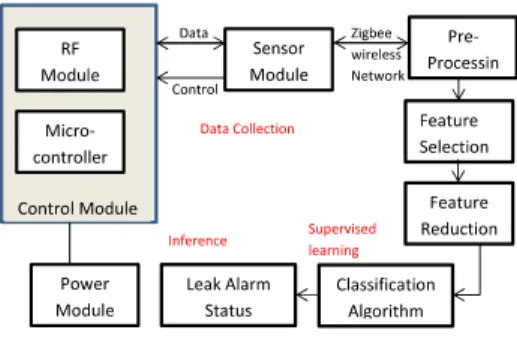
Fig. 1: Leakage detection system in WSN
3. Description of the wml leakage detection system architecture
WML supports supervised and unsupervised learning but we will discuss only supervised learning here. The WML system runs on each node in sensor network and it consists of modules named as data collection, learning and inference. Fig. 1 shows a complete architectural diagram including all modules of proposed system starting from pressure trace acquisition to the alarm generation based on the status of faults in the pipeline.
3.1. Data Collection and Communication Module
The WML leakage detection system caters aspects from reliable sensing to wireless transfer of events and sensing data in a secure fashion whilst utilizing an indigenously developed highly power efficient sensor board. For commu-nication, our system utilizes ZigBee modules that can be connected to a standard UART connector. A latest ZigBee standard compliant transceiver can provide an outdoor range of 3200 m (2 miles), indoor range of 90 m (300 ft), trans-mit power of +18 dBm and receiver sensitivity of -102 dBm. A 2-cell 7.4 V Lithium Polymer Battery Pack is used with the high capacity of 13,500 mAh. The wireless sensor board is designed in such a way that it minimizes current leakages in circuitry which drains the energy of circuitry. The major component of this board is micro-controller, to which several integrated circuit components and interfaces are connected through different protocols . For pipeline infrastructure monitoring, a linear and hierarchical layout is required for sensor node deployment in whole network.
3.2. Learning module
We considered a few learning approaches for WML leakage detection system. Which includes KNN, GMM, SVM and Naive bayes. Details of these techniques are not included due to limited space.
3.3. Inference module
This module is based on the knowledge gained in learning module to make real time decisions. This is the last module in the WML architecture for leakage detection as shown in Fig. 1. Every senor node in the network is allowed to interfere from the features it collects based on the knowledge of training during the learning phase. To minimize the communication overhead in sensor network, local inference is preferred in WML. However , the nodes sleep and awake periodically and there is a chance to miss critical information which may result in approximate result.
3 Kurtosis 0.2851 1.06 Spectrogram <10−6 3.92
4 Spectrogram 0.0058 2.57 Kutosis <10−6 5.9
5 Pseudospectrum 0.0099 2.57 Gradient <10−6 6.18
6 Entropy <10−6 6.8 Variance <10−6 9.8 7 Mean <10−6 6.9 Entropy <10−6 10.01
8 Power spectral density <10−6 6.9 Mean <10−6 10.1
9 Variance <10−6 8.3 Power spectral density <10−6 10.1
4. Feature Selection and Dimensionality Reduction 4.1. Pre-processing
Reduction of noise is one of the main focus areas of research for past few years. There are multiple possibilities to identify the presence of slow leaks in pipelines. To overcome this problem, Wavelet analysis proves to be a great resource to remove signal noise as well as provide insight into frequency content of the signal 20. The signal of NPW
is denoised using daubechies wavelets? and low pass filter?.
4.2. Feature Selection and Reduction
A number of features are extracted to detect leakage in the pipelines. The features selected from time domain are: Expected value (f1) , Variance (f2) , Gradient (f3) and Kurtosis (f4) and features selected from spectral domain are:
Pseudo spectrum (f5) Entropy (f6), Power Spectral Density (PSD) (f7), Percentage of energy (f8) and Entropy (f9). The features are selected from a set of nine features by performing two tests, first test is Wilcoxon rank-sum test, which checks classes based on median values. Second test used is Ansari-Bradley test which tests the dispersions of benign or non-benign class’s features with median values. Based on the high score and acceptable range of p value in Ansari bradley and wilcoxon test, we have reduced feature set to four features.We have selected four features f1, f2,
f7and f9.
5. Performance Evaluation
In this section, we examine the performance of machine learning algorithms for the analysis of leakage detection. To validate the proposed system via experimental campaign, a practical test bed has been deployed. It comprises of 14.1 m long GI pipes with an internal diameter of 2 inches with a horizontal placement of pipeline. A water tank is used as supply reservoir. The pipeline is connected with the tank and a motor to provide water flow. There are five valves in the layout to create artificial leaks for experimentation. Honeywell sensors are used as pressure transducers sending data to wasp-motes. Fig. 2 shows the layout of pipeline in Fig. 2a and Fig. 2b shows a closer view of different sizes of valves in the pipeline to create artificial leaks of different sizes. The pressure transducers can be mounted at any location on the pipeline. We have used five sensor nodes to make three-tier hierarchical wireless mesh network in a tree topology. There are two cluster head nodes and one base station.
There are five valves with diameters 0.25, 0.5, 0.75, 1.0, 1.5 inches to create different sized leaks in the pipelines. As first step, a third level decomposition is performed using daubechies wavelet for noise removal. This part has been explained in detail in20, which was the previous part of our research. In Figure. 3 pressure profiles have been shown
for different sizes of leaks. Fig. 3a shows the signal recorded for a 0.25 inches leak, Fig. 3b shows the signal recorded for a 0.5 inches leak, Fig. 3c shows the signal recorded for a 0.75 inches leak and Fig. 3d shows the signal recorded
(a) Experimental test bed (b) Different size of valves in Pipeline
Fig. 2: Pipeline distribution network developed for experimentation
for a 1 inches leak. In figure. 3 we can see the trade off between leakage size inside the pressure of pipeline. With an increase in the leakage size, the deflection in the pressure curve becomes prominent that is why large leaks are comparatively easy to detect but we focus on detection of small leakages here.
0 0.5 1 1.5 2 2.5 x 10⁴ 700 800 900 1000 1100 Time (Seconds) Pressure (Pa)
(a) 0.25 inches leak trace
0 0.5 1 1.5 2 2.5 x 10⁴ 700 800 900 1000 1100 Time (Seconds) Pressure (Pa)
(b) 0.5 inches leak trace
0 0.5 1 1.5 2 2.5 x 10⁴ 700 800 900 1000 1100 Time (Seconds) Pressure (Pa)
(c) 0.75 inches leak trace
0 0.5 1 1.5 2 2.5 x 10⁴ 600 800 1000 1200 Time (Seconds) Pressure (Pa)
(d) 1.0 inches leak trace
Fig. 3: Traces of five classes with different sizes of leak
Initially, the network is in normal behavior that it is not exposed to any leakage. We collect sixty learning samples for normal behavior of pipeline. Using valves of varying sizes, we collected three hundred and fifty samples pressure transient signals in total. There are sixty samples belonging to range (0-0.25) inches leak size (class 1,very small leak), sixty samples of 0.26-0.5 inches leak size (class 2, small leakage), sixty samples of 0.56-0.75 inches leak size (class 3, medium leak), sixty samples belonging to 0.76-1.0 inches leak size (class 4, large) and sixty samples belonging to 1.1-1.5 inches leak size (class 5, very large leak). The samples of each class is labeled accordingly.
We now discuss the results of experiments conducted with sensor node to study the factors that effect the learning and classification of WML leakage detection system. The performance of KNN is analyzed at first. The performance measures which are considered for evaluation of classifiers are: sensitivity, specificity and accuracy of the classifier. KNN, GMM ,SVM and NAive bayes. The mean accuracy for two class problem is found to be 94.7% and for five class problem it is 92%. In last, Naive Bayes is evaluated and the average accuracy found is 81.25%
The overall performance comparison of the classifiers has been tabulated in Table. 2 . In binary classification problem (leak or non-leak), Naive bayes outperforms GMM, KNN and a very small difference with SVM. If we look into the reason for this behavior, we find that KNN is a clustering algorithm and it takes decision based on that how far a sample is from the centroid of the cluster and GMM follows a Gaussian distribution, Naive bayes takes decision on probability and works well in case of few classes. SVM classifies based on the hyper-planar boundary which can perform classification in a better way than KNN, GMM and Naive bayes.
In second problem, KNN performs better than GMM, we have separated the non-leak signals already in binary classification and to find the size of leaks, a linear classifier can perform better than GMM. A hyperplane boundary classifies samples of different leak sizes more accurately than gaussian curve.
6. Conclusion
The combination of machine learning and wireless sensor network is a rich area of research for environment monitoring applications. Wireless sensor network can leverage the existing machine learning algorithms to provide robust, reliable and autonomous monitoring. In this paper, an intelligent machine learning based leakage detection
SVM 96.05 92.31 93.73 98.8 85.8 92.3 Naive Bayes 96.0 92.6 94.8 70.1 65.3 67.7
system is presented for oil and gas pipelines distribution networks. The system is developed indigenously and provides capability of reporting pipeline health,structure and condition related statistics stretched over large geographic areas. The results show that WML system is deployed successfully and provide accurate real time monitoring of pipelines stretched over large geographical area. The average detection performance in recognizing leakages is 94.5% for SVM, 82.25% for GMM and and 81.25% for Naive Bayes. Using large data sets or a combination of these classifier, the performance can be improved further.
References
1. N. J. Nilsson,Introduction to machine learning.
2. M. A. Alsheikh, S. Lin, D. Niyato, and H.-P. Tan, 2013. Machine learning in wireless sensor networks: Algorithms, strategies, and applications, IEEE Communications Surveys and Tutorials.
3. Turner and N. C, 1991.Hardware and software techniques for pipeline in-tegrity and leak detection monitoring, Proceedings of Offshore
Europe 91, Aberdeen, Scotland.
4. H. Saeed, S. Ali, S. Rashid, S. Qaisar, and E. Felemban, 2014.Reliable monitoring of oil and gas pipelines using wireless sensor network (wsn)
remong, IEEE 9th International System of Systems Engineering Conference.
5. S. rashid, S. qaisar, H. saeed, and E. felemban, 2013.Performance analysis of leak detection algorithm in long range pipeline networks using
transform analysis, IEEE Conference on Systems, Process and Control (ICSPC), pp.10-15.
6. A. Chauhan, R. Chauhan, and S. Semwal,Early detection of forest fire using wire-less sensor network,International Journal of Engineering
Research and Applications (IJERA),ISSN: 2248-9622,Vol. 3, Issue 4, Jul-Aug 2013, pp.163-168
7. A. Awang, M. H. Suhaimi, B. S. Iskandar, and P. D. Ridzuan,A forest monitoring system using wireless sensor networks,1210 Mohd Fauzi
Othman and Khairunnisa Shazali /Procedia Engineering 41, pp. 11011106, 2012.
8. Z. Sun, W. bin Li, H. fei Xiao, , and L. Xu,The research on solar power system of wireless sensor network node for forest monitoring,
International Conference on Web Information Systems and Mining, pp. 395398, October 2010.
9. Puust, R. et al., 2010.A review of methods for leakage management in pipe networks. Urban Water Journal, 7(1), pp.25-45.
10. Romano, M., Kapelan, Zoran Savic, D., 2012.Automated Detection of pipe burst and other events in water distribution systems. Journal of
Water Resources Planning and Management.
11. Ye, G., Ph, D. Fenner, R.A., 2011.Kalman Filtering of HydraulicMeasurements for Burst Detection in Water Distribution Systems. Journal of
pipeline systems engineering and practice, 2(1), pp.14-22.
12. Mounce, S.R., Boxall, J.B. Machell, J., 2010.Development and verification of an online artificial intelligence system for detection of bursts
and other abnormal flows. Journal of Water Resources Planning and Management, 136(3), pp.309-318.
13. Beale, R. Jackson, T., 2010. Pattern Recognition. In Neural Computing - An introduction. New York: Taylor and Francis Group, pp. 15-37.
14. Y. A. Khulief, A. Khalifa, R. Ben Mansour and M. A. Habib, 2012.Acoustic Detection of Leaks in Water Pipelines Using Measurements inside
Pipe, Journal of Pipeline Systems Engineering and Practice ASCE(3), pp.47-54.
15. Bui Van Hieu, Seunghwan Choi, Young Uk Kim, 2011.Wireless Transmission of Acoustic Emission Signals for Real-Time Monitoring of
Leakage in Underground Pipes, KSCE Journal of Civil Engineering, 15(5), pp. 805-812.
16. T. T. L., W.-J. C.and , 2012.Triopusnet: automating wireless sensor network deployment and replacement in pipeline monitoring, in
Proceed-ings of the 11th international conference on Information Processing in Sensor Networks.
17. C. D., R. H., and de Almeida A, 2012.Standing wave difference method for leak detection in pipeline systems.,Journal of Hydraulic
Engineer-ing, 131, pp. 1106-1116.
18. Sima Valizadeh and Behzad Moshiri and Karim Salahshoor, 2009.Leak Detection In Transportation Pipelines Using Feature Extraction and
KNN Classification, Pipelines: Infrastructure’s Hidden Assets.
19. P. O. Duda and P. E. Hart, 1973.Pattern Classification and Scene Analysis, New York: Wiley.
20. Sidra rashid and Saad qaisar and Husnain saeed and Emad felemban, 2013.Performance analysis of leak detection algorithm in long range