POUR L'OBTENTION DU GRADE DE DOCTEUR ÈS SCIENCES
acceptée sur proposition du jury: Prof. W. Zwaenepoel, président du jury
Prof. A. Ailamaki, directrice de thèse Dr F. Özcan, rapporteuse Prof. L. Fegaras, rapporteur
Prof. K. Aberer, rapporteur
Just-in-time Analytics Over Heterogeneous
Data and Hardware
THÈSE N
O8077 (2017)
ÉCOLE POLYTECHNIQUE FÉDÉRALE DE LAUSANNE
PRÉSENTÉE LE 8 DÉCEMBRE 2017À LA FACULTÉ INFORMATIQUE ET COMMUNICATIONS
LABORATOIRE DE SYSTÈMES ET APPLICATIONS DE TRAITEMENT DE DONNÉES MASSIVES PROGRAMME DOCTORAL EN INFORMATIQUE ET COMMUNICATIONS
Suisse
PAR
The struggle itself toward the heights is enough to fill a man’s heart. One must imagine Sisyphus happy. — Albert Camus
To Eleni, who had to survive life with a PhD candidate. To my parents and to my sister.
Acknowledgements
Putting together this thesis required the support and feedback of numerous people; without them, neither my PhD journey nor its destination would have been the same.
I would like to thank my advisor,Anastasia (Natassa) Ailamaki, for her guidance and advice. Natassa always looks out for her students. From my very first meeting with her, I realized two undisputed facts: She has an infectious enthusiasm, and she would do anything to ensure that her students can utilize their PhD to pursue a happy life. At the same time, she urges her students to never settle for mediocrity, but instead strive for excellence in all aspects of their research and life. I thus strongly believe that Natassa’s guidance has shaped me professionally. I would also like to thank the members of my thesis committee, both for finding the time to serve in my committee, as well as for their constructive comments throughout my PhD life. Specifically, I would like to thankFatma Ozcan, who acted as my mentor during an internship at IBM and helped shape a significant part of my thesis,Leonidas Fegaras, whose own work was highly influential in my thesis,Karl Aberer, who has provided feedback to me ever since my first year at EPFL, andWilly Zwaenepoel, who accepted to act as the thesis jury president and encouraged me during the thesis exam.
Through the years of my PhD, I have been fortunate to collaborate with a stellar group of people, namelyMiguel Branco,Ioannis Alagiannis,Matt Olma,Stella Giannakopoulou,Manos Athanassoulis,Raja Appuswamy,Danica Porobic,Thomas Heinis,Benjamin Gaidioz,Avrilia Floratou, andPeriklis Chrysogelos, and learn new skills from every one of them; I thank you all for our collaboration. Besides the direct collaborators, I have to thank the entire DIAS lab family for making life on the 2nd floor of the EPFL BC building enjoyable:Adrian, Angelos, Ben, Cesar, Danica, Darius, Diane, Dimitra, Eleni, Erietta, Erika, Farhan, Fotini, George, Ioannis, Iraklis, Lionel, Manos, Matt, Miguel, Mirjana, Odysseas, Panagiotis, Periklis, Pinar, Radu, Raja, Rakesh, Renata, Satya, Snow, Stella, Tahir, Thomas,andUtkuwere always there to provide feedback / chat / gossip. Likewise,Amir,Mohammed, andYannishave been great friends during and after our EPFL BC 2nd floor tenure. Ioannis, Manos, and Matt (to his dismay) formed the Greek “frappe coffee / pop culture” group. Matt is the most creative researcher / entrepreneur / handyman / person I know. Iraklis was the Thai cuisine aficionado, and Raja the Justin Bieber one. Mirjana had to listen to my made-up Serbian phrases. Danica and Pinar are my academic big sisters, always looking out for me; I thank you all.
Numerous people helped make Lausanne feel like home. Alex, Christos, Stefanos, Natassa, and Ioannis are the loudest of them; Pavlos, Nathalie, and Danae are the kindest; Matt and Stella are the jolliest. Panagiotis and Onur are the human dynamos. Stavros is the go-to guy for bitter beer and for football; Javier the one for random drunken discussions. Katerina, Loukia, Kyveli, Evi, Giannis, Apostolis, George (multiple of you!), Vasilis (also multiple!), Rafa, Farah, Goran, and many more – thank you all for being there.
My parents and my sister have always supported me unconditionally through my N years of studies. My father repeatedly tried to convince me to pursue a PhD, and is the only person more anxious than me during my deadlines; my mother balances him (and me) out; my sister forwards me Internet memes to relieve my stress. Your support has been invaluable.
Last but certainly not least, I’d like to thank my wife Eleni. In the past 5 years, Eleni has had to endure living in a tiny apartment with a workaholic, acting as comic relief to raise my spirits in times of failure, and baking insane amounts of cookies for similar reasons, all while being an infinite source of positive energy. This thesis is for you.
This research has been supported by grants from the School of Computer and Communication Sciences, EPFL, the Swiss National Science Foundation, project No. CRSII2 136318/1, “Trust-worthy Cloud Storage”, the European Union Seventh Framework Programme (ERC-2013-CoG), under grant agreement no 617508 (ViDa), and an IBM PhD Fellowship Award.
Abstract
Industry and academia are continuously becoming more data-driven and data-intensive, rely-ing on the analysis of a wide variety of datasets to gain insights. At the same time, data variety increases continuously across multiple axes. First, data comes in multiple formats, such as the binary tabular data of a DBMS, raw textual files, and domain-specific formats. Second, different datasets follow different data models, such as the relational and the hierarchical one. Data location also varies: Some datasets reside in a central “data lake”, whereas others lie in remote data sources. In addition, users execute widely different analysis tasks over all these data types. Finally, the process of gathering and integrating diverse datasets introduces several inconsistencies and redundancies in the data, such as duplicate entries for the same real-world concept. In summary, heterogeneity significantly affects the way data analysis is performed.
In this thesis, we aim fordata virtualization: Abstracting data out of its original form and manipulating it regardless of the way it is stored or structured, without a performance penalty. To achieve data virtualization, we design and implement systems thati)mask heterogeneity through the use of heterogeneity-aware, high-level building blocks andii)offer fast responses through on-demand adaptation techniques.
Regarding the high-level building blocks, we use aquery language and algebrato handle multi-ple collection types, such as relations and hierarchies, express transformations between these collection types, as well as express complexdata cleaning tasksover them. In addition, we design alocation-aware compiler and optimizerthat masks away the complexity of accessing multiple remote data sources.
Regarding on-demand adaptation, we present a design to produce a new systemper query. The design usescustomization mechanismsthat trigger runtime code generation to mimic the system most appropriate to answer a query fast: Query operators are thus created based on the query workload and the underlying data models; the data access layer is created based on the underlying data formats. In addition, we exploit emerging hardware by customizing the system implementation based on the available heterogeneous processors – CPUs and GPGPUs. We thus pair each workload with its ideal processor type. The end result is ajust-in-time database systemthat is specific to the query, data, workload, and hardware instance.
This thesis redesigns the data management stack to natively cater for data heterogeneity and exploit hardware heterogeneity. Instead of centralizing all relevant datasets, converting them to a single representation, and loading them in a monolithic, static, suboptimal system, our design embraces heterogeneity. Overall, our design decouples the type of performed analysis from the original data layout; users can perform their analysis across data stores, data models, and data formats, but at the same time experience the performance offered by a custom system that has been built on demand to serve their specific use case.
Keywords: data management, database management systems, data analytics, analytical processing systems, query processing, query compilation, code generation, heterogeneous data, data variety, data virtualization, hybrid transactional/analytical processing, real-time analytics, data lakes, ETL, GPU databases
Résumé
Les secteurs industriel et universitaire continuent de devenir de plus en plus data-driven and data-intensive, dépendant de l’analyse d’une grande variété de données pour faire de nouvelles découvertes. En même temps, la variété des données augmente continuellement, et ce, sur plusieurs axes. Tout d’abord, les données existent en plusieurs formats, comme les SGBD, dont les données sont enregistrée sous forme de tables binaires, les fichiers textes purs et les formats spécifiques au domaine. En second lieu, différents set de données suivent différents modèles de données, par example relationnels ou hiérarchiques. L’emplacement des données varie également : certains datasets résident dans un “lac de données” central, tandis que d’autres résident dans des sources de données distantes. En plus, les utilisateurs exécutent des tâches d’analyse largement différentes sur tous ces types de données. Dernière-ment, la procédure pour collecter et intégrer ces sets de données variés introduit plusieurs inexactitudes dans les données, telles que les entrées en double pour le même concept réel. En résumé, l’hétérogénéité affecte de manière significative la façon dont l’analyse des données est effectuée.
Le but de cette thèse et lavirtualisation des données: Abstraire les données de leur forme originale et les manipuler sans affecter les performances. Pour réaliser la virtualisation des données, nous concevons et mettons en œuvre des systèmes quii)masquent l’hétérogénéité en utilisant des blocs de construction de haut niveau, qui prennent en compte cette hétéro-généité, etii)qui offrent des réponses rapides grâce aux techniques d’adaptation à la demande. En ce qui concerne les blocs de construction de haut niveau, nous utilisons unlangage de requête et une algèbrepour gérer plusieurs types de collection, comme les relations et les hiérarchies, pour exprimer des transformations entre ces types de collection, ainsi que pour exprimer des tâches denettoyage de donnéescomplexes sur eux. En plus, nous concevons un
compilateur sensible au placement et un optimisateurqui améliore la complexité de l’accès à plusieurs sources de données distantes.
En ce qui concerne l’adaptation à la demande, nous présentons un design pour produire un nouveau systèmepar requête. La conception utilise des mécanismes d’adaptationqui déclenchent la génération de code d’exécution pour imiter le système le plus approprié pour répondre rapidement à une requête : Les opérateurs de requête sont ainsi créés en fonction de la charge de travail de la requête et des modèles de données sous-jacents ; la couche d’accès
aux données est créée en fonction des formats de données sous-jacents. En plus, nous ex-ploitons les matériels émergents en personnalisant l’implémentation du système en fonction des processeurs hétérogènes disponibles - CPU et GPGPUs. Nous combinons donc chaque charge de travail avec son type de processeur idéal. Le résultat final est unsystème de base de données just-in-time, spécifique à la requête, aux données, à la charge de travail et au matériel disponible.
Cette thèse redéfini la pile de gestion des données pour couvrir nativement l’hétérogénéité des données et exploiter l’hétérogénéité du matériel informatique. Plutôt que de centraliser tous les sets de données, les transformer en une seule représentation, et les charger dans un système monolithique, statique, sous-optimal, notre design embrasse l’hétérogénéité. En general, notre design découple le type d’analyse effectué de la disposition de données originale ; les utilisateurs peuvent effectuer leur analyse dans des data stores, des modèles de données, et des formats de données différents, tout en profitant des performances offertes par un système qui a été construit à la demande pour servir leur cas d’utilisation spécifique.
Mots clefs :gestion de données, systèmes de gestion de base de données, analyse de don-nées, système de traitement de requêtes analytiques, traitement de requêtes, compilation de requêtes, génération de code, données hétérogènes, variété de données, virtualisation de données, traitement transactionnel / analytique hybride, analyse en temps réel, lacs de données, ETL, bases de données GPU
Contents
Acknowledgements i
Abstract (English/Français) iii
List of figures xi
List of tables xv
1 Introduction 1
1.1 Motivating Applications . . . 2
1.2 Pitfalls of heterogeneity . . . 2
1.3 Thesis Statement and Contributions . . . 4
1.3.1 The end goal: Data virtualization. . . 4
1.3.2 Thesis Roadmap . . . 6
2 Background 7 2.1 Raw Data Analytics . . . 7
2.1.1 Traditional: Loading and Accessing Data . . . 7
2.1.2 Accessing Data through External Tables. . . 8
2.1.3 Querying DataIn Situ . . . 8
2.2 Query Languages for Diverse Data Models . . . 9
2.3 Analytical Query Processing . . . 13
2.4 Query Processing on Emerging Server Hardware. . . 14
2.4.1 Generalization of GPGPUs . . . 14
2.4.2 Specialization of CPUs . . . 16
2.5 Data Cleaning . . . 17
2.5.1 Data Cleaning Operations . . . 17
2.5.2 Data Cleaning Systems & Techniques . . . 18
3 Just-in-time Access Paths 21 3.1 Introduction . . . 21
3.2 Preliminaries: Accessing Data through Positional Maps . . . 24
3.3 The RAW Query Engine . . . 25
3.4 Adapting to raw data . . . 27
3.4.2 Evaluating raw data access strategies . . . 30
3.5 When To Load Data . . . 33
3.5.1 Shredding Columns . . . 34
3.5.2 Full Columns vs. Column Shreds . . . 35
3.5.3 Column Shreds Tradeoffs . . . 37
3.6 Use Case: The Higgs Boson . . . 41
3.7 Summary . . . 45
4 Just-in-time Query Engines 47 4.1 Introduction . . . 47
4.2 Related Work. . . 49
4.3 An expressive query algebra . . . 51
4.4 The Architecture of Proteus . . . 53
4.5 On-demand query engines . . . 54
4.5.1 An Engine per Query . . . 55
4.5.2 A Custom Data Access Layer per Query . . . 57
4.6 Adapting storage to workload . . . 62
4.7 Experimental Evaluation. . . 64
4.7.1 Specializing the Query Engine on Demand . . . 65
4.7.2 Adapting to a Real-world Workload . . . 71
4.8 Summary . . . 74
5 Big Data Virtualization 77 5.1 Introduction . . . 77
5.2 Related Work. . . 80
5.3 Motivation and Background. . . 81
5.4 System-PV . . . 84
5.5 Compiling Cross-store Queries . . . 85
5.5.1 Exposing a Virtual Schema . . . 86
5.5.2 Querying over a Virtual Schema . . . 88
5.6 A Two-phase Optimizer for Cross-store Analytics . . . 89
5.6.1 Phase I: SQL Optimization. . . 90
5.6.2 Phase II: Source-aware Optimization . . . 91
5.7 Experimental Evaluation. . . 94
5.7.1 Experimental Setup . . . 95
5.7.2 System-PV vs. Spark . . . 96
5.7.3 System-PV Performance . . . 98
5.8 Perspectives . . . 99
5.8.1 System-PV for enterprise workloads . . . 100
5.8.2 Optimizing SQL-on-Hadoop performance over multiple sources. . . 100
Contents
6 Unified Scale-Out Data Cleaning 103
6.1 Introduction . . . 103
6.2 A unified representation . . . 105
6.2.1 Data cleaning operations . . . 106
6.2.2 From data cleaning operations to code . . . 106
6.3 Cleaning data using monoids . . . 107
6.3.1 Optimizations at the monoid level . . . 107
6.3.2 Expressive Power: Mapping cleaning building blocks to the monoid calculus. . . 109
6.3.3 The CleanM language . . . 111
6.4 Unified algebraic optimization . . . 114
6.5 Executing data cleaning tasks . . . 115
6.6 CleanDB: A data cleaning system. . . 117
6.7 Experimental Evaluation. . . 118
6.7.1 Optimizations at the monoid level . . . 119
6.7.2 Optimizations at the algebra level . . . 121
6.7.3 Optimizations at the physical level. . . 123
6.8 Summary . . . 127
7 Looking forward: HTAP on Heterogeneous Hardware 129 7.1 Introduction . . . 129
7.2 Database engines on emerging hardware . . . 130
7.3 The case for H2TAP . . . 131
7.4 CALDERA: An H2TAP query engine . . . 134
7.5 Evaluation . . . 138
7.5.1 HTAP with software snapshotting . . . 138
7.5.2 OLTP with message passing . . . 140
7.5.3 Data sharing with PAX . . . 141
7.6 Summary . . . 143
8 The Big Picture 145 8.1 Unconditional data virtualization: What we did . . . 146
8.2 Unconditional data virtualization: Next steps . . . 146
A 151 A.1 Spam Analysis Queries . . . 152
Bibliography 175
List of Figures
1.1 The data analysis stack, and the heterogeneity-related challenge in each layer.. 3
2.1 Scan execution time under Fermi/Maxwell GPUs. . . 15
3.1 JIT access paths vs. In Situ and DBMS approaches: Cold and warm run of a query over CSV data. . . 32
3.2 JIT access paths vs. In Situ and DBMS approaches: For binary files, JIT access paths outperform traditional in situ query processing. . . 33
3.3 Benefits from adapting to data: Unrolling the main loop, simplifying parsing and data type conversions reduce the time spent “preparing” raw data.. . . 33
3.4 “Full columns” vs. “Column Shreds”. “Full columns”: all column values are pre-loaded into columnar structures. “Column shreds”: column pieces are only built as needed: in the example, Col2 is only loaded with the rows that passed the filter condition on Col1. . . 34
3.5 “Full columns” vs. “Column Shreds” - CSV. For the 2nd query over a CSV file, column shreds are always faster or exactly the same as full columns, as only elements of column 11 that pass the predicate are loaded from the file. . . 35
3.6 “Full columns” vs. “Column Shreds” - Binary. For the 2nd query over a binary file, we see the same behavior as for CSV: use of column shreds is always faster than use of full columns or exactly the same for 100% selectivity. . . 35
3.7 “Full columns” vs. “Column Shreds”. CSV files with floating-point numbers carry a higher data type conversion cost. The DBMS case is significantly faster.. . . . 37
3.8 “Full columns” vs. “Column Shreds”. The binary format requires no conversions, so the absolute difference between DBMS and column shreds is very small. . . 37
3.9 Shredding Policies: Creating shreds of requested nearby columns in one step is beneficial when accessing raw data in multiple steps is costly.. . . 38
3.10 Shredding Policies: Possible points of column population based on join side. . 39
3.11 Shredding Policies: If the column to be projected is on the “pipelined” side of the join, then delaying its creation is a better option. . . 40
3.12 Shredding Policies: If the projected column is on the “breaking” side, picking its point of creation depends on the join selectivity. . . 40
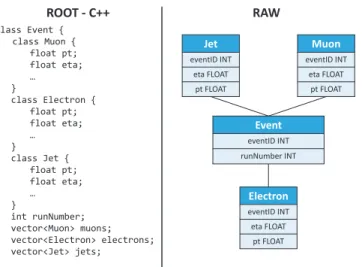
3.14 Data representation in ROOT and RAW. The representation that RAW uses allows
vectorized processing. . . 44
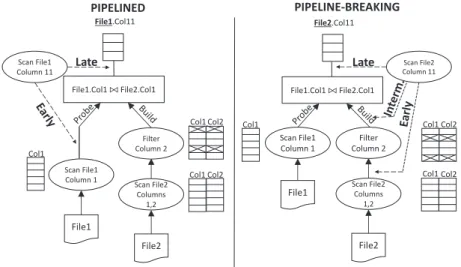
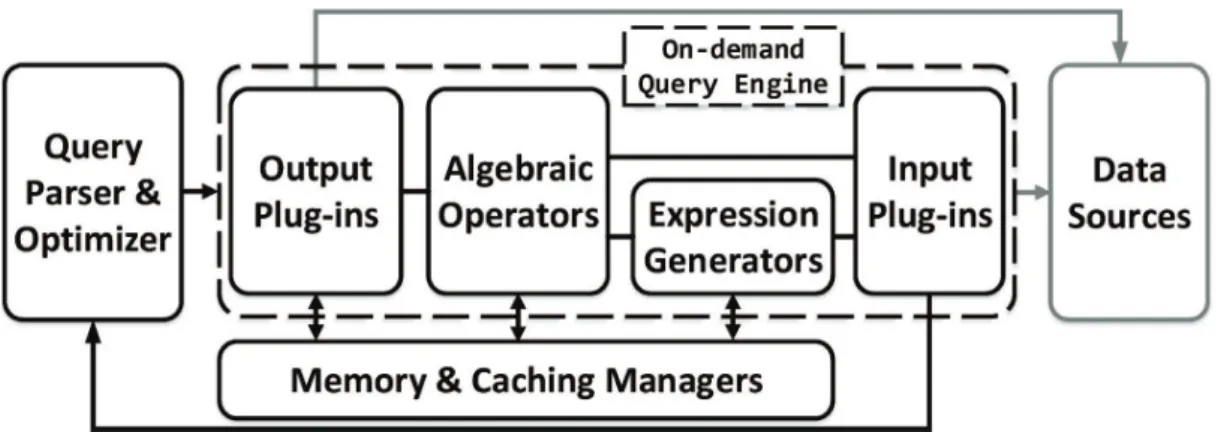
4.1 Query involving unnest operators: Without them, the operators higher in the tree would have to process BLOBs repeatedly every time they need a nested value. 52 4.2 The architecture of Proteus. . . 53
4.3 Example of a query plan and of the generated (pseudo-) code. Once the scan operator places needed fields in virtual buffers, they are used to evaluate the filtering expression.. . . 57
4.4 Example of a structural index for a JSON object. . . 59
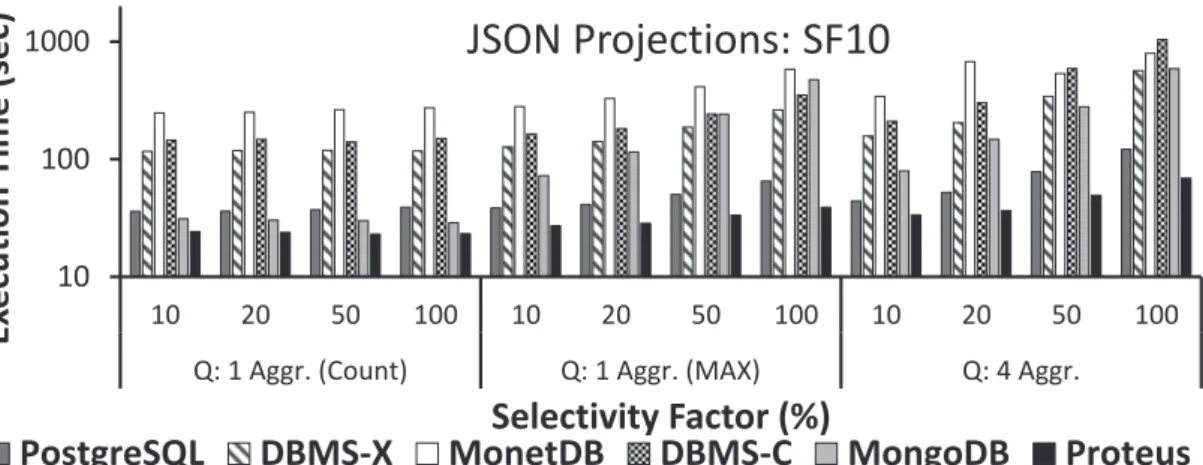
4.5 Projection-intensive queries over JSON data.. . . 66
4.6 Projection-intensive queries over binary relational data. . . 66
4.7 Selection queries over JSON data. . . 67
4.8 Selection queries over binary relational data.. . . 67
4.9 Join and unnest queries over JSON data. . . 69
4.10 Join and unnest queries over binary relational data.. . . 69
4.11 Aggregate queries over JSON data. . . 70
4.12 Aggregate queries over binary relational data. . . 70
4.13 Effect of caching on i) a projection query and on b) a selection query over JSON data.. . . 71
4.14 For a spam analysis workload, Proteus outperforms the other systems in the majority of queries due to i) its lightweight, specialized-on-demand code paths, and ii) the caches it builds as a side-effect of query execution.. . . 72
5.1 Typical scenario in a data lake: Analyzing recent, actively updated data along with historical data.. . . 82
5.2 Architecture of (a) Spark SQL and of (b) System-PV. Dotted boxes in (b) represent extensions. . . 84
5.3 System-PV Pipeline. . . 88
5.4 Virtual plan of our running example (a), and its corresponding grounded plan (b). 89 5.5 Query plan simplification during source-aware optimization.. . . 92
5.6 Join pushdown rewriting during source-aware optimization. . . 93
5.7 Range query rewriting during source-aware optimization: Data accesses become parallelizable. . . 94
5.8 Query Plan Quality: The SQL Optimizer of System-PV picks the best candidate plan (No. 1), whereas Spark’s Catalyst optimizer picks plan No. 9.. . . 96
5.9 Spark vs. System-PV: Spark is unable to keep up with System-PV even for very selective queries. . . 97
5.10 System-PV performance for various data placement configurations and query selectivities. . . 98
6.1 Algebraic plans for our running example, and optimized rewritten plans that coalesce operators and share work. . . 115
List of Figures
6.2 The architecture of CleanDB. . . 117
6.3 Different configurations of CleanDB for term validation. . . 120
6.4 Accuracy of term validation as the noise increases. . . 120
6.5 Unified data cleaning: CleanDB rewrites three cleaning operations into a single one, and avoids duplicate work. . . 122
6.6 Cost of checking for violations of functional dependencies over TPC-H.. . . 124
6.7 Cost of checking for violations of functional dependencies over Tax. . . 125
6.8 Duplicate elimination over simplified representations of DBLP: Spark SQL was unable to terminate when cleaning the original dataset. . . 126
6.9 Duplicate elimination over Customer and MAG. . . 126
7.1 H2TAP deployed over emerging server hardware. . . 132
7.2 The hierarchical data organization of Caldera for a columnar data layout, and the in-memory state after a transaction has updated tableTa. Superscripts represent epochs. . . 135
7.3 GPU-powered Caldera vs. CPU-powered columnar engines for Q6 of TPC-H. Time for Caldera includes data transfer costs. . . 138
7.4 OLTP transaction throughput in the presence of OLAP queries as we vary the OLTP working set and the degree of data freshness. . . 138
7.5 Execution time of OLAP queries in the presence of OLTP queries. All OLAP queries share a single snapshot, but OLTP-triggered copy-on-write stresses mem-ory bandwidth. . . 139
7.6 Execution time of OLAP queries and throughput of OLTP queries. We increase the number of queries that share a snapshot from 10 to 100. Increasing snapshot sharing improves performance.. . . 139
7.7 TPC-C scalability as the number of cores increase. . . 140
7.8 Throughput as the percentage of multi-site transactions increases. . . 140
7.9 Comparing the efficiency of different data layouts for GPU-based computations.142
List of Tables
2.1 The monoid comprehension calculus . . . 11
2.2 The operators of the nested relational algebra. . . 12
2.3 Processing power, memory capacity, and interconnection bandwidth of consumer-grade NVIDIA graphics cards across generations . . . 15
3.1 Hardware setup for experiments evaluating RAW. . . 30
3.2 Execution time of the 1st query over a table with 120 columns of integers and floating-point numbers. A traditional DBMS is significantly slower in the 1st query due to data loading. . . 36
3.3 Comparison of hand-written C++ Higgs Analysis with the RAW version. . . 44
4.1 The input plug-in API of Proteus. . . 58
4.2 Execution time per Symantec workload phase.. . . 74
5.1 Operators used in the view definitions of System-PV. . . 86
6.1 Translation of algebraic operators to Spark operators. Bold parts introduce new Spark operators or deviate from the translation that Spark SQL would have performed. . . 116
6.2 Accuracy of term validation approaches over the DBLP dataset. . . 121
6.3 Overhead introduced by performing syntactic transformations in a plain query. The optimizer of CleanDB applies both operations in one go and reduces over-head by∼2×. . . 123
6.4 Denial constraints involving inequalities as the dataset size increases. All systems beside CleanDB fail to terminate.. . . 124
1
Introduction
Whether in business or in science, the driver of many big data applications is the need for analyzing vast amounts of heterogeneous data to develop new insights. Examples include analyzing medical data to improve diagnosis and treatment, scrutinizing workflow data to understand and optimize business processes, analyzing stock market tickers to support finan-cial trading, etc. Yet, as different as these examples are, their core challenges revolve around providing unified access to data from heterogeneous sources, which remains a formidable challenge today [34,65,99,118,129,245] because the datasets to be analyzed typically come in a variety of formats and models, and can reside in a variety of locations / data stores. State-of-the-art approaches for data analysis have relied on placing all data, originally stored in heterogeneous file formats located at different sources, in one data warehouse. In this process, semantic integration approaches [97] help to map semantically equivalent data from different data sources on a common schema. Physical integration, on the other hand, is commonly addressed by first transforming all heterogeneous data into a common format and then copying and integrating it into a data warehouse. Transforming and integrating all data into a warehouse, however, is no longer an option for a growing number of applications. For example, in many scenarios, institutions owning the data want to retain full control of data, for legal or ethical reasons. In addition, transforming and loading the data into a warehouse is a considerable time investment that is unlikely to pay off as not all data may be accessed, while it bears the risk of vendor lock-in; migrating datasets from a proprietary system to another entails a substantial switching cost in terms of human and computational resources [191]. Furthermore, statically transforming all data into one common format and relying on a single, general-purpose query engine impedes query execution, because different query classes benefit from class-specific i) execution engines and ii) data layouts for efficient query processing. Finally, for applications that opt to operate over a single, aggregating data warehouse, preserving data freshness requires a continuous synchronization effort to propagate updates on the original data sources to the data warehouse in a timely manner; applications thus often ignore the fresh tail end of data that resides in the original sources and operate over stale data.
1.1 Motivating Applications
One of the key visions of the Human Brain project (HBP [175]) is to improve diagnosis and treatment of brain related diseases. Defining sound disease characterizations of brain diseases shared by patients is a necessary first step that requires a representative and large enough sample of patient data. Researchers in the HBP consequently must access data from mul-tiple hospitals in order to perform their analysis over a large sample. Enabling access to heterogeneous data at different hospitals, however, is a massive integration challenge. Integrating all patient data into one warehouse, i.e., transforming it physically and semantically into the same representation and moving it into one administrative location, seems to be the most straightforward approach to enable data analysis. Nevertheless, patient data appears in multiple, heterogeneous data formats; results from various instruments or processing pipelines are stored as JSON, CSV, medical image formats containing arrays, etc. Also, frequent updates occur over medical records. In addition, practitioners launch different types of analysis over the same data. Thus, importing all data into a warehouse is impractical, as many database researchers have recognized [29,36,78,135,141,144,145]. Instead, data remain in their original sources, regardless of whether these sources are loaded databases or raw files. In summary, the major data management challenge lies in optimizing the physical integration of data stored in heterogeneous formats (e.g., database tables, CSV, JSON, etc.) to efficiently support heterogeneous queries.
Similar challenges are common in other applications as well. Banks, for example, operate large numbers of databases and data processing frameworks. The banking sector thus requires a single data access layer that different functional domains (e.g., Trading, Risk, Settlement) can manage, but no such data access layer is available. Existing data processing systems are impractical to use across such a heterogeneous, complex data ecosystem. Furthermore, regulations require banks to keep raw data and correlate it directly with the trade life cycle. Accessing all data in its original form, on the other hand, allows different functional domains in banks to easily interface with the data from others without having to share a common system, and independently of data models or formats. This form of “ad hoc” data integration would allow different communities to create separate “just-in-time” databases, each reflecting a different view/area of interest over the same data. To address the challenges of these use cases as well as many other examples stemming from today’s and future applications, we clearly have to move beyond the state of the art.
1.2 Pitfalls of heterogeneity
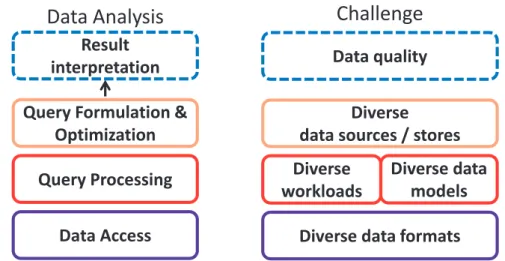
Database architects typically define every layer of the data analysis stack a priori, having a specific use case scenario in mind. The presence of heterogeneity, however, complicates the way practitioners perform data analysis. Specifically, as depicted in Figure1.1, different types of heterogeneity affect each step of data analysis:
1.2. Pitfalls of heterogeneity
Data Analysis
Query Processing
Data Access
Query Formulation &
Optimization
Result
interpretation
Challenge
Diverse data formats
Data quality
Diverse
workloads
Diverse data
models
Diverse
data sources / stores
Figure 1.1 – The data analysis stack, and the heterogeneity-related challenge in each layer.
• Data Access of Heterogeneous Formats.Data volume has been increasing exponentially and data variety increases, with an escalating number of new formats. Still, database systems only operate efficiently over loaded data, i.e., data converted from its original raw format into the system’s internal data format. As a consequence, there is a growing impedance mismatch between the original structures holding the data in the raw files and the structures used by query engines for efficient processing.
• Query Processing over Heterogeneous Models.Besides tabular, relational representations, practitioners model data as hierarchies, arrays, etc. Thus, evaluating queries over diverse datasets is non-trivial. In addition, practitioners launch different types of queries over the same data. For example, even if a dataset is stored in JSON representation, the analysis over it can resemble typical OLAP queries. Thus, data analysis solutions over heterogeneous data models have always involved a trade-off: be flexible and accommodate multiple diverse data models at the cost of performance, or be rigid and specialized for a specific scenario [233], thus leading users to employ a different system per use case.
• Query Processing for Heterogeneous Workloads. Organizations increasingly require an-alytics on fresh operational data to derive timely insights. To meet these requirements, database engines have to efficiently support hybrid transactional and analytical workloads (HTAP) over shared data. Designing a database engine that can serve mixed workloads efficiently is challenging, because besides the diverse requirements and characteristics of OLTP and OLAP workloads, the workloads negatively interfere with each other due to hardware resource contention [210].
• Query Optimization over Heterogeneous Sources.The typical enterprise data architecture consists of several actively updated data sources (e.g., NoSQL systems, data warehouses), and a central data lake, such as HDFS, in which all the data is periodically loaded through ETL processes. To simplify query processing and optimization, state-of-the-art data analysis approaches solely operate on top of the local, historical data in the data lake, and ignore the
fresh tail end of data that resides in the original remote sources. However, as many business operations depend on real-time analytics, this approach is no longer viable. The alternative is hand-crafting the analysis task to explicitly consider the characteristics of the various data sources and identify optimization opportunities, rendering the overall analysis convoluted. • Interpreting dirty data.The process of gathering, storing, and integrating heterogeneous datasets introduces several inaccuracies in the data. For example, the presence of duplicate entries is a typical issue when integrating multiple datasets. Analysts spend 50%-80% of their time preparing dirty data before it can be used for information extraction [172]. Therefore, data cleaning is a major hurdle for data analysis.
1.3 Thesis Statement and Contributions
Heterogeneity, both in data and in query workload, significantly affects the way practitioners perform data analysis. This thesis redesigns the data analysis stack so that every layer of the stack natively caters for heterogeneity in terms of input datasets and query workloads. The end goal is decoupling the type of analysis that a user performs from the original data representation / location.
Thesis Statement
Big data is increasingly heterogeneous, nevertheless data management systems must assume homogeneity to provide efficient data analysis. As data sizes grow exponentially, data harmo-nization overheads are often prohibitive to business applications. To analyze heterogeneous data efficiently, data management architectures must rely on unifying abstractions to manage and mask heterogeneity, and generate customized analysis engines just-in-time to fully adapt to the use case at hand.
1.3.1 The end goal: Data virtualization
A change of paradigm is required for data analysis processes to address data diversity and volume. Database systems must become dynamic entities whose construction is lightweight and fully adaptable to the datasets and the queries.Data virtualization[259], i.e, abstracting data out of its form and manipulating it regardless of the way it is stored or structured, is necessary. To offer unconditional data virtualization, database systems must abolish static decisions like pre-loading data and using “pre-cooked” query operators; such operators are too generic to cope with multiple types of inputs, making them inefficient. In addition, database systems must allow users to use the query language of their choice and express data cleaning tasks declaratively, while masking heterogeneity through the use of heterogeneity-aware, high-level building blocks. In this thesis, we argue that data management must become a lightweight, flexible service, instead of a monolithic software centering around the status quo of static operators and growing obese under the weight of new requirements.
1.3. Thesis Statement and Contributions
To this end, this thesis makes the following key contributions:
• Adapting a query engine to data formats.Traditionally, data has always had to “adapt” to the query engine of a system. We propose a reverse, novel approach: Dynamically adapting a query engine to the underlying raw data files. Thus, we introduceJIT access paths, which define access methods through generation of file- and query-specific scan operators, using information available at query time.
• Customizing a query engine based on the underlying data models.We present a system design that bridges the conflicting requirements for generality in analysis and minimal response times. This design supports both relational as well as nested data by using an expressive, optimizable query algebra that is richer than the relational one. We couple this powerful query algebra with on-demand adaptation techniques to eliminate numerous query execution overheads. To overcome the complexity of the broad algebra, we avoid the use of general-purpose abstract operators. Instead, we dynamically create an optimized engine implementation per query using code generation.
• Customizing a query engine based on the underlying hardware.We present the blueprint of a new architecture for designing database engines that target mixed transactional and analytical workloads. The architecture explicitly targets emerging server hardware, which incorporates accelerators like GPGPUs.
• Optimizing queries across diverse data sources.We show how to perform real-time ana-lytics over a data lake ecosystem, while simultaneously masking the complexity of dealing with multiple data sources and offering fast response times. We design a data virtualization module which is pluggable to modern scale-out data processing systems and which provides a unified view over multiple systems that are heterogeneous in terms of i) data model, ii) up-date rates, and iii) query capabilities. Besides facilitating querying, the data virtualization module optimizes the overall analysis by considering both established cost-based query optimization techniques as well as the properties of the underlying data sources to generate an efficient execution plan.
• Cleaning data in declarative fashion. We address the coverage and efficiency problems of data cleaning by introducing a language that can express multiple types of cleaning operations. The language serves a purpose similar to that of SQL for data management in terms of expressivity and optimization: First, SQL allows users to manage data in an organized way and is subjective to how each user wants to manipulate the data. Similarly, data cleaning is a task that is subjective to the user’s perception of cleanliness and therefore requires a language that allows users to express their requests in a simple yet efficient way. Second, SQL is backed by the highly optimizable relational calculus. Our proposed language thus is backed by an optimizable underlying representation as well, and goes through a three-level translation and optimization process; a different family of optimizations is applied at each abstraction level.
1.3.2 Thesis Roadmap
This thesis is organized as follows:
• Chapter2provides the necessary background on concepts we utilize and extend in the context of this thesis.
• Chapter3shows how a query engine can adapt to heterogeneous data formats, instead of vice versa. Specifically, the chapter introduces Just-In-Time (JIT) access paths, which are generated dynamically per file and per query instance.
• Chapter4presents a system design principle for analytical query engines that serve queries over data of varying models. The system design offers i) generality in analysis and ii) minimal response times. To achieve this, the design couples i) a query algebra that supports both relational and nested data with ii) on-demand customization mechanisms that collapse all layers of the system architecture at query time.
• Chapter5describes how to perform data analysis declaratively over numerous actively updated data sources. This chapter describes a data virtualization module that employs a location-aware compiler and a powerful two-phase optimizer, and is pluggable to scale-out computational frameworks; it supports and optimizes diverse analytics over a global virtual schema that masks data source variety and complexity.
• Chapter6introduces an all-purpose data cleaning query language, which models both straightforward cleaning operations, such as syntactic checks, as well as complex clean-ing buildclean-ing blocks, such as clusterclean-ing algorithms, while beclean-ing naturally extensible and parallelizable.
• Chapter7presents the vision of Heterogeneous-HTAP (H2TAP), a new architecture for database engines that fully utilize emerging server hardware (i.e., machines with heteroge-neous parallelism) to serve both transactional and analytical workloads.
2
Background
This chapter presents a brief overview of topics that are central to this thesis. Specifically, we first discuss and motivate analysis over raw data. Then, we discuss about algebras that are powerful enough to accommodate the analysis of diverse data models. We also present the state-of-the-art in terms of query execution, i.e., how numerous database systems rely on code generation and compilation to minimize query execution overheads, and how one can utilize modern hardware accelerators. Finally, we provide background on numerous data cleaning techniques.
2.1 Raw Data Analytics
Ideally, analyzing data in disparate sources would begin with ad hoc querying of the data. Instead, databases are designed to query data stored in an internal data format, which is tightly integrated with the remaining query engine and, hence, typically proprietary. Thus, if users wish to query raw data, they traditionally first load it into a database. A recent alternative to blindly loading data into a database involves asking queries directly over raw data. This section provides the necessary background on the alternative ways of accessing data.
2.1.1 Traditional: Loading and Accessing Data
Relational database systems initially load data into the database and then access it through the scan operators in the query plan. Each scan operator is responsible for reading the data belonging to a single table. Following the Volcano model [117], every call to the
next()
method of the scan operator returns a tuple or batch of tuples from the table. The scan operator in turn retrieves data from the buffer pool – an in-memory cache of disk pages. In modern column-stores [58] the implementation details differ but the workflow is similar. A call to thenext()
method of a column-store scan operator returns a chunk of a column or the whole column. In addition, the database files are often memory-mapped, relying on the operating system’s virtual memory management instead of relying on a buffer pool internal to the database.A major overhead in this method is loading the data in the first place [36,100]. Queries may also trigger expensive I/O requests to bring data into memory but from there on, accessing data does not entail significant overheads. For instance, a database page can be type-cast to the corresponding C/C++ structure at compile time. No additional data conversion or re-organization is needed.
2.1.2 Accessing Data through External Tables
External tables allow data in external sources to be accessed as if it were in a loaded table. External tables are usually implemented as file-format-specific scan operators. MySQL, for instance, supports external tables through its pluggable storage engine API [187]. The MySQL CSV Storage Engine returns a single tuple from a CSV file when the
next()
method is called: it reads a line of text from the file, tokenizes the line, parses the fields, converts each field to the corresponding MySQL data type based on the table schema, forms a tuple and finally passes the tuple to the query operators upstream.The efficiency of external tables is affected by a number of factors. First, every access to a table requires tokenizing/parsing a raw file. For CSV, it requires a byte-by-byte analysis, with a set of branch conditions, which are slow to execute [59]. Second, there is a need to convert and re-organize the raw data into the data structures used by the query engine. In the case of MySQL, every field read from the file must be converted to the equivalent MySQL data type and placed in a MySQL tuple. Finally, these costs are incurred repeatedly, even if the same raw data has been read previously.
2.1.3 Querying Data
In Situ
Abolishing the data loading phase has the potential to facilitate data exploration. At the same time, accessing data using external tables fails to leverage the effort spent by previous queries. An alternative for accessing data advocates treating “raw” data as a first-class citizen of a DBMS [36,132,145,144,197,41,78,79,219,80,80,55,255,81,135,141]. The scan operators of such systems must be able to handle not only the binary data format that is understandable by the database, but also raw data. In addition, specialized data structures must facilitate raw data access by providing indexing support over raw data.
In Situ Access & Databases.The IBM Starburst [123] project on extensible relational database management systems introduces specialized access paths for external data. The key challenges in Starburst are to define the interfaces and mechanisms to expose externally-resident data, to reflect their added capabilities in the query language, and to make the database components, such as the query optimizer, aware of their costs and advantages [223].
The “NoDB philosophy” [36] advocates that in many scenarios database systems can treat raw data files as first-class citizens and operate directly over them. The implementation of NoDB [36], PostgresRaw, is a DBMS that implements techniques specifically designed to
2.2. Query Languages for Diverse Data Models
operate over raw data. During query execution, PostgresRaw incrementally builds auxiliary indexing structures called “positional maps”, which store the position of frequently-accessed fields. Future accesses to the raw data use the positional maps to skip tokenizing/parsing files, which reduces the overhead in accessing raw data.
Recent work in HyPer [185] also considers querying CSV data. Parallelizing the phases of loading and utilizing vectorization primitives enables HyPer to bulk load data at wire speed. Another alternative to “vanilla” in situ processing is invisible loading, developed for MapRe-duce [29] by piggybacking on MapReMapRe-duce jobs. Tuples are incrementally loaded and organized into a database while data is being processed. In a related approach, Polybase [95] treats data in Hadoop clusters as external tables to a DBMS.
In Situ Access & Cloud Systems.The success of the Map-Reduce paradigm [93] led to a great number of systems operating over data stored in HDFS [226], built over Hadoop [8], or using a similar distributed runtime environment to access in situ data at scale [38,43,39,54,198]. Google Dremel [182] and Apache Drill [5] – Dremel’s open-source variant – also query data in situ, with data stored in various storage layers.
In Situ Access of Scientific data.FastBit [255] is a collection of compressed bitmap indexes that enable efficient exploration of read-only scientific data. FastBit is used internally by FastQuery [81], a framework for posing selection queries over datasets in formats such as HDF5 and NetCDF [242] that has been shown to scale out. SDS/Q [55] and SCANRAW [78] perform parallel analysis over a scientific file format. For array data, Data Vaults [135] have been built on top of MonetDB [58] and offer access to repositories of external files. They are equipped with a cache manager and an optimizer for this data format, while enabling queries using SciQL, a domain specific query language.
2.2 Query Languages for Diverse Data Models
Queries targeting heterogeneous data must consider the unavoidable model heterogeneity and enable the combination of information from diverse data sources. The query language used must also enable users to “virtualize” the original data, i.e., apply powerful transformations over the output of a query. The aim of this thesis is to provide native support for non-relational data sources, therefore the relational calculus is insufficient as a base for a query language in this context.
In the past years, researchers have proposed languages and algebras for rich data models. The majority of the research efforts centered around efficient XML management [26,27,68, 106,180,203]. Another relevant line of work regarding rich data model support comes from the programming languages domain: List and monad comprehensions [69,249] are popular constructs in (functional) programming languages, and are richer than the relational calculus; they offer support for query recursion and for arbitrary data nestings. Comprehensions have been used to iterate through collections in programming languages such as Haskell, Scala, F#, Python and JavaScript. From a database-oriented perspective, the Kleisli functional
query system [254] uses the comprehension syntax and has been used as a facilitator for data integration tasks due to its expressive power [67]. RodentStore [89] uses list comprehensions as the basis for its storage algebra; it manipulates the physical representation of the data by utilizing the expressive nature of comprehensions to express transformations. LINQ [181] exposes query comprehension syntax and enables queries over numerous databases. The works comprising this thesis use themonoid comprehension calculus[104,105], which we summarize in the rest of this section.
The monoid comprehension calculus
Amonoidis an algebraic construct term stemming from category theory. A monoid of type T comprises an associative binary operation⊕and a zero elementZ⊕. The binary operation, calledmerge function, indicates how two objects of type T can be combined. Thezero element Z⊕is the left and right identity of the merge function⊕; for every objectxof type T, the equivalenceZ⊕⊕x=x⊕Z⊕=xis satisfied.
Monoids can be used to capture operations between both primitive and collection data types. The latter also require the definition of aunit functionU⊕, which is used to construct singleton values of a collection type (e.g., a list of one element). For example, (+, 0) represents the primitivesummonoid for integer numbers. The pair (∪, {}) along with the unit function
x
{x} represent thesetcollection monoid.Themonoid comprehension calculusis used to describe operations between monoids. A monoid comprehension is an expression of the form⊕{e|q1, ...,qn}. The termsqiare called
qualifiers. Each qualifier can either be
• agenerator, taking the formv
e, whereeis an expression producing a collection, andvis a variable that is sequentially bound to each value of said collection;
• afilterpredicate.
The expressioneis called theheadof the comprehension, and is evaluated for each value binding produced by the generators. The evaluation results are combined using the merge function⊕, called theaccumulatorof the comprehension in this context. Table2.1, originally from [105], contains the syntactic forms of the monoid comprehension calculus.
The comprehension syntax that this thesis uses is slightly altered but equivalent to the one presented, and resembles the sequence comprehensions of Scala. The syntax we use is
f or{q1, ...,qn}yi el d⊕e. As an example, suppose that we want to pose the following SQL query
2.2. Query Languages for Diverse Data Models
NULL null value
c constant
υ variable
e.A record projection
〈A1=e1, ...,An=en〉 record construction
ife1thene2elsee3 if-then-else statement
e1ope2 op: primitive binary function (e.g., <,+) λυ:τ.e function abstraction e1(e2) function application Z⊕ zero element U⊕(e) singleton construction e1⊕e2 merging ⊕{e|q1, ...,qn} comprehension
Table 2.1 – The monoid comprehension calculus
SELECT COUNT
(e.id)
FROM
Employees e
JOIN
Departments d
ON
(e.deptNo
=
d.id)
WHERE
d.deptName
=
"HR"
The same aggregate query can be expressed in our version of comprehension syntax as follows:
for
{
e
<-
Employees
,
d
<-
Departments
,
e
.
deptNo
=
d
.
id
,
d
.
deptName
=
"HR"
}
yield
sum
1
This example requires us to use thesummonoid for integers to perform the count required. Other primitive monoids we can use in our queries include, among others,maxandaverage. Similarly, queries with universal or existential quantifiers can use the∨and∧monoids for boolean types. More complex operations, such as top-k and bloom filters, can also be treated as monoids.
Monoid comprehensions also support nested expressions. A query requesting an employee’s name along with a collection of all the departments this employee is associated with is ex-pressed as follows:
for
{
e
<-
Employees
,
d
<-
Departments
,
e
.
deptNo
=
d
.
id
}
yield
set
(
emp
:=
e
.
name
,
depList
:=
for
{
d2
<-
Departments
,
d
.
id
=
d2
.
id
}
yield
set d2
)
From calculus to (nested) algebra
For each incoming query, the first step is translating it to a calculus expression. The calculus expression is then rewritten to an algebraic tree of anested relational algebra[105]. This
Operator Name
Select (Outer) Join
Reduce Nest (Outer) Unnest Operator Symbol σp(X) X 1p Y X1pY Δ⊕/e p Γ ⊕/e/f p/g μ pat h p (X) μpat h p (X)
Superscript p: Filtering Expression e: Output Expression & Subscript f: Groupby Expression g: Non-nullable Expression
pat h: Field to unnest ⊕: Output Collection/Aggregate Table 2.2 – The operators of the nested relational algebra.
algebra resembles the relational one, and relational optimization techniques are applicable to it. On top of that, it offers first-class support for operations related to unnesting of queries over nested data. The operators of the nested relational algebra are depicted in Table2.2. Theselection,join, andouter joinoperators are identical to their relational counterparts. The subscriptprepresents the expression based on which filtering occurs (e.g., x<5 for a selection,t1.i d =t2.i d for a join, etc.). Reduceandnest are overloaded versions of the relational projection and the grouping operator respectively. The symbolse, f,p, andg
correspond to algebraic expressions that are used during operator evaluation (e.g.,frepresents the expression to group results by). The symbol⊕represents the type of collection/aggregate to be output. Finally, theunnestandouter unnestoperators “unroll” a collection fieldpat h
that is nested within an object. The subscriptpindicates that an expression is used to filter out the results of this operator, and the superscriptpat hspecifies which is the nested (collection) field to be “unrolled”.
Expressive Power.Monoid comprehensions bear similarities to list and monad comprehen-sions [69,249], which are constructs popular in functional programming languages. This thesis opts for monoid comprehensions as a “wrapping” layer for a variety of languages because they allow inputs of different types (e.g., sets and arrays) to be used in the same query. Query results can also be “virtualized” to the layout/ collection type requested; different applications may require different representations for the same results. Examples include, among others, representing the same original data either as a matrix or by using a relational-like tabular representation, and exporting results as bag collections while the original inputs are lists. This capability aids in “virtualizing” the original data as per the user’s needs.
Crucially, a query language based on monoid comprehensions lends itself perfectly to trans-lation to other languages. Support for a variety of query languages can be provided through a “syntactic sugar” translation layer, which maps queries written in the original language to the internal notation. Doing so enables users to formulate queries in their language of choice. Specifically, monoid comprehensions are a theoretical model behind XQuery’s FLWOR expressions, and also an intermediate form for the translation of OQL [105]. The monoid com-prehension calculus is also sufficient to express relational SQL queries. SPARQL queries over data representing graphs can also be mapped to the monoid comprehensions calculus [87].
2.3. Analytical Query Processing
2.3 Analytical Query Processing
The works in this thesis heavily rely on runtime code generation to accelerate query execution. This section thus discusses different query execution techniques, before focusing on runtime code generation.
The Volcano iterator model. When a query is posed in a database system, it is generally processed by a query planner / optimizer, resulting in an algebraic plan. This plan, expressed in the form of a tree, is traditionally interpreted using the Volcano iterator model [117]. Every operator of the plan exposes a general API, consisting ofopen(),next()andclose()function calls. Whenever an operator’snext()method is called, a request for a new tuple is sent to the operator’s children operators. While being a simple and intuitive interface, its very generality actually penalizes performance. The fact that thenext()function will be called for every tuple leads to increased costs, considering that function calls will take place even for very simple operations. In addition, as these function calls are typically virtual, they lead to frequent branch mispredictions. Finally, the constant changes in control flow lead to poor code locality.
Block-oriented query processing.To address these performance concerns, approaches have appeared suggesting block-oriented query processing, i.e. generating more that one tuple with everynext()call of an operator ([201,58,59] ). For such approaches, the costs resulting from the multiple calls of functions are significantly reduced. In addition, this type of processing also allows exploitation of modern hardware, such as vectorized execution by using SIMD instructions. On the other hand, by processing blocks, the output of operators needs to be materialized before being provided as input to a subsequent operator. Thus, the pipelining capabilities of the iterator model are no longer fully exploited, leading to increased memory bandwidth consumption.
Runtime code generation.In an attempt to keep the best of both worlds, namely both pipelin-ing capabilities and better utilization of modern hardware without sustainpipelin-ing interpretation overheads, HyPer [190] introduces a novel execution model, based on the following guidelines: • The query execution needs to be data-centric instead of operator-centric. Execution revolves around data that are kept in the CPU registers as long as possible, even if it means deviating from the traditional operator model [117].
• By using push-based execution instead of the traditional pull-based Volcano execution [117], the resulting query engine benefits from better code and data locality.
• Compile queries to low-level machine code that is optimized to fully exploit modern hard-ware.
Query compilation (i.e., runtime code generation) results in minimal code, with the majority of work taking place in “tight loops” over tuples. Such a code pattern facilitates prefetching and accurate branch prediction. In addition, the code generated contains fewer branches than the ones encountered in static systems, given that the information known at compile time
about a query can be injected into the generated code. The alternative would be “interpreting” the query plan during query evaluation, and complicating the control flow.
In general, the use of just-in-time code generation to answer database queries has re-gained popularity, years after its initial application in System R [73]. Recently, code generation has been realized using highly efficient code templates and dynamically instantiating them to create query- and hardware-specific code [159]. HyPer [190], Impala [250], and Tupleware [88] employ the LLVM JIT compiler infrastructure [162] to generate and compile code. Other approaches have a high-level language as a starting point to generate code for queries [153, 188,213,224,91]. A prominent example of the other side of low-level code generation, LegoB-ase [153] advocates “abstraction without regret” and staged compilation; its query engine and its optimization rules are both written in the high-level language Scala. Different optimizations can be applied in every query translation step from the original Scala representation to the C code that is eventually generated. Finally, hybrid storage layouts can also benefit by applying code generation to increase CPU efficiency [206] or to adapt the data layout at runtime [37].
2.4 Query Processing on Emerging Server Hardware
The hardware landscape exhibits two major trends to which the data management sector must adapt, namely, the generalization of GPGPUs and the specialization of multisocket CPUs. This section presents the characteristics of emerging hardware and their mismatch with modern database engines.
2.4.1 Generalization of GPGPUs
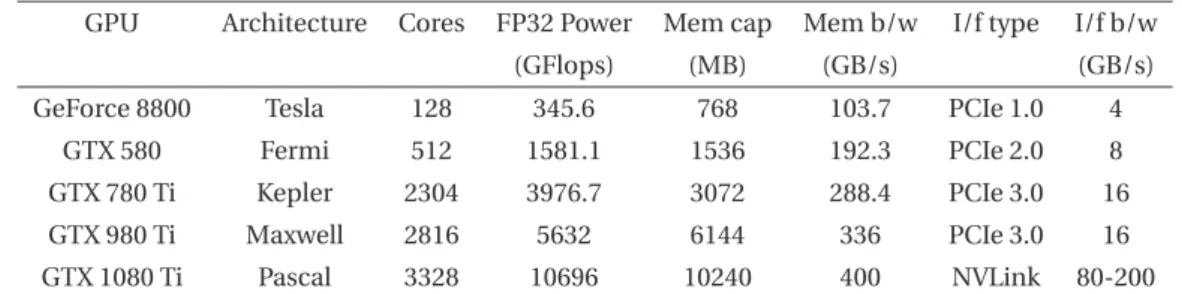
Traditionally, GPGPUs suffered from two major limitations. First, applications that used GPGPUs had to manage host (CPU) and device (GPU) memory separately, thus complicat-ing programmability. Second, GPU device memory capacity was too limited to store all data. Therefore, applications had to manually copy data from system to device memory via the slow PCIe bus before executing a computation on the GPU. As a result, despite work that showed that GPGPUs can provide substantial improvement in performance over CPUs [62,96,127,128,258], they were not widely used in the industry because analytical queries running on GPGPUs spent most of their time transferring data. As Table2.3shows, however, GPGPUs are evolving from memory-limited accelerators for niche domains to general-purpose processors with radical improvements along the dimensions of performance, interfacing, and programmability1.
Performance. The latest Pascal GPUs offer 16×higher processing power and 13.3×more memory capacity than their Tesla counterparts. GTX 1080 Ti will have an order of magnitude more cores and 4×higher memory bandwidth than even state-of-the-art multi-core CPUs. Furthermore, GPU cards which are customized for compute acceleration typically pack 2× more memory capacity and processing power over these consumer-grade graphics cards. 1 While this section uses NVIDIA terminology, all concepts apply to AMD GPGPUs as well.
2.4. Query Processing on Emerging Server Hardware
GPU Architecture Cores FP32 Power Mem cap Mem b/w I/f type I/f b/w
(GFlops) (MB) (GB/s) (GB/s)
GeForce 8800 Tesla 128 345.6 768 103.7 PCIe 1.0 4
GTX 580 Fermi 512 1581.1 1536 192.3 PCIe 2.0 8
GTX 780 Ti Kepler 2304 3976.7 3072 288.4 PCIe 3.0 16
GTX 980 Ti Maxwell 2816 5632 6144 336 PCIe 3.0 16
GTX 1080 Ti Pascal 3328 10696 10240 400 NVLink 80-200
Table 2.3 – Processing power, memory capacity, and interconnection bandwidth of consumer-grade NVIDIA graphics cards across generations
0
0.5
1
1.5
2
2.5
3
memcpy
uva
memcpy
uva
um
fermi
maxwell
Ex
ecution Time
(sec)
Q1
Q2
Q3
Q4
Q5
2.15
5.33
1.02
0.87
0.52
Figure 2.1 – Scan execution time under Fermi/Maxwell GPUs.
Interfacing. PCIe 3.0 already offers 4×higher bandwidth compared to PCIe 1.0, and PCIe 4.0 is expected to double the bandwidth again. In addition, NVIDIA has recently announced NVLink [193], an energy-efficient, high-bandwidth GPU-CPU or GPU-GPU interconnect that will offer at least 5×the bandwidth of the current PCIe 3.0 bus. NVLink is already being used to interconnect IBM Power CPUs and NVIDIA GPUs in Summit and Sierra, two supercomputers commissioned by the U.S DoE [195].
Programmability. Since CUDA 4.0, NVIDIA Fermi GPUs have supported Unified Virtual Addressing (UVA) [192], which enables GPUs and CPUs to share a single address space. The Kepler architecture added support for Unified Memory (UM) in CUDA 6.0 [192]. UM enables applications to offload memory management entirely to the CUDA runtime, which tracks memory accesses and migrates data to host or device memory depending on the access patterns to improve locality. With CUDA 8.0, the Pascal architecture extends UM with support for virtual memory-based page faulting in GPU; data allocated on the CPU is automatically faulted in and moved to the GPU one page at a time, only when accessed. Applications can thus oversubscribe GPU memory, i.e., allocate a chunk of memory larger than the GPU device capacity and access it using the same address pointer across CPUs and GPUs.
Figure2.1quantifies the net effect of some of these improvements by showing the results from a microbenchmark that executes five filter queries over a 2GB column of integers using an
M2090 Fermi GPU and a GTX 980 Maxwell GPU. Each query launches akernel– a function that all the threads of a GPU device execute in parallel. The three cases in the graph present scenarios where memory is allocated separately on device and host, requiring an explicit copy operation (“memcpy”), or memory is allocated using UVA/UM and requires no copying. In the memcpy case, we report the total time taken to perform the host-to-device input copy, kernel execution, and device-to-host output copy. For UVA and UM, we report the time to execute the kernel.
There are four important observations to be made: First, the memcpy case shows a 2× im-provement because of the imim-provement in bandwidth from 8 GB/s under PCIe 2.0 (Fermi) to 16 GB/s under PCIe 3.0 (Maxwell). Second, while UVA was 2.5×slower than memcpy under Fermi, it is 1.18×faster under Maxwell, indicating that UVA enables efficient CPU–GPU data sharing. Third, under UM, the first query takes 0.24 seconds and is 1.5×slower than under UVA. The remaining queries, however, execute in 0.07 seconds, and are 2.5×faster. After the first query, the CUDA runtime migrates the input array allocated in UM over to the GPU. Thus, subsequent queries are unaffected by the PCIe bandwidth limitation. This performance improvement required no programming effort and shows the locality benefit of using UM. Finally, comparing Fermi UVA and Maxwell UVA/UM, execution time gets a 6×reduction with UM, and a 2.46×reduction with UVA. All these speedups are noteworthy because i) they purely stem from improvements in interfaces and programmability, as the kernel does little computation, and ii) they show that efficient CPU–GPU data sharing is possible.
2.4.2 Specialization of CPUs
In stark contrast to the generalization of GPGPUs is the increasing specialization of com-modity multi-socket multi-cores. An aspect of specialization which is particularly relevant to database designers is the design of hardware cache coherence (CC). All widely used multi-cores provide CC-shared memory to ensure that memory store operations performed by one core are visible to load operations performed by another core despite multiple levels of caching. CC also forms the framework for features like atomics on shared memory words and Hardware Transactional Memory. However, as the number of cores increases, the cost and complexity needed to maintain coherence across all core-private caches is also increasing dramatically [178,257]. Research has also shown that CC presents scalability challenges for latency-sensitive workloads [178,183].
While designing scalable CC protocols for multi-cores continues to be a challenging topic [176], hardware vendors have started investigating alternative multi-core architectures that vary widely with respect to CC support. The latest Haswell processors support three modes of CC; choosing the right mode impacts the latency and bandwidth of both core-to-core data transfers and memory accesses [183]. SoCs like TI OMAP4, OMAP5, and Samsung Exynos, which are based on the ARM v8 specification, group cores into multiple domains such that coherence is maintained within but not across domains. Intel SCC [131] is a 48-core processor that provides
2.5. Data Cleaning
non-CC shared memory with core-to-core message passing capability. IBM Cell Broadband Engine [121] is a single-chip multiprocessor with eight non-CC Synergistic Processor Elements (SPE) optimized for data processing. Given such variation among processors in providing CC, several researchers argue that system-wide CC may no longer be available in the near future [49,50,169], and are building software such as operating systems [47,49,169,253], file systems [133], memory management libraries [50], and runtime libraries [70,163], explicitly targeted at emerging non-CC systems.
2.5 Data Cleaning
Cleaning dirty data has been an omnipresent data management challenge. This section surveys i) frequently-required data cleaning operations, and ii) data cleaning frameworks and techniques [25,83,113,134,139,149,212,235,246] used to perform said cleaning operations.
2.5.1 Data Cleaning Operations
In the following we describe a set of popular data cleaning operations.
Denial Constraints (DC).The family ofdenial constraints[102] contains universally quan-tified first order language sentences that represent data dependencies, such as functional dependencies (FD) and conditional functional dependencies. DCs have the following form: ∀t1, ...,tk¬(p(x1)∧p(x2)∧...p(xn)). If a dataset contains one or more tuples for which the
predicatesp(x1)...p(xn) hold, it is considered to be inconsistent.
Duplicate Elimination.Duplicate eliminationinvolves the discovery of tuples that refer to the same real-world entity [158]. The most straightforward way to detect similar tuples is a self-join that discovers identical tuples. A lighter duplicate detection form is to consider an attribute or a set of attributes that should be unique; if two tuples have the same values for that particular set of attributes, then they are considered to be duplicates. A more challenging scenario involves the case where a dataset does not contain completely identical pairs of tuples/attribute sets, but might containsimilarpairs. In this case, the self-join predicate needs to calculate similarity instead of equality, and thus requires the user to choose an appropriate similarity metric.
Transformations & Term Validation. Transforma