CONUNDRUM: A SERIOUS GAME INFORMED BY BLOOM’S TAXONOMY FOR TEACHING ETHICS AND SOCIAL ISSUES
A Thesis Submitted to the College of Graduate Studies and Research In Partial Fulfillment of the Requirements
For the Degree of Masters of Science In the Department of Computer Science
University of Saskatchewan Saskatoon
By
Adam McKenzie
i Permission to Use
In presenting this thesis in partial fulfilment of the requirements for a Postgraduate degree from the University of Saskatchewan, I agree that the Libraries of this University may make it freely available for inspection. I further agree that permission for copying of this thesis in any manner, in whole or in part, for scholarly purposes may be granted by the professor or professors who supervised my thesis work or, in their absence, by the Head of the Department or the Dean of the College in which my thesis work was done. It is understood that any copying or publication or use of this thesis or parts thereof for financial gain shall not be allowed without my written permission. It is also understood that due recognition shall be given to me and to the University of Saskatchewan in any scholarly use which may be made of any material in my thesis.
Requests for permission to copy or to make other use of material in this thesis in whole or part should be addressed to:
Dr. Eric Neufeld
Head of the Department of Computer Science University of Saskatchewan
ii ABSTRACT
Building technology to support students who must learn ethics and social issues is a difficult problem. In fact ethics and social issues is an example of an ill-defined domains, which typically are resistant to standard intelligent tutoring systems techniques. An analysis of current
pedagogical tools for teaching Computer Science ethics and social issues using Bloom’s Taxonomy shows that the task needs tools for achieving Application, Evaluation and Creation educational goals. One promising approach which has the potential to achieve such goals is educational games. This paper explores a proof of concept educational game called Conundrum. This serious game provides three ways for learners to interact with it, each supporting a level of Bloom’s Taxonomy. An experiment was run in a Computer Science ethics and social issues class showing promising results that the design of Conundrum led to students achieving Application, Evaluation and Creation goals. A multidimensional student model was also developed to aid instructors and learners understand their progress. The experiment showed that the design of Conundrum did have some good aspects but leaves a lot of future work to maximize its potential.
iii
ACKNOWLEDGMENTS
There are several people without whom this dissertation would not have been possible. My supervisor Gord McCalla with our many discussions and the beginning of a lifelong coffee addiction. My Father and Mother who have always been supportive. My sister Gail with practical help and direction even in times of great strife. The many back and forth discussions with Chris Brooks. The unending patience of my wife Carie. Finally, many other great friends who have helped me in this process throughout the years.
iv Dedication
This dissertation is dedicated to my late sister Cora. For the masters and PHD she would have done but never got a chance to.
v
TABLE OF CONTENTS
page
ABSTRACT ... ii
ACKNOWLEDGMENTS ... iii
LIST OF TABLES ... vii
LIST OF FIGURES ... viii
LIST OF ABBREVIATIONS ... ix
INTRODUCTION ...1
RELATED WORK ...3
Bloom’s Taxonomy of Educational Objectives ... 3
Bloom’s Taxonomy and Ethics and Social Issue Pedagogy ... 4
Serious Game as Solution for Application, Evaluation and Creation Skills ... 6
Creation of User Generated Content ... 14
Serious Games for Ethics and Social Issues Skills ... 15
Board Games about Ethics and Social Issues ... 16
Games For Change About Ethics and Social Issues ... 18
Educational Serious Games About Ethics and Social Issues ... 19
CONUNDRUM SYSTEM...22
Conundrum Game Play ... 22
Acts Designed For Play in Conundrum ... 29
Security vs. Deadline ...30 Conflict of Interest ...34 Intellectual Property ...36 Computer Crime...38 Flashback ... 41 Act Editor ... 44
EXPERIMENT AND RESULTS ...48
Experiment ... 48
Data Collected ... 49
Game Data ... 49
Flashback Data ... 51
Act Editor Data ... 51
Results ... 52
Participants Achieved Bloom’s Level of Apply ... 52
Participants Achieved Bloom’s Level of Evaluate ... 55
Flashback Usage ...57
vi
Using Jumps ...58
Participants Achieved Bloom’s Level of Create ... 59
The Simplest Acts ...60
Middle Complexity Acts ...62
Most Complex Acts ...63
Additional Results from the Conundrum Experiment ... 65
Participant Details ...65
Summary of Results ... 69
CONCLUSION AND DISCUSSION ...70
Conclusion ... 70
Future Research ... 72
Develop and Deploy a Model of Student Participation in Conundrum ... 72
(i) Breadth - Number of Issues a Participant has Explored ...72
(ii) Depth – Number of Choices a Participant has Explored ...73
(iii) Relative Usage of Conundrum by Time Spent Playing and Reflecting.75 (iv) Flashback vs. Gameplay Proportion of Time ...76
Allowing the Instructor and Learners to Visualize the Metrics: Opening the Student Model ...77
Using Conundrum in Other Domains ... 82
Socializing the Creation of Acts ... 82
Crowd Sourcing the Acts ...83
Translating Case Studies ...83
Dynamically Adding New Choices to Conundrum ...83
Multiplayer Acts ...84
Static and Systemic Versions of Conundrum ... 85
LIST OF REFERENCES ...87
Questionnaires...91
Demographic Information ... 91
Before Use Questionnaire ... 91
Video Game Experience ...91
Conundrum After Use Questionnaire ... 92
Conundrum Experience ...92
Example Game Data ...93
vii
LIST OF TABLES
Table Page
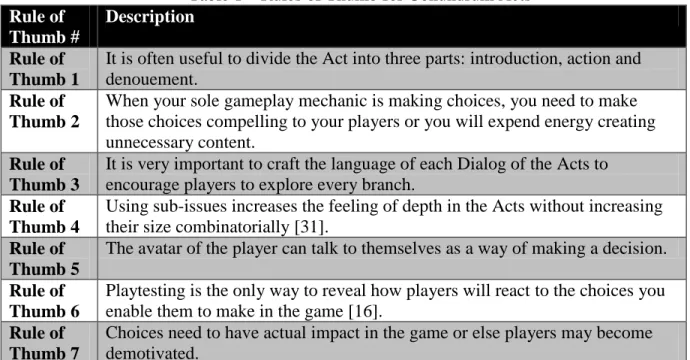
Table 1 – Rules of Thumb for Conundrum Acts………...…41
Table 2 – Release Dates for Acts………...49
Table 3 – Participants Who Failed to Achieve Application Goals………53
Table 4 – Participants Who Achieved Application Goals……….54
Table 5 – Player Created Act Details……….…61
Table 6 – Novice Gamer Gamplay Statistics……….…67
viii
LIST OF FIGURES
Figure page
Figure 1 - Contextual Choice with One Thought Bubble Highlighted and Two Hidden ..23
Figure 2 - Pivotal Choice with One Thought Bubble Expanded and One Hidden ...25
Figure 3 - Result of a Choice ...26
Figure 4 - Relationship Between Acts, Scenes and Dialogs in a Conundrum Act ...27
Figure 5 - Customizable Avatar System in Conundrum ...28
Figure 6 – Number of Pivotal Choices Made by Players in the Security vs. Deadline Act ...31
Figure 7 – Number of Pivotal Choices Made by Players in the Conflict of Interest Act ...35
Figure 8 – Number of Pivotal Choices Made by Players in the Intellectual Property Act ...37
Figure 9 – Number of Pivotal Choices Made by Players in the Computer Crime Act ...39
Figure 10 – Flashback with Dialog Options ...42
Figure 11 - Flashback with Question ...43
Figure 12 - Act Editor Choice Design ...45
Figure 13 - Act Editor Actor Placement ...46
Figure 14 - Evaluation Goals Achieved by Participants ...55
Figure 15 - Time Spent Using the Flashback System ...56
Figure 16 – Breadth – Proportion of Acts Explored by Participants ...733
Figure 17 - Depth Percentage Separated by Act ...744
Figure 18 - Percentage of Max Depth Explored by Participants ...755
Figure 19 - Percentage of Relative Usage ...766
Figure 20 - Ratio of Time Spent by Participants in the Flashback Sequence ...777
Figure 21 - Relative Time, Flashback vs. Gameplay, Depth and Breadth Ratios for Each Participant ...811
ix
LIST OF ABBREVIATIONS
Abbreviation page
CRPGs: Computer Role Playing Game ... 7
CYOA: Choose Your Own Adventure ... 7
MMORPG: Massively Multiplayer Online Role Playing Game ... 27
NPC: Non-Playable Characters... 8
TLTS: Tactical Language Training System ... 19
1 CHAPTER 1 INTRODUCTION
A course in Computer Science ethics and social issues is difficult to teach due to its subject matter being an ill-defined domain [19]. This means it is difficult to design a traditional
automated e-learning system because it will be difficult to automatically evaluate the progress of learners. Looking at the current state of the art for teaching ethics and social issues there are many approaches instructors use including presenting frameworks, expert testimonials, case studies and role playing. Of these approaches role playing is the best at helping students learn deep lessons of how to apply their knowledge but suffers from being difficult to set up, requiring good student participation and favoring students who are more extraverted. All of these
educational approaches fail to exercise students on the even deeper issues of how to evaluate their choices and hypothesize about possible ethical scenarios and creative solutions. The hypothesis of this thesis is that serious games can be used to support students learning at all the Bloom’s Taxonomy levels of Apply, Evaluate and Create in the social issues domain.
Therefore, a proof of concept prototype called Conundrum was created with components designed to help students apply, evaluate and create knowledge of ethical and social issues. It was used in a senior Computer Science ethics and social issues class on a suitable group of students in an experiment that showed that most of the students demonstrated evidence of exercising their Application, Evaluation and Creation skills when it comes to ethics and social issues in Computer Science
This thesis will cover related work including Bloom’s taxonomy that informed the
2
and social issues. It will next discuss the design of Conundrum including the three parts of the system: the game itself, the flashback component and the Act Editor. Afterwards it presents the design and results of the experiment used to show Conundrum’s effectiveness on students in an ethics and social issues class. Finally, there is the future work and conclusions learned from running the experiment with Conundrum.
3
CHAPTER 2 RELATED WORK
It is very important for professionals such as Computer Scientists to understand ethics and social issues because the ramifications of these issues on themselves and others could be tremendous. Bloom’s Taxonomy categorizes pedagogical goals including upper level targets such as Application, Evaluation and Creation goals. There is educational technology to help achieve some of these goals but they aren’t targeted for Computer Science students, and they fail to achieve the goals of Evaluation and Creation. Games provide a way of helping achieve
Application objectives, and serious games seem ideal for supporting Evaluation and Creation levels of learning. This thesis presents a serious game entitled “Conundrum” that does achieve these three goals. But, first I will discuss existing technology to support learning of ethics and social issues.
Bloom’s Taxonomy of Educational Objectives
Bloom’s Taxonomy [10] classifies all learning into three domains: Cognitive, Emotional and Kinesthetic. In the Cognitive domain using the updated version of Bloom’s Taxonomy [3], in which ethics and social issues reside, there are 6 categories arranged in order of increasing complexity: Remember, Understand, Apply, Analyze, Evaluate and Create. One of the strengths of Bloom’s Taxonomy is that it is practical for instructors to reflect upon their instructional activities. They write:
“…a teacher, in classifying the goals of a teaching unit, may find that they all fall within the taxonomy category of recalling or remembering knowledge. Looking at the taxonomy categories may suggest to him that, for example, he could include
4
some goals dealing with the application of this knowledge and with the analysis of the situations in which the knowledge is used.” [10]
So in a Computer Science ethics and social issues course, giving learners an opportunity to practise making correct and incorrect decisions in ethical and social situations would be an example of meeting Application goals. Confronting learners with the ramifications that their choices will have on themselves, coworkers, and society at large, would be meeting Evaluation goals. Practising the Creation of an intricate scenario involving ethics and social issues will give learners a broader perspective on ethics and social issues as they consider difficult positions, perspectives, choices and outcomes these individual situations present.
Bloom’s Taxonomy and Ethics and Social Issue Pedagogy
Current pedagogy for teaching ethics and social issues covers a wide spectrum of Bloom’s Taxonomy from Remembering to Analyzing. Application, however, has proven difficult to support and there are no good methods for Evaluation and Creation. In this next section I will cover the different pedagogical tools of Remembering ethical frameworks to reach Remember goals, expert testimonials to achieve Understand goals, case studies for Analyze goals and role playing for Application goals. I will discuss the benefits and drawbacks for each of these approaches and why Conundrum fulfills the necessary Application, Evaluation and Creation goals better than any of these approaches.
Learners can be taught ethics through the learning and application of ethical frameworks such as Kantianism (if everyone does what I plan to do, how will it affect everyone) or Utilitarianism (attempting to make decisions to maximize overall utility such as happiness) [28] to achieve the Remembering Bloom level. This gives them a tool set that they can use in making ethical decisions and analyzing ethical issues from different perspectives. However, it doesn’t allow
5
learners to make ethical decisions in a realistic and practical context and so fails to support the Bloom levels of Application and above.
The instructor can also bring in experienced industry professionals to give personal
testimonies on ethical and social issues that they have experienced. For example if the instructor was covering the topics of Copyright and Intellectual Property, s/he could bring in the law professor Dr. Michael Geist [18] to speak about the current reforms in Copyright law and his own experience creating awareness and activism. This will help students with the Bloom
categories of Remembering and Understanding of ethical issues. These testimonies may help the students to appreciate the ethical and social issues from a realistic and personal perspective to prepare them for choices in their own careers. They bring weight because of their origin in a realistic context. The downside is that this doesn’t give learners practical experience in making their own ethical or social choices. However, testimonies do help learners Understand how their ethics and social issue decisions interact with the real world.
Also used by instructors are case studies [4] that give students practise in Evaluating ethical and social issues decisions. In case studies, students are exposed to enough of a particular context that it becomes more real to them than talking about issues broadly. If the instructor wants to give practical experience to the students in making ethical and social issue decisions, she or he might ask the students what they would decide to do if they were in the role of different stakeholders in that context. However, these decisions are made by students retroactively with no consequences and with more perfect information than someone would have as a stakeholder in the actual situation.
If the instructor wants students to Apply their skills in making ethical and social issue decisions, she or he might implement role-playing[33]. Role-playing gives a stakeholder’s
6
perspective to each student in a particular context. Unlike case studies it does not allow them to know what the other participants are going to do, making it more realistic and fluid as the scenario develops naturally in response to the role players and the instructor governing the scenario.
The downside to this approach is that all the participants need to be committed to their role or the entire exercise could become sidetracked. A participant not fulfilling their role decreases the immersion and depth to which the students could explore the issue and will also only allow students to experience making realistic decisions in one role. In addition, it requires a great deal of time and effort to set up the role-play and get the students involved by providing the details and rules [15]. Role playing often benefits extroverted students who are more comfortable performing in front of others. It is also hard to reset a scenario for students to try a different approach or to easily switch roles. Already completed role plays will tarnish what learners will think and do for subsequent plays so that perhaps not all actors are playing naturally.
Serious Game as Solution for Application, Evaluation and Creation Skills These drawbacks mean we need some educational tools that could be used alongside these other approaches so that learners would be able to develop Apply, Evaluate and Create skills in Computer Science ethics and social issue. Video games and simulations excel at exercising Application skills and serious game designs can add Evaluation and Creation goals to a video game, making it a more comprehensive pedagogical tool. Video games can be compellingly realistic and immersive for the player. Video games can be single player without requiring a moderator or involvement by other players, resolving the aforementioned issues of roleplaying. The game play can be oriented around trying to decide about trade-offs such as in Sim City [31] [35] or Civilization [15] [35]. These games allow players to perform in roles that they wouldn’t have been able to experience otherwise such as being mayor of a city in the former and ruler of a
7
nation in the latter. The scenarios within the game can be reset on demand to allow learners to try out different choices and roles. Games with ethical gameplay mechanics have the advantage over other mediums of being able to both help players understand ethical dilemmas and make choices about them but also allowing them to explore [31].
There are many video games that include ethics and social issues mechanics and all of these have three layers: the narrative layer, the interaction layer and the design layer [35]. The narrative layer defines the context around the player including the plot, settings and characters. At the interaction layer the player is able to make ethical decisions that impact the game. Finally, there is the design layer where the ethics of the game designer influence the narrative and
interaction of the game depending on what the designer values. The biases that the game
designer brings to the game are impossible to avoid [35] and must be understood by the designer to create a balanced experience for players.
In all ethical dilemmas, including those that occur within an interactive layer of a game, there are three components: the choice that a person has to make, the decision that the person commits to, and finally the result of the decision the person has made [35]. For example a CYOA (Choose Your Own Adventure) novel is a game where there is a gameplay mechanic following this pattern. The novel describes a choice the player has to make, the player makes a decision by turning to a corresponding page in the book for that choice, and then the players reads the result of the decision they made [13] [24].
CRPG (Computer Role Playing Game) is another genre of video games that has explored trade-offs in making ethical or social choices. Examples in this genre include games such as the Ultima series [31] [35] [37] [38], The Witcher series [31], the Mass Effect series [31] [35], the Fallout series [31], the Baldur’s Gate series [31], the Dragon Age series [35], the Elder Scrolls
8
series [8] and the Knights of the Old Republic series [31] [35]. The origin of CRPGs is in translating the pen and paper experience of playing games such as Dungeons and Dragons to a video game [5]. The main game mechanic that players use to make ethical and social decisions consists of conversations with NPCs (non-playable characters). These NPCs are computer controlled avatars in the game world that the player's avatar dialogs with. The majority of the choices available to the player are contextual choices where NPCs reveal to the player details of the current context (i.e. narrative). After a player has received enough information to understand the context they are in, they are given pivotal choices which further the narrative of the game and often end with the player committing to an action.
Ethical dilemmas are also added to games in other genres to add to their depth. There is the interactive drama game Heavy Rain created by Quantic Dream [27] where the player influences the narrative of the game by controlling different actions of the characters in the game but it seems more like an interactive movie and does not contain any of the usual RPG mechanics. The first person shooters Bioshock [31] [35] by Irrational Games and Call of Duty [1] where the ethical dilemmas are represented through the story of the game and trade off decisions the player makes through the gameplay mechanics. The interactive novel Radical Dreamers by Square Enix [30] where most of the game is represented via text that the player can influence by controlling their avatar’s actions. Finally, there is the game series Phoenix Wright where the player is a defense lawyer and spends the game collecting evidence and presenting it in court [12].
Within the interactive layer of a game there are three possible ways the game can respond to player input: it can react in a static way, where the player experiences an ethical scenario through the narrative layer but has no impact with her/his decisions; in an adaptive way, where the player
9
makes ethical decisions which affect the narrative layer but the player doesn’t affect the
interactive layer in an explicit way; or a systemic method, where the underlying game mechanics are altered, such as player statistics [31] for example causing NPCs to attack or join the player’s party or enabling or disabling dialog options based on the player’s reputation. Out of the three possible ways that the ethics system interacts with the gameplay mechanics, adaptive systems allow the most ambiguity in their scenarios from player’s choices. Static systems don’t allow player choices to affect the narrative at all so whatever choices they make the game continues on. Systemic games give a direct result to the player often increasing or decreasing directly an ethical “meter” that keeps track of their good or bad deeds. This ambiguity found in adaptive games can be used to add depth to their experience of ethical issues [31].
One of the classic examples of a game that is static but does use ethics and social issues as a main aspect of the narrative layer is Final Fantasy IV. In this game the player begins as a soldier named Cecil working under the orders of his king to fight against other nations and take their valuable crystals with magical properties. When Cecil questions the king about an attack, he is stripped of his rank and sent to deliver a package to a village. Unbeknownst to him, the package contains monsters that proceed to destroy the village leaving behind a sole orphan crying for her mother. Cecil’s crisis of conscience complete, he abandons his king and protects the young orphan from the same soldiers he previously commanded. While there are many ethics and social issues contained within the narrative of the game, none of the outcomes are alterable by the player’s actions defining it as a static experience of the dilemmas. The player has no input about questioning the king, going to the village or abandoning the king. The player’s avatar decides all of this for them.
10
An example of a commercial game that adds depth to its ethics using the adaptive approach is The Witcher [31]. Playing as Geralt, the protagonist of the game, players are exposed to the difficult ethical dilemma of either attacking or defending a witch. The choice is a dilemma because Geralt discovers the townspeople have been buying poisons from the witch, using them to kill other townspeople, blaming her entirely for their killings, and want her dead as a
punishment. The witch herself argues that she was just providing a service and that the
townspeople didn’t need to purchase the poisons for use on their victims. After the player makes his/her decision, the game delays many hours to present the consequences to the player based on his/her choice. If the player sides with the townspeople and kills the witch, she isn’t available to aid Geralt in a quest where the player needs her supernatural advice to free an innocent girl’s ghost and the ghost is afraid of Geralt with the witch’s blood on his hands. If the player sides with the witch it leads to a direct confrontation with the villagers requiring the player to kill them all and then face a confrontation with the law many hours later. Neither decision alters how the NPCs see the player or changes a meter moving the player closer towards good or evil, valiant or cowardly. The net result from making the choice is a narrative change and a slightly different battle that is quickly resolved leaving an ambiguous result.
The biggest drawbacks of adaptive systems such as the Witcher is that players will react negatively if there is a large difference between the player’s expected choices and the actual choices that the game designer decided to offer them. For example if the designer doesn’t consider a solution that the player feels should be available or there is a difference in viewpoint between the player and the designer [31] they might feel a loss of control and not consider themselves responsible for the actions of their avatar.
11
The earliest example of a systemic CRPG that explicitly represented and required ethical behavior as a part of gameplay is Ultima IV: The Quest of the Avatar [36]. In this game the player identifies a virtue that corresponds to a particular class of character (warrior, bard, paladin etc.) and is tested throughout the game with ethical dilemmas to determine if they are following the virtues. For example in the endgame the player releases several children who then attack him just like monsters do throughout the game. The normal approach to such a confrontation would be to attack the children but this would obviously be contrary to many of the virtues that the player is meant to follow. Making ethical decisions throughout the game alters variables that the player has been working towards the entire game such as not running away from fights increases the valor statistic but harming those who are not deserving of battle decreases the justice statistic. There are several non-violent and virtuous solutions to this situation such as using a spell to make the children sleep. Zagal finds this game notable because
“It attempts to make the player feel personally invested or responsible for the decisions they make in the game.
It encodes an ethical system and requires the player to learn it and follow it in order to succeed.
It provides players with dilemmas or situations in which their understanding of the ethical system is challenged.” [36]
Games with ethical mechanics (static, adaptive or systemic) suffer from several common design problems. There is an open question about whether players can actually feel guilt in a game [31]. Without this feeling of guilt they may choose based on what seems to be the interesting choice instead of what it might do to their avatar and other stakeholders in the scenario. Exploring ethical problems through choices based on what appears to be interesting might not be a valid form of exploration of ethical issues because players might not be reflecting on the choices they are making [31]. Zagal also warns game designers that players need to know
12
why they are making the choices they are [38]. Without this reflection players will also make ethical decisions without understanding or caring about the consequences.
Additionally, as the game designer increases the number of choices available to the player, the number of gameplay outcomes that designers have to conceive of and test increases at a
combinatorial rate [31]. An easy solution to this problem is to limit all decisions to two options of clearly good and clearly evil choices. Unfortunately, it is not interesting to players to have such clear cut binary choices [14] [35] [31]. Players often prefer choosing ethically the first time they play and only some of them return to try out the evil options [35]. They are also trained to maximize their in game rewards and can ignore the ethical dilemma underlying their decisions by only looking at what choice would give the biggest reward [35]. For example in the narrative for the game Bioshock [31] [35] players have to decide whether to sacrifice little girls for “in game” currency and abilities or to let them go [31]. Sadly there are no negative consequences to making the “good” decision of freeing the girls since their “creator” will reward the player with an equal amount of resources if players choose the obvious “good” path. By making the choices neutral in resources it removes the sacrifice the player has to make to do the right thing. This choice is also presented to the player several times so that they only have to try making the “good” choice once to understand that there are no drawbacks to either decision. Making both the error of having an obvious binary choice and making that binary choice balanced removes the motivation for the player to consider the two options carefully.
One other possible solution to the negative effect of explosive growth can be including subquests within the overall narrative that resolve in a small number of ways decreasing the number of choices in the larger narrative but still exploring those ethics and social issues [31]. For example in the CRPG Baldur’s Gate [31] each of the NPCs that the player can recruit into
13
their party has a subquest to perform before they will join the player. All of these NPCs have an alignment of lawful, neutral or chaotic and good, neutral or evil resulting in 9 different possible combinations (e.g. lawful good, lawful neutral, lawful evil, chaotic good etc.). Depending on their alignment the choices and rewards of the subquest will correspond to that alignment. For example one of the “lawful good” NPCs, Dynaheir, can be rescued after being kidnapped and taken to the Gnoll Stronghold. The player meets a “neutral good” character Minsc and a “lawful evil” character Edwin who both want to head to the Gnoll Stronghold for different purposes. Minsc wants to rescue Dynaheir and then both of them will join the player’s group with a gain of party reputation for doing good works. Edwin wants to pay the player a sizable sum at this point in the game to assassinate Dynaheir and then he will join the player’s party as the most powerful sorcerer in the game. Finally, if the player waits 10 days (in game) Dynaheir will be killed automatically at the Gnoll Stronghold, Minsc will attack the player’s party if they have him in their party or talk to him after and Edwin has disappeared. All of these choices are unrelated to the main quest and can be bypassed entirely by not talking to the characters involved. Players can recruit Dynaheir, Minsc and Edwin by saving Dynaheir and convincing Edwin to join them but the three will remain in constant conflict verbally. All of these player choices will affect the systemic mechanics of the gameplay raising or dropping the player’s reputation and it is
impossible to keep everyone happy. Each of these NPCs comes with different abilities and rewards for helping them. This subquest is a good example of making a complex set of decisions for players without creating added complexity for the main quest in the game and has suitable choices for a player role playing anywhere on the alignment spectrum from “lawful good” to “chaotic evil”.
14
All design by definition uses constraints to create something and so the game designer has to be careful about how s/he motivates players to make ethical decisions within a game [31]. A designer’s bias will emerge within any game and s/he must be careful to structure the reward system around the objectives that they desire the player to achieve [31].
Creation of User Generated Content
There are many games where the game developers have polished and then released the tools that game designers used to create the game (such as Neverwinter Nights 2 [9]). This enables players to create their own content. This game in particular allows players to create new dialog trees within the toolset that ships with the game so that players can write their own dialog trees in scenarios they have designed.
If learners are given similar tools for a game they could exercise their own Creation skills by creating ethical dilemmas that their peers could try to navigate. By providing a strong group of ethical dilemmas for learners to first play and then having them design their own ethical
dilemmas a rich collection of scenarios could be harnessed for current and future learners to play. Each game would embed the designer’s perspective and bias giving the learner playing the game a unique perspective on an ethics or social issue while practicing their Application and
Evaluation skills. Meanwhile, designers would gain experience with Creation skills on an ethics or social issue.
Existing commercial games can’t be used directly for teaching ethics and social issues in Computer Science because they don’t cover relevant issues or occur in a realistic setting. For example Mass Effect [31] [35] takes place in a science fiction universe with aliens and far more advanced technology than we have today creating a setting where a modern day IT professional would seem out of place. Instead a new game has to be developed to support the context learners will find themselves in during their careers. The design of the new game needs to navigate a
15
delicate balance. If the game only provides fun and no teaching potential, then it will be less effective than the other pedagogical tools mentioned above, such as case studies and role playing.
Instead we want to create a serious game: a computer game that has an alternative purpose than just providing fun to the player [22]. We have explicit pedagogical objectives beyond the natural ways that games help learners to learn effectively [17]. In particular we want to support development of learner’s cognitive skills at Bloom’s Application, Evaluation and Creation levels.
Serious Games for Ethics and Social Issues Skills
A serious game is a game designed for more than just the purpose of entertainment. In the context of our research it refers to a game that is designed both to entertain and to teach. James Paul Gee [17] presents many of the reasons why games are so effective at enabling learning to learn. Games are effective at keeping beginners trying until they are able to get competency in a topic and at keeping experts motivated for further mastery. Games also distill topics to the essential elements so that learners can understand the necessary complex relationships in systems. They allow players to explore different paths to solving problems. They encourage learners to explore roles, ideologies, worldviews and problem solving techniques that they wouldn't experience in other mediums without risk of negative social repercussions [34] [32].
Both instructors and learners benefit from using a serious game. The advantage for instructors using a serious game is that they don’t have to moderate the experience. As FitzGerald and Groff describe:
“…since the computer manages the structure of the experience (the rules and logistics of the game) the teacher is free to facilitate student thinking and development, whereas with non-digital games, a teacher can be quickly overwhelmed with game management and logistics.” [24]
16
Learners can also experience the learning content as many times as they require without the instructor having to monitor each experience. However, instructors can still find out what the learners have done and what choices they have made. Further, the content remains the same for all learners and can be improved and enhanced each year. Learners benefit because they can play at their own pace at their leisure. They can play independently of other learners enabling them to benefit regardless of how seriously their peers take it. The game can help them evaluate their play automatically through feedback mechanisms which can immediately inform and develop their learning.
Board Games about Ethics and Social Issues
The first type of games that have been used to teach ethics and social issues are board games. For example The Ethics Challenge [7] (for teaching ethics in engineering) and Do the Right Thing [2] (for teaching ethics in accounting) are two different board games that have been developed and used to help teach ethics and social issues to students.
The Ethics Challenge [7] was originally created by the Lockheed Martin Corporation to help them train their employees about ethics issues and was also used in a university engineering course. The motivation behind using it in the university class was because "Student responses were random with uninformative results about student knowledge. After the test, our students commented that the questions were too abstract and vague for them to answer. They suggested that more practical, real life questions, would be a better way to check their knowledge in ethics."[7]. To play The Ethics Challenge teams of students take on the role of a Dilbert character moving around the board trying to collect the most tokens. There are various traditional board game mechanics to move tokens randomly amongst the teams but the educational mechanic is that the instructor reads out a card that has an ethical dilemma with 5 possible answers and the different teams are allowed 5 minutes to discuss what they want their
17
final answer to be. Each of the answers are assigned different token values by the game designer based on how ethical the designer thinks they are for that scenario.
Do the Right Thing [2] is a board game to help accounting students learn how to respond to ethics and social issues. As the teams move around the board they can land on "Take a Chance" or "Truth or Consequence" squares.
Landing on the "Take a Chance" square gives the team a scenario with 4 different answers that they discuss for 5 minutes before making a decision. Each answer is assigned, just like in The Ethics Challenge, a given amount of tokens based on how ethical the game designer thinks it is. After assigning the points, there is an instructor led discussion reflecting on the merits of the different answers.
The "Truth or Consequence" square asks the team to consider and respond whether a scenario is ethical or unethical. The creators of Do the Right Thing state "that board games, as an
experiential pedagogical tool, are effective because they: (1) provide an enjoyable learning environment that enable students to learn by doing, (2) are easy to implement, (3) require no homework or grading, and (4) engage students in active learning that is retained." All of these benefits are just as applicable for digital serious games as they are for board games.
These board games are a good resource for helping students Apply their ethics and social issue knowledge by discussing and giving answers to the scenarios. They can have Evaluate objectives built into the natural flow of the game through discussion of the benefits and drawbacks to the answers.
However, there are also several downsides to using board games as a tool as well. There isn't currently a board game that targets computer science ethics and social issues. Board games don't support a player's ability to explore a different ideology, role or worldview without being judged
18
by the group that they are playing with. Unlike serious games run on a computer or game system, board games still require: instructor moderation to succeed, class time to play the game and significant preparation on the instructor's part to scaffold meaningful discussion to achieve Evaluate goals. Some of this instructor preparation might be wasted on scenarios that aren't reached by players in the time allotted. Included in this preparation effort is instructor reflection on why certain points are assigned to a given answer in case there is disagreement between the designer's assignment of points and the players' expectations. There is also the possibility that if it is always clear what answer should be given to maximize points for every scenario this may indicate that the board game is trivializing or ignoring difficult gray issues that a student may encounter in their career.
Games For Change About Ethics and Social Issues
There is also a genre of serious games called Games for Change [34] [32] that try to use game mechanics to help educate players about a particular ethics or social issue. They have the goal of motivating players to educate themselves further about the issue to succeed in the game, send messages to politicians expressing their concern, join a social movement or donate money to a cause.
For example there is a game called Darfur is Dying [11] [25] where the objective of the game is to bring awareness about the dangers that people were exposed to every day during the conflict in Darfur, Sudan to motivate players to become active. In the first half of the game the player takes on the role of a man, woman or child attempting to gather water for the rest of the family while avoiding being captured by the militia and being abused, raped, kidnaped or killed. In the second half of the game the player is trying to help a community to survive by meeting basic needs in a refuge camp of food, water, shelter and health meanwhile being attacked intermittently by the militia harming these basic needs.
19
Peacemaker [35], another game for change, invites the player to take on the role of being the leader of either Israel or Palestine. The player sets policies for their own country to either achieve peace or further conflict. In the game the other country’s leader wants peace but there are factions in both countries that only desire war and conflict. The game uses actual news footage and pictures to respond to the player's choices to ground it in reality and states that its objective is to challenge the player’s assumptions about the issues of the region.
The Apply objectives for these games are similar to the needs of a tool for a Computer Science ethics and social issues class by giving the player choices to make about an ethics or social issue in a real life context. Unfortunatly, none of these games that I am aware of cover the issues that a computer science graduate will need to deal with in their career. They are also so singularly focused on a particular issue that their game play will not generalize to the multiple issues covered by a ethics and social issues course requiring a newly designed game for each issue.
Educational Serious Games About Ethics and Social Issues
TLTS (Tactical Language Training System) [22] is an example of a serious game for learning. It is used by the military to train soldiers in the language and culture that they will encounter in the field. Traditionally, this has been done through the use of actors and physical sets, but it is very expensive to implement, as are roleplaying activities to illustrate ethics and social issues in class. TLTS was designed as a system to overcome these difficulties by having scenarios that soldiers would work through by not only having the game respond to their choices, but also analyzing the spoken natural language and body language they used in their interactions. This was implemented using a commercial video game engine integrated with complex speech recognition and a human psychology modeling system. This means that TLTS had more
20
have the complexities of interpreting language from players and translating that into something the game can respond to. We don’t necessarily need to represent body language as an aspect of culture requiring high fidelity graphics. The advantage we have in the ethics and social issues domain for Computer Science students is that we can concentrate on the difficult choices and not add the complexity of state of the art game engines and artificial intelligence processing.
Nevertheless, TLTS it is a good example of using a serious game to teach in a difficult domain through difficult choices.
Interactive narrative AEINS [20] [21] uses a Socratic discussion to help students aged 9 to 12 learn ethics. AIENS generates a continuous narrative using production rules and a student model to keep the stories relevant to the user. Learners are asked questions to fulfill the requirements for creating a teaching moment such as inviting along a certain number of friends. The system has one of the NPCs suggest an unethical thing to do, such as shoplifting, and the learner either agrees or disagrees to perform that activity. If they don't agree, the story continues until the next teaching moment. If they do agree to perform the unethical action with the NPC, a different NPC acts as a Socratic agent by disagreeing with the player’s action and discussing it with them.
This approach is not without drawbacks. First it is a passive activity where the player is reading for most of the time without having to make any decisions and waiting for the story to get to a moment where it requires the player’s action. AEINS misses opportunities to motivate players by using game design that views the player as a more active participant. Secondly, the ethics goals are more straightforward with basic ideas such as honesty or respect being important concepts that hopefully, university students have been exposed to and understand. Learners are only corrected when they choose incorrect behavior and then enter a discussion with an NPC. Learners can “game” the system by placating the NPC and thus move onto the next teaching
21
moment without reflection about their decision. This discourages learners from experimenting with risky choices and experiencing the consequences of their actions. When the ethical issues become more complicated, such as trying to balance a trade-off between security testing and meeting a strict deadline, it is important for the learner to be able to make risky choices if they see the benefits outweighing the potential risk. Simplifying each option into “good” and “bad” does a disservice to adult ethical reasoning where more complex trade-offs occur.
Winter and McCalla [36] created a text based game where students made ethical choices and received consequences based on those choices. Student behavior in the choices revealed patterns in play that could be identified as different ethical stereotypes. This work could be extended by adding a video game interface and doing further analysis on learner behaviors. The scenarios that the game presented had very few choices. There were no feedback mechanisms for helping learners Evaluate the choices that they made beyond narrative consequences and there was no opportunity for learners to create their own scenarios.
There are some serious games related to helping people learn to make ethical choices
including TLTS, AEINS and a text based game. However, these games have the drawbacks of not covering the issues and settings that Computer Science students will encounter in their
professional careers and they don’t challenge students at the upper levels of Bloom’s Taxonomy. So a new serious game has been developed called Conundrum to meet these challenges.
22 CHAPTER 3 CONUNDRUM SYSTEM
A proof of concept serious game called Conundrum was designed to attempt to meet the requirements outlined in the previous chapter. Conundrum has three components learners interact with: the game play module, the flashback component that allows players to review their
decision sequence after each game is played, and the Act Editor that allows the game content to be created and edited.
These three systems are designed to support the Bloom Taxonomy categories Apply, Evaluate and Create [3] .The game play is responsible for helping learners to achieve Application
educational goals, the flashback is designed to help them Evaluate their game play and the Act Editor is designed for them to be able to create their own Acts enabling them to achieve educational goals at Bloom’s Creation level.
Conundrum Game Play
The game play of Conundrum is meant to challenge students to make relevant ethical and social issue decisions with realistic trade-offs and consequences, giving them an opportunity to use their Application skills [3]. There are many design goals for Conundrum. Conundrum's NPCs have to give the player sufficient context to understand the trade-offs in the choices they make but not so much that they are acting with perfect information. Ideally there would be no tutoring at the time they make choices (as CYOA [6] does) but instead any pedagogical feedback will be after the fact at the conclusion of the scenario. The narrative should deliver consequences to the student’s avatar and NPC stakeholders so that students can understand the direct
23
ramifications of having selected a particular trade-off. Being a game and not real life, however, it would be useful to allow students to replay any sub-scenario so that they can experiment with other decisions and their consequences. Instead of fellow players Conundrum is designed with a cast of NPCs that remain in character and thus allow the player to experiment with a scenario as many times as they wish with some consistency in character behavior.
24
The setting in which Conundrum embeds a player (the “learner”) is the context of a Computer Science professional. Instead of being an elf or starship captain as in a typical CRPG or CYOA the player is instead a system administrator, application programmer or a project manager. Also unlike the standard CRPG there are no “combat” or other gameplay mechanics, only dialog with NPCs and making choices.
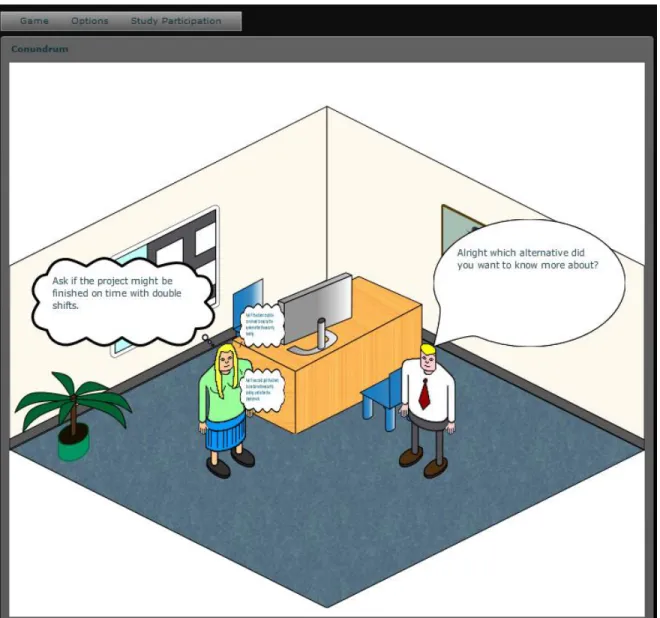
In Figure 1 you can see an example of a contextual choice in Conundrum. Contextual choices are those that give the player information about the setting their avatars are in but doesn’t further the narrative by having them make a decision. The player is on the left hand side (with the skirt and the long hair) while the manager for the player represented by an NPC is on the right hand side (in the tie and pants). The NPC has just asked the player “Alright which alternative did you want to know more about?” In response the player can ask one of three possible questions about the context they find themselves in, with “Ask if the project might be done on time with double shifts” being considered right now. The other two options are asking “…if the client could be convinced to deploy the system after the security testing…” or if the player “…could get the client to postpone the security testing until after the deployment.”
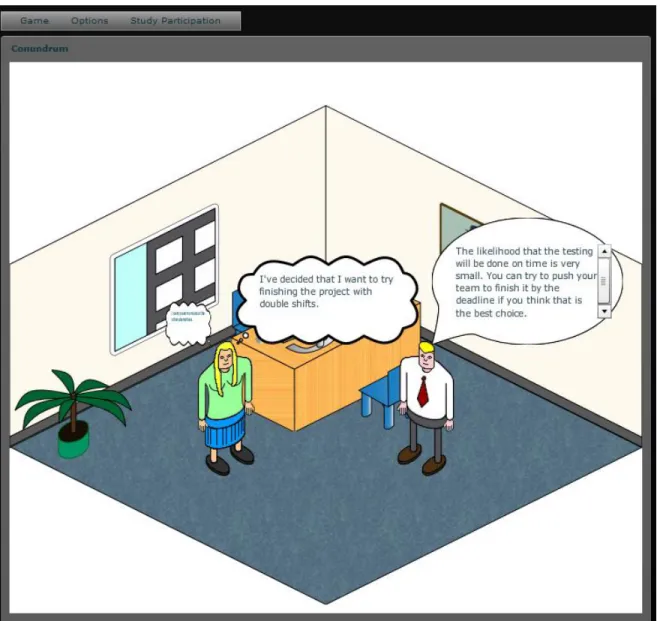
If they do choose to find out more about double shifts by clicking on the thought bubble, the NPC will tell the player (in Figure 2) “The likelihood that the testing will be done on time is very small. You can try to push your team to finish it by the deadline if you think that is the best choice.” From this the player can either ask for more details from the manager or indicate she wants to try double shifts by selecting the choice “I've decided I want to try finishing the project with double shifts.” This choice is a pivotal choice that alters the outcome of the scenario by having the player committing to a choice that will alter the outcome of the scenario they are in.
25
Figure 2 - Pivotal Choice with One Thought Bubble Expanded and One Hidden
Similarly, when the player selects this choice they see the result in Figure 3 where their avatar has told the NPC manager that “I've decided that I want to try finishing the project with double shifts.” The game branches from here depending on the choice the player has made. Having the game interact with the player in this way allows the learner time for reflection, considering the different options. This should be practise for the learners in the necessary skill of
26
gathering requirements and understanding the social and physical environment in which the software they are building will be embedded.
Figure 3 - Result of a Choice
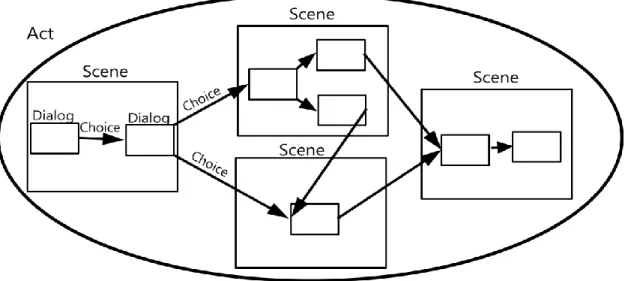
The content in Conundrum is broken into three abstraction levels: Acts, Scenes and Dialogs (Figure 4). An Act covers all the choices students are able to make around an ethical or social issue. In general video game terminology this would be a level or a stage. Using the word
27
“play” or “game” to describe a single play through of an Act can quickly become confusing so I will be using the MMORPG (Massively Multiplayer Online Role Playing Game) term “instance” to describe a player’s single travel through an Act. In an Act’s graph there are far too many nodes and edges for the author to keep track of, so each Act is broken down into Scenes, coarser grained encapsulated sub-scenarios.
Figure 4 - Relationship Between Acts, Scenes and Dialogs in a Conundrum Act All Acts begin with an initial Scene. Edward Packard, the conceiver of and one of the original authors of CYOA books, said that planning an outline for one of the books “look like a tree lying on its side with many branches and limbs. If you can imagine every branch, limb and twig of that tree as a page you get an idea of how an outline is done. My outline would be called a flow chart in computer terms.”[26] The Act is a tree or flow chart in Packard’s terms. The Scenes are the branches and the Dialogs are the twigs. Scenes allow the author of an Act to encapsulate Dialogs into a grain size of their choosing, where the Dialogs within one Scene are independent of those in all other Scenes. All the Dialogs of an Act could be in one Scene or there might be only one Dialog per Scene. To be most effective the Scenes should be graphs of
28
from growing at a combinatorial rate [31]. For example there is a Scene in the Act Security vs. Deadline called Discuss Alternatives shown in part by Figures 1 through 3. This Scene allows the player to discuss with his or her manager the possible avenues out of a difficult situation. The Scene ends when the player has indicated they have decided on one of the possibilities with their manager.
Scenes can lead to the end of the Act, another Scene or many other Scenes. When a Scene starts a title comes up indicating the beginning of the Scene to let the player know they are going into a new context. The title is usually linked to what is going to occur within that Scene.
29
The Dialogs that make up a Scene are themselves made up of one or more choices (up to a maximum of 4). These choices are presented to the player in the Act. Each of these choices has a result such as another Dialog, another Scene or the end of the Act.
Through play testing we determined that players had trouble identifying their own avatar, often confusing it with NPCs. To overcome this issue we also use the CRPG concept of
customizable avatars as shown in Figure 5. By allowing the player to change their avatar they are able to recognize it quicker and are less likely to mistake their avatar for an NPC or vice versa. This should also allow the player to identify more with their avatar as they are able to customize it to suit them, perhaps to reflect some of their own characteristics.
A great deal of the gameplay in Conundrum is modeled after CRPGs and CYOAs with the essential gameplay kept intact but embedded in a setting of Computer Science ethics and social issues to encourage learning.
Acts Designed For Play in Conundrum
There were four different Acts designed for the “original” Conundrum: Security vs. Deadline, Conflict of Interest, Intellectual Property and Computer Crime. They were each designed with three distinct parts in the first rule of thumb that seemed to have been a role model for learners when they were designing their own Acts.
Rule of Thumb 1: It is often useful to divide the Act into three parts: introduction, action and denouement.
There is the introduction where the player is introduced to the environment, NPCs and the conflict with several different options given. The player then makes a decision and enters the second part, called the action, trying to resolve the conflict. Finally there is a quick denouement at the end of the Acts to wrap up what the choices meant leading up to this ending. Even though each of the four Acts follows this basic structure, they each have their own graph structure
30
ranging from complex in Security vs. Deadline to simple in Computer Crime. This graph structure controls how much freedom each player has to affect the overall outcome of the Act. Security vs. Deadline
Introduction to the Security vs. Deadline Act
Security vs. Deadline was the first Act designed and it’s the most complicated Act in number of pivotal and contextual nodes (see Figure 6). It was the most motivating in terms of the average amount spent playing it and it also resulted in the most times being played out of all of the Acts. Three Different Paths
It was designed with a three way split right at the start (Figure 6). This was crafted to motivate players to examine the trade-offs involved in their decision making and to wonder about other possible outcomes.
The parenthesized numbers in Figure 6 after each pivotal choice represent the number of players who made that choice during actual play. As can be seen in Figure 6, two of the paths were explored by participants, including trying to recover from going over a deadline either by using double shifts (“Double Shifts” in the diagram) or trying to talk the client into extending the deadline (“Extend Deadline” in the diagram). The third path of skipping some security testing (“Omit Security” in the diagram) was ignored with one player reporting on the post-test
questionnaire that it sounded too risky. This choice will need to have some incentives added to it in future versions of Conundrum so that the players will consider it a viable option. Although there was one path that was unused by students, it is encouraging that many of them returned to try out some of the other paths they hadn’t taken. This leads to the first rule of thumb learned through the playing of Conundrum.
31
Rule of Thumb 2: When your sole gameplay mechanic is making choices, you need to make those choices compelling to your players or you will expend energy creating unnecessary content.
Figure 6 – Number of Pivotal Choices Made by Players in the Security vs. Deadline Act
32
One student reported that it was the assurances of the NPC manager that convinced her/him to try the risky option of double shifts and that normally she/he wouldn’t have considered it a viable option.
Rule of Thumb 3: It is very important to craft the language of each Dialog of the Acts to encourage players to explore every branch.
Nevertheless, there is still the hard work of convincing students to make choices that
challenge strong preconceived notions about certain issues. For example there was a student who stated that under no circumstances would double shifts or neglecting security by deploying without testing be options.
Sub-Issues
Security vs. Deadline was also designed to have sub-issues covered within two of the three major paths that didn’t impact the Act overall but would lead to local consequences.
Rule of Thumb 4: Using sub-issues increases the feeling of depth in the Acts without increasing their size combinatorially [31].
While trying to convince the client to extend the deadline, players were exposed to three sub-issues and if they had tried to convince the client to postpone the security testing until after deployment they encountered two of these sub-issues.
The first sub-issue was the player attempting to improve his/her reputation with the client by trying to convince them that it was the previous project manager who was to blame. This was to highlight the risks of using other co-workers as scapegoats regardless of whether they were at fault. If the player chose to use the former project manager as an excuse, this would backfire as the client was a good friend with the previous project manager who had helped to secure the contract for the company in the first place. Only a quarter of the time (4 out of 16 plays) was this option chosen.
33
The second sub-issue gave players the opportunity to explain their reasoning about the solution they thought would be the best for the client. A player could choose to give all of the recommendations without a suggestion, thus allowing the client to choose the solution they liked best. The player could also only give the choice they believed to be the best without giving any other options or reasoning for the decision. Finally, the player could give to the client all three of the possible options, but also recommend one as the best choice. Three quarters of the players (12 out of 16) decided to take this last route and give the options along with the
recommendation; the others tried out the other 2 options (2 for each option).
The third and final sub-issue had more of an impact on the outcome of the Act. It was a discussion between the player and the client about who was to pay for a licence to keep the client’s systems operational in the limbo period between when the software was supposed to be delivered and when it was actually delivered. The best option was for the player to offer for her/his company to pay for the licence with their manager congratulating them on cementing the relationship with the client at the cost of the licence. The player was also able to suggest sharing the cost burden of the licence with the client, leading to an unhappy, but still cooperative, client. Finally, if the player suggested that the client pay for the license they would threaten to sue for breach of contract. There wasn’t quite an even split across all possible outcomes but it came close, as can be seen in Figure 6.
Security vs. Deadline was by far the most complicated Act for both the pivotal nodes and context nodes. The following usage data must be taken in context of the fact that this Act was released right at the beginning of the study with Conflict of Interest so players had more time to experience these two Acts compared to the later Acts Computer Crime and Intellectual Property.
34
Even so, this Act has more nodes, both pivotal and context, and more sub issues that were related to the overall theme of the Act, so it isn’t surprising that players spent more time in this Act.
User feedback indicated that depth in the Acts was important to keep player interest, and the use of sub-issues is a manageable way to add this depth without a combinatorial explosion in the size of the graph [31]. One participant actually played both major paths (double shifts and trying to get the deadline extended) at least once but also tried out all possible permutations of the issues to see what would happen in each. Another couple of players were intrigued with the sub-issue of who would pay for the licence and replayed the choices in this sub-sub-issue to find out the different results. Although only three of the players were fascinated with the sub-issues, it still seems to be an appealing way to increase the complexity of the Acts without necessitating a greater increase in complexity of the graph structure for the Act. This would seem to be one good rule of thumb for creating Conundrum Acts.
Conflict of Interest
The central issue of the Conflict of Interest Act (Figure 7) is the player deciding if it is worth the risk to take a bribe for a decision already made, at the risk of future credibility. The design of the Act consists of binary choices starting with whether to take a bribe or not, and the choices after that elaborate a difficult conversation with the player’s supervisor. Conflict of Interest was the second Act designed and released to the students at the same time as Security vs. Deadline in correspondence with the course syllabus. This Act is the second most complicated Act, being simpler in design than Security vs. Deadline in the number of pivotal and context nodes.
As shown in Figure 7, around half of the time players tried to take the bribe (and mostly getting away with it with some consequences) and the other half of the time they didn’t take the bribe. Feedback from the Act confirmed that students understood the main issue at stake. One of the players when asked why s/he didn’t take the bribe “Why didn’t you choose to benefit from a
35
choice you have already made?” answered “If it came out that I took a bribe it would ruin my credibility as a leader. It doesn’t matter that I already decided it. It could easily be
misconstrued.”
36
Two novel Act rules of thumb emerged from playtesting Conflict of Interest. The first of these is rule of thumb 5.
Rule of Thumb 5: The avatar of the player can talk to themselves as a way of making a decision.
The avatar talked out loud about the different possibilities when there were no NPCs in the room and then decided on a course of action. This rule of thumb was actually used by the participants in their own Acts as a method of moving the plot quickly along.
In the first design of this Act the player was offered a bribe by a male in the shadows of their office’s parking lot. Female play testers didn’t feel comfortable with this and felt that they should be given the option to flee the briber. I changed the bribe character to be a well-dressed female to compensate for the threatening nature of a mysterious man accosting them in the parking lot and they reported it removed their reservations about it. This leads to the second rule of thumb coming out of Conflict of Interest.
Rule of Thumb 6: Playtesting is the only way to reveal how players will react to the choices you enable them to make in the game [16].
In future versions of the Act it would also help the Act in terms of depth by having the boss take the bribe you aren’t willing to and having the player need to deal with either confronting their boss about him taking a bribe after he overrides your decision or letting it work itself out. Intellectual Property
Intellectual Property (shown in Figure 8) is actually both about using a rival’s IP to gain a market advantage as well as trust in employees being a major concern when industrial espionage is a possible threat. The main NPC the player interacts with is a rogue employee who leaves the company for a rival company and then offers to give the player the rival’s source code to accept him back. The NPC’s dialog is written in such a way to make him appear untrustworthy and
37
arrogant. There are two major sets of subsequent choices that lead to four possible outcomes. The player can either take the employee back or not. If he is taken back the player can either use the source code and get busted by the rival company later on or not use the source code and be burdened by the employee. If the player doesn’t take back the employee they can either warn their competitor about his activity leading to the second best outcome or wait for the competitor to use the player’s source code and sue them leading to the most successful outcome. As Figure 8 shows, over half of the players warned the competitor about the troublesome employee.
Figure 8 – Number of Pivotal Choices Made by Players in the Intellectual Property Act This Act in hindsight illustrated the problem with having an end goal that was good, but not the optimum outcome. Many of the players seemed to stop at warning the competitor assuming that this led to the most lucrative outcome for the player’s company when in fact suing was the
38
most successful outcome. This illustrates the problem of how to challenge players to explore all of the space without making all of the “non-optimal” outcomes negative ones. A possible solution would be to have alternative endings where only good results are shown when every other option is exhausted, thus rewarding the players for exploring the entire space hopefully not depressing them before they have an opportunity to explore all of it. Letter grades or scores could be assigned to each of the endings to clarify how good the ending they got was or the endings could be designed more like CYOA where there is often only one good ending with several other disappointments but this would take out the important and useful ambiguity of some of the Acts. In fact since this is a video game it could be edited to give negative results until all of the other possibilities were exhausted to motivate students to try out all of the
possibilities. There could also be a reward system that would grade the players on their choices. Computer Crime
Computer Crime (Figure 9) starts with the mystery of who has compromised the company computers and is using them for illicit purposes. The player has to a make a difficult decision about how to regain sole control of the computers for the company by resetting their root passwords, trying to catch the perpetrator in the act, or deleting and reinstalling all of the company machines. After this choice the three branches converge when it is discovered that a difficult employee was abusing the machines just because he could.
Computer Crime is a linear Act with no real variation in the outcome of the Act with one major pivotal choice at the beginning and then a dialog between the player and the employee. This allows for a longer Act than one that branches including a reintegration of all paths after the initial decision, a sort of consolidation so that all game plays allow the player to make the
important decision, see the result, and finally have a conversation with the troublesome employee.
39
Figure 9 – Number of Pivotal Choices Made by Players in the Computer Crime Act
After it has been determined that someone has compromised the player’s company computers, the initial choice is how drastic a solution to take to return control of the company’s machines to their administrators while disturbing the company’s productivity the least. The options the player has from the least drastic to the most are: should the player change the root passwords on all the machines and hope that is enough to stop the perpetrator (6 times played), should they use forensics to try to determine exactly who has gained access and how (11 times played), or finally