ISSN(Online): 2320-9801
ISSN (Print): 2320-9798
I
nternational
J
ournal of
I
nnovative
R
esearch in
C
omputer
and
C
ommunication
E
ngineering
(An ISO 3297: 2007 Certified Organization)
Vol. 4, Issue 10, October 2016
A Survey on Cloud Computing in India
Mandeep Kumar
MCA Student, Department of Computer Science, Central University of Haryana, India
ABSTRACT: TheGovernment of India utilizes the benefits of cloud computing and implement various components
including governance mechanism to ensure proliferation of cloud in government. Cloud computing provides variety of service model to meet your requirements like Platform as a Service (PaaS), Infrastructure as a Service (IaaS) and Software as a Service (SaaS). The Government of India considers Cloud Computing as important and ambitious initiatives in the form of GI Cloud or Meghraj, Meghdoot, Digital India, Smart Cities Mission and Army Cloud, Data Centre and Digi-Locker for the Indian Army. The focus of these initiatives is to evolve a strategy and implement various components including governance mechanism to ensure proliferation of cloud in government services and defence.
KEYWORDS: Cloud Computing, GI Cloud, Meghraj, Meghdoot, Army Cloud, Digital India
I.
INTRODUCTION
Cloud computing is a new technology that has transformed the way of Information technology and provide remote location technique. Using this user and organization can access our data and information at anytime and anywhere through Internet. It provides storage, database, infrastructure, network, application and data center. Because of these advantages organizations prefer cloud computing, due to which Cloud Computing is so popular. Cloud Computing is a powerful technology that provides Software as a Service (SaaS), Infrastructure as a Service (IaaS) and Platform as a Service PaaS). So it provides storage, data center, software, hardware, infrastructure and application.
Mr. Anurag Singh Thakur, Member of Parliament, Lok Sabha, and the Chairman of the Parliamentary Standing Committee on IT said, “We have made great strides in the regulatory environment, including government adoption of cloud, and industry consultations on new technology such as over-the-top (OTT) services. We will build on these achievements and continue to develop cloud infrastructure in India to bring all citizens online.”
The Government of India considers Cloud Computing as important and ambitious initiatives in the form of GI Cloud or Meghraj, Meghdoot, Digital India, Smart Cities Mission and Army Cloud, Data Centre and Digi-Locker for the Indian Army. The Department of Telecom is working with the Home Ministry on a new regulation for lawful monitoring and interception of messages and telephone calls while protecting the privacy of users. Views on net neutrality were requested by the Telecom Regulatory Authority of India (TRAI), and a consultation Paper on Differential Pricing for Data Services was released. MeitY is proposing to require all central government and state government organizations to develop open APIs for software interoperability between all e-governance apps and systems. The National Data Sharing and Accessibility Policy aims to make all information and data of a government organization available through open APIs.
II.
LITERATURE SURVEY
The Government of India has embarked upon a very ambitions and important initiative are “GI Cloud” which has been coined as ‘Meghraj’. GI Cloud utilizes the benefits of cloud computing. The focus of this initiative is to evolve a strategy and implement various components including governance mechanism to ensure proliferation of cloud in government. NIC Cloud services offers variety of service model to meet your requirements like Platform as a Service (PaaS), Infrastructure as a Services (IaaS), Software as a Service (SaaS) and Storage as a Service (STaaS).
ISSN(Online): 2320-9801
ISSN (Print): 2320-9798
I
nternational
J
ournal of
I
nnovative
R
esearch in
C
omputer
and
C
ommunication
E
ngineering
(An ISO 3297: 2007 Certified Organization)
Vol. 4, Issue 10, October 2016
equipment centrally, for automation of Indian Army. With the launching of Digi-Loker, it will provide a secure and exclusive data storage space to all the units and formation headquarters of the Army over its dedicated data network. The Digi-Locker of Indian Army is similar to e-Locker of Digital India program and has all the advance features like digital signatures and watermarking.
Centre for Development of Advance Computing (C-DAC) research focus in cloud computing includes design and development of Open source cloud middleware; virtualization and management tools; and end-to-end security solution for the cloud. A number of applications in C-DAC are being migrated to Cloud computing technology. These include hospital information systems, disaster recovery, telemedicine, HPC services, language services (like translation), e-governance applications, etc. Considering the related, but complimentary driving forces of grid and cloud computing disciplines, C-DAC is also exploring integration of grid and cloud computing.
C-DAC has developed a complete open source based software stack named 'MEGHDOOT' for setting up a private cloud to offer basic cloud services such as Infrastructure, Platform, and Software services. On demand dynamic provisioning, Metering and Monitoring, Graphical Installation of Middleware stack, Customized Elasticity, and Web service based management of cloud are among the value additions by C-DAC.
Other PoC deployments in Government, Academics, SME sector include,
Kerala State IT Mission, Thiruvananthapuram jointly with IIITM-K, Thiruvananthapuram,
CHiPS, Raipur under Government of Chhattisgarh
Naval Dockyard, Visakhapatnam of Indian Navy
Maharashtra State Data Centre Mumbai,
Y3 Technologies, Chennai and Singapore.
Digital India provides all government services electronically and available online through Internet Infrastructure. These schemes also play a role to connect rural and urban area by high speed internet connectivity. Cloud Computing is helpful to achieve all features of Digital India Scheme. The features of Digital India Scheme include:
Government Service distribution Through E-Governance
Electronic Delivery of Services like Education, Health, Farming, Rights and Financial Addition Through E-Kranti
Public Internet Access Service
Universal Access to Mobile Phone
Information for all
Broadband Highways
Electronics Manufacturing
Information Technology for Jobs
Early Harvest Service
III. GI (GOVERNMENT OF INDIA) CLOUD
GI Cloud utilizes the benefits of cloud computing. The Government of India has embarked upon a very ambitious and important initiatives are “GI Cloud” which has been coined as ‘Meghraj’. The focus of this initiative is to evolve a strategy and implement various components including governance mechanism to ensure proliferation of cloud in government. Formulation of the cloud policy is one of the primary steps that will facilitate large scale adoption of cloud by government.
ISSN(Online): 2320-9801
ISSN (Print): 2320-9798
I
nternational
J
ournal of
I
nnovative
R
esearch in
C
omputer
and
C
ommunication
E
ngineering
(An ISO 3297: 2007 Certified Organization)
Vol. 4, Issue 10, October 2016
web applications with the speed and scalability that your business demands. NIC Cloud services offers variety of service model to meet your requirements like Platform as a Service (PaaS), Infrastructure as a Services (IaaS), Software as a Service (SaaS) and Storage as a Service (STaaS).
1. Infrastructure as a Service (IaaS): IaaS Provides you basic virtual compute infrastructure resources like CPU, Memory, Disk Storage attached to blank VMs with allowing you to install OS, using ISOs, from scratch and customization. However you have to use your own licenses for OS and Application software.
2. Platform as a Service (PaaS): PaaS provides pre –installed web and database servers so that you can publish
and run web application without worrying about server setup. The servers are pre configured ready with basic security hardening. Use PaaS service to quickly deploy servers and publish your web applications. The OS and application software licenses are provided by us as part of offering.
3. Software as a Service (SaaS): This provides on demand software service. SaaS is a software delivery model
where users are not responsible for supporting the application or any of the components. The server infrastructure, OS and software is being managed by Cloud services. If you are having web application and want to distribute it to users, use our cloud service to deliver through Software as a Service.
4. Storage as a Service (STaaS): STaaS provides excellent alternative to the traditional onsite and dedicated storage systems and reduces the complexities of deploying and managing multiple storage tiers. You can use it to mitigate risks in disaster recovery, provide long term retention for records and enhance both continuity and availability.
5. Hosting Environments: NIC Cloud Services provides three different types of environment for creating virtual
machines that is Production, Staging and Development so that you keep your VM segregated and manage them properly based on the business need for both PaaS as well as IaaS service model.
The following services support provided to your application as part of the cloud hosting:
Server Vulnerability Assessment
Server Anti-Virus
Server Backup
Network/Application Firewall
Source of all information related to GI Cloud is http://meity.gov.in/content/gi-cloud-initiative-meghraj
IV. ARMY CLOUD, DATA CENTRE AND DIGI-LOCKER FOR THE INDIAN ARMY
The facility under the Army Cloud includes a Central Data Centre, a Near line Data Centre, both in Delhi and a Disaster Recovery site for replication of its critical data along with virtualized servers and storage in an environmentally controlled complex. This is similar to the Meghraj; the cloud of National Informatics Centre (NIC) and will provide all Information Technology Infrastructure including servers for computing, storage, network and network security equipment centrally, for automation of Indian Army. The latest technologies in the field have been incorporated in the implementation of the first ever Software Defined Data Centre wherein all the resources could be provisioned to different application on the cloud, on click of a button. It has already started providing Infrastructure as a Service (IaaS) to the pan Army users as the first Cloud service and will soon provide Software as a Service (SaaS).
ISSN(Online): 2320-9801
ISSN (Print): 2320-9798
I
nternational
J
ournal of
I
nnovative
R
esearch in
C
omputer
and
C
ommunication
E
ngineering
(An ISO 3297: 2007 Certified Organization)
Vol. 4, Issue 10, October 2016
In keeping with the national vision of Digital India, the India Army has launched a program for Digital Army with nine pillars for digitization. Three of the nine pillars of this umbrella program, namely Broadband highways, Universal access to telephones and Army Data Network stress upon Information Technology Infrastructure development. For any modern army, the Network Centric Operations are essential for meeting enhanced challenges of asymmetry, lethality, fluidity and non-linearity in the present day battlefield. The Indian Army is addressing this key are comprehensively.
Source of all information related to Army Cloud, Data Centre and Digi-Locker for the Indian Army is http://pib.nic.in/newsite/PrintRelease.aspx?relid=130337
V.
MEGHDOOT
Centre for Development of Advance Computing (C-DAC) focus in cloud computing includes research, design and development of Open source cloud middleware suite; end-to-end security solution for the cloud, consultancy and training services in cloud computing.
With the expertise of C-DAC on various technologies that act as enablers of Cloud computing and National Resource Centre For Free and Open Source Software (NRCFOSS), C-DAC has developed a comprehensive free and open source suite named 'MEGHDOOT' for setting up a cloud computing environment.
On analysing various free and open source tools for cloud, the featuring tools across all layers of the cloud were incorporated into the suite. C-DAC pursued the remarkable in-house development of features and functionalities based on standards over free and open source tools of cloud.
Enormous research efforts on top of existing open source cloud tools are incorporated. The developments and offerings include, but are not limited to Service provisioning &deployment, Management, Security and other value additions. Simple graphical installation and configuration of the suite, exhaustive monitoring, metering, customizable elasticity, web service oriented management and inclusion of security features focusing on data in transit, data at rest, multi level authentication and authorization are a few of the notable value additions by C-DAC.
After rigorous research and development efforts, the first version of the suite was released at the C-DAC Technology Conclave, Hyderabad in October 2012. From the day of its release, the product has been well received by users from all sectors - banking, e-governance, academic and research, telecommunications, healthcare, logistics based SME, corporate, and manufacturing.
Till date Meghdoot had 3 minor releases (Meghdoot-1.01, 1.02, 1.03) and two major releases (Meghdoot-2.00 and Meghdoot-3.00). Meghdoot is well received by the cloud community with more than 100 DVDs circulated through campaigns and about 500 download.
Deployments of Meghdoot:
Indian Banking Community Cloud, established by Institute for Development and Research in Banking Technology (IDRBT), Hyderabad operated on Meghdoot. This community cloud incorporates various customized developments specific to the banking community requirements. It was inaugurated by the Governor, RBI, and is operational since August 2013, supported by C-DAC. Till date about 13 banks hosted their applications in this cloud and steps are going on to take the cloud to a greater level.
Tamil Nadu State Data Centre Cloud operational since 2012, is based on Meghdoot, which hosts various e-governance
applications from the state departments of the Govt. of Tamil Nadu. Steps to scale up the cloud to a large extent and to deploy upcoming e-Gov solutions are under progress
ISSN(Online): 2320-9801
ISSN (Print): 2320-9798
I
nternational
J
ournal of
I
nnovative
R
esearch in
C
omputer
and
C
ommunication
E
ngineering
(An ISO 3297: 2007 Certified Organization)
Vol. 4, Issue 10, October 2016
PAN C-DAC Cloud environment is established in C-DAC Bengaluru uses Meghdoot, where the applications developed
and used by various C-DAC centers are deployed onto the cloud.
Green Mini Data Centre established by Sabarkantha District Panchayat, Himatnagar, and Gujarat has been operating
in Meghdoot cloud since April 2015, where few e-Governance applications were hosted in the cloud, utilized by Government departments in the district.
Students and Young Entrepreneurs Cloud by Government of Tamilnaduis an initiative by the Government of Tamilnadu to offer Cloud services to students and young entrepreneurs in the state of Tamilnadu. This project is a joint effort by ELCOT, Chennai; C-DAC, Chennai; ICTACT, Chennai and EDI/NASSCOM Chennai.
Source of all information related to Meghdoot is http://cdac.in/index.aspx?id=cloud_ci_cloud_computing
VI. DIGITAL INDIA
Digital India is a new and technical scheme launched on 1 July 2015 by Government of India. The aim of this scheme provides all government services electronically and available online through Internet Infrastructure. These schemes also play a role to connect rural and urban area by high speed internet connectivity. Some famous companies like Microsoft, Google and Facebook support Digital India Scheme. Cloud computing is important requirement for Digital India. Cloud computing is a new technology that has transformed the way of Information technology and provide remote location technique. Using this user and organization can access our data and information at anytime and anywhere through Internet. It provides storage, database, infrastructure, network, application and data center. Because of these advantage organization prefer cloud computing and due to Cloud computing is so popular. So Cloud Computing is important technology for Digital India. The features of Digital India Scheme include:
Government Service distribution Through E-Governance
Electronic Delivery of Services like Education, Health, Farming, Rights and Financial Addition Through E-Kranti
Public Internet Access Service
Universal Access to Mobile Phone
Information for all
Broadband Highways
Electronics Manufacturing
Information Technology for Jobs
Early Harvest Service
Cloud Computing is helpful to achieve all features of Digital India Scheme because it is provides network, data center, software, hardware, application, database, infrastructure and storage; which are available on demand, anywhere and anytime in effective cost. These all are important to achieve features of Digital India Scheme.
VII. RANK OF INDIA IN CLOUD READINESS INDEX (CRI) 2016
ISSN(Online): 2320-9801
ISSN (Print): 2320-9798
I
nternational
J
ournal of
I
nnovative
R
esearch in
C
omputer
and
C
ommunication
E
ngineering
(An ISO 3297: 2007 Certified Organization)
Vol. 4, Issue 10, October 2016
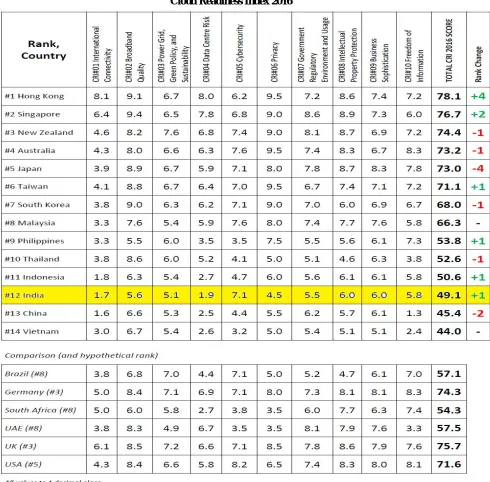
Cloud Readiness Index 2016
Table Source: Asia Cloud Computing Association
The study, which measures the cloud readiness of economies along 10 parameters they are
International Connectivity
Broadband Quality
Power Grid, Green Policy, and Sustainability
Data Center Risk
Cyber security
ISSN(Online): 2320-9801
ISSN (Print): 2320-9798
I
nternational
J
ournal of
I
nnovative
R
esearch in
C
omputer
and
C
ommunication
E
ngineering
(An ISO 3297: 2007 Certified Organization)
Vol. 4, Issue 10, October 2016
Government Regulatory Environment and Usage
Intellectual Property Protection
Business Sophistication
Freedom of information
India claims the 12th position and increase one position. According to Cloud Readiness Index 2016, India claims the 12th ranks and China claims 13th ranks, So India claiming high rank in Cloud Computing from China.
India’s Highlights in Cloud Computing according to Asia Cloud Computing Association’s Cloud Readiness Index 2016:
1. Visionary initiatives Digital India, MeghRaj, and Smart Cities Mission: India’s pro-cloud initiatives and government leadership to develop an innovative tech industry are paying off, and their soft infrastructure is starting to come into focus. Specifically, improvements in cyber security, IP protection and freedom of information sees India climb one position this year. However, India struggles with some of the worst physical cloud infrastructure in the region. India ranks second-last on international connectivity and broad band quality, and last on power grid, green policy and sustainability, data centre risk, and business sophistication.
2. Recommendation: There are clear challenges to overcome both in building the physical infrastructure to support a larger proportion of the population coming online and in securing reliable access to cloud services in the long term. Opportunities to capitalize are India’s entrepreneurial spirit, and a strong IT-savvy population which is actively nurturing its programmers and computer coders.
3. Recent Government Legislation and gCloud/gICT Developments:
Digital India and the MeghRaj deployment continues: India continues to deploy its gCloud project, which will provide public sector cloud facilities for all provinces, connected to a national level cloud infrastructure.
Proposed Provisional Accreditation of Cloud Service Offerings ofPrivate Service Providers (CSPs) :
India’s Dept of IT Electronics (DeitY) has requested feedback on the proposed provisional accreditation process for CSPs to provide services on their “GI Cloud” (Govt of India Cloud) project, also known as MeghRaj (“King of Clouds”).
Data monitoring regulations: The Department of Telecom is working with the Home Ministry on a new
regulation for lawful monitoring and interception of messages and telephone calls while protecting the privacy of users.
Consultation on net neutrality by the Telecom Regulatory Authority of India (TRAI): Views on net
neutrality were requested by the TRAI, and a consultation Paper on Differential Pricing for Data Services was released.
Government data sharing initiative: DeitY is proposing to require all central government and state government organizations to develop open APIs for software interoperability between all e-governance apps and systems. The National Data Sharing and Accessibility Policy aims to make all information and data of a government organization available through open APIs.
VIII. CONCLUSION
ISSN(Online): 2320-9801
ISSN (Print): 2320-9798
I
nternational
J
ournal of
I
nnovative
R
esearch in
C
omputer
and
C
ommunication
E
ngineering
(An ISO 3297: 2007 Certified Organization)
Vol. 4, Issue 10, October 2016
develop open APIs for software interoperability between all e-governance apps and systems. The National Data Sharing and Accessibility Policy aims to make all information and data of a government organization available through open APIs. Hence India utilized the benefits of Cloud Computing in e-governance, academic and research, defence, banking, telecommunications, healthcare, logistics, corporate, and manufacturing.
REFERENCES
1. http://meity.gov.in/content/gi-cloud-initiative-meghraj 2. https://cloud.gov.in/services.php
3. http://pib.nic.in/newsite/PrintRelease.aspx?relid=130337 4. http://cdac.in/index.aspx?id=cloud
5. http://cdac.in/index.aspx?id=cloud_ci_cloud_computing 6. https://digitalindiainsight.com/9-pillars-of-digital-india/
7. http://www.asiacloudcomputing.org/research/cri2016
8. http://www.asiacloudcomputing.org/images/documents/cri2016_acca.pdf
BIOGRAPHY
Mandeep Kumar, pursuing MCA from Central University of Haryana, India. He is MCA