Image Processing Based Bottle Filling and
Label Checking Using Embedded System
Varshal Shah [1], Dr.Kirit Bhatt[2]
PG Student, Dept. of EC., SVIT, Vasad, Gujarat, India
Professor, Dept. of EC., SVIT, Vasad, Gujarat, India
ABSTRACT: This paper aims to present image processing techniques used for automatic bottle filling and label checking. In this work for detection of correct liquid level in bottle image processing techniques are used. This will check whether the bottle is filled with proper quantity of beverage or not. If the bottle is not filled up to reference level it will refill the bottle. Label checking of bottle is done to check whether the proper label is present or not. In this system various image processing techniques are used for liquid level detection such as image filtering, image Thresholding, image segmentation, hole filling algorithm, contour fitting. For detection of proper label present on bottle template matching algorithm is used. The major goal of the paper is to provide a comprehensive reference source for the researchers involved in automatic bottle filling and label checking. This whole system is controlled by the raspberry pi unit without disturbing the fast production line.
KEYWORDS: Image filtering; Image Thresholding; Hole filling algorithm; Template matching algorithm
I. INTRODUCTION
Mobile Indian food industry is perched for huge growth. There are many soft drink companies in market so it is very important to take care of quality and quantity of product. To maintain the quality of large number of bottles is not easy job with manual inspection [2]. In this system bottle is continuous moving on the conveyor belt. For these reasons image processing techniques are used in bottle filling system. In the vision based automated system the camera is used to capture the image. Camera resolution, conveyor belt speed and background color is important factor [2]. In the captured image noise is present so, noise filtering is done on that image to remove noise [6]. After image filtering, image segmentation technique is used to separate the liquid region from the background. Contour fitting is applied on the segmented image to detect correct liquid level in the bottle [1]. The level of liquid in bottle is compared with the reference level for detection of proper level. The problem in bottle filling system is improper or missing label on the bottle. For the detection of correct label image processing is used [9].
II. RELATED WORK
In [1] authors used image Thresholding techniques and contour fitting algorithm to detect correct liquid level in bottle. There are two types of Thresholding techniques adaptive Thresholding and global Thresholding techniques. The disadvantage of global Thresholding technique is that it provide poor results under varying light condition. Under varying light condition Adaptive Thresholding technique provide better results. In [2] authors used image Thresholding technique to detect correct liquid level in bottle. Edge detection and image Thresholding techniques are used to detect correct liquid level. As compared to the edge detection technique Thresholding technique provide faster operation. In [9] authors used image cropping method to detect correct liquid level in bottle and for detection of proper label on the bottle template matching algorithm is used. In [3] authors used Thresholding techniques to detect correct liquid in bottle. For capturing the image of bottle webcam is used. In [6] authors described various noise removing methods to remove the noise from image. In [7] authors described various image Thresholding technique to separate object from background.
III.PROPOSED ALGORITHM
A. Block Diagram:
As shown in block diagram bottle is continuously moving on conveyor belt. Web camera is used to capture the image of bottle continuously. Whenever the bottle is detected by the IR module. Motor will be off and the solenoid valve will be on and bottle filling starts which is monitored by the camera.
Fig.2 Block Diagram
On the capture image, image processing techniques are applied. When the liquid level in the bottle matches with reference line solenoid valve will be off and motor will be on. For detection of correct label on the bottle template matching algorithm is used.
In any case, if bottle overflow take place or label missing is occurred buzzer will be on indicating fault.
B. Image filtering:
noise filtering methods are available. Gaussian filtering, mean filtering, median filtering, max-min filtering. Among all filtering methods median filtering works best [6].
C. Image segmentation:
Image segmentation technique is used to separate the object from background. For image segmentation image Thresholding technique is used to separate liquid region from bottle. There are two different methods of image Thresholding: Global Thresholding andAdaptive Thresholding
In global Thresholding technique single threshold value is used to segment the whole image. The disadvantage of the global Thresholding under the varying light condition it provide poor results. This problem can be solved by using the Adaptive Thresholding technique [7].
In Adaptive Thresholding technique whole image is divided into sub images. Multiple threshold values are selected for image segmentation. This threshold values are based on neighbourhood pixel properties. This technique provide better results under varying light condition [7].
D. Hole filling algorithm:
Hole filling algorithm fills hollow region. It uses dilation, complementation and intersections to achieve results. Hole filling algorithm is used to detect actual amount of liquid present in bottle. In hole filling algorithm all background pixels are assigned value equal to zero and object pixels are assign value equal to one [10]. The hole filling algorithm is described by the following equation:
X = (X B) ᴖ Ac k=1, 2, 3,…eq.(1)
Here in the above equation (1) B is the structuring element. A is the original image andAc is the complement of the image. This process is continue up to
X = X eq.(2)
Whenever the equation (2) is satisfied hole filled image is obtained.
E. Label Checking:
Sometime in the bottle filling industry problem of label missing or improper label on bottle. To check availability of proper label on bottle template matching algorithm is used. Template matching techniques compare portions of images against one another.If standard deviation of the template image compared to the source image is small enough, template matching may be used.Templates are most often used to identify printed characters, numbers, and other small, simple objects [17].
The matching process moves the template image to all possible positions in a larger source image and computes a numerical index that indicates how well the template matches the image in that position. Match is done on a pixel-by-pixel basis.
IV.HARDWARE DESCRIPTION
A. Raspberry pi2 Model B
Raspberry Pi2 is on board minicomputer. The Raspberry Pi2 runs Linux based operating systems and there is a specialized version of Linux based kernel known as Raspian which can run almost all programs which are Linux compatible. Hence in this project we have used python.
Fig.4 Raspberry pi2 Model B[ 13]
As shown in figure- 4 Raspberry pi2 model has 1 GB RAM. It has 900MHzquad-core ARM Cortex-A7 CPU. Raspberry Pi2 model has four USB ports. These USBports are used for interfacing of camera, keyboard and Wi-Fi dongle. It provide one LANport for communication. It has 40 GPIO pins for input and outputs. It has one HDMI port.It can play 1080p resolution videos without lagging. It has a low price relatively ascompared to machines in the market [13].
B. DC Motor:
12v DC motor is connected to the raspberry pi’s GPIO pin. The speed of DC motor will be 10 rpm. Current handling capacity of raspberry pi is 2mA to 16mA. To drive the dc motor relay driver circuit is required.
C. Relay Driver
Fig.5 Relay driver circuit
This relay driver circuit is used to turn on and off the solenoid valve and motor.
C. WEB Camera
For capturing the image of bottle I Ball CHD.20 webcam is used. The features of I Ball CHD.20 webcam [16]:
Fig.6 I Ball CHD.20 WEB Camera [16]
Features of I Ball CHD20.0 webcam:
Interpolated resolution: 20MP (photo), 2.1MP (video)
Frames per second: 30
Max Image resolution: 5500*3640 pixels
Max Video resolution: 1920*1080pixels
Lens: 5G wide angle
D. IR Module:
For detection of bottle IR module is used. The principle of an IR sensorworking as an Object Detection Sensor can be explained using the figure. An IR sensor iscombination of IR LED and IR Photodiode; together they are called as Photocoupler orOptocoupler.
When the IR transmitter emits radiation, it encounter on the object and some of theradiation reflects back to the IR receiver. The output of the sensor is defined based on theintensity of the reception.
Fig.7 Working of IR module [15]
When we use an infrared transmitter and receiver combination, the wavelength of thereceiver should match with that of the transmitter.
E. Solenoid valve:
A solenoid is specially designed electromagnet. A solenoid usually consists of a coil and a movable armature. When current flows through a wire, a magnetic field is set up around the wire. We can increase magnetic field by increasing number of turns of wire of coil. Magnetic field flowing around the coil and through its center in a doughnut shape. When the current passing through the coil of solenoid, the core increase the flux linkage by closing the air gap between the cores. The movable core is usually loaded with spring to allow the core to retract when current is switched off. The force generated is approximately proportional to the square of the current flowing through it and inverselyproportional to the square of the length of the air gap between them [15].
Fig.8 Solenoid Valve [15]
V. SIMULATION RESULTS
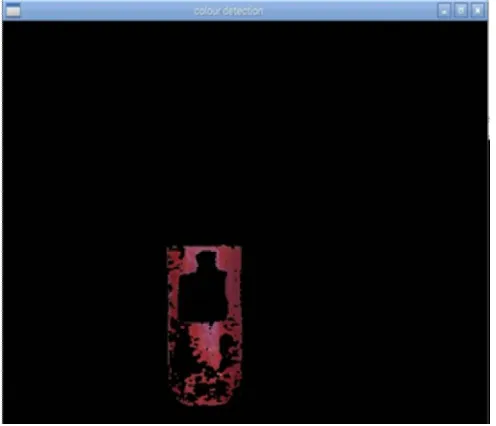
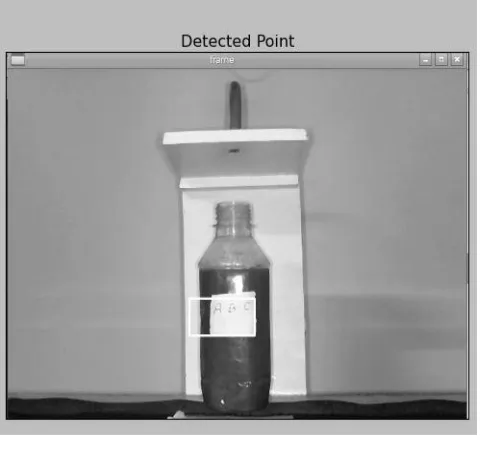
The simulation of bottle filling and label checking is done in python. Fig. 9 is the frame captured by the camera. Fig. 10 describes colour detection of liquid filled in the bottle. The red mask is applied on the image for red colour detection. It is possible to detect any colour liquid by using the pixels values. Fig.11 describes the label detection on bottle using template matching algorithm. Fig.12 is the result of hole filling algorithm and reference line matching. Fig. 13 is indication proper level and Label on the bottle.
Fig.9 is the original image captured by the web camera on which different image processing techniques are applied.
Fig.9 Original image
Fig.10 describe the colour of liquid in the bottle. In this red mask is applied on the original image.
Fig. 11 describe the detection of proper label on the bottle. Template matching algorithm is used to detect the proper label on bottle.
Fig.11. Label Detection
Fig.12 is the result of hole filling algorithm and matching of the level of liquid in the bottle to the reference line.
Fig. 12 hole filling and reference line matching
Fig. 13 Level and Label Detection
VI.CONCLUSION AND FUTURE WORK
The simulation results showed that the proposed algorithm performs better. Automated visual system is non-contact and fast. Use of image processing techniques in bottle filling provide better accuracy. It reduce the complexity of the system. It can sense any coloured liquid. This method of bottle filling system is easy to implement. In this system raspberry pi is used so it reduce the need of computer. Due to this cost of the system is reduced. In future it is also possible to inspect faulty bottle and cap position of bottle using image processing techniques.
REFERENCES
1. M. Gonzalez Ramirez, J. Villamizar Rincon and J. Lopez Parada, "Liquid level control of Coca-Cola bottles using an automated system",
2014 International Conference on Electronics, Communications and Computers (CONIELECOMP), @ieee,2014
2. Kunal J Pithadiya, Chintan K Modi, Jayesh D Chauhan ,” Selecting the Most Favorable Edge Detection Technique for Liquid Level Inspection in Bottles "International Journal of Computer Information Systems and Industrial Management Applications (IJCISIM)Vol.3 , pp.034-044,2011
3. Slim ABDELHEDI, Khaled TAOUIL, Bassem HADJKACEM,” Design of Automatic vision-based Inspection System for Monitoring in an Olive Oil Bottling Line” International Journal of Computer Applications (0975 – 8887),Volume 51– No.21, August 2012
4. Gupta Ramanuj Prasad, Kalpesh R. Jadav,” VISION BASED REAL TIME BOTTLE FILLING INSPECTION SYSTEM” International
Journal of Engineering & Science Research ,vol.3,issue 6,2013
5. Leila Yazdi, Anton SatriaPrabuwono, EhsanGolkar, “Feature Extraction Algorithm for Fill Level and Cap Inspection in Bottling Machine” 2011 International Conference on Pattern Analysis and Intelligent Robotics , Putrajaya, Malaysia @IEEE ,28-29 June 2011 6. "RuchikaChandel, Gaurav Gupta,”Image Filtering Algorithms and Techniques: A Review", International Journal of Advanced Research
in Computer Science and Software Engineering, vol. 3, no. 10, pp. 198-202, 2013.
7. S. Bag and P. Bhowmick, "Adaptive–interpolative binarization with stroke preservation for restoration of faint characters in degraded documents", Journal of Visual Communication and Image Representation, vol. 31, pp. 266-281,2015
8. NazilPerveen, Darshan Kumar Ishan Bhardwaj, “An Overview on Template Matching Methodologies and its Applications, International Journal of Research in Computer andCommunication Technology, Vol 2, Issue 10, October- 2013
10. Ms.GangotriNathaney, Prof.KanakKalyani ,” Lung Cancer Detection System on Thoracic CT Images Based on ROI Processing “, International Journal of Advanced Research in Computer and Communication Engineering Vol. 4, Issue 4, April 2015
11. A.M.Raid, W.M.Khedr, M.A.El-dosuky and Mona Aoud, ”IMAGE RESTORATION BASED ON MORPHOLOGICAL
OPERATIONS", International Journal of Computer Science, Engineering and Information Technology (IJCSEIT), vol. 4, no. 3, pp. 9-21, 2014.
12. www.opencv.org
13. www.raspberr ypi.org
14. www.engineersgarage.com
15. www.wikipedia.org
16. www.iball.co.in
17. https://www.google.co.in/webhp?sourceid=chrome-instant&rlz=1C1RLNS_enIN672IN672&ion=1&espv=2&ie=UTF-8#
BIOGRAPHY
Varshal shah received the B.E. degree in electronics and communication engineering from K.J.Institue of engineering and technology , savli, Gujarat technological University, Ahmedabad, India, in 2013.Currently doing M.E. in electronics and communication engineering (Communication Systems) in Gujarat technological University, Ahmedabad, India. His research interest includes image processing, embedded system and automation.