R E S E A R C H
Open Access
Hybrid energy-efficient APTEEN protocol
based on ant colony algorithm in wireless
sensor network
Jinyu Ma
1,2, Shubin Wang
1*, Chen Meng
1, Yanhong Ge
1and Jingtao Du
1Abstract
Due to the limited energy of the sensor nodes, the unreasonable clustering routing algorithm will cause node premature death and low utilization of energy efficiency in wireless sensor network (WSN). In Adaptive Threshold-sensitive Energy Efficient Network (APTEEN), the assignments of the cluster head (CH) are much heavier than other nodes. The CH unbalanced energy dissipation between nodes that make them die prematurely. Ant colony algorithm can avoid this problem, so this paper presents a double cluster heads Adaptive Threshold-sensitive Energy Efficient Network based on ant colony (ADCAPTEEN). ADCAPTEEN optimizes the cluster head election method compared with APTEEN. It suggests that one master cluster head (MCH) and one vice cluster head (VCH) will be selected in each cluster. The double cluster heads (DCH) can co-work on data collection, fusion, transition, etc. To make routes more stable and energy efficient, this paper proposes a Multiple Adaptive Threshold-sensitive Energy Efficient Network based on Ant-colony (AMAPTEEN). It is the optimization of ADCAPTEEN. And CH selects intermediate node (IM_node) multiple times with ant colony algorithm per round in each cluster, and this way forms multiple route transmission data. Simulation in OPNET proves that compared with APTEEN, ADCAPTEEN reduces energy dissipation, improves node survival rate, and extends network life cycle. AMAPTEEN delays the time of node death, balances energy consumption, and extends network lifetime further operating in the same settings compared with ADCAPTEEN. The proposed two algorithms have good scalability, and they are suitable for large-scale network.
Keywords:Wireless sensor network (WSN), APTEEN, Ant colony algorithm, Multiple routes
1 Introduction
Wireless sensor networks (WSN) consisting of a large num-ber of sensor nodes are deployed randomly in monitor areas. The applications of the WSN have grown rapidly over the recent years. The performance and the quality of WSN are closely related to the type of routing protocol. Clustering routing protocol commonly used as clustering protocol can effectively facilitates saving energy [1]. Basing on the mode of functioning, WSNs can be classified into proactive, react-ive, and hybrid networks [2]. Under proactive network ap-plication mode, sensor nodes continuously monitor the surrounding environment and send periodically the moni-tored data to the user at a constant cycle rate. The reactive network, however, only transmits data when the observed
variable changes, and the change reaches the conditions that need to be sent. The Low-Energy Adaptive Clustering Hier-archy (LEACH) [3] protocol, one of the early cluster algo-rithms, belongs to proactive network, but is not suitable for reactive network. The energy-efficient LEACH (EE-LEACH) protocol for data gathering is introduced [4]. It reduces end-to-end delay and energy consumption. But nodes which are selected to forward the data to sink node only consider the nodes’ residual energy. The improved LEACH selects energy-efficient CH which considers the energy and distance [5]. The sum of alive nodes is quite improved. The novel energy-efficient clustering mechanism, based on artificial bee colony algorithm, is presented to prolong the network lifetime [6]. Threshold-sensitive Energy Efficient Network (TEEN) belongs to the reactive mode [7]. The proposed Adaptive Threshold-sensitive Energy Efficient Network (APTEEN) [8] is classified as a hybrid network and pre-serves the advantages of both proactive network and * Correspondence:[email protected]
1College of Electronic Information Engineering, Inner Mongolia University,
Hohhot, China
Full list of author information is available at the end of the article
reactive network. APTEEN protocol can collect data in a circular way and respond to emergencies. Unfortunately, APTEEN exposes its defects—direct communication be-tween CH and sink node, which results in high energy con-sumption and low efficiency. A proposed Hierarchal Multipath Adaptive Threshold-sensitive Energy Efficient Network Protocol (HMAPTEEN) [9] uses selected nodes in each level for routing to the next level. It also allows mul-tiple routes for the information to reach destinations. It im-proves the routing reliability. But HMAPTEEN selects nodes in each level for routing to the next level causes the energy waste. The proposed Distance Adaptive Threshold Sensitive Energy Efficient Sensor Network (DAPTEEN) [10] enhances the network survivability by removing data redun-dancy, but only considers the distance between nodes within a cluster regardless of node residual energy.
The APTEEN is a single-cluster head-based protocol with nodes of the same initial energy. The cluster head (CH) needs to perform extra computations which bring about imbalanced node energy consumption and prema-ture death of nodes. Yet, the algorithm based on double cluster heads (DCH), commonly used for LEACH, can eliminate the defects. The proposed double heads static cluster (DHSC) algorithm [11] considers the area density, but does not consider the node residual energy; whereas, a double cluster heads topology control algorithm based on the energy threshold which cater to heterogeneous wire-less sensor network (DCCCA) [12] considers those factors but too complicated.
Studies have shown that the design of clustering routing protocols in the WSN introduces DCH or multipath mech-anism can reduce the energy consumption of traditional CH and it can improve network performance. APTEEN is a traditional hybrid clustering routing protocol. In literature [9], it can be seen that HMAPTEEN does not further re-duce energy consumption compared to the single-path protocol. Thus, this article makes comparison of APTEEN protocol with double cluster heads Adaptive Threshold-sensitive Energy Efficient Network based on ant colony (ADCAPTEEN) protocol, and ADCAPTEEN protocol with Multiple Adaptive Threshold-sensitive Energy Efficient Net-work based on ant colony (AMAPTEEN) protocol. Com-bining the advantages of both ant colony algorithm and double cluster heads, ADCAPTEEN is introduced in this paper. In ADCAPTEEN, one master cluster head (MCH) and one vice cluster head (VCH) are chosen in each cluster to co-work on data collection, fusion, and transmission via the double cluster heads (DCH). MCH only communicates with VCH. It avoids the direct communication between MCH and sink nodes. Simulation results show that ADCAPTEEN decreases the energy dissipation, improves node survival rate, and increases the network life cycle compared to APTEEN. However, there is only one inter-mediate node (IM_node), i.e., VCH, is chosen per round in
each cluster. Just one path is formed between MCH and sink node in each round. This paper introduces AMAP-TEEN, combining the characteristics of the nature of ant colony algorithm to quickly identify optimal path [13] and APTEEN. It is an extension of ADCAPTEEN. The IM_ node is chosen, by using ant colony algorithm, as soon as there is data transmitted from CH to the sink node. It is chosen to avoid the direct communication between cluster head and sink nodes. A new optimal path is identified every time, but with likely different identified paths. Therefore, the scheme intends to assign tasks to the multiple paths for saving energy. Simulation results show that in the same net-work environment and parameter settings, AMAPTEEN further delays the time of node death, reduces the energy consumption of nodes, and improves the lifetime of net-work compared to ADCAPTEEN.
The rest of paper will fall into followings: Section 2, background briefs of previous work in energy efficiency using cluster-based routing; Section 3, the detailed de-scription of the proposed algorithms of AMAPTEEN and ADCAPTEEN; Section 4, the simulation and ana-lysis; and finally, Section5, the conclusions.
2 Related works
2.1 APTEEN protocol
APTEEN protocol is developed based on LEACH with CH being selected in random. During the forming of clusters, it will generate random numbers ranging from 0 to 1 compared with a threshold, T(n). The node is made as a CH for the current round, should the gener-ated value <T(n); otherwise, the node remains as a clus-ter member (CM) [3]. The threshold T(n) can be
where p is the elected probability of the MCHs among all the nodes,ris the number of current round, andGis the collections of the nodes that have not yet been se-lected as MCH nodes during the previous1
stored and transmitted again only if the sensed value ex-ceeds HT, and meanwhile, the variations of sensed value in the transmitter and receiver exceed the ST [14]. In addition, as CT is surpassed, the sensed value does not exceed threshold value which causes no sensed data, the nodes are forced to transmit data to CH. CT is the max-imal time interval between two reports sent successively by a node. Since data transmission appears periodic, the sensed values of nodes are transmitted frequently to CH. Reasonable selection on threshold values and CT can re-duce the energy consumption.
2.2 Sensor energy model
Figure 1 demonstrates the radio energy model which is cast-off to evaluate the APTEEN as well as various APTEEN in this paper. For transmitting an l-bit message overd, the node energy consumption is given by
ETxðl;dÞ ¼Eelecð Þ þl Empðl;dÞ
¼ Eeleclþlεfsd2; d<d0
Eeleclþlεmpd4; d≥d0
ð2Þ
and the energy consumption for receiving thel-bit mes-sage overdis given by
ERxð Þ ¼l lEelec ð3Þ
In the above equation, Eelec denotes the transmitting or receiving circuit loss, d0denotes the criticality value
d0¼
p . If the communication distancedis larger than
the threshold distanced0, i.e.,d≥d0, the multipath fading channel mode is used(d4consumption loss). The coefficients for power amplification is denoted byεmp;
otherwise, the free space channel model is chosen (d2consumption loss), and the coefficients for power amplification is denoted byεfs.
2.3 DCH protocol
The DCH routing protocol for the WSN is that the nodes are grouped into clusters and the routing algo-rithm allows to selecting a MCH and a VCH in each cluster. The two kinds of cluster heads play different
roles in the network. They cooperate mutually to complete the collection and aggregation of primary data and transmission from cluster to the sink node. Nodes in the cluster transmit data to MCH which collects and fuses data and sends aggregation data to the same clus-ter of VCH. VCH transmits data to far sink nodes. Since the direct communication is avoided between MCH and sink node, energy consumption is reduced to a large de-gree and the lifetime of the whole network is extended.
3 Propose protocols
In this section, the improved algorithms based on ant col-ony will be explained in detail, so will their characteristics.
3.1 ADCAPTEEN protocol
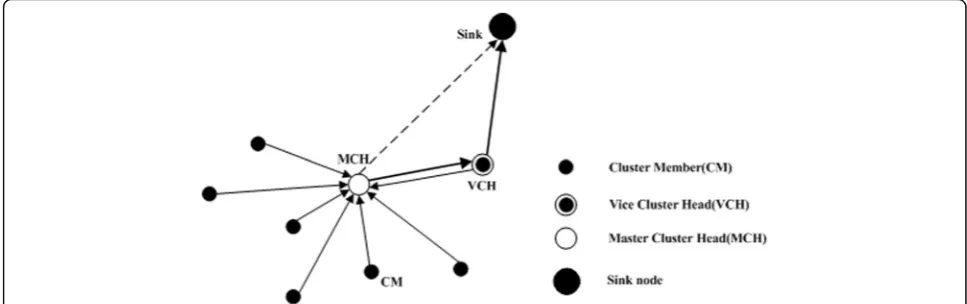
In this paper, Fig. 2 presents the ADCAPTEEN network model. The structure of the network model consists of CM, MCH, VCH, and sink node in four parts. In each cluster, a MCH and a VCH are selected. The CM is re-sponsible for collecting and transmitting data to the MCH. The MCH collects and merges the data and sends the converged data to the VCH of the cluster, and the VCH forwards the data to the sink node at a far distance.
It is periodic for this protocol to implement its process. Each round is divided into two phases: the phase of cluster formulation and intra-cluster data transmission and the phase of VCH selection and stable state. Firstly, it optimizes the computing method of the threshold, T(n). The improved T(n) considers the residual energy of nodes. The im-proved threshold T(n) can be expressed with Eq. (4). The MCH is selected by considering the remaining energy of each node. The choice of MCH is more reasonable.
where ei is the current remaining energy i of node,einit is initial energyiof node, andαis the regulatory factor.
3.1.1 Cluster formulation and intra-cluster data transmission
Each node compares the generated random number with Eq. (4) threshold to determine the current round of the MCH. If it is MCH, broadcast news announce them as the current round of MCH.
The non-MCH node receives the broadcast informa-tion, determines which cluster to join according to the received signal strength, and sends a join request to the MCH with the strongest received signal to become the cluster CM; the nodes are divided dynamically into sev-eral clusters and establish a virtual link between the MCH and the CMs by the ACO algorithm (initial phero-mone concentration value is 0).
After the CM receives the message, the MCH assigns TDMA time slots to all the CMs in the cluster and sends them to the CM. In the phase of cluster formula-tion, node energy in the network has been consumed of a different degree. The pheromone concentration is then calculated according to Eq. (5), which is expressed as:
τmið Þ ¼t Q dmi
1−ρ
ð Þ ð5Þ
Pheromone volatilization rate is defined as ρ, ρ
¼Einit−Em
Einit , and it is related to node energy sending
mes-sages, whereEinit is initial energy of MCH node, andEm is current energy of MCH node. dmi is distance from node ito MCH.Qis a preset parameter; the value ofQ
is 10 in this paper.
All CMs send data to MCHs when the conditions are met for data transmission of the proposed algorithm from CM to MCH. The conditions are as same as APTEEN, i.e. , including ST, HT, and CT comparison. MCH send rout-ing package, let CM report its energy message. CM send routing package carrying the current remaining energy in-formation. MCH calculate the increase in pheromone
concentration according to CM’s energy. The increased amount of pheromone in the corresponding link can be expressed as:
Δτmi¼β ei
einit ð
6Þ
whereeiis the current energy iof node,einitis the initial energyiof node, andβis the regulatory factor.
3.1.2 VCH selection and stable state
Then, according to Eqs. (5) and (6), the pheromone con-centration update expression is concluded as follows:
τmi¼τmið Þ þt Δτmi¼ Q
According to Eq. (7), the pheromone concentration on the link between the MCH and CMs can be obtained. MCH selects the CM node with the largest pheromone concentration on the link as VCH. VCH is selected to re-quire the CM to be as close to the MCH as possible, at the same time, the remaining energy of CM as high as possible. CM sends the sensed data to MCH in its allocated TDMA slot. When MCH receives the data from all the CMs, it collects and aggregates the data and sends the merging message to VCH which receives and transmits the merging message to far sink node. The protocol re-quires only communication between intra-cluster nodes and no communication between clusters.
Once VCH is selected, it will not change until it enters the next round. When entering the next round, phero-mone concentration between nodes will be cleared.
Figure 3 shows the allocation process of ADCAP-TEEN. Obviously, owing to node communication only between MCH and VCH, VCH performs most of energy consumption. MCH has no direct communication with sink node, so it balances energy consumption, improves
the number of surviving nodes, and prolongs the life cycle of the WSN.
3.2 AMAPTEEN protocol
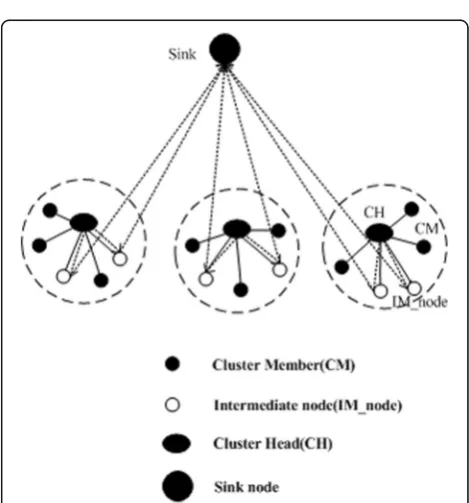
This section focuses on the AMAPTEEN. In the phero-mone update formulas, AMAPTEEN considers the dis-tances between CM and CH node and the residual energy of CM. The AMAPTEEN protocol is illustrated, and its characteristics are explained here. Its network model is as below in Fig. 4. The structure of the network model mainly consists of CM, CH, IM_node, and sink node four parts. CM sends the sensed data to CH, CH collects and fuses the data, and sends the fusion of the data to IM_ node. IM_node forwards the data to a distant sink node.
In this paper, the AMAPTEEN protocol’s implementa-tion procedure appears periodic. Each round is divided into two phases: the phase of cluster formulation and intra-cluster data transmission and the phase of optimal path selection and inter-cluster data transmission.
3.2.1 Cluster formulation and intra-cluster data transmission
Each node compares the generated random number with Eq. (4) threshold to determine the current round of the
Fig. 3Flow of the ADCAPTEEN protocol. The generated random number is compared with the formula threshold to determine MCH. The non-MCH node sends a join request to the MCH with the strongest received signal to become the cluster CM. Nodes are divided dynamically into several clusters. A virtual link between the MCH and the CMs is established. MCH selects the CM node with the largest pheromone concentration on the link as VCH. Once VCH is selected, it will not change until it enters the next round. CM sends the sensed data to MCH in its allocated TDMA slot. When MCH receives the data from all the CMs, it collects and aggregates data and sends the merging message to VCH which receives and transmits the merging message to far sink node
CH. Outside, the phase of cluster formulation and intra-cluster data transmission is the same as ADCAPTEEN. The nodes are divided dynamically into several clusters.
3.2.2 Optimal path selection and inter-cluster data transmission
The optimal path selection phase of the AMAPTEEN protocol replaced VCH selection of the ADCAPTEEN protocol. In this state, using ant colony algorithm, CH selects the CM node with the largest pheromone con-centration on the link according to Eq. (7) as IM_node.
CM sends the sensed data to CH in its allocated TDMA slot. When CH receives the data from all the CMs, it collects and aggregates data and sends the mer-ging message to IM_node. The IM_node forwards the message to far sink node. The protocol requires only communication between intra-cluster nodes, and no communication between clusters.
The IM_node is chosen by CH whenever there are data transmitted from CH to sink node. When entering the next round, pheromone concentration will be cleared between nodes.
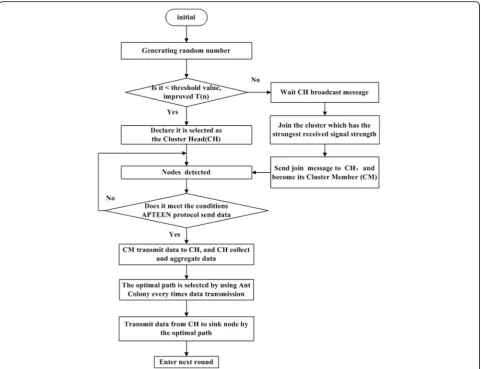
The flow of the AMAPTEEN protocol is depicted in Fig. 5.
In AMAPTEEN protocol, the residual energy of the node is considered in the choice of cluster head. The choice of cluster head is more reasonable. The IM_node is chosen as soon as there is data transmitted from CH to the sink node. The choice of IM_node depends on node maximal pheromone concentration, and thus, choosing the data transmission path is relatively optimal. And it is likely to be different, so there will be formed multiple data transfer paths from CH to sink. Streaming data to multiple paths reduces energy consumption, im-proves node survival rate, and extends life cycle of net-work further compared with ADCAPTEEN.
4 Simulation and analysis
The simulation model embraces many sensor nodes grouped into clusters and one fixed sink node. The OPNET is used to evaluate ADCAPTEEN compared
with APTEEN and AMAPTEEN compared with
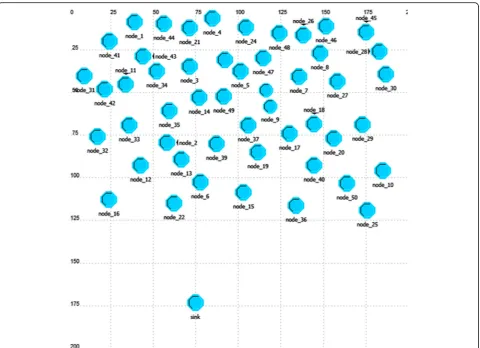
ADCAPTEEN. In the experiment, 50-node network and 100-node network are randomly distributed be-tween the area of (x= 0, y= 0) and (x= 200, y= 125) with the sink node at (x= 75, y= 175). The network models of WSN are shown in Figs. 6 and7. It is peri-odic for this protocol to implement its process. Each round time is 20 s.
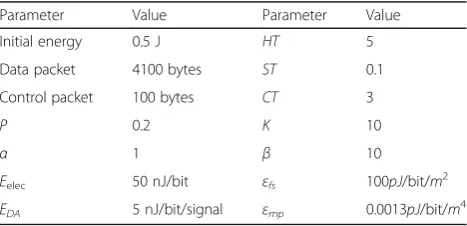
The simulation parameters are shown in Table 1. CM senses data continuously and assumes the detection times (DT) are Kin per round, then CMs are forced to transmit data to MCH or CH if the number of times which CM is not transmitting data to CH exceeds CT.
4.1 APTEEN simulation and analysis
Network life cycle of the algorithms is closely related with the probability of elected cluster heads. After mod-eling and simulation in OPNET, network life cycle com-parison with probabilities are 0.15, 0.2 and 0.25 respectively is shown as Fig.8. The horizontal axis is the simulation time, the vertical shaft is the number of live nodes. As can be seen from Fig. 8, the smaller pvalues selected, the longer network life cycle. Therefore, the probability of elected cluster head elected cluster p is very important to improve the network performance of APTEEN protocol. For the network constructed in this paper, p= 0.15,p= 0.2, andp= 0.25 belong to a reason-able range.ptakes a value of 0.2 in APTEEN and related protocols in this paper.
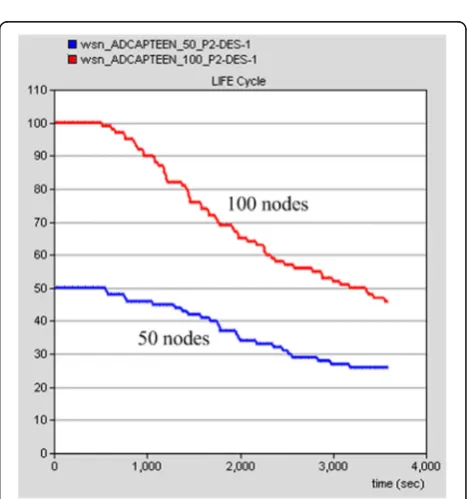
To verify the validity and scalability of the network, we build 100 nodes network topology. The network model is shown in Fig.7. Figure9shows the network life cycle of APTEEN compared 100 nodes with 50-node network topology. The network life cycles of both top-ologies show a downward trend stably. And the death time of the first node is also very close, so this paper established APTEEN network topology effectively. Randomly chosen as one of the nodes, Fig. 10 is a single-node energy consumption of APTEEN in different network scales. The horizontal axis is the simulation time, and vertical shaft is the node energy (J). From Fig. 10, we can see that increasing the number of nodes makes node energy consumption more stable. The de-scription of the network has strong scalability, suitable for large-scale network.
4.2 Comparison of APTEEN and ADCAPTEEN
In creating a new ADCAPTEEN scene, ADCAPTEEN routing protocol is compared with APTEEN routing protocol in OPNET. Figure 11 shows the network life cycle of ADCAPTEEN compared 100 nodes with the 50 nodes network topology. We can see that established ADCAPTEEN network topology is also effective. Com-pared with Fig. 9, ADCAPTEEN protocol results in a greater network life cycle than the APTEEN protocol under two network topologies. ADCAPTEEN outper-forms APTEEN in terms of scalability. It is suitable for large-scale network.
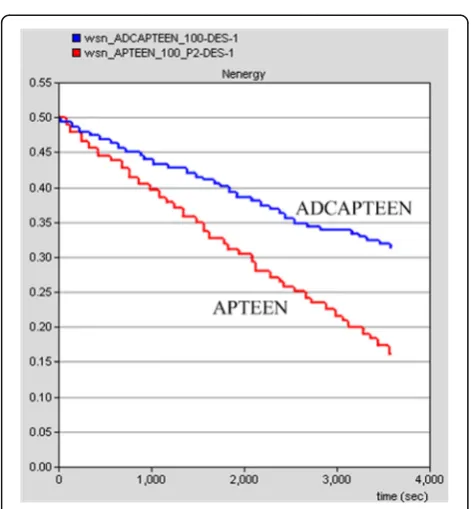
The energy consumption under APTEEN and ADCAPTEEN routing protocol is shown in Fig. 13. It shows ADCAPTEEN routing protocol reduced the en-ergy consumption of a single node compared with APTEEN.
4.3 Comparison of ADCAPTEEN and AMAPTEEN
Creating a new AMAPTEEN scene, AMAPTEEN rout-ing protocol is compared with ADCAPTEEN routrout-ing protocol in OPNET.
The network life cycle of AMAPTEEN compared 100 nodes with the 50-node network topology is shown in Fig. 14. Compared with Figs. 9 and 11, it can be seen
that AMAPTEEN also has good reliability and scalability and fits the large-scale network.
Figure 15 shows the comparison of network lifetime under ADCAPTEEN and AMAPTEEN. We can see that AMAPTEEN has further extended the network life cycle and improved the number of surviving nodes compared with ADCAPTEEN.
The energy consumption of single node compares ADCAPTEEN and AMAPTEEN is shown in Fig.16. The results show that the energy consumption of AMAPTEEN routing algorithm is smaller than ADCAPTEEN. AMAP-TEEN chooses IM_node as soon as there was data trans-mission from CH and sink node. Streaming data to multiple paths, the energy consumption is quiet reduced.
Fig. 5Flow of the AMAPTEEN protocol. The generated random number is compared with the formula threshold to determine CH. The
non-CH node selects the CH with the strongest received signal to join and become the cluster’s CM. Nodes are divided dynamically
5 Conclusions
This paper presents a double cluster heads Adaptive Threshold-sensitive Energy Efficient Network based on ant colony (ADCAPTEEN) and a Multiple Adap-tive Threshold-sensiAdap-tive Energy Efficient Network based on ant colony (AMAPTEEN) in wireless sensor networks (WSN). Two proposed protocols modify traditional T(n), and MCH and CH are selected by considering the residual energy of nodes. Making the choice of MCH and CH is more reasonable. This paper presents ADCAPTEEN to choose one VCH by MCH per round in each cluster, selected VCH to avoid the MCH and sink nodes communicate directly. It reduces the energy dissipation and achieves the improvement on network life cycle. Considering ADCAPTEEN will cause imbalanced energy consump-tion due to one path completing multiple data trans-mission between MCH and sink node in each round. IM_node will be chosen if there was data transmis-sion each time in AMAPTEEN from CH and sink
node. Forming multipath using ant colony, AMAP-TEEN reduces energy consumption, improves node survival rate, and extends life cycle of network further compared with ADCAPTEEN.
6 Results and discussion
6.1 ADCAPTEEN
Compared with APTEEN, ADCAPTEEN reduces
energy dissipation, improves node survival rate, and extends network life cycle. The proposed algorithm has good scalability, and it is suitable for large-scale network. Because ADCAPTEEN optimizes the cluster head election method compared with APTEEN. And one master cluster head (MCH) and one vice cluster head (VCH) will be selected in each cluster. The double cluster heads (DCH) can co-work on data collection, fusion, transition, etc. MCH has no direct communication with sink node, and VCH performs most of energy consumption.
6.2 AMAPTEEN
AMAPTEEN delays the time of node death, balances energy consumption, and extends network lifetime further operating in the same settings compared with ADCAPTEEN. The proposed algorithm also has good scalability, and it is suitable for large-scale network.
This is because AMAPTEEN is the optimization of ADCAPTEEN. And CH selects intermediate node (IM_node) multiple times with ant colony algorithm per round in each cluster and this way forms multiple routes to transmit data.
7 Methods
7.1 ADCAPTEEN
ADCAPTEEN improved threshold T(n), and the im-proved T(n) considers the residual energy of nodes. MCH is selected by comparing the generated random number with the improved threshold T(n). The nodes are divided dynamically into several clusters. In each cluster, to establish a virtual link between MCH and CM by the ACO algorithm. MCH selects the CM node with the largest pheromone concentration on the link according to using ant colony algorithm as VCH. Once VCH is selected, it will not change until it enters the next round. CM is responsible for col-lecting and transmitting data to the MCH. The MCH collects and merges the data, sends the converged
Fig. 7The 100-node network model of the WSN. The 100-node network model of WSN is shown in this figure. One hundred nodes are randomly distributed between the area of (x= 0,y= 0) and (x= 200,y= 125) with the sink node at (x= 75,y= 175)
Table 1Parameters
Parameter Value Parameter Value
Initial energy 0.5 J HT 5
Data packet 4100 bytes ST 0.1
Control packet 100 bytes CT 3
P 0.2 K 10
α 1 β 10
Eelec 50 nJ/bit εfs 100pJ/bit/m
2
EDA 5 nJ/bit/signal εmp 0.0013pJ/bit/m4
Fig. 8The life cycle of APTEEN in different probability. Network life cycle comparison with probabilities is 0.15, 0.2, and 0.25 respectively in the 50-node network scene. As can be seen from the figure, the smallerpvalues selected, the longer network life cycle
Fig. 9The life cycle of APTEEN compared in different scales. This figure shows the network life cycle of APTEEN compared 100 nodes with 50-node network topology. The network life cycles of both topologies show a downward trend stably. And the death time of the first node is also very close, so this paper established APTEEN network topology effectively
Fig. 10Energy consumption of APTEEN compared in different scales. This figure shows a single-node energy consumption of APTEEN in different network scales. From this figure, we can see that increasing the number of nodes makes the node energy consumption more stable
Fig. 11The life cycle comparison of ADCAPTEEN in different scales. This figure shows the network life cycle of ADCAPTEEN compared 100 nodes with the 50-node network topology. We can see that established ADCAPTEEN network topology is also effective. Compared with Fig.9, ADCAPTEEN protocol results in a greater network life cycle than the APTEEN protocol under two network topologies. ADCAPTEEN outperforms APTEEN in terms of scalability. It is suitable for
data to the VCH of the cluster, and the VCH for-wards the data to the sink node at a far distance. MCH has no direct communication with sink node, and VCH performs most of energy consumption. Therefore, ADCAPTEEN reduces energy consump-tion, improves the number of surviving nodes, and prolongs the life cycle of the WSN compared with APTEEN.
7.2 AMAPTEEN
AMAPTEEN is the optimization of ADCAPTEEN to make routes more stable and energy-efficient. The generated random number is compared with the im-proved threshold T(n) to determine the current round of the CH. Using the ant colony algorithm, CH selects the CM node with the largest phero-mone concentration on the link as IM_node. IM_ node is chosen as soon as there is data transmitted from CH to the sink node. CM is responsible for collecting and transmitting data to the CH. The CH collects and merges the data and sends the converged data to the IM_node of the cluster, and the IM_node forwards the data to the sink node at a far distance. The choice of IM_node depends on node maximal pheromone concentration, and thus,
Fig. 12Comparison of a life cycle between APTEEN and ADCAPTEEN. The comparison of a life cycle under APTEEN and ADCAPTEEN routing protocol is shown in this figure. This figure shows that about after 450 s, APTEEN begin node dies. In about 3600 s, most nodes run out of energy, with only a few nodes surviving. ADCAPTEEN begin node dies in about 500 s, and about after 3600 s, ADCAPTEEN have many nodes alive. Compared with APTEEN, ADCAPTEEN routing protocol delays the time of node death, increases the node survival rate, and extends the network survival time
Fig. 13Energy consumption of compared APTEEN with ADCAPTEEN. The energy consumption under APTEEN and ADCAPTEEN routing protocol are shown in this figure. It shows ADCAPTEEN routing protocol reduced the energy consumption of single node compared with APTEEN
Fig. 14The life cycle comparison of AMAPTEEN in different scales. The network life cycle of AMAPTEEN compared 100 nodes with the 50-node network topology is shown in this figure.
Compared with Fig. 9and Fig.11, it can be seen that
choosing the data transmission path is relatively optimal. And it is likely to be different, so there will be multiple data transfer paths from CH to sink. Streaming data to multiple paths, it reduces energy consumption, improves node survival rate, and extends life cycle of network further compared with ADCAPTEEN.
Abbreviations
ADCAPTEEN:Double cluster heads Adaptive Threshold-sensitive Energy Effi-cient Network based on ant colony; AMAPTEEN: Multiple Adaptive Threshold-sensitive Energy Efficient Network based on ant colony; APTEEN: Adaptive Threshold-sensitive Energy Efficient Network; CH: Cluster head; CM: Cluster member; CT: Count time; DAPTEEN: Distance Adaptive Threshold Sensitive Energy Efficient Sensor Network; DCCCA: Double cluster heads topology control algorithm based on the energy threshold which cater to heterogeneous wireless sensor network; DCH: Double cluster heads; DHSC: Double heads static cluster; EE-LEACH: Energy-efficient LEACH; HMAPTEEN: Hierarchal Multipath Adaptive Threshold-sensitive Energy Effi-cient Network; HT: Hard threshold; IM_node: Intermediate node;
LEACH: Low-Energy Adaptive Clustering Hierarchy; MCH: Master cluster head; ST: Soft threshold; SV: Sensed value; TEEN: Threshold-sensitive Energy Efficient Network; VCH: Vice cluster head; WSN: Wireless sensor network
Funding
This work was supported by the National Natural Science Foundation of China (61761034, 61261020) and the Natural Science Foundation of Inner Mongolia, China (2016MS0616).
Availability of data and materials
The materials and data are true and reliable in this paper.
Authors’contributions
W-SB ([email protected]) is the corresponding author. M-JY and W-SB conceived the proposed scheme. M-JY conducted the detailed derivation to evaluate the performance of the proposed scheme and carried out the most experiments and data analysis and wrote the manuscript. MC and G-YH carries out the part experiments and data analysis, D-JT helped to improve the experimental simulation and polish the article language after the suggestions for revision of the manuscript, and W-SB reviewed the manuscript. All authors have read and approved the final manuscript.
Competing interests
The authors declare that they have no competing interests.
Publisher’s Note
Springer Nature remains neutral with regard to jurisdictional claims in published maps and institutional affiliations.
Author details
1College of Electronic Information Engineering, Inner Mongolia University,
Hohhot, China.2Inner Mongolia University of Finance and Economics,
Hohhot, China.
Received: 24 October 2017 Accepted: 18 April 2018
References
1. X Li, F Zhou, D Junping, LDTS: a lightweight and dependable trust system for clustered wireless sensor networks[J]. IEEE Trans. Inf. Forensics Sec.8(6), 924–935 (2013)
2. Debabrata Singh, Sanjeet Kumar Nayak. Enhanced modified LEACH (EMODLEACH) protocol for WSN[J]. Int. Symp. Adv. Comput. Commun. (ISACC),328–333(2015).https://doi.org/10.1109/ISACC.2015.7377364 3. P Nayak, A Devulapalli, A fuzzy logic-based clustering algorithm for WSN to
extend the network lifetime[J]. IEEE Sensors J.16(1), 137–144 (2016)
4. Gopi Saminathan Arumugam, Thirumurugan Ponnuchamy. EE-LEACH:
development of energy-efficient LEACH Protocol for data gathering in WSN[J]. EURASIP J. Wirel. Commun. Netw.,(1):1–9(2015).
Fig. 15The life cycle compared ADCAPTEEN with AMAPTEEN. This figure shows the comparison of network lifetime under ADCAPTEEN and AMAPTEEN. We can see that AMAPTEEN has further extended the network life cycle and improved the number of surviving nodes compared with ADCAPTEEN
5. Krishnakumar Amirthalingam, Dr. Anuratha.Improved LEACH: A modified LEACH for wireless sensor network[J]. Int. Conf. Adv. Comput. Appl. (ICACA),255–258(2016).https://doi.org/10.1109/ICACA.2016.7887961 6. D Karaboga, S Okdem, C Ozturk, Cluster based wireless sensor network routing
using artificial bee colony algorithm[J]. Wireless Network18, 847–860 (2012) 7. Zubaria Andleeb, M.R. Anjum, M. Usman Sardar. Study the impact of
multiple mobile sinks on lifetime of wireless sensor networks[J]. Int. Conf. Innovative Comput. Technol. (INTECH), 418–422(2016).https://doi.org/10. 1109/INTECH.2016.7845065
8. SD Muruganathan, AB Sesay, WA Krzymien, Analytical query response time evaluation for a two-level clustering hierarchy based wireless sensor network routing protocol[J]. IEEE Commun. Lett.14(5), 486–488 (2011) 9. O Abouelkhair, A Elsaadany, Hierarchal energy efficient network protocol for
wireless sensing[J]. Comput. Eng. Conf. (ICENCO), 128–132 (2014).https:// doi.org/10.1109/ICENCO.2014.7050444
10. Anjali, Anshul Garg, Suhali. Distance Adaptive Threshold Sensitive Energy Efficient Sensor Network (DAPTEEN) Protocol in WSN[J]. Signal Process. Comput. Control (ISPCC),114–119(2015).https://doi.org/10.1109/ISPCC.2015. 7375008
11. X Yi, D Lu, A double heads static cluster algorithm for wireless sensor networks[J]. Environ. Sci. Inf. Appl. Technol. (ESIAT)2, 635–638 (2010) 12. Q Xuegong, C Yan, A control algorithm based on double cluster-head for
heterogeneous wireless sensor network[J]. Int. Conf. Ind. Inf. Syst. (IIS)1, 541–544 (2010)
13. M Dorigo, V Maniezzo, A Colomi, The ant system: Optimizationby a Colony of cooperating agents [J]. IEEE Trans. Syst. Man Cybernetics B26(2), 29–41 (1996) 14. D. Baghyalakshmi, J. Ebenezer, S. A. V. Satyamurty . Low latency and energy