R E S E A R C H
Open Access
Control for Markov sampled-data systems
with event-driven transmitter
Wenxia Cui
*, Lu Li and Ruijuan Liu
*Correspondence:
College of Fundamental Studies, Shanghai University of Engineering Science, Shanghai, 201620, China
Abstract
In this paper, feedback control problem is considered for networked systems with discrete, infinite distributed delays and sampled-data. A Markov chain is used to characterize the random sampled measurement process of the networked control systems. In addition, an event-driven transmitter is introduced to transmit the control signal according to the measurement sampling period. Based on Lyapunov functional and the matrix analysis techniques, several sufficient conditions are given to ensure the asymptotical stability in the mean square of the addressed control systems. Furthermore, a novel output feedback controller is proposed with both sampling and event-driven transmitter-induced delay indexes. Finally, a simulation example is provided to illustrate the effectiveness of the theoretical results and the proposed method.
Keywords: stabilization; event-trigger; time-delay; sampled-data
1 Introduction
In the traditional feedback control systems, the connections between system compo-nents are established by point-to-point cables. Compared to the traditional point-to-point systems, networked control systems are real-time control systems where sensors, actua-tors and controllers are interconnected by a shared digital communication network. Net-worked control systems (NCSs) offer many advantages such as lower cost, simpler instal-lation, easier maintenance, and resource sharing []. And NCSs have great applications in aircrafts and spacecrafts control, robotics, process control and vehicles []. Therefore, the field of NCSs has been becoming a hot research topic [–].
Since digital microprocessors are quickly becoming indispensable in practical applica-tions, control designing problems of systems tend to be implemented on digital platforms [, ]. The periodic sampling leads to conservativeness in the usage of computational re-source and bandwidth, because the constant sampling period is chosen to guarantee sta-bility in the worst case []. For reducing the usage of computational resource and limited bandwidth, the nonuniform sampler was employed in the implementations of NCSs. Re-cently, several initial attempts have been proposed to study the stability of NCSs with nonuniformly sampled systems [, ].
On the other hand, time delays widely exist in practical systems due to the unreliable communication channel [, ]. It is well known that time delay makes the analysis and synthesis of NCSs more complex and important. And time delay is also the major cause
for NCS performance deterioration and potential system instability []. Discrete time delay is common [], Liou and Ray proposed the synthesis of a stochastic regulator in the presence of randomly varying delays from the controller to actuator []. Distributed time delay+r=∞μrx(k–r) is another important delay, which has recently drawn much research
interest when modeling a realistic complex system [].
With the very interesting results reported in [, ], it is seen that, in some cases, the activities of sensors/actuators are even triggered by events characterizing stochastic processes,e.g., Markov process [, ]. Experimental result [] shows that the event-triggered control scheme can efficiently reduce the number of control task executions so that communication resources can be saved significantly while retaining satisfactory closed-loop performance.
In practical engineering, discrete and distributed time delays always appear simultane-ously in the systems, and the measurement, communication and control updates need the nonuniform sampler. It is therefore essential and challenging to investigate the control for Markov sampled-data systems with event-driven transmitter, which has great potential in practical applications. Therefore, for the mixed time-delay NCSs, an interesting prob-lem is to find a co-design method of the event-triggered control scheme in this paper. In consequence of the above discussion, the networked-based feedback control problem with event-driven transmitter is investigated for NCSs. The main contributions of this paper are the following ones: () we consider nonuniform sample data, discrete and distributed time-delays, and present criteria for ensuring stochastic stability of the closed-loop networked system; () A novel output feedback controller incorporating both Markov-based sam-pling,+r=∞μrx(k–r) and event-driven transmitter-induced delay indexes is proposed. 2 System description
Consider the following networked control system:
x(k+ ) =Ax(k) +Bx(k–d(k)) +C+r=∞μrx(k–r) +Du(k),
y(θi) =Ex(θi), θi∈ {kh},k,i∈N,
()
wherex(k)∈Rnis the system state,u(k)∈Rqis the control input, andy(θ
i)∈Rqis the
measurement sampled at arbitrary instants θi ( =θ<θ <· · ·<θi<· · ·). A, B, C, D
andE are known real matrices with appropriate dimensions. The positive integerd(k) denotes the time-varying delay satisfyingd ≤d(k)≤d, k∈N+, whered andd are
known positive integers. The constants μr≥ (r= , , . . .) satisfy
+∞
r=rμr< +∞and ¯
μ+r=∞μr< +∞.
The schematic diagram for system () is shown in Figure . System () is derived by dis-cretizing the original continuous-time system under the sampling periodh. The measure-ment cannot be sampled any instantkh. Then the previous measurementy(k– ) is applied in the controller side, and the measurement received by the controller can be expressed as follows:
y(k) =Ex(k–τk), θi≤k<θi+, ()
where the sampling-induced delay indexτkk–θi is still a random variable, andτk is
Figure 1 The structure of NCS in (1).
is defined as follows:
=
⎡ ⎢ ⎢ ⎢ ⎢ ⎢ ⎢ ⎢ ⎣
π –π · · ·
π –π · · ·
..
. ... ... . .. ...
πN– . . . –πN–
· · ·
⎤ ⎥ ⎥ ⎥ ⎥ ⎥ ⎥ ⎥ ⎦
, ()
whereπi∈ {, },i∈ {, , . . . ,N– }.
3 Observer-based output feedback control
Suppose that the system output is available and will be sampled before it is transmitted to the controller through network. Then there is the sampling-induced delay in the sensor-to-controller channel. Certainly, in the controller-to-actuator channel, there is the event-driven induced delay. Therefore, both sampling-induced delay and event-event-driven induced delay indexes are taken into account to design the output feedback controller:
⎧ ⎪ ⎪ ⎪ ⎨ ⎪ ⎪ ⎪ ⎩
ˆ
x(k+ ) =Axˆ(k) +Bxˆ(k–d(k)) +Du(k) +C+r=∞μrxˆ(k–r)
+Lτk–,τk(y(k–τk) –yˆ(k)), ˆ
y(k) =Exˆ(k), xˆ() = ,
u(k) =Kτk–,τkxˆ(k–τk–),
()
wherexˆ(k)∈Rn,yˆ(k)∈Rqare the state and output of the controller, respectively.K τk–,τk∈
Rm×nis the controller gain, andL
τk–,τk∈R
n×qis the observer gain needed to be designed,
where
τk–=
k– –θi ifθi<k<θi+,
k– –θi– ifk=θi.
()
Define the following augmented state vectorX(k),Xˆ(k),X(k–d(k)),Xˆ(k–d(k)), and the error vectore(k) =X(k) –Xˆ(k),e(k–d(k)) =X(k–d(k)) –Xˆ(k–d(k)) and
X(k) =xT(k) xT(k– ) · · · xT(k–N)T, ˆ
The augmented system of () and () can be represented as
The closed-loop system based on the augmented systems () and () with Z(k) = [XT(k)eT(k)]Tcan be further expressed as follows:
In the following, the main results of this paper will be presented, which can be used to study the asymptotical stability in the mean square of system ().
and Li,j(i,j= , , . . . ,N)satisfying
Proof Construct the following Lyapunov-Krasovskii function:
A combination of ()-() leads to
EV(k)≤ξT(k)ξ(k), ()
where
=
⎡ ⎢ ⎣
AˆTP¯
iBˆ AˆTP¯iCˆ ∗ ˆBTP¯
iBˆ– BˆTP¯iCˆ ∗ ∗ CˆTP¯
iCˆ–μ¯W
⎤ ⎥ ⎦,
ξ(k) =ZT(k) ZT(k–d(k)) +∞
r=μrZT(k–r)
T
.
Hence, by inequality () in Theorem , we can getE{V(k)} ≤. From Lyapunov stability theory, we can conclude that closed system () with controller () is asymptotically stable
in the mean square. The proof of Theorem has been completed.
Next, we present the results on the solvability of the control problem based on Theo-rem , where the cone complementarity linearization approach is introduced to deal with the constraint. The main result is concluded in the following theorem by using the Schur complement method and lettingG=P¯–,Gi+=P¯–i+.
Remark In [], Markov-based sample data was reflected on the networked control systems, in which the sampling-induced delay index was modeled by a Markov chain. Different from [], our model includes discrete time-delays, distributed time-delays (+r=∞μrx(k–r)) and Markov-based sample data.
Remark Unlike the method in [], Theorem gives the sufficient and necessary con-dition for the stability, which helps to reduce the conservatism. It should be pointed out that Theorem can be easily applied to stability analysis by LMIs conditions for systems with time-varying and distributed delays in this paper.
Theorem There exists output controller()such that closed-loop system()is asymp-totically stable in the mean square if there exist positive matrices Pi,G,Gi+,and W
such that the following conditions hold for all i∈ {, , , . . . ,N– }:
⎡ ⎢ ⎣
–i Hi, Hi,i+
∗ –G
∗ ∗ –Gi+
⎤ ⎥ ⎦< ,
–N HN, ∗ –G
< , ()
wherei=diag{Pi–μ¯W– ( +d–d),,μ¯W},G=P¯ –
,Gi+=P¯i+–,GN =P¯–N and
Hi,j=
⎡ ⎢ ⎢ ⎢ ⎢ ⎢ ⎢ ⎢ ⎢ ⎣
¯
A+D¯K¯i,jRi–L¯i,jER¯ j –D¯K¯i,jRi ¯
Li,jER¯ A¯–L¯i,jER¯ ¯
B
B¯
¯
C
C¯
⎤ ⎥ ⎥ ⎥ ⎥ ⎥ ⎥ ⎥ ⎥ ⎦
Based on the cone complementarity linearization method[],the controller and ob-server gains can be obtained by the following nonlinear minimization problem subject to
():
Min{Tr(Ni=(PiGi))},
Pi I
∗Gi
≥, i∈ {, , . . . ,N}.
Remark According to [], the computational complexity of the controller design by solving LMIs is defined byT(F) =O(F) [], whereF is the total number of scalar
de-cision variables. From () and the minimization problem, we can see that F satisfies
F=N(n+ n) + (N– )(nq+nm) for Theorem . Therefore, the computational com-plexity of Theorem isO(Nn) for the system dimensionnand the transition matrix
dimensionN.
5 Numerical examples
In this section, the simulation results are presented to illustrate the theoretical results derived in this paper.
Example Consider the networked system () withN= . And other networked system parameters are given as follows:
A=
⎡ ⎢ ⎣
. . .
. –. .
. .
⎤ ⎥
⎦, B=
⎡ ⎢ ⎣
. .
. .
. .
⎤ ⎥
⎦, D=
⎡ ⎢ ⎣
. .
⎤ ⎥ ⎦,
C=
⎡ ⎢ ⎣
.
–. .
. . .
⎤ ⎥
⎦, E=
⎡ ⎢ ⎣
. . .
⎤ ⎥ ⎦
T
, =
⎡ ⎢ ⎣
. .
. .
⎤ ⎥ ⎦,
d(k) = + + (–)
k
, μr=
–(r+).
It is easy to verify thatd= ,d= , andμ¯ =. By using Matlab Toolbox and applying
Theorem to this example, the following feasible controller and observer gain matrices are obtained for controller () as follows:
K= [. –. –.], K= [. –. –.],
K= [. –. –.], K= [. –. –.],
K= [. –. –.], L= [–. . .]T,
L= [–. . .]T, L= [–. . .]T,
L= [–. . .]T, L= [–. . .]T.
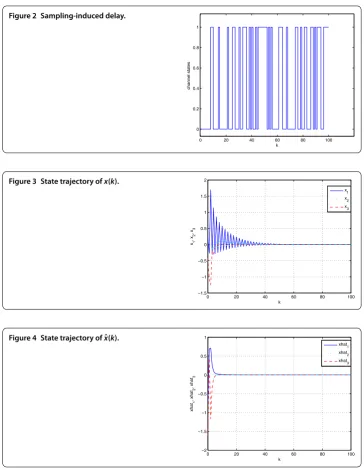
The sampling-induced delay index τk is a random variable,τk is assumed to be
Figure 2 Sampling-induced delay.
Figure 3 State trajectory ofx(k).
Figure 4 State trajectory ofxˆ(k).
andxˆ are shown in Figures and , respectively. We can conclude that, based on the event-driven transmitter, system () is asymptotically stable in mean square.
6 Conclusions
In this paper, we have presented a theoretical framework to analyze network-based output feedback control for Markov sampled-data systems with mixed delays. At first, the net-worked control systems model is constructed including nonuniform sample data, discrete and distributed time-delays. Furthermore, the novel output feedback controller incorpo-rating both Markov-based sampling and event-driven transmitter-induced delay indexes is proposed.
Based on the results obtained in this paper, a new form of controlleru(k) =rkrx(k–r)
work. And we will consider other approaches to give the sufficient and necessary condi-tions to ensure stability of the closed-loop system.
Competing interests
The authors declare that they have no competing interests.
Authors’ contributions
WC analyzed the control problem and the numerical example, LL designed sketch, and RL gave some suggestions to revise the paper. All authors read and approved the final manuscript.
Acknowledgements
This research is supported by the Start-up Project of Shanghai University of Engineering Science (E1-0501-15-0101), the Outstanding Young Teacher Training Project of Shanghai (E1-8500-15-01087).
Received: 15 April 2015 Accepted: 30 October 2015 References
1. Li, H, Yang, H, Sun, F, Xia, Y: Sliding-mode predictive control of networked control systems under a multiple-packet transmission policy. IEEE Trans. Ind. Electron.61, 6234-6243 (2014)
2. Sun, Z, Li, H, Wang, Y: Recent advances in networked control systems. In: International Conference on Control, Automation and Systems, 17-20 October (2007)
3. Cloosterman, MBG, Hetel, L, Wouw, N, Heemels, WPMH, Daafouz, J, Nijmeijer, H: Controller synthesis for networked control systems. Automatica46, 1584-1594 (2010)
4. Xu, Y, Su, H, Pan, Y: Output feedback stabilization for Markov-based nonuniformly sampled-data networked control systems. Syst. Control Lett.62, 656-663 (2013)
5. Shi, Y, Yu, B: Robust mixedH2/H∞control of networked control systems with random time delays in both forward
and backward communication links. Automatica47, 754-760 (2011)
6. Gao, H, Wu, J, Shi, P: Robust sampled-dataH∞control with stochastic sampling. Automatica45, 1729-1736 (2009) 7. Sakthivel, R, Arunkumar, A, Mathiyalagan, K: Robust sampled-dataH-infinity control for mechanical systems.
Complexity20, 19-29 (2015)
8. Xie, L, Xie, L: Stability analysis of networked sampled-data linear systems with Markovian packet losses. IEEE Trans. Autom. Control54, 1368-1374 (2009)
9. Cao, Y, Ren, W: Multi-vehicle coordination for double-integrator dynamics under fixed undirected/directed interaction in a sampled-data setting. Int. J. Robust Nonlinear Control20, 987-1000 (2010)
10. Zhang, Y, Tian, Y: Consensus of data-sampled multi-agent systems with random communication delay and packet loss. IEEE Trans. Autom. Control55, 939-943 (2010)
11. Olfati-Saber, R, Murray, RM: Consensus problems in networks of agents with switching topology and time-delays. IEEE Trans. Autom. Control49, 1520-1533 (2004)
12. Sakthivel, R, Santra, S, Mathiyalagan, K, Marshal Anthoni, S: Robust reliable sampled-data control for offshore steel jacket platforms with nonlinear perturbations. Nonlinear Dyn.78, 1109-1123 (2014)
13. Wang, Z, Ho, D, Liu, Y, Liu, X: RobustH∞control for a class of nonlinear discrete time-delay stochastic systems with missing measurements. Automatica45, 684-691 (2009)
14. Xu, J, Zhang, H, Xie, L: Input delay margin for consensusability of multi-agent systems. Automatica49, 1816-1820 (2013)
15. Liou, LW, Ray, A: A stochastic regulator for integrated communication and control systems. Part I. Formulation of control law. J. Dyn. Syst. Meas. Control113, 604-611 (1991)
16. Yang, R, Shi, P, Liu, G, Gao, H: Network-based feedback control for systems with mixed delays based on quantization and dropout compensation. Automatica47, 2805-2809 (2011)
17. Heemels, W, Donkers, M, Teel, AR: Periodic event-triggered control for linear systems. IEEE Trans. Autom. Control58, 847-861 (2013)
18. Meng, X, Chen, T: Event based agreement protocols for multi-agent networks. Automatica49, 2125-2132 (2013) 19. Arunkumar, A, Sakthivel, R, Mathiyalagan, K, Park, JH: Robust stochastic stability of discrete-time fuzzy Markovian
jump neural networks. ISA Trans.53, 1006-1014 (2014)
20. Sakthivel, R, Raja, R, Anthoni, SM: Exponential stability for delayed stochastic bidirectional associative memory neural networks with Markovian jumping and impulses. J. Optim. Theory Appl.150, 166-187 (2011)
21. Wang, X, Lemmon, M, Anthoni, SM: Event-triggering in distributed networked control systems. IEEE Trans. Autom. Control56, 586-601 (2011)
22. Ghaoui, LE, Oustry, F, Aitrami, M: A cone complementarity linearization algorithm for static output feedback and related problems. IEEE Trans. Autom. Control42, 1171-1176 (1997)