c e-ISSN: 2348-6848, p- ISSN: 2348-795X Volume 3, Issue 01, January 2016
International Journal of Research (IJR)
Available at http://internationaljournalofresearch.org
A Review On: Concurrent and Independent Access to Encrypted
Cloud Databases
T Anand
1; Kbks Durga
2;
G.Nagababu 3& M Saikrishna
4 1Asst professor, Dept. of CSE ST.Martin's Hyderabad,TS.
2
Associate professor, Dept. of CSE ST.Martin's Hyderabad,TS.
3
Asst professor, Dept. of CSE ST.Martin's Hyderabad,TS.
4
Asst professor, Dept. of CSE ST.Martin's Hyderabad,TS.
Abstract
Placing critical data in the hands of a cloud provider should come with the guarantee of security and availability for data at rest, in motion, and in use. Several alternatives exist for storage services, while data confidentiality solutions for the database as a service paradigm are still immature. Since data in cloud will be placed anywhere, because of the critical nature of the applications, it is important that clouds be secure. The major security challenge with clouds is that the owner of the data may not have control of where the data is placed. This is because if one wants to exploit the benefits of using cloud computing. This requirement imposes clear data management choices: original plain data must be accessible only by trusted parties that do not include cloud providers, intermediaries, and Internet; in anyuntrusted context, data must be encrypted. Satisfying these goals has different levels of complexity depending on the type of cloud service.
We propose Secure DBaaS as the first solution that allows cloud tenants to take full advantage of DBaaS qualities, such as availability, reliability, and elastic scalability, without exposing unencrypted data to the cloud provider. The architecture design was motivated by goal: to allow multiple, independent, and geographically distributed clients to execute concurrent operations on encrypted data, including SQL statements that modify the database structure.
Keywords: Cloud; security; confidentiality; Secure DBaaS; database.
1.
Introduction
Cloud based mostly services have become common as they specialize in high accessibility and quantify ability at low value. Where as providing high accessibility and quantify ability, inserting essential knowledge to cloud poses several security problems. For avoiding these security problems the info are a unit keep within the cloud information in associate encrypted format. The encrypted cloud information permits the execution of SQL operations by choosing the cryptography schemes that support SQL operators. Encrypted cloud information permits differing types of accesses like distributed, concurrent, and freelance. one in all the design that supports these 3 types of access is Secure DBaaS.
The Secure DBaaS design supports multiple and freelance shoppers to execute synchronal SQL operations on encrypted knowledge. Knowledge consistency ought to be maintained by
investment concurrency management
c e-ISSN: 2348-6848, p- ISSN: 2348-795X Volume 3, Issue 01, January 2016
International Journal of Research (IJR)
Available at http://internationaljournalofresearch.org
execution on replicated knowledge within the cloud information. Current DBMS supported by cloud suppliers permits relaxed consistency guarantees that successively increase the look complexness of requests.
The second concurrency controlling protocol is that the picisolation (SI) that provides redoubled concurrency in cloud atmosphere in comparison to 1SR.Transactions area unit browse from the pic, reads area unit never blocked attributable to write locks that successively will increase concurrency. SI doesn't permit several of the inconsistencies, SI permits dealing inversions. To avoid dealing inversions sturdy consistency guarantee is needed, i.e. sturdy SI (SSI). The third concurrency management protocol is that the session consistency (SC). Session consistency could be a completely different type of ultimate consistency. The system provides browse your writes consistency within every session. Session consistency is at a coffee value whereas considering interval and dealing value. The value based mostly concurrency management within the cloud is that the C three i.e. cost-based adaptive concurrency management in cloud. C3 dynamically witch between sturdy consistency level and weak consistency level of transactions during cloud information in line with the value at runtime. it\'s designed on the highest of 1SR and SSI.
2.
Related Work
2.1 Existing System:
Original plain data must be accessible only by trusted parties that do not include cloud providers, intermediaries, and Internet; in any entrusted context, data must be encrypted. Satisfying these goals has different levels of complexity depending on the type of cloud service. There are several solutions ensuring confidentiality for the storage as a service paradigm, while guaranteeing confidentiality in the database as a service (DBaaS) paradigm is still an open research area.
2.2 Proposed System:
We propose a novel architecture that integrates cloud database services with data confidentiality and the possibility of executing concurrent operations on encrypted data. This is the first solution supporting geographically distributed clients to connect directly to an encrypted cloud database, and to execute concurrent and independent operations including those modifying the database structure. The proposed architecture has the further advantage of eliminating intermediate proxies that limit the elasticity, availability, and scalability properties that are intrinsic in cloud-based solutions. Secure DBaaS provides several original features that differentiate it from previous work in the field of security for remote database services.
Advantages of proposed system:
The proposed architecture does not require modifications to the cloud database, and it is immediately applicable to existing cloud DBaaS, such as the experimented Postgre SQL Plus Cloud Database, Windows Azure and Xeround .
Here are no theoretical and practical limits to extend our solution to other platforms and to include new encryption algorithm.
It guarantees data confidentiality by allowing a cloud database server to execute concurrent SQL operations (not only read/write, but also modifications to the database structure) over encrypted data.
It provides the same availability, elasticity, and scalability of the original cloud DBaaS because it does not require any intermediate server.
c e-ISSN: 2348-6848, p- ISSN: 2348-795X Volume 3, Issue 01, January 2016
International Journal of Research (IJR)
Available at http://internationaljournalofresearch.org
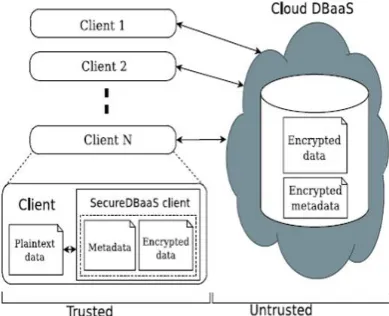
Fig 1: Architecture of Untrusted secure Encrypted Cloud Database
The System has to reach different platforms and to incorporate new encoding algorithmic rule with untrusted cloud information and trustworthy proxy has to be removed. The virtual machine image on cloud uses cloud information severally. This will be achieved by victimization consumer application and cloud knowledgebase with RSA encoding engine for top security and AES encoding for normal data to quick access. The encrypted knowledge is keep into the untrusted cloud information with encrypted data. Clouds don\'t would like any trustworthy proxy for authentication and cloud information is genuine asuntrusted.
3.
Implementation
3.1 Structure Phase:
We describe how to initialize Secure DBaaS architecture from a cloud database service acquired by a tenant from a cloud provider. We assume that the DBA creates the metadata storage table that at the beginning contains just the database metadata, and not the table metadata. The DBA populates the database metadata through the Secure DBaaS client by using randomly generated encryption keys for any combinations of data types and encryption types, and stores them in the metadata storage table after encryption through the master key. Then, the DBA distributes the master key to the legitimate users. User access control policies are administrated by the DBA through some standard data control language as in any
unencrypted database. In the following steps, the DBA creates the tables of the encrypted database.
3.2 Meta information Module:
In this module, we develop Meta data. So our system does not require a trusted broker or a trusted proxy because tenant data and metadata stored by the cloud database are always encrypted. In this module, we design such as Tenant data, data structures, and metadata must be encrypted before exiting from the client. The information managed by Secure DBaaS includes plaintext data, encrypted data, metadata, and encrypted metadata. Plaintext data consist of information that a tenant wants to store and process remotely in the cloud DBaaS. Secure DBaaS clients produce also a set of metadata consisting of information required to encrypt and decrypt data as well as other administration information. Even metadata are encrypted and stored in the cloud DBaaS.
3.3 Subsequent SQL Operations:
c e-ISSN: 2348-6848, p- ISSN: 2348-795X Volume 3, Issue 01, January 2016
International Journal of Research (IJR)
Available at http://internationaljournalofresearch.org
modifying some tenant data by granting limited privileges on some tables. User privileges can be managed directly by the untrusted and encrypted cloud database. The results of the translated query that includes encrypted tenant data and metadata are received by the Secure DBaaS client, decrypted, and delivered to the user. The complexity of the translation process depends on the type of SQL statement.
3.4 Coexisting SQL Operations:
The support to concurrent execution of SQL statements issued by multiple independent (and possibly geographically distributed) clients is one of the most important benefits of Secure DBaaS with respect to state-of-the-art solutions. Our architecture must guarantee consistency among encrypted tenant data and encrypted metadata because corrupted or out-of-date metadata would prevent clients from decoding encrypted tenant data resulting in permanent data losses. A thorough analysis of the possible issues and solutions related to concurrent SQL operations on encrypted tenant data. Here, we remark the importance of distinguishing two classes of statements that are supported by Secure DBaaS: SQL operations not causing modifications to the database structure, such as read, write, and update; operations involving alterations of the database structure through creation, removal, and modification of database tables (data definition layer operators).
4.
Experimental Work
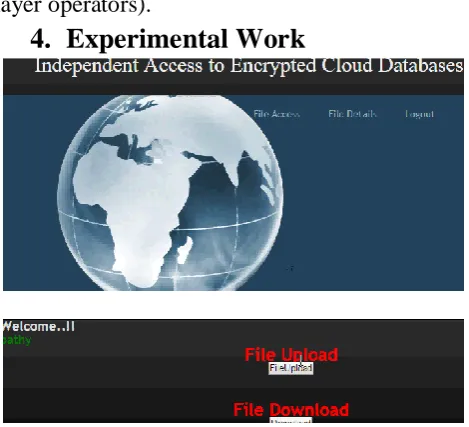
Fig 2: File Upload and Download Module.
Fig 3: Cloud Data.
5.
Conclusion
c e-ISSN: 2348-6848, p- ISSN: 2348-795X Volume 3, Issue 01, January 2016
International Journal of Research (IJR)
Available at http://internationaljournalofresearch.org
6. References
[1]L. Ferretti, F. Pierazzi, M. Colajanni, and M.Marchetti, “Security and confidentiality solutions forpublic cloud database services,” in SECURWARE2013, The Seventh International Conference onEmerging Security Information, Systems andTechnologies, 2013, pp. 36–42.
[2]L. Ferretti, M. Colajanni, M. Marchetti, and A. E.Scaruffi, “Transparent Access on Encrypted DataDistributed over Multiple Cloud Infrastructures,” inCLOUD COMPUTING 2013, The FourthInternational Conference on Cloud Computing,GRIDs, and Virtualization, 2013, pp. 201–207.
[3] H. Hacigumu s, B. Iyer, and S. Mehrotra,Providing Database as a Service, Proc. 18th IEEE IntlConf. Data Eng., Feb. 2002. [7] C. Gentry, FullyHomomorphic Encryption Using Ideal Lattices,Proc.41st Ann. ACM Symp. Theory of ComputingMay 2009.
[4] R.A. Popa, C.M.S. Redfield, N. Zeldovich, and H.Balakrishnan,“CryptDB: Protecting
Confidentialitywith Encrypted Query
Processing,” Proc. 23rd ACMSymp. Operating Systems Principles,Oct.2011
[5] H. Hacigu¨mu¨ s¸, B. Iyer, and S. Mehrotra,“Providing Database as a Service,” Proc. 18th IEEEInt’l Conf. Data Eng., Feb. 2002.
[6] C. Gentry, “Fully Homomorphic
EncryptionUsing Ideal Lattices,”Proc. 41st Ann. ACM Symp.Theory of Computing, May, 2009.
[7] H. Hacigu¨mu¨ s¸, B. Iyer, and S. Mehrotra,“Providing Database as a Service,” Proc. 18th IEEEInt’l Conf. Data Eng., Feb. 2002.
[8] E. Damiani, S.D.C. Vimercati, S. Jajodia,
S.Paraboschi, and P.Samarati,
“BalancingConfidentiality and Efficiency in
UntrustedRelational Dbmss,” Proc. Tenth ACM Conf.Computer and Comm.Security, Oct. 2003.
[9] Efficient Method to Secure Web applications andDatabases against SQL Injection Attacks, ZeinabRaveshi, Sonali R. Idate IJARCSSE Volume 3, Issue5, May 2013 ISSN: 2277 128X International Journalof Advanced Research in Computer Science andSoftware Engineering.
[10] Secured Data Storage in Google CloudS.SABARI VASAN, I.GOLDA SELIA, InternationalJournal of Computer Trends and Technology (IJCTT)- volume4 Issue4 –April 2013.