Performance and Complexity Co-evaluation
of the Advanced Video Coding Standard
for Cost-Effective Multimedia Communications
Sergio Saponara
Interuniversity Microelectronics Center (IMEC), Kapeldreef 75, B-3001 Leuven, Belgium Email:[email protected]
Kristof Denolf
Interuniversity Microelectronics Center (IMEC), Kapeldreef 75, B-3001 Leuven, Belgium Email:[email protected]
Gauthier Lafruit
Interuniversity Microelectronics Center (IMEC), Kapeldreef 75, B-3001 Leuven, Belgium Email:[email protected]
Carolina Blanch
Interuniversity Microelectronics Center (IMEC), Kapeldreef 75, B-3001 Leuven, Belgium Email:[email protected]
Jan Bormans
Interuniversity Microelectronics Center (IMEC), Kapeldreef 75, B-3001 Leuven, Belgium Email:[email protected]
Received 22 November 2002; Revised 26 September 2003
The advanced video codec (AVC) standard, recently defined by a joint video team (JVT) of ITU-T and ISO/IEC, is introduced in this paper together with its performance and complexity co-evaluation. While the basic framework is similar to the motion-compensated hybrid scheme of previous video coding standards, additional tools improve the compression efficiency at the ex-pense of an increased implementation cost. As a first step to bridge the gap between the algorithmic design of a complex multime-dia system and its cost-effective realization, a high-level co-evaluation approach is proposed and applied to a real-life AVC design. An exhaustive analysis of the codec compression efficiency versus complexity (memory and computational costs) project space is carried out at the early algorithmic design phase. If all new coding features are used, the improved AVC compression efficiency (up to 50% compared to current video coding technology) comes with a complexity increase of a factor 2 for the decoder and larger than one order of magnitude for the encoder. This represents a challenge for resource-constrained multimedia systems such as wireless devices or high-volume consumer electronics. The analysis also highlights important properties of the AVC framework allowing for complexity reduction at the high system level: when combining the new coding features, the implementation com-plexity accumulates, while the global compression efficiency becomes saturated. Thus, a proper use of the AVC tools maintains the same performance as the most complex configuration while considerably reducing complexity. The reported results provide inputs to assist the profile definition in the standard, highlight the AVC bottlenecks, and select optimal trade-offs between algorithmic performance and complexity.
Keywords and phrases:video compression standards (MPEG AVC, H.26L, H.264), power-optimized multimedia coding, cost-effective design of multimedia systems, complexity analysis.
1. INTRODUCTION
New applications and services in the communication and computing technology mainly focus on the processing and transmission of multimedia contents with portable and
design challenge for its inherent high data rates and stor-age burdens. To cope with this issue, the advanced video codec (AVC), recently defined in a standardization effort of the ITU-T and ISO/IEC joint video team (JVT) [1,2,3,4], promises both enhanced compression efficiency over existing video coding standards (H.263 [5], MPEG-4 Part 2 [6,7]) and network friendly video streaming. The codec aims at both conversational (bidirectional and real-time videotele-phony, videoconferencing) and nonconversational (storage, broadcasting, streaming) applications for a wide range of bit-rates over wireless and wired transmission networks.
Like previous video coding standards [5, 6,7], AVC is based on a hybrid block-based motion compensation and transform-coding model. Additional features improve the compression efficiency and the error robustness at the ex-pense of an increased implementation complexity. This di-rectly affects the possibility for cost-effective development of AVC-based multimedia systems and hence the final suc-cess of the standard. The scope of this paper is the explo-ration of the compression efficiency versus implementation cost design space to provide early feedbacks on the AVC bot-tlenecks, select the optimal use of the coding features, and assist the definition of profiles in the standard. The com-plexity analysis focuses on the data transfer and storage, as these are the dominant cost factors in multimedia system design for both software- and hardware-based architectures [8,9,10,11,12,13,14,15,16]. Memory metrics are com-pleted by computational burden measures. A comparison of the new codec with respect to current video coding technol-ogy, in terms of both compression efficiency and implemen-tation cost, is also provided.
The paper is organized as follows. After a review of known profiling methodologies for multimedia system de-sign,Section 2defines and motivates the analysis approach adopted throughout the paper. A description of the up-coming standard including both encoder and decoder ar-chitectures is addressed inSection 3.Section 4describes the testbench environment.Section 5presents the global results obtained for the codec in terms of compression efficiency, memory cost, and computational burden.Section 6exploits a multiobjective analysis to select the optimal trade-off be-tween algorithmic performance and implementation cost.
Section 7deals with the definition of profiles in the standard. Conclusions are drawn inSection 8.
2. PERFORMANCE AND COMPLEXITY
EVALUATION METHODOLOGY
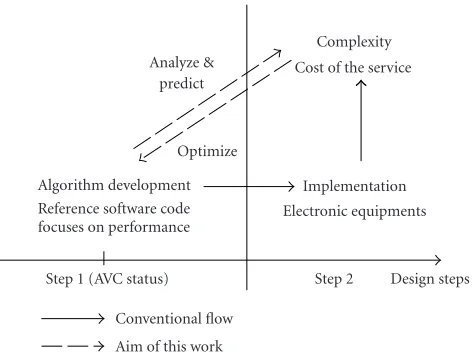
As sketched inFigure 1, the design flow of complex multime-dia systems such as video codecs typically features two main steps: an algorithmic development phase followed by a sys-tem implementation process. The first step focuses on algo-rithmic performance (peak signal-to-noise ratio (PSNR), vi-sual appearance, and bit rate). The algorithmic specification is typically released as a paper description plus a software ver-ification model (often in C). Usually, the software model is not optimized for a cost-effective realization since its scope is mainly a functional algorithmic verification and the
tar-Step 1 (AVC status) Step 2 Design steps Reference software code
focuses on performance
Electronic equipments Algorithm development Implementation
Optimize Analyze &
predict
Cost of the service Complexity
Aim of this work Conventional flow
Figure1: Algorithmic performance and complexity co-evaluation for cost-effective system design.
get platform is unknown. Moreover, in the case of multi-media standards such as ITU-T and ISO/IEC video codecs, the verification software models (up to 100.000 C-code lines [10]) are written in different code styles since they are the results of the combined effort of multiple teams. The sec-ond step of the design flow deals with the actual system realization starting from the paper and software specifica-tion. Only at this late stage, the true implementation com-plexity of the algorithm is known, which will determine the cost of the user’s terminal and hence its success and widespread diffusion or not. If the initial cost specifications are not reached, the gained complexity information is used to re-enter the design flow making new actions at algorith-mic and then implementation levels. This time-consuming loop ends only when the complexity meets the user’s require-ments.
To bridge the gap between the algorithmic development of a new multimedia application and its cost-effective re-alization, we propose to explore the performance versus implementation cost design space at the early algorithmic design phase. The goal of this co-evaluation approach is twofold: (i) to assess the performance and implementation cost of a new multimedia system presenting also a compari-son with current technology (“Analyze & Predict” arrow in
to apply the co-evaluation approach to a complex real-life design such as AVC. To this aim, the C-in-C-out ATOM-IUM/Analysis environment [10,15,17] has been developed. It consists of a set of kernels providing functionality for data transfer and storage analysis and pruning. Using ATOMIUM involves three steps [10]: instrumenting the program, gen-erating complexity data by executing the instrumented code with representative test stimuli, and postprocessing of this data.
High-level profiling analyses have been addressed in the past for previous ITU-T (H.263+ in [5]) and ISO/IEC (MPEG-4 Part 2 in [6, 18], MPEG-1/-2 decoder in [19]) video codecs. However, the above approaches focus mainly on computational complexity (processing time [5] or instruction-level [6,19] profiling on a specific platform: typ-ically general purpose CISC processors, e.g., Pentium in [5], or RISC processors, e.g., UltraSPARC in [6,19]), while the actual implementation of H.263 and MPEG-4 codecs clearly demonstrates that multimedia applications are data domi-nated. As a consequence, data transfer and storage have a dominant impact on the cost-effective realization of multi-media systems for both hardware- and software-based plat-forms [8,9,10,11,12,13,14,15,16]. Application specific hardware implementations have the freedom to match the memory and communication architectures to the applica-tion. Thus, an efficient design flow exploits this to reduce area and power [8,11,12]. On the other hand, programmable processors rely on the memory hierarchy and on the com-munication bus architecture that come with them. Efficient use of these resources is crucial to obtain the required speeds as the performance gap between CPU and DRAM is grow-ing every year [9, 13, 14, 15, 20]. This high-level analy-sis is also essential for an efficient hardware/software sys-tem partitioning. In [18], a complexity evaluation method-ology based on the extraction of execution frequencies of core tasks is proposed. Combining this data with com-plexity figures for the core tasks on a specific platform, a performance estimate of the whole system on that plat-form is obtained. This approach relies on implementation cost measures already available for the single tasks (pro-vided as benchmarks of a specific platform). Therefore, it is not suitable to analyze systems, such as AVC, featuring new algorithms for which complexity results are not avail-able.
In this paper, the coding performance analysis is reported in terms of PSNR and bit rate, while the complexity met-rics are the memory access frequency (total number of data transfers from/to memory per second) and the peak memory usage (maximum memory amount allocated by the source code) as counted within the ATOMIUM environment. These figures give a platform independent measure of the memory cost (storage and communication of data) and are completed with the processing time as a measure of the computational burden (processing time figures are measured on a Pentium IV at 1.7 GHz with Windows 2000). The software models used as input for this paper are the AVC JM2.1 [2] and the MPEG-4 Part 2 [7] (simple profile in [21]), both nonopti-mized source codes.
3. ADVANCED VIDEO CODEC
3.1. Standard overview
An important concept of AVC is the separation of the sys-tem into two layers: a video coding layer (VCL), providing the high-compressed representation of data, and a network adaptation layer (NAL), packaging the coded data in an ap-propriate manner based on the characteristics of the trans-mission network. This study focuses on the VCL. For a de-scription of NAL features, the reader is referred to [22,23]. Figures2and3show the block diagram of the AVC decoder and encoder, respectively. In analogy with previous coding standards, the AVC final committee draft [1] does not ex-plicitly define the architecture of the codec but rather it de-fines the syntax of an encoded video bitstream together with the decoding method. In practice, according to the struc-ture of the AVC reference software [2], a compliant en-coder and deen-coder are likely to include the functional tasks sketched in Figures2and3. Nevertheless, particularly at the encoder side, there is space for variations in the sketched ar-chitecture to meet the requirements of the target application with the desired trade-offbetween algorithmic performance and cost. At the decoder side, the final architecture depends on the encoder profiles (i.e., combination of coding tools and syntax of the relevant bitstream) supported for decod-ing.
The framework defined in Figures2and3is similar to the one of previous standards: translational block-based motion estimation and compensation, residual coding in a trans-formed domain, and entropy coding of quantized transform coefficients. Basically, rectangular pictures can be coded in intra (I), inter (P), or bidirectional (B) modes. Both pro-gressive and interlaced 4 : 2 : 0 YUV sequences are sup-ported. Additional tools improve the compression efficiency, albeit at an increased implementation cost. The motion es-timation and compensation schemes (ME and MC in Fig-ures 2and3) support multiple previous reference pictures (up to 5) and a large number of different block sizes (from 16 ×16 up to 7 modes including 16 ×8, 8×16, 8×8, 8×4, 4×8, and 4×4 pixel blocks). The motion vector field can be specified with a higher spatial accuracy, quarter-or eighth-pixel1resolution instead of half pixel. Pixel inter-polation is based on a finite impulse response (FIR) filter-ing operation: 6 taps for the quarter resolution and 8 taps for the eighth one. A rate-distortion (RD) Lagrangian tech-nique [24] optimizes both motion estimation and coding mode decisions. Since the residual coding is in a transformed domain, a Hadamard transform can be used to improve the performances of conventional error cost functions such as the sum of absolute differences (SAD). Moreover, a de-blocking filter within the motion compensation loop aims at improving prediction and reducing visual artifacts. AVC adopts spatial prediction for intracoding, being the pixels
1The eighth-pixel resolution, available in AVC JM 2.1 [1,2], is no longer
NAL Entropy
decoder Reorder
Q−1 T−1
+ Deblocking
filter Decoded
frame buffer
Intra INTRA
prediction Display
Inter MC
multiblock size multiframe 6/8-tap
FIR Multiple
reference buffer 5 frames back
Motion vectors
Figure2: AVC decoder block diagram.
+ T−1 Q−1
Deblocking filter Decoded
frame buffer
Intra Choose intra mode
& intra prediction
Inter MC
multiblock size multiframe 6/8-tap
FIR Multiple
reference buffer 5 frames back
Motion vectors ME
multiblock size multiframe
NAL Entropy decoder Reorder
Q T
−
Current input frame
Figure3: AVC encoder block diagram.
predicted from the neighbouring samples of already coded blocks. To this aim, the standard provides a DC plus 8 di-rectional modes involving linear combinations of the sam-ples. The conventional 8×8 floating-point discrete cosine transform, specified with rounding error margins, is replaced by a purely integer spatial transform (T and T−1 in Fig-ures2and3), basically working on 4×4 shapes. The small sizes help to reduce blocking artifacts while the integer spec-ification prevents any mismatch between the encoder and the decoder. Finally, two methods are specified for entropy coding: a universal variable-length coder (UVLC) that uses a single reversible VLC table for all syntax elements and a more sophisticated context adaptive binary arithmetic coder (CABAC) [25].
3.2. Related work
Several contributions have recently been proposed to assess the coding efficiency of the AVC/H.26L scheme [3,22,25,
Table1: Characteristics of the test sequences with their targeted bit rate.
Test case Video sequence Format (pixels) Frame rate (Hz) QP Bit rate (Kbps)
MD Mother & Daughter QCIF (176×144) 30 18 40
FOR1 Foreman QCIF (176×144) 25 17 150
FOR2 Foreman CIF (352×288) 25 17 450
CM Calendar & Mobile CIF (352×288) 15 12 2000
in which a certain number of tools are already on, the resid-ual correlation is lower and the further achievable gain is less noticeable.
Complexity assessment contributions have been pro-posed in [26, 27, 29, 30]. However, these works do not exhaustively address the problem since just one side of the codec is considered (the encoder in [26, 27] and the decoder in [29, 30]) and/or the analysis of the complete tool-set provided by the upcoming standard is not pre-sented. Typically, the use of B-frames, CABAC, multirefer-ence frames, and eighth resolution is not considered. Con-sequently, the focus is mostly on a baseline implementation suitable for low-complexity and low-bit-rate applications (e.g., video conversation), while AVC aims at both conver-sational and nonconverconver-sational applications in which these discarded tools play an important role [3,25,28]. Further-more, the complexity evaluation is mainly based on com-putational cost figures, while data transfer and storage ex-ploration proved to be mandatory for efficient implemen-tation of video systems [8, 9, 10, 11, 12, 13, 14, 15, 16] (seeSection 2). Access frequency figures are reported in [29] for a H.26L decoder, but the analysis focuses on the com-munication between an ARM 9 CPU and the RAM, be-ing a platform-dependent measure of the bus bandwidth rather than a platform-independent exploration of the sys-tem.
4. TEST ENVIRONMENT
4.1. Test sequences
The proposed testbench consists of 4 sequences with differ-ent grades of dynamism, formats, and target bit rates. Their characteristics are sketched in Table 1. Mother & Daugh-ter 30 Hz QCIF (MD) is a typical head and shoulder se-quence occurring in very low-bit-rate applications (tens of Kbps). Foreman 25 Hz QCIF (FOR1) has a medium com-plexity, being a good test for low bit rate applications rang-ing from tens to few hundreds of Kbps. The CIF version of Foreman (FOR2) is a useful test case for middle-rate ap-plications. Finally, Calendar & Mobile 15 Hz CIF (CM) is a high-complexity sequence with lot of movements includ-ing rotation and is a good test for high-rate applications (thousands of Kbps). Since the current standard description does not provide online rate controls, the test sequences in
Section 5.1 are coded with a fixed quantization parameter (QP in Table 2) to achieve the target bit rate. The depen-dency of the proposed analysis on the QP value is addressed inSection 5.2.
4.2. Test cases
The paper reports for each test video 18 different AVC con-figurations whose descriptions are shown inTable 2.
For each test case (identified by a number from 0 to 17),
Table 2details the activation status of the optional video tools with respect to a basic AVC configuration (case 0) character-ized by a search range of 8, 1 reference frame, quarter-pixel resolution, intracoding by 9 prediction modes, in-loop de-blocking, UVLC entropy coder, and a first I picture followed by all P pictures. The tools which are changing between two successive test cases are highlighted in bold style in Tables2
and3. Comparisons with MPEG-4 Part 2 [7], simple profile in [21] with a 16 search size, half-pixel resolution, and I and P pictures (referred to as test case M4 in the next sections) are provided in Sections5and6.
The 18 reported AVC configurations are selected, for sake of space, as representatives of more than 50 considered test cases. The first two cases represent a “simple” AVC implementation with all new video tools off(with search displacements of 8 for case 0 and of 16 for case 1). Then, in cases 2 to 9 (“accumulative video tool enabling” inTable 2), the new AVC features are added one by one up to “complex” configurations, with all tools on (including B pictures with search displacements of 16 for cases 10 and 12, and of 32 for case 11), reaching the best coding performance although at maximum complexity. Comparing the test cases from 3 to 12 with the basic configurations 0 and 1 gives feedbacks about the coding efficiency versus complexity trade-offof the new AVC video tools. As it will be explained further, cases 13 to 17 inTable 2have been properly selected to achieve roughly the same coding efficiency as the complex cases, while con-siderably reducing the complexity overhead by discarding some tools and reducing the number of reference frames and the search area. The overall set of AVC configurations (roughly 50) is the same for all the considered test sequences. As it will be detailed in Sections5 and6, the performance and usefulness of the different video tools depend on the considered bit rate and hence on the considered sequence (MD for tens of Kbps, FOR1 and FOR2 from tens to hun-dreds of Kbps, and CM for thousands of Kbps). During the selection, among the set of 50 configurations, of the 18 more representative test cases to be reported in this paper, the configurations from 0 to 12 (“simple,” “accumulative video tool enabling,” and “complex”) have been chosen identical for all the video sequences, while the configurations from 13 to 17 (cost-efficient) feature some differences.Table 2refers to FOR1 and FOR2, whileTable 3 reports the cost-efficient
Table2: AVC configurations cases—FOR1 and FOR2 test sequences (Y=tool on, N=tool off).
Case number Simple Accumulative video tool enabling Complex Cost-efficient
0 1 2 3 4 5 6 7 8 9 10 11 12 13 14 15 16 17
Search range 8 16 16 16 16 16 16 16 16 16 16 32 16 16 8 8 8 8
Block sizesa 1 1 4 7 7 7 7 7 7 7 7 7 7 7 7 7 7 7
Ref. frames 1 1 1 1 3 5 5 5 5 5 5 5 5 5 5 3 2 1
RD-Lagrange N N N N N N Y Y Y Y Y Y Y Y Y Y Y Y
Hadamard N N N N N N N Y Y Y Y Y Y N N N N N
Eighth resolution N N N N N N N N Y Y Y Y Y N N N N N
CABAC N N N N N N N N N Y Y Y Y Y Y Y Y Y
B-frames N N N N N N N N N N 1 1 2 1 1 1 1 1
Table3: AVC “cost-efficient” configurations cases—MD and CM test sequences (Y=tool on, N=tool off).
Case number MD CM
13 14 15 16 17 13 14 15 16 17
Search range 16 16 16 16 8 8 8 8 8 8
Block sizesa 7 7 7 7 7 7 7 7 7 7
Ref. frames 2 1 1 1 1 5 3 2 3 2
RD-Lagrange Y Y Y Y Y Y Y Y N N
Hadamard Y Y Y N N Y N N N N
Eighth resolution Y Y N N N Y Y Y Y Y
CABAC Y Y Y Y Y Y Y Y Y Y
B-frames N N N N N 1 1 1 1 1
aIf block sizes=1, only the 16×16 mode is on; if block sizes=4, then 16×16, 16×8, 8×16, and 8×8 modes are on; otherwise, all modes are on.
5. AVC PERFORMANCE AND COMPLEXITY
ASSESSMENT 5.1. Codec analysis
An overview of the encoder and decoder results (PSNR-Y, bit rate, peak memory usage, memory access frequency, process-ing time) for the 18 AVC test cases and the M4 one is sum-marized in Figures4,5,6,7,8,9,10, and11and Tables4,5, and6.
Coding performance results
Figures4,5,6, and7list the rate-distortion results for all the video inputs using the fixed QP values reported in Table 1. For the sake of clarity, a rhombus represents the simple AVC configurations (cases 0 and 1), a cross identifies test cases from 2 to 9, a square represents complex AVC configurations (cases 10 to 12), a triangle indicates the cost-efficient config-urations (cases 13 to 17 in Tables2and3), and a circle refers to M4 results.
Clearly, AVC is a new codec generation featuring an out-standing coding efficiency: if all the novel video tools are used, AVC leads to an average 40% bit saving plus a 1–2 dB PSNR gain compared to previous M4 video coding standard (see results for test cases 10, 11, and M4 in Figures4,5,6, and
7).
Complexity results
Figures8,9,10, and11deal with processing time and mem-ory access frequency costs for both AVC encoder (Figures8
and9) and decoder (Figures10and11). In these figures, for all video inputs, the reported values are normalized with re-spect to the ones of the relevant test cases 0. A close simi-larity between the processing time and the memory access frequency curves emerges from the comparison of Figures
8 and9 at the encoder and Figures 10 and 11 at the de-coder. Moreover, the analysis of the performance and com-plexity metrics shows that the new coding scheme acts like-wise for all input sequences, particularly at middle and low bit rates (see the behaviors of MD, FOR1, and FOR2 in Fig-ures4,5,6,8,9,10, and11). Small differences arise for high rate video applications (CM) as emerges from Figures 10
and11.
Absolute complexity values are reported inTable 4listing the range achieved by the different AVC configurations (rows Min and Max) and the complexity results of M4 as a refer-ence. The processing time values inTable 4are expressed in a relative way: they refer to the time needed to encode/decode on a Pentium IV at 1.7 GHz, 1 second of the original test se-quence, that is to say, (seeTable 1) 25 frames of FOR1 and FOR2, 30 frames of MD, and 15 frames of CM. As a con-sequence, meting real-time constraints entails a relative pro-cessing time smaller than 1.
Table4: Codec complexity for MPEG-4 Part 2 (M4) and AVC codec (ranges Min, Max).
Test cases Encoder Decoder
Relative time Accesses (109/s) Peak memory (MB) Relative time Accesses (106/s) Peak memory (MB)
MD
AVC Min 6.48 1.40 2.19 0.30 61.10 1.06
AVC Max 409.12 79.92 15.60 0.69 104.41 1.38
M4 4.15 1.32 2.97 0.49 102.79 1.30
FOR1
AVC Min 5.40 1.18 2.19 0.58 90.16 1.06
AVC Max 330.87 65.78 15.60 1.30 153.88 1.38
M4 3.55 1.15 2.97 0.61 107.51 1.30
FOR2
AVC Min 21.70 4.60 7.31 3.04 385.21 2.91 AVC Max 1117.48 258.01 26.87 5.51 636.90 4.15
M4 14.64 4.96 9.88 2.25 411.4 3.13
CM
AVC Min 12.98 2.75 7.31 2.33 287.10 2.91 AVC Max 567.37 134.26 26.87 4.26 492.54 4.15
M4 11.32 3.19 9.88 1.76 278.30 3.13
Bit rate (Kbps)
24 28 32 36
PSNR
-Y
(dB)
35.6 35.8 36 36.2 36.4 36.6 36.8 37
M4 0 1 2 3
4 5 6 7
8 9
1011 12 13
14 15 16 17
Figure4: Rate-distortion results for the MD test cases.
Table5: Decoder memory usage (MB) versus video format and maximum number of decodable reference frames.
1 frame 2 frames 3 frames 4 frames 5 frames QCIF 1.06 1.14 1.22 1.30 1.38
CIF 2.91 3.22 3.53 3.84 4.15
decode. Peak memory usage dependencies for the decoder and the encoder are detailed in Tables5and6.
To better highlight the intertools dependencies, the com-plexity results of Figures8,9,10, and11and Tables4,5, and
6 refer to the whole AVC coder and decoder. A functional access and time distribution over the different components (e.g., motion estimator, intra predictor, etc.) have already been addressed by the authors in [31] for simple and com-plex configurations. At the encoder side, up to 90% of the complexity is due to motion estimation. The decoder’s main bottlenecks are the motion compensation (up to 30% and
Bit rate (Kbps)
90 110 130 150 170
PSNR
-Y
(dB)
34.7 35.1 35.5 35.9
M4 0
1 2
3 4 5 6 7 8 9 10
11
12 1314
15 16 17
Figure5: Rate-distortion results for the FOR1 test cases.
60% for simple and complex configurations, respectively) and the intrareconstruction (nearly 20% and 15% for sim-ple and comsim-plex configurations, respectively). With respect to previous ITU-T and ISO/IEC standards, another impor-tant component of the AVC decoder is the in-loop deblock-ing filter (see further details inSection 5.3) whose implemen-tation entails an overhead up to 6% for the access frequency and 10% for the processing time.
Analysis of coding performance and complexity results
Table6: Encoder memory usage (MB) versus reference frame number, search size, and video format.
Search size QCIF CIF
1 frame 3 frames 5 frames 1 frame 3 frames 5 frames
32 5.76 10.69 15.60 10.87 18.87 26.87
16 2.92 5.09 7.14 8.03 13.06 18.41
8 2.19 3.64 4.98 7.31 11.94 16.25
Bit rate (Kbps)
260 310 360 410 460 510
PSNR
Figure6: Rate-distortion results for the FOR2 test cases.
Bit rate (Kbps)
1200 1400 1600 1800 2000 2200
PSNR
Figure7: Rate-distortion results for the CM test cases.
multimedia communication over wired and wireless trans-mission networks such as xDSL, 3G mobile phones, and WLAN. However, these figures come with a memory and computational complexity increase of more than one order of magnitude at the encoder. The decoder’s complexity in-crease amounts to a factor 1.5–2 (see results for test cases 0, 10, and 11 in Figures8,9,10, and 11and those for the AVC Max and M4 rows in Table 4). These increase factors are higher for the lower bit rate video as it emerges from the
FOR2 FOR1
CM MD
Simple Accumulative Complex Cost-efficient Test cases
Figure8: Normalized access frequency in case of AVC encoder.
CM FOR1
MD FOR2
Simple Accumulative Complex Cost-efficient Test cases
Figure9: Normalized AVC coding time.
FOR2 FOR1
CM MD
Simple Accumulative Complex Cost-efficient Test cases
Figure10: Normalized access frequency in case of AVC decoder.
FOR1 CM
MD FOR2
Simple Accumulative Complex Cost-efficient Test cases
Figure11: Normalized AVC decoding time.
complexity is measured, is the configuration used in [3] to show the AVC compression efficiency with respect to pre-vious video coding standards. Finally, the complexity ratio between the encoder and the decoder further highlights the AVC bottleneck, particularly for conversational applications (e.g., videotelephony), where both the encoder and the de-coder capabilities must be integrated in the user’s terminal. For a simple profile, Min rows in Table 4, the encoder re-quires an access frequency and coding time at least 10 times that of the decoder and uses 2 times more memory space. For complex profiles, Max rows inTable 4, the encoder access frequency is two orders of magnitude larger than the decoder
one, while the peak memory usage is one order of magnitude higher.
The above measurements refer to nonoptimized source code and hence the future application of algorithmic and architectural design optimizations will lead to a decrease of the absolute complexity values, as it is the case in im-plementations of previous ITU-T and ISO/IEC standards [5,11,15,16]. For instance, [32] recently proposed a fast motion estimation technique exploiting the new features of AVC, such as multireference frames and variable block sizes. The authors report a complexity reduction of a factor 5–6 with respect to a nonoptimized encoder realization based on the full search. However, the large complexity ratio between the reference codes of AVC and M4 (one order of magnitude at the encoder and a factor 2 at the decoder) presents a se-rious challenge requiring an exhaustive system exploration starting from the early standard design phase. Indeed, the performance growth rate predicted by Moore’s law for the CPU amounts roughly to a factor 2 every 18 months. If we as-sume the same optimization factor as previously achieved for M4 to the current AVC code, but without any further system-level investigation, a cost-effective implementation could still not be scheduled before 2007 (i.e., the algorithmic complex-ity increase at the encoder would be covered in about four years and a half by the silicon technology improvements). Taking into account the lower performance growth rate of memories compared to CPU [20], the above time figure would even be worse.
The results in Figures4,5,6,7,8,9,10, and11also pro-vide useful hints for the selection of the optimal trade-off be-tween coding efficiency and implementation complexity in order to maximize the utility for the final user. Indeed, the analysis of the above data clearly demonstrates a property of the AVC scheme: when combining the new coding fea-tures, the relevant implementation complexity accumulates (see the waveforms in Figures 8,9,10, and11 for the test cases 0 to 11), while the global compression efficiency sat-urates (see the clusters in Figures4,5,6, and7for the test cases 9 to 17). As a matter of fact, the achievable coding gain when enabling one of the new AVC features is greater for ba-sic codec configurations, where the other tools are offand video data still feature a high correlation. For codec config-urations in which a certain number of tools are already on, the residual data correlation is lower and hence, the further achievable gain is less noticeable, that is, the global compres-sion efficiency saturates.
and memory metrics can be achieved for low bit rate videos. A single AVC configuration able to maximize coding effi-ciency, while minimizing memory and computational costs, does not exist. However, different configurations leading to several performance/cost trade-offs exist. To find these con-figurations, and hence to highlight the bottlenecks of AVC, a multiobjective optimization problem (solved, as it will be ex-plained further, through a Pareto curve analysis) is addressed inSection 6to explore the five-dimensional design space of PSNR, bit rate, computational burden, memory access fre-quency, and storage.
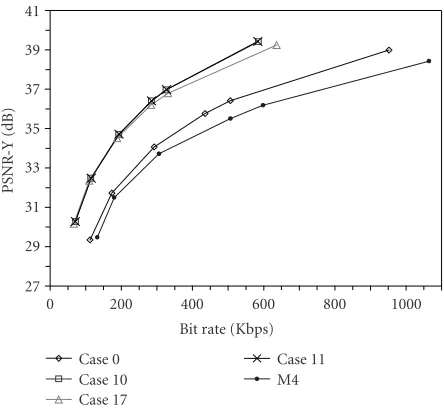
5.2. Performance and complexity analysis versus QP Typically, video codecs incorporate a rate control scheme to target a given bit rate by adapting the quantization level. Since the standard description used in this paper does not yet provide such regulator, this section details the impact of different QP values on the analysis addressed inSection 5.1. All measurements described above are repeated on the 4 test sequences using several QP values (12, 16, 20, 24, 28) next to the fixed ones set in Table 1. To be noted that this anal-ysis refers to the QP range defined in the JM2.1 implemen-tation of the standard.Figure 12sketches rate-distortion re-sults: the points with higher PSNR and bit rate values are ob-tained with lower QP values. Figures13, and14present the encoder and decoder complexity metrics expressed in terms of memory access frequency and processing time (expressed as relative time like in Section 5.1). In Figures 13 and 14, an arrow indicates the direction of growing QP values and hence decreasing bit rates. All these figures refer to the FOR2 video, covering a range from 100 to 1100 Kbps. Four repre-sentative AVC configurations are considered: cases 0, 10, 11, and 17.
The rate-distortion results (Figure 12) show a typical log-arithmic behavior. For all bit rates, the complex configu-rations (cases 10 and 11) achieve at least a 2 dB PSNR in-crement versus the simple one (case 0). As expected from
Section 5.1, the coding performances with a search size of 16 and 32 are practically the same. With respect to the M4 stan-dard, the same PSNR results are achieved with a 50% reduced bit rate enabling full-rate video communication over today wireless and wired networks. For instance, according to the results ofFigure 12, a complex CIF video like Foreman can be transmitted at 25 Hz and 36 dB with less than 300 Kbps being compatible with 3G wireless network capabilities. The analy-sis ofFigure 12for the whole bandwidth range further high-lights the importance of AVC: even in case of broadband net-works (e.g., xDSL and WLAN), nowadays multimedia com-munication terminals, based on MPEG-4 Part 2 and H.263 technologies, lead to a video coding and transmission 3 dB poorer on the same bit rate or they double the bandwidth (thus increasing the cost of the service) required to reach a certain PSNR level. Moreover, the high coding efficiency of AVC allows the insertion of some redundancy in the source coder to improve the transmission robustness in error-prone channels [22,23,33].
As already shown in Section 5.1, a proper use of the AVC tools allows for nearly the same efficiency as the
com-Case 0 Case 10 Case 17
Case 11 M4 Bit rate (Kbps)
0 200 400 600 800 1000
PSNR
-Y
(dB)
27 29 31 33 35 37 39 41
Figure12: PSNR-Y (dB) versus bit rate in case of FOR2.
Case 0 Case 17
Case 10 Case 11 Access frequency (109/s)
0 50 100 150 200 250 300
C
o
ding
time
0 200 400 600 800 1000 1200
28 QP 12
Figure13: Encoder complexity for various QP values.
plex cases with a considerable complexity reduction. Indeed, while in complexity figures (Figures13 and14) the imple-mentation cost of case 17 is close to the simple one, in
The dependency of AVC performance and complexity on the QP value has also been analyzed for the other test videos at lower (MD, FOR1) and higher (CM) rates. The achieved results are similar to those presented for FOR2.
5.3. Low-complexity AVC configuration
To test some low-complexity configurations not included in the basic scheme (half-pixel accuracy instead of quarter one and without in-loop deblocking), the JM2.1 code was suit-ably modified. Results for the same test cases of previous sec-tions prove that restricting to half-pixel resolution decreases the compression efficiency (up to 30%, particularly for com-plex video inputs). Reducing the pixel accuracy can be useful only for very low rate video (MD) coded with a complex AVC profile. In this case, the lower pixel accuracy does not affect the coding efficiency and allows for a complexity reduction (both access frequency and processing time) of 10 and 15% for the encoder and decoder, respectively. As concerns de-blocking, its use leads to PSNR (up to 0.7 dB) and bit rate (up to 6% saving) improvements. The complexity overhead is negligible at the encoder side and is up to 6% (access fre-quency) and 10% (processing time) at the decoder side. As proved in literature [13], the PSNR analysis is not enough for a fair assessment of the deblocking tool since a subjec-tive analysis is also required. The latter, in addiction to the above rate-distortion gain, confirms the effectiveness of the insertion of deblocking within the basic standard profile [1].
6. PERFORMANCE VERSUS COST TRADE-OFF USING PARETO ANALYSIS
As shown inSection 5.1, achieving a good balance between algorithmic performance (coding efficiency) and cost (mem-ory and computational complexity) is the first step to address the challenge of a cost-effective AVC realization. A Pareto curve [9,34,35] is a powerful instrument to select the right trade-offbetween these conflicting issues at system level. In a search space with multiple axes, it only represents the poten-tially interesting points and excludes all the others having an equally good or worse solution for all the axes.
The multi objective design space exploration is reported in this section for the FOR2 (see Figures16,17,18, and19) and CM (see Figures20,21,22, and23) video inputs. The al-gorithmic performance is measured as the required bit rate achieving a fixed PSNR (36 dB for the target FOR2 video, covering a range from 250 to 500 Kbps, and 37.6 dB for the CM video, covering a range from 1000 to 3000 Kbps). The Pareto analysis has also been applied to the other video inputs at very low bit-rates (MD, covering a 20–50 Kbps range) and low bit rates (FOR1, covering a 80–200 Kbps range) achiev-ing similar results to those obtained for the FOR2 video.
Figures 16 and 17 sketch the FOR2 sequence Pareto curves for the encoder using as cost metrics the memory ac-cess frequency and the peak memory usage. Figures18and
19show the same analysis for the decoder. A rhombus repre-sents the simple AVC configurations (cases 0 and 1), a cross refers to test cases from 2 to 9, a square represents complex AVC configurations (cases 10 to 12), a triangle indicates the
Case 0 Case 10
Case 17 Case 11 Access frequency (106/s)
200 300 400 500 600 700 800
Dec
o
ding
time
0 1 2 3 4 5 6 7
28 QP 12
Figure14: Decoder complexity for various QP values.
Case 0 Case 10
Case 17 Case 11 QP
12 16 20 24 28
Me
m
o
ry
u
sa
ge
(M
B
)
2 3 4 5
Figure15: Decoder memory usage versus QP.
cost-efficient configurations (cases 13 to 17), and finally a cir-cle identifies the M4 results. A Pareto analysis for the pro-cessing time is not presented since it is linear with the access frequency (see Figures8,9,10,11,13, and14), leading to the same conclusions.
Optimal Pareto curve Bit rate (Kbps)
250 290 330 370 410 450 490 530 570
A
Figure16: Encoder analysis, data transfer as cost in case of FOR2.
Optimal Pareto curve Bit rate (Kbps)
240 280 320 360 400 440 480 520 560
Me
Figure17: Encoder analysis, data storage as cost in case of FOR2.
The above analysis presents some differences when ap-plied to high-rate video applications. With reference to the CM test, Figures20and21sketch the Pareto curves for the encoder using as cost metrics the memory access frequency and the peak memory usage. Figures 22 and 23 show the same analysis for the decoder. Differently from the results of Figures16,17,18, and19, in Figures20,21,22, and23, com-plex configurations such as cases 9, 10, and 12 are near the Pareto optimal curves.
From the combined analysis of the Pareto plots (Figures
16,17,18,19,20,21,22, and 23) and their description in Tables2and3andSection 5.1, the following considerations can be derived, valid for all kind of sequences (both low and high bit rates).
Optimal Pareto curve Bit rate (Kbps)
250 290 330 370 410 450 490 530 570
A
Figure18: Decoder analysis, data transfer as cost in case of FOR2.
Optimal Pareto curve Bit rate (Kbps)
240 280 320 360 400 440 480 520 560
Me
Figure19: Decoder analysis, data storage as cost in case of FOR2.
(i) The main AVC bottleneck is the combination of multi-ple reference frames and large search sizes. These tools have a limited impact on coding efficiency but a great one on complexity (up to a factor 60).
(ii) The use of Hadamard should be avoided since com-plexity is increased without any coding efficiency gain. (iii) The adoption of multiple block sizes results in higher coding efficiency. While the complexity increases lin-early with the number of block sizes, the major part of the gain is already achieved with the first 4 block sizes (16×6, 16×8, 8×16, and 8×8 pixels).
Optimal Pareto curve Bit rate (Kbps)
1100 1500 1900 2300 2700 3100
A
Figure20: Encoder analysis, data transfer as cost in case of CM.
Optimal Pareto curve Bit rate (Kbps)
1100 1500 1900 2300 2700 3100
Me
Figure21: Encoder analysis, data storage as cost in case of CM.
(v) RD-Lagrangian techniques give a substantial compres-sion efficiency improvement, but the complexity dou-bles when the codec configuration entails a lot of cod-ing modes and motion estimation decisions.
(vi) For all video inputs, the use of B-frames reduces the bit rate (10% in average for the considered tests) for a complexity increase particularly noticeable at the de-coder (from 20 to 40% extra cost specially at low rates). A larger number of B pictures increases the latency of the system (B frames need backward and forward ref-erence pictures to be reconstructed). Thus, this tool is not used in low-latency constrained video
applica-Optimal Pareto curve Bit rate (Kbps)
1100 1600 2100 2600 3100
A
Figure22: Decoder analysis, data transfer as cost in case of CM.
Optimal Pareto curve Bit rate (Kbps)
1100 1500 1900 2300 2700 3100
Me
Figure23: Decoder analysis, data storage as cost in case of CM.
tions and is typically not supported in baseline stan-dard profiles [1,5].
The effect of some tools differs when applied to diff er-ent sequences. Comparing the nonoptimal Pareto points in Figures 16,17,18, and19with their description inTable 2
provides useful hints on the AVC video tools forvideo appli-cations at low and middle bit rates (i.e., few tens up to hundreds of Kbps):
(i) the use of the eighth-pixel resolution leads to a com-plexity increase without any coding efficiency gain; (ii) the use of B-frames for very low-bit-rate sequences as
MD provides a low improvement in compression effi-ciency for the complexity increase it involves.
Different results emerge (see Figures20,21,22, and23
(i) a higher pixel accuracy, eighth pixel instead of the basic quarter one, is a useful tool since it allows the same PSNR performance for at least 12% bit rate reduction (compare point 8 to point 7). The complexity increase is the same as for middle and low rates: roughly 15% for the encoder and 30% for the decoder as concerns data transfer and processing time. The impact on peak memory usage is negligible,
(ii) multiple reference frames are more useful (e.g., 5 ref-erence frames lead to roughly 15% bit saving), where most of the bit saving is already achieved with 3 refer-ence frames.
The above analysis is a static evaluation of the algorith-mic performance and the required complexity to assess the efficiency of the video coding tools. It provides a basis for au-tomatic tool selection and gives pointers for the development of a resource manager in future work.
7. AVC PROFILES
The results of the performance versus cost Pareto analysis in Section 6 provide inputs to assist the profile definition in the standard. A profile defines a set of coding tools that can be used for generating a conforming bitstream. All de-coders conforming to a specific profile must support all fea-tures in that profile. Encoders are not required to make use of any particular set of features supported in a profile but they have to provide bitstreams decodable by conforming de-coders. In AVC/H.264, three profiles are defined: the base-line, the extended, and the main profile [3]. With reference to the VCL video tools presented in Section 3.1,2the Base-line profile supports all new features in AVC (multireference frames, variable block sizes, quarter-pixel accuracy, in-loop deblocking, integer spatial transform, and spatial prediction for intracoding) except 1/8-pixel accuracy, CABAC and B pictures. The Extended profile supports all features of the Baseline profile plus B frames and some tools for error re-siliency (e.g., switching pictures SP/SI and data partitioning [3]). The Main profile supports all VCL features described in
Section 3.1except eighth-pixel accuracy.3 Baseline and Ex-tended profiles are tailored for conversational services cally operating below 1 Mbps) and streaming services (typi-cally operating in the range 50–1500 Kbps), while entertain-ment video applications (several Mbps) would probably uti-lize the main profile.
The results of the VCL analysis presented in this paper are aligned with the profile considerations made by the stan-dards body with the exception of the eighth-pixel accuracy which is no longer included in the last AVC release [3]. Ac-cording to the results ofSection 6, this choice is suitable for
2A detailed analysis of AVC/H.264 profiles, including tools for error
re-siliency and network friendly data packaging, can be found in [3].
3The Main profile does not support some tools for error resiliency, such
as flexible macroblock ordering [3], which are supported by the baseline profile. Thus, only a subset of the coded video sequences decodable by a baseline profile decoder can be decoded by a main profile decoder.
applications not targeting a high-rate, high-quality video sce-nario or when the low cost is the main issue (e.g., wireless video). In high-rate multimedia applications (e.g., thousands of Kbps for the test CM inSection 6), an increased pixel ac-curacy should be adopted since it leads to a noticeable cod-ing efficiency gain. This consideration suggests that future extensions of the standard to high-quality video scenario, currently being considered by AVC, could/should envisage a pixel accuracy higher than quarter.
8. CONCLUSIONS
The advanced video codec (AVC) is recently defined in a joint standardization effort of ITU-T and ISO/IEC. This paper in-troduces this new video codec together with its performance and complexity co-evaluation. First, a description of the up-coming standard including both the encoder and the decoder architectures is addressed. Then, an exhaustive analysis of the coding efficiency versus complexity design space is carried out over a wide variety of video contents at the early algorith-mic design phase. Since the increasing complexity of multi-media applications makes high-level system exploration time consuming and error pone, the co-evaluation approach is supported by a framework for automated analysis of the C-level specification. Different from known profiling method-ologies, focusing mainly on PSNR, bit rate, and computa-tional burden, the proposed approach also investigates mem-ory metrics (data transfer and storage). Real-life implemen-tations of H.263 and MPEG-4 systems demonstrate that mul-timedia applications are data dominated: data transfer and storage are the dominant cost factors for both hardware- and software-based architectures.
The simulation results show that AVC outperforms cur-rent video coding standards (up to 50% bit saving for the same PSNR) offering the enabling technology for a widespread diffusion of multimedia communication over wired and wireless transmission networks. However, this outstanding performance comes with an implementation complexity increase of a factor 2 for the decoder. At the en-coder side, the cost increase is larger than one order of mag-nitude. This represents a design challenge for resource con-strained multimedia systems such as wireless and/or wear-able devices and high-volume consumer electronics, partic-ularly for conversational applications (e.g., video telephony), where both the encoder and the decoder functionalities must be integrated in the user’s terminal.
different configurations leading to several performance/cost trade-offs exist. To find these optimal configurations, and hence to highlight the bottlenecks of AVC, a Pareto multiob-jective analysis is presented to explore the five-dimensional design space of PSNR, bit rate, computational burden, and memory access frequency and storage. The reported results provide inputs to assist the definition of profiles in the stan-dard and represent the first step for a cost-effective imple-mentation of the new AVC.
REFERENCES
[1] T. Wiegand, “Joint Final Committee Draft (JFCD) of joint video specification (ITU-T Rec. H.264, ISO/IEC 14496-10 AVC),” Joint Video Team (JVT) of ISO/IEC MPEG & ITU-T VCEG, JVT-D157, Klagenfurt, Austria, July 2002.
[2] ftp://ftp.imtc-files.org/jvt-experts/reference software
[3] T. Wiegand, G. J. Sullivan, G. Bjontegaard, and A. Luthra, “Overview of the H.264/AVC video coding standard,” IEEE Trans. Circuits and Systems for Video Technology, vol. 13, no. 7, pp. 560–576, 2003.
[4] D. Alfonso, D. Bagni, L. Celetto, and L. Pezzoni, “Detailed rate-distortion analysis of H.264 video coding standard and comparison to MPEG-2/4,” inProc. of SPIE Conference on Vi-sual Communications and Image Processing, Lugano, Switzer-land, July 2003.
[5] G. C ˆot´e, B. Erol, M. Gallant, and F. Kossentini, “H.263+: Video coding at low bit rates,” IEEE Trans. Circuits and Sys-tems for Video Technology, vol. 8, no. 7, pp. 849–866, 1998. [6] P. Kuhn and W. Stechele, “Complexity analysis of the
emerg-ing MPEG-4 standard as a basis for VLSI implementation,” inVisual Communications and Image Processing, vol. 3309 of Proc. of SPIE, pp. 498–509, San Jose, Calif, USA, January 1998. [7] ISO/IEC 14496-2, “Information technology—Generic coding of audio-visual objects,” N 3056, Maui, Hawaii, USA, Decem-ber 1999.
[8] F. Catthoor, S. Wuytack, E. De Greef, F. Balasa, L. Nachter-gaele, and A. Vandecapelle, Custom Memory Manage-ment Methodology: Exploration of Memory Organisation for Embedded Multimedia System Design, Kluwer Academic, Boston, Mass, USA, 1998.
[9] F. Catthoor, S. Wuytack, E. De Greef, F. Balasa, L. Nachter-gaele, and A. Vandecapelle, Data Access and Storage Man-agement for Embedded Programmable Processors, Kluwer Aca-demic, Boston, Mass, USA, 2002.
[10] J. Bormans, K. Denolf, S. Wuytack, L. Nachtergaele, and I. Bolsens, “Integrating system-level low power methodolo-gies into a real-life design flow,” inIEEE Proc. 9th Int. Work-shop Power and Timing Modeling Optimization and Simula-tion, pp. 19–28, Kos, Greece, October 1999.
[11] A. Chimienti, L. Fanucci, R. Locatelli, and S. Saponara, “VLSI architecture for a low-power video codec system,” Microelec-tronics Journal, vol. 33, no. 5-6, pp. 417–427, 2002.
[12] T. Meng, B. Gordon, E. Tsern, and A. Hung, “Portable video-on-demand in wireless communication,” Proceedings of the IEEE, vol. 83, no. 4, pp. 659–680, 1995.
[13] J. Jung, E. Lesellier, Y. Le Maguet, C. Miro, and J. Gobert, “Philips deblocking solution (PDS), a low complexity de-blocking for JVT,” Joint Video Team of ISO/IEC MPEG and ITU-T VCEG, JVT-B037, Geneva, February 2002.
[14] L. Nachtergaele, D. Moolenaar, B. Vanhoof, F. Catthoor, and H. De Man, “System-level power optimization of video codecs on embedded cores: a systematic approach,” Journal of VLSI Signal Processing, vol. 18, no. 2, pp. 89–111, 1998.
[15] K. Denolf, P. Vos, J. Bormans, and I. Bolsens, “Cost-efficient C-level design of an MPEG-4 video decoder,” in Proc. IEEE Integrated Circuit Design. Power and Timing Modeling, Optimization and Simulation: 10th International Workshop, D. Soudris, P. Pirsch, and E. Barke, Eds., vol. 1918 ofLecture Notes in Computer Science, pp. 233–242, Springer-Verlag, Hei-delberg, September 2000.
[16] M. Takahashi et al., “A 60-MHz 240-mW MPEG-4 video-phone LSI with 16-Mb embedded DRAM,” IEEE Journal of Solid-State Circuits, vol. 35, no. 11, pp. 1713–1721, 2000. [17] http://www.imec.be/atomium.
[18] H.-J. Stolberg, M. Berekovic, and P. Pirsch, “A platform-independent methodology for performance estimation of streaming media applications,” inProc. IEEE International Conference on Multimedia and Expo, pp. 105–108, Lausanne, Switzerland, August 2002.
[19] C.-G. Zhou, L. Kohn, D. Rice, I. Kabir, A. Jabbi, and X.-P. Hu, “MPEG video decoding with the UltraSPARC visual instruc-tion set,” in40th IEEE Computer Society International Confer-ence, pp. 470–475, San Francisco, Calif, USA, March 1995. [20] J. L. Hennessy and D. A. Patterson, Computer Architecture:
A Quantitative Approach, Morgan Kaufmann, San Francisco, Calif, USA, 1996.
[21] ISO/IEC 14496-5, “Information technology—Generic coding of audio-visual objects—Part 5: Amd1: Simulation software,” N 3508, Beijing, July 2000.
[22] T. Stockhammer, M. M. Hannuksela, and T. Wiegand, “H.264/AVC in wireless environments,” IEEE Trans. Circuits and Systems for Video Technology, vol. 13, no. 7, pp. 657–673, 2003.
[23] S. Wenger, “H.264/AVC over IP,” IEEE Trans. Circuits and Systems for Video Technology, vol. 13, no. 7, pp. 645–656, 2003. [24] G. Sullivan and T. Wiegand, “Rate-distortion optimization for video compression,”IEEE Signal Processing Magazine, vol. 15, no. 6, pp. 74–90, 1998.
[25] D. Marpe, G. Bl¨attermann, G. Heising, and T. Wiegand, “Video compression using context-based adaptive arithmetic coding,” inProc. IEEE International Conference on Image Pro-cessing, vol. 3, pp. 558–561, Thessaloniki, Greece, October 2001.
[26] V. Lappalainen, A. Hallapuro, and T. H¨am¨al¨ainen, “Optimiza-tion of emerging H.26L video encoder,” inProc. IEEE Work-shop on Signal Processing Systems, pp. 406–415, Antwerp, Bel-gium, September 2001.
[27] V. Lappalainen, T. H¨am¨al¨ainen, and A. Hallapuro, “Perfor-mance analysis of low bit rate H.26L video encoder,” inIEEE Trans. Acoustics, Speech, and Signal Processing, pp. 1129–1132, May 2001.
[28] A. Joch, F. Kossentini, and P. Nasiopoulos, “A performance analysis of the ITU-T draft H.26L video coding standard,” in Proc. 12th International Packet Video Workshop, Pittsburgh, Pa, USA, April 2002.
[29] M. Hagai, K. Abe, S. Kadono, S. Kajita, and M. Schlockerman, “H.26L implementation evaluation,” ISO/IEC MPEG, docu-ment M7666, Pattaya, December 2001.
[30] M. Horowitz, A. Joch, F. Kossentini, and A. Hallapuro, “H.264/AVC baseline profile decoder complexity analysis,” IEEE Trans. Circuits and Systems for Video Technology, vol. 13, no. 7, pp. 704–716, 2003.
[31] K. Denolf et al., “Initial memory complexity analysis of the AVC codec,” inProc. IEEE Workshop on Signal Processing Sys-tems, pp. 222–227, San Diego, Calif, USA, October 2002. [32] H.-Y. Cheong and A. Tourapis, “Fast motion estimation
[33] Y. Wang, S. Wenger, J. Wen, and A. Katsaggelos, “Error re-silient video coding techniques,”IEEE Signal Processing Mag-azine, vol. 17, no. 4, pp. 61–82, 2000.
[34] V. Pareto, Cours D’Economie Politique, vol. I-II, Lausanne, Switzerland, 1896.
[35] E. Brockmeyer, A. Vandecappelle, and F. Catthoor, “System-atic cycle budget versus system power trade-off: a new per-spective on system exploration of real-time data-dominated applications,” inProc. International Symposium on Low Power Electronics and Design, pp. 137–142, ACM Press, New York, 2000.
Sergio Saponarareceived his M.S. degree in electronics and his Ph.D. degree in in-formation engineering, both from the Uni-versity of Pisa, Italy, in 1999 and 2003. In 2001, he collaborated with “Consorzio Pisa Ricerche” on a MEDEA+ project related to the low-power design of xDSL modem. In 2002, he was with MICS group at IMEC, Leuven, Belgium, under a Marie Curie re-search scheme working on the complexity
analysis of advanced video coding standards. Currently, he is a Re-searcher at Pisa University, working on algorithms and VLSI ar-chitecture design for multimedia and low-power CMOS design methodologies.
Kristof Denolfreceived the Industrial En-gineering degree in electronics from the Katholieke Hogeschool, Brugge-Oostende, Belgium, in 1998, and the M.S. degree in electronic system design from Leeds Metropolitan University, Leeds, UK, in 2000. He joined the Multimedia Image Compression Systems (MICS) group at the Interuniversity Microelectronics Centre (IMEC), Leuven, Belgium, in 1998. His
cur-rent research interests are the cost-efficient design of advanced video processing systems and the end-to-end quality of experience.
Gauthier Lafruitwas a Research Scientist with the Belgian National Foundation for Scientific Research from 1989 to 1994, be-ing mainly active in the area of wavelet im-age compression implementations. Subse-quently, he was a Research Assistant in the Vrije Universiteit Brussel (VUB), Belgium. In 1996, he became the recipient of the Scientific Barco Award and joined IMEC, where he was involved as a Senior
Scien-tist with the design of low-power VLSI for combined JPEG/wavelet compression engines. He is currently the Principal Scientist in the MICS group with IMEC. His main interests include progressive transmission in still image, video and 3D object coding, as well as scalability and resource monitoring for advanced, scalable video, and 3D coding applications. He is the author/coauthor of around sixty scientific publications, fifty MPEG standardization contribu-tions, and five patent(s) (applications) and has participated (and has been appointed as Evaluator) in several national and interna-tional project(s) (proposals).
Carolina Blanch was born in Pamplona, Spain. She received her M.S. degree in telecommunications engineering in January 2000 from the University of Navarra, Spain. She received a scholarship from the Flemish community to continue her studies in Bel-gium, and obtained an M.S. in artificial in-telligence from the Katholieke Universiteit Leuven in 2001. Since December 2001, she is working as a Research Engineer in the MICS
group at IMEC, Leuven, Belgium. She has been involved in the complexity assessment of video codecs and has several related arti-cles. Currently, she is involved in cross layer optimization and net-work adaptation of video codecs.
Jan Bormanshas been a Researcher at the Information Retrieval and Interpretation Sciences laboratory, the Vrije Universiteit Brussel (VUB), Belgium, in 1992 and 1993. In 1994, he joined the VLSI Systems and De-sign Methodologies (VSDM) division of the IMEC research center in Leuven, Belgium. Since 1996, he is heading IMEC’s Multi-media Image Compression Systems group. This group focuses on the efficient design