3D Face Recognition by Using Codebook
Generation Technique
Ankita Baoney1, Kanchan Gorde2
PG Student, Dept. of Electronics, Terna Engineering College, Nerul, Navi Mumbai, India1
Assistant Professor, Dept. of Electronics, TernaEngineering College,Nerul, Navi Mumbai, India2
ABSTRACT:Face recognition is used in many areas, it has its applications in industry, films, animations etc. 3D face recognition is a challenging task because it is affected by different parameters such as illumination, expression, camera angles, pose etc. Problems for 3D face recognition have to be handled carefully to improve the performance of detection. Shape features are the important features that have been used widely for designing the face recognition systems. The paper proposes a novel technique by combination of shape and texture features for 3D face recognition. Laplace, Canny, Robert, Prewitt, and Sobel are used for extracting the shape features which determine the edges for the face. Texture features are extracted from the obtained shape feature sets by use of Codebook generation algorithm (LBG). KNN classification algorithm is applied on the feature set for determining the overall recognition rate of the system. The results are compared with existing systems, the proposed system yields better performance.
KEYWORDS:Shape and texture feature, LBG, 3D Face recognition, codebook generation algorithm
I.INTRODUCTION
Face recognition technology is used in various disciplines such as image processing, pattern recognition, computer vision etc. in which research is been continuously carried out and demand for it increases. Biometric-based technologies identifies the individual based on physical characteristics such as fingerprints, hand veins, palm, iris, retina ear and voice. However, face recognition can be done passively without any participation of the user since face images can be taken from a distance by a camera Automatic face recognition is better than biometric technologies due to the natural, nonintrusive, and high throughput properties in face data acquisition
Face recognition technique good for recognizing the individuals, rather than authenticating people and granting them access to physical and virtual domain such as passwords, PINs, smart cards, tokens, keys. Passwords and PINs are hard to remember and can be stolen or guessed; cards, tokens, keys can be misplaced, forgotten, duplicated; magnetic cards can become corrupted and unreadable.
Face recognition is used in various applications of image analysis such as crowd surveillance access control; mugshot identification; Witness faces reconstruction; Designing of human computer interface (HCI). Automated face recognition technologies are also in use in both the civilian and Law enforcement areas. It can be used for generation of synthetic faces, in multimedia communication.it is also used for labelling the faces in video; for gender classification; recognizing expressions and tracking and facial feature recognition in video indexing. Face recognition is one of the most important applied aspects of visual perception. Face recognition is used in many applications such as personal identification, employee access to high security areas, human-machine interfaces, and image retrieval.
Face is an important part of who we are and how people identify us.it is arguably a person’s most unique physical characteristic. While humans have the innate ability to recognize and distinguish between different faces. It requires no physical interaction on behalf of the user. It is accurate and allows for high enrolment and verification rates. It does not require an expert to interpret the comparison result.
images of known persons are stored in database. Face recognition refers to two different aspects.one is “recognition” or “identification” and second is “authentication” or “verification”.
Face Recognition fall into two categories verification and identification. Face verification is a 1:1 match that matches a face against the template face images whose identity is to be claimed. Face identification is 1: N problem that compares a query face image against all image templates in face database to determine the identity of the query face. The purpose of face recognition system is to extract the accurate personal records and improvement of fast and accurate face recognition.
II.LITERATURE SURVEY
The implementation of face recognition technology includes the following four stages:1) Data acquisition 2) Input processing 3)Face image classification and 4) decision making
In recent years intensified research has been carried out in 3D face recognition due to significant advances in 3D imaging technology. Face recognition systems based on 3D facial surface information to improve the accuracy and robustness with regard to facial pose and lighting variations have not been addressed thoroughly. Only a few works on the use of 3D data have been reported. Initial studies concentrated on the curvature analysis [1, 2,3].
Gordon [4, 5] presented a template based recognition method involving curvature calculation from range data. A method to label different components of human faces for recognition was proposed by Yacoobet. al. [6]. Chua et. al. [7] described a technique based on point signature, a representation for free form surfaces. Beumier et al [8, 9] proposed two 3D different methods based on surface matching and profile matching.
Bronstein et al. [10] described a technique to transform the facial surface to a space where the representation is invariant to isometric transformations (i.e. expressions or manipulations of the face. Geometric invariants in the images are obtain which allow the multi-modal 2D+3D recognition using 2D face texture images mapped onto a 3D face. . Once this combined image is generated, they use Eigen decomposition of canonical and flattened texture images. Experiments showed that the proposed technique outperforms a 2D PCA (Eigenfaces) approach.
G¨okberk et al. [11] performed a comparative evaluation of five face shape representations, (point clouds, surface normal, facial profiles, PCA, and LDA) using the well-known 3D-RMA data set of 571 images from 106 subjects. These results that ICP and LDA gives the best average performance. Also, various fusion techniques are performed for combining the results from different shape representations to achieve better performance.
Lu et al. [12] created a method for face recognition that uses a combination of 2.5D scans to create a single 3D image for gallery enrollment. They used 598 2.5D probe models of various poses and expression which were matched to 200 3D gallery models collected at the authors’ institution. Using the full 3D image of a subject in the gallery and implementations of ICP and LDA algorithms they were able to achieve a 90% recognition rate.
Many well-known face recognition techniques have been developed over the last few decades. Research in automatic face recognition started in 1960‟s with the innovative work of Bledsoe [13]. In 1960s, the first semi-automated system for face recognition was proposed wherein the administrator had to first locate features such as nose, mouth, eyes and ears on the photographs and then calculate the distances and ratios to a common reference point. This distance and ratios were then compared to reference data in the database. Goldstein, Harmon, and Lesk [14] in 1970s introduced the use of 21 specific subjective markers such as hair color, eye lobes, lip thickness, etc. to perform the recognition. But the problem with both these solutions was the manual computation of the measurements and locations.
There are mainly three approaches for face recognition. Holistic approach, feature-based approach, and hybrid approach.
Holistic approach (or appearance based) methods use the whole face region as the raw input to a recognition system. The face recognition problem is firstly transformed to a face space analysis problem and then a number of well-known statistical methods are applied to it. They are quite prone to the limitations caused by facial variations such as illumination, 3D pose and expressions.
applications. The 3D Face recognition algorithm can be classified mainly in four groups, they are point cloud approach, depth image, facial curves and differential geometry [15].
Point cloud based approach consists of human facial surface in 3D point cloud representation. In this from the facial surface only (x, y, z) co-ordinates of the sample points are used. The point cloud approach requires the alignment and registration of facial surfaces before the matching module because the similarity of different facial surfaces as opposed by more general 3D objects classes. Under point cloud approach there is Iterative Closest Point (ICP) and local ICP. The ICP is developed to end the emphasis on correct alignment of different facial surfaces of most 3D object identification system and algorithm. The main drawback or the limitation of ICP algorithm is that it cannot handle non-rigid deformations. The local ICP is an extension of ICP based approach.
Depth based approach is very popular to convert 2.5D facial data to a depth image, also called the range image. Each pixel in the depth image represents the distance of the corresponding 3D facial point to the camera. Under these there is Principle Component Analysis (PCA), Independent Component Analysis (ICA) and Linear Discriminant Analysis (LDA).
Face recognition is mainly based on the Principal Component Analysis Principal Component Analysis (PCA, also known as “Eigen surfaces”). The main idea is to de-correlate data in order to highlight differences and similarities by finding the principal directions (i.e. the eigenvectors) of the covariance matrix of a multidimensional data.
Independent component analysis is generalization of PCA, ICA is one method which is used for face recognition task. ICA is performed on images in database under two different architectures: one treated the images as random variables and the pixels as outcomes; conversely, the second treated the pixels as the random variables and the images as outcomes.
Linear discriminant analysis is also known as fisher-surface approach. Linear transformations are found so that the feature clusters are more separable after transformation. PCA and LDA are applied to the surface representation of 3D face models which produces a subspace projection matrix. Taking advantage of “within-class” information minimizes variation between multiple face models of the same person, yet maintaining high class separation. Training set containing several examples of each subject are used which describe facial structure variance from one to another. From training set three scatter matrices are calculated which represent the within class (SW), between class (SB), and total distribution from the average surface.
The differential geometry approaches are invariant to transformation such as translation and rotation is used as common technique for face recognition. In Max/Min Curvature Based Approach Curvature of a surface in 3D measures the amount of local bending. Curvature related descriptors are attractive since they are invariant to rotations, and therefore, they are frequently used in segmenting 3D surfaces. In Mean/Gaussian Curvature the data of high resolution is produced by rotation laser scanner for accurate curvature calculation. For face segmentation the Gaussian curvature sign is used which allows two surfaces: convex/concave and saddle regions.
Frequency domain analysis methods have been widely acquired in face recognition which transform the image signals from spatial domain to frequency domain and analyze the features in frequency domain. Only limited low-frequency components having high energy are selected to represent the image. Different from PCA and LDA, frequency domain analysis methods are independent of data and do not require training images [16].
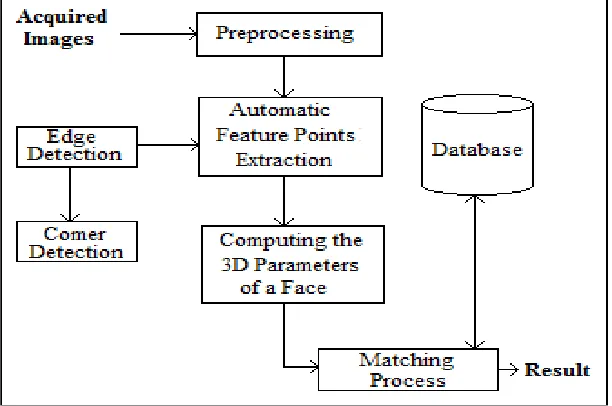
In previous papers, approach for automatic face recognition system is developed based on 3D geometric face features. It is based on the perspective projection of a triangle constructed from three nodal points extracted from two eyes and lips corners. Some mathematical concepts are used to calculate the distances and angles between feature points. Preprocessing steps which include resizing, converting to grayscale, noise filtering, etc. are performed on acquired images. Then corner detection is performed to obtain the accurate corner points of eyes and lips. . Next, drawing triangle and computing 3D measurements of each side of the triangle and angles between them. Finally, matching process has been done [17]. Due to the rounding error and false matching, a few percent errors are occurred in these methods. Recognition rates will be enhancedby the use of Geometric Feature and Stereo Imaging Technique.
A new method, to overcome the problem, in which 3D facial recognition is based on wavelet networks. Firstly, depth image is preprocessed in order to crop the useful area of the face image. Secondly, a compact and representative biometric signature is produced by means of wavelet networks. Finally, the matching of two faces is made by computing Euclidean distance between their two corresponding signatures. Method is sensitive to facial expressions [18].
using methods like Principal Component Analysis (PCA) or Independent Component Analysis (ICA) or others. The proposed method is termed stereo cluster search (SCS) and is inspired from the k-means clustering algorithm [19]. Approach greatly depends on edge detection for subdividing the image into meaningful clusters where the edges act as the marks or flags that separate the clusters. Canny edge detection algorithm is used here. After preprocessing the images, stereo matching is performed to find the depth and 3D information. Stereo matching is the least accurate and requires high computational speed when compared to methods such as laser scanning [20] and structured light [20] [21].
III.COMPARISON OF DIFFERENT FACE RECOGNITION TECHNIQUES
Face recognition is process in which known face is identified from known database. For face recognition first of all features of the face are detected. Features are detected by using various feature detection technique. Classification algorithm is applied to determine the overall rate of classification. Comparison of different face recognition technique based on database used, feature detection method and classification algorithms shown in table.
Sr.
no. Name of paper
Database used for
analysis Feature extraction technique
Classification algorithm
1 Expression-Invariant 3D
Face Recognition 3D Face database
Intrinsic geometric features by using geometric invariants.
Eigen decomposition algorithm
2
3D Face Recognition Based on Facial Structural Angle and Local Region Map
GavabDB database Facial structural angle(FSA) and local region map(LRM)
Principal component analysis
3 Three-Dimensional Face
Recognition Gallery database
A geometric curvature-based feature detector.
canonical form
matching, facial surface matching and 2D image-based Eigen faces
4
Fast and Efficient 3D Face Recognition Using Wavelet Networks
subset of the FRGC v2 database
Wavelet networks to produce a compact biometric signature.
Matching is done by computing Euclidean distance between two biometric signature
5 3D Face Recognition Using Stereo Images
Texas 3D Face Recognition database
Stereo matching to find the depth and 3D information.
Stereo Cluster Search algorithm
IV.PROPOSED SYSTEM
We present the MUCT database consisting of 3755 images of human faces with 76 manual landmarks. Compared to other landmarked databases, the MUCT database provides more diversity of lighting, age, and ethnicity. The database include students, parents attending graduation ceremonies, high school teachers attending a conference, and employees of the university such as cleaners and security personnel. A wide range of subjects was photographed, with approximately equal numbers of males and females, and a cross section of ages and races. It contains three images of same person from three different angle.
First, minimum three 2D images of the same person are taken and then these three images are joined by reducing the pixel value to get a single 3D image. Illumination is removed to get better 3D image.
cluster. Then represent each cluster by single value (one pixel) and that is known as feature of image. Similarly, we find the features of entire image. Here, the feature is a combination of shape and texture. Then store all the features. Image retrieval system is used for matching the images. Modern image search engines retrieve the images based on their visual contents, commonly referred to as Content Based Image Retrieval (CBIR) systems. CBIR systems can organize and retrieve images automatically by extracting some features such as color, texture, shape from images and looking for similar images which have similar feature.
Methodology used for 3D face recognition is based on shape and texture feature. Block diagram for face recognition is shown in Figure 1.
First step in face recognition is acquiring the images for project, images are taken from three different angels. Front, left and right along with non-uniform illumination. Next step is preprocessing of image. Preprocessing steps which includeresizing, converting to grayscale, noise filtering, etc. are performed once acquire the images from camera or scanner.
Figure 1: Block Diagram of Face Recognition Process
After preprocessing feature extraction is done. Feature-based approaches first process the input image to identify and extract (and measure) distinctive facial features such as the eyes, mouth, nose, etc. Here edge detection algorithm is applied to extract the shape features. . The shape features will be extracted by applying edge detection operators such as Laplace, Canny, Robert, Prewitt, and Sobel. The edge detection operators have a mask which is assigned from this the edges are extracted and stored as shape features. From shape features texture features will be extracted by use of codebook generation algorithm. Linde-Buzo-Gray (LBG) algorithm which is also called as Generalized Lloyd Algorithm is used for codebook generation. K-nearest neighbor works on the concept of Euclidean distance and identifies the exact image and KNN algorithm is used to recognize overall rate of recognition.
V. RESULT AND DISCUSSION
Sr. no. Codebook size Precision Recall
1 8 0.01 0.73
2 16 0.009 0.74
3 32 0.01 0.79
4 64 0.009 0.74
VI.CONCLUSION
In this paper, a novel technique for recognizing face is presented. The basic idea is to combine shape and texture features for recognizing the face object. Vector quantization is applied and codebook generation algorithm is used for feature detection K-nearest neighbour (KNN) algorithm is used for overall recognition rate of the system. The characteristics of these technique are very suitable for many applications. The proposed system will give better performance than previous systems
REFERENCES
[1] P. Phillips, P. Grother, R. Micheals, D. Blackburn, E. Tabassi and M. Bone. Face Recognition Vendor Test 2002. In NIST Technical Report, NIST IR 6965, March 2003.
[2] S. Rizvi, P. Phillips and H. Moon. The FERET Verification Testing Protocol for Face. In NIST Technical Report, NIST IR 6281, October 1998. [3] P. Phillips, H. Moon, S. Rizvi, and P. Rauss. The FERET Evaluation Methodology for Face-Recognition Algorithms. In IEEE Trans. Pattern
Analysis and Machine Intelligence, 22:1090-1103, 2000.
[4] G. Gordon. Face Recognition Based on Depth and Curvature Features. In Proceedings of the IEEE Computer Society Conference on Computer Vision and Pattern Recognition, (Champaign, Illinois), pp.108-110, June 1992.
[5] G. Gordon, L. Vincent. Application of Morphology to Feature Extraction for Face Recognition. In Proc. of SPIE, Nonlinear Image Processing, San Jose, Feb. 1992. Vol. 1658.
[6] Y. Yacoob and L. S. Davis. Labeling of human faces components from range data. CVGIP: Image Understanding, 60(2): 168-178, September 1994.
[7] C.S. Chau, F. Han and Y. K. Ho. 3D face recognition using point signature. In Proc. IEEE International Conference on Automatic Face and Gesture Recognition, Pages 233-238, March 2000.
[8] C. Beumier, M. Acheroy. Automatic Face Verification from 3D and Grey Level Clues in RECPAD2000, 11th Portuguese conference on pattern recognition, Porto, Portugal, May 11-12, 2000, pp 95-101.
[9] C. Beumier, M. Acheroy. Face Verification from 3D and grey-level clues. In Pattern Recognition Letters, Vol. 22, 2001, pp1321-1329. [10] A. M. Bronstein, M. M. Bronstein, and R. Kimmel, “Expression-invariant 3D face recognition,” Proc. Audio and Video-Based Biometric
Person Authentication, pp. 62–70, 2003
[11] B. Gokberk and L. Akarun, “Comparative analysis of decision-level fusion algorithms for 3D face recognition,” Proc. 18th International Conference on Pattern Recognition, pp. 20–24, 2006
[12] X. Lu, A. K. Jain, and D. Colbry, “Matching 2.5D Face Scans to 3D Models,”IEEE Transactions on Pattern Analysis and Machine Intelligence, vol. 28,no. 1, pp. 31–43, 2006
[13] W. W. Bledsoe, “The model method in facial recognition,” Panoramic Research Inc., Tech. Rep. PRI15, Palo Alto, CA, 1964 [14] J. Goldstein, L. D. Harmon, and A. B. Lesk, “Identification of Human Faces,” Proc. IEEE, May 1971, Vol. 59, No. 5, 748-760.
[15] 3D FACE RECOGNITION TECHNIQUES - A REVIEW International Journal of Engineering Research and Applications(IJERA) ISSN: 2248-9622 Vol. 2, Issue 1,Jan-Feb 2012, pp.787-793
[16] Face Recognition Techniques: A Review RajeshwarDass, Ritu Rani, Dharmender Kumar International Journal of Engineering Research and Development e-ISSN: 2278-067X, p-ISSN: 2278-800X, www.ijerd.com Volume 4, Issue 7 (November 2012), PP. 70-78
[17] MULTI TRIANGLE BASED AUTOMATIC FACE RECOGNITION SYSTEM BY USING 3D GEOMETRIC FACE FEATURE Moe Ma Ma
Tin and MyintMyintSein University of Computer Studies, Yangon, Haling Township, and Yangon, Myanmar. ©2009 IEEE
[18] FAST AND EFFICIENT 3D FACE RECOGNITION USING WAVELET NETWORKSSalwa Said a,b, Boulbaba Ben Amor b, MouradZaied
a, Chokri Ben Amar a, and Mohamed Daoudi©2009 IEEE
[19] 3D Face Recognition Using Stereo Images Mohammad Dawi, Mohammad Adnan Al-Alaoui, Mohammed Baydoun Electrical and Computer Engineering, American University of Beirut, Beirut, Lebanon@ 2014 IEEE
[20] Zhang Lei, GaoXianwei, Zhao Cheng and Dong Xiuze, "Research on the technology of extracting 3D face feature points on basis of binocular vision," in Image and Signal Processing, 2009. CISP '09. 2nd International Congress on, 2009, pp. 1-4