Fault Tolerant finding in Code regeneration and auditing in
Cloud storage
M N MALLIKARJUNA REDDY1 & SRAVANA LAKSHMI DUBBA2 1
ASSISTANT PROFESSOR Dept. of CSE SVR ENGINEERING COLLEGE, AYYALURU, and NANDYAL
Email: - [email protected]
2
PG-Scholar Dept. of CSE SVR ENGINEERING COLLEGE, AYYALURU, and NANDYAL
Email: [email protected]
Abstract
To protect the outsourced data in cloud storage
against corruptions and inconsistencies, adding
up fault tolerance to cloud storage jointly with
data integrity checking and failure reparation
becomes necessary. Recently, the regenerating
codes have gained significance due to their
lower repair bandwidth and due to their fault
tolerance capabilities. The Earlier remote
checking methods for regenerating coded data
only provides personal auditing and requires
data owners to always keep online and handle
auditing, as well as repairing, which is
sometimes not practical. In this paper, we
recommend a public auditing scheme for the
regenerating-code-based cloud storage. To
overcome this regeneration problem of failed
authenticators in the lack of data owners, we
commence a proxy, which is confidential to
regenerate the authenticators, into the usual
public auditing system model. Introduction of
cloud audit server eliminates the contribution of
user in the auditing and in the pre-processing
phases. In our approach, the client cannot store
any large set of data locally except a secret key
which is required for encryption. In contrast
with the previous methods, we also avoid the
requirement of encrypting complete data at
client side thereby saving client computational
time. The proposed approach is also applicable
for big static data such as video files, audio files
and social networking data etc.
Keywords: Code regeneration, public auditing,
Cloud storage, Fault Tolerant.
1.
Introduction
In recent years, the usage of computers, mobile
devices and social sites has become a part of
day to day activities. Distribution of
information, photographs, video and audio files
have permitted user to communicate and utilize
effective storage space in the Internet without
worrying to purchase physical storage locally.
All these data can be stored anywhere in
Internet and Cloud is found to be a default
Cloud storage is now gaining attraction as it
offers a flexible on-demand data outsourcing
service with interesting benefits, release of the
burden for storage management, worldwide data
access with location independence, and
avoidance of capital expenses on hardware,
software, and personal cares, etc., [4]. However,
this new paradigm of data hosting service also
leads to new security threats in the direction of
user’s data, thus making individuals or
enterprisers to feel quiet hesitant. It is
well-known that data owners may lose control over
their outsourced data; thus, the accuracy,
accessibility and integrity of the data are being
put at risk. On the one hand, the cloud service is
usually met with a broad range of
internal/external challenges, who would
unkindly delete, intrude or corrupt users’ data;
on the other hand, the cloud service providers
may act unfairly, attempting to skin data loss or
corruption and requesting that the files are still
properly stored in the cloud for status or
financial reasons. Thus it makes excessive sense
for users to implement an efficient protocol to
reach periodical verifications of their outsourced
data to confirm that the cloud indeed keeps their
data properly. Numerous mechanisms dealing
with the integrity of outsourced data without a
local copy have been planned under dissimilar
system and security models. The greatest
significant work among these studies are the
ODP (obvious data possession) model and POR
(proof of irretrievability) model, which were
originally advance for the single-server scenario
by Attendees et al. [5] and Jules and Kaliski [2],
respectively. Considering that files are usually
stripy and redundantly stored across
multi-servers or multicourse, [6]–[7] explore integrity
verification policies suitable for such
multi-servers or multi-clouds setting with different
redundancy schemes, set for such multi-servers
or multicourse setting with varied redundancy
schemes, such as, copying erasure codes, and,
more recently, regenerating codes. While cloud
computing makes these favorable more
appealing than ever, it also brings new and
difficult security threats forward users’
outsourced data. Since cloud service providers
(CSP) are isolated administrative entities, data
outsourcing is actually relinquishing user’s
ultimate deal over the fate of their data. As a
result, the In this paper, we focus on the
integrity confirmation problem in
regenerating-code-based cloud storage, especially with the
functional repair strategy [13]. Similar studies
have been performed by Chen et al. [8] and
Chen and Lee [9] separately and independently.
[8] prolonged the single-server CPOR scheme
(private version in [14) to there
integrity protection (DIP) scheme for FMSR
[15]-based cloud storage and the scheme is
adapted to the thin-cloud setting. However,
some of them are designed for private audit,
only the data owner is allowed to verify the
integrity and repair the faulty servers.
Considering the big size of the outsourced data
and the user’s constrained resource capability,
the tasks of testing and reparation in the cloud
can be formidable and costly for the users [10].
The overhead of using cloud storage should be
decreased as much as possible such that a user
does not need to perform too many operations to
their out sourced data (in additional to retrieving
it) [11]. In particular, users may not want to go
through the complexity in verifying and
reparation. The auditing schemes in [8] and [9]
imply the problem that users need to always stay
online, which may prevent its adoption in
practice, especially for long-term archival
storage. To fully ensure the data integrity and
save the users’ computation resources as well as
online burden, we propose public auditing
scheme for the regenerating-code based cloud
storage, in which the integrity checking and
regeneration (of failed data blocks and
authenticators) are invented by a third-party
examiner and a semi-trusted proxy separately on
behalf of the data publisher. Instead of directly
adapting the existing public auditing scheme
[14] to the multi-server setting, we design a
novel authenticator, which is more proper for
regenerating codes. Besides, we “encrypt” the
coefficients to protect data privacy against the
examiner, which is more lightweight than
applying the confirmation blind technique in
[10] and [11] and data blind method in
[12].Several difficulties and threats
spontaneously arise in our new system model
with a proxy (Section II-C), and security
analysis shows that our policy works well with
these problems.
Related Work
2.1 Existing System:
Many mechanisms dealing with the integrity of
outsourced data without a local copy have been
proposed under different system and security
models up to now. The most significant work
among these studies are the PDP (provable data
possession) model and POR (proof of
irretrievability) model, which were originally
proposed for the single-server scenario by
Ateniese et al [5]. and Juels and Kaliski [2],
respectively. Considering that files are usually
striped and redundantly stored across
multi-servers or multi-clouds, explore integrity
verification schemes suitable for such
multi-servers or multi-clouds setting with different
redundancy schemes, such as replication,
codes. Chen et al [8]. and Chen and Lee [9]
separately and independently extended the
single-server CPOR scheme to the regenerating
code- scenario; designed and implemented a
data integrity protection (DIP) scheme for
FMSR-based cloud storage and the scheme is
adapted to the thin-cloud setting.
Disadvantages Existing System:
They are designed for private audit, only
the data owner is allowed to verify the
integrity and repair the faulty servers.
Considering the large size of the
outsourced data and the user’s
constrained resource capability, the tasks
of auditing and reparation in the cloud
can be formidable and expensive for the
users.
The auditing schemes in existing imply the problem that users need to always
stay online, which may impede its
adoption in practice, especially for
long-term archival storage.
2.2 Proposed System:
In this paper, we focus on the integrity
verification problem in regenerating-code-based
cloud storage, especially with the functional
repair strategy. To fully ensure the data integrity
and save the users’ computation resources as
well as online burden, we propose a public
auditing scheme for the regenerating-code-based
cloud storage, in which the integrity checking
and regeneration (of failed data blocks and
authenticators) are implemented by a third-party
auditor and a semi-trusted proxy separately on
behalf of the data owner. Instead of directly
adapting the existing public auditing scheme to
the multi-server setting, we design a novel
authenticator, which is more appropriate for
regenerating codes. Besides, we “encrypt” the
coefficients to protect data privacy against the
auditor, which is more lightweight than
applying the proof blind technique and data
blind method. We design a novel holomorphic
authenticator based on BLS signature, which
can be generated by a couple of secret keys and
verified publicly.
Advantages of proposed system:
Utilizing the linear subspace of the
regenerating codes, the authenticators
can be computed efficiently. Besides, it
can be adapted for data owners equipped
with low end computation devices (e.g.
Tablet PC etc.) in which they only need
to sign the native blocks.
To the best of our knowledge, our scheme is the first to allow
privacy-preserving public auditing for
regenerating code- based cloud storage.
The coefficients are masked by a PRF
Setup phase to avoid leakage of the
original data. This method is lightweight
and does not introduce any
computational overhead to the cloud
servers or TPA.
Optimization measures are taken to
improve the flexibility and efficiency of
our auditing scheme; thus, the storage
overhead of servers, the computational
overhead of the data owner and
communication overhead during the
audit phase can be effectively reduced.
2.3 System Architecture:
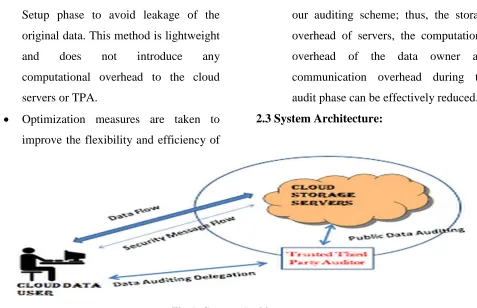
Fig 1: System Architecture.
3.
Implementation
3.1 Owner Module:
Who owns large amounts of data files to be
stored in the cloud and to save resources as well
as the online burden potentially brought by the
periodic auditing and accidental repairing, the
data owners resort to the TPA for integrity
verification and delegate the reparation to the
proxy. Notice that the data owner is restricted in
computational and storage resources compared
to other entities and may becomes off-line even
after the data upload procedure.
3.2 Cloud
:
Which are managed by the cloud service
provider, provide storage service and have
significant computational resources.
3.3 Third Party Auditor (TPA):
Who has expertise and capabilities to conduct
public audits on the coded data in the cloud, the
TPA is trusted and its audit result is unbiased
for both data owners and cloud servers.
3.4 Proxy:
Who is semi-trusted and acts on behalf of the
data owner to regenerate authenticators and data
blocks on the failed servers during the repair
procedure. The proxy, who would always be
online, is supposed to be much more powerful
servers in terms of computation and memory
capacity.
3.5 ALGORITHM:
Authentication, Authorization and Auditing for
secure cloud storage is implemented on the
basis of the following key points
Our System Supports an External auditor
to audit users outsourced data in the
cloud without
learning knowledge on the data content.
The TPA supports scalable on request by
cloud service provider for efficient
public auditing
in the cloud computing
Auditing is the processes which is done
for the cloud to achieve batch auditing
where multiple
delegated auditing tasks from different
users can be performed simultaneously
by the TPA
The auditing is the intelligence based
Dynamic data process for the data and
information
security in cloud computing
data integrity algorithm such as Message
Authentication Code (MAC code) by
means of Hash
Based Message Authentication Code
(HMAC code) to check the integrity of
the data being
stored in the cloud.
By means of MAC code, we enhance the
data integrity of the cloud data.
Step 1: Start of an Algorithm
Step 2: Key Generation by Advanced
Encryption Standard (AES) Algorithm16-bit
Hexa Decimal keys are generated
Step 3: Map the Key to the files
Step 4: Divide the files into the blocks
Step 5: Each Encrypted Block is Associated
with Key
Step 6: Store the data blocks to the Cloud
Storage Server
Step 7: Simultaneously Intelligent system sends
a copy of keys to TPA
Step 8: On request of Cloud Service Provider
(CSP) the Auditing processes with be done by
TPA
Step 9: Validate the data by signatures and data
integrity proofs
Step 10: Successful validation, verification will
be done for dynamic auditing by TPA
End of Algorithm.
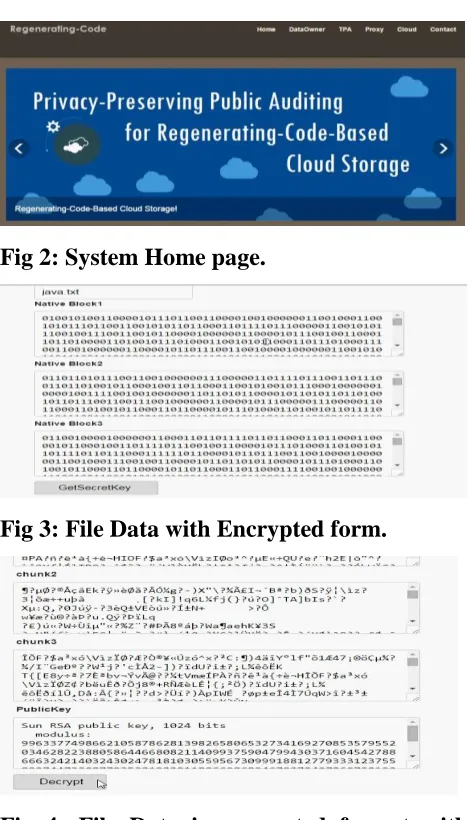
Fig 2: System Home page.
Fig 3: File Data with Encrypted form.
Fig 4: File Data in encrypted format with
public Key.
5.
Conclusion
In this paper, we propose a public examining
scheme for the regenerating-code-in cloud
storage system, where the data owners are
confidential to delegate third party examiner
(TPE) for their data validity checking. To
defend the unique information privacy next to
the third party examiner (TPE), we randomize
the coefficients in the initially rather than
applying the shade technique throughout the
examining process behavior in mind that the
information owner cannot forever stay operative
in carry out, in order to keep the storage space
existing and verifiable after a malicious
corruption, we introduce a partially-trusted
proxy into the structure model and provide a
confidential for the proxy to handle the
reparation of the implicit blocks and
authenticators.
6. References
[1] Jian Liu, Kun Huang, Hong Rong, Huimei
Wang, and Ming Xian,”Privacy-Preserving
Public Auditing for Regenerating-Code-Based
Cloud Storage” IEEE transactions on
information forensics and security, vol. 10, no.
7, July 2015
[2] A. Juels and B. S. Kaliski, Jr., “PORs:
Proofs of retrievability for large files,” in Proc.
14th ACM Conf. Comput.
Commun.Secur.,2007, pp. 584–597.
[3] S. G. Worku, C. Xu, J. Zhao, and X.He,
“Secure and efficient privacy preserving public
auditing scheme for cloud
storage,”Comput.Elect.Eng., vol. 40, no. 5, pp.
1703–1713, 2013.
[4] M. Armbrust et al., “Above the clouds: A
Elect. Eng. Comput.Sci., Univ. California,
Berkeley, CA, USA, Tech. Rep.
UCB/EECS-2009-28, 2009.
[5] G. Ateniese et al., “Provable data possession at untrusted stores,” in Proc. 14th ACM Conf.
Comput. Commun.Secur. (CCS), New
York,NY,USA, 2007, pp. 598–609.
[6] R. Curtmola, O. Khan, R. Burns, and G.
Ateniese, “MRPDP: Multiple-replica provable data possession,” in Proc. 28th Int.Conf. Distrib.
Comput. Syst. (ICDCS), Jun. 2008, pp. 411–
420.
[7] Y. Zhu, H. Hu, G.-J.Ahn, and M. Yu,
“Co-operative provable data possession for integrity
verification in multi cloud storage,” IEEE Trans.
Parallel Distrib. Syst., vol. 23, no. 12, pp. 2231–
2244, Dec.2012.
[8] B. Chen, R. Curtmola, G. Ateniese, and R.
Burns, “Remote data checking for network
coding-based distributed storage systems,”
inProc.ACM Workshop Cloud Comput. Secur.
Workshop, 2010, pp.31–42.
[9] H. C. H. Chen and P. P. C. Lee, “Enabling
data integrity protection in
regenerating-coding-based cloud storage: Theory and
implementation,”IEEE Trans. Parallel Distrib.
Syst., vol. 25, no. 2,pp. 407–416, Feb. 2014.
[10] C. Wang, Q. Wang, K. Ren, and W. Lou,
“Privacy-preserving public auditing for data storage security in cloud computing,” in Proc.
[11] C. Wang, Q. Wang, K. Ren, N. Cao, and
W. Lou, “Toward secure and dependable storage services in cloud computing,” IEEE
Trans.Service Comput., vol. 5, no. 2, pp. 220–
232, Apr./Jun. 2012.
[12] A. G. Dimakis, K. Ramchandran, Y. Wu,
and C. Suh, “A survey on network codes for distributed storage,” Proc. IEEE, vol. 99, no. 3,
pp.476–489, Mar. 2011.
[13] H. Shacham and B. Waters, “Compact
proofs of retrievability,” in Advances in
Cryptology. Berlin, Germany: Springer-Verlag,
2008,pp.90–107.
[14] Y. Hu, H. C. H. Chen, P. P. C. Lee, and Y.
Tang, “NCCloud: Applying network coding for
the storage repair in a cloud-of-clouds, “in
Proc.USENIX FAST, 2012, p. 21.
[15] Y. Hu, H. C. H. Chen, P. P. C. Lee, and Y.
Tang, “NCCloud: Applying network coding for
the storage repair in a cloud-of-clouds, “in
Proc.USENIX FAST, 2012, p. 21.
[16] K. D. Bowers, A. Juels, and A. Oprea,
“HAIL: A high-availability and integrity layer
for cloud storage,” in Proc. 16th ACM
Conf.Comput.Commun. Secur., 2009, pp. 187–