246
A Comprehensive Survey on Multi-Level Thresholding
on Image Segmentation
R.Kalyani1, Dr.P.D.Sathya2
1
Research Scholar, Department of ECE, Annamalai University, [email protected] 2
Assistant Professor, Department of ECE, Annamalai University, [email protected]
ABSTRACT -Image segmentation is used to separate images in parts that represent the desired object. Colour image thresholding is used for tasks such as object detection, region segmentation, enhancement and target tracking, where one of the properties of an image is colour. Selecting an optimal threshold for complex images has been a challenge over decades. A gate to open this challenge more precisely been proposed by using Multilevel Threshold (MLT) which analyses the objects with different classes of intensity levels. In this paper, we have discussed various algorithms to find optimal threshold valuesto achieve robustness and convergence speed of OTSU,Tsalli and kapur, by estimating the parameters likePSNR, FSIM,SSIM and MSE.
Keywords: Multilevel threshold, GTT, OTSU, KHO, MBF
1. INTRODUCTION
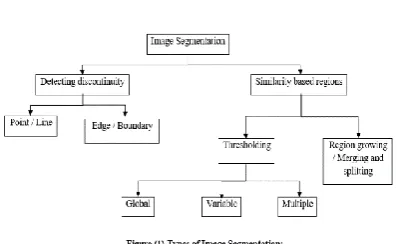
Colour image segmentation converts complex image into simple image and it finds wide range of applications in medical imaging, robot vision, object detection and task recognition. Segmenting an image provide „region of interest‟ based on similarity between the regions and are classified as Thresholding and Region growing/merging and
splitting as shown in figure(1).
The rest of this paper is organised as: Section 4 deals about Global thresholding different techniques. Section 5 describes OTSU fitness function. Section 6 demonstrate various algorithms and comparative study
2. THRESHOLDING
Thresholding converts grey scale image into various classes depending on intensity value as shown in figure (2). The input image is fed to pre-processing stage to remove the noise and threshold optimisation is achieved through optimization using fitness function and optimized algorithm.
Finally, the optimized threshold will segment the image.
T= f1[x, y, p (x, y), q (x, y)]
where; x, y(coordinates), p (x, y) [neighbourhood functions], q (x, y) [intensity of an image]
T= f1(x, y) indicates Global threshold
T= f1[ p (x, y), q (x, y)] indicates Local threshold
T= f1[x, y, p (x, y), q (x, y)] indicates Adaptive/dynamic threshold
Figure (2) Thresholding
Types of thresholding:
Local and dynamic Threshold:
Local threshold divides the image into regions and performs thresholding in each region independently. This technique can be used if particular information about the object is known prior and Dynamic thresholding is used when the object illumination is non-uniform.
[image:1.595.75.274.454.576.2]247
By Proper selection of high(H) and low(L) thresholding levels, Pixel within body is determined when threshold(Ɵ) is greater than (H), the pixel within background is predicted when (Ɵ) is less than (L) and L< Ɵ < H relates the pixel within the body, only if neighbour pixel is already in the body.
Multispectral thresholding:
Multispectral thresholding is used for multiple component images. By estimating the optimal threshold in single channel and based on this, threshold segmentation is carried out for overall image. Subdivision of each regions are carried out using second channel. The repetition of subdivision goes on through all channel until each region in an image exhibits coherence.
Iterative thresholding:
Firstly, Otsu‟s method is applied on an image to get Otsu‟s threshold. Based on two class means, this method separates the image into three classes. Pixel values greater than larger mean defines foreground whereas pixel value less than smaller mean defines the background and between two class means will be the third class mentioned as „to be determined region (TBD)‟. The iteration continues until pre-set criteria is met and thus the last TBD is separated into two classes (foreground, background) and not as three regions.
Global threshold:
Single „T‟ is used for whole image. „T‟ is the level in which output image O(x, y) obtained from input image I(x,y) as
O(x,y) = 1, if I(x,y) >T
=0, if I (x, y) ≤ T
Variable threshold:
„T‟ will vary over the image
i) Local threshold „T‟ depends on neighbourhood of x and y ii) Adaptive threshold „T‟ is a
function of x and y
Multiple threshold value:
O (x, y) = a, if I (x, y) > T2
b, if T1< I (x, y) < T2
c, if I (x, y) ≤ T1
3. REGION GROWING/SPLITTING:
It tends to partition (or) group regions with respect to image properties (colour, intensity, texture and shapes). Region growing select seed pixel and check with neighbour pixel and add them to the region, if they are similar to the seed. Region splitting, and merging combines spatial proximity and similarity by considering the image as a whole area of interest. Similarity constraint is checked for all the pixels contained in the region. If false, split the area of interest.
4. GLOBAL THRESHOLDING TYPES (GTT)
AND DIFFERENT TECHNIQUES
i)
Two level thresholding bisects the image into 2 groups with threshold intensity greater than I2 and less than I1Qi B; when Ɵi≤ B< Ɵi+1
ii) Multilevel thresholding outputs several distinct
regions from a grey level image with „n‟ threshold levels
Qn B; when Ɵn≤ B< ƟK-1
Types of GTT
OTSU
Optimal
Histogram
Iterative
Clustering
Mean: Use mean estimation of pixels as threshold value
P-Tile: Use area size of desired object as threshold value
Histogram: Separate object and background
5. PREDICTING OPTIMAL THRESHOLD
VALUES USING OBJECTIVE
FUNCTIONS (OTSU, KAPUR, TSALLI)
i) Between class – variance method
(OTSU):
248
Let U×V Image Histogram:
„K‟ Intensity levels [0,1…, k-1]
Pixel intensity # ai
UV = 𝑘−1ai 𝑖=0
Histogram normalization: Qi= ai/UV
Qi = 1 𝐼−1
𝑖 =0
where Qi ≥ 0
Let Threshold =‟Ɵ‟ Classes as z1[0, Ɵ], z2[Ɵ+1, k-1]
Mean Intensity:
P1Probability of class z1 P1Probability of class z2
P1= P(z1) = Ɵ𝑖=0Pi
x1 = (1/P1) Ɵ𝑖=0i. Pi where
x1 mean intensity of pixel in z1
x1 = (1/P2) k−1 i. Pi 𝑖=Ɵ+1
Thus xG= 𝑘−1𝑖=0 i. Pi where
xGGlobal Intensity
Global Variance S12: S12 = 𝑘−1𝑖=0[pi .(i-xG)2]
Between class variance S22:
S22 = p1(x1-xG) 2
+ p2(x2-xG) 2
Fitness function (Threshold)= Ɵ estimated as ratio of s22/s12
ii) Tsalli’s Entropy:
Disorder in system is measured by Tsalli‟s entropy function
For non-extensive system: Tsq= 1- 𝑧𝑖=1(Ui )V /V-1
Ui Probability of system in possible state
Z Total number of possibilities of system
V Measure of non-extensivity of system
iii) Kapur’s entropy:
Using maximization of entropy,
Kapur‟s function measures
homogeneity
General Optimal threshold process as:
Step1: Feed the input image Step2: Segment the next region Step3: Select the best peak and apply threshold
Step4: Select the regions to be connected and add them to list of regions
6. DIFFERENT ALGORTHMS FOR
MULTI-LEVEL THRESHOLDING
KHO:
Herding behaviour of krill individuals are simulated. Minimum distance of individual krill for food and from highest density of herd are considered as objective function. Other individuals induce movement, foraging activity and random diffusion formulate the time dependent position of krill individual.
Algorithmic Steps:
1. Get algorithmic parameters in terms of data structures
2. Create initial population randomly
3. Evaluate fitness function with respect to position of krill individual
4. Calculate the motion using foraging and diffusion
5. Genetic operators are implemented, and Krill individual position is updated.
BF:
Successful foraging propagates their genes to reach successful reproduction. E-coli bacteria governs the control system foraging process by Chemotaxis (swimming and tumbling via flagella), Swarming (to reach best food location), Reproduction (weak one dies and healthy one splits) and Elimination dispersal (dispersing into new local environment).
249
Swarming stage is improved from global optimal value and will change with respect to iteration resulting in not trapping the bacteria into local optimum solution with the advantage of increase in converging speed.
CS algorithm for MLT of colour image segmentation:
Import the image
Generate initial population
Select appropriate parameter values for mutation
Obtain the current best nest
[image:4.595.45.519.319.754.2] Stop Once criteria are fulfilled.
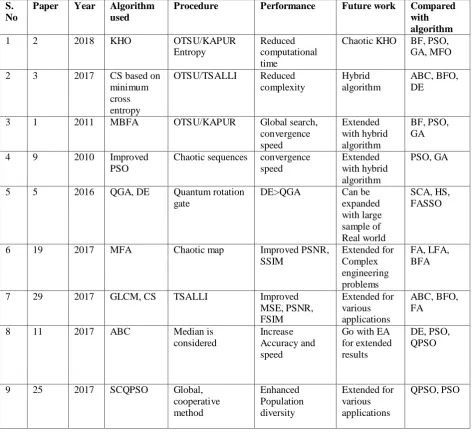
Table 1 Comparative study on Multilevel thresholding using different Algorithms
S. No
Paper Year Algorithm
used
Procedure Performance Future work Compared
with algorithm
1 2 2018 KHO OTSU/KAPUR
Entropy
Reduced computational time
Chaotic KHO BF, PSO, GA, MFO
2 3 2017 CS based on
minimum cross entropy
OTSU/TSALLI Reduced
complexity
Hybrid algorithm
ABC, BFO, DE
3 1 2011 MBFA OTSU/KAPUR Global search,
convergence speed
Extended with hybrid algorithm
BF, PSO, GA
4 9 2010 Improved
PSO
Chaotic sequences convergence speed
Extended with hybrid algorithm
PSO, GA
5 5 2016 QGA, DE Quantum rotation
gate
DE>QGA Can be
expanded with large sample of Real world
SCA, HS, FASSO
6 19 2017 MFA Chaotic map Improved PSNR,
SSIM
Extended for Complex engineering problems
FA, LFA, BFA
7 29 2017 GLCM, CS TSALLI Improved
MSE, PSNR, FSIM
Extended for various applications
ABC, BFO, FA
8 11 2017 ABC Median is
considered
Increase Accuracy and speed
Go with EA for extended results
DE, PSO, QPSO
9 25 2017 SCQPSO Global,
cooperative method
Enhanced Population diversity
Extended for various applications
250
10 30 2016 Honey bee OTSU, Bayesian Reduced
dimensionality
Extended for various applications
PSO, FCM, BF
7. CONCLUSION:
This paper reviews Multilevel Thresholding based on different algorithms for image segmentation, considering the fitness functions of OTSU, KAPUR& TSALLI. Performance of various algorithms are measured in terms of PSNR, FSIM, SSIM and MSE. This study will provide the scope for achieving high computational speed and robustness making use of proficient algorithms.
REFERENCES:
[1] P.D.Sathya, R.Kayalvizhi, “Modified bacterial foraging algorithm based multilevel thresholding for image segmentation”, Engineering applications of artificial intelligence,Vol.24,pp.598-615,2011
[2] K.P.Baby Reshma, Madhu S.Nair,
“Mulitlevel Thresholding for Image segmentation using krill herd optimisation algorithm”, Journal of King sand University – computer and Information sciences”,2018.
[3] S.Pare,A.Kumar, V.Bajaj,G.K.Singh,” An efficient method for Multilevel Colour image thresholding using cuckoo search algorithm based on minimum cross entropy”, vol 61,pp. 570-592,2017 [4] P.D.Sathya, R.Kayalvizhi, “ Optimal
multilevel thresholding using bacterial
foraging algorithm”, Expert system with applications, Vol.38,pp.15549-15564,2011 [5] HimanshuMittal,Mukesh Saraswat,” an
optimal multilevel thresholding
segmentation using non-local means 2D
histogram and exponential Kbest
gravitational search algorithm”,
vol.71,pp.226-235,2018
[6] P. K. Sahoo, S. Soltani, and A. K. C. Wong, “A survey of thresholding techniques,” Computer Vision, Graphics and Image Processing, vol. 41(2), pp. 233-260, 1988
[7] N. Otsu, “A threshold selection method from gray-level histograms,” IEEE Transaction on Systems, Man and Cybernetics, SMC-9(1), pp. 62-66, 1979. [8] M. Tripathy, and S. Mishra, “Bacterial
foraging-based solution to optimize both real power and voltage stability limit,” IEEE Trans. Power Syst., 22(1), pp. 240-248, 2007
[9] P.D.Sathya, R.Kayalvizhi, “Development of a new optimal multilevel thresholding
using improved particle swarm
optimization algorithm for image segmentation”, International Journal of
Electronics
Engineering,2(1),pp.63-67,2010
[10]Du Gen-yuan,MiaoFang,Tian
Sheng-li,GuoXirong.,"Remote Sensing Image Sequence Segmentation Based on the Modified Fuzzy C-means", Journal of Software, Vol. 5, No. 1, PP.28-35, 2009 [11]Hao Gao, Zhengfu, “A multi-level
thresholding based on a improved Artificial Bee colony algorithm”, computers and electrical engineering, pp 1-8,2017.
[12]W. X. Kang, Q. Q. Yang, R. R. Liang,“The Comparative Research on Image Segmentation Algorithms”, IEEE Conference on ETCS, pp. 703-707, 2009. [13]Baradez, M.O., McGuckin, C.P., Forraz,
N., Pettengell, R., Hoppe, A.: „Robust and
automated unimodal histogram
thresholding and potential applications‟, Pattern Recognit., 2004, 37, (6), pp. 1131– 1148
251
images‟ in Indian Journal of Science and Technology 5 (11) , pp. 3660-3664 [15]P.D.Sathya, R.Kayalvizhi, “Comparison
of intelligent techniques for multilevel thresholding problem”, Int.J.Signal and
Imaging Systems
Engineering,Vol.5,No.1,2012
[16]P.D.Sathya, R.Kayalvizhi, “ Image segmentation using Minimum Cross
Entropy and Bacterial foraging
Optimization Algorithm”, Proceedings of ICETECT,2011
[17]Jiafu li, Wenyaan Tang, “ Multilevel thresholding selection based on variational
mode decomposition for image
segmentation”, Signal processing,2018 [18]SD Yanowitz, AM Bruckstein,” A new
method for image segmentation” on Computer Vision, Graphics, and Image, 1989
[19]Lifang he, Songwei, “Modified firefly algorithm based multilevel thresholding
for Colour Image Segmentation”,
Neurocomputing,2017
[20]Mushrif, M.M., Ray, A.K.: „Colour image segmentation: Rough set theoretic approach‟, Pattern Recognin. Lett., 2008, 29, (4), pp. 483– 493
[21][Hedley and Yan, 1992] Segmentation of colour images using spatial and colour space information, Journal of Electronic Imaging, vol. 1, pp. 374-380.
[22][Healey et.al., 1992] Segmenting Images
Using Normalized Colour, IEEE
Transactions on Systems, Man. and Cybernetics, 22(1): 64-73.
[23][Carron et. al., 1994] Colour edge detector using jointly Hue, Saturation and Intensity, in Proc. IEEE International Conference on Image Processing, pp. 977-981.
[24]Liu and Yang, 1994] Multiresolution
Colour Image Segmentation, IEEE
Transactions on Pattern Analysis and Machine Intelligence, 16(7): 689-700. [25]Eli A. Murat Tekalpa, GozdeBozdagic
1997] Fusion of colour and edge information for improved segmentation and edge linking, University of Rochester, Rochester, NY 14627, USA.
[26]Li, C.H. and Lee, C.K. (1993). Minimum cross entropy thresholding. Pattern Recognition, 26(4), 617-625.
[27]Agrawal, S., Panda, R., Bhuyan, S. and Panigrahi, B.K. (2013). Tsallis entropy based optimal multilevel thresholding
using cuckoo search algorithm. Swarm and Evolutionary Computation, 11, 16-30. [28]Yang yang Li, Xiaoyu bai,” Partitioned cooperative quantum behaved particle swarm optimization based on multilevel thresholding applied to medical image segmentation”,vol 56, pp.345-356, 2017.
[29]S.pare, A.K.Bhandari,
A.Kumar,G.K.Singh, “ An optimal colour image multilevel thresholding technique using Grey-level Co- occurrence Matrix”, Expeert systems with applications,2017 [30]Joafi ,Wenyan Tang, “ Multilevel
Thresholding Selection based on