Maximum Metric Score Training for Coreference Resolution
Shanheng Zhao and Hwee Tou Ng
Department of Computer Science National University of Singapore {zhaosh,nght}@comp.nus.edu.sg
Abstract
A large body of prior research on coref-erence resolution recasts the problem as a two-class classification problem. How-ever, standard supervised machine learn-ing algorithms that minimize classifica-tion errors on the training instances do not always lead to maximizing the F-measure of the chosen evaluation metric for coref-erence resolution. In this paper, we pro-pose a novel approach comprising the use of instance weighting and beam search to maximize the evaluation metric score on the training corpus during training. Ex-perimental results show that this approach achieves significant improvement over the state-of-the-art. We report results on stan-dard benchmark corpora (two MUC cor-pora and three ACE corcor-pora), when evalu-ated using the link-based MUC metric and the mention-based B-CUBED metric.
1 Introduction
Coreference resolution refers to the process of determining whether two or more noun phrases (NPs) in a text refer to the same entity. Suc-cessful coreference resolution benefits many nat-ural language processing tasks. In the literature, most prior work on coreference resolution recasts the problem as a two-class classification problem. Machine learning-based classifiers are applied to determine whether a candidate anaphor and a po-tential antecedent are coreferential (Soon et al., 2001; Ng and Cardie, 2002b).
A large body of prior research on corefer-ence resolution follows the same process:
dur-ing traindur-ing, they apply standard supervised ma-chine learning algorithms to minimize the number of misclassified training instances; during testing, they maximize either the local or the global proba-bility of the coreferential relation assignments ac-cording to the specific chosen resolution method.
However, minimizing the number of misclas-sified training instances during training does not guarantee maximizing the F-measure of the cho-sen evaluation metric for coreference resolution. First of all, coreference is a rare relation. There are far fewer positive training instances than neg-ative ones. Simply minimizing the number of mis-classified training instances is suboptimal and fa-vors negative training instances. Secondly, evalu-ation metrics for coreference resolution are based on global assignments. Not all errors have the same impact on the metric score. Furthermore, the extracted training instances are not equally easy to be classified.
(two MUC corpora and three ACE corpora), with both the link-based MUC metric and the mention-based B-CUBED metric.
The rest of this paper is organized as follows. We first review the related work and the evaluation metrics for coreference resolution in Section 2 and 3, respectively. Section 4 describes the proposed MMST algorithm. Experimental results and re-lated discussions are given in Section 5. Finally, we conclude in Section 6.
2 Related Work
Soon et al. (2001) proposed a training and test-ing framework for coreference resolution. Dur-ing trainDur-ing, a positive trainDur-ing instance is formed by a pair of markables, i.e., the anaphor (a noun phrase) and its closest antecedent (another noun phrase). Each markable (noun phrase) between the two, together with the anaphor, form a neg-ative training instance. A classifier is trained on all training instances, using a standard supervised learning algorithm. During testing, all preceding markables of a candidate anaphor are considered as potential antecedents, and are tested in a back-to-front manner. The process stops if either an an-tecedent is found or the beginning of the text is reached. This framework has been widely used in the community of coreference resolution.
Recent work boosted the performance of coref-erence resolution by exploiting fine-tuned feature sets under the above framework, or adopting al-ternative resolution methods during testing (Ng and Cardie, 2002b; Yang et al., 2003; Denis and Baldridge, 2007; Versley et al., 2008).
Ng (2005) proposed a ranking model to maxi-mize F-measure during testing. In the approach,n
different coreference outputs for each test text are generated, by varying four components in a coref-erence resolution system, i.e., the learning algo-rithm, the instance creation method, the feature set, and the clustering algorithm. An SVM-based ranker then picks the output that is likely to have the highest F-measure. However, this approach is time-consuming during testing, as F-measure maximization is performed during testing. This limits its usage on a very large corpus.
In the community of machine learning, re-searchers have proposed approaches for learning
a model to optimize a chosen evaluation met-ric other than classification accuracy on all train-ing instances. Joachims (2005) suggested the use of support vector machines to optimize nonlinear evaluation metrics. However, the approach does not differentiate between the errors in the same category in the contingency table. Furthermore, it does not take into account inter-instance relation (e.g., transitivity), which the evaluation metric for coreference resolution cares about.
Daume III (2006) proposed a structured learn-ing framework for coreference resolution to ap-proximately optimize the ACE metric. Our pro-posed approach differs in two aspects. First, we directly optimize the evaluation metric itself, and not by approximation. Second, unlike the incre-mental local loss in Daume III (2006), we evaluate the metric score globally.
In contrast to Ng (2005), Ng and Cardie (2002a) proposed a rule-induction system with rule pruning. However, their approach is specific to rule induction, and is not applicable to other supervised learning classifiers. Ng (2004) varied different components of coreference resolution, choosing the combination of components that re-sults in a classifier with the highest F-measure on a held-out development set during training. In contrast, our proposed approach employs instance weighting and beam search to maximize the F-measure of the evaluation metric during training. Our approach is general and applicable to any su-pervised learning classifiers.
Recently, Wick and McCallum (2009) pro-posed a partition-wise model for coreference reso-lution to maximize a chosen evaluation metric us-ing the Metropolis-Hastus-ings algorithm (Metropo-lis et al., 1953; Hastings, 1970). However, they found that training on classification accuracy, in most cases, outperformed training on the corefer-ence evaluation metrics. Furthermore, similar to Ng (2005), their approach requires the generation of multiple coreference assignments during test-ing.
achieved a CEAF score slightly better than the baseline. Different from them, our approach works at the instance level, and we output a sin-gle classifier.
3 Coreference Evaluation Metrics
In this section, we review two commonly used evaluation metrics for coreference resolution.
First, we introduce the terminology. The gold standard annotation and the output by a coref-erence resolution system are called key and sponse, respectively. In both the key and the re-sponse, a coreference chain is formed by a set of coreferential mentions. A mention (or markable) is a noun phrase which satisfies the markable def-inition in an individual corpus. A link refers to a pair of coreferential mentions. If a mention has no links to other mentions, it is called a singleton.
3.1 The MUC Evaluation Metric
Vilain et al. (1995) introduced the link-based MUC evaluation metric for the 6 and MUC-7 coreference tasks. Let Si be an equivalence
class generated by the key (i.e., Si is a
corefer-ence chain), andp(Si)be a partition ofSirelative
to the response. Recall is the number of correctly identified links over the number of links in the key.
Recall=
P
(|Si| − |p(Si)|)
P
(|Si| −1)
Precision, on the other hand, is defined in the op-posite way by switching the role of key and re-sponse. F-measure is a trade-off between recall and precision.
F = 2·Recall·P recision
Recall+P recision
3.2 The B-CUBED Evaluation Metric
Bagga and Baldwin (1998) introduced the mention-based B-CUBED metric. The B-CUBED metric measures the accuracy of coref-erence resolution based on individual mentions. Hence, it also gives credit to the identification of singletons, which the MUC metric does not. Re-call is computed as
Recall= 1
N
X
d∈D
X
m∈d |Om|
|Sm|
where D, d, and m are the set of documents, a document, and a mention, respectively. Sm is the
equivalence class generated by the key that con-tainsm, while Om is the overlap ofSm and the
equivalence class generated by the response that containsm. N is the total number of mentions in
D. The precision, again, is computed by switch-ing the role of key and response. F-measure is computed in the same way as the MUC metric.
4 Maximum Metric Score Training
Before explaining the algorithm, we describe our coreference clustering method used during test-ing. It is the same as most prior work in the lit-erature, including Soon et al. (2001) and Ng and Cardie (2002b). The individual classification de-cisions made by the coreference classifier do not guarantee that transitivity of coreferential NPs is obeyed. So it can happen that the pairAandB, and the pairB andCare both classified as coref-erential, but the pair A and C is not classified as coreferential by the classifier. After all coref-erential markable pairs are found (no matter by closest-first, best-first, or resolving-all strategies as in different prior work), all coreferential pairs are clustered together to form the coreference out-put. By doing so, transitivity is kept: a markable is in a coreference chain if and only if it is classified to be coreferential to at least one other markable in the chain.
4.1 Instance Weighting
Suppose there aremkandmrcoreferential links
in the key and the response, respectively, and a coreference resolution system successfully pre-dicts n correct links. The recall and the preci-sion are then mn
k and
n
mr, respectively. The learnt classifier predicts false positive and false negative instances during testing. For a false positive in-stance, if we could successfully predict it as neg-ative, the recall is unchanged, but the precision will be mn
change the F-measure of the evaluation metric at all. If the two markables are not in the same coref-erence chain under the clustering, in case that we can predict it as positive, the recall will be nm+1
k , which is higher than the original recall mn
k, and the precision will be mnr+1+1, which is higher than the original precision mnr, as n < mr. In both
cases, the F-measure improves. If we can instruct the learning algorithm to pay more attention to these false positive and false negative instances and to predict them correctly by assigning them more weight, we should be able to improve the F-measure.
In the literature, besides the training instance extraction methods proposed by Soon et al. (2001) and Ng and Cardie (2002b) as discussed in Section 2, McCarthy and Lehnert (1995) used all possible pairs of training instances. We also use all pairs of training instances in our approach to keep as much information as possible. Initially all the pairs are equally weighted. We then itera-tively assign more weights to the hard-to-classify pairs. The iterative process is conducted by a beam search algorithm.
4.2 Beam Search
Our proposed MMST algorithm searches for a set of weights to assign to training instances such that the classifier trained on the weighted training instances gives the maximum coreference metric score when evaluated on the training instances. Beam search is used to limit the search. Each search state corresponds to a set of weighted train-ing instances, a classifier trained on the weighted training instances minimizing misclassifications, and the F-measure of the classifier when evalu-ated on the weighted training instances using the chosen coreference evaluation metric. The root of the search tree is the initial search state where all the training instances have identical weights of one. Each search statescan expand into two dif-ferent children search statesslandsr.sl(sr)
cor-responds to assigning higher weights to the false positive (negative) training instances in s. The search space thus forms a binary search tree.
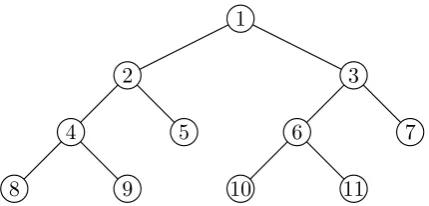
Figure 1 shows an example of a binary search tree. Initially, the tree has only one node: the root (node 1 in the figure). In each iteration, the
algo-1
2 3
4 5 6 7
[image:4.595.305.520.62.165.2]8 9 10 11
Figure 1: An example of a binary search tree
rithm expands all the leaf nodes in the beam. For example, in the first iteration, node 1 is expanded to generate node 2 and 3, which corresponds to adding weights to false positive and false nega-tive training instances, respecnega-tively. An expanded node always has two children in the binary search tree. All the nodes are then sorted in descending order of F-measure. Only the top M nodes are kept, and the remaining nodes are discarded. The discarded nodes can either be leaf nodes or non-leaf nodes. For example, if node 5 is discarded because of low F-measure, it will not be expanded to generate children in the binary search tree. The iterative algorithm stops when all the nodes in the beam are non-leaf nodes, i.e., all the nodes in the beam have been expanded.
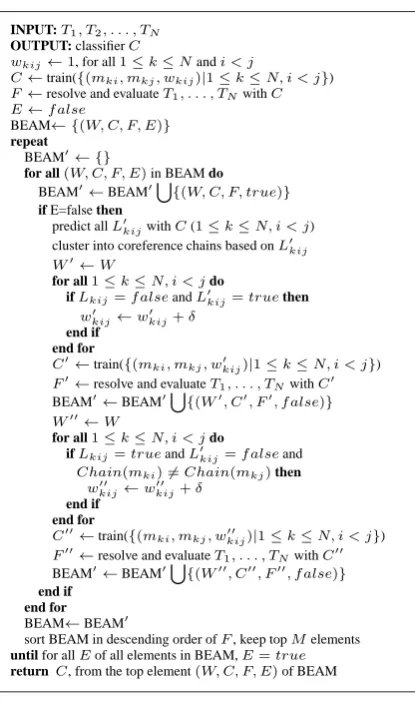
Figure 2 gives the formal description of the proposed maximum metric score training algo-rithm. In the algorithm, assume that we have
N textsT1, T2, . . ., TN in the training data set.
mki and mkj are the ith and jth markable in
the text Tk, respectively. Hence, for all i <
j, (mki, mkj, wkij) is a training instance for the
markable pair (mki, mkj), in which wkij is the
weight of the instance. LetLkij andL′kij be the
true and predicted label of the pair (mki, mkj),
respectively. Let W, C, F, andE be the set of weights{wkij|1 ≤k ≤N, i < j}, the classifier,
the F-measure, and a boolean indicator of whether the search state has been expanded, respectively. Finally,M is the beam size, and δ controls how much we update the weights in each iteration.
INPUT:T1, T2, . . . , TN OUTPUT: classifierC
wkij←1, for all1≤k≤Nandi < j
C←train({(mki, mkj, wkij)|1≤k≤N, i < j})
F←resolve and evaluateT1, . . . , TNwithC
E←f alse
BEAM← {(W, C, F, E)}
repeat BEAM′← {}
for all(W, C, F, E)in BEAM do
BEAM′←BEAM′S{(W, C, F, true)}
if E=false then
predict allL′kijwithC(1≤k≤N, i < j) cluster into coreference chains based onL′
kij
W′←W
for all1≤k≤N, i < jdo
ifLkij=f alseandL′kij=truethen
w′kij←wkij′ +δ end if
end for
C′←train({(mki, mkj, w′
kij)|1≤k≤N, i < j})
F′←resolve and evaluateT1, . . . , TNwithC′ BEAM′←BEAM′S{(W′, C′, F′, f alse)}
W′′←W
for all1≤k≤N, i < jdo
ifLkij=trueandL′kij=f alseand
Chain(mki)6=Chain(mkj)then
w′′
kij←w′′kij+δ end if
end for
C′′←train({(mki, mkj, w′′
kij)|1≤k≤N, i < j})
F′′←resolve and evaluateT1, . . . , TNwithC′′ BEAM′←BEAM′S{(W′′, C′′, F′′, f alse)}
end if end for BEAM←BEAM′
sort BEAM in descending order ofF, keep topMelements until for allEof all elements in BEAM,E=true
[image:5.595.74.282.65.419.2]returnC, from the top element(W, C, F, E)of BEAM
Figure 2: The maximum metric score training (MMST) algorithm
5 Experiments
5.1 Experimental Setup
In the experiments, we used all the five commonly used evaluation corpora for coreference resolu-tion, namely the two MUC corpora (MUC6 and MUC7) and the three ACE corpora (BNEWS, NPAPER, and NWIRE). The MUC6 and the MUC7 corpora were defined in the DARPA Mes-sage Understanding Conference (MUC-6, 1995; MUC-7, 1998). The dry-run texts were used as the training data sets. In both corpora, each training data set contains 30 texts. The test data sets for MUC6 and MUC7 consist of the 30 and 20 for-mal evaluation texts, respectively. The ACE cor-pora were defined in NIST Automatic Content Ex-traction phase 2 (ACE-2) (NIST, 2002). The three data sets are from different news sources: broad-cast news (BNEWS), newspaper (NPAPER), and
newswire (NWIRE). Each of the three data sets contains two portions: training and development test. They were used as our training set and test set, respectively. The BNEWS, NPAPER, and NWIRE data sets contain 216, 76, and 130 train-ing texts, and 51, 17, and 29 test texts, respec-tively.
Unlike some previous work on coreference res-olution that assumes that the gold standard mark-ables are known, we work directly on raw text in-put. Versley et al. (2008) presented the BART package1, an open source coreference resolution toolkit, that accepts raw text input and reported state-of-the-art MUC F-measures on the three ACE corpora. BART uses an extended feature set and tree kernel support vector machines (SVM) under the Soon et al. (2001) training and testing framework. We used the BART package in our ex-periments, and implemented the proposed MMST algorithm on top of it. In our experiments reported in this paper, the features we used are identical to the features output by the preprocessing code of BART reported in Versley et al. (2008), except that we did not use their tree-valued and string-valued features (see the next subsection for de-tails).
Since we use automatically extracted mark-ables, it is possible that some extracted markables and the gold standard markables are unmatched, or twinless as defined in Stoyanov et al. (2009). How to use the B-CUBED metric for evaluating twinless markables has been explored recently. In this paper, we adopt theB3allvariation proposed by Stoyanov et al. (2009), which retains all twin-less markables. We also experimented with their
B30 variation, which gave similar results. Note that no matter which variant of the B-CUBED metric is used, it is a fair comparison as long as the baseline and our proposed MMST algorithm are compared against each other using the same B-CUBED variant.
5.2 The Baseline Systems
We include state-of-the-art coreference resolution systems in the literature for comparison. Since we use the BART package in our experiments,
1http://www.sfs.uni-tuebingen.de/
we include the results of the original BART sys-tem (with its extended feature set and SVM-light-TK (Moschitti, 2006), as reported in Versley et al. (2008)) as the first system for comparison. Vers-ley et al. (2008) reported only the results on the three ACE data sets with the MUC evaluation met-ric. Since we used all the five data sets in our experiments, for fair comparison, we also include the MUC results reported in Ng (2004). To the best of our knowledge, Ng (2004) was the only prior work which reported MUC metric scores on all the five data sets. The MUC metric scores of Versley et al. (2008) and Ng (2004) are listed in the row “Versley et al. 08” and “Ng 04”, respec-tively, in Table 1. For the B-CUBED metric, we include Ng (2005) for comparison, although it is unclear how Ng (2005) interpreted the B-CUBED metric. The scores are listed in the row “Ng 05” in Table 2.
Tree kernel SVM learning is time-consuming. To reduce the training time needed, instead of us-ing SVM-light-TK, we used a much faster learn-ing algorithm, J48, which is the WEKA imple-mentation of the C4.5 decision tree learning algo-rithm. (Quinlan, 1993; Witten and Frank, 2005). As tree-valued features and string-valued features cannot be used with J48, in our experiments we excluded them from the extended feature set that BART used to produce state-of-the-art MUC F-measures on the three ACE corpora. All our sults in this paper were obtained using this re-duced feature set and J48 decision tree learn-ing. However, given sufficient computational re-sources, our proposed approach is able to apply to any supervised machine learning algorithms.
Our baselines that follow the Soon et al. (2001) framework, using the reduced feature set and J48 decision tree learning, are shown in the row “SNL-Style Baseline” in Table 1 and 2. The results suggest that our baseline system is comparable to the state of the art. Although in Table 1, the performance of the SNL-style baseline is slightly lower than Versley et al. (2008) on the three ACE corpora, the computational time needed has been greatly reduced.
Our MMST algorithm trains and tests on all pairs of markables. To show the effectiveness of weight updating of MMST, we built another
base-line which trains and tests on all pairs. The per-formance of this system is shown in the row “All-Style Baseline” in Table 1 and 2.
5.3 Results Using Maximum Metric Score
Training
Next, we show the results of using the proposed maximum metric score training algorithm. From the description of the algorithm, it can be seen that there are two parameters in the algorithm. One parameter isM, the size of the beam. The other parameter isδ, which controls how much we in-crease the weight of a training instance in each iteration.
Since the bestMandδfor the MUC evaluation metric were not known, we used held-out develop-ment sets to tune the parameters. Specifically, we trained classifiers with different combinations of
M andδon a development training set, and eval-uated their performances on a development test set. In our experiments, the development training set contained 2/3 of the texts in the training set of each individual corpus, while the development test set contained the remaining 1/3 of the texts. After having picked the bestM andδ values, we trained a classifier on the entire training set with the chosen parameters. The learnt classifier was then applied to the test set.
2 4 6 8 10 12 14 16 18 20
52 54 56 58 60 62 64 66 68
M
F−measure
[image:6.595.307.518.461.570.2]MMST SNL−Style Baseline All−Style Baseline
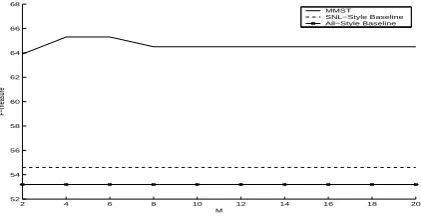
Figure 3: TuningM on the held-out development set
To limit the search space, we tuned the two parameters sequentially. First, we fixed δ = 1, which is equivalent to duplicating each train-ing instance once in J48, and evaluated M =
2, 4, 6, . . . , 20. After having chosen the best
Mthat corresponded to the maximum F-measure, we fixed the value of M, and evaluated δ =
exam-MUC6 MUC7 BNEWS NPAPER NWIRE
Model R P F R P F R P F R P F R P F
Versley et al. 08 – – 60.7 65.4 63.0 64.1 67.7 65.8 60.4 65.2 62.7 Ng 04 75.8 61.4 67.9 64.2 60.2 62.1 63.1 67.8 65.4 73.5 63.3 68.0 53.1 60.6 56.6 SNL-Style Baseline 67.0 49.2 56.7 63.0 54.2 58.3 57.4 64.3 60.7 61.6 67.3 64.3 58.6 66.1 62.1 All-Style Baseline 56.9 69.2 62.5 51.5 73.4 60.6 53.0 76.7 62.7 56.3 75.4 64.4 53.0 74.5 61.9
MMST 73.3 59.9 65.9∗∗†† 66.8 59.8 63.1∗∗† 70.5 61.9 65.9∗∗† 69.9 64.0 66.8† 64.7 64.7 64.7∗∗†
[image:7.595.69.530.70.156.2]M= 6, δ= 1.0 M = 6, δ= 0.7 M = 6, δ= 1.8 M = 6, δ= 0.9 M= 14, δ= 0.7
Table 1: Results for the two MUC and three ACE corpora with MUC evaluation metric
MUC6 MUC7 BNEWS NPAPER NWIRE
Model R P F R P F R P F R P F R P F
Ng 05 – – 57.0 77.1 65.6 62.8 71.2 66.7 59.3 75.4 66.4
SNL-Style Baseline 57.8 74.4 65.1 57.6 76.5 65.7 62.0 74.7 67.8 61.8 70.4 65.8 65.8 75.9 70.5 All-Style Baseline 51.6 86.3 64.6 49.1 90.1 63.6 61.6 83.7 71.0 63.9 74.0 68.6 64.8 80.1 71.7 MMST 62.7 81.5 70.9∗∗†† 61.8 73.6 67.2†† 61.6 83.7 71.0∗∗ 63.1 76.2 69.1∗∗ 64.3 81.0 71.7
M = 6, δ= 1.0 M= 8, δ= 0.8 M = 6, δ= 0.9 M = 14, δ= 0.5 M = 6, δ= 0.1
Table 2: Results for the two MUC and three ACE corpora withB3evaluation metric
0 0.2 0.4 0.6 0.8 1 1.2 1.4 1.6 1.8 2 52
54 56 58 60 62 64 66 68
delta
F−measure
MMST SNL−Style Baseline All−Style Baseline
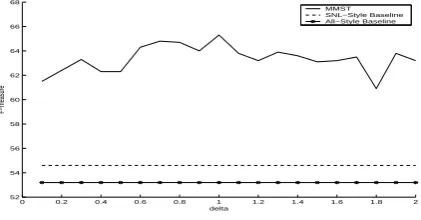
Figure 4: Tuning δ on the held-out development set
ple. The results of tuningM on MUC6 are shown in Figure 3. The maximum F-measure is obtained whenM = 4andM = 6. On all the differentM
values we have tried, MMST outperforms both the SNL-style baseline and the All-style baseline on the development test set. We then fixedM = 6, and evaluated differentδ values. The results are shown in Figure 4. The best F-measure was ob-tained whenδ = 1.0. Again, on all the different
δ values we have tried, MMST outperforms both baselines on the development test set.
The rows “MMST” in Table 1 and 2 show the performance of MMST on the test sets, with the tuned parameters indicated. In our experiments, the statistical significance test was conducted as in Chinchor (1995). ∗ and∗∗stand forp < 0.05
andp <0.01over the SNL-style baseline,
respec-tively. † and†† stand forp < 0.05andp < 0.01
over the All-style baseline, respectively.
For the MUC metric, when compared to the All-style baseline, MMST gains 3.4, 2.5, 3.2, 2.4, and 2.8 improvement in F-measure on MUC6, MUC7, BNEWS, NPAPER, and NWIRE, respec-tively. The experimental results clearly show that MMST gains not only consistent, but also sta-tistically significant improvement over both the SNL-style baseline and the All-style baseline in all combinations (five data sets and two baselines) on the MUC metric, except that it is not significant (p = 0.06) over the SNL-style baseline in NPA-PER. As for the B-CUBED metric, MMST gains significant improvement in F-measure on MUC6 and MUC7 data sets, while its performance on the three ACE data sets are comparable to the All-style baseline.
5.4 Discussion
[image:7.595.76.287.304.414.2]respec-tively. Counting the weighted number of instances (e.g., an instance with weight 2 is equivalent to 2 instances), we have 19,853 positive and 506,651 negative training instances. This changes the ratio of the positive instances from1.9%to3.8%. As a by-product, MMST reduces data skewness, while using all possible NP pairs for training to keep as much information as possible.
The change of weights of the training instances is equivalent to the change of distribution of the training instances. This effectively changes the classification hypothesis to the one that tends to yield higher evaluation metric score. Take the fol-lowing sentence in the MUC6 data set as an ex-ample:
In a news release, the company said the new name more accurately reflects its focus on high-technology communications, including business and entertainment software, interactive media and wireless data and voice transmission.
In the above example, the pronoun its is coref-erential to the antecedent NP the company. The baseline classifier gives a probability of 0.02 that the two NPs are coreferential. The pair is clas-sified wrongly and none of the other pairs in the article can link the two NPs together through clus-tering. However, with MMST, this probability in-creases to 0.54, which leads to the correct classi-fication. This is because the baseline classifier is not good at predicting in the case when the sec-ond markable is a pronoun. In the above exam-ple, its can have another candidate antecedent the new name. There are far more negative training instances than positive ones for this case. In fact, in the induced decision tree by the baseline, the leaf node corresponding to the pair the company – its has 7,782 training instances, out of which only 175 are positive. With MMST, however, these numbers decrease to 83 and 45, respectively. MMST also promotes the Anaphor Is Pronoun feature to a higher level in the decision tree. Al-though we use decision tree to illustrate the work-ing of the algorithm, MMST is not limited to tree learning, and can make use of any learning algo-rithms that are able to take advantage of instance weighting.
It can also be seen that with the B-CUBED metric, MMST gains improvement on MUC6 and
MUC7, but not on the three ACE corpora. How-ever, the results of MMST on the three ACE cor-pora with the B-CUBED evaluation metric are at least comparable with the All-style baseline. This is because we always pick the classifier which cor-responds to the maximum evaluation metric score on the training set and the classifier correspond-ing to the All-style baseline is one of the candi-dates. In addition, our MMST approach improves upon state-of-the-art results (Ng, 2004; Ng, 2005; Versley et al., 2008) on most of the five standard benchmark corpora (two MUC corpora and three ACE corpora), with both the link-based MUC metric and the mention-based B-CUBED metric.
Finally, our approach performs all the F-measure maximization during training, and is very fast during testing, since the output of the MMST algorithm is a standard classifier. For example, on the MUC6 data set with the MUC evaluation metric, it took 1.6 hours and 31 seconds for train-ing and testtrain-ing, respectively, on an Intel Xeon 2.33GHz machine.
6 Conclusion
In this paper, we present a novel maximum met-ric score training approach comprising the use of instance weighting and beam search to maximize the chosen coreference metric score on the train-ing corpus durtrain-ing traintrain-ing. Experimental results show that the approach achieves significant im-provement over the baseline systems. The pro-posed approach improves upon state-of-the-art re-sults on most of the five standard benchmark cor-pora (two MUC corcor-pora and three ACE corcor-pora), with both the link-based MUC metric and the mention-based B-CUBED metric.
Acknowledgments
References
Bagga, Amit and Breck Baldwin. 1998. Algorithms for scoring coreference chains. In Proceedings of the LREC1998, pages 563–566.
Chinchor, Nancy. 1995. Statistical significance of MUC-6 results. In Proceedings of the MUC-6, pages 39–43.
Daume III, Hal. 2006. Practical Structured Learn-ing for Natural Language ProcessLearn-ing. Ph.D. thesis, University of Southern California.
Denis, Pascal and Jason Baldridge. 2007. Joint deter-mination of anaphoricity and coreference resolution using integer programming. In Proceedings of the NAACL-HLT2007, pages 236–243.
Hastings, W. K. 1970. Monte Carlo sampling meth-ods using Markov chains and their applications. Biometrika, 57(1):97–109.
Joachims, Thorsten. 2005. A support vector method for multivariate performance measures. In Proceed-ings of the ICML2005, pages 377–384.
McCarthy, Joseph F. and Wendy G. Lehnert. 1995. Using decision trees for coreference resolution. In Proceedings of the IJCAI1995, pages 1050–1055.
Metropolis, Nicholas, Arianna W. Rosenbluth, Mar-shall N. Rosenbluth, Augusta H. Teller, and Edward Teller. 1953. Equation of state calculations by fast computing machines. Journal of Chemical Physics, 21(6):1087–1092.
Moschitti, Alessandro. 2006. Making tree kernels practical for natural language learning. In Proceed-ings of the EACL2006, pages 113–120.
MUC-6. 1995. Coreference task definition (v2.3, 8 Sep 95). In Proceedings of the MUC-6, pages 335– 344.
MUC-7. 1998. Coreference task definition (v3.0, 13 Jul 97). In Proceedings of the MUC-7.
Ng, Vincent and Claire Cardie. 2002a. Combining sample selection and error-driven pruning for ma-chine learning of coreference rules. In Proceedings of the EMNLP2002, pages 55–62.
Ng, Vincent and Claire Cardie. 2002b. Improving ma-chine learning approaches to coreference resolution. In Proceedings of the ACL2002, pages 104–111.
Ng, Vincent. 2004. Improving Machine Learning Ap-proaches to Noun Phrase Coreference Resolution. Ph.D. thesis, Cornell University.
Ng, Vincent. 2005. Machine learning for coreference resolution: From local classification to global rank-ing. In Proceedings of the ACL2005, pages 157– 164.
NIST. 2002. The ACE 2002 evaluation plan. ftp://jaguar.ncsl.nist.gov/ace/
doc/ACE-EvalPlan-2002-v06.pdf.
Quinlan, J. Ross. 1993. C4.5: Programs for Machine Learning. Morgan Kaufmann.
Soon, Wee Meng, Hwee Tou Ng, and Daniel Chung Yong Lim. 2001. A machine learning ap-proach to coreference resolution of noun phrases. Computational Linguistics, 27(4):521–544.
Stoyanov, Veselin, Nathan Gilbert, Claire Cardie, and Ellen Riloff. 2009. Conundrums in noun phrase coreference resolution: Making sense of the state-of-the-art. In Proceedings of the ACL-IJCNLP2009, pages 656–664.
Vemulapalli, Smita, Xiaoqiang Luo, John F. Pitrelli, and Imed Zitouni. 2009. Classifier combination techniques applied to coreference resolution. In Proceedings of the NAACL-HLT2009 Student Re-search Workshop and Doctoral Consortium, pages 1–6.
Versley, Yannick, Simone Paolo Ponzetto, Massimo Poesio, Vladimir Eidelman, Alan Jern, Jason Smith, Xiaofeng Yang, and Alessandro Moschitti. 2008. BART: A modular toolkit for coreference resolu-tion. In Proceedings of the ACL2008:HLT Demo Session, pages 9–12.
Vilain, Marc, John Burger, John Aberdeen, Dennis Connolly, and Lynette Hirschman. 1995. A model-theoretic coreference scoring scheme. In Proceed-ings of the MUC-6, pages 45–52.
Wick, Michael and Andrew McCallum. 2009. Ad-vances in learning and inference for partition-wise models of coreference resolution. Techni-cal Report UM-CS-2009-028, University of Mas-sachusets, Amherst, USA.
Witten, Ian H. and Eibe Frank. 2005. Data Mining: Practical Machine Learning Tools and Techniques. The Morgan Kaufmann Series in Data Management Systems. Morgan Kaufmann Publishers, second edi-tion.