An Abstraction Method Using a Semantic Engine
Based on Language Information Structure
Hirohito 1NAGAK1 and Tohru NAKAGAWA
N T I " l l u m a n I n t e r f a c e L a b o r a t o r i e s 1 - 2 3 5 6 T a k e Y o k o s u k a - S h i K a n a g a w a 2 3 8 - 0 3 J a p a n
E - t n a i l in a g a k i @ n t t h l i . n t t . j p
A b s t r a c t
This paperdescribes the framework for a new ab- straction method that utilizes event-tmits written in sentences. Event-units are expressed in Lan- guage
Information Structnrc (LIS) form and the
projection of LIS from a sentence is f)cffonned
by
asemantic engine. ABEX (ABstraction
EX-traction system) utilizes the LIS outpttt of the
s e m a n t i c e n g i n e . A B I ' ; X c a n e x t r a c t e v e n t s f r o msentences and classify them. Since ABEX and
t h e L I S f o r m n s c o n l y l i m i t e d k n o w l e d g e , the s y s t e m n e e d n o t c o n s t r u c t o r n l a i n t a i n a l a r g e a m o u n t o f k n o w l e d g e .1 I n t r o d u c t i o n
Automatic abstraction, a l n a j o r natural lauguagc ]n'uecss- ing application, is difficult to achieve. Luhn[5] developed a very simple extraction method that searches for the keywords ill each sentence. This type nf abstraction is easy to accomplish, but its quality is poor. Other abstrac- tion methods[6, 31 utilize natural language u n d e r s ~ d i n g (NLU). However NLU is still in the development stage. For achieving good practical performance, it is necessary to treat the thformation expressed in a tlocument uni- formly so that it can be analyzed with only a small fixed amount of knowledge.
We propose tile L.IS form which allows inlormatinn
a b o u t e v e n t s tO Lvd u n i l o l l n l y treated, t;urt[lcl~nore, the semantE engine only uses abstract words, this reduces thc size of the knowledge. So the semuntic engine projects a sentence to a LIS form within a lmdted anloant of knowledge.
In abstraction, classification is the first step. Classifica- tion is performed using unilorln approach, the LIS lkmn. LIS event representation ullow us to select and classify sentences,
2 A s e m a n t i c e n g i n e
2.1 What is the l,anguage Information
Strncture(LIS) form?
The LIS form expresses the inlormation structure that pernlits commnnication between individuals. If two ino dividuals communicate about one that happened (will happen) m the real world, the core inlormation is the event. Sometm~es a spe,aker will atulche an attitude to the event. So information al~ml real world is expressed by the event and the attitude of tile speaker.
2.2 L 1 S f o r m
In the LIS form, there are two types of feature-structure, word feature-strncture and event feature-structure. Al- most all slots of tile word feature-stxucture are filled with appropriate values and lew slots of the event feature- structure are empty. The semantic engine tries to fill all slots of lhe feature-structure.
2.2.1 E v e n t feuture-str u c t u r e
E v e n t has o n e leature-structure, the role lkkqture. T h e s e n -
tence conlilins one or more events and die event feature- structure indicates the role of words or phrases in the event. The role feature is either essential or extensional. Seven essential roles have been created: as AGENT, OB- JECT, ACTION, LOCATION, TIME, FROM, and TO. These roles are defined not for verbs but for events. This is quite diflerent li'om Fillmore's cases [2]. Therefore, the action ill the event is represented by the ACTION slot, which c~ln be lilled by verbs, nouns, gerunds, and so oil. It is not necessary to fill the ACTION slot by a verb.
l:or exulnple, tile phra.sc " a laud tmrchase agreement" is dealt with as one event in the LIS, and the A C T I O N slot-value is "agreement". Other slots, such as AGENT, OBJECT, LOCAI'ION, T I M E , FROM and T O slots are ahoost the same as in Fillmore's cases of 'agent', 'object', 'location', 'time', 'source', and 'goal (or experiencer)'. It is important that our role model deals with the roles of words (or pltrases) in an event, not word meaning.
Using just seven essential roles, it is difficult to assign a talc to a word (or a phrase). To o v e r c o m e this problem,
we introduce extensional roles which allow to be moditied by the addition o f "/constraint".
2,2.2 W o r d f e a t u r e - s t r u c t u r e
Word has six features. These are semantic lizature (DDF) slot, numerical-value slot, date slot, constmtint slot, modal- ity slot, and word string slot.
Using the semantic feature, the event feature-structure will be determined during semantic interpretation process. Six classes of semantic features are defined, such as INDI- VIDUAL, ELEMENT, T H I N G , ACTION, LOCATION, and TIME These classes are instantiated to the Domain Dependent semantic Features (DDF) when tile domain is decided.
The constraint fcmure restricts the feature-su'ucturc of brother words or t)hrases. FurthcrlllOre, tile constraint feature determines the relations betweell word feature- structure and event feature-structure, ht Japanese lan- guage, a word which have a ACTION DDF usually has the constraint feature that determines tile slots of event feature-structure.
The numerical-value slot expresses numerical value of a word ; 0, 1 , 2, - - (one) , ¢i (hundred) , :1"- (thousand) , and so on. The calculation of countthg up and down is necessary, so all figures are separated. The nmnerical- value feature will be expressed as folh)ws.(Onr notation of a feature-structure is
~eature-name =feature-value].)
[numerical-value=
[s~icr')~!!dTidg~it
. . . . ] ]The date slot expresses event occurrence time and is expressed by the Christian era. In the Christian era, days are counted by numbers, so that date slots arc calculated nsing the numerieal-value feature. The date slot has a minute slot, a second slot, a hour slot, a day slot, a month slot, and a year slot. Eacll slot is expressed in nmnerical value.
The modality slot is classilied into three c,'ttcgories; tense, aspect, and uqood. Since tile tense and aspect are linguistically Iixed, we use an ordinary categorization. However, mood is needed to be categorized differently, because the information unit used this system is an event. So we categorized mood as a combination of Bratman's Belief-Desire-lnten lion model[ 1 ] and modal logic. That is the skate of event is expressed hy modal logic (necessary operator, possible operator, and negation sign) and the attitude of speakers cart tx~ cthssiliod into belief, desire, and intention. For example, a seurence
I think it
tspossible to construct a plant there
will be expressed asBelief(Possibleli',
where E means anevent;construct
a plant there,
that is, the individual believes that E is possible.Furthermore, it is necessary to consider u situation in which information is transferred. In tfie newspaper, it is created by journalists who get information from other services (person or company information bureau), ht this situation, the event aml the attitude of file inforumtion possessor (IP) is transported to a speaker (SP);journalist.
The journalist then reexpresses the information to reflect his attitude. If the modality o f IP and SP are expressed as
M odalit ~,/se (), M odalit Yl v (),
respectively, information in newspaper is expressed as,M odalitys p ( M odality, e( E V E N T) ) ).
If the target document is newspaper, the LIS form includes the modality of speaker
(Modalitysp)
and the modality of information possessor(Modalitylp).
2.3 Projection Mechanism
Parsing is done using Morphological analysis and De- pendency zmalysis[4] attd yields a syntactic tree for a sentence,
After the parsing, we search a feature-structure dictio- nary to extract feature-structures of all words related to the domain. To perform semantic analysis with limited knowledge, word feature-structures are prepared only for abstract words. The registration of proper nouns are left to the u s e r . The semantic engine infers the semantic meaning of words or phrases from the system default and user registrations held in the dictionary. This means the semantic engine do not need all knowledge of words for semantic interpretation. Thus only a small amount o f words need to be maintained.
After attaching the appropriate word feature-structure to all important words, semantic interpretation can proceed. From the type of propagation for the feature-structure in a parsing tree,there are two types of features. One is the synthesized type whose value is calculated from sons to fatber relationship of the parsing tree. The other is the inherited type that are calculated from father or brothers. Word string, DDF, numerical-value, date, and modality features are synthesized type and other features, such as consmdnt and role are inherited type. The propagation e r a feature-structure is accomplished by unification calculus, but the grammar is different.
For DDF features, the g r a m m a r is as follows.
Ii'.I)DF
::=iml~ fini~e
N.DDI'"
::= NI.l)l)Fq~ N2.DDFq,... N , . D D F
N.I)DF
::=individaal(company)l
element(corapm~y) lmoneylmanlproductl
action(company)llocation[time
Note: Uncapitalized words mean terminate and capitalized words mean nonterminate. E means EVENT node structure and N means other node structure and N.DDF means DDF feature-value in node 'N'. Symbol 'n' is the number of nodes. Operator ,~ means unification operator.
For the constraint feature,
E,constraint
::=~
(NI.DDF@ E)
i=l,...,nN ... t,'aint
::=~
(N).DDF@N)
j = l , . . , nN.conslrainl
::=feature-structure of brother nodes
Tile dale and nunierical-value features are ralJlOr COlU-
plicated because we have to 0col with the semantic mo,'tn- ing of time.
The g r a m m a r of l~)r the date feature is,
N . d a t e : : = N i . d a l e ~ h'2.dal~ .] . . . . q, N , , . d a & Sff'olld : • • •
]lollr ~ , ' • N . d a l e : : =
da.q . . .
l ~ l O l ~ l / t : . - • i j e a l . = : , • .
Tile calculation of number aud date features is done like a stack. The nmnerical-value feature has one stack and date feature has six stacks.
For example, lbr the number 1992, all die numbers, 1. 2. and 9, are expressed as follows,
1 ~ [numerical-value = (oval (push-number-stack 111] 2 ~ [numerical-value =(eval (push-nuulber-sluck 2))] 9 ~ [numerical-vulue = (oval (pusll-numbur-stack 9))} Note: Symbol 'oval' i/lealis ltlal next [oi112 will be evaluated by
Common-lisp, Symbol 'push-stuck' is the lunction Ihat puts the argumem wdue ou the top el tile stuck, The equation lot tile nun/eric/l-value of 1992 is, 1992.numerical-value =
{[numerical-value = (ewtl (push-number-stack 1))] ~[numerical-vuluc =(ovid (push-number-stack 9))] ~[numerical-value = (ewil (push-number-stack 9))] (9[numerical-value =(eval (push-number-stack 2))]J which, after evaluation, gives as the value of 1992 as follwing expressions,touting right to left, tirst digit being 2. second digit begin 9, and so on,
first-digit =: 2 ]
second-digit 9
1992.numerieal-value = third-digit 9
fourth-digit 1
If we process the phrase, 1992 ~q". (year 19921, the equation becomes,
1992 ~ . d a t e :
{ 1992.numerical- value ,],
date : (eval(ifSELFnumerical-value
)
(push-year-stack SELF.numerical.value))) j
Note: Nonteriifinate 'SELF' refers to the sell leaturc-structure Symbol 'push-year-stuck' is the functiou that places the argument value to tile year stack ill lhe date feature. Then and we get the time feature-structure as,
[ 1992t, F..date = [ y e a r = 1 9 9 2 ] ] The g r a m m a r for modality is quite simple,
E . m o d a l i t y ::= N l . m o d a l i t y ~l, N~.modality it, • .. N , , . m o d a l i t y
N . m o d a l i t y : : : NI mo l q .~ A"~.tnodulity q, • .. N,,.modolitq
N.modalit¢l ::= t~ n , ~ c , ti ,+p~ (t. u t~d mood
2 . 4 A l l e x a m p l e o f t h e p r o j e c t i o n p r o c e s s in
t i l e s e m a n t i c e n g i n e
This passage comes from Tile Nikkan-kougyou shiu- bun(Daily Industrial Newspaper). The headline is "il~ Co.. Ltd. is constructing a new plant to assemble large- scale steel bridges in W~tkayama-ken.).
amtounced a land purchase agreement in Shimotsu-machi, Wahayeana-ken, where they will construct a new plant giving ttuem additional ,wace and capabilities to fabricate larger scale steel bridge structures.)
-~" "~ o " (771e 170,S56-sq.-ttwter construction site, previ- ously occupied by part e t a Maruzen Oil Co., Ltd. refinery, was purchased from Maruzen Shinwtsu Kosan for an esti- mated x[ 10 billion. Construction on the new plant facility is slated to begin this coming spring.)
S3: " ~ t . t l ~ , j :iG" :: I'{,~:.liJo " (hlvestment capital is about ¥ 22 billion.)
$4: " "~l~ t ( f i l ~ [ L q ) ~ o ) ~ ' ~ o " (Operations will begin in April, 1993,)
el'lie Nikkan-koagyou shinbun, November 17, 19901 At lirst, tile domain is decided. Ill this example, we use "~-.~l~-J/h'~ "(company act) domain.
Tile system rougldy separates events and extracts all events which related to the dolnaill: corupany act. From tile featnre-structure dictionary, file sentence was quickly reviewed to determine whether there is a word which has an A C T I O N D D F or not. If there is no such word, the system thea stops analyzing the sentence. In the example, the Iirst sentence (S 1) is made of two events. One i s " J ~ (construction)" and the other is " D,~]~[l (agreement)". The two events are connected b y " $- -5 ~ ~ "~" (surukoto-de)". So seutence ($1) is separated to two events. Senteuce $3 does not have an A C T I O N DDF, so further analysis is not couducted.
Therefore, we call obk'lin live events from five sen- tences; S I to $5.
L- ~ ~Clli~11 Ii),/ [q'ltlilf i<c ~[t~ L , " ( l a k a d a - k i k o Co., Ltd. will coastruct a new plant giving tl~em additional
space arid capabilities to fabricale larger scale steel bridge structures.)
~EO L hz ~ ~ j ~ L ~ o " (lakada Kiko announced a land purchase agreement )
Event3inS2: " ~t7~.,~|~'.l:l[:l~L~;/S~lll~~l~2E~l~'~:l~tl©--
Jj'J- i-)~-¢~s'Jl'if,~;lXj~"£lt~, " ('1"he 170,856-sq.-
p,u~ter construction site, previously occupied by part o f
a Maruzen Oil Co., Ltd. refinery, was purchased front Maruzen Shimotsu Kosan for an estimated -"#~10 billion.)
Event4inS2: " ~ : ~ h ~ C g ~ 3 2 ~ K - ~ A L " ~ - ~ o " (Con struetion on the new plant facility is slated to begin this coming spring.)
EventSinS4: "' ~ [ z l ~ l - ~ q J : ] ~ e ) ~"~.'o "' (Operations will begin in April 1993.)
After the event separation process concludes, semtmtic interpretation is commenced. The first stage is attaching a feature structure to each word.
Let's consider the Event4 in $2; " ~ 7 5 ~ ¢ 9 ~ 3 L g ~ , ~
~f'c~t~IL'J- ~ o " (Construction on the new plant facility is
slatedtobeginthiscomingspring.), lit this passage, there arc
three Bunsetsu, five independem words, three delxmdent words. We need only five leamre-structures as shown below.
~ l ~ ; t h i s coming s p r i n g - -
" ~ (raisyun)"; thl,~ comlcting .~pr~n!l time
(push-year-stack (1 + *article-year*))
string ::
u l D D F =
date :
! . ~ ; p l a n t ~
string
u 2 D D F
= " A 2 ~ (koujyou)";plaT~l 1
= d e n enl(companlt)
J
t ] ~ ; c o n s t r u c t i o n - -
strtt~9 = "~.~t~ (ket~etsu)"; con.~trucliol*
D D F = .ctw~d~cm~p.n~j)
[ d~gent.l)l)l'" = ~ndivld.alleomlm71y)]
,3 con- I_action.1)l)F= actiott(coTnpany)
I
straint= [_ob3ect,DDF= elemet~ticomp...V) [
[ _timc.DDF = ti,... .... ]
~ ; i s slated to . . . ~
[ st,,ing = ",,,AL(chakkou)"',i.sslaledl .... ]
u 4 modali(y [.sp¢ ('l = ju.~l_bcforc] 6 ; w i i l ~
[ s t r i n g = "~-Zo(suru)";.'ill ]
u 5 modoliltj [t~ ~,sc = J'ul.r~]
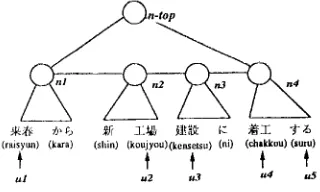
Note: Symbol '_agent.Dl)F' means IhlU if the DDF feature value is unified to the one node, then variable '_agent' is tx)unded to that node's feature-structure. Variable *article-year* is bounded to the date of year when the article is publishezl. The example is parsed as shown in ligure 1. Once the parsing is finished, the semantic thterpre- tution process begins. Node n] wilt have tile feature- structure timt is the result of calculation between the feature-structure o f " ~ (raisynn)" and " 7~, b (kara)", but the w o r d " 2,~ C9 (kava)" has no leature-structurc so thc feature-structure o f " ~ (raisyun)" ul, is propagated to node nl. The feature-structures of all nodes are calculated same way.
For the constraint lcature, uniiication was done to all brothers. For example, [~(tgenl.Dl)t" =
(raisyun) (kara) (shin) (koujyou)(ke~etsu)(ni) (chakkou)(suru)
¢
¢
¢
¢
¢
u l u 2 u 3 u 4 u 5
Figure 1 : First stage of syntactic tree
iJ.lividual(comprmv)] means that one brother node is
needed which have the D D F value of agent(company).
If there is a node which satisfies the constraint, then the variable _agent is ['rounded to that node feature-structure. If there is no node which satisfies tile constraint, then variable _agent is unbounded.
Try to think about the constraint feature in "Jd~P. (kensetsu)". There is no node that has agent(company)
in DDF, but there are nodes which satisfy the constraint, such as the ~action,_object, and _time which are bounded to nodes n3, n2, hi,respectively.
Finally we get the event feature-structure of top node
n-top,shown in figure 2.
3
An abstraction using the LIS form
3.1 The basic method of the abstraction
In tile abstraction, we utilize classification of the LIS ouqmt. First, a sentence is put into the LIS form by the semantic engine.
TIle LIS output is used to c o m m e n c e the abstraction procedurc. To extract information from sentence, we think classilicaUon is tile best way. The semantic engine analyzes sentence in fixed domain, after the semantic attalysis. Sentences tire classilied whether an event or not, artd tile system extracts the events which are related to the domain.
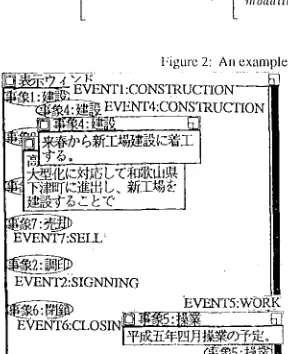
Finally, A B E X provides a abstraction. O n e abstraction proposed here is the classification of event occurrence time and similarity of event. This classification reveals the relationships of each event. Individual event occurrence times will be determnined from value of the time feature and the similarity of events is calculated by comparing event feature-structure slots.
Tile other method is classification by the modality of information. Front the view point of M o d a l i t y t p , we can classify an event according to the modality of information possessor (1P). If there is no modality in the event, we classify it as 'fact'. Others are classified using modality feature. This classification of tile event's modality reveals the attitude of the information possessor.
[image:4.432.231.391.28.124.2]_attic.
_object
..llllt(
t ~ , , , ~ /
[
",~lq~
(kensetsu)IC
(:u)"1)1)t' ~ :l on(COmlm~O )
=
,,~
con au:tlon.l) l)F = act~o~l(CUmlmlLq )smdnt _objert. I)l)l'" : : chm. nl(conumny )
_tlme. Dl)l'" :-: tune
[ sl,,,,9 = "*,i(shit,j lj~t(koujyou) '' ]
ua l)l)t.1 elt:mcnl(~l~mlmng 1
a: ut nto~lh = 4
d,tc = yea, 1991
[image:5.432.214.380.15.308.2],..,,s ,,,o,z.l,,v = L t e ~ s e : :
future
]
Figure 2:
All exam
[ ~ Z C s
c
k - eEVENTT:SELL'
EVEN'F2:SIGNNING
E VF2-rI'6:
~:'~ ~ " ~ O S I N ~
Figure 3: Tile classification result by tile event occurrence time and the similarity
4e of all event node [catttre-stl'ucture
~: ~ 9:ge;5~ (Fact) ' II
I
Takada Kikou Co. Ltd. "will construct...I -~--2~.0)~{,-£~ ( O f fi~t al' bulletin) I
I
.To,~:ada Kikou announced a land...I
I ~_::~o97~:1~ ( I n t e n t i o n ) I l l
l + ~ m ~ .
III
l Operations will begin in April, 1993,
I
Figure 4: An ahsn'action result according to modality
3 . 2 A n e x a m p l e oftlne a b s t r a c t i o n
Figure 2 shows a typical abstraction result of ABEX. The events me classified by tile eveiit occurrence title and the simimlity of each event. In this Iigure, x- axis indicates tthsohlte event (}cctllfence tittle and y axis indicates relative sinlilarity of events alld cilcled icQIIS indicate single events.
A typical classification restllt using tile modality of information is shown in ligure 3.
The Event 2 lilts tile modality of an official bulletin and Event 5 has rite modality of company imention, so we get tile abs~tction result shown in figure 3.
4
Conclusion
We have described a I'ranlework I()r a now ahsIraciitnl method that utilizes classilication. Classilication is per formed using tile outpnt of u senlantic engine that is based on LIS form. Since the LIS Ionn takes into account the incompleteness of knowledge, the system requires curly a small amount of knowledge to i)erfoma the setnaatic
analysis.
First, ABEX utilizes the selectivity of the semantic en- gine according to the domain and the event. Furthermore, ABEX classify accorcling to tile LIS constituents such as, TIME modality and so on. The generation mechanism is poor, bttt ahstraction by classification is an easy way mak- illg all ahsffact. Furthermore, the chtssification nletilod descrihed here well supports human abstract tasks.
R e f e r e n c e s
[] ] M. E. 13ratman. Phms and resource-bouulded practical rea- sonirlg. Computational huelligence, (4), 1988. [2] C. J. Fillmore. Toward a au}dern theory of case. Ibentice.
1lull, 1969,
13] U. Hahn. Topic essentials. Coling-86, 1986.
141 11. hlagakh S, Miyalutra, and F. Obashi. Sentence disam- biguatiorl by docutxlent oriented preference sets. Coling-90. 1990.
15] 11, 1:'. Luhn. The automatic creation of literature abstract.
IBM Journal. Vo12, 1958.
[61 L. F, I~.au. Inlormation extraction and text summariza- tion using linguistic knowledge acquisition. Processing &
Mammgment, ilages ,119~28, 1989.
[image:5.432.54.198.124.301.2] [image:5.432.230.380.152.305.2]