
Zero-Knowledge Accumulators and Set Operations
Esha Ghosh1, Olga Ohrimenko2, Dimitrios Papadopoulos3, Roberto Tamassia1and Nikos Triandopoulos4,3
1 Dept. of Computer Science, Brown University, Providence RI, USA [email protected],[email protected]
2 Microsoft Research, Cambridge, UK [email protected]
3 Dept. of Computer Science, Boston University, Boston MA, USA [email protected]
4 RSA Laboratories, Cambridge MA, USA [email protected]
Abstract. Accumulators provide a way to succinctly represent a set with elements drawn from a given domain, us-ing anaccumulation value. Subsequently, short proofs for the set-membership(ornon-membership) of any element from the domain can be constructed and efficiently verified with respect to this accumulation value. Accumula-tors have been widely studied in the literature, primarily, as anauthenticationprimitive: a malicious prover (e.g., an untrusted server) should not be able to provide convincing proofs on false statements (e.g., successfully prove membership for a value not in the set) to a verifier that issues membership queries (of course, having no access to set itself). In essence, in existing constructions the accumulation value acts as a (honestly generated) “commitment” to the set that allows selective “opening” as specified by membership queries—but with no “hiding” properties.
In this paper we revisit this primitive and propose a privacy-preserving enhancement. We define the notion of azero-knowledge accumulatorthat provides the following very strong privacy notion: Accumulation values and proofs constructed during the protocol execution leak nothing about the set itself, or any subsequent updates to it (i.e., via element insertions/deletions). We formalize this property by a standard real/ideal execution game. An adversarial party that is allowed to choose the set and is given access to query and update oracles, cannot distinguish whether this interaction takes place with respect to the honestly executed algorithms of the scheme or with a simulator that is not given access to the set itself (and for updates, it does not even learn the type of update that occurred—let alone the inserted/deleted element). We compare our new privacy definition with other recently proposed similar notions showing that it is strictly stronger: We give a concrete example of the update-related information that can be leaked by previous definitions.
We provide a mapping of the relations between zero-knowledge accumulators and primitives that are either set in the same security model or solve the same problem. We formally show and discuss a number of implications among primitives, some of which are not immediately evident. We believe this contribution is interesting on its own, as the area has received considerable attention recently (e.g., with the works of [Naor et al., TCC 2015] and [Derler et al., CT-RSA 2015]).
We then construct the first dynamic universal knowledge accumulator. Our scheme is perfect zero-knowledge and is secure under theq-Strong Bilinear Diffie-Hellman assumption.
Finally, building on our dynamic universal zero-knowledge accumulator, we define azero-knowledge authen-ticated set collectionto handle more elaborate set operations (beyond set-membership). In particular, this primitive allows one to outsource a collection of sets to an untrusted server that is subsequently responsible for answering union, intersection and set difference queries over these sets issued by multiple clients. Our scheme provides proofs that are succinct and efficiently verifiable and, at the same time, leak nothing beyond the query result. In particular, it offers verification time that is asymptotically optimal (namely, the same as simply reading the answer), and proof construction that is asymptotically as efficient as existing state-of-the-art constructions— that however, do not offer privacy.
Keywords: knowledge accumulators, cryptographic accumulators, secure set-operations,
1 Introduction
A cryptographic accumulator is a primitive that offers a way to succinctly represent a set
X
of elements by a single valueaccreferred to as theaccumulation value. Moreover, it provides a method to efficiently and succinctly prove (to a party that only holdsacc) that a candidate elementxbelongs to the set, by computing a constant-size proofw, referred to aswitness. The interaction is in a three-party model, where theownerof the set runs the initial key generation and setup process to publish the accumulation value. Later an untrusted serverhandles queries regarding the set issued by a number ofclients, providing membership answers with corresponding witnesses.Accumulators were originally introduced by Benaloh and del Mare in [BdM94].
Since then, the relevant literature has grown significantly (see for example,
[Nyb96a,BP97,BLL00,CL02,CHKO08,DT08,CKS09,ATSM09,Lip12,CPPT14,DHS15]1) with con-structions in various models. At the same time, accumulators have found numerous other applications in the context of public-key infrastructure, certificate management and revocation, time-stamping, authenticated dictionaries, set operations, anonymous credentials, and more.
Traditionally in the literature, the security property associated with accumulators was soundness (or collision-freeness), expressed as the inability to compute a witness for an elementx6∈
X
. Subsequently, accu-mulators were extended touniversal accumulators[LLX07,DT08,ATSM09] that support non-membership proofs as well. Soundness for universal accumulators expresses the inability to forge a witness for an ele-ment, i.e., ifx∈X
, it should be hard to provex∈/X
and vice-versa. No notion of privacy was considered, e.g., “what does an adversary that observes the client-server communication learn about the setX
” or “does the accumulationaccreveal anything about the elements ofX
”. It is clear to us that such a property would be attractive, if not—depending on the application—crucial. For example, in the context of securing the Do-main Name System (DNS) protocol by accumulating the set of records in a zone, it is crucial to not leak any information about values in the accumulated set while responding to queries.2 As an additional example, recently Miers et al. [MGGR13] developed a privacy enhancement for Bitcoin, that utilizes the accumulator of [CL02]. In such a context, it is very important to minimize what is leaked by accumulation values and witnesses in order to achieve anonymity (for individuals and transactions).Quite recently, de Meer et al. [dMLPP12] and Derler et al. [DHS15] suggested the introduction of an indistinguishability property for cryptographic accumulators, in order to provide some notion of privacy. Unfortunately, the definition of the former was inherently flawed, as noted in [DHS15]3, whereas the later, while meant to serve cryptographic accumulators that support changes in the accumulated set (i.e., element insertion and deletion), did not protect the privacy of theses changes, as any adversary suspecting a particular modification can check the correctness of his guess.
In this work, we propose the notion ofzero-knowledgefor cryptographic accumulators. We define this property via an extensive real/ideal game, similar to that of standard zero-knowledge [GMR85]. In the real setting, an adversary is allowed to choose his challenge set and to receive the corresponding accumulation. He is then given oracle access to the querying algorithm as well as an update algorithm that allows him to request updates in the set (receiving the updated accumulation value every time). In the ideal setting, the adversary interacts with a simulator that does not know anything about the set or the nature of the updates, other than the fact that an update occurred. Zero-knowledge is then defined as the inability of the adversary to distinguish between the two settings. Our notion of zero-knowledge differs from the privacy notion of [DHS15], by protecting not only the originally accumulated set but also all subsequent updates. In fact, we formally prove that zero-knowledge is a strictly stronger property than indistinguishability in the context of cryptographic accumulators.
1We refer interested readers to [DHS15] for a comprehensive review of existing schemes. 2See for example,https://tools.ietf.org/html/rfc5155.
We provide the first zero-knowledge accumulator construction and prove its security. Our construc-tion builds upon thebilinear accumulator of Nguyen [Ngu05] and achievesperfect zero-knowledge. Our scheme falls within the category of dynamic universalcryptographic accumulators: It allows to not only prove membership, but also non-membership statements (i.e., one can compute a witness for the fact that x6∈
X
), and supports efficient changes in the accumulation value due to insertions and deletions in the set. It is secure under theq-Strong Bilinear Diffie-Hellman assumption, introduced in [BB04]. In order to provide non-membership witness computation in zero-knowledge, we had to deviate from existing non-membership proof techniques for the bilinear accumulator ([DT08,ATSM09]). We instead used the disjointness tech-nique of [PTT11], appropriately enhanced for privacy. From an efficiency perspective, we show that the introduction of zero-knowledge to the bilinear accumulator comes at an insignificant cost: Asymptotically all computational overheads are either the same or within a poly-logarithmic factor of the construction of [Ngu05] that offers no privacy.In general, a cryptographic accumulator can be viewed as special case of an authenticated data struc-ture(ADS) [Mer80,Mer89,MTGS01,Tam03], where the supported data type is a set, and the queries are set membership/non-membership for elements of this set. As a result, our zero-knowledge accumulator has the same functionality as an authenticated set but with additional privacy property. Moreover, it falls within the general framework of zero-knowledge authenticated data structures (ZKADS) introduced re-cently in [GGOT15], where an underlying data structure supports queries such that the response to a query is verifiable and leaks nothing other than the answer itself.
Beyond set-membership One natural question is how to build a ZKADS with an expanded supported func-tionality that goes beyond set-membership. In particular, given multiple sets, we are interested in accommo-dating more elaborate set-operations (set union, intersection and difference).4 We proposezero-knowledge authenticated set collection for the following setting. A party that owns a database of sets of elements outsources it to an untrusted server that is subsequently charged with handling queries, expressed as set operations among the database sets, issued by multiple clients. We provide the first scheme that provides not only integrity of set operations but also privacy with respect to clients (i.e., the provided proofs leak nothing beyond the answer). The fundamental building block for this construction is our zero-knowledge accumula-tor construction, together with a carefully deployedaccumulation tree[PTT15]. We note that if we restrict the security properties only to soundness—as is the case in the traditional literature of authenticated data structures—there are existing schemes (specifically for set-operations) by Papamanthou et al. [PTT11] for the single-operation case, and by Canetti et al. [CPPT14] and Kosba et al. [KPP+14] for the case of multiple (nested) operations. However, none of these constructions offer any notion of privacy, thus our construction offers a natural strengthening of their security guarantees.
Contributions.Our contributions can be summarized as follows:
– We define the property of zero-knowledge for cryptographic accumulators and show that it is strictly stronger than existing privacy notions for accumulators.
– We describe the complex relations between cryptographic primitives in the area. Specifically, we show that zero-knowledge sets can be used in a black-box manner to construct zero-knowledge accumulators (with or without trapdoors). We also show that zero-knowledge accumulators imply primary-secondary-resolver membership proof systems [NZ14].
– We provide the first construction of a zero-knowledge dynamic universal accumulator (with trapdoor). Our scheme is secure under theq-SBDH assumption and is perfect zero-knowledge.
– Using our knowledge accumulator as a building block, we construct the first protocol for zero-knowledge outsourced set algebra operations. Our scheme offers secure and efficient intersection, union and set-difference operations under theq-SBDH assumption. We instantiate the set-difference operation
in the random oracle model to achieve efficiency and discuss how it can be instantiated in the standard model with some efficiency overhead. Our construction (except for the update cost) is asymptotically as efficient as the previous state-of-the-art construction from [PTT11], that offered no privacy guarantees.
Other related work. Our privacy notion is reminiscent of that of zero-knowledge
sets [MRK03,CHL+05,CFM08,LY10] where set membership and non-membership queries can be answered without revealing anything else about the set. Zero-knowledge sets are a stronger primitive since they assume no trusted owner: Server and owner are the same (untrusted) entity. On the other hand, accumulators (typically) yield more lightweight constructions with faster verification and constant-size proofs, albeit in the three-party model5.
Very recently, Naor et al. [NZ14] introduced primary-secondary-resolver membership proof systems, a primitive that is also a relaxation of zero-knowledge sets in the three-party model, and showed applications in network protocols in [GNP+14]. Our definitions are quite similar, however since they define non-adaptive security our zero-knowledge accumulators imply their definition. Moreover, their privacy notion is func-tional zero-knowledge, i.e., they tolerate some function of the set to be leaked, e.g., its cardinality. Finally, they only cater for the static case and have to rely on external mechanisms (e.g., time-to-live cookies) to han-dle changes in the set. In contrast, our zero-knowledge definition also protects updates and our construction has built-in mechanisms to handle them.
In Section 4 we discuss more extensively the relation between these three primitives.
Existing works for cryptographic accumulators (e.g., [CL02,Ngu05,ATSM09,LLX07]) equip the prim-itive with zero-knowledge proof-of-knowledge protocols, such that a client that knows his valuexis (or is not) in
X
, can efficiently prove to a third-party arbitrator that indeed his value is (resp. is not) in the set, without revealingx. We stress that this privacy goal is very different from ours. Here we are ensuring that the entire protocol execution (as observed by a curious client or an external attacker) leaks nothing.Regarding related work for set operations, the focus in the cryptographic literature has been on the privacy aspect with a very long line of works (see for example, [FNP04,KS05,BA12,HN12,HEK12]), some of which focus specifically on set-intersection (e.g., [JL09,DSMRY09,CT10,DCW13]). The above works fit in the secure two-party computation model and most are secure (or can be made with some loss in efficiency) also against malicious adversaries, thus guaranteeing the authenticity of the result. However, typically this approach requires multi-round interaction, and larger communication cost than our construction. On the other hand, here our two security properties are “one-sided”: Only the server may cheat with respect to soundness and only the client with respect to privacy; in this setting we achieve non-interactive solutions with optimal proof-size. There also exist works that deal exclusively with the integrity of set operations, such as [MBKK04] that achieves linear verification and proof cost, and [ZX14] that only focuses on set-intersection but can be combined with an encryption scheme to achieve privacy versus the server.
Another work that is related to ours is that of Fauzi et al. [FLZ14] where the authors present an efficient non-interactive zero-knowledge argument for proving relations between committed sets. Conceptually, this work is close to zero-knowledge sets, allowing also for more general set operation queries. From a security viewpoint, this work is in the stronger two-party model hence it can accommodate our three-party setting as well. Also, from a functionality viewpoint, their construction works for (more general) multi-set opera-tions. However, they rely on non-falsifiable knowledge-type assumptions to prove their scheme secure, and their scheme trivially leaks an upper-bound on the committed sets. Moreover, their construction cannot be efficiently generalized for operations on more than two sets at a time, and they do not explicitly consider efficient modifications in the sets.
We also note that recently other instantiations of zero-knowledge authenticated data structures have been proposed, including lists, trees and partially-ordered sets of bounded dimension [GOT14,GGOT15].
2 Preliminaries
In this section we introduce notation and cryptographic tools that we will be using for the rest of the paper. We denote with λthe security parameter and withν(λ) a negligible function. A function f(λ)is
neg-ligible if for each polynomial function poly(λ)and all large enough values ofλ, f(λ)<1/(poly(λ)). We
say that an event can occur with negligible probability if its occurrence probability can be upper bounded by a negligible function. Respectively, an event takes place with overwhelming probability if its complement takes place with negligible probability. The symbol ←−$ X denotes uniform sampling from domainX. We denote the fact that a Turing machineAdvis probabilistic, polynomial-time by writing PPTAdv.
Bilinear pairings.LetGbe a cyclic multiplicative group of prime orderp, generated byg. Let alsoGT be
a cyclic multiplicative group with the same order pande:G×G→GT be a bilinear pairing with the fol-lowing properties: (1) Bilinearity:e(Pa,Qb) =e(P,Q)abfor allP,Q∈Ganda,b∈Zp; (2) Non-degeneracy: e(g,g)6=1GT; (3) Computability: There is an efficient algorithm to compute e(P,Q) for allP,Q∈G. We
denote with pub:= (p,G,GT,e,g) the bilinear pairings parameters, output by a randomized polynomial-time algorithmGenParamson input 1λ. For clarity of presentation, we assume for the rest of the paper a
symmetric (Type 1) pairinge. We note though that both our constructions can be securely implemented in the (more efficient) asymmetric pairing case, with straight-forward modifications (see [CM11] for a general discussion on pairings).
Our security proofs makes use of the q-Strong Bilinear Diffie-Hellman (q-SBDH) assumption over groups with bilinear pairings introduced by Boneh and Boyen in [BB04].
Assumption 1 (q-Strong Bilinear Diffie-Hellman) For any PPT adversaryAdvand for q being a
param-eter of size polynomial inλ, there exists negligible functionν(λ)such that the following holds:
Pr
pub←GenParams(1λ);s← RZ∗p; (z,γ)∈Z∗p×GT←Adv(pub,(gs, ...,gs
q
)):γ=e(g,g)1/(z+s))
≤ν(λ)].
Non Interactive Zero Knowledge proof of Knowledge Protocols (NIZKPoK).A non-interactive
zero-knowledge proof of zero-knowledge protocol (NIZKPoK) for any NP language membership L proof system operates in the public random string model, and consists of polynomial-time algorithmsPandV that work as follows: The algorithmPtakes the common reference stringσand values(x,w)such thatx∈Landwis a witness to this.Poutputs a proofπ. The algorithmV takes(σ,x,π)as input and outputsacceptorreject.
The security properties of a NIZKPoK are the following:
Competeness:For allx∈L, for all witnesseswforx, for all values of random stringσand for all outputs πofP(σ,x,w),V(σ,x,π) =accept.
Soundness:For all adversarial prover algorithmsP∗, for a randomly chosenσ, the probability thatP∗can
produce(x,π)such thatx∈/LbutV(σ,x,π) =acceptis negligible.
Knowledge Soundness with errorδ:A zero-knowledge proof of knowledge protocol for any NP language
membership L has a stronger form of soundness that says that if a cheating prover P∗ convinces the verifier that x∈L with noticeable probability (i.e., more than the soundness error), then not only this means that x∈L but it actually means thatP∗ “knows” a witness in the sense that it could obtain a witness by running some algorithm. To put more formally, for every possibly cheating prover P∗, and everyx, ifP∗producesπsuch thatPr[V(σ,x,π) =accept]>δ+ρ, (δis the soundness error) then there’s
a algorithmE(called a knowledge extractor) with running time polynomial in 1/ρand the running time ofP∗, that on inputxoutputs a witnesswforxwith probability at least 1/2.
picked (xi, . . . ,xm) (wheremis polynomial in the security parameter), if xi∈L fori∈[1,m], then the simulated proofsπ1S, . . .πmSare distributed indistinguishably from proofsπ1, . . . ,πmthat are computed by runningP(σ,xi,wi)wherewiis some witness thatxi∈L.
NIZKPoK protocol for Discrete Log (DL). Here we describe a NIZKPoK protocol based on DL
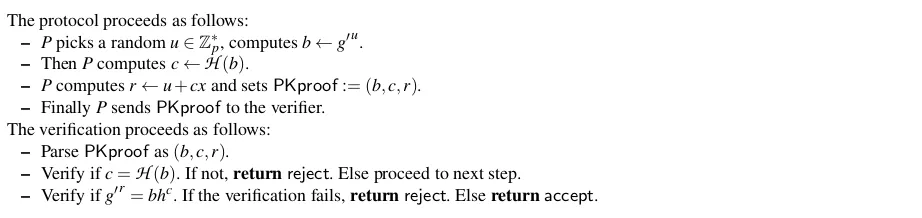
as-sumption, following the style of Schnorr protocols [Sch89]. The construction is non-interactive and uses the Fiat-Shamir transformation [FS87] for efficiency and its security is provable in the random-oracle (RO) model [BR93]. Informally, in the following protocol, the prover P proves to the verifier V that it knows the discrete log of a given value in zero-knowledge. We succinctly represent this protocol as
PK={(h,x):h=g0x}. Let us denote the proof units sent by the proverP to the verifierV as PKproof. We describe the protocol in the RO model in Figure 1, where
H
is a cryptographic hash function viewed as a RO.The protocol proceeds as follows:
– Ppicks a randomu∈Z∗p, computesb←g0 u
.
– ThenPcomputesc←H(b).
– Pcomputesr←u+cxand setsPKproof:= (b,c,r).
– FinallyPsendsPKproofto the verifier. The verification proceeds as follows:
– ParsePKproofas(b,c,r).
– Verify ifc=H(b). If not,returnreject. Else proceed to next step.
– Verify ifg0r=bhc. If the verification fails,returnreject. Elsereturnaccept.
Fig. 1:PK={(h,x):h=g0x}
Characteristic Polynomial.A set
X
={x1, . . . ,xn}with elementsxi∈Zpcan be represented by apolyno-mial following an idea introduced in [FNP04]. The polynopolyno-mialChX(z) =∏ni=1(xi+z) fromZp[z], where z is a formal variable, is called the characteristic polynomial of
X
. In what follows, we will denote this polynomial simply byChX and its evaluation at a pointyasChX(y).The following lemma characterizes the efficiency of computing the characteristic polynomial of a set and of Extended Euclidian algorithm.
Lemma 1 ([PSL76]) Given a set
X
=x1, ...,xn∈Znp, its characteristic polynomialChX :=∑n
i=0cizi∈Zp[z] can be computed with O(nlogn)operations by FFT interpolation.
We will use the following Lemma while proving correctness of coefficients of a polynomial:
Lemma 2 (Schwartz–Zippel) Let p[z],q[z]be two d-degree polynomials fromZp[z]. Then for w←−$ Zp, the
probability that p(w) =z(w)is at most d/p, and the equality can be tested in time O(d).
Ifp∈O(2λ), it follows that the above probability is negligible, ifdispoly(
λ).
Complexity Model.To explicitly measure complexity with respect to the number of primitive cryptographic
Given a collection of sets
Xi
1, . . .Xi
kand their characteristic polynomial representation, we summarize acharacterization of the intersection of the sets in the following lemma.
Lemma 3 ([PTT11]) Set answer is the intersection of the sets
Xi
1, . . .Xi
k if and only if there existspoly-nomials q1[z], . . .qk[z] such that∑j∈[i1,ik]q1[z]P1[z] =1 where Pj[z] =ChXj\answer[z]. Moreover, computing
polynomials qj[z]where j∈[i1,ik]has O(Nlog2Nlog logN)complexity where N=∑j∈[i1,ik]njand nj=|
X
j|.Accumulation tree:Given a collection of setsS={
X
1,X
2, . . . ,X
m}, letacc(X
i)be a succinct representation (constant size) ofXi
using its characteristic polynomial. We describe an authentication mechanism that does the following. A trusted party computes mhash valueshi:=h(acc(X
i)) (using collision resistant crypto-graphic hash function) of them sets ofS. Then given a short public digest information of the current set collectionS, the authentication mechanism provides publicly verifiable proofs of the form “hiis the hash of theithset of the current set collectionS".A popular authentication mechanism for proofs of this form are Merkle hash trees that based on a single value digest can provide logarithmic size proofs and support updates. An alternative authentication mechanism to Merkle trees, (specifically in the bilinear group setting) are accumulation trees [PTT15]. Intuitively, an accumulation tree can be seen as a “flat" version of Merkle trees.
An accumulation tree (AT) is a tree withd1
εelevels, where 0<ε<1 is a parameter chosen upon setup,
andmleaves. Each internal node ofT has degreeO(mε)andT has constant height for a fixed
ε. Each leaf
node contains thehiand each internal node contains the hash of the values of its children. We will describe the setup, query, update and verification of AT in the following algorithms. For simplicity, we skip an explicit key generation phase and describe the keys needed for each algorithm as its input. We have 3 kinds of keys for anAT: the secret key (sk), an evaluation key (ek) derivable from the secret key, which is used by the
ATQueryalgorithm for generating authentication paths, and finally a verification key (vk) corresponding to the secret key, which is used for verification of an authentication path. An accumulation tree schemeAT
is defined as a tuple of 4 PPT algorithms:AT= (ATSetup,ATQuery,ATUpdate,ATVerify). We describe the input and output of each of the algorithms here. To capture the notion of the most recent set collection, we use subscriptt, i.e.,St denotes the set collection at timet. Though this subscript is not necessary to describe these algorithms by themselves, we would need this index when usingATas a subroutine for our zero-knowledge authenticated set collection scheme (ZKASC). A detailed construction from [PTT11] can be found in Appendix A.
Setup:(auth(S0),digest0)←ATSetup(sk,(acc(
X
1), . . . ,acc(Xm)))
ATSetuptakes a secret key (sk) and aset of accumulation values (acc(
X
1), . . . ,acc(Xm)
) for a set collection (S0) and builds an AT on top ofit. This algorithm returns the authentication information for the set collection (auth(S0)) and the root of
the AT as the digest (digest0).
Query:(Πi,αi)←ATQuery(ekt,i,auth(St)) ATQuerytakes the evaluation keyekt, authentication
infor-mation for the set collectionauth(St)and a particular indexiof the set collection and returns the au-thentication path for that set
Xi
, denoted asΠiand the accumulation value of that set asαi.Update:(auth0,digest0,updinfoi)←ATUpdate(sk,i,acc0(
Xi)
,auth(St),digestt) ATUpdate is the update algorithm that updates the accumulation value for a particular setX
i toacc0(X
i). This algorithm takes the old the authentication information for the set collectionauth(St), and the root digestdigestt as input along withacc0(Xi)
. It outputs the updated authentication information for the set collectionauth0, the updated digestdigest0 and the update authentication information (inupdinfoi).For our construction, we will use a variant of the ATUpdate algorithm that allows for batch up-dates. The batch update algorithm ATUpdateBatch takes a series of updated accumulation values (i1,acc0(
X
i1), . . . ,ik,acc0(
X
ik)) instead of one, along with the old authentication information auth(St)
and root digest digestt as input. It outputsauth 0
informa-tion (in(updinfoi1, . . . ,updinfoik)). We describe a construction forATUpdateBatchfromATUpdatein
Appendix A.
Verify:(accept/reject)←ATVerify(vk,digestt,i,Πi,αi) ATVerifyis the verification algorithm that takes the verification key of the scheme vk, digest of the set collection digestt and a particular set indexi along with its authentication path (Πi) and accumulation value (αi) as input and returnsacceptif theαi is indeed the accumulation value of theithset of the collection. It returnsrejectotherwise.
The following lemma summarizes its security and efficiency.
Lemma 4 [PTT11] Under the q-SBDH assumption, for any adversarially chosen authentication pathΠi
for y against an honestly generated digest, digest, such that ATVerify(vk,digest,i,Πi,y) returns accept, it must be that y is the ith element of the tree except for negligible probability. AlgorithmATQuery takes O(mεlogm) and outputs a proof of O(1) group elements and algorithm ATVerify has access complexity
O(1)and algorithmATUpdatehas access complexity O(1).
3 Zero-Knowledge Universal Accumulators
A cryptographic accumulator is a primitive that allows one to succinctly represent a set
X
of elements from a domainX, by a single valueaccfrom a (possibly different) domainA, known as theaccumulation value. Moreover, it provides a way to efficiently and succinctly prove that a candidate elementxbelongs to the set, (to a party that only holdsacc) by computing a constant-size proofw, referred to aswitness.Accumulators were introduced by Benaloh and del Mare in [BdM94] as an alternative to cryptographic signatures for timestamping purposes. The authors provided the first construction in the RSA setting. Later, Baric and Pfitzmann [BP97] refined this construction by strengthening the security notion and Camenisch and Lysyanskaya [CL02] added the property of efficiently updating the accumulation value. More recently, Nguyen [Ngu05] and Camenisch et al. [CCs08] proposed constructions in the prime-order bilinear group setting. Li et al. [LLX07], and Damgård and Triandopoulos [DT08] extended the RSA and bilinear accumu-lator respectively, adding the property to prove non-membership as well. Accumuaccumu-lators that achieve this are referred to asuniversal.
Trusted/untrusted setup.All the above constructions –and the one we provide here– are in the trusted-setup
model, i.e., the party that generates the scheme parameters originally, holds some trapdoor information that is not revealed to the adversary. E.g., for the RSA-based constructions, any adversary that knows the fac-torization of the modulo can trivially cheat. An alternative body of constructions aims to build trapdoorless accumulators (also referred to as strong accumulators) [Nyb96a,Nyb96b,San99,BLL00,CHKO08,Lip12], where the owner is entirely untrusted (effectively the owner and the server are the same entity). Unfortu-nately, the earlier of these works are quite inefficient for all practical purposes, while the more recent ones either yield witnesses that grow logarithmically with the size of
X
or rely on algebraic groups, the use of which is not yet common in cryptography. Alternatively, trapdoorless accumulators can be trivially con-structed from zero-knowledge sets [MRK03], a much stronger primitive. While a scheme without the need for a trusted setup is clearly more attractive in terms of security, it is safe to say that we do not yet have a practical scheme with constant-size proofs, based on standard security assumptions.Moreover, privacy should also hold with respect to updates (insertions or deletions) in the set. That is, an adversary that observes the accumulation and witnesses both before and after an update should learn nothing about the occurred changes, other than the fact that an update occurred –not even whether it was an insertion or deletion.
In the rest of the section, we provide the definition for ZKUA and the corresponding security properties.
Note on definitional style. Traditionally in the literature, a cryptographic accumulator is defined as an
ensemble of families of functions, referring to the function fthat takes as input a set and a seed accumulation value and outputs a new accumulation value. At a high level, the requirements included the existence of an efficient algorithm to sample from the ensemble and that f can be efficiently evaluated. Moreover, f had to be quasi-commutative (i.e., after a series of invocations the final output is order-independent) which yields an efficient way to produce witnesses. Informally, a witness forx∈
X
consists of the evaluation of f on all the other elements of the set (corresponding to the accumulation value ofX
\x). Since f is quasi-commutative, a client can evaluate it using the witness andxand check that it is equal to the set accumulation value produced by the trusted owner. However, in this work we follow the more general definitional style introduced in [FN02], and more recently by [DHS15]. The cryptographic accumulator is described as a tuple of algorithms which is more meaningful in the context of the applications discussed here. The quasi-commutativity property (while satisfied by our construction) is purposely omitted, as there exist more recent constructions of cryptographic accumulators that do not satisfy it but have alternative ways for witness generation (e.g., hash-tree based construction).Auniversal accumulator(UA) consists of four algorithms(GenKey,Setup,Witness,Verify)and it supports queries of the following form: “isx∈
X
?” for elements from a domainX. The response is of the form(b,w) wherebis a boolean value indicating if the element is in the set, i.e.,b=1 ifx∈X
,b=0 ifx∈/X
andwis the corresponding membership/non-membership witness forx.Definition 1 (Universal Accumulator) A universal accumulator is a tuple of four PPT algorithms(GenKey,
Setup,Witness,Verify)defined as follows:
(sk,vk)←GenKey(1λ)
This probabilistic algorithm takes as input the security parameter and outputs a (public) verification key vk that will be used by the client to verify query responses and a secret key sk that is kept by the owner. (acc,ek,aux)←Setup(sk,
X
)This probabilistic algorithm is run by the owner. It takes as input the source set
X
and produces the accumulation valueaccthat will be published to both server and client, and an evaluation key ek as well as auxiliary informationauxthat will be sent only to the server in order to facilitate proof construction. (b,w)←Witness(acc,X
,x,ek,aux)This algorithm is run by the server. It takes as input the evaluation key and the accumulation value ek,accgenerated by the owner, the source set
X
, a queried element x, as input. It outputs a boolean value b indicating whether the element is in the set and a witnesswfor the answer.(accept/reject)←Verify(acc,x,b,w,vk)
This algorithm is run by the client. It takes as input the accumulation valueacc and the public key vk computed by the owner, a queried element x, a bit b, the witnesswand it outputsaccept/reject.
that takes the accumulation value and witness before an update, together with the new accumulation value after the update and produces a corresponding new witness.
Definition 2 (Dynamic Universal Accumulator)A dynamic universal accumulator is a tuple of five PPT
algorithms,DUA= (GenKey,Setup,Witness,Verify,Update)defined as follows:
(GenKey,Setup,Witness,Verify)as in Definition 1. (acc0,ek0,aux0)←Update(acc,
X
,x,sk,aux,upd)This algorithm takes as input the current set with its accumulation value and auxiliary information, as well as an element x to be inserted to
X
if upd=1 or removed fromX
if upd=0. If upd=1 and x∈X
, (likewise ifupd=1and x∈/X
) the algorithm outputs⊥and halts, indicating an invalid update. Otherwise, it outputs (acc0,ek0,aux0) where acc0 is the new accumulation value corresponding to setX
∪ {x}orX
\ {x}(to be published), ek0is the (possibly) modified evaluation key, andaux0is respective auxiliary information (both to be sent only to the server).(upd,w0)←WitUpdate(acc,acc0,x,w,y,ek0,aux,aux0,upd)
This algorithm is to be run after an invocation of Update. It take as input the old and the new accu-mulation values and auxiliary informations, the evaluation key ek0 output by Update, as well as the element x that was inserted or removed from the set, according to the binary value upd(the same as in the execution ofUpdate). It also takes a different element y and its existing witnessw(that may be a membership or non-membership witness). It outputs a new witness w0 for y, with respect to the new set
X
0as computed after performing the update. The output must be thesameas the one computable by runningWitness(acc0,X
0,y,ek0,aux0).In terms of efficiency, the focus is on the owner’s ability to quickly compute the new accumulation value after a modification in the set (typically with most existing constructions, the presence of the trapdoor information makes this achievable with a constant number of group operations). Slightly more formally, the runtime of
Update must be asymptotically smaller than that of Setup on the updated set. An even more attractive property is the ability to update existing witnesses efficiently (i.e., not recomputing them from scratch) after an update occurs, withWitUpdate. As a last remark, we point out that the ability to do this for positive witnesses is inherently more important than that of non-membership witnesses. The former corresponds to the (polynomially many) values in the set whereas the latter will be exponentially many (or infinite). A server that wants to cache witness values and update them efficiently can thus benefit more from storing pre-computed positive witnesses than negative ones (that are less likely to be used again).
Early cryptographic accumulator constructions had deterministic algorithms; once the trapdoor was cho-sen each set had a uniquely defined accumulation value. As discussed at the end of this section, the conse-quent introduction of privacy requirements led to constructions whereSetupandUpdateare randomized, which, in turn, introduced the natural distinction of accumulators into deterministic and randomized. In fact, any deterministic accumulator trivially fails to meet even weak privacy notions: An adversary that suspects that set
X
is the pre-image of a given accumulation value can test this himself. In order to achieve the wanted zero-knowledge property, our definition also refers to randomized schemes but, to simplify notation, we omit randomness from the input (unless otherwise noted).Another important point is which parties can run each algorithm. The way we formulated our definition,
the more general framework where the adversary is given oracle access to these algorithms, that captures both cases.
3.1 Security Properties
The first property we require from a cryptographic accumulator is completeness, i.e., a witness output by any sequence of invocations of the scheme algorithms, for a valid statement (corresponding to the state of the set at the time of the witness generation) is verified correctly with all but negligible probability.
Definition 3 (Completeness) Let
X
i denote the set constructed after i invocations of theUpdatealgorithm(starting from a set
X
0) and likewise for eki,auxi. A dynamic universal accumulator is secure if, for all setsX
0where|X
0|and and l≥0polynomial inλand all xi∈X, for0=1, . . . ,l, there exists a negligible functionν(λ)such that:
Pr
(sk,vk)←GenKey(1λ);(ek
0,acc0,aux0)←Setup(sk,
X
0);{(acci+1,eki+1,auxi+1)←Update(acci,
Xi
,xi,sk,auxi,updi)}0≤i≤l (b,w)←Witness(accl,X
l,x,ekl,auxl):Verify(accl,x,b,w,vk) =accept
≥1−ν(λ)
where the probability is taken over the randomness of the algorithms.
In the above we purposely omitted theWitUpdatealgorithm that was introduced purely for efficiency gains at the server. In fact, recall that we restricted it to return the exact same output as Update (run for the corresponding set and element) hence the valuewin the above definition might as well have been computed during an earlier update and subsequently updated by (one or more) calls ofWitUpdate.
The second property is soundness which captures that fact that adversarial servers cannot provide ac-cepting witnesses for incorrect statements. It is formulated as the inability of Adv to win a game during which he is given oracle access to all the algorithms of the scheme (except for those he can run on his own using ek,aux–see discussion on private versus public setup and updates above) and is required to output such a statement and a corresponding witness.
Definition 4 (Soundness) For all PPT adversariesAdvrunning on input1λand all l polynomial in
λ, the
probability of winning the following game, taken over the randomness of the algorithms and the coins of
Advis negligible:
Setup The challenger runs(sk,vk)←GenKey(1λ)and forwards vk toAdv. The latter responds with a set
X
0. The challenger runs(ek0,acc0,aux0)←Setup(sk,X
0)and sends the output to the adversary.Updates The challenger initiates a list
L
and inserts the tuple (acc0,X
0). Following this, the adversaryissues update xi and receives the output ofUpdate(acci,
X
i,xi,sk,auxi,updi) from the challenger, for i=0, . . . ,l. After each invocation ofUpdate, if the output is not⊥, the challenger appends the returned (acci+1,Xi
+1)toL
. Otherwise, he appends(acci,Xi)
.Challenge The adversary outputs an index j, and a triplet(x∗,b∗,w∗). Let
L
[j]be(accj,X
j). The adversary wins the game if:Verify(accj,x∗,b∗,w∗,vk) =accept∧((x∗∈
X
j∧b∗=0)∨(x∗∈/X
j∧b∗=1))discussion on the winning conditions of the game is due here. This property (also referred to as collision-freeness) was introduced in this format in [LLX07] and was more recently adapted in [DHS15] with slight modifications. In particular, Adv outputs set
X
∗ and accumulation value acc∗ as well as the randomnessAn alternative, more demanding, way to formulate the game is to require that the adversary wins if he outputs two accepting witnesses for the same element and with respect to the same accumulation value (without revealing the pre-image set): a membership and a non-membership one. This property, introduced in the context of accumulators in [BLL00], is known asundeniabilityand is the same as the privacy property of zero-knowledge sets. Recently, Derler et al. [DHS15] showed that undeniability is a stronger property than soundness. However, existing constructions for undeniable accumulators are in the trapdoor-less setting (with the limitations discussed above); since our construction is the trusted setup setting, we restrict our attention to soundness. This should come as no surprise, as undeniability allows an adversary to provide a candidate accumulation value, without explicitly giving a corresponding set. In a three-party setting (with trusted setup) the accumulation value is always maintained by the trusted owner; there is no need to question whether it was honestly computed (e.g., whether he knows a set pre-image or even whether there exists one) hence undeniability in this model is an “overkill” in terms of security (see also the related discussion in Section 4.3).
The last property is zero-knowledge. As we already explained, this notion captures that even a malicious client cannot learn anything about the set beyond what he has queried for. We formalize this in a way that is very similar to zero-knowledge sets (e.g, see the definition of [CHL+05]) appropriately extended to handle not only queries but also updates issued by the adversary. We require that there exists a simulator such that no adversarial client can distinguish whether he is interacting with the algorithms of the scheme or with the simulator that has no knowledge of the set or the element updates that occur, other than whether a queried element is in the set and whether requested updates are valid.
Definition 5 (Zero-Knowledge) Let D be a binary function for checking the validity of queries and updates
on a set. For queries, D(query,x,
X
)) =1iff x∈X
. For updates D(update,x,c,X
)) =1iff(c=1∧x∈/X
) or(c=0∧x∈X
). LetRealAdv(1λ),IdealAdv,Sim(1λ)be games between a challenger, an adversaryAdvanda simulatorSim= (Sim1,Sim2), defined as follows: RealAdv(1λ):
Setup The challenger runs(sk,vk)←GenKey(1λ)and forwards vk toAdv. The latter chooses a set
X
0
with|
X
0| ∈poly(k)and sends it to the challenger who in turn responds withacc0output by runningthe algorithmSetup(sk,
X
0). Finally, the challenger sets(X
,acc,aux)←(X
0,acc0,aux0).Query For i=1, . . . ,l, where l∈ poly(λ), Adv outputs (op,xi,ci) where op∈ {query,update} and ci∈ {0,1}:
Ifop=query: The challenger runs(b,wi)←Witness(acc,
X
,xi,ek,aux)and returns the output toAdv.
Ifop=update: The challenger runsUpdate(acc,
X
,xi,sk,aux,ci). If the output is not⊥he updates the set accordingly to getXi
, sets(X
,acc,ek,aux)←(Xi
,acci,eki,auxi)and forwardsacctoAdv. Else, he responds with⊥.Response The adversary outputs a bit d.
IdealAdv(1λ):
Setup The simulator Sim1, on input 1λ, forwards vk to Adv. The adversary chooses a set
X
0 with
|
X
0| ∈poly(λ).Sim1(without seeingX
0) responds withacc0and maintains statestateS. Finally, let (X
,acc)←(X
0,acc0).Query For i=1, . . . ,lAdvoutputs(op,xi,ci)whereop∈ {query,update}and ci∈ {0,1}:
Ifop=query: The simulator runs(b,wi)←Sim2(acc,xi,stateS,D(query,xi,
X
))and returns the output toAdv.Ifop=update: The simulator runs Sim2(acc,stateS,D(update,xi,ci,
X
)). If the output of D(update,xi,ci,X
)is 1, letX
←X
i∪xi in the case c1=1andX
←X
i\xi in the case c1=0that is however never observed by the simulator. The simulator responds toAdvwithacc0. If the response acc0is not⊥thenacc←acc0.
Response The adversary outputs a bit d.
A dynamic universal accumulator is zero-knowledge if there exists a PPT simulator Sim= (Sim1,Sim2)
such that for all adversariesAdvthere exists negligible functionνsuch that:
|Pr[RealAdv(1λ) =1]−Pr[IdealAdv(1λ) =1]| ≤ν(λ).
If the above probabilities are equivalent, then the accumulator is perfect zero-knowledge. If the inequality only holds for PPTAdv, then the accumulator is computational zero-knowledge.
Observe that, even thoughAdvmay be unbounded (in the case of statistical or perfect zero-knowledge) the size of the set is always polynomial in the security parameter; in fact it is upper bounded byO(|
X
0|+l). Thisensures that we will have polynomial-time simulation, matching the real-world execution where all parties run in polynomial-time. Having computationally unbounded adversaries is still meaningful; such a party may, after having requested polynomially many updates, spend unlimited computational resources trying to distinguish the two settings.
While trying to provide a formal notion of privacy for cryptographic accumulators, the fact that the ac-cumulation value computation must be randomized becomes evident. IfSetupis a deterministic algorithm, then each set has a uniquely defined accumulation value (subject to particularsk) that can be easily repro-duced by any adversary even with oracle access to the algorithm. This observation has already been made in [dMLPP12,dMPPS14,DHS15].
4 Relation to Other Definitions
In this section, we discuss the relation of zero-knowledge accumulators with the existing notion of indistin-guishable accumulations as well as with other cryptographic primitives.
4.1 Zero-knowledge implies indistinguishability (for accumulators)
The notion of zero-knowledge defined here is a strengthening of the indistinguishability property introduced in [DHS15]. There the authors introduce a notion similar to ours that also requires the accumulation value produced bySetupto be randomized. If we restrict our attention to static accumulators, the effect of both notions is the same, i.e., the clients see a randomized accumulation value and corresponding “blinded” witnesses.
However, while the indistiguishability game entails updates, it inherently does not offer any privacy for the elements inserted to or removed from the set, as theUpdatealgorithm is deterministic. At a high level, that notion only protects the original accumulated set and not subsequent updates. We believe this is an important omission for a meaningful privacy definition for accumulators, as highlighted by the following example. Consider, for example, a third-party adversary that observes the protocol’s execution before and after an insertion (or deletion) update. If the adversary has reasons to suspect that the inserted (or deleted) value may be y, he can always test that. A very realistic example of this behavior is a setting where the accumulator is used to implement a revocation list. In that case an adversary may want to know if his fake certificate (valueyin the above case) has been “caught” yet.
We provide the following result6:
deter-Theorem 1 Every zero-knowledge dynamic universal accumulator is also indistinguishable under the defi-nition of [DHS15], while the opposite is not always true.
Proof.We first show that every scheme that is zero-knowledge is also indistinguishable. Then we show that
the construction of [DHS15] is not zero-knowledge.
ZK⇒IND: We prove this direction by contradiction. Assume there exists an accumulator that is zero-knowledge but not indistinguishable. Then, there exists PPT adversaryAdvthat wins the indistinguisha-bility game.Advgives two sets
X
0,X
1 to a challenger who flips a coinband provides oracle access to Advfor the algorithms with respect toXb
. By assumption,Advcan output a bitb0correctly guessingb with non-negligible advantageεover 1/2. The (natural) constraint is thatAdvcannot issue a query (orupdate request) that is trivially revealing the chosen set (e.g., ifx∈
X
0andx6∈X
1,Advis not allowed to query forx). We defer interested readers to [DHS15] for a formal definition of the indistinguishability game.We will now construct PPT adversary Adv0 that breaks the zero-knowledge property of the scheme as follows.Adv0on input 1λ,vkrunsAdvwith the same input and receives sets
X
0,
X
1. He then forwardsX
1as the challenge for the zero-knowledge game and receives accumulation valueacc0, which he forwards toAdv. Consequently, he responds to all messages ofAdv(queries and updates) with calls to the zero-knowledge game interface and forwards all responses back toAdv. Finally, he outputs the output bitb0 ofAdv.
Firstly, observe thatAdv0 is clearly PPT, sinceAdv is PPT. Now let us argue about his success proba-bility in distinguishing between real and ideal interaction. Observe that, ifAdv0 is interacting with the algorithms of the scheme (i.e., is playing the real game), the interface he is providing to Advis a per-fect simulation of the indistinguishability game forb=1. On the other hand, if he is interacting with
Sim, the view of the latter during this interaction is exactly the same independently of whether the set chosen by Adv0 is
X
0 orX
1. Hence, the view offered toAdv is the same in both cases, and thereforePr[b0=1] =Pr[b0=0] =1/2. LetE be the event that theAdv0 is playing the real game (and likewise for the complement Ec). From the above analysis (recall thatAdv0outputs the bitb0 returned byAdv), it holds that Pr[b0 =1|E]>1/2+ε and Pr[b0 =1|Ec] =1/2. This implies that Adv0 can distinguish
between the two executions with non-negligible probability, breaking the zero-knowledge property of the scheme. The claim follows by contradiction.
IND6 ⇒ZK: In the construction of [DHS15], given the accumulationaccof set
X
, the accumulation valueacc0 of set
X
∪x, forx6∈X
, is computed via a deterministic Updatealgorithm, that is executable in polynomial time even without access to the trapdoor (and similarly for a deletion).Assume now an adversary Adv that simply observes query execution and the accumulation value throughout the protocol, and wants to deduce whether value xis added to the set after a given update.
Advproceeds as follows (assumingaccis the accumulation state pre-update andacc0the one published afterwards). After each update, runUpdateon inputx,accto receiveacc00. Check whetheracc00=acc0. If so, deduce thatxwas inserted, otherwise not. This clearly violates zero-knowledge. Recall that in the ideal game the simulator does not get access to the inserted (or deleted) element. Since the update algo-rithm is deterministic, givenaccandxthere exists a unique output accumulation value, and the simulator thus has negligible probability to emulate the real interaction.
This concludes our proof.
The indistinguishability property of [DHS15] is a strengthening of a notion introduced in [dMLPP12]. The latter was the first work to formally define a privacy property for cryptographic accumulators, however their definition had inherent problems, e.g., it was easy to prove that deterministic accumulators –that clearly were not private– satisfied it. Another technique for providing privacy to cryptographic accumulators was proposed earlier in [LLX07], without a formalization. The idea is to simply produce a randomized accumu-lation value for a set
X
by choosing at random an elementxfrom the elements universe duringSetupand outputting the accumulation of setX
∪ {x}. This generic mechanism will work for any static accumulator, but will also not protect updates. Moreover it weakens soundness as an adversary could potentially produce a membership witness for the elementx6∈X
. Out approach does not suffer from such issues as there is no additional element accumulated and the randomnessrused to blind the accumulation value duringSetupis explicitly given to the server without compromising soundness.Contrary to [DHS15], our zero-knowledge property provably protects not only the original set but also all subsequent updates. In fact, the only thing that an adversary (client or third-party) learns is that an update happened; not even whether the update was an insertion or deletion! Liskov in [Lis05] achieved a weaker notion of privacy for updates (called update transparency), in the model of zero-knowledge databases, that relies on assigning a pseudonym patternN(x)to each elementxand leaks not only the fact that an update occurred but also an associated pseudonym. The author conjectures that the use of pseudonyms is unavoid-able in order to achieve non-membership witnesses; here we show that this is not necessarily true, albeit in the more restricted three-party setting of cryptographic accumulators.
Finally, Theorem 1 implies that our construction from Section 5, is also the only known algebraic con-struction of a universal indistinguishable accumulator. The two schemes of [DHS15] are a black-box reduc-tion from the stronger primitive of zero-knowledge sets, and a construcreduc-tion similar to ours that only offers membership witnesses.
4.2 Relation to other primitives
Next we turn our attention to how zero-knowledge accumulators compare against other similar cryptographic primitives. We present a mapping of the research literature for the construction of cryptographic proofs for set-membership and non-membership, which has attracted significant attention lately. This is far from a complete presentation of results in the area; we focus on the relation between those primitives that are most closely related to the problem, avoiding general approaches (e.g., general-purpose zero-knowledge protocols) or related models that address similar problems (such as group signatures, e.g., [ACJT00]).
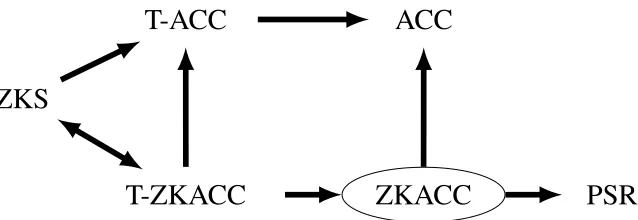
The overall picture for the static case (i.e., without assuming changes in the set) can be seen in Figure 2. Arrows denote implication, e.g., an arrow fromA toBtranslates to “Bcan be built in black-box manner fromA”. Likewise, double-sided arrows denote equivalence of definitions, i.e., both can be constructed in a black-box manner from each other.
Zero-knowledge sets are a stronger primitive than accumulators; they satisfy the same soundness prop-erty with trapdoorless accumulators but they additionally offer privacy. Hence they are a starting point for our mapping, since they can be used to build the other primitives.
In Section 3, we already discussed trapdoorless (or strong) accumulators. If a scheme is a trapdoorless accumulator it is secure with an untrusted setup execution, therefore (and quite trivially) it is also secure with a trusted setup, hence it is a also an accumulator.
ZKS
T-ACC
T-ZKACC
ACC
ZKACC
PSR
Fig. 2: Relations among cryptographic primitives for proof of membership and non-membership (static case). ZKS: zero-knowledge sets, ACC: trapdoorless accumulators, ACC: accumulators, T-ZKACC: trapdoorless zero-knowledge accumulators, T-ZKACC: our zero-knowledge accumulators (circled), PSR: primary-secondary-resolver membership proof systems.
unsurprisingly– ended up with zero-knowledge sets. We stress that latter exist in the common reference string model (or the trusted parameters model) hence thismustalso be true for trapdoorless zero-knowledge accumulators (e.g., a trusted authority runs the key-generation algorithm and publishes the result as a com-mon reference string). On the contrary, this is not necessary for trapdoorless accumulators (without privacy) since the security game there is one-sided; the client can perform key-generation himself. As a final note, we point out, that zero knowledge (trapdoorless) accumulators imply (trapdoorless) accumulators since the former satisfy a strict superset of the security properties of the latter.
This equivalence of zero-knowledge sets and trapdoorless zero-knowledge accumulators can be useful in two ways: (i) more efficient (e.g., with smaller proof sizes) zero-knowledge sets may be achievable with techniques borrowed from the accumulators literature, and (ii) an impossibility result in one of the two models is translatable to the other. This holds, for example, in the case of the batch-update impossibility for accumulators of [CH10] and the lower bound for online public-key operation of [GNP+14]. We want to stress that our construction in Section 5 is not trapdoorless; to the best of our knowledge, the best known way to construct trapdoorless zero-knowledge accumulators is via a black-box reduction from zero-knowledge sets.
Another related primitive are primary-secondary-resolver membership proof systems (PSR) introduced in [NZ14]. Their privacy notion a relaxation defined as functional zero-knowledge, i.e., the simulator is allowed to learn some function of the set (typically its size). Also, the games in the PSR definition are non-adaptive in the following sense:Advneeds to declare its cheating set before he even receives the cor-responding keys (ek,vkfor soundness and only vkfor zero-knowledge –using our terminology)7. For the above reasons, while it is trivial that zero-knowledge accumulators imply PSR (where the leaked function is void), the other direction is generally not true. We stress that the above distinction between adaptive and selective security does not hold in the dynamic setting. There an adversary may declare a cheating set origi-nally, receive the keys, and then modify his choice via a series of update calls (see, however, our discussion for this setting in the next paragraph).
Our results here are complementary to the relations proven in [NZ14]. There, the authors prove that PSR systems exist, if and only if, one-way functions exist, which in turn implies that zero-knowledge sets cannot be built in a black-box manner from PSR.
Dynamic setting.Once we move to the dynamic setting, where there exist efficient algorithms for modifi-cations in the set, the relations are largely the same as in Figure 2, but some clarifimodifi-cations are in order.
Firstly, the only work addressing updatable zero-knowledge sets is [Lis05], where two notions of privacy are introduced: opacity and transparency. The relations between definitions hold with respect to opacity. We defer the interested reader to that work for an in-detail discussion of the two properties. Here, we will only mention that an (efficient) construction for opaque zero-knowledge sets remains an open problem. On the other hand, when restricted to the three-party model (i.e., with trusted setup), it can be shown that our construction from Section 5 (with minor modifications) satisfies the opacity property.
Regarding the relation between zero-knowledge accumulators and PSR, matters are also straight-forward as the latter are explicitly defined only for the static case. In [NZ14], the authors recommend the usage of techniques from certificate-revocation lists [NN00], as an additional external mechanism to accommodate updates. Contrary to this, our definitional approach is to make update-handling mechanisms explicitly part of the scheme. In this sense, zero-knowledge accumulators are a natural definitional extension of PSR in the dynamic setting. That said, we explicitly require that clients can at all times access the latest accumulation value, which would not be the case following the revocation scheme approach. We stress however that this does not necessitate authenticated channels between owner and clients; in practice it is achievable with a “timestamp-sign-and-publish” from the owner.
4.3 Relation to zero-knowledge authenticated data structures
Zero-knowledge accumulators can be seen as a straight-forward relaxation of zero-knowledge sets in the three-party model, i.e., in a honest-committer setting. The set is at all times maintained by a trusted party (the owner) that oversees insertions and deletions checking their validity. This is strongly reflected in the security property: Soundness in zero-knowledge sets (ZKS) does not require that the prover produces a commitment pre-image; indeed the prover may not even know such a set. On the other hand, soundness for zero-knowledge accumulators (trapdoorless) is defined as the inability of an adversary to produce a particular set and an element and a satisfying witness for a false statement. This stems from the fact that the trusted owner “authenticates” that the accumulation value known to clients (corresponding to the commitment in the case of ZKS) is indeed honestly computed, i.e., it corresponds to executing setup (and possibly update) on a known set. With that observation in mind, we can say that zero-knowledge accumulators are, in a sense, zero-knowledge authenticated sets. We note that a similar observation was made by [GOT14] who addressed the problem of order queries on a list in both two-party and three-party settings. Their three-party model (privacy-preserving authenticated list(PPAL)) is also a similar relaxation of their two-party model (zero-knowledge list(ZKL)) .
This in turn, highlights the relation of knowledge accumulators with the framework of zero-knowledge authenticated data structures (ZK-ADS), recently introduced in [GGOT15].8 ZK-ADS extend
the well-known primitive of authenticated data structures (ADS) adding an additional zero-knowledge prop-erty. The setting is the standard three-party model but now the supported type may be any kind of data structure. The choice of data structure defines the kind of data stored and the type of supported queries. In [GGOT15], the authors provided constructions for various types of data structures, in particular for a zero-knowledge authenticated list (i.e., a data structure that supports “insert-after”, “delete” operations, as well as “order” queries), a tree, and a partially-ordered set (poset) of bounded dimension. Consequently, a zero-knowledge accumulator (or zero-knowledge authenticate set, as discussed above) is a type of ZK-ADS where the data structure is a set of elements supporting –unordered– insertions and deletions, and membership/non-membership queries.
The above constructions are the only ZK-ADS instantiations in the literature so far. One natural way to extend zero-knowledge authenticated sets to accommodate more elaborate query types is by allowing
for set-operations beyond (non-)membership. In particular, consider a data structure, called set collection, that consists of a collection of sets and accommodates operations among (a subset of) them. We stress that a construction that accommodates set unions, intersection and differences, allows for a complete set-operation algebra (building any possible “circuit” of set-set-operations9). In Section 6 we provide a definition ofzero-knowledge authenticated set collection, in the style of [GGOT15], and in Section 7 we provide the corresponding construction (which naturally uses our zero-knowledge authenticated set construction from Section 5 as a building block).
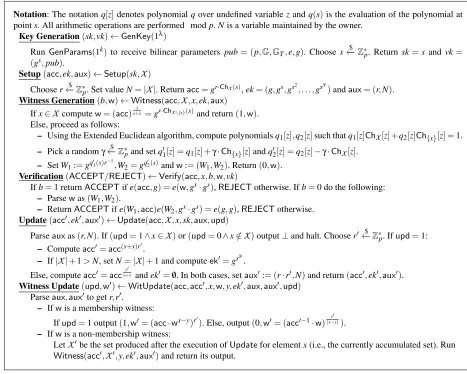
5 A Zero-knowledge accumulator from theq-Strong Bilinear Diffie-Hellman Assumption
In this section we present our construction for a zero-knowledge dynamic universal accumulator. It builds upon the bilinear accumulator of Nguyen [Ngu05], adopting some of the techniques of [DHS15] that we further expand to achieve zero-knowledge. It supports sets with elements fromZp\ {s}where p is prime andp∈O(2λ)andsis the scheme trapdoor. Note that, the fact that the elements must be of logpbits each,
is not a strong limitation of the scheme; one can always apply a collision-resistant hash function that maps arbitrarily long strings toZp. The description of the scheme can be seen in Figure 3.
Observe that the keyvkpublished from the key-generating algorithm, reveals nothing for the set itself. The accumulation value produced bySetupis the standard bilinear accumulation value of [Ngu05] which is now blinded by a random valuer, also revealed to the server. Witness generation for both cases utilizes this randomnessr. For membership queries, the process is the same as in [Ngu05,DT08] with one additional exponentiation withrfor privacy purposes.
The major deviation occurs in the non-membership case. As previously discussed, there are existing works [DT08,ATSM09] that enhance the bilinear accumulator to provide non-membership witnesses. Their technique is a complement of the one used for the membership case. At a high level, it entails proving that the degree-one polynomialx+zdoes not divideChX[z], by revealing the scalar (i.e., zero-degree polynomial) remainder of their long division. Unfortunately, using this approach here entirely breaks the zero-knowledge property: It essentially reveals r (multiplied by an easily computable query-specific value) to any client. Instead, we adopt an entirely different approach. Our scheme uses the set-disjointness test, first proposed by Papamanthou et al. [PTT11], in order to prove non-membership of a queried element x. In order to prove thatx6∈
X
, the server proves the equivalent statementX
∩ {x}=0/. The different nature of the proved statement allows us to use fresh query-specific randomnessγtogether withr to prove non-membership inzero-knowledge.
Verification is also different in the two cases, but always very efficient. Finally, the way updates are handled is especially important as it is another strong point of divergence from previous schemes that seek to provide privacy. After each update, a fresh randomnessr0 is used to blind the new accumulation value. Indeed this re-randomization technique that perfectly hides the nature of the change in
X
is what allows us to achieve our strong notion of zero-knowledge. Observe that, at all times, the owner maintains a variableN which is the maximum set-cardinality observed up to that point (through the original setup and subsequent insertions). When an insertion occurs that increasesN (by one), then the owner provides to the server one additional ekcomponent, that is necessary to the latter for subsequent witness generation. This is a slight deviation from our notation in Section 3 where the new key produced fromUpdatereplaces the previous ek. Instead the new evaluation key must be set toek∪ek0. This difference has no meaningful impact in the security of our scheme; we could always haveUpdateoutput the entire old key together with the additional element. From an efficiency perspective though, that overly naive approach would requireUpdateto run in time linear toN.Notation: The notationq[z]denotes polynomialqover undefined variablezandq(s)is the evaluation of the polynomial at points. All arithmetic operations are performed modp.Nis a variable maintained by the owner.
Key Generation(sk,vk)←GenKey(1λ)
Run GenParams(1k) to receive bilinear parameters pub= (p,
G,GT,e,g). Chooses
$
←−Z∗p. Returnsk=s andvk=
(gs,pub).
Setup(acc,ek,aux)←Setup(sk,X)
Chooser←−$ Z∗p. Set valueN=|X|. Returnacc=gr·ChX(s),ek= (g,gs,gs
2
, . . . ,gsN)andaux= (r,N).
Witness Generation(b,w)←Witness(acc,X,x,ek,aux)
Ifx∈X computew= (acc)s+1x =gr·ChX\{x}(s)and return(1,w).
Else, proceed as follows:
– Using the Extended Euclidean algorithm, compute polynomialsq1[z],q2[z]such thatq1[z]ChX[z] +q2[z]Ch{x}[z] =1.
– Pick a randomγ←−$ Z∗pand setq10[z] =q1[z] +γ·Ch{x}[z]andq02[z] =q2[z]−γ·ChX[z].
– SetW1:=gq01(s)r−1,W2=gq02(s)andw:= (W1,W2). Return(0,w).
Verification(ACCEPT/REJECT)←Verify(acc,x,b,w,vk)
Ifb=1 returnACCEPTife(acc,g) =e(w,gx·gs),REJECTotherwise. Ifb=0 do the following: – Parsewas(W1,W2).
– ReturnACCEPTife(W1,acc)e(W2,gx·gs) =e(g,g),REJECTotherwise.
Update(acc0,ek0,aux0)←Update(acc,X,x,sk,aux,upd)
Parseauxas(r,N). If(upd=1∧x∈X)or(upd=0∧x∈/X)output⊥and halt. Chooser0←−$ Z∗p. Ifupd=1: – Computeacc0=acc(s+x)r0.
– If|X|+1>N, setN=|X|+1 and computeek0=gsN. Else, computeacc0=accr
0
s+x andek0=0/. In both cases, setaux0:= (r·r0,N)and return(acc0,ek0,aux0).
Witness Update(upd,w0)←WitUpdate(acc,acc0,x,w,y,ek0,aux,aux0,upd)
Parseaux,aux0to getr,r0.
– Ifwis a membership witness:
Ifupd=1 output(1,w0= (acc·wx−y)r0). Else, output(0,w0= (acc0−1·w)
r0 (x−y)). – Ifwis a non-membership witness:
LetX0be the set produced after the execution ofUpdatefor elementx(i.e., the currently accumulated set). Run
Witness(acc0,X0,y,ek0,aux0)and return its output.
Fig. 3: Zero-knowledge Dynamic Universal Accumulator Construction
Regarding witness updates, observe that for the (more meaningful, as discussed in Section 3) case of membership witnesses there indeed exists a fast method. On the other hand, for non-membership witness updates, our scheme resorts to re-computation from scratch.
Efficiency. We discuss the asymptotic complexity of the algorithms of our construction. Letnbe the car-dinality of the set at any given time.GenKeyruns in time poly(λ). The algorithmSetupruns has access
complexity O(n) since a degree n polynomial can be evaluated in that many operations, and ek takes n consecutive exponentiations. From Lemma 1, computing the characteristic polynomial of a set of size n takes O(nlogn), hence this is the overall complexity for membership witness generation. Computing a non-membership witness takes O(nlog2nlog logn), due to the complexity of the Extended Euclidean al-gorithm execution. The witnesses consist ofO(1)elements from Gand verification requires can be done withO(1)operations. Finally,Updatehas access complexityO(1), membership witness updates can also be achieved inO(1), and non-membership witness updates take as long as fresh witness generations, i.e., O(nlog2nlog logn).
![Fig. 4: This table compares the access complexity of each operation with that of [PTT11]](https://thumb-us.123doks.com/thumbv2/123dok_us/7937256.1317774/35.612.168.443.121.306/fig-table-compares-access-complexity-operation-ptt.webp)
