Khudra
Block Cipher
Xiaoshuang Ma1,2Kexin Qiao1,2
1State Key Laboratory of Information Security, Institute of Information Engineering,
Chinese Academy of Sciences, Beijing 100093, China 2Data Assurance and Communication Security Research Center,
Chinese Academy of Sciences, Beijing 100093, China
{xshma13,kxqiao13}@is.ac.cn
Abstract. Khudrais a block cipher proposed in the SPACE’2014 conference, whose main design goal is to achieve suitability for the increasingly popular Field Pro-grammable Gate Array (FPGA) implementation. It is an 18-round lightweight cipher based on recursive Feistel structure, with a 64-bit block size and 80-bit key size. In this paper, we compute the minimum number of active F-functions in differential characteristics in the related-key setting, and give a more accurate measurement of the resistance ofKhudraagainst related-key differential cryptanalysis. We construct a related-key boomerang quartet with probability 2−48for the 14-roundKhudra, which is better than the highest probability related-key boomerang quartet of the 14-round
Khudra of probability at most 2−72 claimed by the designers. Then we propose a related-key rectangle attack on the 16-roundKhudra without whitening key by con-structing a related-key rectangle distinguisher for 12-roundKhudrawith a probability of 2−23.82. The attack has time complexity of 278.68memory accesses and data com-plexity of 257.82 chosen plaintexts, and requires only four related keys. This is the best known attack on the round-reducedKhudra.
Keywords: Khudra block cipher, rectangle attack, related-key attack
1
Introduction
Differential cryptanalysis was first proposed by Biham and Shamir in [5] and is one of the most powerful attacks on block ciphers. Differential cryptanalysis analyzes differential propagation patterns of a cipher to discover its non-random behaviors, and uses these be-haviors to build a distinguisher or recover the key. Under the model of related-key attack [1], which considers the information extracted from the two encryptions under two related keys, related-key differential attack [11] allows the attacker to operate differences not only in the plaintexts, but also in keys, though the key values are initially unknown.
For differential attacks, finding out differential characteristics with high probabilities is of great importance, and there are several ways to try a good searching for such differential characteristics. After the Mixed-Integer Linear Programming (MILP) technique was used to analyze ciphers [6], Mouhaet al. [15] and Wuet al. [21] proposed MILP based techniques to find automatically a lower bound of the number of differentially active S-boxes of word-oriented symmetric ciphers. Later, Sunet al.[17, 19] and Qiao et al.[16] improved Mouha
The rectangle-boomerang style attacks [2, 10, 20] are clever extensions of differential cryptanalysis. In a rectangle-boomerang style attack, the cipher is treated as a cascade of two ciphers, where differential with high probability is used in each of these sub-ciphers. The aim of the attack is to benefit from the slow mixing in reduced round versions of the cipher attacked. The rectangle attack [2] is transited from the boomerang attack [20], and the amplified boomerang attack [10] considers all possible intermediate differences and significantly increases the probability of a right quartet, easing the requirements to a chosen plaintext attack instead of adaptive chosen plaintext and ciphertext attack.
To improve the results of the rectangle attack, Bihamet al.[3] proposed a new algorithm and a generic way for launching key recovery attacks and calculating the time and data complexity with boomerang or rectangle distinguishers. In this paper, we will combine the rectangle attack with related-key differentials we found to give an analysis on the 16-round
Khudra block cipher.
The Khudra block cipher [13] was proposed by Kolay et al. in the SPACE’2014 con-ference. It is a lightweight cipher suitable for Field Programmable Gate Array (FPGA) implementation. Khudra is an 18-round block cipher based on the recursive generalized Feistel structure, and has a 64-bit block size and 80-bit key size. In this paper, we will firstly compute the minimum number of activeF-functions in the related-key differential character-istics ofKhudra, and give a more accurate measurement of the resistance ofKhudra against differential cryptanalysis. We will construct a related-key boomerang quartet of probability of 2−48 for the 14-round Khudra, while the designers of Khudra claimed that the highest probability related-key boomerang quartets of 14-roundKhudrahave the probability at most 2−72. Then we will propose a related-key rectangle attack on the 16-roundKhudra without whitening key by constructing a related-key rectangle distinguisher for 12-round Khudra
with a probability of 2−23.82. The attack has time complexity of 278.68 memory accesses, 259.77encryptions,and 257.72decryptions, and data complexity of 257.82 chosen plaintexts.It
requires only four related keys. This is the best known attack on the round-reducedKhudra.
Organization of the paper.We give a brief introduction ofKhudra in Section 2, and present our analysis result on Khudra against related-key differencial attack in Section 3. In Section 4, we firstly describe the construction of the related-key rectangle distinguishers, and then introduce our related-key rectangle attack on round-reducedKhudra. Finally we conclude the paper in Section 5.
2
Description of
Khudra
In this section, we briefly recall the design of the block cipher Khudra and we refer the readers to [13] for more details.
Khudra is a lightweight block cipher suitable for resource-constrained devices. The de-signers ofKhudra have shown that the strategies for designing lightweight block cipher on Application Specific Integrated Circuits (ASICs) are not suitable for Field Programmable Gate Arrays (FPGAs). They have identified new methods and design criteria for designing lightweight block ciphers on FPGAs.Khudra is an actual practice of these guidelines.
Khudra is an 18-round block cipher based on the recursive Feistel structure, which has a 64-bit block size and 80-bit key size. To encrypt a 64-bit plaintext block using a 80-bit key,
the encryption algorithm is demonstrated in the left part of Fig. 1, which is called the Outer Structure of the cipher.
Fig. 1: The Structure ofKhudra [13]
The Inner Structure.The outer structure of 4-branch type-2 generalized Feistel structure ofKhudra is also used for the construction for theF-function, see the right part of Fig. 1. The structure of theF-function is called the Inner Structure of the cipher. It is implemented with a two-level recursive structure. In the inner structure, half of the state is updated by 4×4 S-boxes to achieve nonlinear operations.
Let the input block of the i-th round be (P0(i−1), P1(i−1), P2(i−1), P3(i−1)) ∈
{0,1}16× {0,1}16× {0,1}16× {0,1}16, andRKi denote the round key. The data processing
procedure can be described as follows:
P0(i) =P1(i−1)⊕F(P0(i−1))⊕RK2(i−1),
P1(i) =P2(i−1),
P2(i) =P3(i−1)⊕F(P2(i−1))⊕RK2(i−1)+1,
P3(i) =P0(i−1)
(1)
The S-box.Khudra uses the S-box in the PRESENT block cipher as its substitution box. The S-box is shown in Table 1. The difference distribution table of the S-box is given in Appendix A. Note that throughout this paper we write bit-strings in their hexadecimal format,e.g., the binary string 1100 is written as a hexadecimal symbolC.
Table 1: The S-box ofKhudra
x 0 1 2 3 4 5 6 7 8 9 A B C D E F S(x) C 5 6 B 9 0 A D 3 E F 8 4 7 1 2
The Key Schedule. The key schedule algorithm of the cipher generates 36 round keys
RKi(0≤i <36) and 4 whitening keysW Ki(0≤i <4), all of 16 bits. Represent the 80-bit
master key as (K0, K1, K2, K3, K4), eachKi is of 16 bits. The whitening keysW Kiand the
round keysRKi are generated as follows:
W K0=K0, W K1=K1, W K2=K3, W K3=K4,
RCi={0||i(6)||00||i(6)||0},
RKi=Kimod5⊕RCi
(2)
fori= 0,· · ·,35.
3
Security Analysis of
Khudra
against Related-key Differential
Attack
In this section, we apply the MILP based methods presented in [14, 16, 17, 19] toKhudra in the related-key model.
We develop a Python program to generate the MILP instances for Khudra in the “lp” format [9]. In order to find the characteristic with the maximal probability, we implement the technique proposed by Sunet al.[19] in our Python framework for automatic cryptanalysis. We have computed the minimum number of activeF-functions in differential characteristics for related-key model, which gives a more accurate measurement of the resistance ofKhudra
against related-key differential cryptanalysis.
Table 2: Minimum number of active F-functions in related-key model No. of Rounds 1 2 3 4 5 6 7 8 9 Min. # Act. Related-key ([13]) 0 0 0 1 2 3 3 3 4 F-functions Related-key (this paper) 0 0 0 0 1 1 2 3
-In Table 2 we list our results and that of the designers. Clearly, we can see that we found related-key differential characteristics with fewer activeF-functions compared with that of the designers. Particularly, we give in Table 3 a related-key differential characteristic for the 4-roundKhudra, which is a characteristic with no activeF-function.
Table 3: A related-key differential characteristic for 4-roundKhudra
r ∆I ∆RK2(r−1)∆RK2(r−1)+1NAS Prob. 2 0000000000000004 0000 0004 0 1 3 0000000000000000 0000 0000 0 1 4 0000000000000000 0000 0000 0 1 5 0000000000000000 0004 0000 0 1 6 0004000000000000
of two 7-round sub-ciphers, while the designers [13] claimed that the highest probability boomerang quartet of 14-roundKhudra have a probability at most 2−72.
4
Related-Key Rectangle Attacks on
Khudra
In this section, we firstly give a brief introduction to the construction of the related-key rectangle distinguisher for block ciphers. Then we introduce an analysis on the 16-round
Khudra without whitening key. The related-key differential characteristics presented here are derived from an application of the MILP based method of Sunet al. [18].
4.1 Related-Key Rectangle Distinguisher
The related-key rectangle attack [4, 8, 12] is a combination of the related-key and rectangle attack. LetE denote the encryption function of a block cipher. The related-key differential is a quadruple of a plaintext difference ∆P, a ciphertext difference ∆C, a key difference
∆K, and the corresponding probability Pr[EK(P)⊕EK⊕∆K(P⊕∆P) =∆C].
The rectangle attack treatsEas a cascade of four sub-ciphers asE=Ef◦E1◦E0◦Eb,
whereEis composed of a coreE′ =E1◦E0covered by additional roundsEbandEf. Assume
that for E0 we have a differential α→ β under a key difference ∆K0 with probability p,
and forE1 there exists a differentialγ → δ under key difference∆K1 with probability q,
where (α, β) and (γ, δ) stand for the input-output differences for E0 and E1 respectively.
The rectangle attack can be mounted for all possible differencesβ at the end ofE0 and γ
at the beginning ofE1. Thus we define ˆpα and ˆqδ as the probabilities related to αand δ
respectively as follows:
ˆ
pα= √∑
β
Pr2[α→β], qˆδ = √∑
γ
Pr2[γ→δ]. (3)
The related-key rectangle attack involves four different unknown but related keys –
Ka, Kb=Ka⊕∆K0, Kc=Ka⊕∆K1, Kd=Ka⊕∆K0⊕∆K1, where the key differences
∆K0 and ∆K1 are the respective key differences for sub-ciphers E
0 and E1. The basic
related-key rectangle distinguisher is constructed as follows:
Step 1. Choose N0 plaintext pairs (Pa, Pb) satisfying Pa ⊕Pb = α at random and ask
for the encryption of Pa under Ka and of Pb under Kb, i.e., Ca = EKa(Pa) and
Cb=EKb(Pb).
Step 2. Choose N1 palintext pairs (Pc, Pd) satisfying Pc ⊕Pd = α at random and ask
for the encryption ofPc underKc and of Pd underKd,i.e.,Cc =E
Kc(Pc) and Cd =
Step 3. Search for quartets of cipertexts (Ca, Cb, Cc, Cd) satisfyingCa⊕Cc=Cb⊕Cd=δ.
The probability of the rectangle distinguisher is given by Pr = 2−npˆ2αqˆ2δ where nis the
block size. The related-key differentials should satisfy the condition ˆp2α·qˆ2δ >2−
nto make the
distinguisher make sense. As we expect the number of right quartets is taken to be 4 to get at least one right quartet in the data set with probability 0.982, we set the number of plaintext pairs needed as 2n/2+1/pˆ
αqˆδ. As in general differential attacks, after the distinguisher has
been detected, one or more rounds are attached before and after the distinguisher for key recovery.
4.2 The First Differential (E0) and Second Differential (E1)
Our methods apply the methods in [3] in related-key model with improvement on reducing time complexity by exploiting the properties of a right quartet depending on the GFS feature. We treat the 16-round Khudra encryption function E as a cascade of four sub-ciphers as
E=Ef◦E1◦E0◦Eb, whereE is composed of a coreE′ =E1◦E0 covered by additional
roundsEb andEf.E0 is composed of rounds 3−8,E1commences with round 9 and stops
at the end of round 14. Rounds 1−2 and rounds 15−16 serve as the rounds before and after the distinguisher respectively (Eb andEf).
Table 4: The number of characteristics forE0 of different probability
Prob. Num. Prob. Num. Prob. Num. Prob. Num. 2−12 1 2−22 4 2−24 54 2−26 130 2−14 2 2−23 21 2−25 88 2−27 65
All the related-key differential characteristics used in sub-cipherE0 have the same input
differenceα= 0000000000005C00 and they all work with the master key difference∆K0=
5C00000000005C000000. We found many such characteristics with varying differences at the end of 8th round by the MILP method [18]. The numbers of characteristics with different probabilities are shown in Table 4. Therefore the overall probability forE0 is
ˆ
pα= √
1·(2−12)2+ 2·(2−14)2+ 4·(2−22)2+· · ·+ 65·(2−27)2≈2−11.91
according to Equation (3). Table 5 shows one of the characteristics used forE0. The
prob-ability of the differential characteristic is 2−12.
All the related-key differential characteristics used in sub-cipherE1have the same output
difference δ = 000000005C000000 and they work with the master key difference ∆K1 = 5C0000005C0000000000. Due to the symmetry of GFS that Khudra applied, we can also find the same number of characteristics of different probability inE1 as inE0. As it can be
seen in Table 4, the overall probability forE1 is also ˆqδ ≈2−11.91. Thus, the probability of
the related-key rectangle distinguisher is given by Pr = 2−64pˆ2
αqˆδ2≈2− 111.64.
4.3 The Construction of Differential inEb and Differential inEf
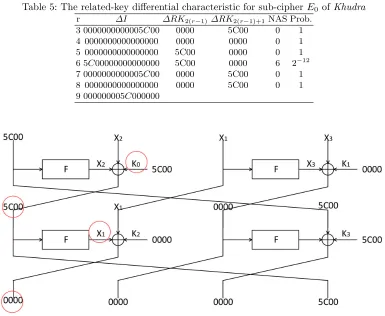
SinceKhudra applies the generalized Feistel structure, we can deduce the relation among the differences. Given theαdifference, Fig. 2 shows the differential propagation pattern of
Table 5: The related-key differential characteristic for sub-cipherE0 ofKhudra
r ∆I ∆RK2(r−1)∆RK2(r−1)+1NAS Prob. 3 0000000000005C00 0000 5C00 0 1 4 0000000000000000 0000 0000 0 1 5 0000000000000000 5C00 0000 0 1 6 5C00000000000000 5C00 0000 6 2−12 7 0000000000005C00 0000 5C00 0 1 8 0000000000000000 0000 5C00 0 1 9 000000005C000000
Fig. 2: The differential propagation pattern of Eb
As is seen in Fig. 2, X1 andX2 are the output differences of the F-function when the
input difference is 5C00, and X3 is the output difference of theF-function with respect to
X1 as the input difference. It turns out that there are 214.52 kind of reasonableX1. When
the input pair of the F-function is fixed with a difference of 5C00(X1), the corresponding
output pair of theF-function will have a fixed output difference. The sub-keys used inEb
that can affectαdifference is K0 (16-bit), and the corresponding related-key difference is
∆K0
0 = 5C00. The way it influence the difference before round 3 is also shown in Fig. 2 with
the circle. Thus we find out the pattern of plaintext differences that can possibly lead toα
difference inEb.
Given theδ difference, we can deduce the relation between the differences afterδ. Fig. 3 shows the differential propagation pattern of Ef, where Y1 is the output difference of
the F-function when the input difference is 5C00, and Y2 is the output difference of the
F-function with respect toY1 as the input difference. It turns out that there are 214.52kind
of reasonableY1. When the input pair of the F-function is fixed with a difference of 5C00
(Y1), the corresponding output pair of the F-function will have a fixed output difference.
Fig. 3: The differential propagation pattern of Ef
As is seen in Fig. 3, the subkeys used for decryption inEf that affectδdifference isK0
(16-bit), and the corresponding related-key difference is∆K1
0 = 5C00. The way it influence
the difference after round 14 is also shown in Fig. 3 with the circle.
4.4 The Attack
The basic idea of the attack is to try all subkeys which affect the differences before and after the distinguisher (i.e., inEb andEf). The selection criterion of right subkeys is whether it
can lead to anαdifference at the beginning ofE0, and theδdifference at the end ofE1can
lead to the ciphertext difference.
To attack the 16-roundKhudra, we request 224.82structures of 232plaintexts each. The attack works as follows:
1. Data Generation:
a) GenerateY = 224.82structuresSa
1,· · · , SYa, each of 232plaintexts. In each structure,
fix the left most 32 bits of the plaintexts and enumerate the right most 32 bits. Ask for the encryption of the structures underKa.
b) For anyi(i= 1,· · ·, Y), describe any plaintext in structureSa
i withPa = (P0a, P1a,∗,∗)
(Pa
0 and P1a represent 16 fix bits respectively, and ∗ represents 16 arbitrary bits).
According to Fig. 2, the plaintexts in structureSi
b are generated as follows:
P0b=P0a⊕5C00,
P1b=P1a⊕F(P0a)⊕F(P0b).
Ask for the encryption of the resulting plaintext Pb = (P0b, P1b,∗,∗) under Kb =
Ka⊕∆K0 for obtainingSb
1,· · ·, SYb.
c) Ask for the encryption of plaintexts generated in Step1(a) underKc =Ka⊕∆K1
(to obtainSc
d) Ask for the encryption of plaintexts generated in Step1(b) underKd=Ka⊕∆K0⊕
∆K1(to obtainSd
1,· · · , SYd).
– This step requires data complexity of 257.82chosen plaintexts. We keep all the 216 input values of theF-function and the corresponding output values in a table and each structure in S1b,· · ·, SYb can be generated by 2 memory accesses. So
the time complexity of this step is 258.82 encryptions, and 2Y = 225.82 memory
accesses. In each structure we get 264plaintext pairs, which lead to 232kinds of
differences afterEb, where 232 of them satisfyαdifference beforeE0. Thus, the
total number of pairs with αdifference before the core function is 256.82 that
produce 2113.64quartets of which 2113.64·2−111.64= 4 are expected to beright.
2. Initializing Counters:
Initialize an array of 216 counters. Each counter corresponds to a different guess of
Ka 0[15:0].
– Time complexity of this step is 216 memory accesses.
3. Data Analysis:
a) According to Fig. 3, insert theN = 258.82ciphertexts ofSa, Sb, Sc andSd into four hash tables Ta, Tb, Tc and Td respectively indexed by the left most 16 bits and
the right most 16 bits. If a collision occurs in the same bins of (Ta, Tc), denote
the ciphertexts as Ca = (Ca
0, C1a, C2a, C3a) andCc = (C0c, C1c, C2c, C3c). For each Ca
in each bin of Ta, build a hash table indexed by 216 values of Cc
1, and insert the
corresponding value ofCc
2by the equationC2c⊕C2a=F(C1a)⊕F(C1c). Check whether
the corresponding 2m+32+16 = 2m+48 = 272.82 values of candidate Cc in Tc. If this
is the case, check whether∆=Ca
1 ⊕C1c⊕5C00 is one of the 214.52possible output
differences may be caused by an input difference 5C00 to the F-function. Do the same for Tb andTd.
– This step has time complexity of 258.82 memory accesses from inserting all the ciphertexts in hash tables. In the hash tables there exist 232 bins and in each
bin we expect to have 224.82 ciphertexts. Therefore, we need 272.82 memory
accesses to build the hash table forCa, and 272.82 memory accesses to check if
the candidateCcis inTc. There are 265.64pairs ofCaandCcto be checked in the
next situation. Out of the 216possible differences for a pair, only 214.52differences
can be caused by theδ difference from the distinguisher and thus about 264.16
pairs remain inTa (Tb) andTc(Td). We keep all the 214.52 differences that can
be caused byδin a hash table, and thus the check requires one memory access for each colliding pair. The time complexity of this step is 274.82+ 265.16memory
accesses.
b) For each surviving pairs (Ca, Cc) ((Cb, Cd)) from the previous step, denote Ci’s
structure by SCi and attach to Ca (Cb) the index of SCc (SCd). After all the
remaining pairs are processed, keep a hash table HSia for each structure Sa
i (i =
1,2,· · ·, Y) and insert the ciphertexts in Sia into HSa
i according to the indexes of
the structures that the ciphertext is related to. Similarly, keep the hash tables HSb i
forSb
i (i= 1,2,· · · , Y).
– This step requires one memory access for each remaining pair of the previous step and thus needs 265.16 memory accesses.
c) For a right quartet (Pa, Pb, Pc, Pd) and the corresponding ciphertexts (Ca, Cb, Cc, Cd),
it must be combined by some Pa ∈ Sa
i, Pb ∈ Sib and Pc ∈Sjc, Pd ∈ Sjd where Sjc
is related to Ca and Sd
distinct). In each pair of structures (Sa
i, Sib) (i = 1,· · · , Y), we search for two
ci-phertexts Ca and Cb from Si
a and Sbi respectively which are attach to some other
pair of structures (Sc
j, Sjd). When we found such a pair, check whether the
differ-ences of (Pa, Pb) and (Pc, Pd) can cause α. Denote the corresponding plaintexts
as Pa = (Pa
0, P1a, P2a, P3a) and Pb = (P0b, P1b, P2b, P3b). First we check whether the
equationPa
3 ⊕P3b=F(P2a)⊕F(P2b) to be true. With this move, we can reduce the
candidate quartets by 2−16. Then check the same for the plaintexts to which Ca
and Cb are related. For the quartets remained after this move, check whether the
difference ofP2aandP2bis one of the 214.52possible output differences may be caused by an input difference 5C00 to theF-function, and the same forP2c andP2d.
– There are 264.16 attachments (colliding pairs) distributed over 224.82 structures,
The first filter here can reduce the candidate quartets to 221.86in each structure.
Out of the 216possible differences for a pair of plaintexts, only 214.52 differences
can cause the α difference into the distinguisher. Therefore, out of the 246.68
possible quartets only 243.72 quartets remain. Since this filtering requires one
memory access for each candidate quartet, thus the algorithm requires 278.68+ 262.68+ 246.68+ 245.20 memory accesses.
4. Subkey Bits Guess: For each remaining quartet ((Pa, Pb),(Pc, Pd)), ((Ca, Cb),(Cc, Cd))
perform:
(a) For each guess of the 16 bits of Ka
0, we have
K0b=K a 0 ⊕∆K
0 0,
K0c =K0a⊕∆K01,
K0d=K0a⊕∆K00⊕∆K01.
(4)
(b) Increment the counter that correspond toK0a if
EbKa0(P
a)⊕E bKb
0
(Pb) =EbKc0(P
c)⊕E bKd
0
(Pd) =α (5)
and
Ef−1
Ka0(C
a)⊕E−1 fKc0(C
c) =E−1 fKb
0
(Cb)⊕Ef−1
Kd0
(Cd) =δ. (6)
– There are 214.52 possible input differences that lead to α difference after E b and
totally 216guesses of subkey bits ofK
a, therefore, 21.48subkeys on average take one
of these differences to α. As each pair suggests 21.48 subkeys, a quartet agrees on
(21.48)2/216= 2−13.04subkeys forE
b. Similarly, a quartet agrees on 2−13.04subkeys
forEf. In total, we get a candidate list of 2−42.08 subkeys from each quartet. Thus,
for the 243.72remaining quartets, there are total 216possible subkeys and 21.64hits. Averagely, the number of hits for a wrong subkey is 2−14.36, while the number of expected hits for the right one is 4. Thus, the attack can almost always succeed in recovering subkey bits. This step requires about 257.72 encryptions and 257,72 decryptions and 259.72memory accesses.
5. Output the subkey with maximal counter.
– This step requires 216 memory accesses.
Thus, the overall attack has data complexity of 257.82 chosen plaintexts, time complexity
of 278.68 memory accesses, 259.77encryptions, and 257.72decryptions. The expected number
5
Conclusion
In this paper, we have launched an related-key rectangle attack on 16-roundKhudra, with time complexity of 278.68 memory accesses, 259.77 encryptions and 257.72 decryptions, and data complexity of 257.82 chosen plaintexts. The attack is a generic related-key rectangle attack with a differential distinguisher deduced from an MILP based search. This is the best known cryptanalysis presented on round-reducedKhudra.
References
1. Biham, E.: New types of cryptanalytic attacks using related keys. Journal of Cryptology 7(4), 229–246 (1994)
2. Biham, E., Dunkelman, O., Keller, N.: The rectangle attack-rectangling the Serpent. In: Ad-vances in Cryptology–EUROCRYPT 2001, pp. 340–357. Springer (2001)
3. Biham, E., Dunkelman, O., Keller, N.: New results on boomerang and rectangle attacks. In: Fast Software Encryption. pp. 1–16. Springer (2002)
4. Biham, E., Dunkelman, O., Keller, N.: Related-key boomerang and rectangle attacks. In: Ad-vances in Cryptology–EUROCRYPT 2005, pp. 507–525. Springer (2005)
5. Biham, E., Shamir, A.: Differential cryptanalysis of DES-like cryptosystems. Journal of CRYP-TOLOGY 4(1), 3–72 (1991)
6. Borghoff, J., Knudsen, L.R., Stolpe, M.: Bivium as a mixed-integer linear programming problem. In: Cryptography and Coding, pp. 133–152. Springer (2009)
7. Hoang, V.T., Rogaway, P.: On generalized feistel networks. In: Advances in Cryptology -CRYPTO 2010. pp. 613–630. Springer (2010)
8. Hong, S., Kim, J., Lee, S., Preneel, B.: Related-key rectangle attacks on reduced versions of SHACAL-1 and AES-192. In: Fast Software Encryption. pp. 368–383. Springer (2005) 9. IBMsoftware-group: User-manual cplex 12. URL:http://www-01.ibm.com (2011)
10. Kelsey, J., Kohno, T., Schneier, B.: Amplified boomerang attacks against reduced-round MARS and Serpent. In: Fast Software Encryption. pp. 75–93. Springer (2001)
11. Kelsey, J., Schneier, B., Wagner, D.: Related-key cryptanalysis of 3-WAY, Biham-DES, CAST, DES-X, NewDES, RC2, and TEA. Information and Communications Security pp. 233–246 (1997)
12. Kim, J., Kim, G., Hong, S., Lee, S., Hong, D.: The related-key rectangle attack–application to SHACAL-1. In: Information Security and Privacy. pp. 123–136. Springer (2004)
13. Kolay, S., Mukhopadhyay, D.: Khudra: A new lightweight block cipher for fpgas. In: Security, Privacy, and Applied Cryptography Engineering, SPACE 2014. pp. 126–145. Springer (2014) 14. Ma, X., Hu, L., Sun, S., Qiao, K., Shan, J.: Tighter security bound of MIBS block cipher against
differential attack. In: Network and System Security. Springer (2014)
15. Mouha, N., Wang, Q., Gu, D., Preneel, B.: Differential and linear cryptanalysis using Mixed-Integer linear programming. In: Information Security and Cryptology. pp. 57–76. Springer (2012)
16. Qiao, K., Hu, L., Sun, S., Ma, X., Kan, H.: Improved MILP Modeling for Automatic Security Evaluation and Application to FOX. IEICE TRANSACTIONS on Cryptography and Informa-tion Security (Special) (to appear)
19. Sun, S., Hu, L., Wang, P., Qiao, K., Ma, X., Song, L.: Automatic security evaluation and (related-key) differential characteristic search : Application to SIMON, PRESENT-80/128, LBlock, DES(L) and other bit-oriented block ciphers. In: Advances in Cryptology–ASIACRYPT 2014. Springer (2014)
20. Wagner, D.: The boomerang attack. In: Fast Software Encryption. pp. 156–170. Springer (1999) 21. Wu, S., Wang, M.: Security evaluation against differential cryptanalysis for block cipher
![Fig. 1: The Structure of Khudra [13]](https://thumb-us.123doks.com/thumbv2/123dok_us/7933776.1317306/3.612.135.477.163.447/fig-the-structure-of-khudra.webp)