Improving Sentiment Analysis in Twitter Using Multilingual Machine
Translated Data
Alexandra Balahur
European Commission Joint Research Centre
Via E. Fermi 2749
21027 Ispra (VA), Italy
[email protected]
Marco Turchi
Fondazione Bruno Kessler-IRST
Via Sommarive, 18
Povo, Trento, Italy
[email protected]
Abstract
Sentiment analysis is currently a very dy-namic field in Computational Linguistics. Research herein has concentrated on the development of methods and resources for different types of texts and various lan-guages. Nonetheless, the implementa-tion of a multilingual system that is able to classify sentiment expressed in various languages has not been approached so far. The main challenge this paper addresses is sentiment analysis from tweets in a multi-lingual setting. We first build a simple sen-timent analysis system for tweets in En-glish. Subsequently, we translate the data from English to four other languages - Ital-ian, Spanish, French and German - using a standard machine translation system. Fur-ther on, we manually correct the test data and create Gold Standards for each of the target languages. Finally, we test the per-formance of the sentiment analysis classi-fiers for the different languages concerned and show that the joint use of training data from multiple languages (especially those pertaining to the same family of lan-guages) significantly improves the results of the sentiment classification.
1
Introduction
Sentiment analysis is a task in Natural Language Processing whose aim is to automatically detect and classify sentiments in texts. Generally, the “positive”, “negative” and “neutral” classes are considered, although other scales have also been used (e.g. from 1 to 5 “stars” - according to the reviewing systems put at the disposal of clients or users by amazon.com, booking.com, etc.; adding the “very positive” and “very negative” classes, scales from 1 to 10, etc.).
In this article, we deal with the issue of sen-timent analysis in tweets, in a multilingual set-ting. We employ machine translation - which was shown to be at a sufficiently high level of perfor-mance (Balahur and Turchi, 2012) - to obtain data in four languages. Our goal is to test if the use of multilingual data can help to improve sentiment classification in tweets (as shown to be the case in formal texts - (Banea et al., 2010)) and if the joint use of data coming from similar languages or lan-guages that are different in structure can influence on the final result.
The main problem when designing automatic methods for the treatment of tweets is that they are highly informal texts, i.e. they contain slang, emoticons, repetitions of letters or punctuation signs, misspellings (done on purpose or due to writing them from mobile devices), entire words in capital letters, etc.
Subsequently, we employ the Google machine translation system1to translate the SemEval 2013 training and development tweets in Italian, Span-ish, German and French. We manually correct the translated development data (which we use for testing, not for parameter tuning) to produce a re-liable Gold Standard.
Finally, we apply the same sentiment classifi-cation system to each of these languages and test the manner in which the combined datasets (from pairs of two languages, families of languages and all the languages together) perform. We conclude that the joint use of training data from differ-ent languages improves the classification of sen-timent and that the use of training data from lan-guages that are similar in structure helps to achieve statistically significant improvements over the re-sults obtained on individual languages and all lan-guages together.
The remainder of this article is structured as fol-lows: Section 2 gives an overview of the related work. In Section 3, we present the motivations and describe the contributions of this work. In the fol-lowing section, we describe in detail the process followed to pre-process the tweets, build the clas-sification models and obtain tweets for four other languages. In Section 5, we present the results obtained on different languages and combinations thereof. Finally, Section 6 summarizes the main findings of this work and sketches the lines for fu-ture work.
2
Related Work
The work described herein is related to the devel-opment of multilingual sentiment analysis systems and sentiment classification from tweets.
2.1 Methods for Multilingual Sentiment Analysis
In order to produce multilingual resources for sub-jectivity analysis, Banea et al. (Banea et al., 2008) apply bootstrapping to build a subjectivity lexi-con for Romanian, starting with a set of 60 words which they translate and subsequently filter us-ing a measure of similarity to the original words, based on Latent Semantic Analysis (LSA) (Deer-wester et al., 1990) scores. Another approach to mapping subjectivity lexica to other languages is proposed by Wan (2009), who uses co-training to
1http://translate.google.com/
classify un-annotated Chinese reviews using a cor-pus of annotated English reviews. (Kim et al., 2010) create a number of systems consisting of different subsystems, each classifying the subjec-tivity of texts in a different language. They trans-late a corpus annotated for subjectivity analysis (MPQA), the subjectivity clues (Opinion Finder) lexicon and re-train a Naive Bayes classifier that is implemented in the Opinion Finder system us-ing the newly generated resources for all the lan-guages considered. (Banea et al., 2010) translate the MPQA corpus into five other languages (some with a similar ethimology, others with a very dif-ferent structure). Subsequently, they expand the feature space used in a Naive Bayes classifier us-ing the same data translated to 2 or 3 other lan-guages. Finally, (Steinberger et al., 2011a; Stein-berger et al., 2011b) create sentiment dictionaries in other languages using a method called “triangu-lation”. They translate the data, in parallel, from English and Spanish to other languages and ob-tain dictionaries from the intersection of these two translations.
2.2 Sentiment Classification from Tweets
One of the first studies on the classification of po-larity in tweets was (Go et al., 2009). The au-thors conducted a supervised classification study on tweets in English, using the emoticons (e.g. “:)”, “:(”, etc.) as markers of positive and nega-tive tweets. (Read, 2005) employed this method to generate a corpus of positive tweets, with positive emoticons “:)”, and negative tweets with negative emoticons “:(”. Subsequently, they employ dif-ferent supervised approaches (SVM, Na¨ıve Bayes and Maximum Entropy) and various sets of fea-tures and conclude that the simple use of unigrams leads to good results, but it can be slightly im-proved by the combination of unigrams and bi-grams.
In the same line of thinking, (Pak and Paroubek, 2010) also generated a corpus of tweets for senti-ment analysis, by selecting positive and negative tweets based on the presence of specific emoti-cons. Subsequently, they compare different super-vised approaches with n-gram features and obtain the best results using Na¨ıve Bayes with unigrams and part-of-speech tags.
super-vised learning with the knowledge on sentiment-bearing words, which they extract from the DAL sentiment dictionary (Whissell, 1989). Their pre-processing stage includes the removal of retweets, translation of abbreviations into original terms and deleting of links, a tokenization process, and part-of-speech tagging. They employ various super-vised learning algorithms to classify tweets into positive and negative, using n-gram features with SVM and syntactic features with Partial Tree Ker-nels, combined with the knowledge on the polar-ity of the words appearing in the tweets. The au-thors conclude that the most important features are those corresponding to sentiment-bearing words. Finally, (Jiang et al., 2011) classify sentiment ex-pressed on previously-given “targets” in tweets. They add information on the context of the tweet to its text (e.g. the event that it is related to). Sub-sequently, they employ SVM and General Inquirer and perform a three-way classification (positive, negative, neutral).
3
Motivation and Contribution
The work presented herein is mainly motivated by the need to: a) develop sentiment analysis tools for a high number of languages, while minimiz-ing the effort to create lminimiz-inguistic resources for each of these languages in part; b) study the manner in which the use of machine translation systems to produce multilingual data performs in the context of informal texts such as tweets; and c) evaluate the performance of sentiment classification when data from different languages is combined in the training phase. We would especially like to study the effect of using data from similar languages ver-sus the use of data from structurally and lexically-different languages. The advantage of such an ap-proach would be that if combined classifiers per-form better, then the effort of separating tweets in different languages at the time of analysis (which in the case of streaming data is not negligeable) can be reduced or eliminated entirely.
Unlike approaches we presented in Related Work section, we employ fully-formed machine translation systems.
Bearing this in mind, the main contributions we bring in this paper are:
1. The creation of a simple tweet senti-ment analysis system, that employs a pre-processing stage to normalize the language and generalize the vocabulary employed to
express sentiment. At this stage, we take into account the linguistic peculiarities of tweets, regarding spelling, use of slang, punctuation, etc., and also replace the sentiment-bearing words from the training data with a unique label. In this way, the sentence “I love roses.” will be equivalent to the sentence “I like roses.”, because “like” and “love” are both positive words according to the GI dictionary. If example 1 is contained in the training data and example 2 is contained in the test data, replacing the sentiment-bearing word with a general label increases the chance to have ex-ample 2 classified correctly. In the same line of thought, we also replaced modifiers with unique corresponding labels.
2. The use of minimal linguistic processing, which makes the approach easily portable to other languages. We employ only tokeniza-tion and do not process texts any further. The reason behind this choice is that we would like the final system to work in a similar fash-ion for as many languages as possible and for some of them, little or no tools are available.
3. The use of a standard news translation system to obtain data in four other languages -Italian, Spanish, German and French;
4. The evaluation of different combinations of languages in the training phase and the effect of using languages from the same family ver-sus the use of individual or all languages in the training phase on the overall performance of the sentiment classification performance.
We show that using the training models generated with the method described we can improve the sentiment classification performance, irrespective of the domain and distribution of the test sets.
4
Sentiment Analysis in Tweets
be able to apply, in a straightforward manner, the same approach to as many languages as possible. The approach can be extended to other languages by using similar dictionaries that have been cre-ated in our team. They were built using the same dictionaries we employ in this work and their cor-rected translation to Spanish. The new sentiment dictionaries were created by simultaneously trans-lating from these two languages to a third one and considering the intersection of the translations as correct terms. Currently, new such dictionaries have been created for 15 other languages.
The sentiment analysis process contains two stages: pre-processing and sentiment classifica-tion.
4.1 Tweet Pre-processing
The language employed in Social Media sites is different from the one found in mainstream me-dia and the form of the words employed is some-times not the one we may find in a dictionary. Fur-ther on, users of Social Media platforms employ a special “slang” (i.e. informal language, with spe-cial expressions, such as “lol”, “omg”), emoticons, and often emphasize words by repeating some of their letters. Additionally, the language employed in Twitter has specific characteristics, such as the markup of tweets that were reposted by other users with “RT”, the markup of topics using the “#” (hash sign) and of the users using the “@” sign.
All these aspects must be considered at the time of processing tweets. As such, before applying su-pervised learning to classify the sentiment of the tweets, we preprocess them, to normalize the lan-guage they contain. The pre-processing stage con-tains the following steps:
In the first step of the pre-processing, we de-tect repetitions of punctuation signs (“.”, “!” and “?”). Multiple consecutive punctuation signs are replaced with the labels “multistop”, for the full-stops, “multiexclamation” in the case of excla-mation sign and “multiquestion” for the question mark and spaces before and after.
In the second step of the pre-processing, we employ the annotated list of emoticons from Sen-tiStrength2(Thelwall et al., 2010) and match the content of the tweets against this list. The emoti-cons found are replaced with their polarity (“pos-itive” or “negative”) and the “neutral” ones are deleted.
2http://sentistrength.wlv.ac.uk/
Subsequently, the tweets are lower cased and split into tokens, based on spaces and punctuation signs.
The next step involves the normalization of the language employed. In order to be able to include the semantics of the expressions frequently used in Social Media, we employed the list of slang from a specialized site3.
At this stage, the tokens are compared to en-tries in Rogets Thesaurus. If no match is found, repeated letters are sequentially reduced to two or one until a match is found in the dictionary (e.g. “perrrrrrrrrrrrrrrrrrfeeect” becomes “per-rfeect”, “pe“per-rfeect”, “perrfect” and subsequently “perfect”). The words used in this form are maked as “stressed”.
Further on, the tokens in the tweet are matched against three different sentiment lexicons: GI, LIWC and MicroWNOp, which were previously split into four different categories (“positive”, “high positive”, “negative” and “high negative”). Matched words are replaced with their sentiment label - i.e. “positive”, “negative”, “hpositive” and “hnegative”. A version of the data without these replacements is also maintained, for comparison purposes.
Similar to the previous step, we employ a list of expressions that negate, intensify or diminish the intensity of the sentiment expressed to detect such words in the tweets. If such a word is matched, it is replaced with “negator”, “intensifier” or “di-minisher”, respectively. As in the case of affec-tive words, a version of the data without these replacements is also maintained, for comparison purposes.
Finally, the users mentioned in the tweet, which are marked with “@”, are replaced with “PER-SON” and the topics which the tweet refers to (marked with “#”) are replaced with “TOPIC”.
4.2 Sentiment Classification of Tweets
Once the tweets are pre-processed, they are passed on to the sentiment classification module. We employed supervised learning using SVM SMO with a linear kernel, based on boolean features - the presence or absence of n-grams (unigrams, bigrams and unigrams plus bigrams) determined from the training data (tweets that were previ-ousely pre-processed as described above). Bi-grams are used specifically to spot the influence
of modifiers (negations, intensifiers, diminishers) on the polarity of the sentiment-bearing words.
4.3 Obtaining Multilingual Data for Sentiment Analysis in Tweets
Subsequent to the tweet normalization, we trans-late the Twitter data (the training and develop-ment data in the SemEval Task 2 campaign) us-ing the Google machine translation system to four languages - Italian, Spanish, French and German. The reason for choosing the development dataset for testing is that this set is smaller and allows us to manually check and correct it, to obtain a Gold Standard (and ensure that performance results are not biased by the incorrect translation in both the training, as well as the development data).
Further on, we extract the same features as in the case of the system working for English - uni-grams and biuni-grams - from these obtained datasets. We employ the features to train an SVM SMO classifier, in the same manner as we did for En-glish.
5
Evaluation and Discussion
Although the different steps included to elimi-nate the noise in the data and the choice of fea-tures have been refined using our in-house gath-ered Twitter data, in order to evaluate our approach and make it comparable to other methods, we em-ploy the data used in an established competition, allowing subsequent comparisons to be made.
5.1 Data Set
The characteristics of the training (T*) and devel-opment (test in our case) - t*- datasets employed are described in Table 1. On the last column, we also include the baseline in terms of accuracy, which is computed as the number of examples of the majoritary class over the total number of ex-amples:
Data #Tweet #Pos. #Neg. #Neu. Bl%
T* 6688 2450 956 3282 49%
t* 1051 386 199 466 44%
Table 1: Characteristics of the training (T*) and testing (t*) datasets employed.
5.2 Evaluation and Results
In order to test our sentiment analysis approach, we employed the datasets described above, for
each of the languages individually, all the two-languages combinations, combinations of guages from the same linguistic family and all lan-guages together.
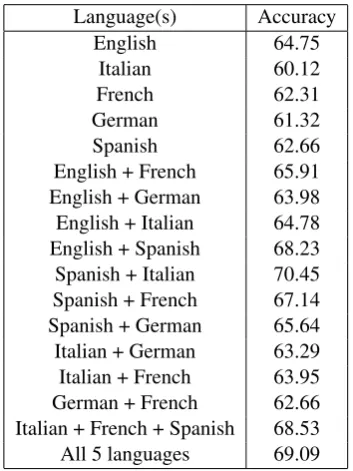
The results are presented in Table 2. We con-sider the measure of accuracy and do not compare to the SemEval official results, because in the com-petition, the results did not take into account the “neutral” class.
Language(s) Accuracy
English 64.75
Italian 60.12
French 62.31
German 61.32
Spanish 62.66
English + French 65.91
English + German 63.98
English + Italian 64.78
English + Spanish 68.23
Spanish + Italian 70.45
Spanish + French 67.14
Spanish + German 65.64
Italian + German 63.29
Italian + French 63.95
German + French 62.66
Italian + French + Spanish 68.53
All 5 languages 69.09
Table 2: Results obtained classifying each lan-guage individually versus on pairs and families of languages, respectively.
5.3 Discussion
From the results obtained, we can draw several conclusions.
First of all, we can see that using tweet nor-malization and employing machine translation, we can obtain high quality training data for senti-ment analysis in many languages. The machine-translated data thus obtained can be reliably em-ployed to build classifiers for sentiment, reaching a performance level that is similar to the results ob-tained for English and significatly above the base-line.
some cases, the overall performance is improved on both systems, which shows that combining this data helps to disambiguate the contextual use of specific words.
Finally, the results show that the use of all the languages together improves the overall classifi-cation of sentiment in the data. This shows that a multilingual system can simply employ joint training data from different languages in a single classifier, thus making the sentiment classification straightforward, not needing any language detec-tion software or training different classifiers.
By manually inspecting some of the examples in the datasets, we could see that the most im-portant causes of incorrect classification were the word orders and faulty translations in context. An-other reason for incorrect sentiment classification was the different manner in which negation is con-structed in the different languages considered. In order to improve on this aspect, we will include language-specific rules by adding skip-bigrams (bigrams made up of non-consecutive tokens) fea-tures in the languages where the place of the nega-tors can vary.
6
Conclusions and Future Work
In this article, we presented a method to create a simple sentiment analysis system for English and extend it to the multilingual setting, by employing a standard news machine translation system. We showed that using twitter language normalization, we can obtain good results in target languages and that the joint use of training data from differ-ent languages helps to increase the overall perfor-mance of the classification. Finally, we showed that the joint training using translated data from languages that are similar yield significantly im-proved results.
In future work, we plan to evaluate the use of higher-order n-grams (3-grams) and skip-grams to extract more complex patterns of sentiment ex-pressions and be able to identify more precisely the scope of the negation. In this sense, we plan to take into account the modifier/negation schemes typical of each of the languages, to consider (fur-ther to translation) language-specific schemes of n-grams.
We also plan to test the performance of sen-timent classification using translations *to* En-glish and employing classifiers trained on EnEn-glish data. In order to do this, we require lists of slang
and digital dictionaries to perform normalization. We would like to study the performance of our approach in the context of tweets related to spe-cific news, in which case these short texts can be contextualized by adding further content from other information sources. In this way, it would be interesting to make a comparative analysis of the tweets written in different languages (from the same or different regions of the globe), on the same topics.
References
Alexandra Balahur and Marco Turchi. 2012. Mul-tilingual sentiment analysis using machine transla-tion? InProceedings of the 3rd Workshop in Com-putational Approaches to Subjectivity and Sentiment Analysis, pages 52–60, Jeju, Korea, July. Associa-tion for ComputaAssocia-tional Linguistics.
C. Banea, R. Mihalcea, and J. Wiebe. 2008. A boot-strapping method for building subjectivity lexicons for languages with scarce resources. InProceedings of the Conference on Language Resources and Eval-uations (LREC 2008), Maraakesh, Marocco.
C. Banea, R. Mihalcea, and J. Wiebe. 2010. Mul-tilingual subjectivity: are more languages better? InProceedings of the International Conference on Computational Linguistics (COLING 2010), Bei-jing, China., pages 28–36.
S. Deerwester, S. Dumais, G. W. Furnas, T. K. Lan-dauer, and R. Harshman. 1990. Indexing by latent semantic analysis. Journal of the American Society for Information Science, 3(41).
Alec Go, Richa Bhayani, and Lei Huang. 2009. Twit-ter sentiment classification using distant supervision.
Processing, pages 1–6.
Long Jiang, Mo Yu, Ming Zhou, Xiaohua Liu, and Tiejun Zhao. 2011. Target-dependent twitter sen-timent classification. InProceedings of the 49th An-nual Meeting of the Association for Computational Linguistics: Human Language Technologies - Vol-ume 1, HLT ’11, pages 151–160, Stroudsburg, PA, USA. Association for Computational Linguistics.
J. Kim, J.-J. Li, and J.-H. Lee. 2010. Evaluating multilanguage-comparability of subjectivity analy-sis systems. In Proceedings of the 48th Annual Meeting of the Association for Computational Lin-guistics, pages 595–602.
Seventh conference on International Language Re-sources and Evaluation (LREC’10), Valletta, Malta; ELRA, may. European Language Resources Associ-ation. 19-21.
John C. Platt. 1998. Sequential minimal optimiza-tion: A fast algorithm for training support vector ma-chines. Technical report, Advances in Kernel Meth-ods - Support Vector Learning.
Jonathon Read. 2005. Using emoticons to re-duce dependency in machine learning techniques for sentiment classification. In Proceedings of the
ACL Student Research Workshop, ACLstudent ’05,
pages 43–48, Stroudsburg, PA, USA. Association for Computational Linguistics.
J. Steinberger, P. Lenkova, M. Ebrahim, M. Ehrman, A. Hurriyetoglu, M. Kabadjov, R. Steinberger, H. Tanev, V. Zavarella, and S. Vazquez. 2011a. Creating sentiment dictionaries via triangulation. In
Proceedings of the 2nd Workshop on Computational Approaches to Subjectivity and Sentiment Analysis, Portland, Oregon.
J. Steinberger, P. Lenkova, M. Kabadjov, R. Stein-berger, and E. van der Goot. 2011b. Multilingual entity-centered sentiment analysis evaluated by par-allel corpora. InProceedings of the Conference on Recent Advancements in Natural Language Process-ing (RANLP), Hissar, Bulgaria.
Mike Thelwall, Kevan Buckley, Georgios Paltoglou, Di Cai, and Arvid Kappas. 2010. Sentiment in short strength detection informal text. J. Am. Soc. Inf. Sci. Technol., 61(12):2544–2558, December.
Weka Machine Learning Project. 2008. Weka. URL http://www.cs.waikato.ac.nz/˜ml/weka.
Cynthia Whissell. 1989. The Dictionary of Affect in Language. In Robert Plutchik and Henry Kellerman, editors, Emotion: theory, research and experience, volume 4, The measurement of emotions. Academic Press, London.
Theresa Wilson, Zornitsa Kozareva, Preslav Nakov, Sara Rosenthal, Veselin Stoyanov, and Alan Ritter. 2013. SemEval-2013 task 2: Sentiment analysis in twitter. In Proceedings of the International Work-shop on Semantic Evaluation, SemEval ’13, June.