ENHANCED FRAMEWORK FOR ALERT PROCESSING USING CLUSTERING APPROACH BASED ON
ARTIFICIAL IMMUNE SYSTEM
ASHARA BANU BINTI MOHAMED
A thesis submitted in fulfilment of the requirements for the award of degree of Doctor of Philosophy (Computer Science)
Faculty of Computing Universiti Teknologi Malaysia
iii
DEDICATION
Dedicated to :
My mother,
Hajjah Khatijah Bt Osman, without whom I would not have the courage to embark on this journey and the perseverance to complete it.
My father,
Haji Mohamed Bin Maidin, for giving me balance and perspective.
My Brothers,
The charming men in my life, without fail supporting and encouraging me, throughout this journey
My Sisters
The beautiful ladies in my life, especially Anita, Aida, Azlinah without whom I would have been lost in the process of completing this phase of my life.
My Nephews and Nieces
Adorable darlings that made my stressful and hectic life bearable
iv
ACKNOWLEDGEMENT
Bismillah. With the Grace of Allah SWT, I would first and foremost thank the Lord Almighty for giving me the health, strength and ability to complete my
thesis as a requirement for my Doctorate studies. I am very grateful to the Malaysian Government, through the Jabatan Perkhidmatan Awam (JPA) who has been the key instrument in enabling me to enhance my capabilities by pursing my studies to the highest level. I am truly blessed to be given this opportunity.
This thesis would not have been possible without the guidance and support I received from both supervisors, Dato’ Professor Dr. Norbik Bashah Bin Idris and Dr. Bharanidharan Shanmugum. Your words of encouragement, patience, and guidance had inspired me and gave me the strength throughout this journey. I would also like to extend my gratitude to PRISMA, my previous work place for providing me with the confidential dataset to be applied in my experiments.
Life would be harder without the support of many good friends. Thanks to Rozelinda Bt Khalid, Jalajah Gopalan and Dr. Azalena Haron, for providing me solace when I needed a break and encouragement when I needed a boost of morale. Not forgetting my friends in CASE Lab UTM Kuala Lumpur and new colleagues in i-IMATEC INTAN, thank you for being great companions.
Finally, again to my beloved family who had always stood by me with undying love, encouragement and patience in seeing me through this phase of my life.
May ALLAH swt. bless and bestow his Rahmah to us all.
v
vi
vii
TABLE OF CONTENTS
CHAPTER TITLE PAGE
DECLARATION ii
DEDICATION iii
ACKNOWLEDGMENT iv
ABSTRACT v
ABSTRAK vi
TABLE OF CONTENTS vii
LIST OF TABLES xii
LIST OF FIGURES xvi
LIST OF ABBREVIATIONS xviii
LIST OF APPENDICES xx
1 INTRODUCTION 1
1.1 Overview 1
1.2 Background of Computer Security (CS) 4 1.2.1 Challenges of Existing Security
Mechanisms 5
1.2.2 Problem Background on IDS 6
1.3 Problem Statement 12
1.4 Research Motivation 13
1.5 Research Objectives 15
1.6 Research Scope 15
1.7 Research Significance 16
1.8 Thesis Organization 17
1.9 Definition of Terms 19
viii
2.1 Introduction 21
2.2 Intrusion Detection System (IDS) 22
2.3 Implementation Challenges 25
2.3.1 Technical 26
2.3.2 Operational 27
2.4 Implementation Solutions 27
2.4.1 Detection Methods 28
2.4.2 Alert Processing Method 29 2.5 Alert Processing Method (APM) 30
2.5.1 Data Reduction 33
2.5.1.1 Filtering 33
2.5.1.2 Feature Selection 34 2.5.1.3 Aggregation/Fusion 35
2.5.1.4 Clustering 36
2.5.2 Correlation 47
2.5.2.1 Statistical Correlation 48 2.5.2.2 Knowledge-Based Correlation 49 2.5.2.3 Similarity Correlation 50 2.6 Existing Alert Procesing Method (APM) 50
2.6.1 Single-level APM 51
2.6.2 Multiple-level APM 63
2.6.3 Intelligent APM 72
2.7 Camparative Analysis 74
2.8 Discussion on AP approaches 81
2.9 Summary 86
3 RESEARCH METHODOLOGY 87
3.1 Introduction 87
3.2 Research Procedures and activities 88 3.2.1 Phase I (Activity 1 & 2) : Problem
identification and Justification &
Define the objectives for a solution. 90 3.2.2 Phase II (Activity 3) : Design and
ix
3.2.3 Phase III (Activity 4) : Demonstration 94 3.2.4 Phase IV (Activity 5): Evaluation. 95
3.3 Operational Framework 95
3.4 Proposed Solution 99
3.4.1 Proposed Framework 99
3.5 Research Instruments 101
3.6 Data Source 103
3.6.1 DARPA 103
3.6.1.1 DARPA 1999 104
3.6.1.2 DARPA 2000 105
3.6.2 PRISMA 108
3.7 Data Format 109
3.8 Evaluation Model 110
3.9 Evaluation Criteria 113
3.9.1 Performance Measurement for Reduction Component / Clustering
Analysis 113
3.9.2 Performance Measurement for Correlation Component/ Association
Analysis 115
3.9.3 Link Analysis 116
3.10 Assumption 117
3.11 Limitation 117
3.12 Summary 118
4 PROPOSED INTELLIGENT ALERT
PROCESSING FRAMEWORK 119
4.1 Introduction 119
4.2 Research Solution Strategy 120
4.3 Overview of the Proposed Framework 120
4.3.1 Conceptual Design 121
4.3.2 Intelligent Alert Processing Framework
(IAPF) 122
4.3.2.1 Security Information Dataset
(SID) 122
x
4.3.2.3 Alert Correlation Module
(ACM) 131
4.4 Challenges of Research Motivation Addressed by
the IAPF 134
4.4.1 Designing Modules Using Best
Techniques 134
4.4.2 Extract Implicit and Explicit Knowledge 136 4.4.3 Implementing the IAPF processing
engine with SID 137
4.5 Designing and Engineering of IAPF 137
4.5.1 Designing SID 138
4.5.1.1 Information Harvesting 138 4.5.1.2 Information Organization 142
4.5.1.3 Knowledge Creation 145
4.5.2 IAPF Modules 148
4.5.3 ARM Specification Based on AIS 151 4.6 Development and Implementation of IAPF
Modules 156
4.6.1 Alert Reduction Module (ARM) 157 4.6.2 Alert Correlation Module (ACM) 176 4.7 Clustering Algorithm Requirements 181
4.8 Summary 183
5 EXPERIMENTATION AND EVALUATION 185
5.1 Introduction 185
5.2 Evaluation Method Selection 186 5.2.1 Evaluation Procedure Based on Formal
Experimental Technique 187 5.3 Research Evaluation Process 189
5.3.1 Conception 189
5.3.2 Design and Planning 191
5.3.3 Preparation 193
5.3.3.1 IAPF Experiment 193 5.3.3.2 Previous Research 194
5.3.4 Execution 195
xi
5.3.6 Dissemination and decision-making 196 5.4 IAPF Experiments Result the IAPF 196
5.4.1 DARPA 1999 196
5.4.2 DARPA 2000 205
5.4.3 PRISMA 221
5.5 Summary of Experiments 234
5.6 Benchmarking the IAPF Results 237 5.6.1 ARM Performance and Accuracy
Evaluation 239
5.6.2 ACM Performance and Accuracy
Evaluation 247
5.7 Analysis and Discussion of the Evaluation and
Experiment Results 251
5.7.1 Maximize Accuracy 251
5.7.2 Enhanced Automation 254
5.7.3 Decision Making 259
5.8 Summary 259
6 CONCLUSION AND FUTURE RESEARCH 260
6.1 Introduction 260
6.2 Research Summary and Achievement 260
6.3 Research Contributions 262
6.4 Recommendations for Future Research 263
6.5 Closing 264
REFERENCES 265
xii
LIST OF TABLES
TABLE NO TITLE PAGE
2.1 Adaptive Immune System 43
2.2 The Mapping of HIS and AIS 44
2.3 A List of Alert Processing Methods (APMs) 52
2.4 Summary of the APM applied techniques 76
2.5 Overall comparison of Correlation Technique (Mirheidati et
al., 2013) 79
2.6 Summary of the APM Applied Techniques vs Contribution 80
2.7 Summary of related works based on Alert Processing
Method (APM) 82
3.1 Summary of Design and Development Activity (Phase II) 93
3.2 Operational Framework 96
3.3 Number of Alerts by Datasets 103
3.4 DARPA 2000 Scenario Specific Dataset 105
3.5 Evaluation Method Selection (Kitchenham et al.,1997) 110
3.6 Evaluation Strategy (Kitchenham et al.,1997) 112
3.7 Reduction Component (ARM) Measurement Equation 114
3.8 Correlation Component (ACM) Measurement Equation 116
4.1 The Mapping of ‘Ba’ Concept against SID 127
4.2 Meetings and Brainstorming Sessions with Security Experts 128
xiii
4.4 Incident Classification 144
4.5 Attack Signature Classification 145
4.6 List of tables in SID 147
4.7 Mapping Between ARM and the Immune System 152
4.8 IAPF Main Algorithm 158
4.9 Time Frame Format 160
4.10 Time Frame Instruction 161
4.11 Create Receptor Instruction 162
4.12 Packet Table with Generated Output 163
4.13 List of Time Frame for DARPA 1999 165
4.14 Clustering Algorithm 166
4.15 An example of the Initial Dataset 168
4.16 An example of the Fusion and Clustering process 169
4.17 Calculation of Binding Affinity Algorithm 170
4.18 Classification of Alert Vulnerability 172
4.19 An example of Total Attack table 172
4.20 An example of the Final Total Attack table 173
4.21 Attack Rate and Classification Instruction 174
4.22 An Example of a Total Attack Table : DARPA 1999 175
4.23 An Example of a Total Attack Table : LLDOS2.0.2_Inside 178
4.24 An Example of a Total Result Table : LLDOS2.0.2_Inside 180
4.25 ACM Algorithm 180
5.1 ARM Measurement criteria 192
5.2 ACM Measurement criteria 192
5.3 Number of Alerts by Database 194
xiv
5.5 List of Clusters for Time Frame 93 298
5.6 IAPF Integrated Result (DARPA 1999) 202
5.7 Attack Signature Classification (DARPA 1999) 203
5.8 ARM Measurement for the DARPA 1999 dataset 204
5.9 ACM Measurement for the DARPA 1999 dataset 205
5.10 Results from the LLDOS2000 dataset 206
5.11 Summarize result for Pre-Processing Phase (DARPA 2000) 207
5.12 Summarize Results for ARM (DARPA 2000) 208
5.13 ARM Result for LLDOS2.0.2_Inside dataset (Total Attack) 210
5.14 ARM Result for LLDOS2.0.2_Inside dataset (Total
Compromise) 212
5.15 ACM Result for LLDOS2.0.2_Inside dataset (Total Result) 213
5.16 IAPF Integrated Result (LLDOS2.0.2_Inside) 213
5.17 Attack Signature Classification (LLDOS2.0.2_Inside) 214
5.18 ARM Measurement for the LLDOS2.0.2_Inside dataset 216
5.19 ACM Measurement for the LLDOS2.0.2_Inside dataset 216
5.20 Summary of DDOS Attack Steps for DARPA 2000 Dataset 218
5.21 IAPF Performance Measurement Results for DARPA 2000
dataset 217
5.22 IAPF Summarized Results for PRISMA Dataset 221
5.23 Compromised Results for PRISMA_Nov Dataset 222
5.24 ARM Results for PRISMA_March dataset (Total Attack) 224
5.25 ACM Results for PRISMA_March Dataset (Total Result) 230
5.26 Attack Signature Classification for PRISMA_MARCH
dataset 231
5.27 ARM Performance and Accuracy for PRISMA Dataset 232
xv
5.29 Overall Performance Results of the IAPF 235
5.30 The Distribution of Attack Classification For All Datasets 236
5.31 Comparison Analysis Of Related Works 238
5.32 Alerts Reduction Rate by various Clustering Solution 241
5.33 Performance Accuracy of Various Clustering Solution 246
5.34 The Performance and Method of Various Clustering
Solution 246
5.35 A Summarized Description of the Benchmarked Solutions
for ACM 249
5.36 Completeness comparison on ACM and other works 250
5.37 Performance Summary of The IAPF engine 255
xvi
LIST OF FIGURES
FIGURE NO TITLE PAGE
1.1 Distribution of Cyber-Attack Targets (Passeri, 2013) 2
1.2 Computer Security 5
1.3 PRISMA Total Alerts Within Four Years 10 1.4 Categorization of PRISMA Raw Alerts for year 2013 11
1.5 Overview of the Thesis Organization 17
2.1 Layout of the Literature Review: Introduction 22
2.2 IDS Complete Operational Cycle 23
2.3 IDS Implementation Challenges 25
2.4 Layout of the Literature Review: Alert Processing Method 30 2.5 Classification of Alert Processing Technique (Al-Mamory
and Zhang, 2007; Valdes and Skinner, 2000 and Frank,
1994) 31
2.6 Organization of a generalized intrusion detection system
(Wu and Banzhaf, 2010) 32
2.7 A taxonomy of clustering approaches (Jain et al., 1999) 38
2.8 Immune System (Castro and Jonathon, 2002) 42
2.9 Idiotypic network of B-cells and antigens 45 2.10 Layered Framework of AIS (Castro and Jonathon, 2002) 46 2.11 Existing Alert Processing Method (APM) 51 2.12 Network, alarm log, and generalization hierarchies of the
running example (Julisch, 2003) 57
2.13 Alarm Clustering System (Perdisci et al. 2006) 60 2.14 Framework of false alarm classification model (Tjhai et al.
xvii
2.15 Correlation process overview (Valeur et al.,2004) 67 2.16 Architecture of the Framework for Alert Correlation
(Marchetti et al.,2011) 71
2.17 JEAN Architecture (Cheng et al.,2011) 73 2.18 Gap analysis of APM techniques using spider graph 79
2.19 Gap analysis of APM researches 81
3.1 Research Procedure 89
3.2 Phase 1 Deliverables 91
3.3 Design and Development Activity Process Flow (Phase II) 92
3.4 Demonstration & Evaluation Activity Process Flow (Phase
III and IV) 94
3.5 Conceptual Diagram of Proposed Alert Processing
Framework 100
3.6 Instruments for Building an Alert Processing Framework 102 3.7 Distributed Denial of Service (DDoS) attack Steps 107
3.8 PRISMA’s Conceptual Infrastructure 108
4.1 Intelligent Alert Processing Framework (IAPF) 123 4.2 Attack Taxonomy (Wood and Stankovich, 2004; Jiang,
2012) 125
4.3 SID 3 Layer Components 126
4.4 Information Harvesting Process 139
4.5 MySQL script for feature extraction 141
4.6 ER Diagram of SID 147
4.7 IAPF Procedural Work Flow 157
4.8 ARM First Level Clusters 164
4.9 Footprint Cluster Vs Raw Packet 176
4.10 Representation of Data in ARM 183
5.1 Evaluation Model of the proposed IAPF 190
5.2 IAPF Experiments Using DARPA 1999 197
5.3 Classification of Alert Vulnerability (DARPA1999) 201 5.4 Classification of Alert Vulnerability (LLDOS2.0.2_Inside) 215 5.5 Classification of Alert Vulnerability (PRISMA_March) 232
xviii
LIST OF ABBREVIATIONS
AINE - Artificial Immune Network AIS - Artificial Immune System AOI - Attribute-Oriented Induction APM - Alert Processing Method
BIRCH - Balanced Iterative Reducing and Clustering using Hierarchies
CAML - Correlated Attack Modeling Language
CBHFS - Correlation-based Hybrid Feature Feature Selection CFS - Correlation-based Feature Selection
Chameleon - Hierarchical clustering using dynamic modeling CI - Computational Intelligence
CLARAty - Clustering Alerts for Root Cause Analysis CLUBS - CLustering Using Binary Splitting
CRG - Causal Relation Graph CRQT - Causal Relation Queue Tree
CS - Computer Security
CURE - Clustering Using REpresentatives DAG - Directed Acyclic Graphs
DDOS - Distributed Denial of Service DOS - Denial of Service
DS - Design Science
DSRM - Design Science Research Methodology FCM - Fuzzy C mean
GFMM - General Fuzzy Min-Max HIS - Human Immune System
xix
IS - Information System IT - Information Technology IUR - Improved Unit Range
PAM - Partitioning Around Mediods PCA - Principal Component Analysis
PRISMA - Pemantauan Rangkaian ICT Sektor Awam (Public Sector Network Security Operation Centre)
RAINE - Resource Limited Artificial Immune System ROCK - Robust Clustering
SE - Software Engeneering SOM - Self-Organizing Map
SSAIS - Self-Stabilizing Artificial Immune System SVC - Support Vector Clustering
xx
LIST OF APPENDICES
APPENDIX TITLE PAGE
A Non-Disclosure Contract (PRISMA) 285
B Security expert from PRISMA 286
C Procedures of preparing DARPA dataset 287
D MySQL list of procedures 289
E Raw Information Extracted from MySQL 294
F List of Tables in SID 295
G Total Attacks table for DARPA 1999 dataset 299
H Total Result table for DARPA 1999 dataset 301
I Snapshots of experiments using the DARPA 2000
scenario-specific dataset. 303
J Total Attacks table for LLDOS1.0.1 DMZ 307
K Total Result table for LLDOS1.0.1 DMZ 309
L Total Compromise table for LLDOS1.0.1 DMZ 313
M Total Attacks table for LLDOS1.0.1 Inside 312
N Total Result table for LLDOS1.0.1 Inside 314
O Total Compromise table for LLDOS 1.0.1 Inside 316
P Total Attacks table for LLDOS2.0.2 DMZ 317
Q Total Results table for LLDOS2.0.2 DMZ 318
R Total Compromise table for LLDOS2.0.2 DMZ 319
S Total Attacks table for LLDOS2.0.2 Inside 320
xxi
U Total Compromise table for LLDOS2.0.2 Inside 322
CHAPTER 1
INTRODUCTION
1.1 Overview
Issues of hacking and phreaking are as old as the history of computers, dating back to the first generation of computers in the late 1930’s. These activities became more blatant and extensive with the advent of the Internet in 1969 and personal home and office computers in 1981. In view of this, protection against intruders or attackers has become essential although initially this of greater concern to the government, because the targets were mostly universities, laboratories and military organizations (Lawson, 2011). The next stage was the rise of corporate networks with companies being intricately linked via Internet and the nascent developments in e-commerce in the 90’s with their online shopping and other services that deal with private and confidential material such as credit cards, bank accounts and tax revenue
which require much personnel identification information.
Advancements in technology have made users extremely vulnerable and concerns for security and the need to protect private and confidential information has
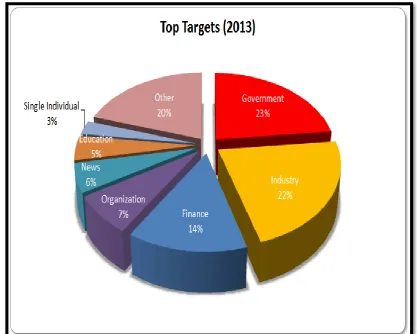
2
the education sector and news groups (Passeri, 2013). Although this report is not exhaustive and only represents discovered attacks, it does provide a global view of
the existing and continuously emerging threats to the security of computer data.
Figure 1.1: Distribution of Cyber-Attack Targets (Passeri, 2013)
The concept of security through monitoring user activity was first introduced in 1980 by James Anderson (1980). It was to protect information from being
accessed by unauthorized external or internal users and also to protect information from ‘misfeasors’, users that misused their privilege (Lunt, 1988). This was the
3
It operates as a secondary defense layer prior to conventional security technique such as authentication and access control (Peddabachigari et al., 2007).
Detection is the initial aspect in IDS, this is followed by the manual processing of the detected alerts. Although there have been many new and innovative
IDS softwares since the formation of IDES, due to the persistent problems mentioned in Section 1.2.2, this research focuses on the operational aspects of IDS which is the Alert Processing Method (APM). A framework that is able to refine process and manage the huge amount of alerts generated by IDS so as to finally produce an operational framework which analyze positive attack scenarios is proposed. The proposed framework introduces two most important features in alert processing; data reduction and alert correlation technique. Under the reduction component, feature selection is applied to choose the needed attributes to precede with the clustering and this is followed by the filtering of clusters that are not relevant or in this case clusters that are not a threat to the targeted computer. Next, results from the reduction component are then used as input for our alert correlation module to create attack scenarios and calculate attack scenarios probability. While the reduction solution is inspaired by Human Immune System (HIS) principles, correlation component applied pattern recognition method. By implementing the algorithm, we are able to achieve our objective and solve the problem stated at the initial stage of our research.
The rest of this chapter will explain further the importance of CS by stating the purpose and focus of this research. Firstly, Section 1.2 narrates the background of CS and the central problems addressed in this research. Section 1.3 describes the problem statement, followed by the motivation for performing this research in
4
1.2 Background of Computer Security (CS)
Security has become an integral component of the digital world as humans are no longer safe just by locking their physical doors and windows. Nowadays security has evolved and mutated in synchronization with the ease and speed of hackers and attackers in designing new and sophisticated attacks. New security mechanisms have to be developed to defend and protect users from these attacks; but even as sophisticated security mechanisms are developed, there will be attempts to intrude and violate the protection established. While computer security is being developed and enhanced, attack activities are growing and spawned at an alarming rate with new holes, new attack strategies and new attackers surfacing almost daily.
Unfortunately, security defenders are mostly reacting to attacks, instead of being able to prevent attacks before they occur. Nevertheless efforts must continue in the
attempts to produce an improved security mechanism to assists security defenders in safe guarding organization assets.
Previously, research and development of security were mostly focused and based on military importance and needs (Ware, 1967; Landwehr, 1983). However, with the growth in computer crimes from simple hacking to financial and information theft, the need for security has spread broader and wider among users in the computer world. CS is a service provided to protect and maintain the confidentiality, integrity and availability (CIA) of an automated information system resources (NIST., 1995) which also includes the network infrastructures (Bishop, 2003) governing it. Consequently, the CIA triad has become the fundamental characteristics (Kesh and Ratnasingam, 2007) in Information Security (IS) (ISO/IEC, 2005.). In addition to the triad, non-repudiation, accountability, authenticity, and reliability are the characteristics of Information and Communication Technology (ICT) security (ISO/IEC, 2004). Meanwhile the functionality of Cyber Security (CBS) is to protect the CIA of information in the cyberspace (ISO/IEC, 2012); which indicates the permutation or intersection of IS and ICT security. The definition of
5
Figure 1.2: Computer Security
Standalone systems, applications and data are protected via information security ; wherelse network connection and transmission is protected by ICT security. Therefore the transmission or accessibility of data or information through the network will constitute the application of cyber security. There are various approaches in the development of CS mechanisms built to address or resolve a particular issue at a given time. Since there is no single solution to multiple problems, the different security mechanisms are used simultaneously as they complement each other in setting up a secure environment.
1.2.1 Challenges of Existing Security Mechanisms
The main goal in implementing CS is to protect classified material against malicious activity whether intentional or not and is a major challenge faced by security practitioners and developers. Security mechanisms have their limitations and vulnerabilities that are constantly being addressed by researchers and developers. Technically there are many different kinds of security mechanisms applied at various levels of the Open System Interconnection (OSI) layer, information and the network infrastructure remain vulnerable. Since existing security mechanisms are solutions to current problems, attackers are continuously designing new and sophisticated attacks to outsmart them. For example hackers have developed methods such as ‘SQL injection’ and ‘cross site scripting’ to penetrate the source code of an application or
Information Security ]
ICT Security ]
6
web portal to steal information. Meanwhile operating systems and anti-virus packages are constantly being updated with new patches to resolve vulnerabilities
that are created. Although firewalls are a common element in a network infrastructure, they are still susceptible to circumvention by attackers besides being
unable to detect new threats and viruses as they are not programmed to block malicious acts committed by insiders. Similarly, IDS faced similar limitations except that it is able to detect and monitor malicious activity from within and outside the network domain. However IDS has additional concern, which is the huge number of alert generated on a daily basis.
Providing security services is a complicated and difficult task where users, custodians and security experts need to be alert and prepared at all times. It is important to keep abreast of the current security developments and attackers’ new exploits. Based on the challenges mentioned, it is obvious that existing security mechanisms require further improvement. This research, however, focuses on the IDS mechanism in managing the huge amounts of alerts generated.
1.2.2 Problem Background on IDS
7
merely detects and logs traffic that is suspected or considered malicious. Although IDS technology has evolved much since the formation of the Intrusion Detection
Expert System (IDES) in 1980 (Denning, 1987), towards designing and producing better detection systems, there is still room for improvement as will be discussed
briefly in Chapter 2.
IDS has become a major security application which is widely implemented among practitioners and its importance as a security feature to computer infrastructure is indisputable. There are two main segments in IDS applications: a fully automated detection mechanism and an alert processing mechanism which is human dependent (Chaboya et al., 2006). The alerts produced to be processed are generated via the detection segment of IDS sensors resulting in huge amounts of daily alerts due to the efficiency and accuracy of the detection mechanism. The IDS-generated alerts are classified into four categories which are listed below:
i) True Positive (TP) indicating alert generated for a real intrusion ii) False Positive (FP) indicating alert generated for normal activity
iii) False Negative (FN) indicating missing alert which is not generated iv) True Negative (TN) indicating no alerts generated for normal activity
Although actions are continuously taken to create a better and more accurate detection mechanism, intruders and attackers are always introducing new and innovative ways to penetrate the user’s network. The single most notable limitation
of IDS technology since the beginning of its formation is conceptual in nature which is the detection mechanism. This weakness, causes another major implementation problem for security operators, which is the enormous number of alerts to be
8
(a) Huge number of alerts: It is reported that, in 2012 there was a 42% increase in the number of attacks of which 40% were caused by hackers
(Symantec-Corporation, 2013). This increase could be due to ‘overstimulation attacks’ which is a ploy developed to flood the network
with false positive alerts and confuse or distract security experts from real attacks (Yurcik, 2002; Chaboya et al., 2006; Corona et al., 2013). Elusion Strategies , such as SYN Flood, is a fragmentation technique that sends useless data to IDS to swamp the IDS sensor with ambiguous data to masquerade the actual attack. Secondly, there are also cases where attacks are disguised through specific coding to evade recognition (Chaboya et al., 2006). Also tools can be used to perform attacks (Giannetsos and Dimitriou, 2013; Mandelcorn, 2013; Prasad et al., 2013), such as DDoS attack tolls that could be initiated randomly by armature hackers(Dayanandam et al., 2013; Ozcelik et al., 2013). Such activities have aggravated the issue further and could paralyze the whole network.
(b)Processing Accuracy: Practitioners Broderick (1998), Manganaris et al.
(2000) and researchers Dain and Cunningham (2001) and Julisch (2001) have frequently highlighted the thousands of ‘innocence alerts’ or ‘mistakes’ (Abouabdalla et al., 2009) generated daily by IDS sensors and
the difficulty in sifting through them to find genuine threats (Vignesh et al., 2010; Liao et al., 2012). The act of manually analyzing and processing these alerts is said to be ‘labor-intensive/ human oriented base
(Chaboya et al., 2006) and error-prone (Broderick, 1998; Manganaris et
al., 2000; Dain and Cunningham, 2001)’. Although there are tools to automate alert analysis and processing (Dain and Cunningham, 2001; Debar and Wespi, 2001; Valdes and Skinner, 2001), there is still need for human involvement in the analysis and processing of alerts, since there is ‘no silver-bullet’ solution to this problem.
(c) False Positive (FP): It is reported that daily IDS’s detected thousands of
9
Though the percentage of false positives has reduced overtime due to research and development work for creating better and more sophisticated
detection mechanisms, detection inaccuracy is still an issue (Chun-Jen et al., 2013; Tiwari and Alaspurkar, 2013). This false positive alerts
dilemma is still a problem which has been extensively researched, as discussed in Chapter 2.
(d) Processing Performance: Owing to the above mentioned issues, the
performance rate in terms of time and memory capacity of an IDS implementation decreases. As such, reducing the number of alerts and false positives will contribute to better performance rates.
(e) Intelligent Decision Making Support: IDS is a monitoring system that
complements other security mechanisms. It is not a total integrated solution that could completely prevent attack from occurring and despite its strength, like other security system IDS lacks the ability to support decision making. Since the final assessment on the magnitude of damage caused by an attack is made by security experts therefore it is important that any IDS mechanism provide information to facilitate such decision making.
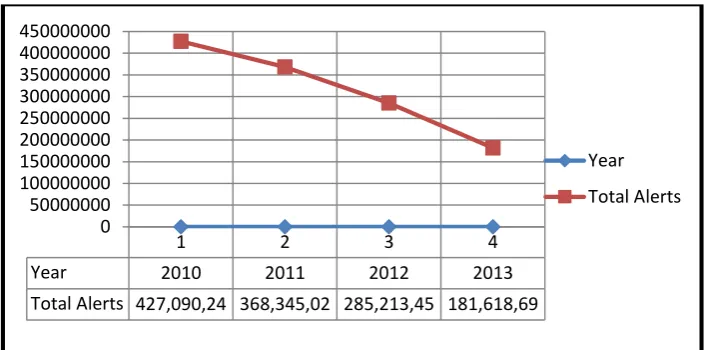
These are problems faced daily by PRISMA (Pemantauan Rangkaian ICT Sektor Awam) a unit created to monitor possible cyber-attacks on Malaysian government agencies. Due to the massive amount of alerts received daily, the 40-staff unit operates around the clock (24x7x365). Figure 1.3 shows the total amount of alerts captured since 2010 and the data up to October 2013 shows a continuous decline in alerts and is due mainly to PRISMA’s success in instilling awareness in
10
Figure 1.3: PRISMA Total Alerts Within Four Years
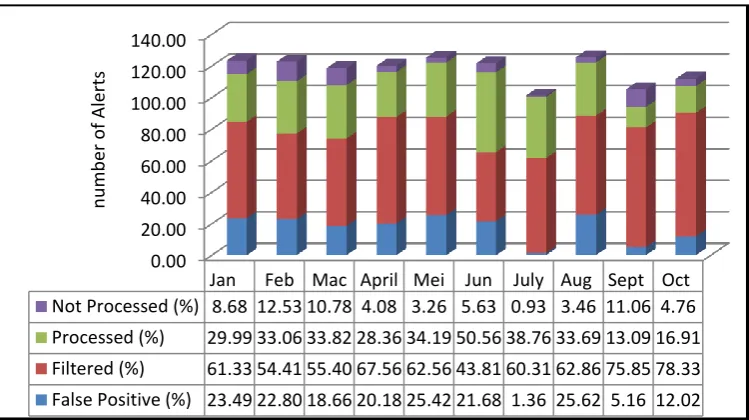
Although the number of alerts has reduced significantly with the implementation of extra security appliances such as firewalls and active maintenance of attack signatures used by IDS sensors that were inappropriate and obsolete, the 181.62 million alerts in 2013 indicates some degree of ineffectiveness. To illustrate further, a breakdown on the total alerts in 2013 into four categories is presented in Figure 1.4. The false positives, filtered, processed and not processed categories could explain the almost 182 million alerts. As shown more than 50% of the alerts were filtered and not considered a threat to the government agencies. This is a very large number and without proper automation process could cause missing alerts. Although the number of monthly false positive alerts is considerably small in
percentage terms, in reality filtered alerts are also false positives alerts. The difference being that the filtering is done automatically, while the later were confirmed false positives after a series of manual processing by security experts. It is thus safe to assume that the overall average of false positive alerts for 2013 (up to October) was 79.88%. Another important issue that has to be highlighted is the low percentage of processed alerts that were tasked to the 40 security experts. Despite the large number of human resources and their non-stop efforts they were only able to process an average of 31.24% of the overall total alerts. Although the percentage of the unprocessed alerts looks small however, the potential damage that could occur from these unprocessed alerts which is considered as malicious threats is undeniable.
1 2 3 4
Year 2010 2011 2012 2013
Total Alerts 427,090,24 368,345,02 285,213,45 181,618,69 0
50000000 100000000 150000000 200000000 250000000 300000000 350000000 400000000 450000000
Year
11
Figure 1.4: Categorization of PRISMA Raw Alerts for year 2013
The issues relating to IDS implementation are not only in theory but very much a practical concern as demonstrated by the data gathered from PRISMA (refer Figure 1.4). The authenticity of mostly false positives alerts generated and filtered through the filtering process is questionable due to the lack of important information as a filtering criteria. Furthermore, even though a huge number of alerts were filtered, the processing performance is still inadequate owing the number of unprocessed alerts arising monthly. The tedious and time consuming manual process has made it impossible for security experts to process all the remaining alerts. Accordingly, the operative function which is supposedly online and in real time is impossible to implement because of the time spent processing useless and
meaningless alerts. In addition, the equipment used is constantly in need of upgrading to cater to the huge amounts of data collected and processed.
Taking into consideration the specified problems mentioned above, the purpose of this research is to construct a holistic solution that focuses on the alert processing segment of the IDS application with the objective of minimizing human dependency and to assist security experts in focusing on diagnosing the impact of any attack. It is about managing these alerts and organizing them in a meaningful way to enable the experts to make appropriate decisions on each individual asset under attack. This is achieved by first, reducing the numbers of alerts collected and
0.00 20.00 40.00 60.00 80.00 100.00 120.00 140.00
Jan Feb Mac April Mei Jun July Aug Sept Oct
Not Processed (%) 8.68 12.53 10.78 4.08 3.26 5.63 0.93 3.46 11.06 4.76
Processed (%) 29.99 33.06 33.82 28.36 34.19 50.56 38.76 33.69 13.09 16.91
Filtered (%) 61.33 54.41 55.40 67.56 62.56 43.81 60.31 62.86 75.85 78.33
False Positive (%) 23.49 22.80 18.66 20.18 25.42 21.68 1.36 25.62 5.16 12.02
n
u
mb
er o
f A
12
grouping them to produce attack scenarios. This is done by splitting tasks into smaller modules to create a holistic framework as explained in Chapter 4. Although
the main design of this framework is to manage and organize the alerts, the most important element is the accuracy and performance factors in achieving these goals.
As such, choosing the best technique to perform the tasks assigned in this framework is a crucial element of the decision-making process.
1.3 Problem Statement
This research focuses on providing a complete and enhanced solution in making alert processing efficient. Through automating alert processing activity human intervention is reduce and intellectual decision making element is
incorporated. Based on the problem relating alert processing mentioned in Section 1.2.2, the main research question to be addressed is:
How to effectively refine, process and manage the huge number of alerts
generated by IDS to eventually produce an operational framework which analyzes
all vulnerable and possible attack scenarios?
To answer the above question, the following need to considered and addressed:
(a) RQ1: What are the methods and techniques used in the process of
managing the alerts generated by IDS?
(b) RQ2: How to classify and enhance existing alert processing technique?
(c) RQ3: What are the types of data generated by the SNORT IDS sensor and
how to assemble the data required?
13
(e) RQ5: How to enhance the existing alert processing framework through the technique and approaches identified?
(f) RQ6: What are the required components involved in the process of constructing the proposed framework?
(g) RQ7: How to evaluate the framework and clustering technique introduced
in the proposed solution ?
1.4 Research Motivation
In IDS implementation, alert processing is a component that is activated in response to the output produced by the detection module. The number of alerts produced and their accuracy is beyond the control of the alert processing component
but that has to be managed and processed within its jurisdiction. Section 1.2.5 provides a full explanation on the problems originating from this component which is also the research problem of this study. Chapter 3 discusses the limitations of the existing alert processing techniques by earlier researchers, which either concentrate in reducing the number of alerts separately from correlating those alerts or performing both techniques. Based on the review conducted, calculations of vulnerability level assessment and successful attack probability estimation are not available in any of the previous frameworks. Therefore, the emphasis in this research is to address these limitations and enhance the existing framework. Improvements in the current solutions are essential because of the following:
14
process off data reduction will jeopardize the credibility of the data and ultimately present an unreliable end result.
(b) To enhance automation: Large amount of raw alerts are generated by IDS sensors on a daily basis. These alerts have to be processed immediately and
efficiently and as such automation process is extremely crucial in this phase of IDS implementation. Even though human involvement in this process is unavoidable, the effort has to be made to try and enhance the automation process to its ultimate capacity using their implicit and explicit knowledge.
(c) To support decision making: For the raw alerts to have meaning and value they have to undergo a series of procedures and actions. These processed alerts will ultimately be a source of information for intelligent and decisive decision making. Currently, existing alert processing frameworks are focus on reducing the number of alerts and forming causal relationship among them, but, this is inadequate for sound and effective human decision making which requires more robust and reliable information inputs.
The above are the source of motivation of this research and will aid in answering the main research question:
How to effectively refine, process and manage the huge number of alerts
generated by IDS to eventually produce an operational framework which analyzes
all vulnerable and possible attack scenarios?
To accomplish this objective the following issues have to be addressed:
(a) Designing modules using best techniques in both spectrum of alert processing
15
(b) Extracting implicit and explicit knowledge using the taxonomy derived based on previous studies and the scope of this research.
(c) Implementing the newly developed alert processing techniques using the documented knowledge collected.
1.5 Research Objectives
The research objectives based on the problem statement above, are as follows:
(a) To analyze existing clustering technique to present a novel method of reducing the amount of alerts generated by performing a new clustering technique based on Artificial Immune System.
(b) To analyze existing correlation technique to present a knowledge based
correlation method based on pattern recognition technique to detect known attack pattern and successfully calculate its probability.
(c) To propose a framework on alert monitoring and processing operation
that focuses on an individual machine under attack
1.6 Research Scope
The scope of this study is as follows:
(a) The overall focus of this research is the alert processing segment and the
area highlighted is the reduction of the amount of alerts and correlating alerts into scenarios.
(b) This research is geared to the clustering methodology that is based on
16
(c) The data used for this research are the ones captured by SNORT engine. Though there is much information stored in a particular alert that is
captured, for the purpose of this research five features which are destination IP, source IP, signature ID, time stamp and event ID are
selected.
(d) Targeted assets under attack (destination IP) is the priority in this
research; the alert cluster and the scenarios created are based on destination IP.
(e) This research focuses on producing a framework that is practicable and doable within a security monitoring environment.
1.7 Research Significance
The significance of the study lies in the following areas:
(a) Firstly, the most important contribution of this research is towards the
ability to reduce the amount of alerts processed without jeopardizing the integrity of the alert.
(b) The clustering techniques are time efficient and computationally cost
effective.
(c) The proposed approach is based on individual assets that are being
monitored which is critical to any institution.
17
1.8 Thesis Organization
This is a research that explores the computer security domain and focuses on a particular security application named Intrusion Detections Systems. It is a documentation of activities and processes conducted aimed at producing an artifact or object which is a solution to the issue or problem identified. This thesis consists of seven (7) chapters with each beginning with an introduction and ending with a summary to facilitate understanding of the thesis. The organization overview of this thesis is shown in Figure 1.5, which explains the flow of normal and alternative reading of this thesis. A summary of the succeeding chapters is as follows:
Chapter 2: Presents an overall review of the IDS technology and emphasizes on the
limitation currently surrounding the detection mechanisms. This is followed by a survey of the comparative evaluation study performed on a previous Alert Processing
Method. The chapter begins with an explanation of two important elements of the alert processing segment. Next is the discussion and comparative evaluation of the existing methods. This is followed with the implementation issues or limitations of each method. Finally, it highlights the elements that could contribute to overcoming the existing limitations.
Figure 1.5: Overview of the Thesis Organization CHAPTER 1
Introduction Literature Review CHAPTER 2
Chapter 3 Research Methodology
CHAPTER 6 Conclusion and Future Research
CHAPTER 5 Experimentation and Evaluation of IAPF
18
Chapter 3: Constitutes the research methodology adopted in completing this research. The procedures and activities presented by the methodology, guided the
research to its proposed objectives. Next, the operational framework presents deliverables of each objectives, followed by a brief presentation of the proposed
solution. The data source and format applied for the experiment are discussed. Next the evaluation critera is discussed and lastly, the limititations and assuptions of the proposed solutions are listed.
Chapter 4: This chapter presents the detailed process of designing and developing the proposed Intelligent Alert Processing Framework (IAPF) solution. It begins by explaining the conceptual model of the IAPF and illustrates the designing of each module and the challenges involved in doing that. Lastly, the procedures and processes in building and developing the modules are explained .
Chapter 5: This chapter first describes the implementation procedures for the experiments to be conducted and the evaluation method. Next the experimental results from both data sets are evaluated using the model proposed. The performance of the IAPF prototype is measured based on the calculations mentioned in chapter 4. Next, the evaluation results are used to address the research purpose identified at the beginning of the research. Finally an overall analysis and discussion is conducted on the experimental results.
19
1.9 Definition of Terms
The terms used in this research are as listed below:
Alert/Event/Attack – a notification of the occurrence of specific events that
matches the signatures (in signature-based NIDS) or deviates from normal activities (for anomaly-based NIDS).
Alert correlation – multi steps process that receives raw alerts as input and acts
as a platform to manage and understand the alerts.
Attack graph - is a relational/causal graph or Directed Acyclic Graph
(DAG) that represents the causal relationship between attacks to reveal attack strategy. Edges represent action and nodes represent system’s tate.
Attack step/stages - steps involved in an attack stage. Technically, it represents
the clusters produced by clustering in ARM.
Attack strategy - a complete attack launched by attacker which consists of
attack steps and attack stages.
DDoS - stand for Distributed Denial of Service. It referred to an attack which a multitude of compromised systems attack a single target, thereby causing denial of service for users of the targeted system. The flood of incoming messages to the target system essentially forces it to shut down, thereby denying service to the system to legitimate users.
True Positive (TP) - indicates alert that is generated for a real intrusion.
False Positive (FP) - indicates alert that is generated for normal activity
False Negative (FN) - indicates missing alerts which is not generated
20
False Positive Attack - indicatescalculated vunerability level of a cluster.
Known alert - a labelled alert that has class information based on previous
data or domain experts knowledge. It is usually used for training the machine learning algorithm.
Unseen/new alert - an unlabeled alert that has no class information. It is
usually used for validation and testing the machine learning algorithm.
Missing alerts - attacks that are not captured by the IDS sensor.
Reduce alerts - alerts that are clustered or grouped together based on a
sepecified criteria to reduce redundancy.
Reduce False Positive- alerts or clusters that are not malicious and not a threat to
265
REFERENCES
Abouabdalla, O., El-Taj, H., Manasrah, A. and Ramadass, S. (2009). False positive reduction in intrusion detection system: A survey. Broadband Network &
Multimedia Technology, 2009. IC-BNMT'09. 2nd IEEE International
Conference, 463-466.
Abraham, A., Grosan, C. and Martin-Vide, C. (2007). Evolutionary Design of Intrusion Detection Programs. IJ Network Security. 4 (3), 328-339.
Ada, G. L. and Nosal, G. (1987). The clonal selection theory. Scientific American Ahrabi, A. A. A., Feyzi, K., Orang, Z. A., Bahrbegi, H. and Safarzadeh, E. (2012).
Using Learning Vector Quantization in Alert Management of Intrusion Detection System. International Journal of Computer Science and Security. 6 (2), 128.
Aickelin, U., Greensmith, J. and Twycross, J. (2004). Immune System Approaches to
Intrusion Detection – A Review. In G. Nicosia, V. Cutello, P. Bentley and J.
Timmis. Artificial Immune Systems. (pp. 316-329), Berlin Heidelberg:Springer. Al-Mamory, S. O. and Zhang, H. L. (2007). A survey on IDS alerts processing
techniques. Proceedings of the 6th Wseas International Conference on
Information Security and Privacy (Isp '07),69-78.
Al-Mamory, S. O. and Zhang, H. L. (2009). Intrusion detection alarms reduction using root cause analysis and clustering. Computer Communications. 32 (2), 419-430.
Alserhani, F. (2013). A framework for multi-stage attack detection. Electronics,
Communications and Photonics Conference (SIECPC). Saudi International. 1-6.
Alserhani, F., Akhlaq, M., Awan, I. U., Cullen, A. J. and Mirchandani, P. (2010). MARS: Multi-stage Attack Recognition System. Advanced Information
Networking and Applications (AINA), 2010 24th IEEE International Conference
266
Amrita, P. and Ahmed, P. (2014). A Hybrid-Based Feature Selection Approach for IDS. In Networks and Communications (NetCom2013). Springer, 195-211. Aniello, L., Di Luna, G. A., Lodi, G. and Baldoni, R. (2011). A collaborative event
processing system for protection of critical infrastructures from cyber attacks. In
Computer Safety, Reliability, and Security. Springer, 310-323.
Anifowose, F. A. and Eludiora, S. I. (2011). Application of Artificial Intelligence in Network Intrusion Detection.
Asif-Iqbal, H., Udzir, N. I., Mahmod, R., & Ghani, A. A. A. (2011). Filtering events using clustering in heterogeneous security logs. Information Technology
Journal, 10(4), 798-806.
Bakar, N. A., Belaton, B. and Samsudin, A. (2005). False positives reduction via intrusion alert quality framework. IEEE 7th Malaysia International Conference
on Communication. . 16-18 November.Malaysia.6-11.
Balajinath, B. and Raghavan, S. V. (2001). Intrusion detection through learning behavior model. Computer Communications. 24 (12), 1202-1212.
Bansode, N. S., Pawar, A. B., & Parvat, T. J. (2014). Improve IDS Alert Result By Using Decision Support Techniques.
Bateni, M., Baraani, A. and Ghorbani, A. (2012). Alert correlation using artificial immune recognition system. International Journal of Bio-Inspired Computation.
4 (3), 181-195.
Bateni, M., Baraani, A., Ghorbani, A. and Rezaei, A. (2013). An AIS-inspired Architecture for Alert Correlation. International Journal of innovative
Computing, Information & Control. 9 (1), 231-255.
Ben-Hur, A., Ong, C. S., Sonnenburg, S., Schokopf, B. and Ratsch, G. (2008).
Support Vector Machines and Kernels for Computational Biology. PLoS
Computational Biology. 4 (10), e1000173.
Berkhin, P. (2006). A survey of clustering data mining techniques.Springer-Verlag Heidelberg, 25-71
Biermanna, E., Cloeteb, E. and Venterc, L. M. (2001). A comparison of Intrusion Detection systems. Computers & Security, Elsevier Science Ltd. 20 (8), 676-683 Bishop, M. (2003). What is computer security? Security & Privacy, IEEE. 1 (1),
67-69.
267
displayTC.pl?/980504sb3-ibm.htm (Accessed: 6 January 2011).
Bundy, A. (1985). Incidence calculus: A mechanism for probabilistic reasoning.
Journal of Automated Reasoning. 1 (3), 263-283.
Carpenter, G. A., Grossberg, S. and Reynolds, J. H. (1991). ARTMAP - Supervused real-time learning and classification of nonstationary data by a self-organizing
neural network. Neural Networks. 4 (5), 565-588.
Castro, L. N. d. and Jonathan, T. (2002). Artificial Immune Systems: A New
Computational Intelligence Approach. Great Britain: Springer-Verlag
Castro, L. N. d. and Timmis, J. I. (2003). Artificial immune systems as a novel soft computing paradigm. Soft Computing. 7(8), 526-544.
Chaboya, D. J., Raines, R. A., Baldwin, R. O. and Mullins, B. E. (2006). Network intrusion detection: automated and manual methods prone to attack and evasion.
Security & Privacy, IEEE. 4 (6), 36-43.
Chebrolu, S., Abraham, A. and Thomas, J. P. (2005). Feature deduction and
ensemble design of intrusion detection systems. Computers & Security. 24 (4), 295-307.
Chen, Y., Li, Y., Cheng, X.-Q. and Guo, L. (2006). Survey and taxonomy of feature selection algorithms in intrusion detection system. Information Security and
Cryptology.153-167.
Cheng, B.-C., Liao, G.-T., Huang, C.-C. and Yu, M.-T. (2011). A Novel Probabilistic Matching Algorithm for Multi-Stage Attack Forecasts. IEEE Journal on
Selected Areas in Communications.29 (7), 1438-1448.
Cheung, S., Lindqvist, U. and Fong, M. W. (2003). Modeling multistep cyber attacks for scenario recognition. DARPA Information Survivability Conference and
Exposition Proceedings. 284-292.
Chou, T.-S. and Chou, T.-N. (2009). Hybrid Classifier Systems for Intrusion Detection. Seventh Annual Communication Networks and Services Research
Conference(CNSR'09).286-291.
Chowdhary, M., Suri, S., & Bhutani, M. (2011). Comparative Study of Intrusion Detection System. Journal of Computer Science International Journal of Computer Science International Journal of Computer Sciencesand Engineering
268
Chun-Jen, C., Khatkar, P., Tianyi, X., Jeongkeun, L. and Dijiang, H. (2013). NICE: Network Intrusion Detection and Countermeasure Selection in Virtual Network Systems. IEEE Transactions on Dependable and Secure Computing, 10 (4), 198-211.
Corbató, F. J., Merwin-Daggett, M. and Daley, R. C. (1962). An experimental
time-sharing system. Spring Joint Computer ConferenceProceedings. May 1-3, 335-344.
Corbató, F. J., Saltzer, J. H. and Clingen, C. T. (1972). Multics: The first seven years.
Spring Joint Computer Conference Proceedings. May 16-18, 1972, 571-583.
Corona, I., Giacinto, G. and Roli, F. (2013). Adversarial attacks against intrusion detection systems: Taxonomy, solutions and open issues. Information Sciences.
239 (0), 201-225.
Cuppens, F., & Miege, A. (2002). Alert correlation in a cooperative intrusion detection framework. Proceedings of the IEEE Symposium on Security and
Privacy.202-215.
Cuppens, F. and Ortalo, R. (2000). LAMBDA: A language to model a database for detection of attacks. Proceedings of Recent Advances in Intrusion Detectio. 197-216.
Dadkhah, S., KhaliliShoja, M. and Taheri, H. (2013). Alert Correlation through a Multi Components Architecture. International Journal of Electrical and
Computer Engineering (IJECE). 3(4), 461-466.
Dain, O. and Cunningham, R. K. (2001). Fusing a heterogeneous alert stream into scenarios. . In: Proceedings of ACM Workshop on Data Mining for Security
Applications. Philadelphia,PA,1-13.
Daley, R. C. and Neumann, P. G. (1965). A general-purpose file system for
secondary storage. Proceedings of the Joint Computer Conference. November 30 - December 1, 213-229.
Dasgupta, D., Ji, Z. and Gonzalez, F. (2003). Artificial immune system (AIS) research in the last five years. The Congress on Evolutionary Computation
(CEC '03). 8-12 December, 121, 123-130
Dayanandam, G., Rao, T., Reddy, S. P. K. and Sruthi, R. (2013). Password Based Scheme And Group Testing For Defending DDOS Attacks. International
269
Debar, H. and Wespi, A. (2001). Aggregation and Correlation of Intrusion-Detection Alerts. Heidelberg: Springer-Verlag, 85-103.
Denning, D. E. (1987). An Intrusion-Detection Model. . IEEE Transactions On
Software Engineering.13( 2 ).
Depren, O., Topallar, M., Anarim, E. and Ciliz, M. K. (2005). An intelligent
intrusion detection system (IDS) for anomaly and misuse detection in computer networks. Expert Systems with Applications. 29 (4), 713-722.
Després, S. and Zargayouna, H. (2009). Evaluation of knowledge based applications: benchmark and guidelines. Fifth International Conference on Signal-Image
Technology & Internet-Based Systems (SITIS). 472-478.
Dewan, M. F. and Mohammad, Z. R. (2010). Anomaly Network Intrusion Detection Based on Improved Self Adaptive Bayesian Algorithm. Journal Of Computers. 5(1).
Du, H., Liu, D. F., Holsopple, J. and Yang, S. J. (2010). Toward ensemble characterization and projection of multistage cyber attacks. Computer
Communications and Networks Conference (ICCCN). 1-8.
Dunn, J. (1974). A fuzzy relative of the isodata process and its use in detecting compact well-separated cluster. Journal of Cybernetic. 3 32.
Ebrahimi, A., Navin, A., Mirnia, M., Bahrbegi, H. and Ahrabi, A. (2011). Automatic attack scenario discovering based on a new alert correlation method. Systems
Conference (SysCon), IEEE International. 52-58.
Elshoush, H. T. and Osman, I. M. (2011). Alert correlation in collaborative
intelligent intrusion detection systems—A survey. Applied Soft Computing. 11 (7), 4349-4365.
Elshoush, H. T. and Osman, I. M. (2013). Intrusion Alert Correlation Framework: An Innovative Approach. In IAENG Transactions on Engineering Technologies. Springer, 405-420.
Embar-Seddon, A. (2002). Cyberterrorism Are We Under Siege? American
Behavioral Scientist. 45 (6), 1033-1043.
Estivill-Castro, V. (2002). Why so many clustering algorithms: a position paper.
270
Faccin, S., Purnadi, R., Hulkkonen, T., Rajaniemi, J., Tuohino, M. and Sivanandan, M.(2012). System And Method Of Controlling Application Level Access Of Subscriber To A Network. US Patent Application 13/430,779.
Fava, D. S., Byers, S. R. and Yang, S. J. (2008). Projecting cyberattacks through variable-length markov models. IEEE Transactions on Information Forensics
and Security. 3(3), 359-369.
Fayyad, U., Piatetsky-Shapiro, G. and Smyth, P. (1996). From data mining to knowledge discovery in databases. AI magazine. 17(3), 37.
Forrest, S., Perelson, A. S., Allen, L. and Cherukuri, R. (1994). Self-nonself
discrimination in a computer. IEEE Computer Society Symposium on Research
in Security and Privacy. 202-202.
Frank, J. (1994). Artificial Intelligence and Intrusion Detection: Current and Future Direction. Proc. 17th National Computer Security Conference (Baltimore, MD).
Gaber, M. M., Zaslavsky, A. and Krishnaswamy, S. (2005). Mining data streams: a review. ACM Sigmod Record. 34 (2), 18-26.
Gabrys, B. and Bargiela, A. (2000). General fuzzy min-max neural network for clustering and classification. Ieee Transactions on Neural Networks.11 (3), 769-783.
Gaidhane, R., Vaidya, C. and Raghuwanshi, M. (2014). Survey: Learning Techniques for Intrusion Detection System (IDS).
Giannetsos, T. and Dimitriou, T. (2013). Spy-Sense: spyware tool for executing stealthy exploits against sensor networks. Proceedings of the 2nd ACM
workshop on Hot topics on wireless network security and privacy. 7-12.
Gifty Jeya, P., Ravichandran, M. and Ravichandran, C. S. (2012). Efficient Classifier
for R2L and U2R Attacks. International Journal of Computer Applications.45( 21).
Gionis, A., Mannila, H., & Tsaparas, P. (2007). Clustering aggregation. ACM
Transactions on Knowledge Discovery from Data (TKDD), 1(1), 4.
Gollmann, D. (2010). Computer security. Wiley Interdisciplinary Reviews:
Computational Statistics. 2 (5), 544-554.
Gonçalves, M., Andrade Netto, M. and Costa, J. (2011). Land-Cover Classification Using Self-Organizing Maps Clustered with Spectral and Spatial Information.
271
Graham, R. M. (1968). Protection in an information processing utility.
Communications of the ACM. 11(5), 365-369.
Guha, S., Rastogi, R. and Shim, K. (2000). ROCK: A Robust Clustering Algorithm for Categorical Attributes. Information System. 25(5), 345-366.
Guha, S., Rastogi, R. and Shim, K. (2001). Cure: An efficient clustering algorithm
for large databases. Information Systems. 26(1), 35-58.
Haines, J. W., 2012. "DARPA Intrusion Detection Evaluation." 2013, from
http://www.ll.mit.edu/mission/communications/cyber/CSTcorpora/ideval/data/2
000/LLS_DDOS_1.0.html.
Han, J., Kamber, M. and Pei, J. (2006). Data mining: concepts and techniquesSan Fancisco, CA itd: Morgan kaufmann.
Hansman, S. and Hunt, R. (2005). A taxonomy of network and computer attacks.
Computers & Security. 24(1), 31-43.
Hashim, M. and Zaiton, S. (2008). Network intrusion alert correlation challenges and techniques. Jurnal Teknologi Maklumat. 20 (2), 12-36.
Hathaway, R. J. and Bezdek, J. C. (2001). Fuzzy c-means clustering of incomplete data. Ieee Transactions on Systems Man and Cybernetics Part B-Cybernetics. 31 (5), 735-744.
Hevner, A. R., March, S. T., Park, J. and Ram, S. (2004). Design Science in Information Systems Research. MIS Quarterly. 28 (1), 75-105.
Holsopple, J. and Yang, S. J. (2008). FuSIA: future situation and impact awareness.
Information Fusion, 2008 11th International Conference on. 1-8.
Huan, L. and Lei, Y. (2005). Toward integrating feature selection algorithms for classification and clustering. IEEE Transactions on.Knowledge and Data
Engineering. 17(4), 491-502.
Iivari, J. (2007). A Paradigmatic Analysis of Information Systems as a Design Science. Scandinavian Journal of Information Systems. 19(2) 87-92. Ingham, K. and Forrest, S. (2002), A History and Survey of Network Firewalls.
University New Mexico: Technical Report :TRCS-2002-37.
ISO/IEC,(2004). ISO/IEC TR 13335-1:2004 information technology security
272
ISO/IEC (2011). Information technology-security techniques-information security incident management. ISO/IEC 27035:2009.
ISO/IEC(2012). ISO/IEC 27032:2012 Information technology — Security techniques — Guidelines for cybersecurity
ISO/IEC, (2005). ISO/IEC 27002: code of practice for information security
management
Jain, A. K. (2010). Data clustering: 50 years beyond K-means. Pattern Recognition
Letters. 3(8), 651-666.
Jain, A. K., Murty, M. N. and Flynn, P. J. (1999). Data clustering: A review. Acm
Computing Surveys.31(3),264-323.
Jerne, N. K. (1974). Towards a network theory of the immune system. In Annales
d'immunologie.125(1-2), 373-389.
Jiang, W. (2012). Survey of network and computer attack taxonomy. IEEE
Symposium onRobotics and Applications (ISRA). 3-5 June 2012. 294-297.
Julisch, K. (2001). Mining Alarm Clusters to Improve Alarm Handling Eficiency. .
In 17th Annual Computer Security Applications Conference (ACSAC). 12-21.
Julisch, K. (2003). Clustering intrusion detection alarms to support root cause analysis. ACM Trans. Inf. Syst. Secur. 6(4), 443-471.
Kabiri, P. and Ghorbani, A. A. (2005). Research on intrusion Detection and
Response: A Survey. International Journal of Network Security. 1(2), 84-102. Kabiri, P. and Ghorbani, A. A. (2007). A Rule-Based Temporal Alert Correlation
System. International Journal of Network Security.5 (1).
Karypis, G., Han, E. H. and Kumar, V. (1999). Chameleon: Hierarchical clustering using dynamic modeling. Computer.32(8), 68-75.
Kavousi, F. and Akbari, B. (2013). A Bayesian network‐based approach for learning
attack strategies from intrusion alerts. Security and Communication Networks.
7(5),833-853.
Kayacik, H. G., Zincir-Heywood, A. N. and Heywood, M. I. (2005). Selecting features for intrusion detection: A feature relevance analysis on KDD 99 intrusion detection datasets. Proceedings of the third annual conference on
privacy, security and trust.
273
Kephart, J., Sorkin, G., Swimmer, M., & White, S. (1999). Blueprint for a Computer
Immune System.Springer Berlin Heidelberg.242-261.
Kesh, S. and Ratnasingam, P. (2007). A knowledge architecture for IT security.
Communications of the ACM. 50 (7), 103-108.
Kitchenham, B., Linkman, S. and Law, D. (1997). DESMET: a methodology for
evaluating software engineering methods and tools. Computing & Control
Engineering Journal. 8(3), 120-126.
Kitchenham, B. A. (1996). Evaluating software engineering methods and tool part 1: The evaluation context and evaluation methods. ACM SIGSOFT Software
Engineering Notes. 21(1), 11-14.
Kohonen, T. (2001). Self-organizing maps (Vol. 30). Springer-Verlag New York. Inc., Secaucus, NJ, 43.
Kruegel, C., Robertson, W. and Vigna, G. (2004). Using alert verification to identify successful intrusion attempts. Praxis der Informationsverarbeitung und
Kommunikation. 27 (4), 219-227.
Kruegel, C. and Toth, T. (2003). Using decision trees to improve signature-based intrusion detection. Recent Advances in Intrusion Detection, Proceedings. 2820 173-191.
Kumar, G., Kumar, K. and Sachdeva, M. (2010). The use of artificial intelligence based techniques for intrusion detection: A review. Artificial Intelligence
Review. 34 (4), 369-387.
Kumar, M., Hanumanthappa, M. and Kumar, T. S. (2011). Intrusion Detection System-False Positive Alert Reduction Technique. ACEEE International
Journal on Network Security. 2 (3).
Kumar, M., Siddique, S. and Noor, H. (2009). Feature-based alert correlation in security systems using self organizing maps. SPIE Defense, Security, and
Sensing. 734404-734407.
Landwehr, C. E. (1983). Best available technologies for computer security.
Computer. 16 (7), 86-95.
![Figure 1.2: ] Computer Security](https://thumb-us.123doks.com/thumbv2/123dok_us/1292410.1161779/25.595.202.461.91.246/figure-computer-security.webp)