University of South Carolina
Scholar Commons
Theses and Dissertations
2015
Potential Range Expansion of the Invasive Lionfish
in the Western Atlantic Ocean
Brian Grieve
University of South Carolina - Columbia
Follow this and additional works at:https://scholarcommons.sc.edu/etd
Part of theBiology Commons
This Open Access Thesis is brought to you by Scholar Commons. It has been accepted for inclusion in Theses and Dissertations by an authorized administrator of Scholar Commons. For more information, please [email protected].
Recommended Citation
Grieve, B.(2015).Potential Range Expansion of the Invasive Lionfish in the Western Atlantic Ocean.(Master's thesis). Retrieved from
P
OTENTIAL RANGE EXPANSION OF THE INVASIVE LIONFISH IN THE WESTERN ATLANTIC OCEAN IN RESPONSE TO FUTURE CLIMATE CHANGEby Brian Grieve Bachelor of Science Michigan State University, 2012
Submitted in Partial Fulfillment of the Requirements For the Degree of Master of Science in
Biological Sciences College of Arts and Sciences University of South Carolina
2015 Accepted by:
Ryan Rykaczewski, Director of Thesis Blaine Griffen, Reader
Matthew Kimball, Reader David Wethey, Reader
D
EDICATIONA
CKNOWLEDGEMENTSA
BSTRACTT
ABLE OFC
ONTENTSDEDICATION ... iii
ACKNOWLEDGEMENTS ... iv
ABSTRACT ... v
LIST OF TABLES ... vii
LIST OF FIGURES ... viii
LIST OF ABBREVIATIONS ... ix
CHAPTER 1:INTRODUCTION………..………..……….1
CHAPTER 2:METHODS…….………..………..……….6
CHAPTER 3:RESULTS ... 14
CHAPTER 4:DISCUSSION ... 22
L
IST OFT
ABLESL
IST OFF
IGURESFigure 1.1 Comparison of potential lionfish habitats in the Western Atlantic Ocean over the present day time period ... 4 Figure 2.1 The delta method visualized for one model, NOAA-GFDL-CM3 ... 9 Figure 3.1 Bottom-water temperature projections and anomalies in the South Atlantic
Bight ... 16 Figure 3.2 :Number of suboptimal months (10°C-16°C) per year in present and future
time periods under different RCP scenarios ... 18 Figure 3.3 Percentage of RCP 8.5 models that project year-round and seasonal lionfish
L
IST OFA
BBREVIATIONSCHAPTER
1
I
NTRODUCTIONNovelty confers certain advantages to lionfish, including a unique appearance and hunting strategy that may confuse potential prey, if prey recognize the lionfish as being a predator at all (Morris et al., 2009; Albins & Lyons, 2012; Albins & Hixon, 2013). Lionfish possess venomous spines that discourage predation by local predators (but see Maljković
et al., 2008; Diller et al., 2014), and their only predator in the native range, the bluespotted cornetfish Fistularia commersonii, is not present in the invaded range
(Bernadsky & Goulet, 1991). Given these traits, along with a voracious, generalist appetite (Morris & Akins, 2009; Muñoz et al., 2011), lionfish have been found to drastically lower abundance, recruitment, and diversity of prey fish in areas which they have invaded (Green et al., 2012; Albins & Hixon, 2008; Albins, 2013). Benthic macroinvertebrates – the preferred prey of young and small lionfish – likely face similar consequences, but quantifying the impact of lionfish on this community requires further analysis (Muñoz et al., 2011; Layman et al., 2014). Lionfish may also affect abundance and behavior of commercially and ecologically important predators in the region, such as snapper and grouper, by competing with them for food and space (O’Farrell et al., 2014; Raymond et al., 2015).
months (December-March), a steep, inshore-offshore temperature gradient develops between the cold, nearshore waters and the relatively warm waters of the Gulf Stream. These warm waters provide a refuge for lionfish in the center of the SAB (Whitfield et al., 2002, 2014; Meister et al., 2005; Muñoz et al., 2011), while the shallow inshore waters rapidly cool due to surface mixing (Atkinson et al., 1983). This gradient is reversed in the summer months (June-August), allowing adult lionfish to move further inshore (Whitfield
et al., 2007; Schofield, 2009) as hot summer surface temperatures are mixed into the shallow inshore waters. Lionfish larvae are occasionally advected north by the Gulf Stream and warm-core eddies (Hare et al., 2002), resulting in the presence of young-of-the-year juveniles as far north as the coast of Long Island, NY (Figure 1.1; Whitfield et al., 2002). These individuals do not survive the harsh winters and have not established a breeding population (Kimball et al., 2004).
conditions are ripe for invasion, further increasing the opportunity for trophic cascades (Albins & Hixon, 2013) and regime shifts (Quero, 1998; Scheffer et al., 2001; Daskalov et al., 2007).
Many marine fishes have already shifted their range in response to climate change (Perry et al., 2005; Rose, 2005; Parmesan, 2006; Nye et al., 2009; Lucey & Nye, 2010), and many more are projected to in the future (Loukos et al., 2003; Cheung et al., 2009, 2010; Hare et al., 2012). Many of these analyses utilize bioclimatic envelope models that project the fundamental niche – a combination of physical conditions tolerable to an organism – to estimate range instead of interspecific biological interactions (Hutchinson, 1957; Magnuson et al., 1979). This is a popular way of conducting species distribution models, and they tend to be accurate despite their assumptions (Peterson, 2003; Jeschke & Strayer, 2008)
Given how other fishes have responded to climate change, it is expected that lionfish range will shift as well. Specifically, we expect lionfish to move further inshore (Whitfield et al., 2014) and north within the northern branch of the Gulf Stream(Hare et al., 2002). In this study, we use an ensemble of 17 different climate models to project future bottom-water temperatures under different climate scenarios and examine whether the fundamental niche of lionfish will move based on experimentally-derived physiological tolerance limits of lionfish. This approach has previously been used to estimate future distributions of the ecologically-similar gray snapper Lutjanus griseus
CHAPTER
2
M
ETHODSBottom water projections
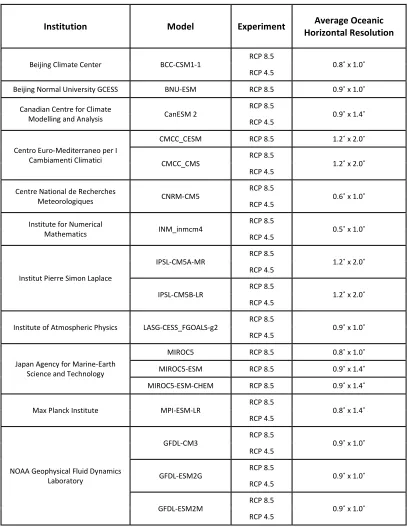
I obtained output from climate models used in the Fifth Assessment Report of the Intergovernmental Panel on Climate Change (IPCC; Stocker et al., 2014) from the Climate Model Intercomparison Project phase 5 (CMIP5; Taylor et al., 2012) hosted on the servers of the Earth System Grid Federation (ESGF) . For this analysis, I used the historical model runs (1987-2005) to represent the present-day conditions and future model runs forced with continued greenhouse-gas emissions from 2006 to 2100 following Representation Concentration Pathway (RCP) 8.5 and RCP 4.5 (Moss et al., 2010; van Vuuren et al., 2011). These scenarios represent “business-as-usual” and an intermediately optimistic scenario where global greenhouse gas emissions level off by about 2050, among other factors (Meinshausen et al., 2011). Seventeen of the CMIP5 models had unique, complete monthly projections of bottom-water temperatures (BWT) for both the historical and RCP 8.5 scenarios. Of these 17 models, 11 had accompanying RCP 4.5 models (Table 2.1).
Table 2.1: Climate models used in this analysis
Institution Model Experiment Average Oceanic
Horizontal Resolution
Beijing Climate Center BCC-CSM1-1 RCP 8.5 0.8˚ x 1.0˚ RCP 4.5
Beijing Normal University GCESS BNU-ESM RCP 8.5 0.9˚ x 1.0˚
Canadian Centre for Climate
Modelling and Analysis CanESM 2
RCP 8.5
0.9˚ x 1.4˚ RCP 4.5
Centro Euro-Mediterraneo per I Cambiamenti Climatici
CMCC_CESM RCP 8.5 1.2˚ x 2.0˚
CMCC_CMS
RCP 8.5
1.2˚ x 2.0˚ RCP 4.5
Centre National de Recherches
Meteorologiques CNRM-CM5
RCP 8.5
0.6˚ x 1.0˚ RCP 4.5
Institute for Numerical
Mathematics INM_inmcm4
RCP 8.5
0.5˚ x 1.0˚ RCP 4.5
Institut Pierre Simon Laplace
IPSL-CM5A-MR RCP 8.5 1.2˚ x 2.0˚ RCP 4.5
IPSL-CM5B-LR RCP 8.5 1.2˚ x 2.0˚ RCP 4.5
Institute of Atmospheric Physics LASG-CESS_FGOALS-g2 RCP 8.5 0.9˚ x 1.0˚ RCP 4.5
Japan Agency for Marine-Earth Science and Technology
MIROC5 RCP 8.5 0.8˚ x 1.0˚
MIROC5-ESM RCP 8.5 0.9˚ x 1.4˚
MIROC5-ESM-CHEM RCP 8.5 0.9˚ x 1.4˚
Max Planck Institute MPI-ESM-LR
RCP 8.5
0.8˚ x 1.4˚ RCP 4.5
NOAA Geophysical Fluid Dynamics Laboratory
GFDL-CM3 RCP 8.5 0.9˚ x 1.0˚ RCP 4.5
GFDL-ESM2G RCP 8.5 0.9˚ x 1.0˚ RCP 4.5
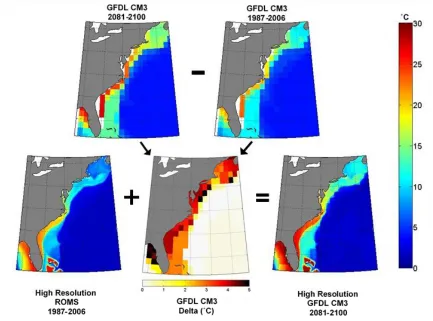
Western Atlantic Ocean (Kang & Curchitser, 2013). Using an approach called the delta method (Figure 2.1; e.g., Hamlet et al., 2010; Ramirez-Villegas & Jarvis, 2010), the BWT for each climate model in the present period (1987-2006, coincident with last 20 full years of Run 03 of the ROMS simulation) was subtracted from the BWT in the future period (2081-2100), giving the change projected for each model (the “delta” BWT, referred to simply as the delta). The delta was regridded using nearest neighbor interpolation and added to the present day BWT simulated by the ROMS model, providing a high-resolution representation of the Western Atlantic BWT in the future. Twenty-year averages were used for each time period in order to ameliorate noise related to inter-annual variability (e.g., phases of the North Atlantic Oscillation, meandering of the Gulf Stream) of the ROMS model. The delta method also reduces the chance that biases resulting from different initial conditions of each climate model are represented in the 2100 projections.
The climate models are run using 4 or 6 hour temporal resolutions, but are packaged as monthly averages from the ESGF. In order to consider physiological stresses on lionfish that may occur due to cold temperatures occurring at frequencies higher than monthly, for each area I calculated the average standard deviation, SDM,a , of daily ROMS BWT away from the monthly means of each year using
𝑆𝐷𝑀,𝑎 = ∑
√∑𝑛𝐷=1(𝑇𝐷,𝑦 − 𝑇̅𝑀,𝑦)2
𝑛
𝑁 𝑦=1
𝑁
where T refers to the bottom-water temperature of the specific day, D, in each month,
number of days in each month, respectively. a is each 7-by-7 km region of the ROMS simulation.
Most BWT results are given as an average of all climate models used, as studies have shown that multi-model means are more accurate than single models alone (Randall
et al., 2007; Reichler & Kim, 2008). However, each model can also be considered as a trial, requiring a minimum threshold of agreement among the models to consider an area habitable (e.g. Wethey et al., 2011). These analyses required inverse-distance interpolation of the delta before being added to the ROMS simulation.
Lionfish distributions
behavior or physiology, but anything lower is fatal (Jud et al., 2014). This is only important in estuaries, as salinities in the open ocean are much higher (~35‰) year-round.
Given the lack of significant limitations on non-estuarine lionfish distribution by predators, salinity, prey availability, and water depth, BWT is believed to be the primary factor influencing the fundamental niche of lionfish. Lionfish are a benthic species, and sea surface temperatures in relatively deep (>30 m) waters appear to have no impact on lionfish presence (Kimball et al., 2004). Kimball et al. (2004) estimated that lionfish stop feeding at approximately 16°C and die at 10°C. It has not been experimentally determined how long lionfish can survive starvation, but Fishelson (1997) observed a group of adults that all survived three months in experimental aquaria without feeding before cessation of the experiment. Seasonally, adult lionfish have been found in areas that experience up to four months of suboptimal conditions (10°C-16°C).
than 2 months per year of suboptimal conditions, seasonally habitable if 2-3 months exhibited suboptimal BWT conditions, and potentially habitable if 4 months had suboptimal BWT conditions. No more than 4 suboptimal months were considered as potential habitable areas. The bioclimatic envelope analysis was conducted using the multi-model mean BWT from all climate models, then repeated requiring at least 50% model agreement in order to consider an area habitable in any capacity.
Assessment of ROMS BWT accuracy
Present-day bottom-water temperatures in the ROMS simulation were compared with NOAA Winter, Spring, and Autumn Bottom Trawl Survey data from 2002-2006. In these surveys, bottom trawls were conducted throughout the Mid and North Atlantic Bights in February, March, April, September, and October in order to census fish abundance and diversity. Water temperature and depth data were obtained during each trawl using a CTD (conductivity, temperature, and depth) instrument. These data were obtained from Resource Survey Reports of each expedition from the NOAA Northeast Fisheries Science Center website.
CHAPTER
3
R
ESULTSAssessment of ROMS BWT accuracy
Over the 2002-2006 period of NOAA trawl surveys examined here, there were 2802 samples deemed suitable for comparison. Altogether, the ROMS model averages 0.06˚C warmer than the samples, with some seasonal variation. According to a Wilcoxon Signed Ranks test, the observed BWTs are not significantly different than those in the model (N = 2802, p = 0.13), indicating that the ROMS simulation provides a suitable present-day representation of BWT on the continental shelf and is useful for examining potential changes in lionfish distribution in the region. The biases present (e.g., the model’s maximum bias of 0.30°C cooler than observations in September) are rather small. A mean monthly BWT difference of 0.30°C is substantially less than the average daily SD of 1.41 in the SAB in September.
Bottom-water projections
Table 3.1: Spatially-averaged bottom-water temperatures and total lionfish habitat in the South Atlantic Bight
RCP 8.5 SAB Temperature (°C) Habitable Area (km2) Seasonal Area (km2) Extreme Area (km2)
1987-2006 16.66° 65,709 21,749 2,989
2040-2060 17.74° 77,959 25,669 3,577
2080-2100 19.03° 89,229 26,943 5,635
Change 2.37° 23,520 5,194 2,646
RCP 4.5
1987-2006 16.66° 65,709 21,749 2,989
2040-2060 17.69° 75,950 25,669 3,381
2080-2100 18.01° 78,253 25,914 3,822
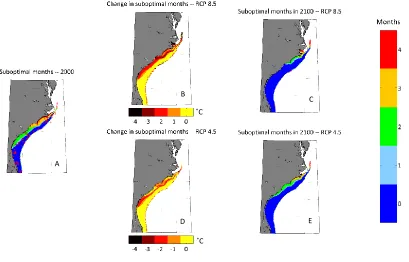
Figure 3.1: Bottom-water temperature projections and anomalies in the South Atlantic Bight. A) Present day period (1987-2006) from ROMS model. B) Anomaly between 2100 (2080-2100) and present day under RCP 8.5. C) 2100 period under the RCP 8.5 scenario. D) RCP 4.5 anomaly. D) 2100 period under RCP 4.5.
A
C
E
D B
a similar pace through the 2040-2060 time period, but then increases at a much faster rate in the second half of the 21st century under the RCP 8.5 scenario (Table 3.1).
Lionfish distributions
Most of the reported lionfish sightings are in areas that have one or fewer months of suboptimal temperature conditions (10°C - 16°C) per year (Figure 3.2). This year-round habitat covers ~65,700 km2 of the SAB (Table 3.1). In present-day conditions, inshore
areas off the coast of Georgia and the Carolinas, exhibiting 2-3 months per year of suboptimal conditions, are uninhabited by lionfish in the winter. However, lionfish have been found in these areas during summer months. These conditions cover ~21,700 km2.
Sightings at the extreme end of lionfish’s physiological cold tolerance (4 suboptimal months per year) are rare (Table 3.1; Figure 3.2).
Under future scenarios of continued greenhouse-gas emissions, the number of suboptimal months for lionfish survival is expected to decrease throughout the inner continental shelf of the SAB, increasing the probability of successful lionfish invasion. Under the RCP 8.5 scenario, no suboptimal conditions are expected off Georgia and South Carolina at any point of the year by the last two decades of the 21st century (Figure 3.2).
Suitable year-round habitat could increase by up to 23,500 km2 by the same period – an
Figure 3.2:Number of suboptimal months (10°C-16°C) per year in present and future time periods under different RCP scenarios. Less than two months is considered suitable habitat for lionfish year-round, 2-3 months may be vulnerable seasonally, and 4 months is the most a lionfish could survive. A) Present day (1987-2006) from ROMS model. Red crosses indicate confirmed lionfish sightings. B) Change between 2100 time period (2080-2100) and present day time period under RCP 8.5. C) 2100 time period under RCP 8.5. D) Change between present and 2100 period for RCP 4.5 E) 2100 period under RCP 4.5.
A
B
C
E D
estimated by present-day BWT. Under RCP 4.5, the rate of increase of lionfish habitat drops off dramatically after 2040-2060, with RCP 4.5 gaining only 20% of the year-round habitable area that the region gains under RCP 8.5, despite having similar areas in 2050 (Table 3.1).
New regions throughout the SAB may face novel pressure of seasonal lionfish migration in the future under RCP 8.5, with seasonally suitable expansion up to 24%. These regions also face some of the sharpest decreases in suboptimal months per year, with portions of the inshore SAB losing 3 months of lionfish-deterring cold water (Figure 3.2). This includes the southern fork of the Pamlico Sound, NC. RCP 4.5 showed similar results for seasonal habitat.
If lionfish are able to tolerate living at the extreme cold limits of their physiological tolerance (4 suboptimal months per year), RCP 8.5 projects the northern fork of the Pamlico Sound to be threatened by seasonal lionfish invasion. Also, lionfish could move approximately 100 km north in a deep branch of the Gulf Stream along the Outer Banks, almost reaching 37°N (Figure 3.2). However, expansion into these extreme conditions is minimal under RCP 4.5, with only ~800 km2 being added in this scenario (Table 3.1).
The same analysis was conducted treating bioclimatic envelopes created by each model as a replicate instead of using the ensemble average. Using a threshold of 50% model agreement to define habitat area, I found that habitat expansion may be greater than that projected by the ensemble average; about 2000 km2 of additional year-round
Figure 3.3: Percentage of RCP 8.5 models (out of 17) that project year-round (0-1 suboptimal months; A,C) and seasonal (2-3 suboptimal months; B,D) lionfish habitat for the 2050 (2040-2060; A,B) and 2100 (2080-2100; C,D) periods
A B
CHAPTER
4
D
ISCUSSIONThe aim of this investigation was to explore the expansion of lionfish thermal habitat associated with anthropogenic global warming as projected by an ensemble of IPCC-style climate models. Based on these models, I expect to see a substantial increase in potential lionfish habitat in the coming century. As expected, the RCP 4.5 scenario leads to a smaller BWT niche for lionfish, about 50% less increase in total areal extent by the end of the 21st century in comparison to the RCP 8.5 scenario. This is largely due to the
decreased rate of expansion in the second half of the century. This is also expected, as the RCP 4.5 scenario caps emissions by 2050 (Meinshausen et al., 2011; van Vuuren et al., 2011). Under the RCP 8.5 scenario, lionfish’s projected range will expand to include almost the entire SAB, with the remaining area susceptible to seasonal invasion by the species. This shoreward expansion of range is relatively unique among fishes, with most species distribution models projecting poleward shifts of marine fishes with climate change (Perry et al., 2005; Cheung et al., 2010; Hare et al., 2012).
partial eradication of adults can be extremely effective at reducing lionfish populations and restoring prey biomass (Morris et al., 2011; Frazer et al., 2012; Green et al., 2014). However, these previous analyses were conducted for Bahamian populations of lionfish. Characteristics of the SAB may make the dynamics of invasion and management different than Bahamian reefs for a number of reasons. For instance, lionfish density is much lower in the SAB than it is in the Bahamas, averaging 21.2 lionfish per hectare and 393 lionfish per hectare, respectively (Whitfield et al., 2007; Green & Côté, 2009). In theory, this would make controlling populations easier in the SAB. However, primary lionfish habitat is currently further offshore and in deeper water than the Bahamian reef system, requiring use of SCUBA to cull individuals rather than snorkeling or freediving. Additionally, limited visibility caused by increased turbidity on the SAB combined with fewer fish being easy to find may limit the efficiency of targeted culling efforts. These factors make culling in the SAB comparatively difficult and expensive, and could preclude many civilians from hunting lionfish recreationally.
The shoreward expansion of this voracious predator population is alarming. However, it is important to note the caveats of the techniques used here. I explored the BWT changes associated with two emissions scenarios, RCP 4.5 and RCP 8.5. The RCP 8.5 scenario is considered the “worst-case” (or “business as usual”) that anticipates
Note, however, that emissions during the recent five years have met or exceeded those expected under the RCP 8.5 scenario (Fuss et al., 2014), and continued “business-as-usual” emissions seems increasingly likely.
In addition to assumptions regarding the future evolution of climate, my results have not considered future rapid change in lionfish physiology and behavior, nor the potential adaptability of larger piscivorous fishes and sharks in the region that may exert biological control on the population, particularly fish weakened by suboptimal physical conditions (Maljković et al., 2008; Mumby et al., 2011; Diller et al., 2014). My results are also sensitive to the bioclimatic envelope parameters (i.e. that “suboptimal months” is a useful metric, lionfish behave similarly in cold-water habitats), suitability of new ranges (presence of appropriate bottom-habitat, available food), and even lionfish’s current range (wintertime surveys are rare). Planque et al. (2011) review other sources of uncertainty in distribution models, and the difficulties with this model are no exception.
insight regarding the timing and likelihood of lionfish invasion would be vital for planning future eradication efforts and marine spatial planning.
Mechanistic species distribution models (SDM) – models using experimentally-derived physiological limits to simulate future distributions – are uncommon for fish species (but see Hare et al., 2012). Nevertheless, similar methodology can be applied across species in a variety of different systems (Wethey et al., 2011; Glibert et al., 2014; Overgaard et al., 2014; Fly et al., 2015). The more common approach for SDMs, called correlative SDMs, utilizes presence/absence data from established populations to statistically determine parameters relevant to their occurrence. These parameters are then used to estimate a species’ range in currently unoccupied regions (Guisan & Zimmermann, 2000). However, this method can underestimate the impact of invasive species because the invader may be released from whatever biological interactions were responsible for confining expansion in its native range (Fitzpatrick et al., 2006; Broennimann et al., 2007). As a result, correlative SDMs may be more conservative for species in new habitats than mechanistic models (Buckley et al., 2010). Similarly, research regarding species’ range expansion under conditions associated with future climate change may benefit by considering both biotic and abiotic factors in defining niche space (Helmuth et al., 2005; Buckley et al., 2010; Woodin et al., 2013).
R
EFERENCESAlbins MA (2013) Effects of invasive Pacific red lionfish Pterois volitans versus a native predator on Bahamian coral-reef fish communities. Biological Invasions, 15, 29–43.
Albins MA, Hixon MA (2008) Invasive Indo-Pacific lionfish Pterois volitans reduce recruitment of Atlantic coral-reef fishes. Marine Ecology Progress Series, 367, 233–238.
Albins MA, Hixon MA (2013) Worst case scenario: potential long-term effects of invasive predatory lionfish (Pterois volitans) on Atlantic and Caribbean coral-reef communities.
Environmental Biology of Fishes, 96, 1151–1157.
Albins MA, Lyons PJ (2012) Invasive red lionfish Pterois volitans blow directed jets of water at prey fish. Marine Ecology Progress Series, 448, 1–5.
Arias-González JE, González-Gándara C, Luis Cabrera J, Christensen V (2011) Predicted impact of the invasive lionfish Pterois volitans on the food web of a Caribbean coral reef.
Environmental Research, 111, 917–925.
Atkinson LP, Lee TN, Blanton JO, Williams CS (1983) Climatology of the Southeastern United States continental shelf waters. Journal of Geophysical Research, 88, 4705–4718. Baltz DM (1991) Introduced fishes in marine systems and inland seas. Biological Conservation,
56, 151–177.
Barbour AB, Montgomery ML, Adamson AA, Díaz-Ferguson E, Silliman BR (2010) Mangrove use by the invasive lionfish Pterois volitans. Marine Ecology Progress Series, 401, 291–294. Barbour AB, Allen MS, Frazer TK, Sherman KD (2011) Evaluating the potential efficacy of invasive
lionfish (Pterois volitans) removals. PLoS ONE, 6, e19666.
Bernadsky G, Goulet D (1991) A natural predator of the lionfish, Pterois miles. Copeia, 1991, 230. Broennimann O, Treier UA, Müller-Schärer H, Thuiller W, Peterson AT, Guisan A (2007) Evidence
of climatic niche shift during biological invasion. Ecology Letters, 10, 701–709. Buckley LB, Urban MC, Angilletta MJ, Crozier LG, Rissler LJ, Sears MW (2010) Can mechanism
inform species’ distribution models?: Correlative and mechanistic range models. Ecology
Letters, 13, 1041–1054.
Cheung WWL, Lam VWY, Sarmiento JL, Kearney K, Watson R, Pauly D (2009) Projecting global marine biodiversity impacts under climate change scenarios. Fish and Fisheries, 10, 235– 251.
Cheung WWL, Lam VWY, Sarmiento JL, Kearney K, Watson R, Zeller D, Pauly D (2010) Large-scale redistribution of maximum fisheries catch potential in the global ocean under climate change: Climate change impacts on catch potential. Global Change Biology, 16, 24–35. Claydon JAB, Calosso MC, Traiger SB (2012) Progression of invasive lionfish in seagrass,
mangrove and reef habitats. Marine Ecology Progress Series, 448, 119–129.
Côté IM, Green SJ, Hixon MA (2013) Predatory fish invaders: Insights from Indo-Pacific lionfish in the western Atlantic and Caribbean. Biological Conservation, 164, 50–61.
Cure K, McIlwain JL, Hixon MA (2014) Habitat plasticity in native Pacific red lionfish Pterois
volitans facilitates successful invasion of the Atlantic. Marine Ecology Progress Series,
Daskalov GM, Grishin AN, Rodionov S, Mihneva V (2007) Trophic cascades triggered by
overfishing reveal possible mechanisms of ecosystem regime shifts. Proceedings of the
National Academy of Sciences, 104, 10518–10523.
Diller JL, Frazer TK, Jacoby CA (2014) Coping with the lionfish invasion: Evidence that naïve, native predators can learn to help. Journal of Experimental Marine Biology and Ecology,
455, 45–49.
Fishelson L (1975) Ethology and reproduction of pteroid fishes found in the gulf of Aqaba (Red Sea), especially Dendrochirus brachypterus (Cuvier),(Pteroidae Teleostei).[Conference paper]. Pubblicazioni della Stazione Zoologica, Napoli.
Fishelson L (1997) Experiments and observations on food consumption, growth and starvation in Dendrochirus brachypterus and Pterois volitans (Pteroinae, Scorpaenidae).
Environmental Biology of Fishes, 50, 391–403.
Fitzpatrick MC, Weltzin JF, Sanders NJ, Dunn RR (2006) The biogeography of prediction error: why does the introduced range of the fire ant over-predict its native range? Global
Ecology and Biogeography, 16, 24–33.
Fly EK, Hilbish TJ, Wethey DS, Rognstad RL (2015) Physiology and Biogeography: The Response of European Mussels (Mytilus spp.) to Climate Change. American Malacological Bulletin,
33, 136–149.
Frazer TK, Jacoby CA, Edwards MA, Barry SC, Manfrino CM (2012) Coping with the lionfish invasion: Can targeted removals yield beneficial effects? Reviews in Fisheries Science, 20, 185–191.
Fuss S, Canadell JG, Peters GP et al. (2014) Betting on negative emissions. Nature Climate
Change, 4, 850–853.
Glibert PM, Icarus Allen J, Artioli Y et al. (2014) Vulnerability of coastal ecosystems to changes in harmful algal bloom distribution in response to climate change: projections based on model analysis. Global Change Biology, 20, 3845–3858.
Golani D, Orsi-Relini L, Massuti E, Quignard J (2002) CIESM Atlas of Exotic Species in the
Mediterranean. Vol 1. Fishes. CIESM Publisher, Monaco, 256 pp.
Golani D, Orsi-Relini L, Massuti E, Quignard J-P, Dulcic J (2007) Fish invasion of the
Mediterranean -- retrospective and prospective. Rapp. Comm. int. Mer Médit, 38, 10. Green SJ, Côté IM (2009) Record densities of Indo-Pacific lionfish on Bahamian coral reefs. Coral
Reefs, 28, 107–107.
Green SJ, Akins JL, Maljković A, Côté IM (2012) Invasive lionfish drive Atlantic coral reef fish declines. PloS one, 7, e32596.
Green SJ, Dulvy NK, Brooks AM, Akins JL, Cooper AB, Miller S, Côté IM (2014) Linking removal targets to the ecological effects of invaders: a predictive model and field test. Ecological
Applications, 24, 1311–1322.
Guisan A, Zimmermann NE (2000) Predictive habitat distribution models in ecology. Ecological
modelling, 135, 147–186.
Hamlet AF, Salathé EP, Carrasco P (2010) Statistical downscaling techniques for global climate model simulations of temperature and precipitation with application to water resources planning studies. The Columbia Basin Climate Change Scenarios Project (CBCCSP) report. Hare JA, Whitfield PE (2003) An integrated assessment of the introduction of Lionfish (Pterois
volitans/miles complex) to the Western Atlantic Ocean. NOAA Technical Memorandum
NOS NCCOS, 2.
Hare JA, Churchill JH, Cowen RK et al. (2002) Routes and rates of larval fish transport from the southeast to the northeast United States continental shelf. Limnology and
Hare JA, Wuenschel MJ, Kimball ME (2012) Projecting range limits with coupled thermal tolerance - climate change models: An example based on gray snapper (Lutjanus
griseus) along the U.S. East Coast (ed Peck M). PLoS ONE, 7, e52294.
Helmuth B, Kingsolver JG, Carrington E (2005) BIOPHYSICS, PHYSIOLOGICAL ECOLOGY, AND CLIMATE CHANGE: Does Mechanism Matter? Annual Review of Physiology, 67, 177–201. Hutchinson GE (1957) Concluding Remarks. Cold Spring Harbor Symposia on Quantitative
Biology, 22, 145–427.
Jeschke JM, Strayer DL (2008) Usefulness of bioclimatic models for studying climate change and invasive species. Annals of the New York Academy of Sciences, 1134, 1–24.
Jud ZR, Layman CA, Lee JA, Arrington DA (2011) Recent invasion of a Florida (USA) estuarine system by lionfish Pterois volitans/P. miles. Aquatic Biology, 13, 21–26.
Jud ZR, Nichols PK, Layman CA (2014) Broad salinity tolerance in the invasive lionfish Pterois spp. may facilitate estuarine colonization. Environmental Biology of Fishes, 98, 135–143. Kang D, Curchitser EN (2013) Gulf Stream eddy characteristics in a high-resolution ocean model.
Journal of Geophysical Research: Oceans, 118, 4474–4487.
Kimball ME, Miller JM, Whitfield PE, Hare JA (2004) Thermal tolerance and potential distribution of invasive lionfish (Pterois volitans/miles complex) on the east coast of the United States. Marine Ecology Progress Series, 283, 269–278.
Layman CA, Allgeier JE (2012) Characterizing trophic ecology of generalist consumers: a case study of the invasive lionfish in The Bahamas. Marine Ecology Progress Series, 448, 131– 141.
Layman CA, Jud ZR, Nichols P (2014) Lionfish alter benthic invertebrate assemblages in patch habitats of a subtropical estuary. Marine Biology, 161, 2179–2182.
Loukos H, Monfray P, Bopp L, Lehodey P (2003) Potential changes in skipjack tuna (Katsuwonus
pelamis) habitat from a global warming scenario: modelling approach and preliminary
results. Fisheries Oceanography, 12, 474–482.
Lucey SM, Nye JA (2010) Shifting species assemblages in the Northeast US Continental Shelf Large Marine Ecosystem. Marine Ecology Progress Series, 415, 23–33.
Magnuson JJ, Crowder LB, Medvick PA (1979) Temperature as an ecological resource. American
Zoologist, 19, 331–343.
Maljković A, Van Leeuwen TE, Cove SN (2008) Predation on the invasive red lionfish, Pterois
volitans (Pisces: Scorpaenidae), by native groupers in the Bahamas. Coral Reefs, 27,
501–501.
Meinshausen M, Smith SJ, Calvin K et al. (2011) The RCP greenhouse gas concentrations and their extensions from 1765 to 2300. Climatic Change, 109, 213–241.
Meister HS, Wyanski DM, Leofer JK, Ross SW, Quattrini AM, Sulak KJ (2005) Further evidence for the invasion and establishment of Pterois volitans (Teleostei: Scorpaenidae) along the Atlantic Coast of the United States. Southeastern Naturalist, 4, 193–206.
Morris JA, Akins JL (2009) Feeding ecology of invasive lionfish (Pterois volitans) in the Bahamian archipelago. Environmental Biology of Fishes, 86, 389–398.
Morris JA, Whitfield PE (2009) Biology, ecology, control and management of the invasive Indo-Pacific lionfish: an updated integrated assessment. NOAA Technical Memorandum NOS
NCCOS, 99.
Morris JA, Akins JL, Barse A et al. (2009) Biology and ecology of the invasive lionfishes, Pterois
miles and Pterois volitans. Proceedings of the Gulf and Caribbean Fisheries Institute, 29,
409–414.
Moss RH, Edmonds JA, Hibbard KA et al. (2010) The next generation of scenarios for climate change research and assessment. Nature, 463, 747–756.
Mumby PJ, Harborne AR, Brumbaugh DR (2011) Grouper as a natural biocontrol of invasive lionfish. PloS one, 6, e21510.
Muñoz RC, Currin CA, Whitfield PE (2011) Diet of invasive lionfish on hard bottom reefs of the Southeast USA: insights from stomach contents and stable isotopes. Marine Ecology
Progress Series, 432, 181–193.
National Marine Fisheries Service (2013) U.S Commercial Landings. National Marine Fisheries Service, National Oceanic and Atmospheric Administration.
Northeastern Fisheries Science Center (2012) Ecosystem status report for the Northeast Shelf Large Marine Ecosystem - 2011. Reference Document, 12-07, 1–35.
Nye JA, Link JS, Hare JA, Overholtz WJ (2009) Changing spatial distribution of fish stocks in relation to climate and population size on the Northeast United States continental shelf.
Marine Ecology Progress Series, 393, 111–129.
O’Farrell S, Bearhop S, McGill RAR, Dahlgren CP, Brumbaugh DR, Mumby PJ (2014) Habitat and body size effects on the isotopic niche space of invasive lionfish and endangered Nassau grouper. Ecosphere, 5, art123.
Overgaard J, Kearney MR, Hoffmann AA (2014) Sensitivity to thermal extremes in Australian
Drosophila implies similar impacts of climate change on the distribution of widespread
and tropical species. Global Change Biology, 20, 1738–1750.
Parker RO, Dixon RL (1998) Changes in a North Carolina reef fish community after 15 years of intense fishing—global warming Implications. Transactions of the American Fisheries
Society, 127, 908–920.
Parmesan C (2006) Ecological and evolutionary responses to recent climate change. Annual
Review of Ecology, Evolution, and Systematics, 37, 637–669.
Perry AL, Low PJ, Ellis JR, Reynolds JD (2005) Climate change and distribution shifts in marine fishes. Science, 308, 1912–1915.
Peterson AT (2003) Predicting the geography of species’ invasions via ecological niche modeling.
The quarterly review of biology, 78, 419–433.
Planque B, Bellier E, Loots C (2011) Uncertainties in projecting spatial distributions of marine populations. ICES Journal of Marine Science, 68, 1045–1050.
Prakash S, Balamurugan J, Kumar TA, Balasubramanian T, others (2012) Invasion and abundance of reef-inhabiting fishes in the Vellar estuary, southeast coast of India, especially the lionfish Pterois volitans Linnaeus. Current Science(Bangalore), 103, 941–944.
Quero J (1998) Changes in the Euro‐Atlantic fish species composition resulting from fishing and ocean warming. Italian Journal of Zoology, 65, 493–499.
Ramirez-Villegas J, Jarvis A (2010) Downscaling global circulation model outputs: the delta method decision and policy analysis Working Paper No. 1. Policy Analysis, 1, 1–18. Randall JE (1987) Introductions of marine fishes to the Hawaiian Islands. Bulletin of Marine
Science, 41, 490–502.
Randall DA, Wood RA, Bony S et al. (2007) Climate models and their evaluation. In: Climate Change 2007: The physical science basis. Contribution of Working Group I to the Fourth
Assessment Report of the IPCC (FAR), pp. 589–662. Cambridge University Press.
Raymond WW, Albins MA, Pusack TJ (2015) Competitive interactions for shelter between invasive Pacific red lionfish and native Nassau grouper. Environmental Biology of Fishes,
98, 57–65.
Reichler T, Kim J (2008) How well do coupled models simulate today’s climate? Bulletin of the
Rose GA (2005) On distributional responses of North Atlantic fish to climate change. ICES Journal
of Marine Science, 62, 1360–1374.
Scheffer M, Carpenter S, Foley JA, Folke C, Walker B (2001) Catastrophic shifts in ecosystems.
Nature, 413, 591–596.
Schofield PJ (2009) Geographic extent and chronology of the invasion of non-native lionfish
(Pterois volitans [Linnaeus 1758] and P. miles [Bennett 1828]) in the Western North
Atlantic and Caribbean Sea. Aquatic Invasions, 4, 473–479.
Schofield PJ (2010) Update on geographic spread of invasive lionfishes (Pterois volitans [Linnaeus, 1758] and P. miles [Bennett, 1828]) in the Western North Atlantic Ocean, Caribbean Sea and Gulf of Mexico. Aquatic Invasions, 5, S117–S122.
Schultz ET (1986) Pterois volitans and Pterois miles: Two valid species. Copeia, 1986, 686. Semmens BX, Buhle ER, Salomon AK, Pattengill-Semmens CV (2004) A hotspot of non-native
marine fishes: evidence for the aquarium trade as an invasion pathway. Marine Ecology
Progress Series, 266, 239–244.
Sorte CJB, Williams SL, Carlton JT (2010) Marine range shifts and species introductions:
comparative spread rates and community impacts: Range shifts and non-native species introductions. Global Ecology and Biogeography, 19, 303–316.
Stocker T, Qin D, Plattner G-K et al. (eds.) (2014) Climate change 2013: the physical science basis: Working Group I contribution to the Fifth assessment report of the Intergovernmental
Panel on Climate Change. Cambridge University Press, New York, 1535 pp.
Taylor KE, Stouffer RJ, Meehl GA (2012) An overview of CMIP5 and the experiment design.
Bulletin of the American Meteorological Society, 93, 485–498.
Van Vuuren DP, Edmonds J, Kainuma M et al. (2011) The representative concentration pathways: an overview. Climatic Change, 109, 5–31.
Wethey DS, Woodin SA, Hilbish TJ, Jones SJ, Lima FP, Brannock PM (2011) Response of intertidal populations to climate: Effects of extreme events versus long term change. Journal of
Experimental Marine Biology and Ecology, 400, 132–144.
Whitfield PE, Gardner T, Vives SP, Gilligan MR, Courtenay WR, Ray GC, Hare JA (2002) Biological invasion of the Indo-Pacific Iionfish Pterois volitans along the Atlantic coast of North America. Marine ecology. Progress series, 235, 289–297.
Whitfield PE, Hare JA, David AW, Harter SL, Muñoz RC, Addison CM (2007) Abundance estimates of the Indo-Pacific lionfish Pterois volitans/miles complex in the Western North Atlantic.
Biological Invasions, 9, 53–64.
Whitfield PE, Muñoz RC, Buckel CA, Degan BP, Freshwater DW, Hare JA (2014) Native fish community structure and Indo-Pacific lionfish Pterois volitans densities along a depth-temperature gradient in Onslow Bay, North Carolina, USA. Marine Ecology Progress
Series, 509, 241–254.