188
Mathematics Module Based On RME To Improve
Students Creative Thinking
Desi Rubiyanti, Suparman
Abstract: In the 21st century learning, students must have creative thinking. The limitations of teaching materials that facilitate students to think creatively are still lacking. This study aims to describe the mathematics teaching materials needed to increase student creativity in the learning process. This research uses descriptive qualitative. The subjects of the research were the eighth grade junior high school students. Data collection instruments used was observation, interviews, and questionnaires. Interview guidelines are given to teachers and students to analyze the mathematics teaching material used. The observation guide is used to observe the learning model used by the teacher during the learning process. Questionnaire is given to students to get student characteristics data. The results showed that: the teaching materials used did not facilitate students creative thinking so students needed teaching materials to improve their creative thinking and teachers needed mathematics teaching materials in the form of module-based learning models that could increase the creativity of their students.
Keywords: Math Module, Creative Thinking, Realistic Mathematics Education.
—————————— ——————————
1 INTRODUCTION
The main skills that must be possessed by 21st century students are, creative thinking, problem solving skills, innovative learning, communication, and collaboration skills[1]. Skills possessed by students can help students to develop in the future, therefore students must have the ability to apply the knowledge they have learned to face challenges in his life [2] In education, students must be able to solve many problems using creative thinking [3]. the effect of the 21st century is that schools have begun to develop teaching materials that can make students independent and active and can improve students' creative thinking skills [4]. Students who have creative thinking skills will get success in the future, therefore, 21st century education is expected to prepare students to master various skills, especially students' creative thinking skills to become successful people in the future [5]. defines creativity as providing unique responses; flexibility as the ability to adapt to changing conditions; and fluency as a quick sorting of ideas. Creativity is one of the abilities needed to solve problems. Creativity is needed for science, technology, and art that covers everyday life. Creative thinking is often seen as the ability to produce brilliant ideas [6]. One of the main subjects and should be taught to students is mathematics [7] Most of the students consider that math is complicated, so that students are lazy to the work that mathematics [8]. Most of the students stated that math and everyday life are closely related to each other, which means that the mathematics is very useful for everyday life and even the World [9]. Students need worksheets as teaching materials to improve their creative thinking skills and be able to make them active and independent in learning mathematics [10]. RME is a theory of learning mathematics learning approach using the context of the "real world" [11]. RME was first introduced by mathematician Freudenthal institute at the University of Utrecht in the Netherlands [12].
RME is learning that originates in Real life to develop mathematical concepts in learning mathematics [13]. RME is an effective approach to be used in mathematics teaching in accordance with the curriculum, in which case the RME focuses on students' creative thinking skills, including helping to build knowledge to find their own mathematical concepts [14]. The RME theory focuses on rediscovering mathematics and being guided by students' creative thinking through problems based on real-world contexts [15]. The RME approach provides opportunities for students to learn cooperatively with a pleasant environment and enhance students' creative thinking. In this approach, the teacher's role is to stimulate learning so that effective learning is created [16].
2 RESEARCH METHODS
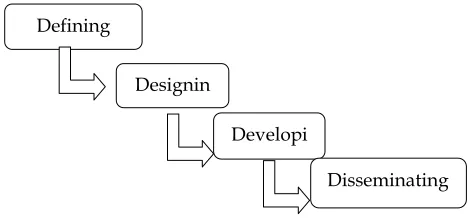
The type of research used is the development of research. This study develops teaching materials in the form of module-based Realistic Mathematics Module to improve students' creative thinking skills. The stages of the 4D model are the stages of defining, designing, developing, and disseminating [6]. This procedure is presented in figure 1.
Figure 1: General steps in Research and Development
This research was conducted in class VIII of Muhammadiyah Middle School 4 Yogyakarta. The subjects in this study were teachers, students, subject matter experts, and media experts. Data collection methods used in this study were interviews, instruments and tests of students' creative thinking skills. The instrument used is a validation sheet. Interviews were conducted with teachers and students at Muhammadiyah 4 Middle School in Yogyakarta to study the curriculum used and the character of the
Defining
Designin g
Developi ng
Disseminating
————————————————
• Desi Rubiyanti is currently pursuing master’s degree program in mathematics education at University Ahmad Dahlan, Indonesia, PH-087731122297. E-mail: [email protected]
189
students. A validation sheet is addressed to material experts and media experts. Student and teacher responses are given after the trial is complete. Students 'creative thinking ability test is given before and after the use of student worksheets, so that it is known whether there is an increase in students' creative thinking skills.
3.
RESULTS AND DISCUSSION
This study uses the 4D model (Defining, Design, Development, and Dissemination). Defining the first phase that aims to identify and determine the conditions studied. Stages in the definition include the analysis of the initial phase, the student’s analysis, material analysis, task analysis and formulation of learning objectives. Initial analysis phase, the analysis results obtained in the form of the mathematics curriculum, which refers to the curriculum in 2013 include the identification of core competencies, basic competencies, learning materials, learning activities, assessment, allocation of time, and learning resources are used. This indicator is a reference to the module construction. Basic competence found in the material linear equations and inequalities of the variables in Table 1 [17]:
Table 1. Basic Competence
No. competence
3.6 Explaining the equation and one variable linear inequality and completion.
4.6 Resolving issues related to equality and
one variable linear inequality
Based on Table 1 there are two basic competencies to be used in the manufacture of modules. Next, analyses of students do. Based on observations on learning activities carried out in class VIII and interviews with teachers obtained the results of analysis of the characteristics of students confidence of students is low, seen from the students who are still hesitant in answering the questions given by the teacher. Creative thinking skills students need to be improved. After analysis of the students, the analysis tasks are performed. Analysis step tasks used to analyze the tasks that must be mastered by the student so that competence can be achieved. Tasks in the form of group assignments, individual assignments that are used to measure the ability of students. Formulation of learning objectives. Steps in formulating learning goals result in the formulation of the learning objectives of the indicators of achievement of competencies that have been developed previously. The learning objectives in Table 2:
Table 2. Learning Objectives
No. Learning objectives
3.6 Determining the value of a variable in a linear equation
of one variable.
3.6 Determining the value of a variable in a linear
inequality Variables.
4.6 Changing the issues related to equality and one
variable linear inequality to be a problem in context.
4.6 Solve the problem contextual relating to the equation
and one variable linear inequality.
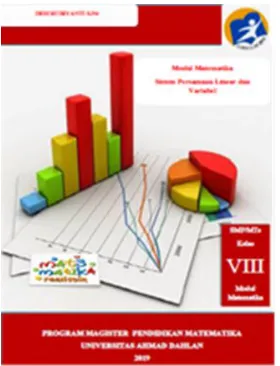
The design of the second phase, which aims to design modules developed. Stages in the design, including the selection of media, format selection, preliminary design. Based on the task analysis, analysis of the concept, and the facilities available in schools, the media selected is the module. In the design stage, the module will be designed in the form of a mathematics learning module based on Realistic Mathematics Education. Based on the results of the analysis above, the design of the mathematics learning module based on Realistic Mathematics Education has been made as shown in the following Figure 2 and 3:
Figure 2. Display Module Design
The cover of the mathematics module is interestingly designed, so that interested people read it or study it. The cover of the Mathematical Module contains the Module Title "Mathematical Module of Two Variable Linear Equation Systems" so that the reader can easily find out, Author's name "Desi Rubiyanti", Class "VIII SMP / MTs", Curriculum used "2013 Curriculum".
190 Figure 4. Display Module Design
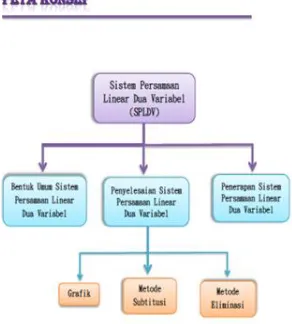
Covering the mathematics learning module based on Realistic Mathematics Education is entitled "Mathematical Statistics Module Based on Realistic Mathematics Education for Class IX Middle / MTs students". So that the module is easy to understand, the cover section is equipped with the name of the author, the origin of the university, and the subject matter contained in this module. in the section Concept map in the mathematics learning module based on Realistic Mathematics Education contains topics to be studied in the module and shows the interrelationships between topics in the module. Concept maps also help teachers to improve the effectiveness of the learning process in the classroom. The following is the design of the concept map in Figure 3.
Figure 5. Display Module Design
The introduction in the mathematics learning module based on Realistic Mathematics Education contains the advantages of modules compared to other modules. The advantages of this module can be seen from how to package material combined with a learning approach based on Realistic Mathematics Education. The introduction also contains an overview of the contents of the module material, convincing the learners that the material in the module is useful for them and provides guidance on how to learn the material to be taught. In this section there are also core competencies and basic competencies used. Following is the preliminary design of the module in figure 4.
Figure 6. Display Module Design
The third stage design, task analysis, which is an activity to identify the main skill required in learning appropriate to the curriculum, and analyzing skills that will be developed in modules, in this case, the development of this module aims to improve creative thinking ability junior high school students of class VIII. Design of the fourth stage, the stage of validation, assessment is carried out to determine the validity of the design of the module to be developed. Module design that has been approved by the supervisor then validated by a validator lecturers namely media. Design validation modules using assessment tools and instruments in the form of questions and questionnaires have been reviewed by the lecturer, Mr. Puguh Wahyu Prasetyo, S.Si., M.Sc. After a valid instrument that can be used by media experts to assess the modules developed. Here is some feedback and advice from subject matter experts are summarized in Table 3.
Table 3 comments and suggestions from the expert media
Comments and
suggestions Follow
In preliminary under KI
and KD inserted
Indicators
In the design of the module have been
added indicators that have been
suggested.
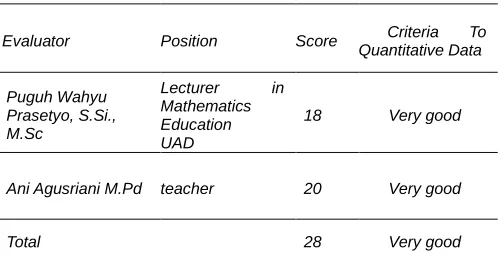
Comments and suggestions from media experts then revised. Furthermore, the feasibility of the design of modules assessed by expert media. The following is ideal assessment criteria category and the calculation results of the questionnaire design validation modules are shown in Table 4 and Table 5 [18].
Table 4.Category Rating Criteria Ideal
Score range Calculation Classifica
tion
Very good
Well Pretty good
191 Table 5. Results Calculation Questionnaire Design validation
module
Evaluator Position Score Criteria To
Quantitative Data
Puguh Wahyu Prasetyo, S.Si., M.Sc
Lecturer in
Mathematics Education UAD
18 Very good
Ani Agusriani M.Pd teacher 20 Very good
Total 28 Very good
Based on Table 5, it can be seen that the average score is 28. The media expert assessment these results indicate that the design of teaching materials in the form of modules that will be developed in the excellent category.
3 CONCLUSION
This research resulted in the design of the module based on the learning cycle to help improve students' mathematics creative thinking. Development is done by developing methods and procedures 4D development namely: Define Design, Development, and Deployment. Components module, cover, preface, table of contents, manuals, basic competencies, core competencies, indicators of achievement, a summary of the material, stage action, and evaluation. Module contains stages in accordance with the principles of RME. Indicators analytical representation capability is also included in the learning cycle stages in this module section. For further development will continue on the development and dissemination.
4 ACKNOWLEDGMENT
The researcher thanked Ahmad Dahlan University for encouraging and facilitating researchers to complete this research. Thanks also to Dr. Rully Indra Prahmana as a supervisor who teaches and motivates researchers to learn more about research in mathematics education. Finally, the researchers also thanked the teachers at the Muhammadiyah 4 Middle School in Yogyakarta and the 3 Middle School Pleret who had helped this research by facilitating researchers with their students as research subjects.
5
REFERENCES
[1] F. Isdiarti and Suparman, “Design Development Learning Media Based PMRI Orinted Capabilities Study Creative Students Gradw VII of Junior High School in Indonesia”. International Journal of Enggineering & Technology, Vol 7 (4.30), pp. 50-52, 2018.
[2] D. Rich and H. Aydin, “Elementary Mathematics Teachers Perceptions and Lived Experiences on Mathematical Communication”. Eurasia Journal of Mathematics Science & Technology Education, Vol 12 No. 6, pp. 1619-1629, 2016.
[3] C. Schultz, "Mathematical Communication and Achievement Through Journal Writing", Journal Writing summative Projects, for MA Degree 27, 2016.
[4] L. Santos and S. Semana, "Developing Mathematics Written Communication Expository Writing Through Supported by Assessment Strategies", Vol. 88, pp. 65-87, Education Studies In Mathematics, 2015. [5] F. Fatimah, ”Communication Skills Learning
Mathematics in Elementary SPLDV through Problem-Based Learning”, Vol 5, No 3, 2012.
[6] E.S. King, “Mathematical Relation (Connecting Mathematical Ability) Students in Solving”, 2017. [7] D, Rohendi and J. Dulpaja, “Connected Mathematics
Project (CMP) Model Based on Presentation Media Connection to the Mathematical Ability of Junior High School Student” . J. Educ. Pact. 4 (4), pp. 17-22, 2013.
A. Abdi, “The Effect of Inquiry-based Learning Method on Students' Academic Achievement in Science Course”. Universal Journal of education Research 2 (1), pp. 37-41, 2014. [8] Runtyani and H.S. Sugianto, “ The Effectiveness of
Strategies React Seen From Achievement, Problem Solving Ability, Mathematical Connections, Self Efficacy” Journal of Math Education Research, Vol 2, No 2, pp. 262-272, 2015.
[9] S. Pratama, A. Minarni and S. Saragih, “Development of Learning Devices Integrated Approach Based on Context Realistic Deli Malay Culture To Improve Ability of Understand Mathematical Concepts and Students”, IOSR Journal of Mathematics (IOSR-JM) Vol 13, No 6, pp. 18-29, 2017
[10]Zulyadaini, “Development of Student Worksheets Based Realistic Mathematics Education (RME)”, International Journal of Engineering Research and Development, Vol 1, No 9, pp. 01-14, 2017.
[11]R. Handayani and Supaman "Design of mathematics student worksheet based on RME approach to improving the mathematical communication Ability junior students of Class VII Hing School in Indonesia", International Journal of Engineering & Technology 7 (4.30), pp.31-35, 2018.
[12]E.L. Palupi and S, Khabibah, “Developing workshop module of realistic mathematics education: Follow-up workshop”, InIOP Conference Series: Materials Science and Engineering, Vol 296, No 1, pp. 012006, 2018.
A. Veloo, R.M. Ali and H. Ahmad, “Effect of Realistic Mathematics Education Approach Among Secondary School Students In Riau, Indonesia”, Aust. J. Basic & Appl. Sci., Vol 9, No 28, pp.131-5, 2015.
[13]R. Hidayat and H.I. Zanaton, “The Effect of Realistic Mathematic Education on Students Conceptual Understanding of Linear programing” Creative Education 6, pp. 2438-2445, 2015.
[14]T.S. Utami and Suparman “Mathematics-based development module guided discovery model to improve creative thinking ability”, International Summit on Science Technology and Humanity, pp. 2477-3328, 2018.
[15]J. Steven, “Instructional Systems Design (ISD): Using the ADDIE Model”, Penn State University: College of Education, Vol 10, pp. 513-553, 2000.
192