A A
-C
A
“I
⊕
C” B
C
M
W
O
Jon Passki
[email protected]
Tom Ritter
[email protected]
June 3, 2012
Abstract
Certain block cipher confidentiality modes are susceptible to an adaptive chosen-ciphertext attack against the underlying format of the plaintext. When the application decrypts altered ciphertext and attempts to process the manipulated plaintext, it may disclose information about intermediate values resulting in an oracle. In this paper we describe how to recognize and exploit such an oracle to decrypt ciphertext and control the decryption to result in arbitrary plaintext. We also discuss ways to mitigate and remedy the issue.
1
I
Quoting from [1]:
Adaptive chosen-ciphertext attacks on cryptographic protocols allow an attacker to decrypt a cipher-textC, getting the plaintextM, by submitting a series of chosen-ciphertextsC′ ̸=Cto an oracle which returns information on the decryption. The ciphertexts can be adaptively chosen so that information on previous decryptions is available before the next chosen ciphertext is submitted.
Adaptive chosen-ciphertext attacks against different confidentiality modes are not novel. The CBC confidentiality mode can suffer from a side channel attack against padding verification [2], popularized by [3]. A variant of the Cipher Feedback (CFB) confidentiality mode has been attacked in different encryption mail protocols by [4, 5, 1], and the padding schemes of asymmetric ciphers are another source of such attacks [6, 7]. In some form, they rely on the use of anoraclethat leaks or communicates information back to attackers. We examine four different confidentiality modes encrypting plaintext that is separated by a delimiter, and the absence or inclusion of that delimiter generates anoracleby the application. We call this oracle aSeparator Oracle.
2
“I
⊕
C” C
M
B
C
A common form of block cipher construction is to implement decryption such that an XOR is performed with the ciphertextafterthe cipher operation¹to produce the decrypted plaintext block. We refer to this property as “I⊕C”, where C represents the ciphertext and I an Intermediate Value. It is featured in the Cipher Block Chaining (CBC), Counter (CTR), Cipher Feedback (CFB), and Output Feedback (OFB) modes of operation and may be present in other less well known modes.
CBC mode encrypts a value derived from the plaintext block XOR-ed with the previous ciphertext block - or the Initialization Vector if it is the first block. This value, after it is encrypted, becomes the ciphertext block. To decrypt, CBC mode decrypts the ciphertext block, resulting in an Intermediate Value. This Intermediate Value is then XOR-ed with either the Initialization Vector or the prior ciphertext block. In many scenarios, the ciphertext is attacker-controlled; in CBC mode, the attacker controlled data is processed in the decryption mode.
Figure1shows CBC mode encryption and decryption for blocks of data numberedj. In this figure, and the three following, theI⊕Cconstruction is visible in the decryption equation. Targeting theI⊕Cconstruction has been mentioned in [8], with specific detail for CBC demonstrated in both academic and practical contexts [8, 9, 10], including recent work on breaking XML encryption in [10] - but it is made difficult because modifications to a ciphertext block propagate to other blocks².
Figure 1: CBC Mode
Cj=
{
ifj=0 Ek(Pj⊕IV) else Ek(Pj⊕Cj−1)
CBC Encryption
Pj=
{
ifj=0 Ek(Cj)⊕IV else Ek(Cj)⊕Cj−1
CBC Decryption
CTR mode encrypts an incrementing counter to produce an Intermediate Value, which is XOR-ed with the plaintext to produce the ciphertext. The independent count prevents modification propagation. The process is repeated for decryption: the counter is encrypted and the result XOR-ed with the ciphertext to produce the plaintext. CTR mode is often recommended because attacker-controlled data is never processed through the encryption function, reducing the risk of side channel attacks [11]. Figure2shows CTR mode encryption and decryption for blocks of data numberedj.
Figure 2: CTR Mode
Cj=Ek(noncej)⊕Pj
CTR Encryption
Pj=Ek(noncej)⊕Cj
CTR Decryption
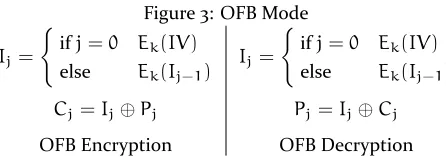
OFB Mode repeatedly encrypts an Intermediate Value, which is XOR-ed with the plaintext (or ciphertext) block to produce the ciphertext (or plaintext) block. Like CTR mode, attacker controlled data is never processed through the encryption function and a modification in a ciphertext block is not propagated. Figure3shows OFB mode encryption and decryption for blocks of data numberedj.
Figure 3: OFB Mode
Ij=
{
ifj=0 Ek(IV) else Ek(Ij−1)
Cj=Ij⊕Pj
OFB Encryption
Ij=
{
ifj=0 Ek(IV) else Ek(Ij−1)
Pj=Ij⊕Cj
OFB Decryption
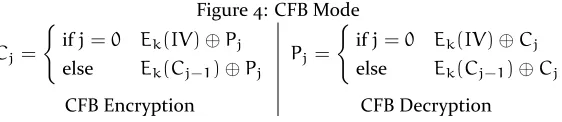
CFB mode encrypts an Initialization Vector to produce an Intermediate Value, which is XOR-ed with the first block of plaintext to produce the first block of ciphertext. Each subsequent block of intermediate values is produced by encrypting the prior block of ciphertext, and the ciphertext is produced by XOR-ing the intermediate block with the plaintext block. In CFB mode, attacker controlled data is processed in the decryption mode. Figure4shows CFB mode encryption and decryption for blocks of data numberedj. Like CBC mode, a modification to a ciphertext block is propagated. The details and difficulties of performing an attack on CFB mode in whole are presented in AppendixA.
Figure 4: CFB Mode
Cj=
{
ifj=0 Ek(IV)⊕Pj else Ek(Cj−1)⊕Pj
CFB Encryption
Pj=
{
ifj=0 Ek(IV)⊕Cj else Ek(Cj−1)⊕Cj
CFB Decryption
During the decryption phase of each of these block cipher modes, attacker controlled data is XOR-ed against an Intermediate Value to produce the plaintext block. It is possible to produce any desired plaintext block by modifying the ciphertext block correctly. This requires knowing the Intermediate Value produced by the encryption function -but in some cases cryptographic oracles can leak enough information to make it possible to learn the Intermediate Value.
3
S
O
Assume an application uses a block cipher mode with a construction as described above, for example CTR mode. It encrypts plaintext, sends the ciphertext to users, and does not include a MAC or other integrity check. Users send the ciphertext back to the application, perhaps for session management, which the application decrypts. If a user modifies the ciphertext, the application will decrypt it to an unexpected value. If the application produces error messages based on the structure of the mangled plaintext, information about the plaintext can be derived. Depending on the type of information derived, it may be possible to decrypt the ciphertext to learn the original plaintext or alter the ciphertext to decrypt to a chosen plaintext.
As a practical example, we will consider the case when the plaintext is composed of delimited values, such as
username|timestamp|access-level. The separator character, the pipe | in this example, will be denoted by
PS. If the application cannot split the delimited plaintext into the appropriate number of values by performing a split operation usingPS, the application responds with a state we will callSeparatorException. If the split operation succeeds, the application continues - if the split values are considered invalid for another reason the application may respond with another state we will callOtherException. If the application does not raise any exception, we will consider it normal application state.
SeparatorExceptionis a discernible state different from the normal state orOtherException. This difference is called aSeparator Oracle. Applications that disclose an oracle during encryption or decryption have been studied and attacked previously. Although labeled an “Exception”, the oracle may manifest as a verbose error message, an HTTP Status Code, or a measurable difference in response time. The Separator Oracle occurs as a result of application code following the cryptographic routine - no changes to a cryptography library can be made to silence this oracle, the change must occur in the application code.
4
S
O
CTR M
We will now present an algorithm for decrypting ciphertext encrypted with CTR mode using a Separator Oracle. This algorithm assumes the underlying plaintext uses a one-byte encoding format, such as ASCII, with a single encoding of each glyph. Algorithms targeting other plaintext encoding formats like ASN.1 or UTF-8, or encodings with multiple representations of the same glyph, need to adjust accordingly.
4.1 P
1: L
T
S
( )
We are given ciphertextCand plaintextP. We denote the least significant byte ofCasC[0]andPasP[0].
respond with eitherSeparatorException,OtherException, or normal application state. For the purposes of the at-tack,OtherExceptionand normal application state are functionally identical; we will concern ourselves only with
SeparatorExceptionor not.
By negating the least significant bit, we have negated the least significant bit ofP[0], altering it. If a SeparatorExcep-tionwas generated, this indicates that either aPSwas removed from the plaintext and the values could not be split correctly, or aPSwas added to the plaintext, resulting in too many separators. From a single bit negation, we are unsure which is the case - in fact at this point we are unsure if the application does produce aSeparatorException
if too manyPScharacters are present! However, we can learn if a separator was added or subtracted by perform-ing a second bit negation. We negate the second-least significant bit ofC[0]by XOR-ing with0x02(C[0]⊕0x02) and submit the ciphertext. BecausePScannot be produced by two different negations within the same byte, if we receive aSeparatorExceptionwe can confirm that we areremovinga separator by modifyingP[0]- and thus the first byte of the plaintext contains a separator. We denote the first separator found asPS0, the secondPS1, and the total number of separators asPSm.
If noSeparatorExceptionis received after modifyingC[0], we restore it to its original value, and perform the same operation on a bit of the next byte,C[1]. By performing the test on each byte individually, we can determine which bytes of the ciphertext are separators. For a ciphertext of lengthn, this algorithm determines the location and number of separators in a maximum of(2×n)queries to the oracle.
#Input: String: ciphertext #Output: List: separatorPositions
foreach(i in [0..len(ciphertext)]): # Iterate over all bytes
ciphertext' = ciphertext
ciphertext'[i] = ciphertext[i] ^ 1 # Negate the Least Significant Bit of the byte
result = queryOracle(ciphertext')
if result == SeparatorException: # Confirm this is a separator ciphertext' = ciphertext
ciphertext'[i] = ciphertext[i] ^ 2 # Negate Second Least Significant Bit of the byte result = queryOracle(ciphertext')
if result == SeparatorException: # If both results match
Byte at position i is a separator
else:
# Byte at position i not a separator , but is 1 bit removed from it # such that negating the least significant bit made it a separator # and the application cannot handle extra separators
else: # OtherException or Normal Operation # Byte at position i is not a separator
Listing 1: Algorithm for Determining Separators in Plaintext
4.2
P
2: A
M
At this stage, we know the positions of all the separators in the plaintext. We take the original ciphertext, and negate a bit in the byte at the first separator position,PS0. When this modified ciphertext, call it ciphertext′, is submitted, aSeparatorExceptionwill be returned because the application expects one more separator than is present in the modified plaintext.
However, by modifying a byte knownnotto be a separator, we can correct theSeparatorExceptionand induce an
OtherExceptionor normal application state. SetC[0]³to each possible byte valueBsuccessively and query the oracle. If aSeparatorExceptionis returned, modifyingC[0]toBdid not produce a newPSin the plaintext. Before modifying
C[0]we hadm−1separator characters. As long as we receive aSeparatorException, we know that modifyingC[0] toBdid not turnP[0]into a separator.
But some value ofBwillresult in anOtherExceptionor normal application state. That means that value ofB, when XOR-ed with the Intermediate Value from the encryption function, produces a separator (B⊕I[0]= PS), and the plaintext now has the expected number of separators. We solve this formula forI[0], producingI[0]=B⊕PS.
We recall the original decryption relation in Figure2and summarize it asPj = Ij⊕Cj. We solve this equation for the Intermediate Value, using byte [0], creating the following equation: I[0] = P[0] ⊕C[0]. We substitute
I[0] in this formula with the results of the aforementioned formula, B⊕PS, and solve forP[0]. This produces
P[0]=C[0]⊕PS⊕B. We store B as an approximate valueA[0]for index 0, restoreC[0]to the original value, and repeat the process for all bytes that are not separators. At the end, we have a series of relations for each byte [i]:
P[i]=C[i]⊕PS⊕A[i], whereC[i]andA[i]are known. For a ciphertext of lengthn, we determine these relations in a maximum of(255×n)queries to the oracle.
#Input: String: ciphertext , List: separatorPositions #Output: Array: approximateValues
Initialize approximateValues as an empty array
# Set ciphertext' to a string known to produce a SeparatorException
ciphertext' = ciphertext
ciphertext'[separatorPositions[0]] = ciphertext'[separatorPositions[0]] ^ 1
foreach(i in [0..len(ciphertext)]): # Iterate over all bytes if byte b at position i is a separator:
# Append 0 to approximateValues else:
foreach(B in [1..255]): # Byte Loop, Iterate over all possible byte values ciphertext'' = ciphertext'
ciphertext''[i] = B
queryOracle(ciphertext'')
if result == SeparatorException:
continue #b XOR Intermediate Value does not produce a Separator
else:
# Append b to approximateValues # break Byte Loop
Listing 2: Algorithm for Determining Approximate Values
4.3 P
3: D
S
V
D
C
At this point we are a single value away from decrypting the entire message. Recall we have an array containing an approximate valuesA[i]for all byte positions [i]. We can use this array with the relationP[i]=C[i]⊕PS⊕A[i]to find the plaintextP[i]for each byte,if we know the separator characterPS.
#Input: Array: approximateValues , String: ciphertext , Character: separator , List: separatorPositions #Output: String: plaintext
Initialize plaintext as an empty string
foreach(i in [0..len(ciphertext)]): # Iterate over the ciphertext
if position i is a separator: byte plaintextChar = separator
else:
byte plaintextChar = ciphertext[i] ^ separator ^ approximateValues[i] append plaintextChar to plaintext
Listing 3: Decrypting the ciphertext using the separator character.
5 P
M
Recall the construction ofI⊕Cconfidentiality modes. The final step XORs attacker controlled data against the Intermediate Value to produce the plaintext. Therefore, if the Intermediate Value is known, it is possible to calcu-late a ciphertext that results in an arbitrary plaintext value equal to or less than the original length. For the chosen plaintext to be accepted by the application, we must choose a plaintext that contains the same number ofPS char-acters as the original plaintext. To create plaintext values of greater lengths than recovered Intermediate Values, insert the ciphertext and repeat the attack outlined to recover these values. Once recovered, additional plaintext can be added.
After decrypting the ciphertextC, we know the plaintextP, and can calculate the Intermediate ValueI,I=C⊕P. For a chosen plaintextP′, we calculate a new ciphertextC′via Figure5, for each byte [i].
Figure 5: Equation for Performing Plaintext Modification
C[i]′ =C[i]⊕P[i]⊕P[i]′
6
R
6.1
S
T
: R
O
As a short term solution, an application developer could modify existing code to silence the Separator Oracle. One potential work-around is to utilize a common exception handler that returns the same values forSeparatorException
andOtherException. Another fix may be to use exception catching routines around the separator function (e.g.
try/catch/finally).
While these work-arounds may decrease the likelihood of exploiting the Separator Oracle, they do not guarantee the application is invulnerable to other types of oracles. They should only be seen as temporary work-arounds until a more robust solution described in Section6.2is implemented.
6.2 L
T
: P
A
C
-C
A
Adaptive chosen-ciphertext attacks can be prevented when the authenticity of the message is verified by the crypto-system. Two approaches can be used to provide authenticity: using an encryption mode that includes authentication or utilizing message authentication codes in addition to an encryption mode.
6.2.1 Authenticated Encryption Modes
NIST’s 800-38 series defines two encryption modes that authenticate the ciphertext: Counter with Cipher Block Chaining-Message Authentication Code (CCM) [12] and Galois/Counter Mode (GCM) [13]. An authenticated cipher mode builds integrity into the block cipher mode. Any alteration to the ciphertext is detectable as part of the decryption routine, an error will be raised, and no plaintext will be produced.
6.2.2 Message Authentication Codes
7
C
We have demonstrated an attack against block ciphers that use an “I⊕C” confidentiality mode when the imple-mentation discloses aSeparator Oracle. An attack was shown against CTR mode that allowed plaintext recovery in a low number of queries to the oracle, and how to manipulate the ciphertext to decrypt to arbitrary plaintext. Finally, short-term and long-term solutions to the vulnerability were presented.
8
A
We wholeheartedly thank Nate Lawson, Marsh Ray, and Matthew Green for reviewing various versions this paper. Their valuable feedback is very much appreciated. We would also like to thank several of our inspirations: Julian Rizzo and Thai Duong for demonstrating padding oracles, Adam Langley, Moxie Marlinspike, Dino Dai Zovi, Bran-don Edwards, Dan Guido, and Peter Oehlert. We would also like to thank our employers, Aspect Security and iSEC Partners; and our partners, whose constant encouragement we could not do without.
We thank and apologize to Juraj Somorovsky for leading us to more work on the topic.
9
R
[1] S. Mister and R. Zuccherato, “An attack on c mode encryption as used by openpgp,” 2005.1
[2] S. Vaudenay, “Security flaws induced by cbc padding - applications to ssl, ipsec, wtls,” inProceedings of In Advances in Cryptology - EUROCRYPT’02, pp. 534–546, Springer-Verlag, 2002.1
[3] T. Duong and J. Rizzo, “Padding oracles everywhere.” http://www.ekoparty.org/archive/2010/ekoparty_2010-Duong_Rizzo-Padding_Oracles_Every_Where.pdf, 2010. 1
[4] J. Katz and B. Schneier, “A chosen ciphertext attack against several e-mail encryption protocols,” in9th USENIX Security Symposium, pp. 241–246, 2000.1
[5] K. Jallad, J. Katz, J. J. Lee, and B. Schneier, “Implementation of chosen-ciphertext attacks against pgp and gnupg,” inInformation Security, 5th International Conference, volume 2433 of Lecture Notes in Computer Science, pp. 90–101, Springer-Verlag, 2002.1
[6] D. Bleichenbacher, “Chosen ciphertext attacks against protocols based on the rsa encryption standard pkcs #1,” inProceedings of the 18th Annual International Cryptology Conference on Advances in Cryptology, pp. 1–12, 1998. 1
[7] J. Manger, “A chosen ciphertext attack on rsa optimal asymmetric encryption padding (oaep) as standardized in pkcs #1 v2.0,” inProceedings of the 21st Annual International Cryptology Conference on Advances in Cryptology, pp. 230–238, 2001. 1
[8] C. J. Mitchell and R. Holloway, “Error oracle attacks on cbc mode: Is there a future for cbc mode encryption?,” 2005.2
[9] J. Black and H. Urtubia, “Side-channel attacks on symmetric encryption schemes: The case for authenticated encryption,” inIn Proceedings of the 11th USENIX Security Symposium, pp. 327–338, 2002.2
[10] T. Jager and J. Somorovsky, “How to break xml encryption,” inProceedings of the 18th ACM Conference on Com-puter and Communications Security, 2011. 2
[12] M. Dworkin, “Recommendation for block cipher modes of operation: The ccm mode for authentication and confidentiality,” SP 800-38c, U.S. DoC/National Institute of Standards and Technology, 2004. Seehttp://
csrc.nist.gov/publications/nistpubs/800-38C/SP800-38C_updated-July20_2007.pdf.6
[13] M. Dworkin, “Recommendation for block cipher modes of operation: Galois/counter mode (gcm) and gmac,” SP 800-38d, U.S. DoC/National Institute of Standards and Technology, 2007. Seehttp://csrc.nist.gov/
publications/nistpubs/800-38D/SP-800-38D.pdf.6
[14] N. Lawson, “Timing attack in google keyczar library.” http://rdist.root.org/2009/05/28/timing-attack-in-google-keyczar-library/, 2009. 6
[15] C. Percival, “Encrypt-then-mac.” http://www.daemonology.net/blog/2009-06-24-encrypt-then-mac.html, 2009.6
[16] M. Dworkin, “Recommendation for block cipher modes of operation,” SP 800-38a, U.S. DoC/National Institute of Standards and Technology, 2001. Seehttp://csrc.nist.gov/publications/nistpubs/800-38a/
A CFB M
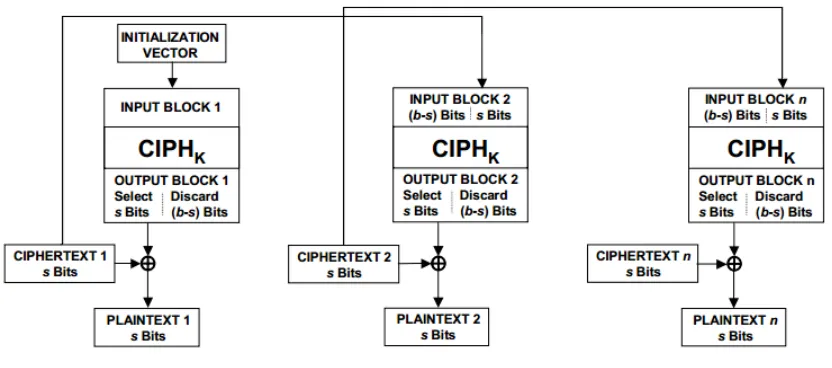
Cipher Feedback Mode is defined in [16] as a confidentiality mode of block ciphers that requires an integer parameter denotedsthat specifies thesegment sizeof the algorithm. The segment size is a value greater than or equal to 1 and less than or equal to the block size of the cipher algorithm that refers to how many bits of the Intermediate Value are used, and correspondingly, how many bits are encrypted or decrypted for each invocation of the cipher operation. For a segment size of 1, an entire cipher operation is performed, an Intermediate Value the size of the algorithm’s block size produced, and a single bit selected from the most significant side of the Intermediate Value. The single bit is then XOR-ed with the first bit of the plaintext (or ciphertext) to produce the first bit of ciphertext (or plaintext). FigureA, taken from [16], depicts CFB Decryption using the segment size parameter.
Figure 6: CFB Mode Decryption depicting segment parameter
A.1
T
E
S
S
S
O
A
CFB Mode is starkly different from CTR and OFB modes of operation with regards to the Separator Oracle attack. In CTR and OFB modes, Intermediate Values are derived from application-controlled values: an increasing counter and a repeatedly encrypted Initialization Vector respectively. In CFB mode, the ciphertext itself feeds into the encryption routine to produce Intermediate Values. The Separator Oracle attack relies on detecting the effect of changing a single bit or byte of the plaintext at a time. However, segmentj’s Intermediate Value is created by performing the cipher operation on segmentj−1- therefore altering a bit or byte in segmentj−1changes the Intermediate Value and plaintext for segmentj. This breaks the underlying assumption that a single bit or byte change in the ciphertext produces a corresponding single bit or byte change in the resulting plaintext.
A.2
C
M
-S
C
If the ciphertext spans multiple segments, manipulating segmentjwill entirely corrupt the plaintext of segment
A.2.1 Randomly Introduced Separators
If a byteC[B]in segmentjis altered, segmentj+1will be corrupted. Corrupting segmentj+1may introduce the separator characterPSto the segment. If segmentj+1did not contain a separator, the corruption may cause a false positive for the byteC[B]changed in segmentj. A false positive occurs when a byteC[B]in segmentj, altered by XOR-ing with some valueX, introduces one or more separators into the plaintext of the corrupted segmentj+1. But the false positive can be detected by performing the same query on byteC[B]XOR-ed with different values:W,Y,Z, etc. Separator characters may appear in the corrupted segmentj+1for some values, includingX, but are unlikely to appear for all values. There are 255 waysC[B]can be altered, and the majority of them should not introduce separators into the subsequent corrupted segment. Discarding the outlier result(s) can be used to eliminate the random effect of a separator being introduced into a corrupted segment.
The same problem presents itself during the second approximation phase. ByteC[B]in segmentjis modified to some valueXand we look for theabsenceof aSeparatorExceptionto indicate thatXis the Approximate Value for
C[B]we are searching for. However, it is also possible that altering byteC[B]corrupted segmentj+1and introduced aPS, giving another type of false positive. This type of false positive can also be detected, although the segment size
sscomes into play, andsmay be unknown. ByteC[B]is held at valueX;Xeither produces a false positive or is the Approximate Value we are searching for. Assume byteC[B]is not the last byte in a segment - modifying byteC[B+1] would then corrupt segmentj+1in a new way. If we are dealing with a false positive - theSeparatorExceptionwill reappear; ifXis the legitimate Approximate Value, theSeparatorExceptionwillprobablynot reappear⁴. Now assume byteC[B]is the last byte in a segment, and byteC[B+3]in the corrupted segmentj+1is producing aPS. Modifying byteC[B+1]will not remove thatPS, all bytes up to byteC[B+(s/8)]⁵must be changed to detect the false positive. A segment size of 8 (one byte), is the exception - although all bytes are on a segment boundary, modifying byteC[B+1] will result in a new cascade of alternations.
A.2.2 Corrupted Blocks
If the plaintext of segmentj+1does contain aPS, corrupting it by altering a byteC[B]in segmentjwill remove that
PS. Thus, all bytes in segmentjwill consistently return aSeparatorException⁶. When segmentj+1is processed, the algorithm will work as normal, as segmentjis unaltered and segmentj+1uncorrupted. By skipping segment
j, the algorithm can still proceed on segmentj+1. However if segmentj+2, or segmentj+x, also contains aPS, the pattern repeats. In this case, it is advisable to work backwards to find the final (or only)PSin some segmentk. When the finalPS,PSmis found in segmentk, all segments fromkonward may be processed.
However, there are mitigating factors to processing segmentk onwards also. The plaintext contains separator-delimited valuesv1, v2, . . . , vn.PSmdelimits valuevn. Consider the case wherevnspans two segments: segment
kandk+1. If the application does not give discernible behavior when an extra separator appears invn– either through aSeparatorExceptionor other behavior – then segmentk+1cannot be decrypted. In order to decrypt segmentk+1, segmentkwould need to be altered to removePSm– but by altering segmentk, segmentk+1is corrupted and cannot be processed.
A.2.3 Summary of Challenges
It is clear that these situations are complicated and depend heavily on implementation specific details. This Ap-pendix does not seek to present algorithms that correctly handle all cases, but rather discuss some techniques to handle certain situations when some knowledge is availablea priori.
⁴ It is conceivable that even though we have found the correct Approximate Value, the corrupted segmentj+1now contains a separator characterPSand the application issues aSeparatorExceptionif too manyPSare present. Modifying byteC[B+1]to alternate values and discarding
outliers can reduce this possibility.
⁵The segment sizesis given in bits, thusC[B+(s/8)]indicates one segment past positionB.
A.3
S
S
G
T
1 B
If the segment size used in CFB mode is greater than one byte, it is always possible to conclusively locate one separator – but fully decrypting some or all of the ciphertext depends on the plaintext being attacked and the implementation of the application.
First the segment containing the final separatorPSmmust be located. This segment will be calledk. When segment
k−1is altered, segmentkwill be corrupted – therefore altering any byte in a segment prior tokwill cause a Sep-aratorException⁷. If we work backwards altering one byte at a time, the first occurrence of twoSeparatorExceptions
in a row is likely to indicate we have reached segmentk−1and corrupted segmentk. Although implementation specific, it is unlikely for two separators to be found in a row – therefore, once two sequentialSeparatorExceptions
are found, we consider the first of the two to be the final byte in segmentk−1. As we worked backwards, we encountered at least oneSeparatorExceptionoccurring on its own; indicating a separator characterPS.
#Phase 1: Finding the separators #Input: String: ciphertext #Output: Array: byteIndicators
const Type.TemporaryMarker = 3 const Type.PreKSegment = 2 const Type.Separator = 1 const Type.CiphertextByte = 0 separatorExceptionsInARow = 0
foreach(i in [len(ciphertext)-1..0]): # Iterate over all the bytes in reverse
ciphertext' = ciphertext
ciphertext'[i] = ciphertext[i] ^ 1 # Flip the Least Significant Bit of the byte
result = queryOracle(ciphertext')
if result == SeparatorException: # Confirm this is a separator ciphertext' = ciphertext
ciphertext'[i] = ciphertext[i] ^ 2 # Flip Second Least Significant Bit of the byte result = queryOracle(ciphertext')
if separatorExceptionsInARow >= 1 and result == SeparatorException:
if Type.Separator not in byteIndicators:
# First SeparatorException was actually a Separator , then we crossed into the prior block. # May miss scenario where two separators are both in segment k
byteIndicators[i+1] = Type.Separator
else:
byteIndicators[i+1] = Type.PreKSegment
foreach(j in [i..0]: # Now mark all remaining bytes as off limits
byteIndicators[j] = Type.PreKSegment
break
elif separatorExceptionsInARow == 0 and result == SeparatorException:
# Byte at position i is a separator (maybe)
# Set to Type.TemporaryMarker so we don't accidentally overwrite when looking for Type.Separator
byteIndicators[i] = Type.TemporaryMarker separatorExceptionsInARow = 1
else:
if Type.TemporaryMarker in byteIndicators: # Plaintext byte, confirm any outstanding separator
byteIndicators[byteIndicators.index(Type.TemporaryMarker)] = Type.Separator byteIndicators[i] = Type.CiphertextByte # Byte at position i is not a separator
separatorExceptionsInARow = 0
else: #OtherException or Normal Operation
if Type.TemporaryMarker in byteIndicators: # Plaintext byte, confirm any outstanding separator
byteIndicators[byteIndicators.index(Type.TemporaryMarker)] = Type.Separator byteIndicators[i] = Type.CiphertextByte # Byte at position i is not a separator
separatorExceptionsInARow = 0
Listing 4: Algorithm for Determining Separators when Segment Size > 1 Byte
The output of this algorithm will be an array containing indicators for each position of the ciphertext. A 2 (or
Type.PreKSegment) indicates a byte on a segment we cannot process. Altering any of those bytes would corrupt subsequent segments. A 0 (or Type.Separator) indicates a ciphertext byte we can attempt to decrypt, and a 1 (or Type.Separator) indicates a separator. We will alter the first separator so it is no longer a separator, as we did in the single-segment case. Then we will alter each 0-indicated byte to produce a separator to find the Intermediate Value.
# Phase 2: Approximating the final plaintext value # Input: String: ciphertext , Array: byteIndicators # Output: Array: approximateValues
const Type.PreKSegment = 2 const Type.Separator = 1 const Type.CiphertextByte = 0
Initialize approximateValues as an empty array
separatorPosition = index of first 1 in byteIndicators ciphertext' = ciphertext
ciphertext'[separatorPosition] = ciphertext'[separatorPosition] ^ 1
foreach(i in [0...len(ciphertext')]): #Ciphertext Loop
if byteIndicators[i] == Type.Separator: append 0 to approximateValues
elif byteIndicators[i] == Type.PreKSegment: append 0 to approximateValues
else:
foreach(b in [1..255]): # Byte Loop
ciphertext'' = ciphertext' ciphertext''[i] = b
queryOracle(ciphertext'') if result != SeparatorException:
append b to approximateValues break Byte Loop
else:
continue # b is not an Approximate value
Listing 5: Algorithm for Determining Approximate Values when Segment Size > 1 Byte
Finally, we can perform the decryption phase, omitting any bytes in segments prior tok.
# Phase 3: Decrypting the final plaintext value
# Input: Array: approximateValues , String: ciphertext , Character: separator , Array: byteIndicators # Output: String: plaintext
Initialize plaintext as an empty string
foreach(i in [0..len(ciphertext)]):
if byteIndicators[i] == 1: byte plaintextChar = separator
else if byteIndicators[i] == 2:
byte plaintextChar = '?' # This value cannot be decrypted
else:
byte plaintextChar = ciphertext[i] ^ separator ^ approximateValues[i] append plaintextChar to plaintext
Listing 6: Decrypting the ciphertext when Segment Size > 1 Byte
The success of the above algorithm does depend on the structure of the (unknown) plaintext. It will only work when the final separator appears in the final segment. In this scenario, the final segment will be decrypted entirely. If the final separator does not appear in the final segment, and the final valuevnspans two segments as described in SectionA.2.2 Corrupted Blocks, the algorithm willnotwork correctly.
to byteC[B]in segmentn−rwas a valid Approximate Value forC[B]or a corruption of a subsequent segment. (In practice, the corrupted segment regularly produces the random separator.) The only recourse is to store all the values that produce a separator⁸, and try each value for the position and see if the plaintext is recognizable. These results are deemed partial, as it may be possible to assemble multiple reasonable values of segmentn−rfrom the choices of stored values.
Application-specific behavior determines whether partial results of segmentsn−r+1 . . . n−1and decryption of segmentnis possible. In some cases, it may not be possible to decrypt segmentsn−r+1 . . . n, even partially. If the application does not throw aSeparatorExceptionif an extra separator is present in the plaintext, then segments
n−r+1 . . . ncannot be decrypted. If it does, we can continue. The byte in segmentn−rcontaining the final separator must remain unaltered so segmentn−r+1is not corrupted. Keeping segmentn−requal to the original value, each byteC[B]in segmentn−r+1is altered until the application throws aSeparatorException– indicating the Approximate Value forC[B]. However, the same problem with randomly introduced separators applies to segment
n−r+1also: a list of potential values must be stored. When the final segmentnis reached, the values can be determined conclusively as no further segments exist to be corrupted.
A.4 S
S
1 B
If the segment size used in CFB mode is a single byte, each byte functions as its own segment. This configuration is relatively common, and is the default for both PyCrypto in python and mcrypt in PHP. In 8-bit CFB mode, modifying byteC[B]corrupts all subsequent bytes. However, it is always possible to work backwards to find the final separator in some byte positioni.
#Phase 1: Finding the final separator #Input: String: ciphertext
#Output: Int: separatorPosition
foreach(i in [len(ciphertext)-1..0]): # Iterate over all the bytes in reverse
ciphertext' = ciphertext
ciphertext'[i] = ciphertext[i] ^ 1 # Flip the Least Significant Bit of the byte
result = queryOracle(ciphertext')
if result == SeparatorException: # Confirm this is a separator ciphertext' = ciphertext
ciphertext'[i] = ciphertext[i] ^ 2 # Flip Second Least Significant Bit of the byte result = queryOracle(ciphertext')
if result == SeparatorException:
# Byte at position i is the final separator
break else:
# Byte at position i is not a separator
else: #OtherException or Normal Operation # Byte at position i is not a separator
Listing 7: Algorithm for Finding the Final Separator when Segment Size equals 1 Byte
After the separator has been found at positioni, it may be possible to decrypt bytes after i. Altering byteito remove the separator would corrupt all bytes subsequent toi. Again, implementation-specific behavior must be relied on. First we must confirm that the application throws aSeparatorExceptionif an extra separator is present in the plaintext. Alter bytei+2through all possible values. If aSeparatorExceptionoccurs once or a few times, then the application does throw aSeparatorExceptionwhen an extra separator is present in the plaintext. When this is the case, all subsequent bytes fromican be decrypted. For each subsequent byte fromi, alter it in all ways until a
SeparatorExceptionis generated - this is the Approximate Value. Move to the next byte and repeat.
#Phase 2: Approximating the final plaintext value #Input: String: ciphertext , Int: separatorPosition #Output: Array: approximateValues
Initialize approximateValues as an empty array
foreach(i in [0...len(ciphertext')]): #Ciphertext Loop if i == separatorPosition:
append 0 to approximateValues else if i < separatorPosition:
append 0 to approximateValues else:
foreach(b in [1..255]): # Byte Loop ciphertext' = ciphertext
ciphertext'[i] = b queryOracle(ciphertext')
if result == SeparatorException: append b to approximateValues
break Byte Loop
else:
continue # b is not an Approximate value
Listing 8: Algorithm for Determining Approximate Values when Segment Size equals 1 Byte
Again, we can perform the decryption phase, omitting any bytes prior to positioni.
#Phase 3: Decrypting the final plaintext value
#Input: Array: approximateValues , String: ciphertext , Character: separator , Int: separatorPosition #Output: String: plaintext
Initialize plaintext as an empty string
foreach(i in [0..len(ciphertext)]):
if i == separatorIndex:
byte plaintextChar = separator
else if position i < separatorIndex:
byte plaintextChar = '?' # This value cannot be decrypted
else:
byte plaintextChar = ciphertext[i] ^ separator ^ approximateValues[i] append plaintextChar to plaintext
Listing 9: Decrypting the ciphertext when Segment Size equals 1 Byte
If no SeparatorExceptionis thrown after altering bytesi+2 onward, the application does not seem to throw a
SeparatorExceptionif extra separators appear in the plaintext. In this case, it may not be possible to decrypt from bytesi+1onward.