Rotational cryptanalysis of round-reduced
Keccak
Pawe l Morawiecki1,3, Josef Pieprzyk2, and Marian Srebrny1,3
1 Section of Informatics, University of Commerce, Kielce, Poland [email protected]
2 Department of Computing, Macquarie University, Australia [email protected]
3 Institute of Computer Science, Polish Academy of Sciences, Poland [email protected]
Abstract. In this paper we attack round-reduced Keccakhash function with a technique called rotational cryptanalysis. We focus onKeccakvariants proposed as SHA-3 candidates in the NIST’s contest for a new standard of cryptographic hash function. Our main result is a preimage attack on 4-roundKeccakand a 5-round distinguisher onKeccak-f[1600] permutation — the main building block ofKeccakhash function.
Keywords: preimage attack,Keccak, rotational cryptanalysis, SHA-3
1 Introduction
In 2007, the U.S. National Institute of Standards and Technology (NIST) announced a public contest aiming at the selection of a new standard for a cryptographic hash function. The main motivation behind starting the contest has been the security flaws identified in the SHA-1 stan-dard in 2005. Similarities between SHA-1 and the most recent stanstan-dard SHA-2 were worrisome and NIST decided that a new, stronger hash function would be needed. Overall, 51 functions were submitted to the first round of the contest. In July 2009 out of the submitted functions, 14 were selected to the second round. At the end of 2010, the five finalists were announced and eventually in October 2012 the winner has been selected. The new SHA-3 standard will be
Keccakhash function [5]. In this paper we analyzeKeccakusing a technique called rotational
cryptanalysis.
Rotational analysis is a relatively new type of attack. The technique was mentioned and applied in [2, 14, 16], and formally introduced in [12]. Unlike the differential analysis, where for a pair (x, y) the attacker follows the propagation of the differencex⊕ythrough the cryptographic system, in the rotational analysis, the adversary investigates the propagation of the rotational relations through the cryptographic transformations. Khovratovich and Nikoli´c in [12] analyze the primitives composed of only three operations: addition, rotation, xor (ARX). For these prim-itives, they prove that the probability that a rotational pair of inputs will produce a rotational pair on the output depends on the number of additions only. In [17] a rotational distinguisher was designed for the keyed permutation of the Shabal hash function. Rotational cryptanalysis was combined with the rebound attack and applied to the compression function of the SHA-3 candidate Skein and its underlying cipher Threefish [13].
The known cryptanalytic results on Keccak can be divided into two types. The first type
is showing a non-random behaviour, weakness in the Keccak’s internal permutation, such
as our rotational distinguishers. The second type is attacking the core security properties of the whole function (a preimage attack and a collision attack). The distinguisher of Keccak’s permutation with the highest number of rounds is the zero-sum distinguisher proposed in [1] and later improved in [6, 9]. However, the complexity of these distinguishers is very high. For example, the zero-sum distinguisher for all 24 rounds has the complexity of 21579. A differential analysis of Keccak’s internal permutation, given in [10], leads to distinguishers up to 8 rounds with
complexity of 2491.47and for 5 rounds with complexity of 28. Among the attacks on theKeccak
However, the attack is much slower than parallel exhaustive search and it is inherently memory-intensive. Also with the aid of differential analysis, Naya-Plasencia et al. mounted the preimage and collision attacks on 2-round Keccak [15]. In [11] the same result (2-round preimage and
2-round collision attacks) were obtained through the SAT-based attacks. The most successful collision attack was given in [8] where 4-round collisions were presented.
In this paper we focus our analysis on theKeccakvariants proposed as SHA-3 candidates.
First we analyze the permutation Keccak-f[1600]. We mount the 4-round rotational
distin-guisher and then enhance it with a correlation analysis which improves the result to 5 rounds. We implement the distinguishers and verify the experimental results. Unlike the other rotational analysis we treat rotational relations between bits independently and we operate on probabil-ities of rotational relations. Our rotational cryptanalysis not only serves as a mean to show a non-random behaviour in the cryptographic primitive, but also for the first time the technique is used for mounting the preimage attack. A family of 4-round distinguishers is the base for our 4-round preimage attack with the complexity 64 times lower than exhaustive search. This is also the first 4-round preimage attack with a negligible amount of memory needed for the attack.
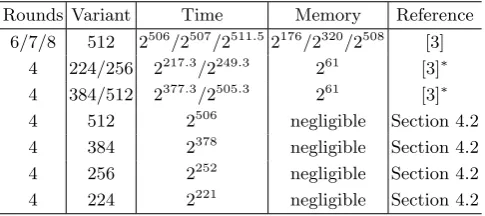
Table 1.Best known preimage attacks on theKeccakvariants proposed as SHA-3 candidates. The number in the column ‘Variant’ denotes a hash length.
Rounds Variant Time Memory Reference 6/7/8 512 2506/2507/2511.52176/2320/2508 [3]
4 224/256 2217.3/2249.3 261 [3]∗
4 384/512 2377.3/2505.3 261 [3]∗
4 512 2506 negligible Section 4.2 4 384 2378 negligible Section 4.2 4 256 2252 negligible Section 4.2 4 224 2221 negligible Section 4.2
2 KECCAK
In this section we provide a description of Keccak to the extent necessary for understanding
the attack described in the paper. For a complete specification, we refer the interested reader to the original specification [5].
Keccakuses the sponge construction and hence is a member of the sponge function family [4]. Figure 1 shows the construction. It can be used as a hash function but also can be applied for generating infinite bit stream, making it suitable as a stream cipher or a pseudorandom bit generator. In this paper we focus on the sponge construction for cryptographic hashing.Keccak
has two main parameters r and c, which are called bitrate and capacity, respectively. The sum of those two makes the state size, which Keccak operates on. For the SHA-3 proposal, the
state size is 1600 bits. Different values for bitrate and capacity give the trade-off between speed and security. The higher bitrate gives the faster function that is less secure.Keccakfollows the
sponge two-phase processing.
The initial 1600-bit state is filled with 0’s. In the first phase (also called the absorbing phase), interleaved with applications of the permutationf (calledKeccak-f in the specification). The
∗
Fig. 1.Sponge Construction [4]
absorbing phase is finished when all message blocks have been processed. In the second phase (also called the squeezing phase), the first r bits of the state are returned as part of the output bits, interleaved with applications of the function f. The squeezing phase is finished after the desired length of output digest has been produced.
For the variants proposed as SHA-3 candidates, the value of the parametercis equal to a hash length multiplied by 2. For example, the SHA-3 candidate with 512-bit hash length is Keccak
withc= 1024 andr = 576 (r +c= 1600). In this paper we denote variants proposed as SHA-3 candidates by Keccak-512, Keccak-384,Keccak-256, and Keccak-224. (The number is a
hash length for a given variant.)
Keccakcan also operate on smaller states but through the whole paper we always refer to
the default variant with 1600-bit state. The state can be visualised as an array of 5×5 lanes, each lane is 64-bit long. The state size determines the number of rounds inKeccak-f function.
For the default 1600-bit state there are 24 rounds. All rounds are the same except for constants which are different for each round.
Below there is a pseudo-code of a single round. In the latter part of the paper, we often refer to the algorithm steps (denoted by Greek letters) described in the following pseudo-code.
Round(A,RC) {
θ step
C[x] = A[x,0] xor A[x,1] xor A[x,2] xor
A[x,3] xor A[x,4], forall x in (0...4) D[x] = C[x-1] xor rot(C[x+1],1), forall x in (0...4) A[x,y] = A[x,y] xor D[x], forall (x,y) in (0...4,0...4)
ρ step forall (x,y) in (0...4,0...4) A[x,y] = rot(A[x,y], r[x,y]),
π step forall (x,y) in (0...4,0...4) B[y,2*x+3*y] = A[x,y],
A[x,y] = B[x,y] xor ((not B[x+1,y]) and B[x+2,y]),
ι step
A[0,0] = A[0,0] xor RC
return A }
All the operations on the indices shown in the pseudo-code are done modulo 5.Adenotes the complete permutation state array and A[x,y]denotes a particular lane in that state. B[x,y],
C[x], D[x] are 64-bit intermediate variables. The constants r[x,y] are the rotation offsets, while RC are the round constants. rot(W,m)is the usual bitwise rotation operation, moving bit at position iinto positioni+m in lane W(i+mare done modulo 64 – note that 64 is the lane size for the default variant of Keccak). θ is the linear operation intends to provide diffusion for the state. ρ is a permutation between bits in the lanes and π is a permutation between the whole lanes. The only non-linear operation is χ which can be treated as a layer of 5-bit Sboxes. Finally, ι xores the round constant with the first lane. The constants play a vital role in our analysis and it is worth mentioning that they have the very low Hamming weight. The constants for the first 5 rounds are: 0000000000000001, 0000000000008082, 800000000000808a, 8000000080008000, 000000000000808b (given respectively in hexadecimal using the little-endian format).
In our work we often need to refer to a particular bit of the state and we do that byA(x,y,z). The coordinates x, y range from 0 to 4 specifying the lane in the state and the coordinate z ranges from 0 to 63 specifying the bit number in the given lane. With this notation we can refer to a state by A, to a lane by A(3,2), to a value of a single bit by A(1,4,6), or to a position of a
single bit by (3,1,60).
3 Rotational distinguishers for the Keccak-f[1600] permutation
In our analysis we follow the relation between two states (A, A←) which change through subse-quent steps of Keccak-f[1600] permutation. In particular we are interested in evolution of a
rotational pair of states. Let us define the rotational pair in the context of the Keccak-f[1600]
permutation.
Definition 1. A pair of two 1600-bit states (A,A←) is called a rotational pair when each lane
in the state A← is created by bitwise rotation operation of the corresponding lane in the state
A. The operation moves the bit from the position (x, y, z) to the position (x, y, z+n), where
z +n is done modulo 64. The coordinates x, y range from 0 to 4 specifying the lane in the
state and the coordinate z ranges from 0 to 63 specifying the bit number in the given lane.
n is called a rotational number and is the same for every lane. Thus in the rotational pair
∀(x, y, z) :A(x,y,z)=A←(x,y,z+n).
Remark 1. Following Definition 1, there are up to 64 possible rotational pairs including a pair,
where A and A← are the same (having n = 0). We will use this fact in the preimage attack described later in the paper.
In some parts of this work we are interested in the probability that a given pair is a rota-tional one or a given pair of corresponding bits preserve the rotarota-tional relation. Two following definitions help to formally define this probability.
Definition 2. Set Sn is a set of 21600 pairs of states which are created by an operation (some
number of steps ofKeccak-f[1600]or their inverse) applied to all possible rotational pairs. (All
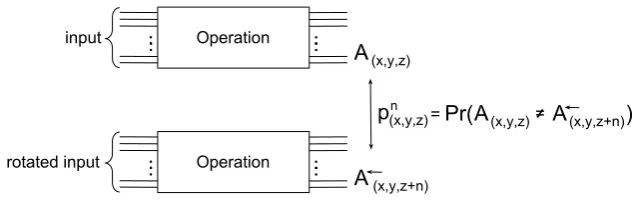
Definition 3. Probability pn(x,y,z) is the probability that for a pair of states (A, A←) randomly
selected from the set Sn we have A(x,y,z) 6=A←(x,y,z+n).
pn(x,y,z) can be expressed as pn(x,y,z)= 1/2 +n(x,y,z). Therefore if n(x,y,z)= 1/2, the corresponding
bits have opposite values and ifn(x,y,z) =−1/2, the corresponding bits are equal. In casen(x,y,z)=
0, the bits are independent.
Fig. 2.Probabilistic relation between bits in a pair of states (A,A←)
A(x,y,z+n)
(x,y,z)
A =
Pr( )
(x,y,z)
p =
Operation ....
.... input
Operation ....
.... rotated input
A(x,y,z+n) A(x,y,z)
n
When mounting distinguishers we refer to a random permutation which now we define for-mally.
Given a permutation of n-bit sequences, i.e p : {0,1}n → {0,1}n. The collection of all
permutations overn bit sequences is denoted byPn. The cardinality of the set Pnis n!.
Definition 4. Given a probability distribution Dn that assigns the probability n!1 for each
per-mutation p ∈ Pn. A permutation is called random if it is chosen according to the (uniform)
distribution Dn.
For a random permutation we assume that pn(x,y,z) follows the binomial distribution B(t, s) where tis a number of trials and sis a probability of success and is equal to 0.5. The mean for the binomial distribution equals s·tand the standard deviation σ =p(1−s)s·t .
To distinguishKeccak-f[1600] permutation from a random permutation we check whether
the experimental results (for a chosenp(x,y,z) follow the binomial distributionB(t,0.5). We choose
a typical 95% confidence interval and hence the mean from the experimental sample should be within the range 0.5t±2σ. If the mean is beyond that range we conclude that experimental results do not follow the binomial distributionB(t,0.5) and henceKeccak-f[1600] can be distinguished
from a random permutation.
To calculate how the probabilities change through the successive steps of the algorithm, let us first analyze two basic bitwise operations used in Keccak.
For the following Lemmas it is assumed that each p(x,y,z) is independent. Also we assume
that if corresponding bits from (A, A←) are equal, both combinations (‘00’ or ‘11’) have the same probability to be the actual values. The same applies for combinations with opposite bits (‘01’ or ‘10’).
Lemma 1 (AND).Given the bitwise AND operation, its input bitsa,band the output bitout. Then the probability
Pout=
1
2(pa+pb−papb),
Lemma 2 (XOR). Given the bitwise XOR operation, its input bitsa,band the output bitout. Then the probability
Pout=pa+pb−2papb,
where the probabilities pa and pb are defined according to Definition 3.
Proofs of the lemmas are given in Appendix.
There is also the bitwise NOT operation in the algorithm but it does not affect the proba-bilities. NOT flips the values of the corresponding bits A(x,y,z) andA←(x,y,z+n) but their relation (or precisely speaking the probability of relation pn(x,y,z)) remains unchanged. Also the bitwise rotation operation (denoted in the pseudo-code as rot(W,n)) does not change the values of probabilities. It rotates the bits in the lane so their positions (coordinates z in pn(x,y,z)) change while their probabilities pn(x,y,z) are not changed.
Having explained how the basic bitwise operations change the rotation probabilities, the analysis of the Keccak-f[1600] steps remains mostly straightforward. In the transformation
θ, there is the XOR operation only, applied a number of times. Due to the linearity of the XOR operation, the repeated application of Lemma 2 will give the correct results of calculated probabilities. For the permutationsρandπ, nothing needs to be calculated as only the positions of bits change. In the transformation χ, the two Lemma 1 and Lemma 2 are applied. The last step is the transformationι, where the lane (0,0) is xored with a constant. Xoring with ‘0’ does not change anything. However, if there is ‘1’ at position m in the constant and a rotational number n >0, then xoring with a constant change the probabilities as follows
pn(0,0,m):= 1−pn(0,0,m) and pn(0,0,m−n):= 1−pn(0,0,m−n)
Example 1. Let us consider two 8-bit lanes A(0,0) andA←(0,0) with the rotational number n= 3.
The lanes have the following binary values: A(0,0) = 00000010 and A←(0,0) = 00010000. Because
∀z: A(0,0,z) = A(0,0,z+3)← , then ∀z: p3(x,y,z) = 0 (according to Definition 3). Now if both lanes
are xored with 8-bit constant C = 00000001, new values of lanes are A(0,0) = 00000011 and A←(0,0) = 00010001. Rotational relation has been spoilt at two positions (0 and 5), therefore the probabilities p3
(0,0,0) andp3(0,0,5) are now equal to 1. InKeccak-f[1600] the constants are 64-bit
long but the reasoning shown above is still valid.
3.1 4-round distinguishers
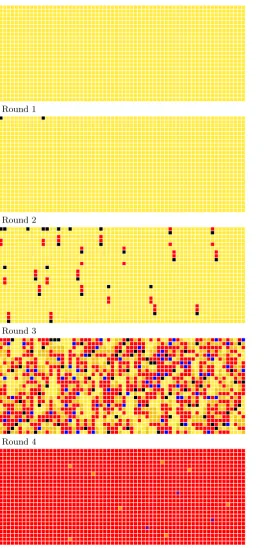
We build a 4-round rotational distinguisher and show that after 4 rounds, there are some co-ordinates (x, y, z) and the rotational number n for which pn(x,y,z) does not follow the binomial distributionB(t,0.5). Figure 3 illustrates an evolution of rotation probabilities. A single square represents a value (or a range of values) of the probabilitypn(x,y,z). Usually in this paper, we refer to a lane by its two coordinates (x, y). However here for the sake of diagram readability instead of 5x5 matrix of lanes there are 25 rows, each representing a single lane. For example, a value of pn(0,1,0) is represented by the leftmost square in the sixth row and pn(4,4,63) is represented by the rightmost square in the last (25th) row.
we chose randomly 10000 rotational pairs and ran them on the 4-round Keccak-f[1600]. The
mean from that sample was equal to 5682 (for 5682 rotational pairs bits had different values). For a random permutation which follows the binomial distribution B(10000,0.5), the mean equals 5000 and the standard deviation equals 50. Thus the mean from the experiment on the 4-round
Keccak-f[1600] should be within the range 5000±2·50 and clearly 5682 is beyond that range.
Hence we conclude we have a distinguisher for the 4-round Keccak-f[1600] permutation.
We could not directly extend the distinguisher to 5 rounds because afterθ in the 5th round all pn(x,y,z)= 0.5.
3.2 Extension to 5-round distinguisher
To extend the distinguisher to 5 rounds, we show that correlation between some corresponding bits fromAand A←deviates from what is expected from random permutation. Let us first give an observation which helps to mount the 5-round distinguisher.
Observation 1 Consider two bits (A(x,y,z), A(x,y0,z)) from state A which are in the same
col-umn and let us assume that we know the probability thatA(x,y,z)6=A(x,y0,z)). Our point is that
θ does not change this probability. It is because θtreats each bit within a column in the same way: either it flips all 5 of them or it leaves them unchanged.
We can use this observation in our rotational analysis. The difference is that now we look at relations in one pair (A(x,y,z), A←(x,y,z+n)) and the second pair (A(x,y0,z), A←
(x,y0,z+n)). Each of
these two pairs has the relation between its bits (that is bits have either the same or opposite values). We are interested whether the relations are the same in both pairs, specifically the probability that relations are the same in both pairs. For a random permutation this probability has the binomial distribution B(t,0.5). If we can show that for the 5-round Keccak-f[1600]
experimental results do not follow this distribution, then we have a distinguisher.
First we determine a rotational number n for which pn(x,y,z) and pn(x,y0,z) have the highest
deviation from 0.5 at the end of the 4th round. It turns out that for n= 63,p63(2,1,37)andp63(2,2,37) is the best pair? (p63(2,1,37)= 0.5625 andp63(2,2,37)= 0.49219).
Now let Pc denotes a probability that in the first pair (A(x,y,z), A←(x,y,z+n)) and in the second
pair (A(x,y0,z),A←
(x,y0,z+n)) is the same relation. That is the probability:
Pc=pn(x,y,z)·pn(x,y0,z)+ (1−pn(x,y,z))(1−pn(x,y0,z))
We can calculate Pc for the chosen pairp63(2,1,37) and p63(2,2,37).
Pc= 0.5625·0.49219 + (1−0.5625)(1−0.49219) = 0.49902375
This is the Pc value at the beginning of the 5th round. Then we have to examine how the
steps in the algorithm change this probability. As explained in Observation 1,θdoes not change this value. Subsequent algorithm steps ρ and π also do not change Pc value, they only change
a position of Pc which now refers to different pairs of bits (A(1,2,43), A←(1,2,44)) and (A(2,0,16),
A←(2,0,17)). After that there is χ which preserves the relation between the first pair and the second with a probability equals 0.53125. The reason that this value deviates from 0.5 is thatχ is a non-linear operation and precisely the bitwise AND operation which introduces the bias. All the details on how this value is calculated are given in Appendix. Finally, ιdoes not affect our
?An anonymous reviewer pointed that a better pair can be found, that isp31
(0,0,3)andp 31
Fig. 3.Evolution of probabilitiesp53
(x,y,z)through 4 rounds ofKeccak-f[1600].
p= 0
0.4≥p >0 0.5> p >0.4
p= 0.5 0.6≥p >0.5 1> p >0.6
p= 1
Round 1
Round 2
Round 3
analysis here. Therefore, to have our pairs with the same relation at the end of the 5th round, there are two ways this event may occur. Either the pairs enter into the 5th round with the same relation andχ does not spoil it or they enter into the 5th round with the opposite relation and χ‘fixes’ it. Then the total probability Pcfor the chosen pair at the end of the 5th round is:
Pc= 0.53125·0.49902375 + (1−0.53125)·(1−0.49902375) = 0.499938984
For a random permutation, Pc follows the binomial distribution with the probability of
success s = 0.5 — very close to 0.499938984. Then the bias for 5-round Keccak-f[1600] is
expected to be very small. To experimentally verify and observe the bias we need to check many rotational pairs. A sufficient number of rotational pairsmis calculated from Chernoff bound [7] and can be expressed as the following inequality:
m≥ 1
(Pc−0.5)2
ln√1
,
where is the probability of an error of the bound (typically set to 0.05). From the inequality we have m≥402 332 890≈228.6 and in the experiment we checked 403 000 000 rotational pairs. The distinguisher we implemented can be described in a few short steps:
1. Generate randomly 403 000 000 rotational pairs 2. For eachpair
(a) Run 5-round Keccak-f[1600] on the stateA and the stateA←;
(b) if (A(1,2,43)⊕A←(1,2,44)⊕A(2,0,16)⊕A←(2,0,17)= 0)then
mean:=mean+ 1;
The mean from the experiment was equal to 201 450 503. For a random permutation which fol-lows the binomial distributionB(403 000 000,0.5), the mean equals 201 500 000 and the standard deviation equals 10 037. Thus the mean from the experiment on the 5-round Keccak-f[1600]
should be within the range 201 500 000±2·10 037 and 201 450 503 is beyond that range. Hence we conclude we have a distinguisher for the 5-round Keccak-f[1600] permutation.
3.3 5-round distinguisher with lower complexity
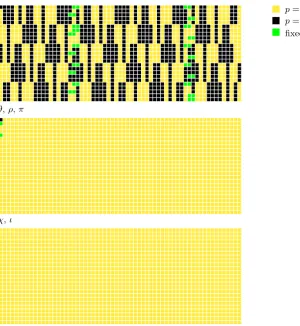
The idea allowing us to reduce the complexity of the 5-round distinguisher is to start not from a rotational pair of states but from the pair of states (called ‘good’ states) which after one round gives the rotational pair. First diagram in Figure 4 shows the structure which is used to generate a pair of ‘good’ states. Now we explain how we construct this structure. (A rotational number nis set to 63 in the following explanation but for any othernthe logic of construction stays the same.)
On the way to the rotational pair from a pair of ‘good’ states the following should happen:
• ι from the first round flips the value of p63(0,0,0) and p63(0,0,1). Thus to get the rotational pair afterι, there have to be p63(0,0,0) = 1,p63(0,0,1) = 1 and for all otherp63(x,y,z) = 0 beforeιstep.
• We want thatp63(0,0,0)= 1,p63(0,0,1) = 1 and all otherp63(x,y,z)= 0 are going toχandχ does not change any ofp63(x,y,z). This wayιgets the right p63(x,y,z) to produce the rotational pair.
However χ is a non-linear operation and to have the condition fulfilled, some A(x,y,z) and
Fig. 4.1-round transition to a rotational pair. A rotational numbernset to 63.
p= 0
p= 1
fixed value
θ,ρ,π
χ,ι
invert these three operations to get the rotational relation at the beginning of the first round. Figure 4 shows a 1-round transition to a rotational pair where exact positions of the fixed bits are marked. The values of fixed bits which lead to this transition are given in Appendix.
We hoped that this 1-round transition to a rotational pair would give one more round in the distinguisher. However it is not the case and the problem is that the constant of the second round has the Hamming weight 3 (and not 1 as for the first round). More 1’s in the round constant introduce more pn(x,y,z) = 1 which subsequently cause more pn(x,y,z) with undesirable value of 0.5. Yet this 1-round transition can be used to lower the complexity of the 5-round distinguisher. Similarly as in the distinguisher from the previous section, we are interested in the pair of pn(x,y,z) at the end of 4th round which are in the same column and whose values deviate from 0.5. For a rotational number n set to 63, we find an excellent pair where both p63(4,3,22) and p63(4,4,22) are equal to 0. We calculate Pc in exactly the same way as in Section 3.2
but this time the total probabilityPcis much higher and is equal to 0.53125. Putting this value
to the Chernoff inequality, we calculate the number of pairs m needed to detect the bias and obtain m ≥ 1534 ≈ 211 . Around 211 needed pairs make the complexity of the distinguisher roughly equal 212.
the approach where each undesirable pn(x,y,z)= 0.5 becomes 0 with probability 2−1. However, we could not reach anything better than 5 rounds without exceeding the generic complexity.
4 Preimage attacks on round-reduced Keccak
First, we describe the preimage attack on 3-roundKeccak-512 which is based on the rotational
distinguisher given in the previous section. Then we show how to extend the attack to 4 rounds. To have the attack working onKeccakhash function, we have to consider padding andKeccak
parameters. Let us consider Keccak-512 which hasr= 576, c= 1024 and a hash length set to
512 bits. For the preimage attack we propose the following structure of the message. A message length is 574 bits, where first 8 lanes (512 bits) are unknown (to be determined by the attacker). Last 62 bits of the message are set to 1. The message is padded with two 1’s giving a block of 576 bits. This way we fulfil a condition that all lanes (except first 8 lanes) have all 0’s or 1’s. We would use similar constraints on a message when attacking Keccak with different parameters
(including allKeccakvariants proposed as SHA-3 candidates).
4.1 3-round preimage attack
The goal of our attack is to find a preimage for a given 512-bit hash h. In the structure of the message described above we have 512 unknown bits, then we can expect that among 2512 possible messages there is, on average, one with a given hash. The main idea of our attack is to find a rotational counterpart of the preimage and show that the workload for this task is below exhaustively trying all 2512 values. Once we have a rotational counterpart of the preimage, we simply rotate it back and get the preimage.
As stated in Remark 1, for a given state there are up to 64 possible rotational pairs (including the identity function). There are 512 unknown preimage bits in the stateA, then the probability that we guess one of the rotational counterpart A← is 2−512·64 = 2−506. Thus we need 2506 guesses. There is a subtlety here which should be mentioned. There are some messages which have fewer than 64 rotations. These ‘special’ messages have a cyclic pattern. For example a message starting with four 0’s then four 1’s, then four 0’s and so on. However, the number of ‘special’ messages is relatively small in comparison to 2512. It can be shown there are 2256 such messages for our case. (See Appendix for detailed analysis.) For simplicity, we can start our attack with checking 2256 these special messages. Then there are still almost 2512 possibilities left, but at least we are sure that in this poll each state gives 64 rotational pairs.
To make our attack working, at the end of the 3rd round we need some pn(x,y,z) = 0 or pn(x,y,z)= 1 for each rotational numbern. In the precomputation phase of the attack we generate 64 diagrams (the same as shown in Figure 3), each with a different rotational number n. From these diagrams for each rotational numbernwe make a list of 10 sets of coordinates (x, y, z) for which pn(x,y,z) equals 0 or 1 at the end of the 3rd round. Please note that we have to consider only (x, y, z) such that 64x+ 320y+z <512 because the attacker knows only 512 bits of a hash (not the whole 1600-bit state).
Here is the main loop of the attack given in the following pseudo-code:
1. guess first 8 lanes (512 bits) of the state A←, the other bits are fixed according to the structure of the message given above.
2. run 3-round Keccak-f[1600] on the stateA←.
3. forn:= 0 ton <64 do
(a) candidate:=true;
if (pn(x,y,z)= 0)and (A(x,y,z)6=A←(x,y,z+n)) thencandidate:=false; if (pn(x,y,z)= 1)and (A(x,y,z)=A←(x,y,z+n)) thencandidate:=false;
(c) if (candidate=true) then rotate back the guessed state by n bits and run 3-round
Keccak-512 on it to check whether the state is the preimage of a given hash.
The attacker compares the probabilitiespn(x,y,z) from the distinguisher with the actual values of A (the given hash) and A← state (a result of 3-round Keccak-512on a guessed state). So,
for example, ifpn(2,3,1) = 0, then the bitsA(2,3,1)andA←(2,3,1+n)have to be the same. If the bits are
different, then the candidate is rejected as a potential rotational counterpart of the preimage. (It is the point in the pseudo-code where a variable candidate becomes false.)
As said earlier, running the main loop 2506times, we should get one rotational counterpart of the preimage. It could be the case that our guess (candidate) of a rotational counterpart is not rejected, but in fact it is not a rotational counterpart. Let us call it a false positive candidate. There will be many such false positive candidates and the number of them is calculated as follows. For each rotational number n there is a list of 10 sets of (x, y, z) (created in precomputation) for which pn
(x,y,z) equals 0 or 1. A probability that we hit on a candidate for which all 10 values
of pn(x,y,z) are the same as on the list is 2−10. Hence there will be around 2512/210 = 2502 false positive candidates to check.
Now let us analyze the workload of inner loops. For each candidate there are 64 rotational numbers n, and for each n there are 10 sets of coordinates to check. Checking one set of coor-dinates can be implemented with 3 bitwise XOR operations. So the workload of inner loops is roughly 64·10·3 = 1920 XOR operations. This workload is negligibly small as in the single step θ (in a single round) there are 3200 bitwise XOR operations.
Summing up, the workload of the attack is 2256 (checking special messages) + 2506 (main
loop) + 2502 (checking false positive candidates). Thus complexity of the attack is roughly 2506
Keccak-512 calls, 64 times better than the exhaustive search.
4.2 Extension to 4-round preimage attack
A direct extension of the attack to 4 rounds is not possible since there are not any pn(x,y,z) = 0 or pn(x,y,z) = 1 at the end of the 4th round of the rotational distinguisher. (As said earlier, we need somepn
(x,y,z) equals 0 or 1 for mounting the attack.)
It is easy to notice from Figure 3 that ι flips some pn(0,0,z) and in consequence it leads to undesirable pn(x,y,z) = 0.5. Then if we could limit this effect, hopefully some pn(x,y,z) = 0 or pn
(x,y,z)= 1 would be kept till the end of the 4th round and make the attack work for 4 rounds.
To realize this, we do the following. We trace the rotational relations between A and A← (as in previous sections), but this time A← is run on the modified version of Keccak-f[1600] — Keccak-f[1600] withoutι. Such a modification leads to the following observation.
Observation 2 In Example 1, Section 3 it was shown that application of ιto A and A← states
flips the valuepn
(x,y,z) for some triples (x, y, z). Our point is that if we do not apply ιto an A ←
state, there will be half as many flips. (It is not a general rule but for constants with very low Hamming weight there are roughly half as many flips.) Let us see a simple example.
Example 2. Let us consider two 8-bit lanes A(0,0) andA←(0,0) with the rotational number n= 3.
The lanes have the following binary values: A(0,0) = 00000010 and A←(0,0) = 00010000. Now A(0,0) is xored with 8-bit constant C = 00000001 and A←(0,0) is left without changes. Then we haveA(0,0)= 00000011 and the unchangedA←(0,0) = 00010000. Therefore a rotational relation has
been spoilt at only one position so now p3(0,0,0) is equal to 1. In Keccak-f[1600] the constants
Now is the key point. As stated earlier, fewer flips lead to fewerpn(x,y,z) with undesirable 0.5 value. In consequence, now in the 4th round there are 9 triples (x, y, z) for whichpn(x,y,z)= 0 or pn(x,y,z)= 1. These triples fulfil the condition 64x+ 320y+z <512 as the attacker is given only 512 bits of a hash. In fact pn(x,y,z) = 0 or pn(x,y,z) = 1 are not at the end of the 4th round but before χ in the 4th round. (Step χ destroys these desirable probabilities.) Fortunately, we can invert ιandχ from the given hash asχoperates on the rows independently and can be inverted on a row-by-row basis. In Appendix we give a diagram showing how the probabilities pn(x,y,z) evolve and propagate in the modified version of Keccak-f[1600] withoutι.
In precomputation phase we generate the list of sets of coordinates in the very similar way as described for the 3-round attack. The only difference is that now we use the diagram dedicated to the modified version ofKeccak-f[1600] (withoutι). The diagram and exact positions where
pn
(x,y,z) equals 0 or 1 is given in Appendix. Also in precomputation we invert ιand χof the 4th
round from the given hash (since these desirablepn(x,y,z)are beforeχin the 4th round,χdestroys them). The result of the inversion is now our state A to which we refer in the pseudo-code of the attack.
Here is the main loop of the attack given in the following pseudo-code:
1. guess first 8 lanes (512 bits) of the state A←, the other bits are fixed according to the structure of the message given above.
2. run 4-round modified Keccak-f[1600] on the state A←
3. forn:= 0 ton <64 do
(a) candidate:=true;
(b) for all9 sets of coordinates (x, y, z) being on the list created in precomputation do if (pn(x,y,z)= 0)and (A(x,y,z)6=A←(x,y,z+n)) thencandidate:=false;
if (pn(x,y,z)= 1)and (A(x,y,z)=A←(x,y,z+n)) thencandidate:=false;
(c) if (candidate=true) then rotate back the guessed state by n bits and run 4-round
Keccak-512 on it to check whether the state is the preimage of a given hash.
The main loop of the 4-round preimage attack onKeccak-512 is very similar to the 3-round
variant, they differ only in a few places. In Step 2 of the pseudo-code instead of running a normal, full 4-round Keccak-f[1600], we run the modified version without ι (in all 4 rounds) up toχ in the 4th round. Finally, there will two times more false positive candidates as there are only 9 triples (x, y, z) for which pn(x,y,z) = 0 or pn(x,y,z) = 1. The complexity of the attack stays the same as in the 3-round attack. That is 2256 (checking special messages) + 2506 (main loop) + 2503 (checking false positive candidates), which is amounts roughly to 2506 evaluations of the 4-roundKeccak-512.
ForKeccak-512, the preimage attack is better than the exhaustive search by a factor of 26.
The same gain can be achieved in the attack onKeccak-384. Our preimage attack works also on Keccak-256 andKeccak-224 but the gain is slightly smaller for these variants. The reason is
that there are more false positive candidates to check. It is because an attacker knows fewer bits of a hash (a hash is shorter in these variants) and hence there are fewer triples (x, y, z) (fewer than in Keccak-512 and Keccak-384) for which pn(x,y,z) = 0 or pn(x,y,z) = 1. Consequently, the complexities of the preimage attacks on Keccak-224 andKeccak-256 are 2221 and 2252,
respectively.
Please also note that if we try to attackKeccakvariant with higher bitrater(e.g. a variant
We could not extend the attack to 5 or more rounds because in the 5th round allpn(x,y,z)= 0.5, while for the attack we need some pn(x,y,z)= 0 or pn(x,y,z)= 1.
5 Conclusion
In this paper we have presented the rotational distinguisher for Keccak-f[1600] permutation
— the main building block of the Keccakhash function. The distinguisher has been enhanced
with the correlation analysis, allowing us to reach 5 rounds with the complexity of 212. We
have implemented and verified the distinguisher and experimental results have been consistent with the theoretical model. A family of 4-round distinguishers helps us to mount the 4-round preimage attack on Keccak-512 variant with the complexity of 2506. All the presented attacks
are valid for all the Keccakvariants submitted as SHA-3 candidates. As future work, it would
be interesting to investigate whether the differential rebound attack could improve the rotational distinguishers. These two types of analysis (rebound and rotational) were combined in the attacks on Skein hash function [13].
Acknowledgement
We would like to thank the Keccak Team for useful comments and discussion. We also thank Dmitry Khovratovich, Thomas Peyrin and anonymous reviewers for improving the quality of the paper. The research was cofounded by the European Union from resources of the European Social Fund, Project PO KL Information technologies: Research and their interdisciplinary ap-plications, Agreement UDA-POKL.04.01.01-00-051/10-00. Josef Pieprzyk was supported by the Australian Research Council grant DP0987734.
References
1. Aumasson, J.P., Meier, W.: Zero-sum distinguishers for reduced Keccak-f and for the core functions of Luffa and Hamsi. Tech. rep., NIST mailing list (2009)
2. Bernstein, D.J.: Salsa20. Tech. rep., eSTREAM, ECRYPT Stream Cipher Project (2005),http://cr.yp.to/ snuffle.html
3. Bernstein, D.J.: Second preimages for 6 (7? (8??)) rounds of Keccak? NIST mailing list (2010), http:// ehash.iaik.tugraz.at/uploads/6/65/NIST-mailing-list_Bernstein-Daemen.txt
4. Bertoni, G., Daemen, J., Peeters, M., Van Assche, G.: Cryptographic sponges,http://sponge.noekeon.org
5. Bertoni, G., Daemen, J., Peeters, M., Van Assche, G.: Keccak sponge function family main document,http: //keccak.noekeon.org/Keccak-main-2.1.pdf
6. Boura, C., Canteaut, A.: Zero-Sum Distinguishers for Iterated Permutations and Application to Keccak-f and Hamsi-256. In: Biryukov, A., Gong, G., Stinson, D. (eds.) Selected Areas in Cryptography, Lecture Notes in Computer Science, vol. 6544, pp. 1–17. Springer Berlin Heidelberg (2011)
7. Chernoff, H.: A Note on an Inequality Involving the Normal Distribution. Annals of Probability 9, 533–535 (1981)
8. Dinur, I., Dunkelman, O., Shamir, A.: New Attacks on Keccak-224 and Keccak-256. In: Canteaut, A. (ed.) Fast Software Encryption, Lecture Notes in Computer Science, vol. 7549, pp. 442–461. Springer Berlin Heidelberg (2012)
9. Duan, M., Lai, X.: Improved zero-sum distinguisher for full round Keccak-f permutation. Chinese Science Bulletin 57, 694–697 (2012)
10. Duc, A., Guo, J., Peyrin, T., Wei, L.: Unaligned Rebound Attack - Application to Keccak. Cryptology ePrint Archive, Report 2011/420 (2011)
11. Homsirikamol, E., Morawiecki, P., Rogawski, M., Srebrny, M.: Security margin evaluation of SHA-3 contest finalists through SAT-based attacks. In: 11th Int. Conf. on Information Systems and Industrial Management. LNCS, vol. 7564. Springer Berlin Heidelberg (2012)
12. Khovratovich, D., Nikoli´c, I.: Rotational cryptanalysis of ARX. In: Proceedings of the 17th international conference on Fast software encryption. pp. 333–346. LNCS, Springer-Verlag (2010)
14. Knudsen, L.R., Matusiewicz, K., Thomsen, S.S.: Observations on the Shabal keyed permutation. Available online (2009),http://www.mat.dtu.dk/people/S.Thomsen/shabal/shabal.pdf
15. Naya-Plasencia, M., Rck, A., Meier, W.: Practical analysis of reduced-round keccak. In: Bernstein, D., Chat-terjee, S. (eds.) Progress in Cryptology INDOCRYPT 2011, Lecture Notes in Computer Science, vol. 7107, pp. 236–254. Springer Berlin Heidelberg (2011)
16. Standaert, F.X., Piret, G., Gershenfeld, N., Quisquater., J.J.: SEA: A Scalable Encryption Algorithm for Small Embedded Applications. In: CARDIS’06. LNCS, vol. 3928, pp. 222–236 (2006)
17. Van Assche, G.: A rotational distinguisher on Shabals keyed permutation and its impact on the security proofs. Available online,http://gva.noekeon.org/papers/ShabalRotation.pdf
Appendix
Proof of Lemma 1
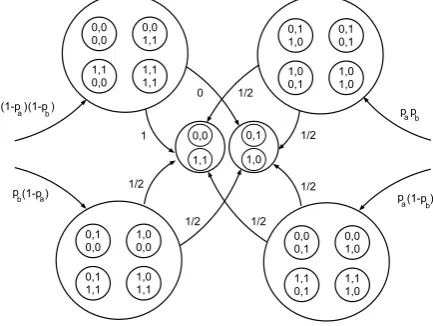
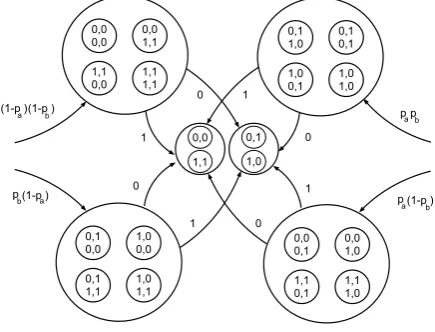
Analyzing the AND operation we consider two pairs of input bits. A pair from an A state and its counterpart from an A← state. There are 16 possible combinations of pairs and we group them in fours. We assume that all pairs of bits inside the groups are uniformly distributed. It is shown in Figure 5. Probabilities of getting the given group are also shown. The most inner circles represents pair of output bits (one bit from an A state and its counterpart from an A← state). It is clear from Figure 5 that four paths lead to a circle with output bits having opposite values (pairs (0,1) and (1,0)). Actually, one path has probability 0 thus a calculation of Pout
(a probability that output bits have opposite values) comes down to adding probabilities of the three paths. We have:
Pout=papb·
1
2 + (1−pa)pb· 1
2+ (1−pb)pa· 1 2 =
1
2(pa+pb−papb)
Fig. 5.All possible ‘paths’ for the bitwise AND operation for rotational pairs of bits.
1,1 0,0 1,1 1,1 0,0 0,0 0,0 1,1 0,1 1,1 1,0 1,1 0,1 0,0 1,0 0,0 1,0 1,0 1,0 0,1 0,1 0,1 0,1 1,0 1,1 1,0 1,1 0,1 0,0 1,0 0,0 0,1 (1-p )a
p
apb
p
b (1-p )
b
p
a
(1-p )
a(1-p )b
1/2 1/2 1/2 1/2 0,0 1,1 0,1 1,0 1/2 1/2 0 1
Proof of Lemma 2
Proof of Lemma 2 is the same as for Lemma 1. The only difference is that now there are only two paths leading to a circle with output bits having opposite values. It is shown in Figure 6. We have:
Fig. 6.All possible ‘paths’ for the bitwise XOR operation for rotational pairs of bits. 1,1 0,0 1,1 1,1 0,0 0,0 0,0 1,1 0,1 1,1 1,0 1,1 0,1 0,0 1,0 0,0 1,0 1,0 1,0 0,1 0,1 0,1 0,1 1,0 1,1 1,0 1,1 0,1 0,0 1,0 0,0 0,1 (1-p )a
pap
b
p
b (1-p )
b
p
a
(1-p )
a(1-p )b
0 1 0 1 0,0 1,1 0,1 1,0 0 1 0 1
Probability of relation preservation by χ
We are given two pairs of bits (A(1,2,43), A←(1,2,44)) and (A(2,0,16), A←(2,0,17)). Each of these two
pairs has the relation between its bits (that is bits have either the same or opposite values). We can also look at relation between pairs and there are two possibilities: either the same relation in both pairs or different relation in each pair. For example a pair (0,1) and a pair (1,0) means that relations in both pairs is the same (bits are different in pairs). We are interested in a probability that χpreserves the relation between pairs. χ changes the values of bits in the following way.
A(1,2,43):=A(1,2,43) XOR (A(2,2,43) AND A(3,2,43)) A←(1,2,44):=A←(1,2,44) XOR (A←(2,2,44) AND A←(3,2,44))
)
first rotational pair
A(2,0,16):=A(2,0,16) XOR (A(3,0,16) AND A(4,0,16))
A←(2,0,17):=A←(2,0,17) XOR (A←(3,0,17) AND A←(4,0,17)) )
second rotational pair
To keep the relation between bitsA(1,2,43) and A←(1,2,44) from the first pair, the result of the
AND operation has to be the same in both equations from the first pair. The probability of such event can be calculated from Figure 5. We add probabilities (paths) leading to the left, inner circle. (This circle represents the output bits with the same values.) Then a probability is:
P = (1−pa)(1−pb)·1 +papb·
1
2 + (1−pa)pb· 1
2+ (1−pb)pa· 1 2 In the 5th round, afterθ allpn
(x,y,z)= 1
2, then a numerical value of p is:
P = (1−1
2)(1− 1 2)1 +
1 2 1 2 1
2 + (1− 1 2)
1 2 1
2 + (1− 1 2) 1 2 1 2 = 5 8
For the second rotational pair calculations are exactly the same with the result of 58. The event that χ preserves the relation between the first and second pair can happen either when the relation in each pair is preserved or the relation in each pair is spoilt. Thus the probability of this event is equal to:
Pevent=
5 8 ·
5
8+ (1− 5 8)(1−
5 8) =
34
Values of fixed bits in the distinguisher from Section 3.3
Bits given in tables below are set to 1. All other fixed bits which are not listed below (but are marked as fixed in Figure 4) are set to 0.
Bit Value
A(4,4,50) 1
A(4,4,51) 1
A←
(4,4,51) 1
A←
(0,2,21) 1
A←
(0,3,21) 1
A←
(0,0,22) 1
A←
(0,2,22) 1
A←
(0,3,22) 1
A←
(0,4,22) 1
A←
(2,0,20) 1
A←
(2,3,20) 1
A←
(2,2,21) 1
Bit Value
A←(2,3,21) 1
A←(3,2,51) 1
A←(3,3,51) 1
A←
(3,0,50) 1
A←
(3,3,50) 1
A←
(3,0,52) 1
A←
(3,2,52) 1
A←
(3,3,52) 1
A←
(3,4,52) 1
A←
(0,2,51) 1
A←
(0,3,51) 1
As a consequence of such settings, afterπ some bits have also fixed (known) values. Specif-ically, A(1,0,0) and A(1,0,1) with their rotational counterparts are equal to 0. Also A(4,0,0) and
A(4,0,1) with their rotational counterparts are fixed, equal to 1. With this known values we are sure that the non-linear χ changes the states into the desirable rotational relation, as shown in Figure 4.
Calculation of a number of special messages
According to Definition 1 and Remark 1, for a given state A there are up to 64 possible rota-tional pairs (including an identity function). There are some messages which have fewer than 64 rotations. These special messages must have a cyclic pattern (e.g. alternating four 1’s and four 0’s) in all lanes. All 0’s or all 1’s in the given lane are also considered cyclic here. Please note that if at least one lane in a state A is not cyclic then there are exactly 64 possible rotational pairs (A, A←). It is because this non-cyclic lane is distinct for each rotational number n and consequently the whole A← will be distinct.
For a 64-bit lane there are 232 cyclic patterns. In our preimage attack there are 8 unknown lanes in the A state (remaining lanes are fixed and cyclic), so the number of combinations of cyclic patterns in these 8 lanes is: 232·232. . .·232
| {z }
8 factors
= 2256. And hence the number of special
messages is 2256.
Evolution of probabilities pn(x,y,z) in the modified Keccakvariant
Figure 7 shows how probabilities pn(x,y,z) change in the modified Keccak variant (without ι).
Fig. 7.Evolution of probabilitiespn
(x,y,z)in the modifiedKeccakvariant.
p= 0
0.4≥p >0 0.5> p >0.4
p= 0.5 0.6≥p >0.5 1> p >0.6
p= 1
Round 1
Round 2
Round 3
![Fig. 1. Sponge Construction [4]](https://thumb-us.123doks.com/thumbv2/123dok_us/7885770.1308440/3.595.117.477.96.279/fig-sponge-construction.webp)