- extended version, 17 December 2015∗
-Nicolas T. Courtois
University College London, Gower Street, London, UK
Abstract. GOST 28147-89 is a well-known block cipher and the official encryp-tion standard of the Russian Federaencryp-tion. A 256-bit block cipher considered as an alternative for AES-256 and triple DES, having an amazingly low implementa-tion cost and it is becoming increasingly popular [51, 36]. Until 2010 researchers unanimously agreed that: “despite considerable cryptanalytic efforts spent in the past 20 years, GOST is still not broken”, see [51] and in 2010 it was submitted to ISO 18033 to become a worldwide industrial encryption standard.
In 2011 it was suddenly discovered that GOST can be broken and it is insecure on more than one account. There is a substantial variety of recent innovative attacks on GOST [9, 26, 37, 10–12, 31, 21, 19, 20]. We have reflection attacks [37, 26], at-tacks with double, triple and even quadruple reflections [26, 20], a large variety of self-similarity and black-box reduction attacks [9, 26, 19, 20], some of which do not use any reflections whatsoever [26, 9] and few other. The final key recov-ery step in various attacks is in many cases a software algebraic attack [26, 9, 20] or/and a Meet-In-The-Middle attack [37, 26, 31, 21]. In differential attacks key bits are guessed and confirmed by the differential properties [54, 10–14, 49] and there have already been quite a few papers about advanced differential attacks on GOST [54, 10–13, 49, 14, 22, 15]. There is also several even more advanced “combination” attacks which combine the complexity reduction approach based on high-level self-similarity of [26, 19, 9] with various advanced differential prop-erties with 2,3 or 4 points, see [26, 20].
In this paper we consider some recent differential attacks on GOST [54, 10–14, 49, 15] and show how to further improve them. We present a single-key attack against full 32-round 256-bit GOST with time complexity of 2179which is sub-stantially faster than any previous single key attack on GOST.
∗Note:This paper is a new extended and updated version of a paper with the same title [27] to appear in LNCS 9100, Springer in March 2016. This paper is substan-tially expanded compared to the earlier version from 2012. The main attack remains the same and also the same as in the Springer version [27]. The introduction, preliminary study and exploration of underlying cipher structure and properties attacks are however greatly expanded in order to show a bigger picture and provide useful insights. We ex-plain in details the philosophy and the structure of our attacks, and the methodology of how one can find such attacks, cf. Part I, “Discovery of Advanced Differential Attacks on GOST”, pages 9- 24. We also cite recent related and follow-up work.
1
Introduction
This paper is about advanced differential attacks on GOST block cipher [54, 10–12, 22, 53, 49, 52, 13, 14, 24]. The first half of this paper is consecrated to the question of how such attacks can be discovered, cf. Part I. An interesting question is then how reliable some heuristic results are [54, 10–14, 49, 24] which question is not obvious given the fact that GOST is not a Markov cipher [40, 23, 49] and that truncated differentials can be decomposed into some interesting sub-classes, cf. [22, 49] and Section 4.
Remark.This paper does NOT cover the whole spectrum of what differential prop-erties can bring in terms interesting or/and efficient attacks on GOST. In this paper we do not consider multiple key attacks [17, 19, 26, 20, 39] and we do not try to develop or at more advanced “combination” attacks which combine the complexity reduction approach based on high-level self-similarity of [26, 19, 9] with advanced differential properties with 2,3 and 4 points, [26, 20]. This paper is essentially a technical paper on simple yet highly-optimized truncated differential attacks in a single key scenario.
1.1 Background: Differential Cryptanalysis
Differential cryptanalysis (DC) is based on tracking of changes in the differences be-tween two messages as they pass through the consecutive rounds of encryption. It is one of the oldest classical attacks on modern block ciphers, if not the oldest. We refer to [13] for a short historical survey. In cryptographic literature it was first described and analysed by Biham and Shamir [4, 5, 45] and applied to DES algorithm in early 1990s, and has been studied ever since [45, 7]. However, as reported by Coppersmith it was already known by the IBM team which have designed DES around 1974 [30, 28, 6, 29], under the name of T-attack or Tickle attack. Reportedly, Don Coppersmith has explained that defending against DC had been a design goal when DES was designed in 1970s and after discussions with NSA it was decided this technique should be kept confidential, in the context of the “competitive advantage” the United States enjoyed (compared to other countries) in the field of cryptography, cf. [28, 13].
3]. Later in 2000 Russian researchers claimed that breaking GOST with five or more rounds is “very hard” and explain that as few as 7 rounds out of 32 are sufficient to pro-tect GOST against differential cryptanalysis [33]. Needless to say later research have not confirmed at all such very optimistic claims [40, 41, 44, 23, 24] However GOST ap-pears to be quite secure in the standard historical Biham-Shamir formulation of DC with single differences on the full state [4, 33, 54].
Interestingly however Knudsen and other researchers have soon after Biham and Shamir proposed more powerful advanced differential attacks. We have “truncated dif-ferential” attacks by Knudsen [46] and other similar attacks (for example attacks with a more general concept of sets of differentials [10]). Such attacks are applied to GOST as early as in 2000 by Seki and Kaneko [54] with some success. In 2011 Courtois and Mis-ztal have found new differential sets for GOST [10] which are substantially better than previously known. They also report that even the original attack of Seki and Kaneko [54] works actually substantially better than predicted, see [11, 12].
More advanced differential attacks are still nevertheless very much underestimated in the cryptographic community. A lot of research about Boolean functions and opti-mal resistance against DC have been done, in a totally unrealistic settings where sopti-mall components of ciphers are studied in isolation regardless of how they are connected inside a cipher. This research leads to highly misleading results about types of strong or “optimal” S-boxes which [47, 50–52, 13] are expected to protect ciphers against DC. In contrast in this paper we are going to make a rather very surprising claim that the secu-rity of a cipher such as GOST against DC does not depend that much on the S-boxes, but rather on the connections of the cipher, see Section 4 and [53, 13, 14, 49, 22, 15, 23, 24].
1.2 Road Map
This paper is organized as follows:
1. In the Abstract and Introduction section 1, we explained the history of differential cryptanalysis and its advanced variants, and how it relates to other known attacks on GOST and block ciphers. Then in Section 2 we explain the outside-symmetric character of the GOST key schedule and the general principle of splitting GOST into three sections of for example 6+20+6 rounds.
2. Then we have Part I which is consecrated to the difficult combinatorial exploration questions of discovery of “good” differential properties for GOST. These questions are also studied in [54, 10–13, 49, 22].
3. Then in Part II we study the question of constructing a good distinguisher for a larger number of 20 rounds of GOST which is one of the key questions in this paper.
Additional questions heuristics and results related to parts I and II are also covered in [49, 54, 10–13, 49, 14, 22, 15].
4. In part III we show ho to transform a distinguisher attack on 20+ rounds into an op-timized key recovery attack for the full 32 rounds. Earlier and more basic attempts to develop such an attack can be found in [11, 12, 49]. A highly optimized competi-tive attack is necessarily more complex and requires more stages. We construct our main attack1in three stages:
a. In Section 6 we explain a concept of a sequence of concentric distinguishers and construct one very precise example.
b. In Section 7 we study the propagation inside GOST in order to be able to construct well chosen subsets of key bits to be guessed at various stages of our attack.
c. Then finally in Section 8 we describe a full advanced differential attack on 32 rounds of GOST. It is described as a sequence of consecutive steps, in which well-chosen assumptions on the key and data (plaintext) bits are progressively refined with early rejection. It can also be seen as depth-first tree search with multiple levels, such that when no valid solution (full correct 256-bit key) is found in one sub-branch, we backtrack and explore another sub-branch.
1The core of this attack also appears in [27] which paper misses however a lot of additional
2
How To Construct A Differential Attack on GOST?
This paper is about advanced differential attacks on GOST block cipher. In essence this paper describes essentially one such attack on GOST and all the necessary facts and methodology. At the high level the attack exploits the poor key schedule in GOST. At the low level the attack exploits insufficient diffusion and advanced differential proper-ties.
2.1 Key Schedule in GOST
The key structural property of GOST which makes it suitable for cryptanalytic attacks of the specific kind and specific form, is that the last 8 rounds are identical to the fist 8 rounds run in the opposite direction (however this symmetry does not follow for more inner rounds).
rounds 1 8 9 16
keys k0k1k2k3k4k5k6k7k0k1k2k3k4k5k6k7
rounds 17 24 25 32
keys k0k1k2k3k4k5k6k7 k7k6k5k4k3k2k1k0
Fig. 1.Key schedule in GOST is symmetric and the first/last few rounds use the same subset of keys, guessing these keys allows to “peel-off” many rounds from both sides at a low price.
This property has a big impact on security of GOST and was already exploited in numerous attacks on this cipher [9, 26, 37, 10–12, 31, 21, 19, 20]. Only 32 bits of the whole 256-bit key are used in one round and 32 out of 256 is a fairly small proportion equal to 1/8. Moreover for every 32 bits guessed we can remove two full outer rounds, instead of 1 round for a similar cipher without a weak key schedule. Similar the keys used int he firstXrounds are the same as used in the lastXrounds for everyX=0. . .8. We call this property “outer symmetry”. This property makes GOST vulnerable to differential cryptanalysis, for example earlier research showed that if we guess 192 key bits in just 6 rounds, we can remove 12 full rounds of GOST we can already get an attack faster than brute force, see [11].
In this paper we will exploit this precise and strong symmetry in GOST key schedule further and in more detail. We will look at differential properties which involve sets of differentials which are totally symmetric for the first 8 rounds and the last 8 rounds. Our key guesses will be far more precise than guessing keys for full rounds and specially adapted to this highly symmetric situation. This in order to maximize the number of cases which can be safely discarded due to these partial key guesses.
2.2 Preliminary Remarks
internal differentials. The question of constructing further distinguishers on say e.g. 20 rounds of GOST have subsequently been studied in [22, 23, 49]. Their applications have been studied in [27, 22, 23, 49] and in this paper.
Our approach is substantially more detailed. We will guess only some well-chosen key bits which will be used to filter P/C (Plaintext,Ciphertext) pairs used later in the attack. As in [11, 12, 49] the attack runs through many stages with great many filter-ing/guessing steps, where at each step we reduce the number of cases to consider (the plaintext space, some key bits already guessed and pre-computed relations between all these) and only after this reduction of number of cases we make additional guesses. In contrast to the attack presented in [12] our attack will use symmetric differential sets, which is dictated by the symmetry in the key schedule.
Large parts of this whole process can be viewed as an adaptive Depth-First-Search (DFS) attack on a tree of possibilities which is constructed adaptively depending on the assumptions currently considered as valid. This type of process is very widely used in cryptanalysis.
There is a substantial difficulty in differential attacks where the key size is much larger than the block size as in GOST: there are false positives, differentials which do not propagate but occur naturally, by accident. The key point is that for a very long time the false positives are not eliminated in a differential attack on GOST. We are just dealing with assumptions on internal difference bits in GOST, their consequences and relations between these assumptions but for many many steps none of the steps of the attack is able to see if the inner 20 rounds are 20 rounds of GOST, more rounds of GOST, or maybe just some other permutation. This can only be seen at a much later stage of the attack.
Part I
Discovery of Advanced
3
The Structure of GOST
We will only study the [by far] most popular set of GOST S-boxes known as the ”GostR3411 94 TestParamSet” in [36] which was published as early as in 1994. This set of S-boxes is according to Schneier [55] the one which would be used by the Cen-tral Bank of the Russian Federation. This is exactly what most researchers call just “the GOST cipher” (without any additional mention) in the cryptographic literature, and many papers ignore the existence of numerous additional variants of the GOST cipher.
Important Remark:This choice of S-boxes greatly affects all the differential prob-abilities we use in this paper. It is possible to see that similar attacks exist for other variants of GOST It is very extremely naive to believe that they don’t exist, cf. [53, 52]. On the contrary. Recent research shows that differential attacks on GOST work quite well across all (known or alternative] sets of S-boxes see [13, 14, 22, 49].
3.1 Notation
In this paper we consider the traditional “Twisted” representation of Feistel ciphers. Each round of GOST looks exactly the same:
(L,R)7→(R,L⊕fk(R))
3.2 Internal Connections in GOST
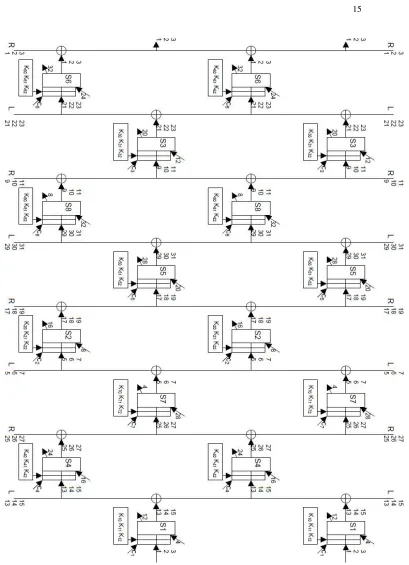
We number the inputs of the S-box Si fori=1,2, . . . ,8 by integers from 4i+1 to 4i+4 out of 1..32. The outputs of one S-box Si are numbered according to their final positions after the rotation by 11 positions: for example the inputs of S6 are 20,21,22,23 and the outputs are 32,1,2,3.
GOST has 32 rounds such as the one described in Fig. 2 below.
On our picture below thedenotes the addition modulo 232. On this picture we do NOT represent the final circular shift by 11 positions modulo 32 which occurs in GOST after the S-boxes. It is represented in a different way, by numbering the output bits of the S-boxes, to see directly where they are connected.
Fig. 2.One Round of GOST And Connections in The Following Round
3.3 Sets of Differentials, Aggregated and Truncated Differentials
GOST seems2to be secure in the standard historical Biham-Shamir formulation of
dif-ferential cryptanalysis (DC) withsingle differences on the full state[4, 33]. However, Knudsen and other researchers have soon proposed more powerful advanced differential attacks, which are called“truncated differential” attacksby Knudsen [46]. Similar attacks were applied to GOST as early as in 2000 by Seki and Kaneko [54]. In this paper [54] authors propose a more general formulation:“sets of differentials”, and it is clear that “truncated differential” attacks [46] are a special case of attacks with “sets of differ-entials” cf. [54, 10]. It remains the question of which exact properties are the strongest and most relevant in practical cryptanalytic attacks. This is not a small question and the whole Part I of this paper is consecrated to the study of this paper. It is possible to see that properties presented by Seki and Kaneko in 2000 are not the strongest [54] and until 2011 these questions have not received sufficient attention. Since 2011 many very substantially stronger differential properties have been discovered, cf. [10, 11, 22, 49, 24, 13] and this paper.
Interestingly best known attacks of this type are currently much closer to less gen-eral “truncated differential” attacks [46] than to more gengen-eral “sets of differentials” attacks of [54], which formulation is maybe too general and very hard to study due to combinatorial explosion of the number of possible differentials. Basically “truncated differential” attacks [46] seem to capture well the best advanced differential attacks on GOST, they work extremely well with additional [guess then determine] steps of more complex attacks and little [if any] benefit is achieved by considering more general for-mulations. One slight generalization is the notion ofaffine setsstudied in Section 4.5. Another important intermediate notion is the notion of“aggregated differentials”as defined in [10, 11] and in Section 3.4 of this paper. All these notions are useful and we cannot know in advance which attacks on GOST are optimal and how to capture best attacks on GOST without excessive generality which would make such attacks harder to discover and harder to study.
Remark:An alternative way of looking at truncated differential attacks is to em-phasizecollisions at the set of “inactive” bits. See Section 2.3 Collision tests in [32]. See [24] for a detailed explanation how these attacks are related.
3.4 Aggregated and Truncated Differentials in GOST
We consider differences with respect to the popular bitwise XOR operation. Follow-ing previous work on this topic [11, 12] we definean aggregated differential A,Bas the transition where any non-zero differencea∈Awill produce an arbitrary non-zero differenceb∈Bwith a certain probability.
In particular, we consider the case whenAis a set of all possible non-zero differen-tials contained within a certain mask. This also is a special case of “Truncated Differen-tials” [46] which are defined as fixing the difference not on all but a subset of data bits. For example we can assume that active bits are{9,10,11,20,21,22,31} ⊂ {0..31}. In addition we need to be careful and explicitly exclude all-zero differentials from this set. For example let
∆=0x80700700
we obtain a set of all differences on 32 bits with between 1 and 7 active bits (but not 0) and where the active bits are contained within the mask 0x80700700. This is exactly the same as saying that active bits are{9,10,11,20,21,22,31}and we disallow all-zero differences. This is equivalent to having a set of 27−1 differences on 32 bits whcih are allowed, all the other differences are not allowed.
Similarly, the set denoted by[∆,∆]is a set of difference on 64 bits with up to 14 active bits, where any non-zero difference is allowed, including also differences where the difference is zero in one half, but not the all-zero difference on both halves. We have |A|=214−1: there are exactly 214−1 single 64-bit differences in this set of differentials
For example the following fact was established in [10–12]:
Fact 3.4.1 The truncated differential [∆,∆] with uniform sampling of all differences it allows, produces an element of the same aggregated differential set [∆,∆]after 4 rounds of GOST with probability about2−13.6on average over all possible keys, where
∆=0x80700700has 7 active bits.
For 6 rounds the probability is2−18.7on average over all possible keys. For 8 rounds the probability is2−25.0on average over all possible keys.
Remark:Recent research shows that the size of 14 bits is close to optimum, i.e. sets with a different size are less likely to be as good, see Fig. 9 page 23 in Section 4.13 and [24].
Now we look at a one particular differential which we have noticed, arrives with a particularly large probability:
Fact 3.4.2 The set[∆,∆] = [80700700,80700700]produces a differential of the form
[00000700,80780000]with probability of2−22.19for 7 rounds of GOST.
This was obtained by a computer simulation3. We have |A|=214−1 and|B|=
28−1. Thisan aggregated differential A,Bcontains(214−1)(28−1)single differential
characteristics.
3Assuming that events are governed by a Poisson process, it is possible to know at which
4
Propagation of Differentials in GOST
It is possible to see that among truncated differentials of type[80700700,80700700]like for example in Fact 3.4.1 there exist several interesting non-trivial sub-classes. This is related to the notion ofgeneral open setswhich we study in [22, 49].
4.1 General Open Sets
It is a quite peculiar definition based on a certain heuristic idea on how to replace the study of all possible subsets of 264−1 or just 214−1 possible differences on 64 bits by a smaller number of distinct disjoint sets of differentials in which certain differentials are considered to be similar and are always studied together.
Then we callgeneral open setssets or justopen sets, special sets of differentials on 64 bits, in which we have removed all non-trivial sub-classes. For example from the set of differentials[80700700,80700700]we remove all the differentials which represent a greatly simplified pattern with less active bits, for example differentials which are members of[80000000,00000700]and many other similar sub-sets.
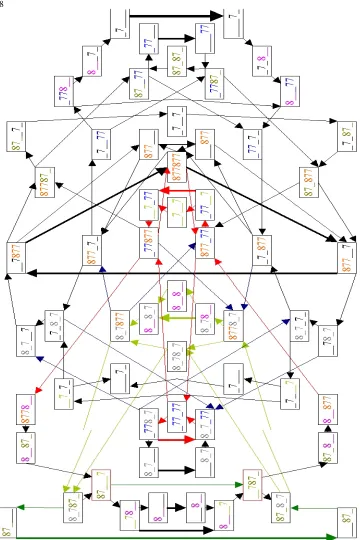
In this notion different bits are grouped into 32 groups of 1 or 3 bits. Each byte in hex is split into 1 higher bit and 3 lower bits corresponding to hex mask either 8 or 7. The key idea is that these sets of 1 or 3 bits behave in a “similar way” in differential attacks due to the GOST connections which we can contemplate on Fig. 3 below. Ac-cordingly, we can define the open set 80700700,80700700 where by convention we will not put square brackets[]anymore, as follows. We will only keep differentials which have essentially simultaneously all major 6 parts of the string of 80700700,80700700 which remain “active” as opposed to inactive. For example we keep the single differen-tial 0x80500300,0x80200400 in which all the 6 zones of 1 or 3 bits each remain active. We refer to [22, 49] for a formal definition and additional examples.
Overall it is possible to see that we can partition the set of 214−1 differences
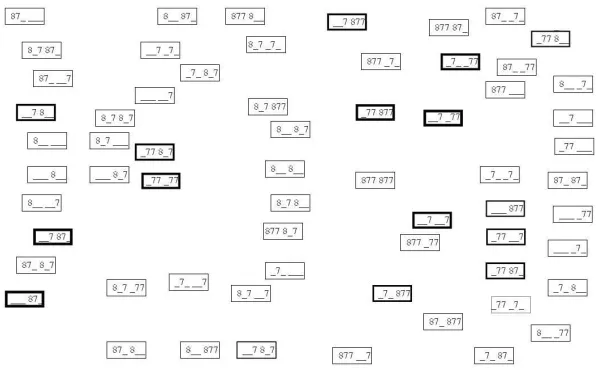
de-noted by [80700700,80700700] which uses 6 groups of 1 or 3 bits each, into 26−1 distinct open sets which aredisjointsets of differentials of variable sizes. In Fig 6 be-low we denote these sets by 6-character abbreviations for example 00700000,80700000 would be abbreviated as 7 87).
4.2 Transitions Between General Open Sets
At this level of detail, it is already possible to see that not all transitions are possible, for example in one round no differential in one set is possible at all given differential from one specific set at the input. This leads to a certain particular graph of possible transitions which can be used to find efficient differential attacks on GOST, cf. Fig 6 page 18. This behavior is again dictated by the connections inside GOST cf. Fig. 3.
4.3 On Important Classes of Aggregated Differentials in GOST
It is possible to see that many very good differential attacks on GOST are related to the important structure which exists within GOST. Basically, half of GOST S-boxes are very closely connected, and loosely connected with the other half, which is shown in Fig. 3. It is like two distinct nearly-bijective block ciphers applied in parallel with relatively few connections or leakage between the two internal states.
Remark.Moreover these 2 sub-ciphers use distinct keys for large numbers of rounds up to 24.
In this respect some very good attacks on GOST known to us can be classified in several major categories which we call 8+0, 5+1, and 3+3.
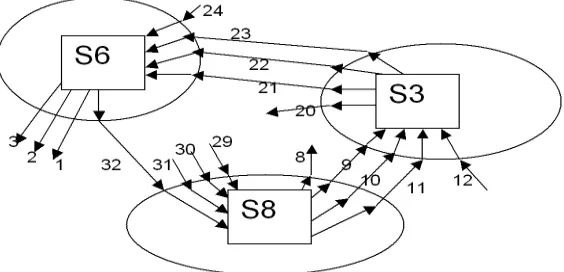
Differential Attacks of Type 3+3: The meaning of 3+3 is that the attack uses ONLY 3 fixed S-boxes from Fig. 3, for example S3,S6,S8, and another fixed 3 S-boxes from the complement of Fig. 3, and no other S-boxes. Moreover all these S-boxes are connected in a cyclical structure such that non-zero differences circulate within the structure, and do not leave it. The structure must be closed and circular because the GOST S-boxes are bijective and non-zero differentials cannot be canceled totally. This is shown in Fig. 4. The key interesting differentials which we exploit in this paper are of the type 3+3.
Fig. 4.Connections between S-boxes used in our 3+3 attack
Differential Attacks of Type 1+5:Other non-trivial interesting classes of differ-entials exist in GOST. We give one example of a differential set of type 1+5. It is as follows:
[07070008,08007070]. This set of 214−1 single differentials propagates for 8 rounds
with an average probability of 2−26.0for 8 rounds of GOST. Here active S-boxes are,
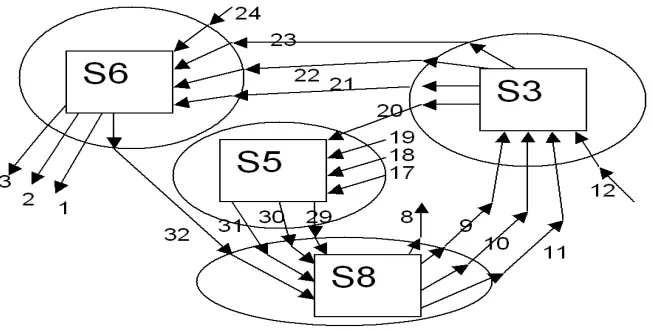
Differential Attacks of Type 4+4:They can also be seen as an overlapping of two 3+3 attacks, see Fig. 5
Fig. 5.Extended Version: of Fig. 4 with 4 S-boxes
Differential Attacks of Type 8+0:These are the original attacks of Seki and Kaneko from [54]. These attacks are the oldest and not the best ones, but clearly already depend on our partitioning of all GOST S-boxes into two sets.
4.4 How Much Attacks Depend on S-boxes
The key point we want to make here is that these classes of differentials do NOT depend that much on the S-boxes. They depend much more on the structure of the cipher and the exact connections inside. This is especially true for sets which include many dif-ferentials, such as studied in this paper where individual very strong differentials will matter less.
A common misconception is that the security of a cipher such as GOST against differential cryptanalysis (DC) depends extensively on the S-boxes, and some ”optimal” boxes would make it more secure, see [47, 51]. Researchers in the academia study S-boxes in isolation [47, 50] and propose new ciphers [47, 51] or try to tweak/improve the security of known ciphers [47, 41, 52]. However when S-boxes are connected together, everything changes(!). We arenot certain if it is possible at allto make a cipher such as GOST secure against DC by changing only the S-boxes [47, 51, 52], which idea was discussed during the ISO standardization process of GOST. The question of how far one can go with advanced differential attacks such as studied in this paper remains widely open, see [53]. We conjecture that the security of GOST against advanced forms of DC depends ”essentially” on the connections on the cipher, and though some S-boxes make it weaker against DC, none will make it really very strong.
Remark.This conjecture is disputed in [53]. It is totally incorrect to claim that the attacks do not work for the new replacement S-boxes they propose [53, 52], on the contrary. We refer to [13] and also [14, 49, 22, 24, 15, 23, 49] and to the following sections for a more detailed discussion of this topic. Numerous examples of attacks with different sets of S-boxes can be found below starting from Section 4.12.
4.5 Affine Sets
We take another look at our example of alternative differential set of type 1+5 which is [07070008,08007070]. It had 214−1 single differentials propagates for 8 rounds with
an average probability of 2−26.0for 8 rounds of GOST.
Interestingly, this set can be seen as a linear space of dimension 14 without the zero point. Quite remarkably, if we shift this set by a constant, so that it becomes an affine set for example with the exact shift of 0x00000002,0x00000000 (where we need to exclude another point which is still 0 after the shift by our affine constant) we obtain an affine iterative set of differentials which also contains 214−1 single differentials and yet it propagates for 8 rounds with an average probability of 2−24.9 for 8 rounds of GOST instead of 2−26.0, and which is strictly better even than in our best “traditional” 3+3 set from Fact 3.4.1. However we have not been able to find such properties for other numbers of rounds.
4.6 Propagation, Order From Chaos
The propagation of differentials can be seen as a system in which the initial low entropy differential pattern slowly dissipates, cf. also [23, 22]. However it does NOT have to be so if we consider the output entropy relative to specific output differentials. Our experiments show that the output entropy will almost always be substantially lower then expected. For example the exact distribution of the 214−1 output single differentials
observed something quite remarkable which is like order emerging from chaos and is not obvious to explain. We give here one example.
As in Fact 3.4.1 we consider the input differential(∆,∆)and the output differen-tial(∆,∆)after 6 rounds. On average over possible 214−1 input differentials it prop-agates with probability 2−18.6. This probability however hides the fact that among
the 214−1 input differentials there are few for which the propagation is much eas-ier, because some S-boxes are going to be inactive, for example differentials of form [80000700,00700000]. Therefore it is interesting to look at the “hardest” case, which is the majority of the 214−1 cases, where we specifically forbid the difference under any of 8’s and 7’s to be non-zero at then input. In this case the propagation for 6 round occurs with probability 2−23.8instead of 2−18.6. We call this sort of set an “open set”.
Now the amazing property we have observed is that out of these 2−23.8cases with differences on 14 bits, an unexpectedly large proportion of cases, about 40%, or 2−25.0, has only 3 active bits out of 14, and falls within[00000000,00000700]after 6 rounds. We have done everything to obtain input differences as chaotic possible just because of the sheer complexity of 6 rounds of encryption. Yet the output we have seen they areeitherhighly complex and random (when outside of[80700700,0x80700700]), or nearly constant (for 40% of the remaining time).
Another example which illustrates on how entropy of differentials in GOST in-creases slowly within a certain framework can be found in Fig 4.9 below.
4.7 Another Example
We consider the following transition: from[80700000,00000700]at the input to [80700700,80700700]after 4 rounds. This happens with probability 2−8.40. Quite inter-estingly, inside these 2−8.40cases the output set of type[80000000,00000700]happens about half of the time and this set is smaller than our input set of differentials.
It is possible that these properties or low entropy (or emerging order) are due to “rigidity” of our advanced differentials sets: only some patterns are possible.
4.8 Interpretation of Our Examples
4.9 How Quick Is Diffusion of GOST?
Following [22] it is possible to analyse the propagation of differential and show that the entropy seems ot increase linearly with the number of rounds at a rather slow rate. This is shown on Fig 4.9 below which we borrow from [22]:
Round Entropy
0 0.0
1 0.0
2 2.81 3 5.61 4 5.72 5 8.19 6 10.92 7 12.31
Fig. 7.A relative differential entropy estimation and plot after 1-7 rounds of GOST starting from a simple input set 8000000000000000 when staying within the framework of Fig. 6.
4.10 Propagation For 8 Rounds
The following figure which we borrowed from [22] show that only some general open sets within the framework of Fig. 6 are likely to be obtained after 8 rounds. We are still very from from “good” diffusion for 8 rounds of GOST.
4.11 Attacks with Single Differentials
We predict that GOST also has some quite strong attacks with single differentials, which however are NOT at all obtained compositions of traditional single-differential charac-teristics, yet lead to efficient attacks for larger numbers of rounds of GOST. This is simply an inevitable consequence of the existence of strong truncated differentials for large numbers of rounds which is the main property which leads to efficient attacks in this paper. It is easy to see that truncated differential can transition into single differen-tial on both sides for larger number of rounds. This is already seen in Section 4.9 with a single differential on one side.
4.12 Discovery Of New Truncated Differential Properties
Interesting sets of truncated differentials for GOST can be found by trial and error and hill climbing by a basic evolutionary algorithm as follows.
1. We select a set of sayX=17 bits at random.
Some starting points for this algorithm have also been guessed or constructed by hand following heuristics such as in Section 4.3.
2. We use a variant of method called method of “Structures” by Biham and Shamir [5]. More precisely we fix the 64-17 bits and consider all possible plaintexts with such fixed 64-17 bits, and look at how many ciphertext also share the same 64-17 bits. This method gives a quadratic speedup in measuring the propagation probability. 3. We keep a population of some 1000 best sets and mix new sets of 14 bits generated
with older sets of 14 in which we flip a few bits. We sample from each distribution half of the time.
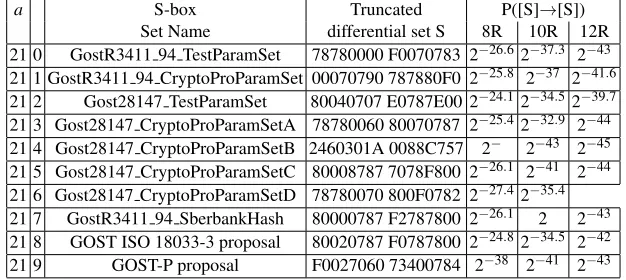
More detailed variant of this basic method are studied in [49, 23]. In Table 1 below and on the following pages we show some results obtained with this algorithm through extensive computer simulations (done with several CPUs running for months) by Nico-las Courtois, Theodosis Mourouzis and Guangyan Song.
a S-box Truncated P([S]→[S])
Set Name differential set S 8R 10R 12R 21 0 GostR3411 94 TestParamSet 78780000 F0070783 2−26.62−37.3 2−43 21 1 GostR3411 94 CryptoProParamSet 00070790 787880F0 2−25.8 2−37 2−41.6 21 2 Gost28147 TestParamSet 80040707 E0787E00 2−24.12−34.52−39.7 21 3 Gost28147 CryptoProParamSetA 78780060 80070787 2−25.42−32.9 2−44 21 4 Gost28147 CryptoProParamSetB 2460301A 0088C757 2− 2−43 2−45 21 5 Gost28147 CryptoProParamSetC 80008787 7078F800 2−26.1 2−41 2−44 21 6 Gost28147 CryptoProParamSetD 78780070 800F0782 2−27.42−35.4 21 7 GostR3411 94 SberbankHash 80000787 F2787800 2−26.1 2 2−43 21 8 GOST ISO 18033-3 proposal 80020787 F0787800 2−24.82−34.5 2−42 21 9 GOST-P proposal F0027060 73400784 2−38 2−41 2−43
4.13 On Optimal Size in Truncated Differential Attacks
Recent research shows that truncated differential with 14 bits are the best, and that sets with smaller or bigger size are typically at least slightly worse. This is shown on Fig. 9 and studied in more detail in [24].
Fig. 9.For each set of GOST S-boxes there existsD≈14 which maximizes the propagation of truncated differential properties for 8 rounds.
a S-box Truncated P([S]→[S])
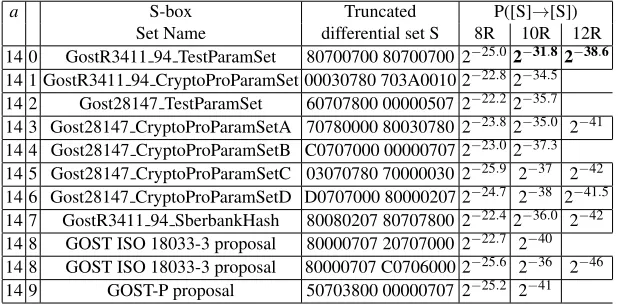
Set Name differential set S 8R 10R 12R 14 0 GostR3411 94 TestParamSet 80700700 80700700 2−25.02−31.82−38.6 14 1 GostR3411 94 CryptoProParamSet 00030780 703A0010 2−22.82−34.5 14 2 Gost28147 TestParamSet 60707800 00000507 2−22.22−35.7 14 3 Gost28147 CryptoProParamSetA 70780000 80030780 2−23.82−35.0 2−41 14 4 Gost28147 CryptoProParamSetB C0707000 00000707 2−23.02−37.3 14 5 Gost28147 CryptoProParamSetC 03070780 70000030 2−25.9 2−37 2−42 14 6 Gost28147 CryptoProParamSetD D0707000 80000207 2−24.7 2−38 2−41.5 14 7 GostR3411 94 SberbankHash 80080207 80707800 2−22.42−36.0 2−42 14 8 GOST ISO 18033-3 proposal 80000707 20707000 2−22.7 2−40 14 8 GOST ISO 18033-3 proposal 80000707 C0706000 2−25.6 2−36 2−46 14 9 GOST-P proposal 50703800 00000707 2−25.2 2−41
Table 2.Some attack sets with 14 active bits
4.14 Can Truncated Differentials Be Joined and Probabilities Multiplied?
This is a provocative question as most of the time we do just that and probabilities are multiplied. Most of the time there are just small discrepancies. The final result is sometimes worse, and also quite frequently it is better than expected. This could be because of existence of additional middle states not captured by a given composition.
Numerous examples which we have studied show that the discovery of new sets is a non-trivial task and not every heuristic works. Even though this heuristic was nec-essary in the past to construct attacks on larger numbers of rounds of GOST, we need to remark that onecannotjust combine arbitrary “truncated differentials”. More pre-cisely,combining such properties and multiplying the probabilities is not reliable and cannot be trusted to be correct in general. In general it appears that truncated differen-tials which work well for X rounds will NOT be those which work best of Y rounds, and vice versa, and in general not even close. For each number of rounds, a different dedicated attack need to be developed. This can be seen in Table 2. Additional examples can be found in Section 1 page 160 in [23] and many more can be found [13, 22, 49, 23, 24] and many more are also found in different Tables with results displayed in this section.
We recall from the beginning of Section 4 that a better heuristic methodology and important refinement of “truncated differentials” is proposed in [22, 49].
4.15 Open vs. Closed Sets of Differentials
The paper [22] introduces an important notion of so called “General Open Sets” which are a specific way to partition “truncated differentials” into disjoint sets of differentials which are very similar. This leads to more refined attacks than traditional truncated cryptanalysis [46] and allows us to see that there is hidden very substantial complexity even inside one single set of differentials, cf. Fig. 6 page 18 and Fig. 8 page 21.
A useful notion of a “closure” of these “open sets” is defined in [22]. Closed sets are basically ordinary truncated differentials, while open sets are their subsets which remove significant special cases which heuristically make a big difference given the internal structure of GOST. If we denote[7007070070070700]a closed set, the corre-sponding open set may be denoted by just 7007070070070700 without square brackets, this notation is used for example in [22].
Closed sets are usually just slightly bigger than some underlying open sets but their behavior is substantially harder to account for. In results such as in Table 2 and 1 we present transitions for closed sets. This what attackers need to use in final attacks.
4.16 Open to Open Transitions
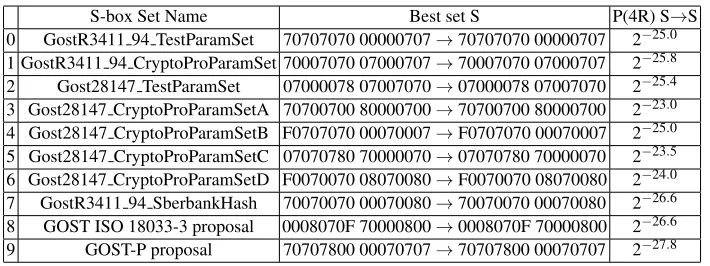
In this section we give some examples of open to open transitions of various sizes which again is a useful building block to find interesting attacks on larger numbers of rounds and to overcome problems outlined in Section 4.14 and in order to implement search/interpolation strategies such as described in [22] and below in Section 4.17 and in Fig 10.
Unlike for other Tables, these results are for 4 rounds. Results of type open→open are usually weaker than closed→closed [i.e. ordinary truncated differentials] which can be seen as a union of a certain number of open→open transitions.
S-box Set Name Best set S P(4R) S→S
0 GostR3411 94 TestParamSet 70707070 00000707→70707070 00000707 2−25.0 1 GostR3411 94 CryptoProParamSet 70007070 07000707→70007070 07000707 2−25.8 2 Gost28147 TestParamSet 07000078 07007070→07000078 07007070 2−25.4 3 Gost28147 CryptoProParamSetA 70700700 80000700→70700700 80000700 2−23.0 4 Gost28147 CryptoProParamSetB F0707070 00070007→F0707070 00070007 2−25.0 5 Gost28147 CryptoProParamSetC 07070780 70000070→07070780 70000070 2−23.5 6 Gost28147 CryptoProParamSetD F0070070 08070080→F0070070 08070080 2−24.0 7 GostR3411 94 SberbankHash 70070070 00070080→70070070 00070080 2−26.6 8 GOST ISO 18033-3 proposal 0008070F 70000800→0008070F 70000800 2−26.6 9 GOST-P proposal 70707800 00070707→70707800 00070707 2−27.8
4.17 Putting It All Together
Following [22, 49] one can construct closed sets fornrounds by decomposing a block cipher in 3 pieces as shown in Fig. 10 and by using open set on the inside and closed sets on the outside, so we study transitions closed→open→open→closed which at the end are just traditional truncated differentials with a precise upper bound on their probability [if it is bigger, it is not a problem, the attacks get easier] . Then we sum all the probabilities which are multiplied along each possible path as shown on Fig. 10. This summation is correct because all middle sets of differentials are disjoint [it is possible to show that our open sets are always disjoint].
Fig. 10.A construction of a distinguisher for n rounds by splitting in 3 blocks
Part II
5
Our Main Distinguisher For 20 Rounds
Our goal is to design an attack on the full 32-round GOST. We will use the same methodology as in [11, 12] guess some key bits and use a distinguisher and we also design a distinguisher for 20 rounds. However our new distinguisher is symmetric and the attack is more complicated. Our attacks operate with distinguishers which count certain individual quite rare events of a certain type. This can be modeled by the so calledLaw of Small Numbersalso known simply as a Poisson process [8, 16, 49].
A crucial question is how a differential attack on GOST can cope with false posi-tives. The expected average has frequently two distinct components. There are differ-entials which occur due to propagation of small Hamming weight differdiffer-entials for 20 rounds of GOST. Then there are also some other which occur “by accident” for an arbitrary permutation on 64 bis but without very strong differences in the middle of the encryption process. Such additional differences occur not only for a Random Per-mutation (RP) but alsoalmost always, with overwhelming probability 1−εfor ANY permutation, such as several rounds of GOST block cipher or any other bijection.
Fact 5.0.1 We look at the combination of a non-zero input difference of type
[80780000,00000700]and a non-zero output difference of type
[00000700,80780000]for 20 rounds of GOST.
For a typical permutation on 64-bits (does NOT have to be a random permutation, can be GOST with more rounds) we expect that there are215 pairs Pi,Pj with such
differences. The distribution of this number can be approximated by a Gaussian with a standard deviation of27.5.
For 20 rounds of GOST and for a given random GOST key, there exists two disjoint sets of215+213.9such pairs Pi,Pj.
Fig. 11.Signal vs. Noise Differential Distinguisher for 20 Rounds of GOST
These are two entirely disjoint sets of pairs, which can be distinguished by the fact that213.9pairs will have the difference0x80700700,0x80700700after 6 rounds from the beginning AND 6 rounds from the end, and none of the215will have such internal differences.
The distribution of the sum can be approximated by a Gaussian with an average of about215+213.9and the standard deviation of27.8.
This distinguisher works at26.1standard deviations.
Justification:For any permutation, we observe that every single combination of an input differential on 64 bits, and on an output differential on 64 bits, is expected to occur about 0.5 times on average. Indeed we have 2127pairs and about 2128possible sets of two dif-ferentials. Now we have(28−1)(28−1)possibilities of type:[80780000,00000700)]to (after some permutation OR 20 inner rounds of GOST)→[00000700,80780000]. Over-all we expect to obtain 0.5·28+8=215pairsPi,Pj for a given GOST key, with any of
these 28−23+1 differences.
a precise meaning to the word “propagation” in this precise 20 rounds case: we say that the differential ”propagates” if it goes through two additional differences in the middle as follows:
0x80780000 0x00000700 (7 Rounds)
0x80700700 0x80700700 (6 Rounds) 0x80700700 0x80700700
(7 Rounds) 0x00000700 0x80780000
Fig. 12.”Propagation” For 20 rounds With Specific Middle Differentials
Following Fact 3.4.1 and given 264+14−1pairs with the initial difference, we have 277−18.7=258.3pairs for the middle 6 rounds.
Then following Fact 3.4.2 the propagation in the next 7 rounds occurs with proba-bility 2−22.2on average over GOST keys. Since this is a permutation, the same prop-agation can be applied backwards in the preceding 7 rounds. Overall, we expect that 258.3−44.4=213.9pairs survive.
Now we are going to show that typically, none of these 213.9pairsP
i,Pjis a member
of the set of 215established beforehand. This can be established as follows: for any of the 215 cases which occur naturally at random, we have a non-zero input differential [80780000,00000700]. Then, a computer simulation shows that a differential of type [80700700,8070070]CAN occur at 7 rounds from the beginning (as in Fig. 12 which is 6+7 rounds from the beginning in GOST) but only with probability of 2−16.2. Similarly it can also occur 7 rounds from the end, but only with probability of 2−16.2. Overall we expect that only about 215−16.2−16.2=2−17 pairsPi,Pj on average will have the
“propagation” characteristics according to Fig. 12. Therefore, the two sets are entirely disjoint with a very high probability.
5.1 Related Research: Distinguishers For 20 Rounds of GOST
We can compare this result to a distinguisher which is used in [12]: where the input dif-ference is[80000000,00000000], and the output difference is of the form[00000100,80600200]. In the case of the actual 20 rounds of GOST we expect to get 24+25such differences, while 24would occur naturally at random for some other permutation.
Part III
6
Concentric Distinguishers
So far we have constructed one very good distinguisher for 20 rounds of GOST, cf. Fact 5.0.1. Now the question is as follows. In the similar way as in [12, 49] we want to avoid the necessity to examine all possibilities for the key in the first 6 rounds, and just apply the distinguisher. We want to progressively reduce the key size and the data space on the way, and for this to build a sequence ofconcentric distinguishersfor 22, 24 and more rounds which allow early rejection of many cases, so that we are going to examine 20 rounds of GOST with some assumptions on the key and some subset of data much less frequently. This is expected to lead to really efficient attacks on full 32 rounds of GOST. One very simple example of such attack was already described in [12]. More complex distinguishers for 20 rounds have been constructed and studied in [22, 49]. In this paper we study similar and also more complex distinguishers.
6.1 Extending with Additional Weakly Constrained Rounds
We start with our distinguisher property of Fact 5.0.1. This property is going to be extended with a “weakly constrained” differential propagation which occurs with quite a high probability for 6 more rounds on each side.
We also need a model to account for what is going to happen when our assump-tions are wrong. Therefore we are going to compare what happens with GOST split as 6+20+6 rounds to a situation which involves a random permutation (RP) as follows. We look at combination of 6 rounds of GOST, some permutation, and 6 rounds of GOST with the same keys in the backwards direction, as in GOST. This is illustrated in Fig. 13 which accounts for both sort of situations. It can represent the full 32-round GOST with 20 rounds in the middle, and it could also be a situation which we wrongly assumed to be the full 32-round GOST and the middle permutation is not exactly a random permu-tation however it is not at all what we assumed in our attack and we can expect that it might behave as a random permutation for the properties we study.
Definition 6.1.1 (Alpha Property) We say that a pair of encryptions for the full 32-round GOST (or for a combination of 6 32-rounds of GOST, some permutation, and 6 rounds of GOST with reversed keys) has the Alpha Property if the following whole configuration of sets of differentials simultaneously holds:
<plaintext> --->
0xFFFFFFFF 0xFFFFFFFF | 0x00000700 0x80780000
(1 Round) | (1 Round)
0xFFFFFFFF 0xFFFFFFFF | 0x80780000 0xF0000787
(1 Round) | (1 Round)
0xFFFFFFFF 0xFFFF8787 (20 Rounds) 0xF0000787 0x807FFF80
(1 Round) (or RP) (1 Round)
0xFFFF8787 0x807FFF80 (or other) 0x807FFF80 0xFFFF8787
(1 Round) | (1 Round)
0x807FFF80 0xF0000787 / \ 0xFFFF8787 0xFFFFFFFF
(1 Round) | (1 Round)
0xF0000787 0x80780000 | 0xFFFFFFFF 0xFFFFFFFF
(1 Round) | (1 Round)
0x80780000 0x00000700 | 0xFFFFFFFF 0xFFFFFFFF
|___________________| <ciphertext>
Fig. 13.The Alpha Property
6.2 Alpha Property: GOST vs. Random Permutation
In a similar way as before, a key problem in our distinguisher is that unhappily the Alpha property can occur also ”by accident”, not at all for the reasons we expect. This question needs to be formulated more precisely, as this property is about differentials also inside GOST, and therefore we cannot just compare GOST to a random permutation. The right question which we need to ask is as follows: in our composition of 6 rounds of GOST, some permutation and then the same 6 rounds in the decryption mode, can we have a fully consistent situation with all the differences which we have in the property Alpha on the outer 2x6 rounds, similar as in Fig. 13.
We have the following result:
Fact 6.2.1 For the full 32-round GOST and on average over the GOST keys, there exists 213.0+211.9distinct pairs of plaintexts Pi6=Pjwhich have the Alpha property.
If we replace the inner 20 rounds by a random permutation or with GOST with more rounds, we expect only about213.0distinct pairs with a standard deviation of26.5.
Justification:We apply Fact 5.0.1 and obtain 215+213.9pairs for the inner 20 rounds with two disjoint sets as explained before. Then it is easy to verify, by a computer simulation, that this provokes the 6 difference sets in the following 6 rounds, simultane-ously, with probability as large as 2−0.98, which is due to slow diffusion in GOST. The same applies in the first 6 rounds. Overall we obtain about 213.9−2.0≈211.9pairs with propagation, and a disjoint set (because subsets of disjoint sets from Fact 5.0.1) with 215−2.0≈213.0pairs which occur by accident.
7
Guess Then Determine Attacks on GOST
In this section we explain how to compute output bits for a certain round of GOST with incomplete knowledge of all the key bits on which this bit depends in this and previous rounds. We have the following basic fact:
Fact 7.0.2 The input on 4 bits of any particular S-box in GOST can be computed as: a=x+k+c mod16where k are the 4 key bits at this S-box, c is a single carry bit with c=1⇔x0+k0+c0≥16where x0and k0are the data and the key at the previous S-box, and c0is the previous carry bit. This is illustrated in Fig. 14 below.
Fig. 14.Computation of the Input Of One S-box With A Carry Bit
Remark:A simplified version of this fact is also shown and used in [21].
1. We defineW r(i)by the equationW r(i)−1= (i−1)mod 8. This corresponds to the number of S-box within 1..8 with wrap-around.
2. The input of each S-box Si in roundr+1 is a=x+k+cmod 16
and depends on (i) the 4 key bitskat the entry of this Si and (ii)xobtained from the outputs of two S-boxes in roundrwith numbersW r(i−2)andW r(i−3)XORred with the appropriate bits after roundr−2 (this part does not change in roundr−1), and (iii) one carry bitc.
3. The carry bitcis such that
c=1⇔x0+k0+c0≥16
wherex0andk0are the data and the key at the previous S-box, andc0is the previous carry bit.
4. The previous carry bit influences the result with low probability which will be quan-tified below.
From here we easily obtain that:
Fact 7.0.3 Let i>1(with S1 there is no carry entering as in Fig 14.
We assume that the attacker knows the whole 64-bit output of round r−2, the input of one S-box Si at round r+1, and the key k at the same Si in round r+1, and the state of W r(i−2)and W r(i−3)in round r.
Let k0be the unknown key at S-box i-1 in round r+1(cf. Fig 14). Then we have the following results:
1. Let d,e be respectively the most significant bits of k0and x0.
The bit d is obtained from 1 lower bit from W r(i−3)XORed with the appropriate state from round r−2, which is bit 20 on our example at Fig. 14,
If d=e=1, we have c=1with probability 1 and we can compute a. If d=e=0, we have c=0with probability 1 and we can compute a.
If d+e=1, we have c=0or c=1which are more or less equally likely. Here we get exactly two possibilities for a.
On average we obtain2×1/4×1+1/2×2=1.5=20.6possibilities for a. These possibilities for a are computed using only 5 bits of the key and the state of only 2 S-boxes in the previous round.
2. If the attacker knows the whole 4-bit x0 he can compute k0+x0 with an interval of incertitude of 8 instead of 16 previously. Thus only with probability 1/4 there will be two answers. Thus on average we obtain1/4×2+3/4×1=1.25=20.3 possibilities for a.
3. The same happens if the attacker knows the whole 4-bit k0but not x0.
4. If the attacker knows k0AND the whole state of W r(i−4)in round r, he can compute c correctly with probability of roughly about1−2−4.
Justification:The first result is straightforward and we will derive the second result. Each of these probabilities can be established by a discrete simulation checking all the possible cases.
We decide thatc=1⇔8∗b+4+k0+c0≥16. This will be accurate unlessx0+
k0+c0<16 AND 8∗b+4+k0+c0≥16 or the vice versa with the difference between these two numbers being on average 1.31. Each of these 2 cases occurs with probability of very roughly about 1.3/16≈2−4. Overall we expect that with probability 1−2−3
our computation ofcis correct.
In the similar way we derived the other results.
8
An Improved Differential Attack on GOST
For the ease of reading we split our attack in 5 stages. All the stages should be seen as a part of the same Depth First Search procedure with several levels.
8.1 Basic Tree Search Methodology
At each level we guess key (or internal data) bits, reject some cases, then guess more key bits to go to the next level, the reject again in order to reduce the number of times we visit a node at the third level, etc. This is illustrated in Fig. 15 below.
Fig. 15.The principle of progressive filtering, tree exploration, depth-first
Fig. 16.Example how the complexity of tree exploration splits per each level
The total time complexity will be the sum of these figures, which in case of sub-stantial differences is usually essentially equal to the maximum of these numbers. More advanced and highly optimized attacks tend however to be more balanced and in general we need to sum the cost of all levels carefully.
Now we apply this methodology to GOST. We describe an attack which is essen-tially a one single depth-first search procedure with several levels which we for better readability we organized in 5 major stages and which is later summarized in Fig. 20 page 45 and a basic description can also be found in [27].
8.2 The Actual Tree Search - First Two Levels
In our attack we are going to work simultaneously on data, which will be pairs of encryptions out of 264pairs possible, and on keys. We have found that [partly] guessing the data and [partly] determining the keys can be more economical then just guessing the keys as suggested by Fig. 15 above.
Fig. 17.Revised progressive filtering: working on data pairs AND key bits.
A good measure of progress of such an attack is the number of data pairs (2 encryp-tions) per key which are yet allowed at any given stage/level in the attack. Initially we need to consider that all 2127pairs are possible for every key. Then we determine a set
Then the number of pairs per key will decrease steadily in further steps of the attack in spite of guessing additional key bits, see the column ”per key” in Fig 20 page 45.
8.3 Attack Stage 1 - First 4 and Last 4 Rounds
We proceed as follows:
1. We are given 264KP which are assumed to be stored in a database.
2. We have the Alpha property cf. Fig. 13 which holds for 213+211.9distinct pairsi,j of encryptions for the full 32=6+20+6 rounds, cf. Fact 6.2.1.
3. First we are going to reduce the total number of pairs from 2127to a lower number, by a birthday-like approach which avoids the enumeration of all possible pairs. 4. Given an assumption on a certain number of key bits, we define asinactive bita
bit wherePi andPj collide (the difference is 0) at a certain bit location inside the
cipher,ifour assumption about the key is correct.
5. Our attack will have many steps in which we are going progressively guess some key bits, then reduce the space of pairs considered due to our differentials, which reduce the number of pairs under attack and make it feasible to guess additional key bits at a later stage.
6. We want to write constraints which describe the following events which occur in the first 3 then 4 and the last 3,4 rounds in our property Alpha, cf.Fig. 18.
<plaintext> --->
0xFFFFFFFF 0xFFFFFFFF | 0xF0000787 0x807FFF80
(2 Rounds) | (1 Round)
0xFFFFFFFF 0xFFFF8787 (24 inner) 0x807FFF80 0xFFFF8787
(1 Round) (rounds) (1 Round)
0xFFFF8787 0x807FFF80 (of GOST) 0xFFFF8787 0xFFFFFFFF
(1 Round) | (2 Rounds)
0x807FFF80 0xF0000787 / \ 0xFFFFFFFF 0xFFFFFFFF
|___________________| <ciphertext>
Fig. 18.First 4 and last 4 rounds in the Alpha Property of Fig. 13
– The output after the addition of the output of S7 and S1 after round 2 gives 8 inactive bits at 0 which are 3-6,11-14. This is implied by the set 0xFFFF8787 which our Alpha property imposes after round 2.
– The output after the addition of the output of S4,S5,S6,S7 after round 3 gives 15 inactive difference bits at 0 which are 24-31,1-7 (excluding bit 32). This is implied by the set 0x807FFF80 which occurs after round 3.
7. We consider and try to guess the following key bits: all key bits at rounds 1,2,3 and 20 key bits for S-boxes S12345 in round 4.
8. We observe that for any guess of these 96+20=116 key bits, we get 8+15+13=36 cancelations after rounds 1-4 as explained above, and 36 more cancelations on ex-actly the same S-boxes with the same keys after round 29 going backwards. This can be seen as a collision on 36+36=72 bits, computed as a function of type
9. For each 116 possible guesses for our selected key bits we compute 264 possible strings on 72 bits for eachPi. Only a proportion of one out of 28values on 72 bits
are taken. For any given caseithe probability that there is another jfor which the 72 bits collide is 2−8.
10. Then we can enumerate in time of maybe 4·264 CPU clocks some 264−8=256
possibleior jwith 256/2=255distinct pairsi,jwhich collide on these 72 bits. Another way of looking at this is as follows: there are (we do NOT ever enumerate all of them) about 2127 pairsPi,Pj and there are about 2127 differences fk(Pi)−
fk(Pj)on 72 bits. Some 2127−72=255of these differences will have all the 72 bits
at 0.
11. These 255 pairs per key assumption can be enumerated efficiently. A simplified method is as follows: We make a hash table where at address being a hash offk(Pi)
on 72 bits, and we storeias well. Each time the value is already taken we output a collision. We will output a list of 255pairsPi,Pj.
Memory required is roughly about 270bytes.
12. The total time spent in these steps of the attack should not exceed 2116+64times the cost of computing roughly speaking 1 round of GOST.
It is not needed to do as much work as computing 2116times 4 first rounds of GOST
and 4 last rounds of GOST. Basically the cost of computing the first 3+ and the last 3+ rounds of GOST can be neglected. More precisely it will be amortized in 220 sub-cases of the 296cases, in which we just need to evaluate 4 S-boxes in round 3 and 4 S-boxes in round 30, which is roughly feasible to do in most an equivalent of 1 round of GOST.
Therefore we estimate that we need only about 2116+64·8 CPU clocks, which could be seen as an equivalent of roughly about 2174GOST encryptions.
To summarize, we can thus in total overall time equivalent to about 2174 GOST encryptions and with memory of about 270 bytes, enumerate 2171=2116+55 cases of typek116,i,j. We get on average 255possible pairsi,jfor each key assumption on 116
bits.
Fig. 19.Summary of selected initial stages in our attack.
8.4 Attack Stage 2 - Working on Rounds 5 and 28
Now we are going to work on additional key assumptions with the objective to decrease the number of pairs per key from 255to a much lower number so that we will be able later at Stage 4 apply the distinguisher given by Fact 6.2.1.
1. Now we look at the difference 0x80780000 obtained after round 5, where outputs of S-boxes S8, S1 and S2 are ’newly’ inactive which is a cancelation on 12 bits after round 5, cf. earlier Fig. 13 page 36 or Fig. 21 page 48.
First we will work on S8, then on S1, then on S2.
2. First we guess additional 4+4 key bits. The situation is the same as in Fig. 14 with boxes S78 at round 5 depending mostly on boxes S456 in round 4.
We guess 4 bits at S-box S6 in round 4, needed only to compute the bit 31 entering S8 at round 5, and the 4 key bits at S8 in round 5, and an approximation on the 4-key bits at S7 in round 5, which together with outputs of S4 and 1 bit from S5 in round 4, can be used to compute the carry entering S-box S8 at round 5 with probability of about 1−2−4(cf. Fact 7.0.3).
3. More over and quite importantly we donotallow any errors in our computations. In rare cases where there is an ambiguity about the carry, because for example we have 15 and the carry added from S6 in round 5 could matter, we simply check both cases. This leads to a negligible increase in the total number of cases checked from about 2171+12to about(1+2−4)2171+12, see Fact 7.0.3.3. For simplicity we ignore these additional numbers which are negligible compared to other numbers in this attack.
Later during the attack, when the key at S6 and early S-boxes becomes known, these additional cases will be eliminated instantly. In fact we can also leave these additional cases, everything we do later in our attack can tolerate a small proportion of additional incorrect cases.
4. With these 12 new key bits, we can enumerate 2171+12 casesk116+12,i,j. In each
cases with probability 2−4the 4 bits XORed to the output of S-box S8 become inactive at round 4, and with probability 2−4they also become inactive at round 29. 5. Accordingly in time of about 2177computations of 2/32 full GOST, which is about 2179 GOST computations, (assuming one takes 29CPU clocks). We reject most cases except 2171+12−4−4=2175casesk128,i,j.
6. This, is 247cases per key.
7. Now we guess 8 more key bits. These are 4 bits at S-box S7 in round 4 which output 3 is needed to compute the input of S1 in round 5 (there is no carry entering S1). We also guess 4 key bits at S1 in round 5.
8. Now we have an enumeration of 2175+8casesk136,i,j, where we now have 136 key
bits. In this list with probability 2−4the 4 bits XORed to the output of S-box S1
become inactive at round 4, and with probability 2−4they also become inactive at round 29.
9. Accordingly in time of about 2175+8 computations of 2/32 full GOST, which is about 2174GOST computations, we have an enumeration 2175+8−4−4=2175cases k136,i,j.
5 (the carry entering S2 is already known for S1 in round 5 above). We also guess 4 key bits at S2 in round 5.
11. Thus we consider the enumeration of 2175+8casesk144,i,j, where we now have 144
key bits. In this list with probability 2−4the 4 bits XORed to the output of S-box
S2 become inactive at round 4, and with probability 2−4they also become inactive
at round 29.
Accordingly in time of about 2175+8 computations of 2/32 full GOST, which is about 2174GOST computations, we enumerate about 2175+8−4−4=2175casesk144,i,j.
We are left with 231pairsi,jon average for each key assumption on 144 bits which will be the cases which we will check in later steps of our attack.
8.5 Attack Stage 3
We will continue the process of guessing additional key bits and decreasing the number of cases per key assumption.
<plaintext> --->
0xFFFFFFFF 0xFFFFFFFF | 0x00000700 0x80780000
(2 Rounds) | (2 Rounds)
0xFFFFFFFF 0xFFFF8787 (20 Rounds) 0xF0000787 0x807FFF80
(1 Round) (or RP) (1 Round)
0xFFFF8787 0x807FFF80 (or other) 0x807FFF80 0xFFFF8787
(1 Round) | (1 Round)
0x807FFF80 0xF0000787 / \ 0xFFFF8787 0xFFFFFFFF
(2 Rounds) | (2 Rounds)
0x80780000 0x00000700 | 0xFFFFFFFF 0xFFFFFFFF
|___________________| <ciphertext>
Fig. 21.First 6 and last 6 rounds in the Alpha Property of Fig. 13
1. At this stage, in each case, we know all key bits in rounds 1,4 and key bits S-boxes S1278 in round 5, for a total of 144 key bits.
2. Now in round 6 we have the difference 0xF0000787 which becomes 0x00000700 , cf. Fig. 21. The S-box outputs which are going to become inactive are: 3 outputs of S5 with numbers 29,30,31, the whole of S6 with numbers 32,1-3, and one lower bit of S8 with number 8.
3. We will first work on S5, then on S6, and later on S8.
4. First we guess 9 key bits: for S3 at round 5, and for S5 at round 6 and just one most significant bit for S4 at round 6. We have 3 inactive bits 29-31. Following Fact 7.0.3. this allows to determine exactly the carry bitcwith probability 1/2, and the attacker knows in which case it is (whend=e, cf. Fact 7.0.3.1.), and otherwise we have two cases to include (whend6=e, cf. Fact 7.0.3.1.).
Overall on average we have(1+2)/2≈20.6more cases to check and we compute the output of S5 at round 6 about 2175+9+0.6=2177times.
5. In addition we also need to compute the output of S5 at round 27 in each of these cases. In the same way sometimes this generates 1 or 2 cases to check, and overall we get another factor of 20.6.
6. Accordingly in time of about 2175+9+0.6+0.6computations of 2/32 full GOST, which is about 2176.2 GOST computations, we obtain a list of 2175+9+1.2−3−3=2179.2 casesk153,i,j. This is 226.2cases per key.
7. Then we guess 8 more key bits: for S4 at round 5, and for S6 at round 6. We have 4 inactive bits 32,1-3.
8. Accordingly in time of about 2179.2+8computations of 2/32 full GOST, which is
about 2178.2GOST computations, we obtain a list of
2179.2+8−4−4=2179.2casesk 161,i,j.
9. This is only 218.2 cases per key on 161 bits which is within reach of our distin-guisher attacks.
8.6 Attack Stage 4
Now we are going to be able to see if 161 key bits are right or wrong.
We recall Fact 6.2.1. For the full 32-round GOST and on average over the GOST keys, there exists two disjoint sets with 213+211.9distinct pairs of plaintextsPi6=Pj
which have the Alpha property.
We have 218.2 cases per key, which for the right key on 161 bits contains these correct 213+211.9cases. All these cases come from the fact that we have independently in the first 6 and the last 6 rounds, checked if certain set of twice 55 differences are at 0, which gives 217 pairs surviving. We have also produced an overhead of some 21.2 additional cases which result from incertitude due to further unknown key bits which gives 218.2pairs total.
As before, It is clear that these 218.2pairs obtained in the specific case of the right
161-bit key, occur at random due to the random intersection between cases which may occur at the beginning of GOST, and at the end of GOST, without correlation between these events.
It is easy to see that 218.2such pairs on average, with an expected standard deviation of about 29.1, are still going to occur if we explicitly exclude about 264+14−12127 cases where a difference of type[80700700,80700700]occurs after 6+7 rounds AND at 6+7 rounds from the end, which as explained for Fact 5.0.1 occurs with very low probability of about 2−32.4and in fact less, because in our case it is not yet certain that the difference is as expected after round 7.
However because the 211.9cases do ALL have differences of type
[80700700,80700700]after 6+7 rounds AND at 6+7 rounds from the end, the two sets are disjoint. To summarize we obtain the following result:
Fact 8.6.1 After Stage 3 of our attack, if the 161 bits are wrong, most of the time (this will be quantified below) we get about218.2cases per key.
We assume that the attacker will decide that the key on 161 bits is correct if he sees at least218.2+211.5cases for this key. Otherwise he will reject it.
The correct 161-bits key will be accepted with probability of95%. Incorrect 161 bits will be accepted with probability of about2−39.
Justification: A correct 161 bits should give about 218.2+211.9 cases with standard deviation of 29.1and will be rejected only if we are below 218.2+211.5cases which is on one side of and outside of(211.9−11.5)/29.1=2 standard deviations. By applying the Gauss error function [56] we see that a correct key will be accepted with probability of about 95%.
8.7 Attack Stage 5
We need to do some additional guessing and filtering. Up till now, with total time of up to about 2178.5GOST computations, we are able to enumerate 2179.2−24=2155.2cases k161,i,j. Our 161 bits of the key are all the bits for the first 4 rounds, and 24 bits at
round 5 for S781234, and 9 bits at round 6 for S5,S6 and one bit at S4.
1. We guess the remaining 8 bits to complete round 5 with boxes S56. Then we guess the key at boxes S7181 at round 6 and at S213 in round 7. This is a total of 28 bits. For simplicity we guess all these bits (a more refined approach is NOT needed because the total time spent in this step is small).
2. The output after S8 in round 6 needs to cancel on 1 bit which is number 8, and the output of S3 in round 7 needs to cancel on 4 bits which are 20-23. This is implied by the sets 0x00000700 and 0x80000000 in the Alpha property obtained after round 6 and 7.
3. Accordingly in time of about 2155.2+28computations of 2/32 full GOST, which is about 2175GOST computations, we reject most cases except some 2155.2+28−5−5= 2173.2casesk189,i,j.
This seems to be about 2−16per key on average, which comes from the fact that
only some 161-bit sub-keys are present in the keys on 189 bits. However if we look only at 2165keys on 189 bits which are actually present, we have 28.2cases per key.
4. We assume that the attacker will reject all cases where the count is less than 28.2+ 210.
5. Then it is easy to see that if the key is correct, it will be accepted with probability very close to 1.
6. If the key is wrong, we observe that 28.2+210is outside 25.9standard deviations. Here the Gauss error function [56] gives a figure much smaller than 2−256.
Summary:Thus given 264KP and in an average time of about 2179GOST
compu-tations, we are able to determine with certitude 189 bits of GOST key. The remaining 66 bits can then be found by brute force. The attack was designed to work for 95% of GOST keys.