Exploring the Planet of the APEs: a Comparative Study
of State-of-the-art Methods for MT Automatic Post-Editing
Rajen Chatterjee(1,2), Marion Weller(3), Matteo Negri(2), Marco Turchi(2) (1) University of Trento
(2) FBK - Fondazione Bruno Kessler (3)IMS, University of Stuttgart
{chatterjee,negri,turchi}@fbk.eu
Abstract
Downstream processing of machine trans-lation (MT) output promises to be a so-lution to improve translation quality, es-pecially when the MT system’s internal decoding process is not accessible. Both rule-based and statistical automatic post-editing (APE) methods have been pro-posed over the years, but with contrast-ing results. A misscontrast-ing aspect in previous evaluations is the assessment of different methods: i)under comparable conditions, andii)on different language pairs featur-ing variable levels of MT quality. Fo-cusing on statistical APE methods (more portable across languages), we propose the first systematic analysis of two ap-proaches. To understand their potential, we compare them in the same conditions over six language pairs having English as source. Our results evidence consis-tent improvements on all language pairs, a relation between the extent of the gain and MT output quality, slight but statis-tically significant performance differences between the two methods, and their possi-ble complementarity.
1 Introduction
Automatic post-editing (APE) aims to correct sys-tematic machine translation (MT) errors. The problem is appealing for several reasons. On one side, as pointed out by Parton et al. (2012), APE systems can improve MT output by exploiting in-formation unavailable to the decoder, or by per-forming deeper text analysis that is too expensive at decoding stage. On the other side, and to our view more importantly, APE represents the only way to recover errors produced in “black-box” conditions in which the MT system is unknown or its internal decoding process is not accessible.
The task, firstly proposed by Knight and Chan-der (1994) to cope with article selection in Japanese to English translation, has been later ad-dressed in various ways. On one side, rule-based methods (Rosa et al., 2012) gained limited atten-tion, probably due to the extensive manual work they involve and their scarce portability across lan-guages. On the other side, the statistical approach proposed by Allen and Hogan (2000) reached ma-turity in the work by Simard et al. (2007) and in-spired a number of further investigations (Isabelle et al., 2007; Dugast et al., 2007; Dugast et al., 2009; Lagarda et al., 2009; B´echara et al., 2011; B´echara et al., 2012; Rubino et al., 2012; Rosa et al., 2013; Lagarda et al., 2014, inter alia).
Such prior works address orthogonal aspects like: i) performance variations when APE is ap-plied to correct the output ofrule-based vs. statis-tical MT, ii)the use of APE forerror correction vs. domain adaptation,iii)the difference between training on general domain vs. domain-specific data, iv) performance variations when learning fromreference translations vs. human post-edits. Their common trait is that the reported results are difficult to generalise. Indeed, most of the works focus on evaluating a specific method,1 which is typically applied to one single dataset for a given language pair. As a result, the global landscape of the “planet of the APEs” is still blurred and open to more systematic explorations.
To shed light on the potential of statistical post-editing, in this paper we examine two alterna-tive approaches. One is the method proposed in (Simard et al., 2007), which to date is the most widely used. The other is the “context-aware” so-lution proposed in (B´echara et al., 2011) which, to the best of our knowledge, represents the most significant variant of (Simard et al., 2007).
The major contribution of our work is the first systematic analysis of different APE approaches,
1Typically the same of (Simard et al., 2007).
which are tested in controlled conditions over sev-eral language pairs. To ensure the soundness of the analysis, our experimental setup consists of a dataset composed of the same English source sentences with automatic translations into six lan-guages and respective manual post-edits by pro-fessional translators. Overall, this represents the ideal condition to complement prior research with the missing answers to questions like:
Q1: Does APE yield consistent MT quality im-provements across different language pairs?
Q2: What is the relation between the original MT output quality and the APE results?
Q3: Which of the two analysed APE methods has the highest potential?
2 Statistical APE methods
The two methods we analyse follow the same “sta-tistical phrase-based post-editing” strategy out-lined by Simard et al. (2007), but differ in the way data is represented. Let’s give them a closer look.
2.1 Method 1 (Simard et al., 2007)
The underlying idea is that APE components can be trained in the same way in which statistical MT systems are developed –i.e. starting from “paral-lel data”. Since the goal is to transform rough MT output into its correct version, parallel data con-sists of MT output as source texts and correct (hu-man quality) sentences as target. In (Simard et al., 2007) these are used to train a phrase-based MT system, which is then applied to correct the output of a commercial rule-based MT system.
Positive evaluation results are reported on English-French, and even better ones on French-English data. In both cases, statistical APE yields significant BLEU and TER improvements over the original MT output. However, since training and test data for the two language directions are dif-ferent (in content and size), the measured perfor-mance variations cannot be directly ascribed to the effectiveness of the method in the two settings.
2.2 Method 2 (B´echara et al., 2011)
One limitation of the “monolingual translation” approach proposed in (Simard et al., 2007) is that the basic statistical APE pipeline is only trained on data in the target language (F), disregarding infor-mation about the source language (E): Correction
rules learned from (f0, f) pairs2 lose the connec-tion between the translated words (or phrases) and the corresponding source terms (e). This implies that information lost or distorted in the translation process is out of the reach of the APE component, and the resulting errors are impossible to recover.
To cope with this issue, B´echara et al. (2011) propose a “context-aware” variant to represent the data. For each word f0, the corresponding
source word (or phrase) e is identified through word alignment and used to obtain a joint rep-resentation f0#e. The result is an intermediate
language F0#E that represents the new source
side of the parallel data used to train the statis-tical APE component. Though in principle more precise, this method can be affected by two prob-lems. First, preserving the source context comes at the cost of a larger vocabulary size and, con-sequently, higher data sparseness. While the ba-sic statistical APE pipeline combines and exploits the counts of all the co-occurrences of f0 and f
in the parallel data, its context-aware variant con-siders eachf0#ei as a separate term, thus
break-ing down the co-occurrence counts of f0 and f
into smaller numbers. Second, all these counts can be influenced by word alignment errors. To cope with data sparseness and unreliable word align-ment, B´echara et al. (2011) experiment with differ-ent thresholds set on word alignmdiffer-ent strengths to filter context information. In particular, they dis-card the (f0#e, f) pairs in which thef0#e
align-ment score is smaller than the threshold.
The approach, applied to correct the output of a statistical phrase-based MT system, achieves am-biguous evaluation results. On French-English, significant improvements up to 2 BLEU points are observed both over the baseline (the original MT output) and the basic method of Simard et al. (2007). On English-French, however, perfor-mance slightly drops. Moreover, follow-up exper-iments with the same method (B´echara, 2014) did not confirm these results.In light of these ambigu-ous results and the lack of a systematic compari-son between the two APE methods, our objective is to replicate them3for a fair comparison in a con-trolled evaluation setting involving different
lan-2Here,f0andfrespectively stand for the rough MT
guage pairs.
2.3 Reimplementing the two methods
To obtain the statistical APE pipeline that repre-sents the backbone of both methods we used a phrase-based Moses system (Koehn et al., 2007). Our training data (see Section 3) consists of (source, MT output, post-edition) triplets for six language pairs having English as source. While Method 1 uses only the last two elements of the triplet, all of them play a role in the context-aware Method 2. Apart from the different data represen-tation, the training process is identical.
Translation and reordering models were esti-mated following the Moses protocol with default setup using MGIZA++ (Gao and Vogel, 2008) for word alignment.4 For language modeling we used the KenLM toolkit (Heafield, 2011) for standard n-gram modeling with ann-gram length of 5. The APE system for each target language was tuned on comparable development sets (see below), op-timizing TER with Minimum Error Rate Training (Och, 2003) using the post-edited sentences as ref-erences.
3 Experiments
Some lessons learned from prior works on sta-tistical APE methods (B´echara, 2014) include: i) learning from human post-edits is more effec-tive than learning from (independent) reference translations,ii)learning from (and applying APE to) domain-specific data is more promising than working on general-domain data, iii) correcting the output of rule-based MT systems is easier than improving translations from statistical MT. Our work capitalizes on these findings (we learn from domain-specific post-edited data and apply APE to statistical MT), but fills a gap of previous research: a fair comparative study between different meth-ods in controlled conditions. The key enabling factor is the availability, for the first time, of data consisting of thesame source sentences, machine-translated in several languagesandpost-edited by professional translators.
Data. We experiment with the Autodesk Post-Editing Data corpus,5 which predominantly cov-ers the domain of software user manuals. English
4In Method 1, MGIZA++ is used to alignf0andf. In
Method 2 it is used to alignf0ande, and thenf0#eandf.
5https://autodesk.app.box.com/
Autodesk-PostEditing
Lang. No. Vocab. No.
tokens Size Lemmas
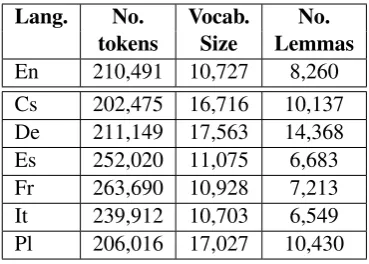
[image:3.595.324.509.61.193.2]En 210,491 10,727 8,260 Cs 202,475 16,716 10,137 De 211,149 17,563 14,368 Es 252,020 11,075 6,683 Fr 263,690 10,928 7,213 It 239,912 10,703 6,549 Pl 206,016 17,027 10,430
Table 1: Data statistics for each language.
sentences are translated into several languages (30K to 410K translations per language) with Au-todesk’s in-house MT system (Zhechev, 2012) and post-edited by professional translators.
Our experiments are run on six language pairs having English as source and Czech, German, Spanish, French, Italian and Polish as target. To set up our controlled environment, we extract all the (source,MT output,post-edition) triplets shar-ing the same source (En) sentences across all lan-guage pairs. Table 1 provides some statistics about the resulting tri-parallel corpora. After random shuffling the triplets, we create training (12.2K triplets), development (2K) and test data (2K) sharing exactly the same source sentences across languages. Training and evaluation of our APE systems are performed on true-case data.
To guarantee similar experimental conditions in the six language settings, we also train compara-ble target language models from external data (in-deed, the 12.2K post-edits would not be enough to train reliable LMs). We build our LMs from approximately 2.5M translations of the same En-glish sentences collected from Europarl (Koehn, 2005), DGT-Translation Memory (Steinberger et al., 2012), JRC Acquis (Steinberger et al., 2006), OPUS IT (Tiedemann, ) and other Autodesk data common to all languages.
cor-MT Baseline Method 1 Method 2 Oracle
TER TER ∆ % Reduction TER ∆ % Reduction TER
En-De 46.46 43.07 -3.39 7.3 42.79∗ -3.67 7.9 40.17
En-Cs 44.06 39.38 -4.68 10.62 39.10∗ -4.96 11.25 36.32
En-Pl 43.02 38.24 -4.78 11.11 37.75∗ -5.27 12.25 35.05
En-It 34.44 30.43 -4.01 11.64 30.13∗ -4.31 12.55 28.33
En-Fr 32.76 29.70 -3.06 9.34 29.51 -3.25 9.92 27.12
[image:4.595.76.525.62.176.2]En-Es 30.90 26.69 -4.21 13.62 26.35∗ -4.55 14.72 24.34
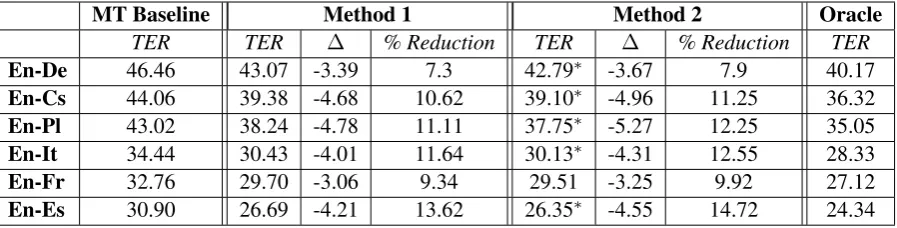
Table 2: Performance of the MT baseline and the APE methods for each language pair. Results for Method 2 marked with the “∗” symbol are statistically significant compared to Method 1.
rect version.6 This can be either a reference trans-lation created independently from the MT out-put (TER) or a human post-edition obtained by manually correcting the MT output (HTER). For the sake of simplicity, henceforth we will use the term TER to refer to both situations (though, when measuring the distance between the MT output and its human post-edition the actual metric is the HTER).
Baseline. Similar to all previous works on APE, our baseline is the MT outputas is. Hence, base-line scores for each language pair correspond to the TER computed between the original MT out-put (produced by the “black-box” Autodesk in-house system) and the human post-edits.
4 Results
Table 2 lists our results, with language pairs or-dered according to the respective baseline TER. The positive answer toQ1(“Does APE yield con-sistent improvements to MT output?”) is evident: both APE methods consistently improve MT qual-ity on all language pairs. TER reductions range from 3.06 to 5.27 points. Quality improvements are statistically significant atp < 0.05, measured by bootstrap test (Koehn, 2004).
In answer toQ2(“What is the relation between original MT quality and APE results?”), our con-trolled experiments evidence for the first time in APE research that the higher the MT quality, the higher is the improvement, i.e. percentage of er-ror reduction, yielded by the APE methods. On one side, this interesting result may seem counter-intuitive because a larger room for improvement
6Edit distance is calculated as the number of edits (word insertions, deletions, substitutions, and shifts) divided by the number of words in the correct translation. Lower TER/HTER values indicate better MT quality.
is expected for sentences of poor quality. On the other side, it reveals that learning from (and cor-recting) noisy data affected by many errors is par-ticularly difficult for statistical APE methods. This finding is violated by En-Fr, for which a reason-ably good MT quality does not induce a gain in performance comparable to language pairs featur-ing similar MT TER (En-It and En-Es). On fur-ther analysis of the data, we notice that all the tar-get languages except French keep a coherent be-haviour with respect to the domain-specific En-glish terms, which are always either preserved (It) or translated (other languages). Instead, French shows an alternation between the two conducts. One example is the English word “workflow”, which appears in the French post-editions bothas is(21 sentences) and translated into “flux de tra-vail” (34 sentences). In contrast, in the other lan-guage directions all the occurrences of ‘workflow” are either translated or kept in English. These fre-quent ambiguities are difficult to manage (espe-cially if the two forms occur a similar number of times in the training data), and might motivate the smaller quality gains observed on En-Fr compared to the other language pairs.
In answer toQ3(“Which method has the high-est potential?”), we observe slight TER reduc-tions when moving from Method 1 to its “context-aware” variant.7 Although small (from 0.19 to 0.49 TER points), such gains are statistically sig-nificant (p < 0.05), except for En-Fr (p < 0.07). This suggests that linking the MT words to the source terms can help to recover adequacy errors that are out of the reach of Method 1.
To better understand to what extent the two methods behave differently, we calculated the re-sults of anOraclesystem, similar to the one
posed by Rubino et al. (2012), defined by se-lecting for each test sentence the best post-edit (lower TER) produced by two approaches. As shown in the last column of Table 2, such an ora-cle achieves a significant TER reduction (from 1.8 to 2.78 points) for all the language pairs. We inter-pret such gains as clues of a possible complemen-tarity between the two methods, which is worth to investigate.
As mentioned in Section 2.2, an advantage of Method 1 is its robust estimation of translation pa-rameters. In contrast, by exploiting contextual in-formation from the source, Method 2 is more pre-cise but potentially affected by data sparsity issues due to its highly increased vocabulary. In an at-tempt to use a less sparse model at the level of word alignment, we trained a SMT system based on the context-aware representation of Method 2 (f0#e), but with word alignment computed on the
representation of Method 1 (f0). Applying this
method to the three language pairs for which the two original methods achieved the lowest TER re-ductions (i.e.En-De, En-Fr and En-Cs) shows that this simple way to combine Methods 1 and 2 is able to produce a TER decrement of 0.75 (42.04) for En-De, 0.60 (38.50) for En-Cs and 0.53 (28.98) for En-Fr. This seems to validate our intuition about the possible complementarity of Methods 1 and 2, suggesting a promising direction for future work.
5 Conclusions
We explored the “planet of the APEs” in ideal conditions (quantity and quality of data) and with the right equipment (state-of-the-art meth-ods). The data available (the same English sen-tences, machine-translated in six languages and post-edited by professional translators) allowed us to compare for the first time different approaches in a fair setting (our first contribution). The two methods we analysed allowed us to measure con-sistent improvements on all language pairs (TER reductions from 7.3% to 14.7% – second contri-bution), and to observe interesting relations be-tween the extent of the gain and the original MT output quality (the higher the quality, the higher the gain yield by APE –third contribution). This first study represents a good starting point for fu-ture quests. A promising direction to explore is the possible complementarity between the two meth-ods and the room for mutual improvement. Now
we just have a glimpse of the path (higher ora-cle results, slight gains with a first combination method –fourth contribution), but positive prelim-inary results confirm its existence.
To encourage the replication of our exper-iments by other researchers and the reuse of the selected Autodesk data for benchmark-ing purposes in the same settbenchmark-ing, the scripts developed in this work have been publicly re-leased. They can be downloaded from: https: //bitbucket.org/turchmo/apeatfbk/
src/master/papers/ACL2015/.
Acknowledgements
This work has been partially supported by the EC-funded H2020 project QT21 (grant agreement no. 645452). The work of Marion Weller was sup-ported by the FBK-HLT Summer Internship Pro-gram 2014. The authors would like to thank Dr. Ventsislav Zhechev for his support with the Au-todesk Post-Editing Data corpus.
References
Jeffrey Allen and Christopher Hogan. 2000. To-ward the Development of a Post Editing Module for Raw Machine Translation Output: A Controlled Language Perspective. InThird International Con-trolled Language Applications Workshop (CLAW-00), pages 62–71.
Hanna B´echara, Yanjun Ma, and Josef van Genabith. 2011. Statistical Post-Editing for a Statistical MT System. InProceedings of the 13th Machine Trans-lation Summit, pages 308–315, Xiamen, China, September.
Hanna B´echara, Rapha¨el Rubino, Yifan He, Yanjun Ma, and Josef Genabith. 2012. An Evaluation of Statistical Post-Editing Systems Applied to RBMT and SMT Systems. In Proceedings of COLING 2012, pages 215–230, Mumbai, India.
Qin Gao and Stephan Vogel. 2008. Parallel Implemen-tations of Word Alignment Tool. InProceedings of the ACL 2008 Software Engineering, Testing, and Quality Assurance Workshop, pages 49–57, Colum-bus, Ohio.
Kenneth Heafield. 2011. KenLM: Faster and Smaller Language Model Queries. In Proceedings of the EMNLP 2011 Sixth Workshop on Statistical Ma-chine Translation, pages 187–197, Edinburgh, Scot-land, United Kingdom.
Pierre Isabelle, Cyril Goutte, and Michel Simard. 2007. Domain Adaptation of MT Systems through Automatic Post-editing. In Proceedings of the Eleventh Machine Translation Summit (MT Summit XI), pages 255–261, Copenhagen, Denmark. Kevin Knight and Ishwar Chander. 1994. Automated
Postediting of Documents. In Proceedings of the 12th National Conference on Artificial Intelligence, pages 779–784, Seattle, WA, USA.
Philipp Koehn, Hieu Hoang, Alexandra Birch, Chris Callison-Burch, Marcello Federico, Nicola Bertoldi, Brooke Cowan, Wade Shen, Christine Moran, Richard Zens, Chris Dyer, Ondrej Bojar, Alexandra Constantin, and Evan Herbst. 2007. Moses: Open Source Toolkit for Statistical Machine Translation. In Proceedings of the 45th Annual Meeting of the Association for Computational Linguistics Compan-ion Volume Proceedings of the Demo and Poster Ses-sions, pages 177–180, Prague, Czech Republic. Philipp Koehn. 2004. Statistical Significance Tests for
Machine Translation Evaluation. InProceedings of EMNLP 2004, pages 388–395, Barcelona, Spain. Philipp Koehn. 2005. Europarl: A Parallel Corpus for
Statistical Machine Translation. In Proceedings of the Tenth Machine Translation Summit (MT Summit X), pages 79–86, Phuket, Thailand, September.
Antonio L. Lagarda, Vicent Alabau, Francisco Casacu-berta, Roberto Silva, and Enrique D´ıaz-de Lia˜no. 2009. Statistical Post-editing of a Rule-based Ma-chine Translation System. InProceedings of Human Language Technologies: The 2009 Annual Confer-ence of the North American Chapter of the Associa-tion for ComputaAssocia-tional Linguistics, pages 217–220. Antonio L. Lagarda, Daniel Ortiz-Mart´ınez, Vicent Al-abau, and Francisco Casacuberta. 2014. Translat-ing without in-domain Corpus: Machine Transla-tion Post-editing with Online Learning Techniques. Computer Speech & Language.
Franz Josef Och. 2003. Minimum Error Rate Training in Statistical Machine Translation. InProceedings of the 41st Annual Meeting on Association for Com-putational Linguistics - Volume 1, ACL ’03, pages 160–167, Sapporo, Japan.
Kristen Parton, Nizar Habash, Kathleen McKeown, Gonzalo Iglesias, and Adri`a de Gispert. 2012. Can
Automatic Post-Editing Make MT More Meaning-ful? In Proceedings of the 16th Conference of the European Association for Machine Translation (EAMT), pages 111–118, Trento, Italy.
Rudolf Rosa, David Mareˇcek, and Ondˇrej Duˇsek. 2012. DEPFIX: A System for Automatic Correc-tion of Czech MT Outputs. In Proceedings of the Seventh Workshop on Statistical Machine Transla-tion, WMT ’12, pages 362–368, Montreal, Canada. Rudolf Rosa, David Marecek, and Ales Tamchyna.
2013. Deepfix: Statistical Post-editing of Statistical Machine Translation Using Deep Syntactic Analy-sis. In Proceedings of the ACL 2013 Student Re-search Workshop, pages 172–179, Sofia, Bulgaria. Rapha¨el Rubino, St´ephane Huet, Fabrice Lef`evre, and
Georges Lenar´es. 2012. Statistical Post-Editing of Machine Translation for Domain Adaptation. In Proceedings of the European Association for Ma-chine Translation (EAMT), pages 221–228, Trento, Italy.
Michel Simard, Cyril Goutte, and Pierre Isabelle. 2007. Statistical Phrase-Based Post-Editing. In Proceedings of the Annual Conference of the North American Chapter of the Association for Compu-tational Linguistics (NAACL HLT), pages 508–515, Rochester, New York.
Matthew Snover, Bonnie Dorr, Richard Schwartz, Lin-nea Micciulla, and John Makhoul. 2006. A Study of Translation Edit Rate with Targeted Human An-notation. InProceedings of Association for Machine Translation in the Americas, pages 223–231, Cam-bridge, Massachusetts, USA.
Ralf Steinberger, Bruno Pouliquen, Anna Widiger, Camelia Ignat, Tomaz Erjavec, Dan Tufis, and Dniel Varga. 2006. The JRC-Acquis: A Multilingual Aligned Parallel Corpus with 20+ Languages. In Proceedings of the 5th International Conference on Language Resources and Evaluation (LREC’2006), Genoa, Italy.
Ralf Steinberger, Andreas Eisele, Szymon Klocek, Spyridon Pilos, and Patrick Schl¨uter. 2012. DGT-TM: A Freely Available Translation Memory in 22 Languages. In Proceedings of the Eight Interna-tional Conference on Language Resources and Eval-uation (LREC’12), Istanbul, Turkey.
J¨org Tiedemann. Parallel Data, Tools and Interfaces in OPUS. InProceedings of the Eight International Conference on Language Resources and Evaluation (LREC’12), pages 2214–2218, Istanbul, Turkey. Ventsislav Zhechev. 2012. Machine Translation