• No results found

SYNTHESIS, CHARACTERIZATION, MOLECULAR DOCKING OF SOME NOVEL BENZOFURAN CHALCONE DERIVATIVES AND THEIR EVALUATION OF INVITRO ANTI CANCER ACTIVITY

N/A
N/A
Protected

Academic year: 2020

Share "SYNTHESIS, CHARACTERIZATION, MOLECULAR DOCKING OF SOME NOVEL BENZOFURAN CHALCONE DERIVATIVES AND THEIR EVALUATION OF INVITRO ANTI CANCER ACTIVITY"

Copied!
14
0
0

Loading.... (view fulltext now)

Full text

(1)

SYNTHESIS, CHARACTERIZATION, MOLECULAR DOCKING OF

SOME NOVEL BENZOFURAN CHALCONE DERIVATIVES AND

THEIR EVALUATION OF INVITRO ANTI CANCER ACTIVITY

1

*Kathiravan M., 2Umarani G. and 3Abdul Hassan Sathali

Department of Pharmaceutical Chemistry, College of Pharmacy, Madurai Medical College,

Madurai—625020.

ABSTRACT

A series of Novel benzofuran chalcone derivatives have been

synthesised in multiple steps with the suitable claisen schmidt

condensation reaction procedures and then well characterized by

various analytical techniques. All the synthesised compounds were

evaluated for their invitro anticancer activity against two human cell

lines includes Human breast cancer cells (MCF-7) and human liver cell

lines (HepG2) at various concentrations. The results were shown in

terms of percentage cell viability reduction and IC50 values. Amoung

all the five synthsesied compounds, Compounds 5a and 5b has showed

potent activity against breast cancer cells (MCF-7) And the

synthesised compounds 5c and 5d has showed significant activity

against Liver cells (HepG2). Furthermore, the structure and anticancer activity relationship

was supported by molecular docking study of the major potent compounds 5a, 5b and 5c.The

compounds 5a, 5b and 5c were dock against the two major target proteins. The PDB id of

1MOX (lung cancer) and 2DSQ (breast epithelian cancer) were selected and obtained from

protein data bank (PDB) selected for INSILICO study and the protein-ligand binding site was

analysed and visualized. Its results majorly compounds 5a and 5b are the best binding pose

with targets.

KEYWORDS: Benzofuran chalcone derivatives, Claisen schmidt condensation reaction,

Invitro- anticancer activity, Insilico molecular docking study.

Volume 8, Issue 10, 749-762. Research Article ISSN 2277– 7105

Article Received on 16 June 2019,

Revised on 07 July 2019, Accepted on 28 July 2019

DOI: 10.20959/wjpr201910-15332

*Corresponding Author

Kathiravan M.

Department of

Pharmaceutical Chemistry,

College of Pharmacy,

Madurai Medical College,

(2)

INTRODUCTION

Cancer is one of the leading causes of death worldwide, accounting for death of 82 lakh

people in the year 2012. Top three death-causing cancers are lung cancer, liver cancer, and

stomach cancer which killed 15.9 lakh, 7.45 lakh, and 7.23 lakh people, respectively, in the

same year. On gender-wise, lung cancer is the leading cause of deaths in males while breast

cancer in females, killing 10 lakh males and 5.21 lakh females in single year, respectively.

In India, 6.82 lakh people died because of various types of cancer during the same period, of

which 48,697 males and 70,218 females died because of lung cancer and breast cancer,

respectively. Worldwide, lung cancer is the foremost cause of cancer-related deaths, whereas

in India, breast cancer is the topmost cause. Higher incidence of lung cancer can be accrued

to increased air pollution or smoking while the reasons for breast cancer in India are late

diagnosis due mainly to lack of awareness on early detection, barriers to health services or

change in lifestyle such as obesity, late pregnancy, hormone replacement therapy, and lower

lifetime duration of breast feeding.[1]

Chalcones an important intermediate of flavonoid synthetic pathway, has been shown to

exhibit diverse biological and pharmacological activities. Chalcones are unsaturated ketone

containing the reactive keto ethylenic group –CO CH=CH. These are coloured compounds

because of the presence of chromophore. Chalcones are also called as benzalacetophenone or

benzylidine acetophenone or phenyl styryl ketone. Chalcone derivative have wide variety of

biological activities reported for these compounds include anti-inflammatory, anti-fungal,

antibacterial, antimalarial and antitumor activity.[2]

Benzofuran derivatives are an interesting class of heterocyclic compounds. Benzofuran

derivatives are of great interest in medicinal chemistry and have drawn remarkable attention

due to their biological activities with chemotherapeutic properties. Some benzofurans

bearing various substituents at the C-2 position are greatly distributed in nature; for example,

ailanthoidol, a neolignan derivative, has been reported to have antiviral, antioxidant, and

antifungal activities. Furthermore, most of the compounds prepared from 2- acetylbenzofuran

have antimicrobial, anticancer, antitumor, anti-inflammatory, and antitubulin activities and

(3)

Molecular Docking

Molecular docking provides useful information about drug receptor interactions. It analyzes

the binding orientation of small molecule drug candidates to their protein targets in order to

predict the affinity and activity of the small molecule.

Docking is considered to be a powerful simulation of the molecular recognition process. It is

used to illustrate the probable molecular interaction of a designed ligand with the protein of

interest, predict the affinity and activity of the ligand, and identify the energy of the

interaction between the ligand and protein. It is an invaluable tool in the field of molecular

biology, computational structural biology, computer-aided drug designing, and

pharmacogenomics.

In present work, we describe the synthesis of Benzofuran chalcone derivatives (5a-e). in

addition to this, all these compounds were evaluated for their invitro anticancer against 2

cells, viz Human breast carcinoma (MCF-7) and Human lung cancer (Hep G2) was

performed at various concentrations. The results of cell viability interms of IC50 values.

Furthermore, all these pharmacologically effective compounds were explored for molecular

docking studies.

MATERIALS AND METHODS

2.1 Materials: All the reagents and solvents purchased from commercially available sources

dimethyl sulfoxide (DMSO) fetal bovine serum (FBS) and DMEM (Dulbecco’s Modified

Eagle Medium). Double distilled water as used at all stages of experiments. Samples of

chalcone compounds for testing were prepared at various concentrations. Analytical TLC was

performed on Merck Silica Gel Precoated plates and visualization by I2 Vapours/UV light.

2.2Characterization Techniques: Melting points were determined in open capillary tubes on

ce100 labtronics. NMR spectra were determined on a Bruker AC 400 (400MHz)

spectrometer with tetramethylsilane (TMS) as the internal standard in DMSOd6 or CDCl3 as

solvents. FT-Infrared (FT-IR) spectra were recorded as KBr pellets on a Perkin-Elmer

Spectrum One FTIR spectrometer.

Synthesis of 1-(1-benzofuran-2-yl)ethanone

A mixture of salicylaldehyde (1g, 4.97mmol) and potassium carbonate (0.69 g, 4.97mmol) in

(4)

and then chloroacetone (4 mL, 4.97mmol) was added dropwise. Reaction mixture was stirred

at room temperature for ten minutes and then refluxed. Progress of the reaction was

monitored by TLC. Upon completion, the reaction mixture was poured on crashed ice. The

precipitated solid was filtered, washed with water, and dried. The product was crystallized

from ethanol.[23]

General Procedure for Synthesis of Chalcones (5a–e)

A solution of 1-(1-benzofuran-2-yl) ethanone (1 g, 4.18mmol) and Benzaldehyde (4.18mmol)

in MeOH (10 mL) was cooled at 0–5⁰C and then 6mL of aqueous NaOH (1 mol/L) was added

to this solution and stirred at room temperature for 3 hours. The reaction mixture was poured

on crushed ice. The precipitated solid was filtered after neutralization with diluted HCl and

was washed several times with water and then dried. The product was recrystallized from

ethanol.[4]

(2E)-1-(1-benzofuran-2-yl)-3-phenylprop-2-en-1-one (5a). Yield: 74%; M.p. 146∘C; FT-IR

(KBr, cm−1): 1566(C=O), 1647 (C=C); 1H-NMR (400MHz, DMSO-d6), ppm:7.79 (s, 1H,

5-H), 8.12 (s, 1H, 7-5-H), 7.92–7.84 (m, 4H, 13-H, 17-H, 10-H, 11-5-H), 7.84–7.65 (m, 2H, 3-H,

2-H), 7.65–7.40 (m, 3H, 16-H, 15-H, 14-H); 13C-NMR (400MHz, DMSO-d6): 178.96, 154.59,

154.55, 144.46, 134.76, 131.63, 131.46, 129.64, 129.50, 129.46, 126.49, 122.18, 116.77,

114.88, 114.56.

(2E)-1-(1-benzofuran-2-yl)-3-(4-chlorophenyl)prop-2-en-1-one (5b). Yield: 76%; M.p.

149∘C; FT-IR (KBr, cm−1): 1658 (C=O), 1652 (C=C); 1H-NMR (400MHz, DMSO-d6),

ppm: 8.29 (s, 1H, 5-H), 8.15 (s, 1H, 7-H), 8.00– 7.62 (m, 8H, 3-H, 2-H, 17-H, 16-H, 14-H,

13-H, 10-H, 11-H); 13C-NMR (400MHz, DMSO-d6): 178.90, 154.58, 154.52, 143.18,

134.04, 132.47, 131.78, 131.68, 131.43, 129.62, 126.59, 124.98, 122.87, 116.84, 114.98.

(2E)-1-(1-benzofuran-2-yl)-3-(4-nitrophenyl)prop-2-en-1-one (5c). Yield: 72%; M.p.

154∘C; FT-IR (KBr, cm−1): 1577 (C=O), 1650 (C=C); 1H-NMR (400MHz,DMSO-d6), ppm:

8.78 (s, 1H, 5-H), 8.37–8.27 (m, 13-H, 15-H, 17-H), 8.13 (s, 1H, 7-H), 8.08 (d, 1H, 𝐽 =

15.6Hz, 11-H), 7.92 (d, 1H, 𝐽 = 16Hz, 10-H), 7.78–7.68 (m, 3H, 3-H, 2-H, 16-H); 13C-NMR

(400MHz, DMSO-d6): 178.73, 154.67, 154.40, 148.95, 141.86, 136.66, 135.70, 131.87,

(5)

(2E)-1-(1-benzofuran-2-yl)-3-(4-nitrophenyl)prop-2-en-1-one (5d). Yield: 69%; M.p.

138∘C; FT-IR (KBr, cm−1): 1566 (C=O), 1658 (C=C); 1H-NMR (400MHz, DMSO-d6),

ppm: 8.10 (s, 2H, 5-H, 7-H), 7.78–7.5 (m, 6H, 3-H, 2-H, 13-H, 17-H, 10-H, 11-H), 6.77 (d,

1H,𝐽 = 2.8Hz, 14-H), 6.75 (d, 1H, 𝐽 = 3.6Hz, 16-H), 3.02 (s,6H, CH3); 13C-NMR (400MHz,

DMSO-d6): 178.52, 155.35, 154.31, 152.75, 145.69, 131.61, 131.10, 129.85, 126.24,

122.00,116.64, 115.98, 114.83, 112.98, 112.22, 40.56–39.31.

(2E)-1-(1-benzofuran-2-yl)-3-(4-hydroxy-3-methoxyphenyl)prop-2-en-1-one (5e). Yield:

65%; M.p. 144∘C; FT-IR (KBr, cm−1): 1604 (C=O), 3400 (C-OH); 1H-NMR (400MHz,

DMSO-d6), ppm:8.03–7.96 (m, 3H, 5-H, 7-H, 15-H), 7.74–7.62 (m, 3H, 3-H, 2-H, 11-H),

7.55–7.40 (d, 1H, 𝐽 = 15.2Hz, 10-H), 7.14 (s, 1H, 13-H), 6.71 (s, 1H, 14-H); 13C-NMR

(400MHz, DMSO-d6):178.56, 154.54, 154.41, 151.34, 147.15, 131.48, 130.78, 129.65,

126.37, 118.73, 118.50, 116.72, 114.85, 114.57, 113.77.

2.3 Invitro Anticancer Activity

Principle

MTT, a yellow tetrazole, is reduced to purple formazan in living cells. A solubilization

solution (usually either dimethyl sulfoxide, an acidified ethanol solution, or a solution of the

detergent sodium dodecyl sulfate in diluted hydrochloric acid) is added to dissolve the

insoluble purple formazan product into a colored solution. The absorbance of this colored

solution can be quantified by measuring at a certain wavelength (usually between 500 and

600 nm) by a spectrophotometer. The degree of light absorption depends on the solvent.

Tetrazolium dye reduction is dependent on NAD(P)H-dependent oxido reductase enzymes

largely in the cytosolic compartment of the cell. Therefore, reduction of MTT and other

tetrazolium dyes depends on the cellular metabolic activity due to NAD(P)H flux. Cells with

a low metabolism such as thymocytes and splenocytes reduce very little MTT. In contrast,

(6)

MTT Assay Method

The MTT assay is a standard colorimetric non-radioactive assay for measuring viable cell and

cytotoxicity through increased metabolism of the tetrazolium salt. Cancer cells (1 x 10⁻⁵

cells/ml) were seeded into 96 well plates and incubated for 24 hours incubation. Then the

cells were treated with different concentration of drug formulation (10-200µg/ml). then, the

cells were incubated in the presence of 5% CO2 at 37⁰C for 24 hours. After incubation, MTT

(0.5 mg/mL) was added to the incubated cells. Then cells were incubatedfor another 4 hours.

Then 100µL of DMSO were added into each well and mixed well. Absorbance was measured

in a multimode reader at 570 nm.[3]

2.4 Insilico Docking Analysis

Geometry optimized molecular structures for all synthesized derivatives were obtained using

AUTODOCK 4.0 (A Generic Evolutionary Method for molecular docking) automated

docking program. AUTODOCK 4.0 is software used for integrated structure based virtual

screening, molecular docking, post screening analysis and visualization step. The

3-dimension (3D) coordinates of four cancer target proteins were selected and obtained from

protein data bank (PDB). The PDB id of 1MOX (lung cancer) and 2DSQ (breast epithelian

cancer) were selected for INSILICO study. The 3D structure coordinates of each therapeutic

target protein and ligand molecules were implemented through the AUTODOCK 4.0

graphical environment interface. Before doing docking analysis, the output path was set.

AUTODOCK 4.0.

RESULT AND DISCUSSION

3.1 Chemistry: The synthetic route for the desired

(2E)-1-benzofuran-2-yl)-3-phenylprop-2-en-1-one derivatives (5a-e) were summarized in scheme. The synthetic compound derivatives

were constructed b commerciall available salic laldeh de ( ) and chloroacetone ( ) in

presence of Sodium carbonate at C for one hour it forms ( ) The intermediate compound ( ) with aromatic aldeh de ( a) in presence of methanol was cooled at - C and then ml of

aqueous NaOH at room temperature for 3 hours upon claisen Schmidt condensation reaction

(7)

SCHEME STEP 1 O OH O CH3 Cl 2-hydroxybenzaldehyde 1-chloropropan-2-one

O CH3

O

1-(1-benzofuran-2-yl)ethanone

NaCO3 25 o

C For 1 hours then 0-5oC

(1) (2) (3)

STEP-2 O CH3 O 1-(1-benzofuran-2-yl)ethanone

+

O R2 R1 O O R2 R1

CH3OH at 0-5 o

C

Aq.NaOH Stirred for 3 hours

Aromatic aldehyde

(3) (4) (5a-e)

SUBSTITUTIONS

COMPOUND R1 R2

3a H H

3b H Cl

3c H OCH3

3d H NO2

3e CH3 OH

Scheme: Conditions (1) NaCO3 for 1 hr then reflux (2) CH3OH with aqueous NaOH stirred

for 3hrs at RT.

3.2 Structural Characterization: All the synthesized compounds were confirmed by

analytical and spectroscopic data. In the FT-IR spectra of the compounds (5a-e) were showed

characteristic bands between 1564 and 1604 cm-1 (C=O Stretching at chalcone) and between

1647 1nd 1658 cm-1 (C=C Strectching at chalcone). The compound (5a-e) confirmed by

representative signals in 1H NMR, observed at 8.29-8.03 ppm(B3-H at Benzofuran ring) and

at 7.80-7.40 ppm (α-H and β-H of chalcone moiety) The carbonyl carbon was observed at

about 178ppm in the 13C NMR Spectra of 5a-e.These were further confirmed by mass

(8)

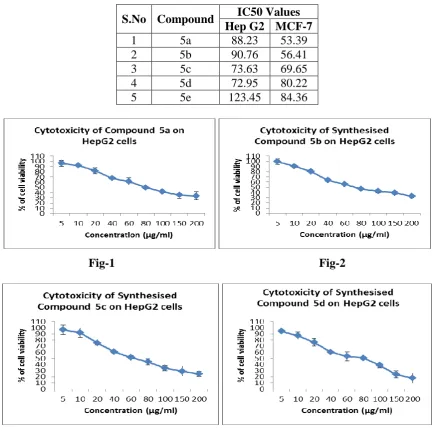
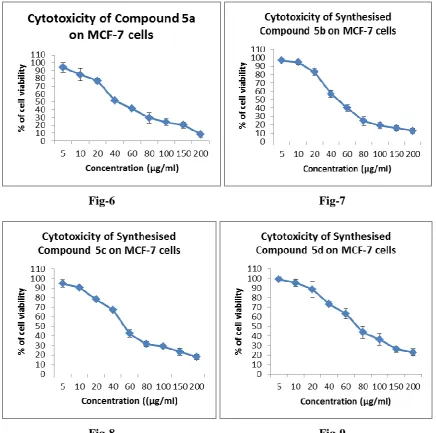
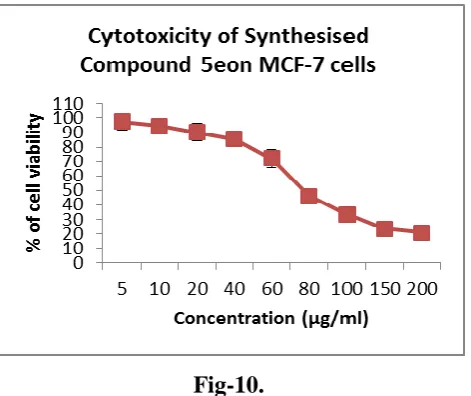
3.3. Anticancer Activity: synthesized novel benzofuran chalcone derivatives 5a-e were

evaluated for their invitro anticancer activity against a panel of Human breat cancer and lung

cancer cell lines MCF-7 and Hep G2 By MTT Colorimetric assay as per ATCC protocol and

the results were performed in table-1 as percentage of inhibition and interms of IC50 Values.

Cell viability of all the two human cell lines were also presented separately as shown in Fig

1-5 demonstrates cell viability on Hep G2; Fig 6-10 reveals the cell viability on MCF-7 cells

at various concentrations.

From the results, the synthesized compound 5a and 5b were potent activity against breast

cancer cells (MCF-7) and the synthesized compound 5c and 5d shown significant activity

against liver cells (Hep G2).

Table 1.

S.No Compound IC50 Values

Hep G2 MCF-7

1 5a 88.23 53.39

2 5b 90.76 56.41

3 5c 73.63 69.65

4 5d 72.95 80.22

5 5e 123.45 84.36

Fig-1 Fig-2

[image:8.595.80.515.323.758.2]
(9)
[image:9.595.179.420.74.261.2]

Fig-5.

Fig 1-5: Invitro anticancer activity of compounds 5a-e measured by MTT Aaasay on

Human lung cancer (Hep G2) with various concentrations for 48 hours.

Fig-6 Fig-7

[image:9.595.80.517.323.756.2]
(10)
[image:10.595.183.419.70.268.2]

Fig-10.

Fig 6-10: Invitro anticancer activity of compounds 5a-e measured by MTT Aaasay on

Human breast cancer (MCF-7) with various concentrations for 48 hours.

Docking studies

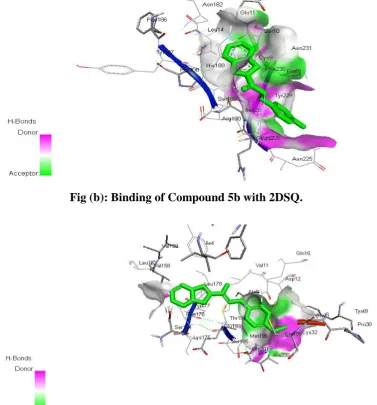
From the docking studies, the PDB id of 1MOX (Lung cancer) and 2DSQ (Breast epithelium

cancer) were selected and obtained from protein data bank (PDB), In the post docking

screening the best binding pose and total energy of each ligand was analysed and visualized.

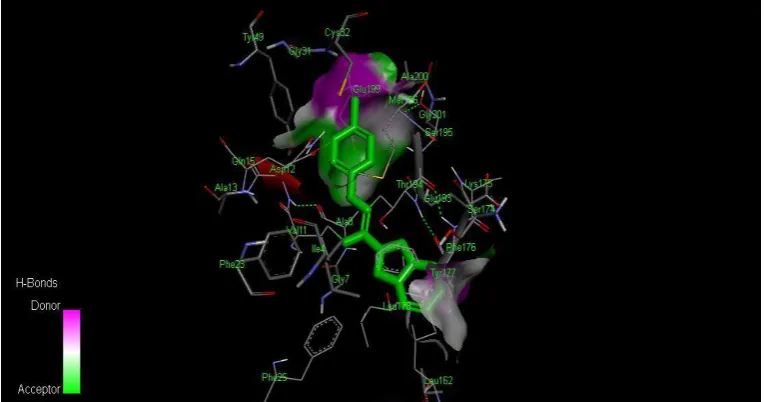
Its results majorly compounds 5a and 5b are the best binding pose with targets. Fig A, B,C

represents the docking poses with ligand interaction diagram of compound 5a,5b,5c

molecules in the target of 1MOX (Lung cancer) Fig D, E,F represents the docking poses with

ligand interaction diagram of compound 5a,5b,5c molecules in the target of 2DSQ (Breast

epithelial cancer) And the docking scores with binding energies were given in table 2 & 3.

[image:10.595.250.465.527.700.2]
(11)

Fig (b): Binding of Compound 5b with 2DSQ.

Fig (c): Binding of Compound 5c with 2DSQ.

[image:11.595.115.446.83.271.2] [image:11.595.111.489.90.496.2] [image:11.595.104.490.550.743.2]
(12)

Fig (e): Binding of Compound 5b with 1MOX.

Fig (f): Binding of Compound 5c with 1MOX.

Table 2: With Breast epithelian cancer-2DSQ.

Compound Target protein Binding energy

5a 2DSQ -10.63

5b 2DSQ -7.14

5c 2DSQ -6.83

Table 3: With Lung cancer-1MOX.

Compound Target protein Binding energy

5a 1MOX -6.13

5b 1MOX -10.74

[image:12.595.107.490.73.274.2] [image:12.595.105.489.319.543.2]
(13)

CONCLUSION

A series of novel (2E)-1-(1-Benzofuran-2-yl)-3-phenyl prop-2-en-1-one and derivatives were

synthesized and well characterized by using various spectral techniques. All the synthesized

compounds were examined for their anticancer activity against human cell lines viz (HepG2

and MCF-7) at various concentrations and the results were performed by means of cell

viability. Among all the compounds, Compound 5a, 5b and 5c showed potent activity against

MCF-7 and compound 5c and 5d showed significant activity against HepG2. Based on the

anticancer activity, docking and molecular design studies, the synthesized molecule can be

considered as promising lead molecules for the development of new anticancer medicines.

ACKNOWLEDGEMENT

The authors are greatful to The principal, college of pharmacy, Madurai medical college,

Madurai-20 for providing lab facilities and encouraging ideas and also thankful to my

eminent guide

Funding: The Tamilnadu Pharmaceutical Science Welfare Trust for providing fellowship

award and financial support.

REFERENCES

1. S.D. Tala, P.B. Vekariya, R.M. Gheti a and joshi ‖s nthesis and biological stud of some

new chalcone and pyrazole derivatives. Indian journal of chemistry, 2013; 52b: 807-809.

2. Studies on some heterocyclic entities, Part-IV, studies on chalcones., 85-109.

3. Jaya Seema D.M, Saifullah B, Selvanayagam M, Subbaih Sk, Mohd Esa N, Arulselvan P,

Designing Of The Anticancer nanocomposite with sustained release properties by using

graphene ocide nano carrier. Pharmaceutics, aug 1, 2018: 10(3): 109.

4. Demet coskun and Mechmet faith Coskun ―S nthesis, Characterisation and Anticancer

activit of New Benzofuran substituted Chalcones,‖Journal of Chemistr , Hindawi

publishing corporation, article ID 7678486, 2016; 8.

5. R.S.Myers, MEDCH,401, Spring, 2006; 1-16

6. Phrmacological Significance of Synthetic Heterocycles Scaffold: A Review Rajiv

Duatal., Advances in Biological Research, 2011; 5(3): 120-144.

7. Y.-L. Chen, S.-Z. Lin, J.-Y Chang et al , ―In vitro and in vivo studies of a novel potential

anticancer agent of isochaihulactone on human lung cancer A 9 cells,‖ Biochemical

(14)

8. R Abonia, D Insuast , J Castillo et al , ―S nthesis of novel quinoline-2-one based

chalcones of potential anti-tumor activit ,‖ European Journal ofMedicinal Chemistry,

2012; 57: 29–40.

9. DeSantis, C.; Ma, J.; Bryan, L.; Jemal, A. Breast cancer statistics, 2013. CA Cancer J.

Clin., 2014; 64: 52–62. [CrossRef] [PubMed]

10.Kennedy, M.J.; Donehower, R.C.; Rowinsky, E.K. Treatment of metastatic breast cancer

with combination paclitaxel/cyclophosphamide. Semin. Oncol, 1995; 22: 23–27.

[PubMed]

11.Singh, P.; Anand, A.; Kumar, P. Recent developments in biological activities of

chalcones: A mini review. Eur. J. Med. Chem., 2014; 85: 758–777.

12.Zhuang, C.; Zhang, W.; Sheng, C.; Zhang, W.; Xing, C.; Miao, Z. Chalcone: A privileged

structure in medicinal chemistry. Chem. Rev., 2017; 117: 7762–7810.

13.Aryapour, H.; Riazi, G.H.; Ahmadian, S.; Foroumadi, A.; Mahdavi, M.; Emami, S.

Induction of apoptosis through tubulin inhibition in human cancer cells by new

Figure

Fig-4
Fig-8
Fig-10.
Fig (d): Binding of Compound 5a with 1MOX.
+2

References

Related documents

Legal scholars have agreed on an operational definition for maritime terrorism based on article 3 and 4 of the 1988 Convention for the Suppression of the

The organic acids induced several proteins involved in amino acid biosynthesis, purine and pyrimidine biosynthesis, and cofactor biosynthesis in

The mix design of geopolymer concrete was carried out to test the specimens for the study of compressive strength and durability properties such as Permeability, Shrinkage,

The floating Atenolol tablets were formulated by using HPMC K100M, HPMC K4M, HPMC K15M as the release retardant polymers, and sodium bicarbonate used as a gas generating agent

take blogs, reviews, and tweets as research objects, aiming to extract people’s opinions towards some subjects or products. Usually, people’s opinions are

Kulsum, S; Reddy, R and Durga, Padmalatha M (2012-13), “A simple and validated RP-HPLC method for the simultaneous estimation of Tinidazole and Ciprofloxacin in bulk

added that “‘freedom to associate with others for the common advancement of political beliefs and ideas’ [is] a freedom that encompasses ‘[t]he right to associate with the

According to the characteristic of the parity nodes, we cut down the searching space and storage space in real graphs and random graphs, thereby reducing the computational cost