Improving Vector Space Word Representations
Using Multilingual Correlation
Manaal Faruqui and Chris Dyer Carnegie Mellon University Pittsburgh, PA, 15213, USA {mfaruqui, cdyer}@cs.cmu.edu
Abstract
The distributional hypothesis of Harris (1954), according to which the meaning of words is evidenced by the contexts they occur in, has motivated several effec-tive techniques for obtaining vector space semantic representations of words using unannotated text corpora. This paper ar-gues that lexico-semantic content should additionally be invariant across languages and proposes a simple technique based on canonical correlation analysis (CCA) for incorporating multilingual evidence into vectors generated monolingually. We evaluate the resulting word representations on standard lexical semantic evaluation tasks and show that our method produces substantially better semantic representa-tions than monolingual techniques. 1 Introduction
Data-driven learning of vector-space word embed-dings that capture lexico-semantic properties is a technique of central importance in natural lan-guage processing. Using cooccurrence statistics from a large corpus of text (Deerwester et al., 1990; Turney and Pantel, 2010),1 it is possible
to construct high-quality semantic vectors — as judged by both correlations with human judge-ments of semantic relatedness (Turney, 2006; Agirre et al., 2009) and as features for downstream applications (Turian et al., 2010).
The observation that vectors representing cooc-currence tendencies would capture meaning is ex-pected according to the distributional hypothe-sis (Harris, 1954), famously articulated by Firth 1Related approaches use the internal representations from neural network models of word sequences (Collobert and We-ston, 2008) or continuous bags-of-context wordsels (Mikolov et al., 2013a) to arrive at vector representations that likewise capture cooccurence tendencies and meanings.
(1957) asYou shall know a word by the company it keeps. Although there is much evidence in fa-vor of the distributional hypothesis, in this paper we argue for incorporating translational context when constructing vector space semantic models (VSMs). Simply put: knowing how words trans-late is a valuable source of lexico-semantic infor-mation and should lead to better VSMs.
Parallel corpora have long been recognized as valuable for lexical semantic applications, in-cluding identifying word senses (Diab, 2003; Resnik and Yarowsky, 1999) and paraphrase and synonymy relationships (Bannard and Callison-Burch, 2005). The latter work (which we build on) shows that if different words or phrases in one lan-guage often translate into a single word or phrase type in a second language, this is good evidence that they are synonymous. To illustrate: the En-glish word formsaeroplane, airplane, andplane
are observed to translate into the same Hindi word:
vAyyAn (vaayuyaan). Thus, even if we did not
know the relationship between the English words, this translation fact is evidence that they all have the same meaning.
How can we exploit information like this when constructing VSMs? We propose a technique that first constructs independent VSMs in two lan-guages and then projects them onto a common vector space such that translation pairs (as deter-mined by automatic word alignments) should be maximally correlated (§2). We review latent se-mantic analysis (LSA), which serves as our mono-lingual VSM baseline (§3), and a suite of stan-dard evaluation tasks that we use to measure the quality of the embeddings (§4). We then turn to experiments. We first show that our technique leads to substantial improvements over monolin-gual LSA (§5), and then examine how our tech-nique fares with vectors learned using two dif-ferent neural networks, one that models word se-quences and a second that models bags-of-context
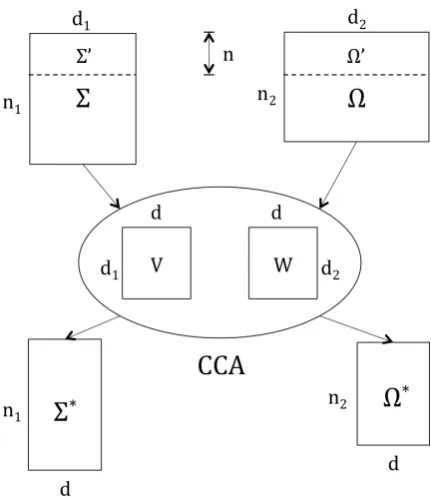
Figure 1: Cross-lingual word vector projection us-ing CCA.
words. We observe substantial improvements over the sequential model using multilingual evidence but more mixed results relative to using the bags-of-contexts model (§6).
2 Multilingual Correlation with CCA To gain information from the translation of a given word in other languages the most basic thing to do would be to just append the given word represen-tation with the word represenrepresen-tations of its transla-tion in the other language. This has three draw-backs: first, it increases the number of dimensions in the vector; second, it can pull irrelevant infor-mation from the other language that doesn’t gen-eralize across languages and finally the given word might be out of vocabulary of the parallel corpus or dictionary.
To counter these problems we use CCA2which
is a way of measuring the linear relationship be-tween two multidimensional variables. It finds two projection vectors, one for each variable, that are optimal with respect to correlations. The dimen-sionality of these new projected vectors is equal to or less than the smaller dimensionality of the two variables.
Let Σ ∈ Rn1×d1 and Ω ∈ Rn2×d2 be vector 2We use the MATLAB module for CCA:http://www. mathworks.com/help/stats/canoncorr.html
space embeddings of two different vocabularies where rows represent words. Since the two vo-cabularies are of different sizes (n1 andn2) and there might not exist translation for every word ofΣinΩ, let Σ0
⊆ Σwhere every word inΣ0
is translated to one other word3 in Ω0
⊆ Ω and Σ∈Rn×d1 andΩ∈Rn×d2.
Letxandybe two corresponding vectors from Σ0
andΩ0
, andvandwbe two projection direc-tions. Then, the projected vectors are:
x0 =xv y0 =yw (1)
and the correlation between the projected vectors can be written as:
ρ(x0,y0) = E[x 0
y0]
p
E[x02]E[y02] (2)
CCA maximizesρfor the given set of vectorsΣ0
andΩ0
and outputs two projection vectors v and
w:
v,w= CCA(x,y)
= arg max
v,w ρ(xv,yw)
(3)
Using these two projection vectors we can project the entire vocabulary of the two languagesΣand Ωusing equation 1. Summarizing:
V,W = CCA(Σ0
,Ω0
) (4)
Σ∗ =ΣV Ω∗ =ΩW (5)
where, V ∈ Rd1×d, W ∈ Rd2×d con-tain the projection vectors and d =
min{rank(V),rank(W)}. Thus, the
result-ing vectors cannot be longer than the original vectors. Since V and W can be used to project the whole vocabulary, CCA also solves the problem of not having translations of a particular word in the dictionary. The schema of performing CCA on the monolingual word representations of two languages is shown in Figure 1.
W in equation 4 are already sorted in descending order of correlation. Therefore in,
Σ∗
k=ΣVk Ω∗k=ΩWk (6) Σ∗kandΩ∗kare now word vector projections along the top k correlated dimensions, where, Vk and
Wkare the column truncated matrices. 3 Latent Semantic Analysis
We perform latent semantic analysis (Deerwester et al., 1990) on a word-word co-occurrence ma-trix. We construct a word co-occurrence frequency matrixF for a given training corpus where each roww, represents one word in the corpus and ev-ery column c, is the context feature in which the word is observed. In our case, every column is a word which occurs in a given window length around the target word. For scalability reasons, we only select words with frequency greater than10
as features. We also remove the top100most fre-quent words (mostly stop words) from the column features.
We then replace every entry in the sparse fre-quency matrix F by its pointwise mutual infor-mation (PMI) (Church and Hanks, 1990; Turney, 2001) resulting in X. PMI is designed to give a high value toxij where there is a interesting rela-tion betweenwi andcj, a small or negative value ofxij indicates that the occurrence ofwi incj is uninformative. Finally, we factorize the matrixX
using singular value decomposition (SVD). SVD decomposesX into the product of three matrices:
X =UΨV> (7)
where, U and V are in column orthonormal form andΨis a diagonal matrix of singular val-ues (Golub and Van Loan, 1996). We obtain a re-duced dimensional representation of words from size|V|tok:
A=UkΨk (8)
wherekcan be controlled to trade off between re-construction error and number of parameters,Ψk is the diagonal matrix containing the topksingular values,Ukis the matrix produced by selecting the corresponding columns fromU andArepresents the new matrix containing word vector representa-tions in the reduced dimensional space.
4 Word Representation Evaluation We evaluate the quality of our word vector repre-sentations on a number of tasks that test how well
they capture both semantic and syntactic aspects of the representations.
4.1 Word Similarity
We evaluate our word representations on four dif-ferent benchmarks that have been widely used to measure word similarity. The first one is the WS-353 dataset (Finkelstein et al., 2001) containing 353 pairs of English words that have been assigned similarity ratings by humans. This data was fur-ther divided into two fragments by Agirre et al. (2009) who claimed thatsimilarity(WS-SIM) and
relatedness(WS-REL) are two different kinds of relations and should be dealt with separately. We present results on the whole set and on the individ-ual fragments as well.
The second and third benchmarks are the RG-65 (Rubenstein and Goodenough, 1965) and the MC-30 (Miller and Charles, 1991) datasets that contain 65 and 30 pairs of nouns respectively and have been given similarity rankings by humans. These differ fromWS-353in that it contains only nouns whereas the former contains all kinds of words. The fourth benchmark is theMTurk-287 (Radinsky et al., 2011) dataset that constitutes of 287 pairs of words and is different from the above two benchmarks in that it has been constructed by crowdsourcing the human similarity ratings using Amazon Mechanical Turk.
We calculate similarity between a given pair of words by the cosine similarity between their corresponding vector representation. We then re-port Spearman’s rank correlation coefficient (My-ers and Well, 1995) between the rankings pro-duced by our model against the human rankings.
4.2 Semantic Relations (SEM-REL)
Mikolov et al. (2013a) present a new semantic re-lation dataset composed of analogous word pairs. It contains pairs of tuples of word relations that follow a common semantic relation. For example, in England : London :: France : Paris, the two given pairs of words follow the country-capital re-lation. There are three other such kinds of rela-tions: country-currency, man-woman, city-in-state and overall8869such pairs of words4.
The task here is to find a word d that best fits the following relationship:a : b :: c : dgivena, b
in Mikolov et al. (2013a) that computes the vector
y=xa−xb+xcwhere,xa,xbandxcare word vectors of a, b andc respectively and returns the vectorxw from the whole vocabulary which has the highest cosine similarity toy:
xw= arg max
xw
xw·y
|xw| · |y|
It is worth noting that this is a non-trivial|V|-way classification task where V is the size of the vo-cabulary.
4.3 Syntactic Relations (SYN-REL)
This dataset contains word pairs that are differ-ent syntactic forms of a given word and was pre-pared by Mikolov et al. (2013a). For exam-ple, in walking and walked, the second word is the past tense of the first word. There are nine such different kinds of relations: adjective-adverb, opposites, comaparative, superlative, present-participle, nation-nationality, past tense, plural nouns and plural verbs. Overall there are10675
such syntactic pairs of word tuples. The task here again is identifying a worddthat best fits the fol-lowing relationship: a : b :: c : d and we solve it using the method described in§4.2.
5 Experiments 5.1 Data
For English, German and Spanish we used the WMT-20115 monolingual news corpora and for
French we combined the WMT-2011 and 20126
monolingual news corpora so that we have around
300million tokens for each language to train the word vectors.
For CCA, a one-to-one correspondence be-tween the two sets of vectors is required. Obvi-ously, the vocabulary of two languages are of dif-ferent sizes and hence to obtain one-to-one map-ping, for every English word we choose a word from the other language to which it has been aligned the maximum number of times7in a
paral-lel corpus. We got these word alignment counts using cdec (Dyer et al., 2010) from the paral-lel news commentary corpora (WMT 2006-10) combined with the Europarl corpus for
English-{German, French, Spanish}.
5http://www.statmt.org/wmt11/ 6http://www.statmt.org/wmt12/
7We also tried weighted average of vectors across all aligned words and did not observe any significant difference in results.
5.2 Methodology
We construct LSA word vectors of length6408for
English, German, French and Spanish. We project the English word vectors using CCA by pairing them with German, French and Spanish vectors. For every language pair we take the top k cor-related dimensions (cf. equation 6), where k ∈
10%,20%, . . .100%and tune the performance on WS-353 task. We then select the k that gives us the best average performance across language pairs, which is k = 80%, and evaluate the cor-responding vectors on all other benchmarks. This prevents us from over-fittingkfor every individual task.
5.3 Results
Table 1 shows the Spearman’s correlation ratio ob-tained by using word vectors to compute the sim-ilarity between two given words and compare the ranked list against human rankings. The first row in the table shows the baseline scores obtained by using only the monolingual English vectors whereas the other rows correspond to the multi-lingual cases. The last row shows the average per-formance of the three language pairs. For all the tasks we get at least an absolute gain of20points over the baseline. These results are highly assur-ing of our hypothesis that multilassur-ingual context can help in improving the semantic similarity between similar words as described in the example in §1. Results across language pairs remain almost the same and the differences are most of the times sta-tistically insignificant.
Table 1 also shows the accuracy obtained on predicting different kinds of relations between word pairs. For the SEM-RELtask the average improvement in accuracy is an absolute30points over the baseline which is highly statistically sig-nificant (p < 0.01) according to the McNemar’s test (Dietterich, 1998). The same holds true for theSYN-RELtask where we get an average im-provement of absolute8 points over the baseline across the language pairs. Such an improvement in scores across these relation prediction tasks fur-ther enforces our claim that cross-lingual context can be exploited using the method described in§2 and it does help in encoding the meaning of a word better in a word vector than monolingual informa-tion alone.
Lang Dim WS-353 WS-SIM WS-REL RG-65 MC-30 MTurk-287 SEM-REL SYN-REL
En 640 46.7 56.2 36.5 50.7 42.3 51.2 14.5 36.8
De-En 512 68.0 74.4 64.6 75.5 81.9 53.6 43.9 45.5
Fr-En 512 68.4 73.3 65.7 73.5 81.3 55.5 43.9 44.3
Es-En 512 67.2 71.6 64.5 70.5 78.2 53.6 44.2 44.5
[image:5.595.80.520.62.127.2]Average – 56.6 64.5 51.0 62.0 65.5 60.8 44 44.7
[image:5.595.112.490.148.441.2]Table 1: Spearman’s correlation (left) and accuracy (right) on different tasks.
Figure 2: Monolingual (top) and multilingual (bottom; marked with apostrophe) word projections of the antonyms (shown in red) and synonyms of “beautiful”.
5.4 Qualitative Example
To understand how multilingual evidence leads to better results in semantic evaluation tasks, we plot the word representations obtained in §3 of sev-eral synonyms and antonyms of the word “beau-tiful” by projecting both the transformed and un-transformed vectors onto R2 using the t-SNE
tool (van der Maaten and Hinton, 2008). The untransformed LSA vectors are in the upper part of Fig. 2, and the CCA-projected vectors are in the lower part. By comparing the two regions, we see that in the untransformed representations, the antonyms are in two clusters separated by the synonyms, whereas in the transformed representa-tion, both the antonyms and synonyms are in their own cluster. Furthermore, the average intra-class distance between synonyms and antonyms is re-duced.
Figure 3: Performance of monolingual and mul-tilingual vectors on WS-353 for different vector lengths.
5.5 Variation in Vector Length
[image:5.595.311.522.500.657.2]for different number of dimensions, we compared the performance of the monolingual and (German-English) multilingual vectors with k = 80%(cf.
§5.2). It can be see in figure 3 that the perfor-mance improvement for multilingual vectors re-mains almost the same for different vector lengths strengthening the reliability of our approach.
6 Neural Network Word Representations Other kinds of vectors shown to be useful in many NLP tasks are word embeddings obtained from neural networks. These word embeddings capture more complex information than just co-occurrence counts as explained in the next section. We test our multilingual projection method on two types of such vectors by keeping the experimental set-ting exactly the same as in§5.2.
6.1 RNN Vectors
The recurrent neural network language model maximizes the log-likelihood of the training cor-pus. The architecture (Mikolov et al., 2013b) con-sists of an input layer, a hidden layer with recur-rent connections to itself, an output layer and the corresponding weight matrices. The input vector
w(t) represents input word at timetencoded us-ing 1-of-N encodus-ing and the output layery(t) pro-duces a probability distribution over words in the vocabularyV. The hidden layer maintains a repre-sentation of the sentence history ins(t). The val-ues in the hidden and output layer are computed as follows:
s(t) =f(Uw(t) +W s(t−1)) (9)
y(t) =g(V s(t)) (10)
where,f andgare the logistic and softmax func-tions respectively. U and V are weight matri-ces and the word representations are found in the columns ofU . The model is trained using back-propagation. Training such a purely lexical model will induce representations with syntactic and se-mantic properties. We use the RNNLM toolkit9to
induce these word representations.
6.2 Skip Gram Vectors
In the RNN model (§6.1) most of the complexity is caused by the non-linear hidden layer. This is avoided in the new model proposed in Mikolov
9http://www.fit.vutbr.cz/˜imikolov/ rnnlm/
et al. (2013a) where they remove the non-linear hidden layer and there is a single projection layer for the input word. Precisely, each current word is used as an input to a log-linear classifier with con-tinuous projection layer and words within a cer-tain range before and after the word are predicted. These vectors are called the skip-gram (SG) vec-tors. We used the tool10 for obtaining these word
vectors with default settings.
6.3 Results
We compare the best results obtained by using dif-ferent types of monolingual word representations across all language pairs. For brevity we do not show the results individually for all language pairs as they follow the same pattern when compared to the baseline for every vector type. We train word vectors of length80because it was computation-ally intractable to train the neural embeddings for higher dimensions. For multilingual vectors, we obtaink= 60%(cf.§5.2).
Table 2 shows the correlation ratio and the accu-racies for the respective evaluation tasks. For the RNN vectors the performance improves upon in-clusion of multilingual context for almost all tasks except forSYN-RELwhere the loss is statistically significant (p < 0.01). For MC-30 and SEM-RELthe small drop in performance is not statis-tically significant. Interestingly, the performance gain/loss for the SG vectors in most of the cases is not statistically significant, which means that in-clusion of multilingual context is not very helpful. In fact, forSYN-RELthe loss is statistically sig-nificant (p < 0.05) which is similar to the perfor-mance of RNN case. Overall, the best results are obtained by the SG vectors in six out of eight eval-uation tasks whereas SVD vectors give the best performance in two tasks:RG-65,MC-30. This is an encouraging result as SVD vectors are the eas-iest and fastest to obtain as compared to the other two vector types.
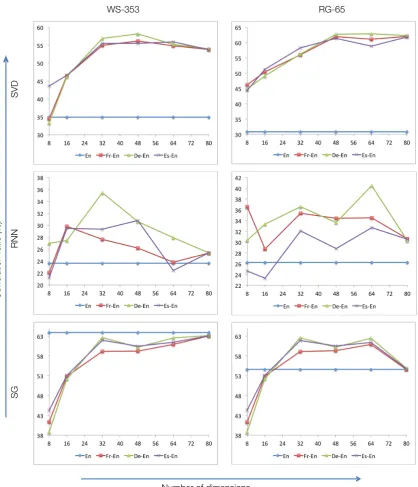
To further understand why multilingual context is highly effective for SVD vectors and to a large extent for RNN vectors as well, we plot (Figure 4) the correlation ratio obtained by varying the length of word representations by using equation 6 for the three different vector types on two word similarity tasks:WS-353andRG-65.
SVD vectors improve performance upon the in-crease of the number of dimensions and tend to
Vectors Dim Lang WS-353 WS-SIM WS-REL RG-65 MC-30 MTurk SEM-REL SYN-REL SVD 8048 MonoMulti 34.858.1 45.565.3 52.723.4 30.862.7 21.067.7 62.146.6 23.413.5 24.433.2
[image:7.595.75.522.61.137.2]RNN 8048 MonoMulti 23.635.4 35.647.3 29.817.5 26.236.6 47.746.5 43.832.9 4.14.7 18.212.2 SG 8048 MonoMulti 63.963.1 69.970.4 57.660.9 54.654.9 62.864.7 58.766.9 46.547.8 47.844.2
Table 2: Spearman’s correlation (left) and accuracy (right) on different tasks. Bold indicates best result across all vector types. Mono: monolingual and Multi: multilingual.
WS-353 RG-65
SV
D
RN
N
SG
Number of dimensions
Co
rr
el
at
io
n
ra
tio
(%
)
[image:7.595.92.511.184.672.2]saturate towards the end. For all the three lan-guage pairs the SVD vectors show uniform pat-tern of performance which gives us the liberty to use any language pair at hand. This is not true for the RNN vectors whose curves are signifi-cantly different for every language pair. SG vec-tors show a uniform pattern across different lan-guage pairs and the performance with multilin-gual context converges to the monolinmultilin-gual perfor-mance when the vector length becomes equal to the monolingual case (k= 80). The fact that both SG and SVD vectors have similar behavior across language pairs can be treated as evidence that se-mantics or information at a conceptual level (since both of them basically model word cooccurrence counts) transfers well across languages (Dyvik, 2004) although syntax has been projected across languages as well (Hwa et al., 2005; Yarowsky and Ngai, 2001). The pattern of results in the case of RNN vectors are indicative of the fact that these vectors encode syntactic information as explained in§6 which might not generalize well as compared to semantic information.
7 Related Work
Our method of learning multilingual word vectors is most closely associated to Zou et al. (2013) who learn bilingual word embeddings and show their utility in machine translation. They optimize the monolingual and the bilingual objective together whereas we do it in two separate steps and project to a common vector space to maximize correla-tion between the two. Vuli´c and Moens (2013) learn bilingual vector spaces from non parallel data induced using a seed lexicon. Our method can also be seen as an application of multi-view learning (Chang et al., 2013; Collobert and We-ston, 2008), where one of the views can be used to capture cross-lingual information. Klementiev et al. (2012) use a multitask learning framework to encourage the word representations learned by neural language models to agree cross-lingually.
CCA can be used for dimension reduction and to draw correspondences between two sets of data.Haghighi et al. (2008) use CCA to draw trans-lation lexicons between words of two different lan-guages using only monolingual corpora. CCA has also been used for constructing monolingual word representations by correlating word vectors that capture aspects of word meaning and dif-ferent types of distributional profile of the word
(Dhillon et al., 2011). Although our primary ex-perimental emphasis was on LSA based monolin-gual word representations, which we later gener-alized to two different neural network based word embeddings, these monolingual word vectors can also be obtained using other continuous models of language (Collobert and Weston, 2008; Mnih and Hinton, 2008; Morin and Bengio, 2005; Huang et al., 2012).
Bilingual representations have previously been explored with manually designed vector space models (Peirsman and Pad´o, 2010; Sumita, 2000) and with unsupervised algorithms like LDA and LSA (Boyd-Graber and Blei, 2012; Zhao and Xing, 2006). Bilingual evidence has also been ex-ploited for word clustering which is yet another form of representation learning, using both spec-tral methods (Zhao et al., 2005) and structured prediction approaches (T¨ackstr¨om et al., 2012; Faruqui and Dyer, 2013).
8 Conclusion
We have presented a canonical correlation anal-ysis based method for incorporating multilingual context into word representations generated using only monolingual information and shown its ap-plicability across three different ways of generat-ing monolgenerat-ingual vectors on a variety of evalua-tion benchmarks. These word representaevalua-tions ob-tained after using multilingual evidence perform significantly better on the evaluation tasks com-pared to the monolingual vectors. We have also shown that our method is more suitable for vec-tors that encode semantic information than those that encode syntactic information. Our work sug-gests that multilingual evidence is an important resource even for purely monolingual, semanti-cally aware applications. The tool for projecting word vectors can be found athttp://cs.cmu. edu/˜mfaruqui/soft.html.
Acknowledgements
We thanks Kevin Gimpel, Noah Smith, and David Bamman for helpful comments on earlier drafts of this paper. This research was supported by the NSF through grant IIS-1352440.
References
A study on similarity and relatedness using distri-butional and wordnet-based approaches. In Pro-ceedings of North American Chapter of the Associ-ation for ComputAssoci-ational Linguistics, NAACL ’09, pages 19–27, Stroudsburg, PA, USA. Association for Computational Linguistics.
Colin Bannard and Chris Callison-Burch. 2005. Para-phrasing with bilingual parallel corpora. InProc. of ACL.
Jordan L. Boyd-Graber and David M. Blei. 2012. Mul-tilingual topic models for unaligned text. CoRR, abs/1205.2657.
Kai-Wei Chang, Wen-tau Yih, and Christopher Meek. 2013. Multi-relational latent semantic analysis. In
Proceedings of the 2013 Conference on Empirical Methods in Natural Language Processing, pages 1602–1612, Seattle, Washington, USA, October. Association for Computational Linguistics.
Kenneth Ward Church and Patrick Hanks. 1990. Word association norms, mutual information, and lexicog-raphy.Comput. Linguist., 16(1):22–29, March. Ronan Collobert and Jason Weston. 2008. A unified
architecture for natural language processing: deep neural networks with multitask learning. In Pro-ceedings of the 25th international conference on Machine learning, ICML ’08, pages 160–167, New York, NY, USA. ACM.
S. C. Deerwester, S. T. Dumais, T. K. Landauer, G. W. Furnas, and R. A. Harshman. 1990. Indexing by latent semantic analysis. Journal of the American Society for Information Science.
Paramveer S. Dhillon, Dean P. Foster, and Lyle H. Un-gar. 2011. Multi-view learning of word embeddings via cca. InNIPS, pages 199–207.
Mona Talat Diab. 2003. Word sense disambiguation within a multilingual framework. Ph.D. thesis, Uni-versity of Maryland at College Park, College Park, MD, USA. AAI3115805.
Thomas G. Dietterich. 1998. Approximate statis-tical tests for comparing supervised classification learning algorithms. Neural Computation, 10:1895– 1923.
Chris Dyer, Adam Lopez, Juri Ganitkevitch, Jonathan Weese, Hendra Setiawan, Ferhan Ture, Vladimir Ei-delman, Phil Blunsom, and Philip Resnik. 2010. cdec: A decoder, alignment, and learning framework for finite-state and context-free translation models. InIn Proceedings of ACL System Demonstrations.
Helge Dyvik. 2004. Translations as semantic mir-rors: from parallel corpus to wordnet. Language and Computers, 49(1):311–326.
Manaal Faruqui and Chris Dyer. 2013. An informa-tion theoretic approach to bilingual word clustering.
InProceedings of the 51st Annual Meeting of the As-sociation for Computational Linguistics (Volume 2: Short Papers), pages 777–783, Sofia, Bulgaria, Au-gust.
Lev Finkelstein, Evgeniy Gabrilovich, Yossi Matias, Ehud Rivlin, Zach Solan, Gadi Wolfman, and Ey-tan Ruppin. 2001. Placing search in context: the concept revisited. InWWW ’01: Proceedings of the 10th international conference on World Wide Web, pages 406–414, New York, NY, USA. ACM Press. J.R. Firth. 1957. A synopsis of linguistic theory
1930-1955.Studies in linguistic analysis, pages 1–32. Gene H. Golub and Charles F. Van Loan. 1996. Matrix
computations (3rd ed.). Johns Hopkins University Press, Baltimore, MD, USA.
Aria Haghighi, Percy Liang, Taylor Berg-Kirkpatrick, and Dan Klein. 2008. Learning bilingual lexicons from monolingual corpora. InProc. of ACL. Zellig Harris. 1954. Distributional structure. Word,
10(23):146–162.
Eric H Huang, Richard Socher, Christopher D Man-ning, and Andrew Y Ng. 2012. Improving word representations via global context and multiple word prototypes. InProceedings of the 50th Annual Meet-ing of the Association for Computational LMeet-inguis- Linguis-tics: Long Papers-Volume 1, pages 873–882. Asso-ciation for Computational Linguistics.
Rebecca Hwa, Philip Resnik, Amy Weinberg, Clara Cabezas, and Okan Kolak. 2005. Bootstrapping parsers via syntactic projection across parallel texts.
Natural Language Engineering, 11:11–311. Alexandre Klementiev, Ivan Titov, and Binod
Bhat-tarai. 2012. Inducing crosslingual distributed rep-resentations of words. InProceedings of COLING. Tomas Mikolov, Kai Chen, Greg Corrado, and
Jef-frey Dean. 2013a. Efficient estimation of word representations in vector space. arXiv preprint arXiv:1301.3781.
Tomas Mikolov, Wen-tau Yih, and Geoffrey Zweig. 2013b. Linguistic regularities in continuous space word representations. InProceedings of the 2013 Conference of the North American Chapter of the Association for Computational Linguistics: Human Language Technologies, pages 746–751, Atlanta, Georgia, June. Association for Computational Lin-guistics.
George A. Miller and Walter G. Charles. 1991. Con-textual correlates of semantic similarity. Language and Cognitive Processes, 6(1):1–28.
Andriy Mnih and Geoffrey Hinton. 2008. A scalable hierarchical distributed language model. InIn NIPS. Frederic Morin and Yoshua Bengio. 2005. Hierarchi-cal probabilistic neural network language model. In
Jerome L. Myers and Arnold D. Well. 1995. Research Design & Statistical Analysis. Routledge, 1 edition, June.
Yves Peirsman and Sebastian Pad´o. 2010. Cross-lingual induction of selectional preferences with bilingual vector spaces. InHuman Language Tech-nologies: The 2010 Annual Conference of the North American Chapter of the Association for Com-putational Linguistics, HLT ’10, pages 921–929, Stroudsburg, PA, USA. Association for Computa-tional Linguistics.
Kira Radinsky, Eugene Agichtein, Evgeniy Gabrilovich, and Shaul Markovitch. 2011. A word at a time: computing word relatedness using temporal semantic analysis. In Proceedings of the 20th international conference on World wide web, WWW ’11, pages 337–346, New York, NY, USA. ACM.
Philip Resnik and David Yarowsky. 1999. Distinguish-ing systems and distDistinguish-inguishDistinguish-ing senses: new evalua-tion methods for word sense disambiguaevalua-tion. Nat. Lang. Eng., 5(2):113–133, June.
Herbert Rubenstein and John B. Goodenough. 1965. Contextual correlates of synonymy. Commun. ACM, 8(10):627–633, October.
Eiichiro Sumita. 2000. Lexical transfer using a vector-space model. In Proceedings of the 38th Annual Meeting on Association for Computational Linguis-tics, ACL ’00, pages 425–431, Stroudsburg, PA, USA. Association for Computational Linguistics. Oscar T¨ackstr¨om, Ryan McDonald, and Jakob
Uszko-reit. 2012. Cross-lingual word clusters for direct transfer of linguistic structure. InThe 2012 Confer-ence of the North American Chapter of the Associ-ation for ComputAssoci-ational Linguistics: Human Lan-guage Technologies, volume 1, page 11. Association for Computational Linguistics.
Joseph Turian, Lev Ratinov, and Yoshua Bengio. 2010. Word representations: a simple and general method for semi-supervised learning. InProceedings of the 48th Annual Meeting of the Association for Com-putational Linguistics, ACL ’10, pages 384–394, Stroudsburg, PA, USA. Association for Computa-tional Linguistics.
Peter D. Turney and Patrick Pantel. 2010. From fre-quency to meaning : Vector space models of se-mantics. Journal of Artificial Intelligence Research, pages 141–188.
Peter D. Turney. 2001. Mining the web for synonyms: Pmi-ir versus lsa on toefl. InProceedings of the 12th European Conference on Machine Learning, EMCL ’01, pages 491–502, London, UK, UK. Springer-Verlag.
Peter D. Turney. 2006. Similarity of semantic rela-tions. Comput. Linguist., 32(3):379–416, Septem-ber.
Laurens van der Maaten and Geoffrey Hinton. 2008. Visualizing Data using t-SNE. Journal of Machine Learning Research, 9:2579–2605, November. Ivan Vuli´c and Marie-Francine Moens. 2013. A study
on bootstrapping bilingual vector spaces from non-parallel data (and nothing else). In Proceedings of the 2013 Conference on Empirical Methods in Natu-ral Language Processing, pages 1613–1624, Seattle, Washington, USA, October. Association for Compu-tational Linguistics.
David Yarowsky and Grace Ngai. 2001. Inducing mul-tilingual pos taggers and np bracketers via robust projection across aligned corpora. In Proceedings of the second meeting of the North American Chap-ter of the Association for Computational Linguistics on Language technologies, NAACL ’01, pages 1– 8, Stroudsburg, PA, USA. Association for Computa-tional Linguistics.
Bing Zhao and Eric P. Xing. 2006. Bitam: Bilingual topic admixture models for word alignment. In In Proceedings of the 44th Annual Meeting of the As-sociation for Computational Linguistics (ACL06. Bing Zhao, Eric P. Xing, and Alex Waibel. 2005.
Bilingual word spectral clustering for statistical ma-chine translation. InProceedings of the ACL Work-shop on Building and Using Parallel Texts, ParaText ’05, pages 25–32, Stroudsburg, PA, USA. Associa-tion for ComputaAssocia-tional Linguistics.