Proceedings of the 2011 Conference on Empirical Methods in Natural Language Processing, pages 1557–1567, Edinburgh, Scotland, UK, July 27–31, 2011. c2011 Association for Computational Linguistics
Bootstrapped Named Entity Recognition for Product Attribute Extraction
Duangmanee (Pew) Putthividhya
eBay Inc. 2065 Hamilton Ave San Jose, CA 95125 [email protected]
Junling Hu
eBay Inc. 2065 Hamilton Ave San Jose, CA 95125 [email protected]
Abstract
We present a named entity recognition (NER) system for extracting product attributes and values from listing titles. Information extrac-tion from short listing titles present a unique challenge, with the lack of informative con-text and grammatical structure. In this work, we combine supervised NER with bootstrap-ping to expand the seed list, and output nor-malized results. Focusing on listings from eBay’s clothing and shoes categories, our bootstrapped NER system is able to identify new brands corresponding to spelling variants and typographical errors of the known brands, as well as identifying novel brands. Among the top 300 new brands predicted, our system achieves 90.33% precision. To output normal-ized attribute values, we explore several string comparison algorithms and found n-gram sub-string matching to work well in practice.
1 Introduction
Traditional named entity recognition (NER) task has expanded beyond identifying people, location, and organization to book titles, email addresses, phone numbers, and protein names (Nadeau and Sekine 2007). Recently there has been a surge of interest in extracting product attributes from online data due to the rapid growth of E-Commerce. Current work in this domain focuses on mining product reviews and descriptions from retailer websites. Such text data tend to be long and generate enough context for the target task (Brody and Elhadad 2010; Liu et al. 2005; Popescu and Etzioni 2005). In this paper, we focus on mining short product listing titles, which poses unique challenges.
Short listings are typical in classified ads where each seller is given limited space (in terms of words) to describe the product. On eBay, product listing ti-tles cannot exceed 55 characters in length. Similarly, on Craigslist and newspaper ads, the length of a list-ing title is restricted. Extractlist-ing product attributes from such short titles faces the following challenges:
• Loss of grammatical structure in short listings where many nouns are piled together.
• Typographical errors, abbreviations, and acronyms that must be normalized to the standardized values.
• Lack of contextual information to infer product attribute value.
It can be argued that the use of short listings simpli-fies the problem of attribute extraction, since short listings can be easily annotated and one can apply supervised learning approach to extract product at-tributes. However, as the size of the data grows, ob-taining labeled training set on the scale of millions of listings becomes very expensive. In such a sce-nario, incorporating unlabeled examples in a semi-supervised fashion to scale up the solution becomes a necessity rather than a luxury.
on eBay, constituting a dataset of1,380,337word tokens.
In the first part of this work, we outline a super-vised learning approach to attribute value extraction where we train a sequential classifier and evaluate the extraction performance on a set of hand-labeled listings. Using maximum entropy and SVM as the base classifier (for classifying the individual word tokens), a hidden Markov model (HMM) is trained on the the probabilistic output of the base classifier, and a sequential label prediction is obtained using a Viterbi decoding. We show a performance compar-ison of supervised HMM, MaxEnt, SVM, and CRF for this task.
In the second part of our work, to grow our seed list of attributes, we present a bootstrapped algo-rithm for attribute value discovery and normaliza-tion, honing in on one particular attribute (brand). The goal is given an initial list of unambiguous brands, we grow the seed dictionary by discover-ing context patterns that are often associated with such attribute type. First, we automatically parti-tion data into a training/test set by labeling word to-kens in each listing using exact matching to entries in the dictionary. Brand phrases that can be confused with other attributes, e.g. the wordcamel— both a brand and a color — will not be a part of this ini-tial seed list to create the training set. A classifier is then trained to learn context patterns surrounding the known brands from the training set, and is used to discover new brands from the test set.
Finally, for known attribute values, we normalize the results to match to words in our dictionary. Nor-malizing the variants of a known brand to a single normalized output value is an important aspect of a successful information extraction system. To this end, we investigate several string similarity/distance measures for this task and found that n-gram
sub-string similarity (Kondrak 2005) yields accurate nor-malization results.
The main contribution of this work is a product attribute extraction system that addresses the unique problems of information extraction from short list-ing titles. We combine supervised NER with boot-strapping to expand the seed list, and investigate sev-eral methods to normalize the extracted results. Our system has been tested on large-scale eBay listing datasets to demonstrate its effectiveness.
2 Related Work
Recent work on product attribute extraction by (Brody and Elhadad 2010) applies a Latent Dirich-let Allocation (LDA) model to identify different as-pects of products from user reviews. Similar work is presented in (Liu et al. 2005). Topic models such as LDA groups similar words together by identify-ing topics (product aspects) from patterns of word-occurrences. Such grouping can discover new as-pects of a product such as ”portability” (for net-book computers), but it may generate aspects that are vague and not easily interpretable. Indeed, how to refine discovered aspects and clean up words in each aspect remains an open question. The LDA approach also treats documents as bags of words, where important information in word sequences is not taken into account in learning the model.
Our work is most closely related to (Ghani 2006), where a set of product attributes of interests are pre-defined and a supervised learning method is applied to extract the correct attribute values for each class. Starting out from a small set of training examples, a bootstrapping technique is used to generate more training data from unlabeled data. The main dif-ference to our method lies in how bootstrapping is used. (Ghani 2006) used EM to add more train-ing data from unlabeled data, while in our approach bootstrapping is used to expand the seed list. First, we automatically generate labeled data by matching seed list to unlabeled data. Then, these auto-labeled training set is used to train a classifier to identify new attribute values from a separate set of unlabeled data. Thirdly, newly discovered product attribute values are added back to our seed list. Thus our original classifier for product attribute extraction can be im-proved through an expanded seed list.
corresponding expansions occur in similar contexts; consequently, the surrounding context patterns can be used in associating the correct expansion to its acronym.
Our seed list expansion algorithm indeed bears some similarity to the work of (Nadeau el al 2006) and (Nadeau 2007). In (Nadeau el al 2006), automo-bile brands are learned automatically from web page context. First, a small set of 196 seed brands are ex-tracted together with their associated web page con-texts from popular news feed. The web context is subsequently used to extract additional automobile brands, which result in a total of 5701 brands. How-ever, the reported results in (Nadeau el al 2006) have low precision, in some case less than 50%. Eventu-ally their approach needs to rely on rule-based ambi-guity resolver to increase the precision. Our system does not rely on manually created rules.
A more NLP-oriented approach is proposed in (Popescu and Etzioni 2005), where noun phrases are extracted from online user reviews. Their system tries to identify product features and user opinions from such noun phrases. A PMI (pointwise mutual information) score is evaluated between each noun phrase and discriminators associated with the prod-uct class. The noun-phrase approach does not work well in informal texts. In our case, user-generated short product listings may have many nouns con-catenated together without forming a phrase or obeying correct grammatical rules.
Finally, another similar bootstrapping method is presented in (Mintz et al. 2009), where instances of known entity relations (or seed list in our paper) are matched to sentences in a set of Wikipedia arti-cles, and a learning algorithm is trained from the sur-rounding features of the entities. The trained model is then applied to a test set of Wikipedia articles, and has been reported to be able to discover new in-stances. In our case, we apply our learned model to a new test set, and discover new brand names from the listings.
The nature of non-grammatical text we face makes our work similar to the NER work on infor-mal texts. (Minkov et al. 2005) proposes an NER system that extracts personal names from emails. The work in (Gruhl et al 2009) identifies song titles from online forums on popular music, where song titles can be very ambiguous. By using real-world
constraints such as known song titles, (Gruhl et al 2009) restricts the set of possible entities and are able to obtain reasonable recognition performance.
3 Corpus
The data used in all analysis in this paper is obtained from eBay’s clothing and shoes category. Clothing and shoes have been important revenue-generating categories on the eBay site, and a successful at-tribute extraction system will serve as an invaluable tool for gathering important business and market-ing intelligence. For these categories, the attributes that we are interested in are brand (B), garment type/style (G), size (S), and color (C). We gather 105,335listings from men’s clothing category and 72,628 listings from women’s clothing category, constituting a dataset of1,380,337word tokens. On average, each listing title contains7.76words.
A few examples of listings from eBay’s clothing and shoes categories are shown in Fig 1. When de-signing an attribute extraction system to distinguish between the 4 attribute types, we must take into ac-count the fact that individual words alone — with-out considering context — are ambiguous, as each word can belong to multiple attribute types. To give concrete examples,incis a brand name of women’s apparel but many sellers use it as an acronym for inch (brand vs. size). The word blazer can be a brand entity or it can be a garment type (brand vs. garment type). In addition, like other real-world user-generated texts, eBay listings are littered with site-specific acronyms, e.g.BNWT (brand new with tag),NIB(new in box), and abbreviations introduced by individual sellers, e.g. immac(immaculate), trs
(trousers). In designing an information extraction system for our dataset, we need to account for the general as well as specific properties of our dataset.
4 Supervised Named Entity Recognition
Figure 1: Example listings and their corresponding labels from the clothing and shoes category.
the following manner. For each listing, we remove extraneous punctuation symbols (*,(,),!,:,;) and tok-enize each listing into a sequence of tokens. Given 4 dictionaries of seed values for the 4 attribute types, we match n-gram tokens to the seed values in the
dictionaries, and create an initial round of labeled training set, which must then be manually inspected for correctness. In this work, we tagged and manu-ally verified1,000listings randomly sampled from the 105,335listings from the men’s clothing cate-gory, resulting in a total of7,921labeled tokens with 1,521-word vocabulary. Fig. 1 shows examples of labeled listings, with tagsBcorresponding to brand,
Cfor color,Sfor size,Gfor garment type/style, and
NAfor none of the above.
4.1 Classifiers
One of the most popular generative model based classifiers for named entity recognition tasks is Hid-den Markov Model (HMM), which explicitly cap-tures temporal statistics in the data by modeling state (label/tag) transitions over time. Discrimina-tive classifiers, which directly model the posterior distribution of class label given features, i.e. SVM (Isozaki and Kazawa 2002) and Maximum Entropy model for NER (Chieu and Ng 2003), have been shown to outperform generative model based clas-sifiers. More recently, Conditional Random Fields (CRF) (Feng and McCallum 2004; McCallum 2003) has been proposed for a sequence labeling problem and has been established by many as the state-of-the-art model for supervised named entity recogni-tion task. In this secrecogni-tion, we briefly summarize the pros and cons of each approach.
4.1.1 Hidden Markov Models
A hidden Markov model (HMM) is a probabilistic generative model for sequential data. HMM is char-acterized by 2 sets of model parameters — emission probabilities which produce the observation variable given the hidden state, and the state transition prob-ability matrix which captures the temporal corretion in the hidden state sequences. Given a set of
la-beled training sequences as shown in Figure 1, one can train an HMM to model temporal statistics in the observation sequences. In our task, a sequence of word tokens from listing titles are our observa-tions. One simple approach to use HMM is to set a hidden state to correspond to a tag class. In the train-ing phase, since all the tags are given, the hidden states indeed become visible and inference in this model becomes much more simplified. The multino-mial parameter for the emission probabilitiesp(w|s) can be learned with a closed-form update (maximum likelihood estimate). During testing, however, an ef-ficient forward-backward algorithm must be used to infer the most likely tag sequence that accounts for the observation.
One main drawback of HMM is the type of fea-tures that it can handle. Like other probabilistic gen-erative models, in order to account for rich, over-lapping feature sets, e.g. text formatting features, the correlation structures in the overlapping features must be explicitly modeled. Indeed, in the clas-sic HMM based NER, the simple feature used is the word identity itself, which might not be suffi-ciently discriminative in distinguishing between dif-ferent classes. In addition, because of data sparsity (out-of-vocabulary) problem due to the long-tailed distribution of words in natural language, sophisti-cated unknown word models are generally needed for good performance (Klein et al. 2003).
4.1.2 Maximum Entropy models
The principle of maximum entropy states that among all the distributions that satisfy feature con-straints, we should pick the distribution with the highest entropy, since it makes the least assumption about the data and will have better generalization capability to unseen data. Maximum entropy clas-sifier, therefore, is the highest entropy conditional distribution of the class label given features, which has been shown to conveniently take an exponential form. Maximum entropy classifier is thus closely related to logistic regression model.
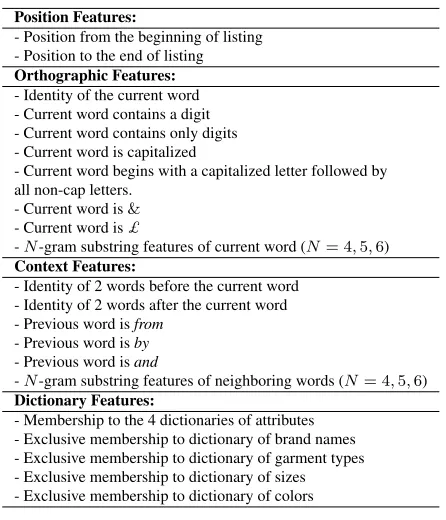
Position Features:
- Position from the beginning of listing - Position to the end of listing
Orthographic Features:
- Identity of the current word - Current word contains a digit - Current word contains only digits - Current word is capitalized
- Current word begins with a capitalized letter followed by all non-cap letters.
- Current word is&
- Current word is£
-N-gram substring features of current word (N= 4,5,6)
Context Features:
- Identity of 2 words before the current word - Identity of 2 words after the current word - Previous word isfrom
- Previous word isby - Previous word isand
-N-gram substring features of neighboring words (N= 4,5,6)
Dictionary Features:
[image:5.612.75.298.68.328.2]- Membership to the 4 dictionaries of attributes - Exclusive membership to dictionary of brand names - Exclusive membership to dictionary of garment types - Exclusive membership to dictionary of sizes - Exclusive membership to dictionary of colors
Table 1: Feature set used in discriminative classifiers.
MaxEnt classifiers (Ratnaparkhi 1996; Ratna-parkhi 1998) have been applied to various NLP ap-plications. The attraction of the framework lies in the ease with which different information sources used in the modeling process are combined and the good results that are reported with the use of these models. The set of redundant features used for the MaxEnt classifier is the same as those used for the SVM classifier, which we outline in the next section.
4.1.3 Support Vector Machines
Support Vector Machine (SVM) is yet another popular classifier for a supervised NER task. In a binary classification case, SVM finds parameters of a linearly separating hyperplane that best separates data from the 2 classes, in a sense that the margin of separation is maximized. Since only the samples closest to the decision boundary (the so-called sup-port vectors) determine the location of the separating hyperplane, SVM can be trained on very few train-ing examples even for data in a high-dimensional space. For our supervised NER system, we use the following features, as described in detail in Table 1, as input to the discriminative classifiers.
The use of charN-gram (N-gram substring)
fea-tures was inspired by the work of (Klein et al. 2003), where the introduction of such features has been
shown to improve the overall F1 score by over 20%. In (Kanaris et al. 2006), charN-gram features con-sistently outperform word features in learning effec-tive spam classifiers. Indeed the use of characterN
-gram features as an input to the classifier subsumes the use of prefix, suffix, and the entire word features. Generally speaking, charN-gram features provide a
more robust representation against misspelling since strings1and its spelling variants2may share many charN-gram substrings in common.
POS and punctuation features are not used in our NER system. This is mainly due to the fact that eBay listing titles are not complete sentences and the out-put from running a POS tagger through such data can indeed be unreliable. For punctuation features, eBay sellers are known to abuse punctuation marks excessively to draw attention of the potential buyers to click on their listings. In addition, we find that morphological features are less predictive of entity names in eBay listing titles than they are in formal documents. To give a concrete example, capitaliza-tion is a good predictor of entity names in tradicapitaliza-tional NER systems, but on the eBay site, many sellers use all-cap or all-lowercase letters for every word in their titles, bringing into question the discrimi-native power of widely used features in traditional NER systems.
4.1.4 Viterbi Smoothing
We adopt the approach from the work of (Chieu and Ng 2003), which uses Viterbi to improve the classification results from MaxEnt classifier for NER tasks. Instead of computing the transition probability matrix by recording the frequency of how many times stateiat timeT transitions to state j at time T + 1, we simply record that this state i
tojtransition is admissible. This approach, indeed, divides a set of all label sequences into ones that are admissible and inadmissible, and assign equal prob-abilities to all the admissible sequences. Such an ap-proach therefore eliminates all the inadmissible se-quences of labels (i.e. prohibit the scenario where
-insub-tag is followed by-beginsub-tag), while al-lowing the Viterbi algorithm to give more weight to the classification outputs from SVM or MaxEnt.
4.1.5 Conditional Random Field (CRF)
Conditional Random Field, since its conception in the seminal work of (Lafferty et al. 2002), is a dis-criminative classifier for sequential data that com-bines the best of both worlds. Like SVM and Max-Ent, CRF is a discriminative classifier that directly models the conditional distribution of the target vari-able given the observed varivari-able, i.e. no modeling resource is wasted in modeling complex correlation structures in the observation sequences. Like HMM, CRF makes prediction on the label sequence by in-corporating the temporal smoothness. Indeed CRF has been established by many as the state-of-the-art supervised named entity recognition system for traditional NER tasks (Feng and McCallum 2004; McCallum 2003), for NER in biomedical texts (Set-tles 2004), and in various languages besides English, such as Bengali (Ekbal et al. 2008) and Chinese (Mao et al 2008). Various modifications to CRF have recently been introduced to take into account of non-local dependencies (Krishnan and Manning 2006) or broader context beyond training data (Du et al. 2010).
4.2 Experimental Results
In this section, we compare the generative model based and discriminative model classifiers for super-vised NER tasks. Given1,000manually tagged list-ings from the clothing and shoes category in eBay, we adopt a 90-10 split and use 90% of the data for training and 10% for testing. Each listing title is to-kenized into a sequence of word tokens, each
manu-SVM MaxEnt HMM CRF
w/o Viterbi 89.05% 87.64% - -w/ Viterbi 89.47% 88.13% 83.82 93.35%
Table 2: Classification accuracy (%) on 9-class NER on men’s clothing dataset, comparing SVM, MaxEnt, super-vised HMM, and CRF.
ally assigned to one of the 5 tags: brand (B), size (S), color (C), garment type (G), and none of the above (NA). In order to more accurately capture the boundary of multi-token attribute values, we further sub-divide each tag into 2 classes using-begand-in
sub-tags. This step increases the number of classes that our classifier needs to handle from 5 to 9 classes given as follows: {B-beg,B-in,C-beg,C-in,S-beg,
[image:6.612.315.539.73.111.2]S-in,G-beg,G-in, andNA}.
Table 2 shows a comparison of classification ac-curacy from 4 classifiers — SVM, MaxEnt, HMM, and CRF. Supervised HMM, with the most simplis-tic feature, yields the baseline result at 83.82% accu-racy. All the discriminative classifiers — CRF, Max-Ent, and SVM — outperform the baseline by HMM, with CRF improving on the baseline performance by the largest margin, concurring to other reports of its state-of-the-art results. Indeed, when using exactly the same set of features as SVM and MaxEnt, the performance of CRF indeed drops to 89.11%, which is on par with that of SVM and MaxEnt. However, when restricting to using dictionary and word iden-tity features, the performance of CRF improves, in-dicating the importance of feature selection to such model. SVM and MaxEnt yield similar performance with SVM slightly outperforming MaxEnt classifier by 1.6%. The incorporation of temporal smoothness constraint enforced by the Viterbi algorithm slightly improves the label sequence prediction (comparing row 1 and row 2 in Table 2).
performance, with a significantly higher computa-tional cost. The MaxEnt implementation used in our experiment is the version available from the NLTK toolkit, with BFGS optimizer. For CRF, we use the linear-chain CRF model available from the Mallet package1.
5 Bootstrapping for Dictionary Expansion
The supervised learning approach assumes the ex-istence of an annotated set of training data. Often times, training data must be painstakingly marked up and collecting large-scale labeled training exam-ples can be very costly. In recent years, more and more research effort has been focused on how to leverage a vast amount of unlabeled data in a semi-supervised or entirely unsemi-supervised fashion for NER as well as for other similar NLP tasks, e.g. POS tagging, sentence boundary detection, and word sense disambiguation (Riloff 1999; Ghani and Jones 2002; Probst et al. 2006; Brody and Elhadad 2010; Haghighi 2010).
One way to incorporate a vast amount of unla-beled data is to learn a clustering of words that as-signs syntactically similar words to the same clus-ters. Popular clustering algorithms used prevalently in many NER systems are, for example, the combi-nation of distributional and morphological similar-ity work of (Clark 2003) or the classicN-gram
lan-guage model based clustering algorithm of (Brown et al. 1992). In such a system, when training an NER classifier, we introduce a word cluster id as an additional feature in the input, with the hope that the model will pick out clusters that are highly indica-tive of each class. When encountering words that are out-of-vocabulary (OOV) in the test set, if those words are assigned the same cluster membership as some other words in the training set, the cluster fea-ture will fire, allowing for correct classification re-sults to be obtained (Lin and Wu 2009; Faruqui and Pado 2010).
5.1 Growing Seed Dictionary
In this work, we focus on the problem of how to grow the seed dictionary and discovering new brand names from eBay listing data. While the perfor-mances of supervised NER classifiers as described in sections 4.1.1-4.1.5 are satisfactory, in practice,
1http://mallet.cs.umass.edu/
however, especially with a small training set size, we often find that the trained model puts too much weight on the dictionary membership feature and new attribute values are not properly detected. In this section, instead of using the seed list of known attribute values as a feature into a classifier, we use the seed values to automatically generate la-beled training data. For the specific case of brand discovery, this initial list used to generate training data must contain only names that are unambigu-ously brands. We hence remove ambiguous names or phrases that belong to multiple attribute types from the list, such as jumpers(both a brand name and a garment type), or (ii) camel is a short name of brandCamel activeas well as a color, or (iii)lrg
is an acronym for a brand as well as an acronym for large which specifies size.
The training/test data is generated by matching
N-gram tokens in listing titles to all the entries in
the initial brand seed dictionary. Following the con-vention in (Minkov et al. 2005), we use the follow-ing set of 5 tags, (1) one-token entity (B1 tag) (2) first token of a multi-token entity (Bo tag for Brand-open) (3) last token of a multi-token entity (Bc tag for Brand-close) (4) middle token of a multi-token entity (Bi tag for Brand-inside) (5) token that is not part of a brand entity (NA tag). The listings with at least one non-NA tags are put in the training set, and listings that contain only NA tags are in the test set. Similar to the acronym expansion algorithm of (Pakhomov 2002) which learns contexts that asso-ciate acronyms to their correct expansions, the in-tuition behind our work in this section is that the classifier, trained on a labeled training set of known brands, learns context patterns that can discriminate the current word as being a brand (more precisely as part of a brand) from the other attribute types, which are now lumped together asNA.
5.2 Experiments
Women’s Clothing Men’s Clothing Garment Type
’monsoon’ henley’s nightshirt
riverislandtop abercrombie&fitch cargoshorts dorothyperkins lacost trenchcoat
river islanfd versace sweatpants marks&spencers sonnetti cardigans
river islands supremebeing boardshorts river islan brookhaven tracksuite
monsoomn guiness swimshorts
dorothry perkins ’next’ trouses principle suprerdry microfleece ?river island henbury boilersuit bnwtmonsoon paul smiths snopants
marella ricci pjs
soulcal craghopper jkt
Table 3: Discovered attribute values, ranked order by their confidence scores. (Left) Discovered brands from Women’s clothing category. We use 6,312 brands as seed values. (Middle) Discovered brands from Men’s clothing category, with 3,499 seed values used. (Right) Discov-ered garment types (styles) from Men’s clothing category, learned from 203 seed values.
test data (using exact string matching criterion). We train a 5-class MaxEnt classifier and adopt the same feature sets as described in Section 4.1.3. During the test phase, the classifier predicts the most likely brand attribute from each listing, where we are only interested in the predictions with confidence scores exceeding a set threshold. We ranked order the pre-dicted brands by their confidence scores (probabil-ities) and the top 300 unique brands are selected. We manually verify the 300 predicted brands and found that 90.33% of the predicted brands are indeed names of designers or women’s apparel stores (true positive), resulting a precision score of 90.33%.
Indeed, the precision score presented above is ob-tained using an exact matching criterion where par-tial extraction of a brand is regarded as a miss, i.e. our extractor extracts onlyCalvinwhenCalvin Klein
is present in the listing (false positive). The left col-umn of Table 3 shows examples of newly discovered brands from Women’s clothing category. Many of these newly discovered brands are indeed misspelled versions of the known brands in the seed dictionary.
The middle column of Table 3 shows a set of Men’s clothing brands learned automatically from a similar experiment conducted on a set of 105,335 listings from Men’s clothing category. Using an
ini-Seed list Test set 1 Test set 2 Orig. seeds 83.56% 90.02% Orig. seed + 200 new brands 92.75% 93.66%
Table 4: NER Accuracy on 2 test sets as the seed dictio-nary for brands grows. Results shown here are obtained the same Men’s clothing category dataset, as used to show the supervised NER results in Table 2.
tial set of 3,499 known brand seeds, we partition the dataset into a training set of67,307listings and a test set of 38,028listings (for later reference we refer to this test set as set A). Based on the top200 predicted brands,179of which are verified as being true positive samples, resulting in 89.5% precision. We carry out a similar experiment to grow the seed dictionary for garment type, and are able to iden-tify the top 60 new garment types. 54 out of 60 are true positive samples, resulting in precision score = 90%. Examples of the newly discovered garment types are shown in Table 3 (right column), where ab-breviated forms of garment types such asjkt (short for jacket) andpjs (short for pajamas) are also dis-covered through our algorithm.
By adding these newly discovered attributes back to the dictionary, we can now re-evaluate our super-vised NER system from section 4 with the grown seed list. To this end, we construct 2 test sets from the same 105,335listings of Men’s clothing cate-gory as used in Section 4. Test set 1 is a set of 500 listings randomly sampled from the 38,028 -listing subset known not to contain any brands in the original brand seed dictionary (set A). As seen in Table 4, an improvement of 9% in accuracy re-sults from the use of the grown seed list. Since this dataset is known to not contain any brands from the original brand seed dictionary, the addition of 200 new brands solely accounts for all the accuracy boost. Test set 2 is constructed slightly differently by randomly sampling 500 listings from the entire 105,335 listings of Men’s clothing category. As seen in Table 4, a smaller improvement of 3.7% is observed.
6 Normalization
invariants, abbreviated forms of known brands in the seed list or (ii) novel brands or clothing/shoes de-signers, which are not members of the original seed list. Normalizing the variants of a known brand to a single normalized output value is an important as-pect of our attribute extraction algorithm, as these variants account for over 20% of listings in the eBay clothing and shoes category. When gathering busi-ness/marketing intelligence, missing out on 20% of the data could skew the calculation of supply, de-mand, and pricing metrics, and eventually lead to the wrong policy decision made.
The problem of alternate spellings of names has been addressed in the database community success-fully using fuzzy string matching algorithms e.g. Soundex or string edit distance. In this work, since the attribute values are often partially extracted, i.e. a word in a multi-word phrase is extracted, in or-der to match to the correct normalized value, we must investigate robust substring matching algo-rithms suitable for partial matching. To this end, we explore 2 string similarity/distance measures for normalizing the extracted attributes. First, we in-vestigaten-gram similarity measures defined as the
number of shared charactern-grams, i.e. substrings of length n (Kondrak 2005). More specifically, a
string similarity measure betweens1and s2 is de-fined as the percentage of common substrings of length n (out of all substrings of length n). This
similarity measure is quite robust to partial match-ing, as a two-word phrase can appear out of order while most of the charactern-grams, wheren= 3,
remain virtually unchanged. Certainly, finding the right value ofnwill greatly impact the matching per-formance of the algorithm. In our experiment, we find the optimalnfor brands to be 3 and 4. Table 5
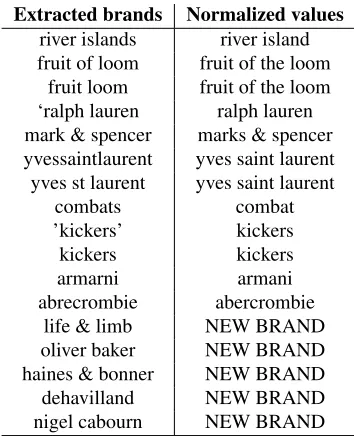
shows a few examples of normalized outputs as a re-sult of finding the best match for the extracted brand names from among a set of predefined normalized values. When the best matching score falls below a threshold, we declare no match is found and classify the extracted brand as a new brand.
Another distance measure that we explore is the Jaro-Winkler distance. Designed to be more suitable for matching short strings such as people’s names, Jaro-Winkler distance is defined based on the num-ber of character transpositions and the numnum-ber of matching characters. In addition, a prefix scale p
Extracted brands Normalized values river islands river island fruit of loom fruit of the loom
fruit loom fruit of the loom ‘ralph lauren ralph lauren mark & spencer marks & spencer yvessaintlaurent yves saint laurent yves st laurent yves saint laurent
combats combat
’kickers’ kickers kickers kickers
armarni armani
[image:9.612.336.513.70.288.2]abrecrombie abercrombie life & limb NEW BRAND oliver baker NEW BRAND haines & bonner NEW BRAND dehavilland NEW BRAND nigel cabourn NEW BRAND
Table 5: Extracted brands and their corresponding nor-malized values.
parameter is used and can be tuned to weigh more favorably on strings that match from the beginning for a set prefix length. In our experiments with brand normalization, over 50% of the matches from the Jaro-Winkler distance are, however, identified as be-ing incorrect.
7 Conclusion
In this work, we have described an information ex-traction system for applications in the domain of in-ventory/business Intelligence. The goal is given an eBay listing title, our system correctly extracts the defining attributes in order to associate each item to a specific product. We investigate and compare sev-eral supervised NER systems — supervised HMM, SVM, MaxEnt, and CRF — and found SVM and MaxEnt with Viterbi decoding to yield the best per-formance. Focusing on the clothing and shoes cat-egories on eBay’s site, we presented a bootstrapped algorithm that can identify new brand names corre-sponding to (1) spelling invariants or typographical errors of the known brands in the seed list and (2) novel brands or designers. Our attribute extractor correctly discovers new brands with over 90% pre-cision on multiple corpora of listings. To output nor-malized attribute values, we explore several fuzzy string comparison algorithms and found n-gram sub-string matching to work well in practice.
8 Acknowledgment
The authors would like to thank Nalini Johnas and Padmanaban Ramasamy for their help in gathering listing data used in all of our experiments.
References
A. Berger, S. Pietra, V. Pietra,A Maximum Entropy Ap-proach to Natural Language Processing, ACL 1996. S. Brody, N. Elhadad,An Unsupervised Aspect-Sentiment
Model for Online Reviews, HLT-NAACL 2010. P. Brown, P. deSouza, R. Mercer, V. Della Pietra, J.
Lai, Class-basedn-gram Models of Natural Language, ACL 1992.
C.-C Chang, C.-J. Lin, LibSVM: A Library for Support Vector Machines (2001).
H. L. Chieu, H. T. Ng,Named Entity Recognition with a Maximum Entropy Approach, ACL 2003.
A. Clark, Combining Distributional and Morphological Information for Part of Speech Induction, EACL 2003 G. Demartini, C. S. Firan, M. Georgescu, T. Iofciu, R. Krestel, and W. Nejdl,An Architecture for Finding En-tities on the web, Latin American Web Congress 2009. J. Du, Z. Zhang, J. Yan, Y. Cui, and Z. Chen. Using search session context for named entity recognition in query. In SIGIR10, Geneva, Switzerland, July 19-23 2010.
Asif Ekbal, Rejwanul Haque, and Sivaji Bandyopadhyay. 2008.Named entity recognition in Bengali: A condi-tional random field approach. In Proceedings of IJC-NLP, pages 589594.
M. Faruqui, S. Pado, Training and Evaluating a German Named Entity Recognizer with Semantic Generaliza-tion, Proceedings of Konvens 2010, Saarbrucken, Ger-many.
F. Feng, A. McCallum, Chinese segmentation and new word detection using conditional random fields, in COLING 2004.
J. R. Finkel, T. Grenager, and C. Manning, Incorporat-ing Non-local Information into Information Extraction Systems by Gibbs Sampling, ACL 2005.
J. R. Finkel, C. Manning,Nested Named Entity Recogni-tion, EMNLP 2009.
R. Ghani, K. Probst, Y. Liu, M. Krema, A. Fano, Text Mining for Product Attribute Extraction, SIGKDD, 2006.
R. Ghani, R. Jones, A comparison of efficacy and as-sumptions of bootstrapping algorithms for training information extraction systems, Workshop on Lin-guistic Knowledge Acquisition and Representation at the Third International Conference on Language Re-sources and Evaluation (LREC), 2002.
T. Grenager, D. Klein, and C. D. Manning,Unsupervised Learning of Field Segmentation Models for Informa-tion ExtracInforma-tion, ACL 2005.
D. Gruhl, M. Nagarajan, J. Pieper, C. Robson, and A. Sheth.Context and Domain Knowledge Enhanced En-tity Spotting In Informal Text. In Proceedings of the 8th International Semantic Web Conference (ISWC 2009). Springer, 2009.
A. D. Haghighi, Unsupervised Models of Entity Refer-ence Resolution, Ph. D. Thesis, University of Calfor-nia, Berkeley, 2010.
P. Halacsy, A. Kornai, C. Oravecz, HunPos: an open source trigram tagger, ACL 2007.
H. Isozaki and H. Kazawa,Efficient Support Vector Clas-sifiers for Named Entity Recognition, ACL 2002. R. Jones,Learning to Extract Entities from Labeled and
Unlabeled Text, PhD Thesis, 2005.
I. Kanaris, K. Kanaris, I. Houvardas, E. Stamatatos, Words vs. Character N-grams for Anti-spam Filtering, International Journal on Artificial Intelligence Tools, 2006.
D. Klein, J. Smarr, H. Nguyen, C. Manning,Named En-tity Recognition with Character-level Models, CoNLL 2003.
R. Koeling, Chunking with Maximum Entropy Models, Proc. of CoNLL-2000.
G. Kondrak, N-Gram Similarity and Distance, SPIRE 2005.
V. Krishnan and C. D. Manning,An effective two-stage model for exploiting non-local dependencies in named entity recognition, in ACL-COLING, 2006.
T. Kudo, Y. Matsumoto, Chunking with Support Vector Machines, ACL 2001.
J. Lafferty, A. McCallum, F. Pereira, Conditional Ran-dom Fields: Probabilistic Models for Segmenting and Labeling Sequence Data, ICML 2002.
V. I. Levenshtein,Binary code capable of correcting dele-tions, inserdele-tions, and reversals.Phs. Dokl., 6:707-710. D. Lin, X. Wu, Phrase Clustering for Discriminative
Learning, ACL 2009.
B. Liu, M. Hu, and J. Cheng, Opinion Observer: Ana-lyzing and Comparing Opinions on the Web, WWW 2005.
Xinnian Mao, Saike He, Sencheng Bao, Yuan Dong, and Haila Wang, Chinese Word Segmentation and Named Entity Recognition Based on Conditional Ran-dom Fields, Sixth SIGHAN Workshop on Chinese Language Processing, 2008
A. McCallum, Efficiently Inducing Features of Condi-tional Random Fields, UAI 2003.
A. McCallum, D. Jensen, A Note on Unification of Information Extraction and Data Mining using Conditional-Probability, Relational Models, Proceed-ings of IJCAI-2003 on Learning Statistical Models from Relational Data, 2003.
J. F. McCarthy, A Trainable Approach to Coreference Resolution for Information Extraction, Ph. D. Thesis, University of Massachusetts at Amherst, 1996. E. Minkov, R. C. Wang, and W. W. Cohen, Extracting
Personal Names from Email: Applying Named Entity Recognition to Informal Text, ACL 2005.
Mike Mintz, Steven Bills, Rion Snow, Daniel Juraf-sky. 2009.Distant Supervision for Relation Extraction without Labeled Data, In Proceedings of ACL/AFNLP 2009.
S. Moghaddam, M. Ester,Opinion Digger: An Unsuper-vised Opinion Miner from Unstructured Product Re-views, CIKM 2010
David Nadeau, P. Turney, S.Matwin, Unsupervised Named Entity Recognition: Generating Gazetteers and Resolving Ambiguity. In Proc. Canadian Confer-ence on Artificial IntelligConfer-ence, 2006.
David Nadeau and Satoshi Sekine.A survey of named en-tity recognition and classification. Linguisticae Inves-tigationes, 30(1):326, 2007.
Nadeau, D.,Semi-Supervised Named Entity Recognition: Learning to Recognize 100 Entity Types with Little Su-pervision, PhD thesis, University of Ottawa, 2007. S. Pakhomov,Semi-supervised Maximum Entropy Based
Approach to Acronym and Abbreviation Normalization in Medical Texts, ACL 2002.
A.-M. Popescu, O. Etzioni,Extracting Product Features and Opinions from Reviews, EMNLP 2005.
K. Probst, R. Ghani, M. Krema, A. Fano, Semi-Supervised Learning to Extract Attribute-Value Pairs from Product Descriptions on the Web, ECML 2006. V. Punyakanok, D. Roth,The use of classifiers in
sequen-tial inference, NIPS 2001.
H. Raghavan, J. Allan, Matching Inconsistently Spelled Names in Automatic Speech Recognizer Output for In-formation Retrieval, HLT-EMNLP 2005.
A. Ratnaparkhi,A Maximum Entropy Part of Speech Tag-ger.In EMNLP 1996.
A. Ratnaparkhi, Maximum Entropy Models forNatural Language Ambiguity Resolution, Ph. D. Thesis, Uni-versity of Pennsylvania.
E. Riloff, R. Jones,Learning Dictionaries for Informa-tion ExtracInforma-tion by Multi-Level Bootstrapping, AAAI 1999.
Settles, B. (2004),Biomedical named entity recognition using conditional random fields and rich feature sets, in Proceedings of the International Joint Workshop on Natural Language Processing in Biomedicine and its Applications (NLPBA), 2004, Geneva, Switzerland. W. M. Soon, H. T. Ng, D. Chung, Y. Lim, A machine
learning approach to coreference resolution of noun phrases, Computational Linguistics, 27(4): 521-544, 2001.
H. Wallach, Efficient Training of Conditional Random Fields, M. Sc. Thesis, Division of Informatics, Uni-versity of Edinburgh, 2002.
D. Wu, W. S. Lee, N. Ye, and H. L. Chieu, Domain adaptive bootstrapping for named entity recognition, EMNLP 2009.
Y. Zhao, B. Qin, S. Hu, T. Liu, Generalizing Syntactic Structures for Product Attribute Candidate Extraction, ACL 2010