Finnish resources for evaluating language model semantics
Viljami Venekoski
National Defence University Helsinki, Finland [email protected]
Jouko Vankka
National Defence University Helsinki, Finland [email protected]
Abstract
Distributional language models have con-sistently been demonstrated to capture se-mantic properties of words. However, research into the methods for evaluat-ing the accuracy of the modeled seman-tics has been limited, particularly for less-resourced languages. This research presents three resources for evaluating the semantic quality of Finnish language dis-tributional models: (1) semantic similarity judgment resource, as well as (2) a word analogy and (3) a word intrusion test set. The use of evaluation resources is demon-strated in practice by presenting them with different language models built from varied corpora.
1 Introduction
In the spirit of the distributional hypothesis stat-ing that semantically similar words appear in simi-lar contexts (Harris, 1954), distributional language models of recent years have successfully been able to capture semantics properties of words given large corpora (e.g., Mikolov et al., 2013a; Pen-nington et al., 2014). However, there are only few resources for evaluating the accuracy or validity of language models, particularly for less-spoken languages, due to language dependence of such resources (Leviant and Reichart, 2015). Further, a single good resource may not be sufficient due to the complexity of semantics; performance in an intrinsic evaluation task may not predict per-formance in extrinsic downstream language tech-nology applications (Chiu et al., 2016). Therefore, the evaluation of semantics should be based on a variety of tasks, estimating different semantic phe-nomena (Baroni et al., 2014).
With respect to language models, two distinct measures of semantic quality can be identified: va-lidity and completeness (Lindland et al., 1994).
The latter is dependent on the underlying corpus because a language model can only represent lin-guistic units which have been present in its training data. While it is possible for some models to infer the meaning of novel input, the inference can be considered an additional training step of the model and thus an extension of the training corpus. Com-pleteness is also likely to affect the validity of a model; given the distributional hypothesis (Harris, 1954), more encompassing knowledge about the possible contexts of words results in more accurate knowledge of their semantics. In this study, the lack of completeness is estimated only by presenting a rate of out-of-vocabulary (OOV) words for each separate evaluation resource, but not investigated further.
The aim of this research is to present scientist and practitioners working with Finnish tools to evaluate their language models with respect to se-mantics.1 While most research compares the
per-formance of models to that of humans, we also present effortlessly extensible tools requiring no human annotation. Finally, baseline results for the evaluation methods are reported, utilizing varied corpora and language model architectures.
2 Materials and Methods
2.1 Language models
The distributional language models used in this re-search are constructed using word2vec (Mikolov et al., 2013a), GloVe (Pennington et al., 2014) and fastText (Bojanowski et al., 2016) software. These model architectures have been used to produce vector representations of words, known as word embeddings, efficiently from large corpora, with the vectors yielding intuitively semantic proper-ties (Mikolov et al., 2013b; Baroni et al., 2014). The word embeddings have been used in a
vari-1The evaluation resources are available online at
github.com/venekoski/FinSemEvl.
ety of semantics-incorporating downstream appli-cations such as sentiment analysis and text genera-tion (see e.g., Brigadir et al., 2015; Karpathy and Fei-Fei, 2015; Bansal et al., 2014).
The models are constructed utilizing the default hyperparameters as set out by the authors of each model, except for the minimum word frequency which is set to 5 for each model. Both Continu-ous Bag of Words (CBOW) and Skip-gram (SG) architectures of word2vec and fastText are used. It should be noted that these parameters may not be optimal, particularly for Finnish (Venekoski et al., 2016), and tuning of the parameters would likely lead to better results.
2.2 Corpora and pre-processing
The language models are created based on four dif-ferent publicly available Finnish corpora. These include the Suomi24 (Aller Media Oy, 2014) and Ylilauta (Ylilauta, 2011) corpora of social media discussions, as well as corpora derived from a Wikipedia dump (Wikimedia Foundation, nd) and all Finnish language Project Gutenberg texts (Project Gutenberg, nd). No pre-processing other than lowercasing of characters was conducted on the data. The descriptives of the corpora are re-ported in Table 1.
Corpus Tokens Unique tokens
Suomi24 2834M 31508K
Ylilauta 30M 524K
Wikipedia 79M 2747K
[image:2.595.103.258.438.499.2]Gutenberg 72M 2034K
Table 1: Corpora and their sizes after tokenization.
2.3 Word similarity resource
Arguably, the standard for evaluating semantic ac-curacy of language models is using word similar-ity resources. These typically comprise of a set of word pairs, each having a human-rated simi-larity score. The human ratings are then corre-lated with similarity scores produced by a computa-tional language model. Among the most utilized re-sources are WordSim-353 (Finkelstein et al., 2001), MEN (Bruni et al., 2012), and SimLex-999 (Hill et al., 2015). However, the resources differ in what they quantify; the instructions of WordSim-353 lead its respondents to rate association between words (Agirre et al., 2009), whereas the instruc-tions of SimLex-999 guided the subjects to evaluate similarity between words specifically (Hill et al.,
2015). Notably, performance in SimLex-999 pre-dicts the performance in downstream applications, unlike most intrinsic evaluation benchmarks (Chiu et al., 2016).
Similarity judgment resources cannot be used cross-lingually by translating a resource to another language and using the scores of the original re-source to evaluate cross-language models (Leviant and Reichart, 2015; but see Agirre et al., 2016). Thus, in order to evaluate Finnish language models, a new similarity resource based on SimLex-999 (henceforth SL999) was constructed. Following the same instructions as in SL999, an online survey was conducted in which respondents were asked to rate the similarity of pairs of two words on a scale of 0 to 10, where 0 meant no similarity between the words while 10 meant that the words were synonymous. The survey consisted of 300 word pairs from SL999 which were translated to Finnish. The chosen words each had a single unambiguous sense in both Finnish and English, hence exclud-ing homographic words. This was to ensure that the Finnish participants would rate words denoting senses most similar to their English counterparts, allowing cross-lingual comparisons. The transla-tions were agreed upon by two fluent bilingual researchers. The inflectional form of the Finnish words was singular nominative for nouns and ad-jectives and first infinitive for verbs. Finally, the set was randomly reduced to 300 pairs to reduce survey fatigue of the respondents. The presentation order of word pairs was randomized for each re-spondent. The survey was conducted online and the respondents recruited through social media. Only native Finnish speakers were instructed to fill out the survey. To filter out outliers, the exclusion cri-terion of SL999 was followed: the respondents whose answers’ average Spearman correlation with all other respondents’ answers deviated from the mean of all such averages by more than one stan-dard deviation were excluded. As a result, 4 out of 59 total respondents were excluded from the subsequent analyses. The resulting data set of simi-larity ratings for 300 Finnish word pairs as judged by 55 respondents will henceforth be called the FinnSim-300 (or FS300) data set.
et al., 2015), ρ =.67, it can be considered suf-ficiently high as inter-annotator agreements can be relatively low in similar ambiguous tasks (Ga-mon, 2004; Strapparava and Mihalcea, 2007). The lower agreement in the Finnish resource and re-lated greater variance in individual responses can be partially attributed to the fact that respondents in SL999 rated word pairs on a smaller scale of 1−7 (which the researches extrapolated to a 0−10 scale). The standard deviations of respondent simi-larity ratings for individual items in SL999 ranged from .34 to 2.18 (Hill et al., 2015), scoring notably higher compared to a range of .13 to 3.35 in the current Finnish survey.
More recently, it has been argued that the aver-age correlation of one human rater with the averaver-age of all the other raters is a fairer measure for evaluat-ing computational models performance compared to inter-rater agreement (Mrkˇsi´c et al., 2016). This score, gold standard agreement, was ρ =.72 in FS300, which is also more in line with the score in SL999,ρ=.78.2 We consider this value as a point of comparison for language model evalua-tion. Should the correlation between the similarity scores of a language model and the similarity judg-ment resource exceed this number, the model can be considered to perform at a human level.
2.4 Analogies
Analogies have previously been used as a method for evaluating the semantic reliability of language models (see e.g., Bojanowski et al., 2016; Sun et al., 2016). Alongside word2vec model, its au-thors released an English language analogy test set, consisting of approximately 20 000 syntactic and semantic test units, each following the analogy A is to B what C is to D (Mikolov et al., 2013a). In the test task, a well-performing model is expected to estimate the correct word D given vectors of words A, B and C, by estimating the most similar word vector to that obtained from the linear op-eration wB+wC−wA. The test is correct if the most similar word is exactly that which has been determined by the test set. If there were no vector representation for one of the words in the analogy, the analogy determined incorrect. The overall per-centage of correct analogies indicates the extent in which a model is able to capture known semantic relations.
2Reported by the authors at:
http://www.cl.cam.ac.uk/%7Efh295/simlex.html.
The words the original English test set are not directly applicable to other language models, if translated, due to culture-specific terminology (e.g. US newspapers and sports teams). Thus, a small Finnish analogy test was created, consisting of 1037 analogies. The relation types in the ogy set were in part taken from the Google anal-ogy set (capital-country, country-currency, female-male), but extended with other relation types as well (antonymic adjectives, orthogonal directions, hockey team-city, cardinal-ordinal number).
The semantics of models are highly reliant on the conceptual knowledge that is exhibited in the data. The human authors of the underlying corpus may have distorted conceptual knowledge compared to the curated analogy test sets. For instance, an in-dividual may think that the capital of Australia is Sydney and consequently produce utterances corre-sponding to this proposition. Thus, even if a model would be able to perfectly capture the conceptual information of said individual, the model would fail at an analogy task utilizing capital-country re-lations. Therefore, the analogy task is not only an evaluatory tool for the semantic validity of a language model but also for the conceptual valid-ity of the corpus. If only the former evaluation is desired, effort should be put onto making the anal-ogy test sets such that they contain unambiguous, uncontroversial, common knowledge factual rela-tionships, where the to-be-guessed word (notated word D above) is the only correct alternative in the vocabulary.
2.5 Word intrusion
Word intrusion task (also known asodd-one-outor
oddity task) is a traditional experimental paradigm in psycholinguistic research where the subject is instructed to choose a word which is semantically incompatible with rest of the words in a list (see e.g., Albert et al., 1975; Campbell and Sais, 1995). More recently, the paradigm has been used in ma-chine learning literature to evaluate the semantic coherence of topic models (Chang et al., 2009). In this setting, a list of nwords (we call this an in-trusion set) is created, out of whichn−1 words are taken from one topic, constructed by the topic model, and one outlier word is taken from another topic. Human subjects are asked to point out the outlier word, and if they agree with the topic model partition, the model is considered coherent.
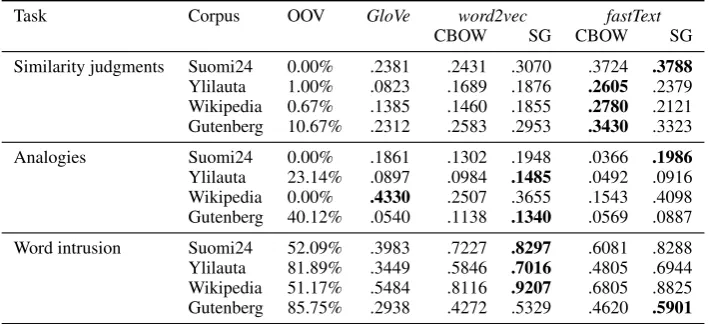
Task Corpus OOV GloVe word2vec fastText
CBOW SG CBOW SG
Similarity judgments Suomi24 0.00% .2381 .2431 .3070 .3724 .3788
Ylilauta 1.00% .0823 .1689 .1876 .2605 .2379 Wikipedia 0.67% .1385 .1460 .1855 .2780 .2121 Gutenberg 10.67% .2312 .2583 .2953 .3430 .3323 Analogies Suomi24 0.00% .1861 .1302 .1948 .0366 .1986
[image:4.595.122.477.63.225.2]Ylilauta 23.14% .0897 .0984 .1485 .0492 .0916 Wikipedia 0.00% .4330 .2507 .3655 .1543 .4098 Gutenberg 40.12% .0540 .1138 .1340 .0569 .0887 Word intrusion Suomi24 52.09% .3983 .7227 .8297 .6081 .8288 Ylilauta 81.89% .3449 .5846 .7016 .4805 .6944 Wikipedia 51.17% .5484 .8116 .9207 .6805 .8825 Gutenberg 85.75% .2938 .4272 .5329 .4620 .5901
Table 2: Performance of different language models in the three presented evaluation tasks. The scores of the best performing models for each corpus in each evaluation task are marked in bold.
turn attention away from evaluating coherence of topics and towards evaluating the language model itself. We conduct the same task but manually construct the intrusion sets from words which are known, a priori, to belong to specified topics. The topics used in this research comprised of lists of articles from Finnish language Wikipedia. In total, 16 lists were extracted, including lists of sports, illnesses, minerals, and professions, among others. The lists contained 4127 unique items in total. In order to evaluate the language model and not the underlying corpus, only words which had a vector representation in the language model under evalua-tion were included in the intrusion sets.
Following (Chang et al., 2009), the size of the intrusion set was set to 6 words, where 5 words are randomly sampled from word list A and one outlier word from list B. The intrusion task is conducted 10 000 times with each ordered pair of the given lists. This was done to increase the task’s reliability by reducing effects arising from random sampling of words from variable-length lists. A models score is the overall percentage of correctly determined intruder words.
3 Results
To demonstrate the evaluation methods in effect, results on multiple distributional language models are presented in Table 2. Out of vocabulary rates are reported for each task given a corpus.3 The
Gutenberg corpus has the highest OOV rate in all tasks, suggesting that these evaluation sets function best with models built from contemporary corpora.
3OOV words were excluded from similarity and intrusion
tasks but included and counted as errors in the analogy task.
While the performance of different models is varied between different tasks and corpora, some trends can be observed. The word2vec Skip-gram and fastText models appear to produce better re-sults compared to GloVe and word2vec-CBOW models. Conceptual relations as measured by the analogy task are best captured from Wikipedia corpus, while the large social media corpus of Suomi24 achieves the best correspondence with human similarity judgments.
4 Conclusions
References
Eneko Agirre, Enrique Alfonseca, Keith Hall, Jana Kravalova, Marius Pas¸ca, and Aitor Soroa. 2009. A study on similarity and relatedness using distribu-tional and wordnet-based approaches. In Proceed-ings of Human Language Technologies: The 2009 Annual Conference of the North American Chap-ter of the Association for Computational Linguis-tics, pages 19–27. Association for Computational Linguistics.
Eneko Agirrea, Carmen Baneab, Daniel Cerd, Mona Diabe, Aitor Gonzalez-Agirrea, Rada Mihalceab, German Rigaua, Janyce Wiebef, and Basque Coun-try Donostia. 2016. Semeval-2016 task 1: Seman-tic textual similarity, monolingual and cross-lingual evaluation. Proceedings of SemEval, pages 497– 511.
Martin L Albert, Avinoam Reches, and Ruth Silver-berg. 1975. Associative visual agnosia without alexia. Neurology, 25(4):322–326.
Aller Media Oy. 2014. The Suomi 24 Corpus. May 14th 2015 version, retrieved October 27, 2016 from http://urn.fi/urn:nbn:fi:lb-201412171.
Mohit Bansal, Kevin Gimpel, and Karen Livescu. 2014. Tailoring continuous word representations for dependency parsing. InACL (2), pages 809–815.
Marco Baroni, Georgiana Dinu, and Germ´an Kruszewski. 2014. Don’t count, predict! A systematic comparison of context-counting vs. context-predicting semantic vectors. In ACL (1), pages 238–247.
Piotr Bojanowski, Edouard Grave, Armand Joulin, and Tomas Mikolov. 2016. Enriching word vec-tors with subword information. arXiv preprint arXiv:1607.04606.
Igor Brigadir, Derek Greene, and P´adraig Cunningham. 2015. Analyzing discourse communities with dis-tributional semantic models. InProceedings of the ACM Web Science Conference, page 27. ACM.
Elia Bruni, Gemma Boleda, Marco Baroni, and Nam-Khanh Tran. 2012. Distributional semantics in tech-nicolor. In Proceedings of the 50th Annual Meet-ing of the Association for Computational LMeet-inguistics: Long Papers-Volume 1, pages 136–145. Association for Computational Linguistics.
Ruth Campbell and Efisia Sais. 1995. Accelerated metalinguistic (phonological) awareness in bilingual children.British Journal of Developmental Psychol-ogy, 13(1):61–68.
Jonathan Chang, Sean Gerrish, Chong Wang, Jordan L Boyd-Graber, and David M Blei. 2009. Reading tea leaves: How humans interpret topic models. In
Advances in Neural Information Processing Systems 21 (NIPS), pages 288–296.
Billy Chiu, Anna Korhonen, and Sampo Pyysalo. 2016. Intrinsic evaluation of word vectors fails to predict extrinsic performance. In Proceedings of the 1st Workshop on Evaluating Vector Space Representa-tions for NLP, pages 1–6. Association for Computa-tional Linguistics.
Lev Finkelstein, Evgeniy Gabrilovich, Yossi Matias, Ehud Rivlin, Zach Solan, Gadi Wolfman, and Ey-tan Ruppin. 2001. Placing search in context: The concept revisited. InProceedings of the 10th inter-national conference on World Wide Web, pages 406– 414. ACM.
Michael Gamon. 2004. Sentiment classification on customer feedback data: noisy data, large feature vectors, and the role of linguistic analysis. In Pro-ceedings of the 20th international conference on Computational Linguistics, page 841. Association for Computational Linguistics.
Zellig S Harris. 1954. Distributional structure. Word, 10(2-3):146–162.
Felix Hill, Roi Reichart, and Anna Korhonen. 2015. SimLex-999: Evaluating semantic models with (gen-uine) similarity estimation. Computational Linguis-tics, 41(4):665–695.
Andrej Karpathy and Li Fei-Fei. 2015. Deep visual-semantic alignments for generating image descrip-tions. In Proceedings of the IEEE Conference on Computer Vision and Pattern Recognition, pages 3128–3137.
Ira Leviant and Roi Reichart. 2015. Separated by an un-common language: Towards judgment lan-guage informed vector space modeling. CoRR, abs/1508.00106.
Odd Ivar Lindland, Guttorm Sindre, and Arne Solvberg. 1994. Understanding quality in conceptual model-ing.IEEE software, 11(2):42–49.
Tomas Mikolov, Kai Chen, Greg Corrado, and Jef-frey Dean. 2013a. Efficient estimation of word representations in vector space. arXiv preprint arXiv:1301.3781.
Tomas Mikolov, Ilya Sutskever, Kai Chen, Greg Cor-rado, and Jeffrey Dean. 2013b. Distributed repre-sentations of words and phrases and their composi-tionality. InAdvances in neural information process-ing systems, pages 3111–3119.
Nikola Mrkˇsi´c, Diarmuid ´O S´eaghdha, Blaise Thom-son, Milica Gaˇsi´c, Lina Rojas-Barahona, Pei-Hao Su, David Vandyke, Tsung-Hsien Wen, and Steve Young. 2016. Counter-fitting word vectors to lin-guistic constraints. InProceedings of NAACL-HLT, pages 142–148. Association for Computational Lin-guistics.
Project Gutenberg. n.d. Retrieved October 27, 2016 from www.gutenberg.org.
Carlo Strapparava and Rada Mihalcea. 2007. Semeval-2007 task 14: Affective text. In Proceedings of the 4th International Workshop on Semantic Evalu-ations, pages 70–74. Association for Computational Linguistics.
Fei Sun, Jiafeng Guo, Yanyan Lan, Jun Xu, and Xueqi Cheng. 2016. Semantic regularities in document representations. arXiv preprint arXiv:1603.07603.
Viljami Venekoski, Samir Puuska, and Jouko Vankka. 2016. Vector space representations of documents in classifying finnish social media texts. In Pro-ceesings of the 22nd International Conference on In-formation and Software Technologies, ICIST 2016, pages 525–535. Springer.
Wikimedia Foundation. n.d. Wikipedia
– the free encyclopedia. 2016-10-20
dump, retrieved October 27, 2016 from
https://dumps.wikimedia.org/fiwiki/20161020/.
Ylilauta. 2011. Ylilauta Corpus. March 4