Support of Arabic Sign Language Machine Translation
based on Morphological processing
Sawsan Asjea
Postgraduate Student (PhD.)Computer Engineering Dept Faculty of Electrical & Electronic
Engineering University of Aleppo, Syria
O. Ismail
ProfessorComputer Engineering Dept Faculty of Electrical & Electronic
Engineering University of Aleppo, Syria
Souheil Khawatmi
Associate Professor Computer Systems and NetworksDept.
Faculty of Informatics Engineering, University of Aleppo,
Syria
ABSTRACT
This paper presents a morphological processing system as a part of arabic text to arabic sign language machine translation system. This morphological processing depends on Farasa analyzer tool, Stanford model and Arramooz lexicon. The characteristics of sign language are achieved to get intermediate arabic sign language sentences. Then these sentences are searched in a sign language dictionary word by word to display the related signs images if available, or to display letters of word using finger spelling alphabet images. The proposed system is tested on many non-vowelized arabic sentences, and good results and high accuracy are obtained.
Keywords
Machine Translation (MT), Morphological Analysis, Arabic sign language.
1.
INTRODUCTION
Sign language is the native language of the deaf. The presence of translators from and into sign language is important to ensure communication between deaf and normal people. Machine translation between natural languages has been and remains a major challenge for researchers in the field of natural language processing and machine translation. This challenge increases when the source language and the target language are not identical at the syntactic and morphology levels [1].
Arabic language is very rich in morphological and syntactic structures. Each word in arabic has a certain pattern and morpheme parts which distinct words from each other. Arabic derivational and declension processes allow a wide range of verbs and nouns variation [2], Arabic linguistic resources are computerized as Arramooz lexicon [3], Almaany dictionary [4], and Azhary lexical ontology [5].
Arabic sign language is basically manual language, it has special structure and semantic features. Arabic sign language is made by combination of manual features as hands shape, position of hands in relation to body, directions of hands within space, and non-manual features, like face expression, mouth, and tongue movement[6].The vocabulary in arabic sign language is few and limited comparing with standard arabic. Unified Arabic Sign Dictionary contains 1500 sign in 2001, then 1,600 sign is added in 2007, so arabic sign language is still in developmental stages and many efforts are done to standardize it in arabic world [7].
A prototype of arabic sign language translation system is designed in [8] using example based EBMT approach, morphological processing and root extractor are added in this
system for getting syntactic and semantic information in order to increase the accuracy of the system and overcome the limitation of small corpus.
A first version of machine translation system ATLASLang MTS 1 is presented in [9] based on rule-based Interlingua and example-based approaches, the system uses SAFAR Platform and ALKHALIL morph to extract the morphological properties of each word of the input sentence, then it generates a video sequence representing the sentence in arabic sign language, the input of the system must be completely vowelized.
An intelligent system to translate arabic natural language to arabic sign language is designed in [10] based on knowledge base and image processing, the knowledge base solves the problem of few number of words in the arabic sign dictionary compared with words in arabic language dictionaries.
Moreover morphological analysis is used in several applications as machine translation [11], Search Engine [12].
Researchers in the field of natural language processing has interested on designing morphological and syntactical analyzers to use them in improving the performance of natural language processing tasks [13][14]. Farasa is a fast and accurate arabic morphological analyzer tool depends on SVM-rank using linear kernels [15], Farasa tool has the ability of segmentation, part speech tagging, lemmatization, named entity recognition, and parser [16], the Stanford CoreNLP toolkit, an extensible pipeline that provides core natural language analysis is described in [17]. Stanford CoreNLP toolkit has analysis components supported for arabic like Tokenize, Sentence Splitter, POS tagger, Regex NER, Parser [18].
This paper is organized in the following sections, section 2 shows the characteristic of arabic sign language, and section 3 presents importance of the morphological search, whereas section 4 displays the architecture of proposed arabic sign language machine translation system and explains the design of morphological processing, and section 5 illustrates the results and comparison.
2.
CHARACTERISTIC OF ARABIC
SIGN LANGUAGE
the sign sentence, because the prepositions are implicitly understood by the movement of the sign. Table1 shows several syntactic structures of the sentence in arabic sign language.
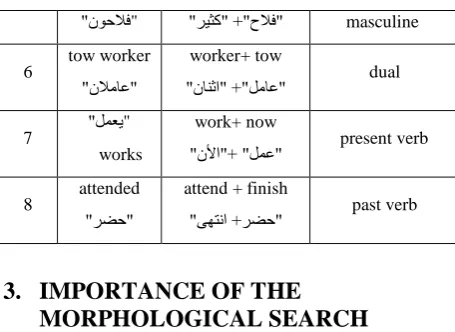
On the other hand, many morphological forms in arabic sign language are indicated by special signs, for example plural form is expressed by the sign of the word " a lot" "ريثك", a human feminine is expressed by the sign of the word "girl"
تنب
[image:2.595.314.542.67.233.2]"
", and a dual form is indicated with the sign of the word "two""
نانثا
", also the tenses of the verb are presented with special signs as the sign of the word "finish""
ىهتنا
" for the past verb, the sign of the word "now""
نلآا
" for the present verb and the sign of the word "after" "دعب" for the future verb. Table 2 shows examples of these morphological forms in arabic sign language.Table 1. Syntactic structures of the sentence in arabic sign language
Arabic Sign Language Arabic Language
No.
Subject+ Verb+ Object Verb+ Subject+ Object
1
Subject+ Adjective+ Verb Verb+ Subject+ Adjective
2
Subject+ Verb+ Object+ Adjective Verb+ Subject+ Object+
Adjective 3
adverbial of time + Subject+ Verb Verb+ Subject+ adverbial
of time 4
? + Subject+ Verb+ Object+ "reason" Why+ Verb+ Subject+
Object+? 5
? + "place" + Subject+ Verb+ Object Where + Verb+ Subject+
Object+? 6
Subject+ verb +noun after preposition Verb+ subject+
[image:2.595.57.280.277.497.2]preposition+ noun after preposition 7
Table 2. Examples of morphological forms in Arabic sign language
No. Arabic word Arabic sign
language word
Morphological form
1 manager ةريدم " "
manager + girl
ريدم " + " تنب
" " human feminine
2 workers " تلاماع "
worker+ girl+ a lot
" لماع " + " تنب " +
" ريثك "
regular
plural human feminine
3 library ةبتكم " "
library
ةبتكم " "
inhuman feminine
4 books
"بتك"
book+ a lot
" باتك " + " ريثك "
irregular plural masculine
5 farmers farmer + a lot regular plural
نوحلاف
" " "ريثك" +"حلاف" masculine
6 tow worker " نلاماع "
worker+ tow
" لماع " + " نانثا
" dual
7 "لمعي" works
work+ now
" لمع "+ " نلأا
" present verb
8 attended " رضح "
attend + finish
" رضح + ىهتنا
" past verb
3.
IMPORTANCE OF THE
MORPHOLOGICAL SEARCH
Algorithms of the Morphological search depend on the morphological analysis of the words [11] [19].
Sign language dictionary contains the signs of the words as images, the arabic words which have the same lemma is indicated by the same image, so the arabic sentences need arabic morphological processing for getting the lemma of the arabic words. For instance, the sign of arabic word "worker" "لماع" is the same sign of the words "workers" "نولماع", "two workers" "نلاماع", "the worker" "لماعلا", "the workers" "نولماعلا", "تلاماعلا" or "لامعلا", so only one word have to be found "worker" "لماع" from morphological processing, then this word will be searched from arabic sign dictionary.
4.
ARCHITECTURE OF THE
PROPOSED ARABIC SIGN
LANGUAGE MACHINE
TRANSLATION SYSTEM
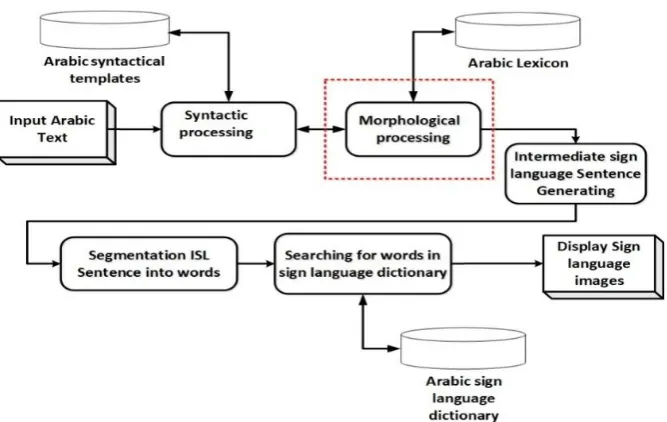
Arabic sign language machine translation system is used for converting text from arabic language (source language) into images of arabic sign language (target language) automatically. The implementing of this proposed system needs two tasks of processing, these tasks are:
1- Syntactic processing: which is used in creating the structure of the intermediate arabic sign language sentences based on the syntactic structure of arabic sentences and syntactic structure of arabic sign language sentences.
2- Morphological processing: which is used for achieving morphological forms in arabic sign language, and doing morphological search in arabic sign language dictionary.
So, when the arabic sentence is entered to system, morphological processing using arabic lexicon is done, and syntactical processing using syntactical templates will take place, then intermediate arabic sign language sentence is generated based on the combination results of morphological processing and syntactical processing, finally, every word in intermediate arabic sign language sentence is searched for in arabic sign language dictionary to display related sign images. Figure 1 shows the architecture of proposed arabic sign language machine translation system.
[image:2.595.51.284.539.735.2]Fig 1: Architecture of the Arabic Sign Language Machine Translation System
4.1
Design and Implementation of
proposed Morphological Processing
System
[image:3.595.53.287.409.742.2]Morphological processing system is essential part in arabic sign language machine translation system, and it is word based analysis. So, at first, the arabic sentence is split into words, and every word is passed to all phases of the proposed morphological system as shown in figure 2 as follows:
Fig 2: The phases of the design proposed morphological system
4.1.1
Determining the type of the word:
The type of the word in arabic is a name, a verb or a character. The names are distinguished from the verbs in arabic by different patterns, prefixes and suffixes.
The distinguishing process between names and verbs is a basic task to achieve the characteristics of words in the sign language, such as plural, dualization, feminization, and the tenses of the verb. Stanford POS tagger, the one of the most popular and accurate Arabic Part Of Speech (POS), is used in this stage as follows:
S = w0…. wn T = t0…… tm
where, S is arabic sentence of n words, T is intermediate Arabic sign language sentence of m words.
R1#: If posstanford(wi)={VBD} then type(wi) = past verb.
R2#: If posstanford(wi)={VBP} then type(wi) = present verb. R3#: If posstanford(wi)={VBN}and prefix(wi)={"ya" 'ي', "ta" 'ت', "noon" 'ن', "hamza" 'أ'} then type(wi) = present verb.
R4#: If posstanford(wi)={DTNN| NN| DTJJ| NNP| DTNNS,JJ,NNS} then type(wi) = noun.
Table 3 shows examples for determining the type of the arabic words using Stanford POS tagger.
Table 3. Examples for determining the type of the word using Stanford Part Of Speech model
Arabic Input Sentence Stanford Part of
Speech
The manager attended the party
" ةلفحلا ةريدملا ترضح "
The workers help the human
" ناسنلإا نولماعلا دعاسي "
Pressure gauge device consists of pipes
The skull protects the brain
" غامدلا ةمجمجلا يمحت "
The two doctors treated the children " جلاع نابيبطلا دلاولأا "
4.1.2
Extracting the lemma of the word:
Some verbal shifts occur in arabic when the verb is connected with pronouns, for example "he came" "ءاج", "they came" "اوؤاج","I came" "تئج" and "he came back" "داع", "he comes back" "دوعي","we came back"
"
اندع
"
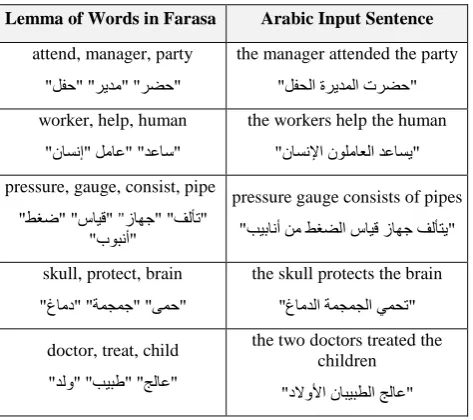
. Also, the forms of the nouns are changed when the noun is singular, dual or plural or when nouns are connected to pronouns. So the lemma of the noun or the verb is extracted to get the basic form of the word without any changes. In addition, the searching process in arabic sign dictionary will be done depending on lemma of the word. [image:4.595.51.289.71.149.2]Farasa lemmatization tool is used for extracting lemma of the arabic word because it is accurate, whereas Stanford can not. Table 4 shows some examples for extracting lemma of the words.
Table 4. Examples for extracting the lemma of the words using Farasa lemmatization tool
Arabic Input Sentence Lemma of Words in Farasa
the manager attended the party
" لفحلا ةريدملا ترضح "
attend, manager, party
" رضح " " ريدم " " لفح "
the workers help the human
" ناسنلإا نولماعلا دعاسي "
worker, help, human
" دعاس " " لماع " ناسنإ "
pressure gauge consists of pipes
" بيبانأ نم طغضلا سايق زاهج فلأتي "
pressure, gauge, consist, pipe
" ت فلأ " " زاهج " " سايق " " طغض " " بوبنأ "
the skull protects the brain
" غامدلا ةمجمجلا يمحت "
skull, protect, brain
" ىمح " " ةمجمج " " غامد "
the two doctors treated the children
" نابيبطلا جلاع دلاولأا
" doctor, treat, child
" جلاع " " بيبط " " دلو "
4.1.3
Analysis of the nominal word:
The nominal word in this phase is analyzed to match one or two forms of plural, dualization, and feminization.
1- identify of the plural form:
The plural form is obtained based on the Farasa tool and the Stanford model for morphological analysis. Farasa is accurate in determining irregular plural form (P) of the word. Stanford is accurate in determining regular plural form (NNS, DTNNS) of word, so the result of Stanford and Farasa analysis is combined to determine the plural form of word that is analyzed. Two rules are proposed to overcome the mistakes that may occur when determining the morphological form of word as a plural instead of a singular.
The first rule R5 adds a condition to the plural word that the suffix of word is ("ya" 'ي', "waw" 'و', "alef ta" "تا" "ya noon"
"ني" "waw noon" "نو"), and the word doesn't equal to the
lemma of the word.
R5#: if typestanford (wi)=noun and (posstanford ={DTNNS|NNS} || posfarasa=P ) and suffix(wi) = {
|
ني
|
نو
تا
|
و
|
ي
} and lemma(wi)≠ wi then number(wi)=plural "عمج"The second rule R6 adds a condition to the plural word that the word without "al" "لا" is must be a broken plural in Arramooz.
R6#: if typestanford (wi) =noun and (posstanford =
{DTNNS|NNS} || posfarasa=P) and
broken_pluralarramooz(wi without
"
لا
") = true then number(wi)= plural "عمج". [image:4.595.311.546.299.651.2]Table 5 shows examples for determining the plural form in proposed system, Where the symbol () represents a correct case and the symbol () is a false case.
Table 5. Determining the plural form in the proposed system word plural form in arabic language plural form in Stanford plural form in Farasa pro_ posed rule plural form in proposed system farmers " نوحلاف " regular plural masculine plural () singula r () R5
plural () workers " نولماع " regular plural masculine plural () plural
() R5
plural () writers " تابتاك " regular plural human feminine singular () plural
() R5
plural () lands " يضارأ " irregular plural singular () plural
() R6
plural () children " أ دلاو " irregular plural singular () plural
() R6
plural () manager " ةريدم " singular singular () plural () R5,R6 singular () mad " نونجم " singular singular () singula r ( ) none singular ()
[image:4.595.49.287.363.575.2] [image:4.595.50.287.365.575.2]a decision making of many cases, as the word manager "ةريدم", in spite of Farasa determines it as plural but it is not. If the word is not determined as plural in Farasa or Stanford then the rules are not applied, as the word mad "نونجم".
2- identify of the dual form:
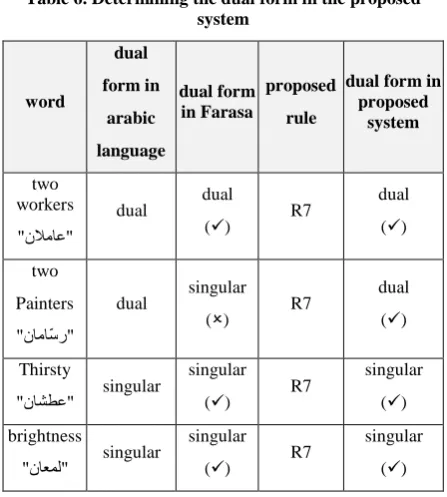
Dual form is not supported in Stanford model, so the word is determined as dual using Farasa tool, or by ensuring that the suffix of the word is "alef noon" "نا", and the word is not equal to the lemma of it.
R7#: If typestanford (wi)=noun and (posfarasa=D || (suffix(wi)=
"
نا
"
and lemma(wi)≠ wi )) then number(wi)=dual. [image:5.595.55.279.268.517.2]Table 6 shows examples for determining the dual case using R7, where the symbol () represents a correct case and the symbol () is a false case.
Table 6. Determining the dual form in the proposed system
word
dual
form in
arabic
language
dual form in Farasa
proposed
rule
dual form in proposed
system
two workers
" نلاماع "
dual dual
() R7
dual
()
two
Painters
" ناماّسر "
dual singular
() R7
dual
()
Thirsty
" ناشطع
" singular
singular
() R7
singular
()
brightness
" ناعمل
" singular
singular
() R7
singular
()
For example, in table 6 the first word two workers "نلاماع" is determined by Farasa tool as dual, but the word two painters "ناماسر" is determined as dual because the suffix is an "نا" and the word "ناماسر" is not equal to the lemma of word painter "ماسر", but in the rest examples, the result of the rule is false because the words and the lemma of them are the same.
Notice that the dual in the case of accusative and genitive is ignored because the case markers are the same in the plural and the dual and it cannot distinguish from each other without vowels.
3- identify of the human feminine form:
The following rules are proposed to find the form of femininity and to distinguish the human feminine form.
R8#: If typestanford (wi) =noun and suffix (wi) ='ة' then gender1
(wi) = feminine.
R9#: If gender1 (wi)= feminine and feminable_valuearramooz
(wi without 'ة') =Ta then gender(wi)= is human feminine
Every word in Arramooz lexicon has many properties, one of
them is "feminable", the value of the "feminable" property is Ta when the feminine is human and the value is "Ta" with double quotation for feminine which is not human like animal, or the value is blank for words which has the letter ' ة' as a basic letter. Some words has to be vowelized to distinguish it as human feminine or not like Syrian women "ةَّيروس" and the country Syria "ةيروس". Table 7 shows examples for determining human feminine form of the word and comparing results of the proposed rules with Farasa tool results.
Table 7. Determining the human feminine form in proposed system
word
human feminine
form in
arabic
language
human feminine
form in
Farasa Pro_
posed
rule
human feminine
form in proposed
system
schoolgirl " ةبلاط "
human
feminine feminine R8, R9 human feminine
manager
" ةريدم "
human
feminine Masculine R8, R9 human feminine
skull
" ةمجمج "
non-human
feminine feminine R8, R9
non-human feminine
bird
" ةروفصع "
non-human
feminine feminine R8, R9
non-human feminine
4.2
Syntactic Processing:
Syntactical processing is done in previous works at the level of sentence structure. The syntactic processing studies the structure of arabic sentences, and the structure of arabic sign language. many researches utilized the syntactic processing and needed morphological analysis for translation as in [20], which used colored petri net (CPN) in the transformation stage from the grammatical components of the arabic sentence (the source), to the intermediate structure of the grammatical components of the arabic sign language sentence (target language).
4.3
Generating Intermediate Arabic Sign
Language:
The generating of the intermediate arabic sign language sentences need to combine the results of the morphological and syntactic processing systems. The arabic input sentence is split into words, each word is processed and the output of morphological processing is arranged according to output of syntactic processing which is the grammatical structure of the sentence in arabic intermediate sign language. Table 8 shows examples of combination the results of morphological and syntactical processing to generate intermediate arabic sign language sentence.
R10#: If type(wi) = present verb then tj=lemma(wi)+ "now" "نلآا"
R11#: If type(wi) = past verb then tj=lemma(wi)+ "finish" "ىهتنا"
R12#: If gender2(wi)= is human feminine then ti=lemma(wi)+"girl" "تنب"
R14#:If number(wi)=dual then tj=lemma(wi)+"two" "نانثا
"
[image:6.595.314.539.123.414.2]where .
Table 8. Generating intermediate arabic sign language
Input Arabic sentence
Result of syntactical processing
Result of morphological
processing
Output Arabic Intermediate sign sentence
the manager attends the
party
" ةريدملا ترضح
ةلفحلا "
verb + subject +object
subject + verb+ object
" لعف + لعاف +
هب لوعفم "
" لعاف + لعف +
وعفم هب ل "
"attends"
" ترضح "
"attend" "finish"
" رضح " " ىهتنا "
" the manager "
" ا ةريدمل
"
" girl "" manager "
" ريدم " " تنب "
" the party "
" ةلفحلا "
" party "
" ةلفح "
manager girl attend finish
party
" رضح تنب ريدم
ةلفح ىهتنا "
4.4
Searching in Arabic Sign Language
Dictionary:
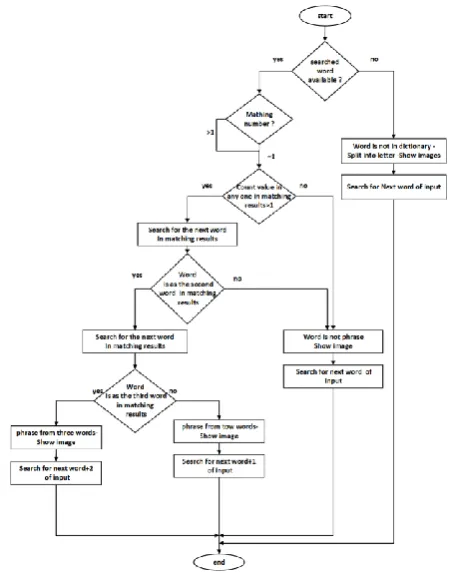
There are no digital dictionaries available for arabic sign language. Building digital arabic sign dictionary needs long time, effort and experience. A digital sign language dictionary is constructed by mapping the lemma of arabic word with the related image of the sign, jpg picture is used and they are obtained from Unified Arabic Sign Dictionary hardcopy. There is a concept of phrase in arabic sign language dictionary, the phrase consists of two or three words and it is indicated with one sign image.
The searching process of each word of intermediate arabic sign language sentence in the digital arabic sign language dictionary will be done as follows:
1) The word is not available in the dictionary: the word is divided into its constituent letters and the corresponding sign image of letters are displayed.
2) The word is available in the dictionary: check the matching's number and the search for phrase is tested.
4.4.1
Search Algorithm in Arabic Sign Language
Dictionary:
When the searching process for the arabic word in the sign dictionary is done, there are two cases:
1) The first case:
- The word is found in one match, then the count of words in this match is checked.
- The count of words is one then the sign image of the word is displayed, else, the second and third word are searched for.
2) The second case:
- The word is found in more than one match, then the count of words for every match is checked.
- The count of words is checked in all matches, then the word is single/not phrase, or a part of phrase of two or three words.
[image:6.595.53.281.127.344.2]The algorithm steps is shown in figure 3.
Fig 3: Search Algorithm in Arabic Sign Language Dictionary
For example, when the input text starts with the sentence "pressure gauge device" "طغض سايق زاهج" and the word device "زاهج" is searched in dictionary, three matches are found.
1) "Device" "زاهج", the count of the words =1. In this match the count is one so it is not a phrase.
2) "Digestive system" "مضهلا زاهج", the count of the words=2 , so phrase of two words is tested, the first word in match 2 is the same word in input sentence, but the second word in the match 2 is not the same word in input sentence, so it is not phrase of two words.
3) Temperature measuring device "ةرارحلا سايق زاهج", the count of words=3, so phrase of three words is checked, the second word in match 3 is the same of the input sentence, but the third word of the match 3 is not the same third word in the input sentence, so there is no phrase of three word.
4) "Pressure gauge device" "طغضلا سايق زاهج", the count of the words=3, so phrase of three words is checked, the second word in match 4 is the same word of the input sentence, and the third word in match 4 is the same word in the input sentence, so it is phrase of three word.
words, and word+3 if the word is determined as phrase of three words.
5.
RESULTS AND COMPARISON
The proposed morphological system is applied to many non-vowelized arabic sentences. The results are combined with the results of the syntactic processing system in order to obtain the intermediate arabic sign language sentences. Each word of the intermediate arabic sign language sentence is searched in the arabic sign language dictionary to display the related sign images. The proposed system is implemented on a laptop with a Core i5 2.50 GHZ processor and Windows10 operating system, using java programming language. Stanford and Farasa software are invoked as free jar files in the NetBeans 8.0.2 environment.
Example1
:
1) Input arabic sentence: The farmers implants the lands "يضارلأا نوحلافلا عرزي"
2) The sentence is split into words The farmers "نوحلافلا"- implants "عرزي" – the lands "يضارلأا".
3) Morphological processing:
- The type of words: Implants "عرزي"is determined by R2 as present verb because it is marked VBP in Stanford. The farmers "نوحلافلا" and the lands"يضارلأا" are determined by R4 as noun because they are marked DTNN and DTNNS in Stanford.
- The lemma of words: The lemma of words are "implant" "عرز", "farmer" "حلاف" and "land" "ضرأ" using Farasa.
- The nominal Analysis: the word the farmers "نوحلافلا" is determined as plural by R5, and the word the lands"يضارلأا" is determined as plural by R6.
4) Syntactic processing: the arabic sentence has a structure of verb+ subject+ object, so it is transferred by previous work to the structure of arabic sign language which is subject+ verb + object.
5) Generating Integrated Arabic sign language: the subject is generated by R12 as "farmer" "a lot " "حلاف "
" ريثك
" , verb is generated by R10 as "implant" "عرز" "now" "نلآا"and object is generated by R13 as "land" "a lot" "ضرأ""ريثك".So the output is generated "farmer a lot implant now land a lot" "ريثك ضرأ نلآا عرز ريثك حلاف".
6) Search in Arabic sign language dictionary: the words "the farmer" "حلاف", "implant" "عرز", "now" "نلآا" are found as one match and the count of word is one so each word is not a phrase then the image is displayed, the words "a lot" "ريثك", "land" "ضرأ" are not found in dictionary so the images of the letters ('ك', 'ث' , 'ي' ,'ر') and ('أ', 'ر' , 'ض') are displayed.
So the output arabic sign language is displayed as follows.
"farmer""حلاف" "a lot" "ريثك" "implant" "عرز"
"now" "نلآا" "land" "ضرأ" "a lot" "ريثك"
Example2
:
1) Input arabic sentence The doctor used a pressure gauge in the clinic
ةدايعلا يف طغضلا سايق زاهج ةبيبطلا تمدختسا
" "
2) Output intermediate arabic sign language sentence: Doctor girl use finish pressure gauge device clinic
"ةدايع طغض سايق زاهج ىهتنا مدختسا تنب بيبط"
"doctor""بيبط" "girl" "تنب" "use""مدختسا"
"finish" "ىهتنا"
"pressure gauge device" سايق زاهج"
طغضلا
" clinic" " "ةدايع"
In comparing the results in this research with others [9][10], it turns out that:
The topic The current
research research [9] research[10]
The input
non-vowelized
sentences
vowelized
sentences
some vowelized
words
used utilities NLP tools
Farasa tool, Stanford model
Arramooz lexicon
SAFAR Platform and ALKHALIL
morphological system
none
methodology
of morphologic al processing
morphological processing depends on Farasa and Stanford and proposed rules are designed to improve results
stem - based stemming, comparing resulted
stem with pattern, and root- based
stemming.
Using
ALKHALIL
-building
knowledge base
morph for pre-processing text
Using SAFAR to convert the output
of analyzer from html to xml format
problems
-extracting stem by key
word processing
human feminine
Processing
determine human feminine
determine feminine determine feminine
word connected with pronoun
Processing
transform the word to the
lemma
transform connected pronouns to corresponding separated ones
transform the word to the
lemma
search in dictionary
lemma based search
word based search or root based
search
word based search or stem
based search
morpho-logical cases
lemma- type of word-number-gender-human
feminine- the tense of verb
type of word-number- gender- the tense of verb
lemma- stem gender-number- the proper noun.
output arabic sign language sentence
static images 2D animation
images static images
In according of table 9, the current system is easily suitable for arabic users where the input of the system is non-vowelized sentence, and more morphological features are determined like human feminine. The current system depends on Farasa and Stanford which give one result compared with ALKHALIL which gives many results, or maybe doesn't give any result. Lemma based search overcomes the root based search because more than one word has the same root as "martyr" "ديهش", "witness" "دهاش" and each of them has a different sign image in the sign dictionary. Usually, most dictionaries don't contain all forms of the words, so word based search is often considered not useful.
6.
CONCLUSION
In this paper, a morphological processing system is proposed to achieve the characteristic of arabic sign language at the level of word, this system is a part of the proposed arabic sign language Machine translation system. The morphological system extracts lemma of the arabic word, identifies the type of word and determines the plural, dual and human feminine morphological forms. Many rules are proposed to use with Stanford model, Farasa tool and Arramooz lexicon, so the system overcomes the limitations and the weakness of morphological analyzers of the arabic language, i.e.,(inability to contain all the advantages of the arabic language).
A digital sign language dictionary is constructed by mapping the lemma of the arabic word with the related picture of the sign because the lack of digital arabic sign language dictionary.
The proposed search algorithm takes into account phrases in sign language. Many non-vowelized arabic sentences have been translated into arabic sign language with high accuracy
and good performance.
This work provides a contribution to morphological analysis development field of arabic language to suit the arabic sign language.
Arabic sign language dictionary will be developed in future work to display the signs by animation 3D avatar.
7.
ACKNOWLEDGMENTS
Our thanks to Deaf school in Aleppo city, especial thanks to the teacher Zekra Breedy for the help in understanding sign language.
8.
REFERENCES
[1] Okpor, M. D. 2014. Machine Translation Approaches: Issues and Challenges. IJCSI International Journal of Computer Science Issues. 11(5). 159-165.
[2] Ryding, K. C. 2005. A reference grammar of modern standard Arabic (chapter 3.Arabic Word Structure: An Overview). Cambridge University press, 44-56.
[3] Arramooz Alwaseet: Arabic Dictionary for Morphological analysis, http://arramooz.sourceforge.net/ [Date Accessed 16-3-2019].
[4] The Meanings Dictionary, http://www.almaany.com/ [Date Accessed 23- 9 -2019].
[5] Ishkewy, H., Harb H., Farahat, H. 2014. Azhary: An arabic lexical ontology. International Journal of Web & Semantic Technology (IJWesT). 5(4). 71-82.
[6] Abdel-Fattah, M. A. 2005. Arabic sign language: a perspective. Journal of deaf studies and deaf education. 10(2). 212-221.
[7] Samrine, S., El Benali M., Standard Arabic Sign Language Rules. Qatar National Library ISBN: 99921- 53- 41- 0.
[8] Almohimeed, A., Wald M., Damper, I., 2011. Arabic text to Arabic sign language translation system for the deaf and hearing-impaired community. The Second Workshop on Speech and Language Processing for Assistive Technologies. Association for Computational Linguistics, 101-109.
[9] Brour, M., Benabbou, A., 2019. ATLASLang MTS 1: Arabic Text Language into Arabic Sign Language Machine Translation System. Procedia computer science. 148. 236-245.
[10] El- Alfi, A., El- Basuony, M., El- Atawy, S. 2014. Intelligent Arabic text to Arabic Sign Language Translation for Easy Deaf Communication. International Journal of Computer Applications. 92(8). 22-29.
[11] Abu Shquier, M. M., Atoum, M. S., Abu Shqeer, O. M. 2017. Arabic to English Machine Translation. Proceedings of the New Trends in Information Technology (NTIT). 118-124.
[12] Hattab, M., haddad, B., yaseen, M., duraidi, A. 2009. Addaall arabic search engine: Improving search based on combination of morphological analysis and generation considering semantic patterns. In The second International Conference on Arabic Language Resources and Tools, Cairo, Egypt, 159-162.
language MT. International Journal of Speech Technology, 19(2). 203-228.
[14]Boudchiche, M., MazrouI, A., Bebah, M., Lakhouaja, A., Boudlal, A. 2017. AlKhalil Morpho Sys 2: A robust Arabic morpho-syntactic analyzer. Journal of King Saud University-Computer and Information Sciences, 29(2), 141-146.
[15]Abdelali, A., Darwish, K., Durrani, N., Mubarak, H. 2016. Farasa: A fast and furious segmenter for arabic. Proceedings of the 2016 Conference of the North American Chapter of the Association for Computational Linguistics: Demonstrations, 11-16.
[16]FARASA : QCRI Arabic Language Technologies Tools & Demos, Qatar Computing Research Institute, http://qatsdemo.cloudapp.net/farasa/demo.html. [Date Accessed 16- 3 -2019].
[17] Manning, C., Surdeanu, M., Bauer, J. 2014. The Stanford CoreNLP natural language processing toolkit. Proceedings of 52nd annual meeting of the association for computational linguistics: system demonstrations, 55-60.
[18] Stanford CoreNLP: http://corenlp.run/. [Date Accessed 16 -3 -2019].
[19] Khadim, S.M., Abdulmunim, M.E. 2013. Design a Computerized Lexicon for Machine Translation from Arabic to English. University of Technology. Baghdad, 191-202.