Munich Personal RePEc Archive
A component model for Dynamic
Conditional Correlations: Disentangling
interdependence from contagion
Urbina, Jilber
Department of Economics, Universitat Rovira i Virgili (URV),
Centre de Recerca en Economia Industrial i Economia Pública
(CREIP), Banco Central de Nicaragua (BCN)
12 September 2013
Online at
https://mpra.ub.uni-muenchen.de/75579/
A Component Model for Dynamic Conditional
Correlations: Disentangling Interdependence from
Contagion
Jilber Urbina
∗Abstract
We analyze whether the crisis sourced in US is spread over the world by contagion
or through interdependence. Within this work, contagion is defined as a significant
increase in cross-correlations after a crisis hits a country, we assumed that correlations
are not constant over time and also evolve according to a GARCH(1,1)-type structure
which give rise to the use of the popular DCC model introduced by Engle (2002) and
extended in Colacito et al. (2011) to disentangle the short and long run component of
the total correlation of the portfolio under study. We link interdependence with long-run
fluctuations in correlations and contagion is associated with the short-run correlations.
JEL codes: C01, C58, G01, G15.
Keywords: contagion, financial crisis, stock markets, global transmission, market integration,
Dy-namic Conditional Correlations.
∗This paper was totally developed at the Department of Economics, Universitat Rovira i Virgili and
1
Introduction
Assessment of the transmission mechanisms of financial crisis across countries based on
cor-relations have been payed a lot of attention since King and Wadhwani (1990) and then
reinforced by Forbes and Rigobon (2002). Correlation approach is useful since it provides a
straightforward way to test for contagion (see Forbes and Rigobon, 2002), nevertheless the
“static” correlation approach is very simplistic, it splits the sample into two subsamples
(pre-crisis and post-(pre-crisis periods) and performs a test of significant increase in correlations over
these two periods where the underlying correlations are fixed within periods, none dynamic
is involved in the correlations.
The lack of temporal dynamics in the correlations can be overcome by using a Dynamic
Conditional Correlation (DCC) model, first introduced by Engle (2002). Several attempts
have been done to test for contagion by averaging the dynamic correlations belonging to
each subsamples and then performing a classical t-test for mean differences, see for instance
Wang and Nguyen Thi (2013), Naoui et al. (2010a), Naoui et al. (2010b) and Chiang et al.
(2007) . These works rely on defining contagion as an increase in cross-market linkages after
a exogenous negative shock in one country or group of countries (such definition corresponds
to the World Bank’s “very restrictive” definition), but none of them show the time varying
behavior of both interdependence and contagion.
We try to shed some light on the gap, which in terms of Rigobon (2003), no satisfactory
procedure has been developed to be able to answer the question whether contagion occurs
or not using the correlation-based definition since the seminal contribution by King and
Wadhwani (1990).
We use a component model for the DCC to capture both, interdependence and contagion
via a parsimonious parameter structure and still rely on thevery restrictive definition of
con-tagion, but allowing the correlations to be time varying. Using the DCC-MIDAS1 introduced
by Colacito et al. (2011) we can disentangle both, the long run and short run components
of the time varying correlations which can allows us to associate the former with contagion
1
DCC-MIDAS: Dynamic Conditional Correlation - Mixed Data Sampling Model.
and the latter with interdependence.
Within this framework we identify interdependence which is in itself a contribution since
it helps to better understand contagion. Forbes and Rigobon (2002) discussed the influence
of heteroscedasticity over the correlations and furthermore, a correction is also proposed.
Nevertheless, the test over the corrected correlation operates in a static environment such
that contagion can be wrongly diagnosed, mainly because interdependence effects have not
been discounted from the correlations.
As discussed inForbes and Rigobon(2002) correlation after a negative shock can increase
because of heteroscedasticity, however, as markets moves more and more together due to
market integration, it is plausible to think that interdependence also varies over time and
moves in the same direction of market integration, therefore, correlations also can be increased
by the effect of integration and such integration is represented by interdependence which is
not explicitly taken into account in previous works.
The above ideas are relevant since financial links play an important role in economic
integration of an individual country into the world market (Dornbusch et al., 2000), this
means that a financial crisis in one country can lead to direct financial effects to other
countries. In line with Dornbusch et al. (2000) the spread of a financial crisis depends
primarily on the investors’ behavior and on the degree of financial market integration, they
claims that in this sense, financial markets facilitate the transmission of real or common
shocks but do not cause them. As these kind of links (financial and trade) give rise to market
integration (interdependence) play and important role for transmitting crisis, a measure of
such links over time become crucially important, this measure is provided in this context by
the long-run correlation given by the MIDAS filter.
Long-run component can be seen as the measure of financial market integration which is
plausible to be modeled as a slowly moving average of correlations due to the fact that such
integrations are neither constant overtime nor fast-moving, it evolves slowly.
Empirical works on contagion has been focused mainly on the co-movements in asset
prices rather than on “excessive” co-movements among them (Dornbusch et al., 2000). We
of interdependence, this is done by subtracting from the short-run correlation at time t,
the corresponding long-run correlation. Once we have the correlation without the effects of
interdependence, we can perform a test for contagion.
In order to estimate both kind of correlation, we use recently introduced DCC-MIDAS
model of Colacito et al. (2011). DCC-MIDAS model is not a new model since is was
intro-duced by Colacito et al.(2011), nevertheless the novelty of our approach is the application of
this model to the context of contagion vs interdependence, where we associate contagion to
short-lived events (short run correlations) and interdependence is directly linked to long-run
correlations.
After adjusting the correlations by discounting the interdependence effects we perform a
test for contagion leading to the conclusion that the Global Financial Crisis triggered in US
was spread to other countries through interdependence. We only find evidence of contagion
for one pair of countries: Brazil - Japan.
The remaining of this work is arranged as follows: insection 2 we present the model, its
notation, the estimation procedure and the hypothesis test strategy. Empirical application
is developed in section 3, some concluding remarks are in section 4.
2
Model Specification
2.1
Notation and Preliminaries
We begin this section by providing the meaning of the notation used throughout this work.
Letrt = [r1,t, . . . , rn,t]′ be a vector of returns such that follows the processrt ∼N(µ,Ht)
with:
Ht=DtQtDt, (1)
where µ is the vector of unconditional means, Ht is the conditional covariance matrix, Qt
is the conditional correlation matrix and Dt is a diagonal matrix with conditional standard
deviations on the diagonal, with:
Qt=E[ξtξt′ |Ωt−1] (2)
ξt=D−
1
t (rt−µ), (3)
where ξt is a vector of standardized residuals andΩt−1 is the information set available up to
t−1. Therefore, we can write the vector of returns as rt=µ+H
1/2
t ξt with ξt∼N(0,In)
2.2
The DCC–MIDAS model
The DCC-MIDAS model is a natural extension to DCC model, they both are very similar in
their formulation and the main difference between them is that DCC-MIDAS has two
com-ponents: a long-run and a short-run component for correlations. The standard formulation
of a DCC models is shown in (4) and the one corresponding to a DCC-MIDAS model is (5),
one can tell that the difference between them is the construction of R¯. For the standard DCC model R¯ represents the matrix of unconditional correlations which is time invariant, in contrast for the DCC-MIDAS,Rbecomes intoR¯t(ω), which is time varying and its behaviour is entirely determine by a slowly moving average weighting, ω. R¯t(ω) is interpreted as the long-run component and its counterpart, the short-run component, is left to be represented
by Qt:
Qt= (1−a−b)R¯ +aξt−1ξt′−1+bQt−1 (4)
Qt = (1−a−b)R¯t(ω) +aξt−1ξ′t−1+bQt−1 (5)
where the long-run component is R¯t(ω) = PK
l=1Φl(ω)⊙Ct−1 a slowly moving average of
some correlation matrix denoted by Ct−l with typical element being ci,j,t−l. The operator
⊙ denotes the Hadamard product. For the short-run component to be a correlation, the following transformation is needed Qt∗ = {diag(Qt)−
1
Qtdiag(Qt)−
1
} (Engle, 2002), where
q∗
If we denote the typical element ofQt as qi,j,t and if the typical element of matrix R¯t is
denoted by ρ¯i,j,t, then we can write the full formulation of the DCC-MIDAS as follows:
qi,j,t= (1−a−b)¯ρi,j,t+aξi,t−1ξj,t−1+bqi,j,t−1 (6)
q∗
i,j,t=
qi,j,t
√q i,i,tqj,j,t
¯
ρi,j,t= K
X
l=1
ϕ(ω)ci,j,t−l
ci,j,t−l=
Pt−l
k=t−l−N ξi,kξj,k
qPt−l k=t−l−Nξ
2
i,k
qPt−l k=t−l−Nξ
2
j,k
ϕ(ω) = 1−
1
K
ω−1
K
P
j=1
1− Kjω−1
According to the formulation of system (6), the value of N is needed for estimating
the weighted correlation ci,j,t−l which only accounts for the last N past observations in its
calculation, then over these correlations, a long run correlation is estimated as a weighting
average of all the K past values giving weights ϕ(ω).
Under this formulationq∗
i,j,t is the short run correlation between assets i and j, whereas
¯
ρi,j,tis a slowly movinglong runcorrelation. Furthermore,ϕ(ω)are the so called Beta weights
which governs the movements of the long run component, this weighting scheme allows us
to extract the slowly moving secular component around which the short-run component
evolves. Lag lengths are denoted by N and span lengths of historical correlations are left to
be represented by K, we consider N and K are constant for all assets.
Rewriting the first equation of system (6) as:
qi,j,t−ρ¯i,j,t =a(ξi,t−1ξj,t−1 −ρ¯i,j,t) +b(qi,j,t−1−ρ¯i,j,t), (7)
conveys de idea of short run fluctuations around a time-varying long run relationship.
2.3
Estimation procedure
The estimation procedure is fully described in Colacito et al. (2011), here we briefly point
out the main aspects. In order to estimate the parameters of the DCC-MIDAS model we
follow the two step procedure of Engle (2002). Let ψ2 be the collection of parameters of the
univariate GARCH model and let Ξ be the vector of DCC parameter (a, b, ω), the
quasi-maximum likelihood (QL) takes the following form:
QL(ψ,Ξ) =QL1(ψ) +QL2(ψ,Ξ) (8)
=−
T
X
t=1
(nlog(2π) + 2log|Dt|+r′
tD
2
trt)− T
X
t=1
(log|Rt|+ξ′
tR−
1
t ξt+ξt′ξt).
The separation of QL(ψ,Ξ) into QL1(ψ) and QL2(ψ,Ξ) indicates that we can first
esti-mate the parameters of the univariate GARCH-type processes contained in ψ by maximizing
QL1(ψ) to obtain ψˆ, then we can plug ψˆ in QL2(ψ,Ξ) so that it becomes into QL2( ˆψ,Ξ)
where standardized residuals ξˆ= ˆD−1
t (rt−µˆ) are used in the second stage.
System (6) requires setting two extra parameters: N the MIDAS lag length and K, the
span lengths of historical correlations, both are chosen from the parameter space by maximum
likelihood profiling. The profiling procedure of the likelihood function is performed over the
maximization of QL2(ψ,Ξ), once we get the “optimal” N and K we reestimate the entire
model using the complete likelihood defined by
logL =−1 2
T
X
t=1
(nlog(2π) + 2 log|Dt|+r′tD−
1
t D−
1
t rt−ξt′ξt+ log|Rt|+ξt′R−
1
t ξt), (9)
maximizing it in one step to obtain the relevant standard errors of the estimated coefficients
to perform individual hypothesis tests.
2
2.4
Testing procedure
In this section we present the strategies to test for contagion based on the dynamic
correla-tions estimated under the DCC-MIDAS scheme.
One of the alternatives consist of testing H0 : a = 0 which implies that under the null,
qi,j,t is determined by (1−b)ρi,j,t(ω) +bi,j,t−1 with0≤b <1. If the empirical evidence do not
reject the null, then interdependence can be reached as the conclusion of the test. However,
if H0 :a = 0 turns out to be rejected, then this constitutes contagion defined as in Corsetti
et al.(2005) who consider that “for contagion to occur, the observed pattern of comovements
in asset prices must be too strong (or too weak) relative to what can be predicted conditional
on a constant mechanism of international transmission".
Corsetti et al. (2005) definition conveys the idea that contagion can be assessed through
performing a test for increases or decreases in the conditional correlations, in our context this
boils out to be a test overH0 :a= 0 to determine whether the co-movements are too strong
or too weak, this is the reason why the one-step estimation of the DCC-MIDAS is required.
Another approach to test for contagion is using directly the time-varying conditional
correlations produced by the model. Considering contagion as an increase in the mean
correlation after a crisis, if such increase stemmed from a model which acts like a filter
discounting the economic fundamentals, then it is plausible to assume that the increase
(positive excess) in correlations is due to irrational reactions of the agents in the markets. A
way to measure this excess based on the daily conditional time-varying correlation from the
DCC-MIDAS model is:
ql∗
i,j =
1
Tl
X
t
q∗
i,j,t−ρi,j,t(ω)
✶(t ∈precrisis) (10)
qh∗
i,j =
1
Th
X
t
q∗
i,j,t−ρi,j,t(ω)
✶(t∈crisis) (11)
where ✶(·) is an indicator function that takes value 1 when condition in () is met and 0
otherwise. Tl = ✶Pt(t∈precrisis) is the sample size corresponding to the stable period,
The proposed test of contagion interprets an increase in mean excess of correlations as
evidence of contagion because it represents additional comovements in asset returns during
the crisis period not present in the precrisis period. As contagion represents the additional
comovements in asset returns over that predicted by changes in the market fundamentals, the
identification of contagion requires the extraction of market fundamentals from the returns
series (Fry et al., 2010). Within the DCC-MIDAS approach here proposed, we associate
market fundamentals with the long-run correlations mainly because the MIDAS part filters
the series and the result can be used as a proxy for the fundamentals, leading to identification
of contagion as any excess of short-run correlation from the levels of long-run correlations.
As a consequence the hypothesis test boils out to be as follows:
H0 : qhi,j∗ ≤qli,j∗ (12)
H1 : qhi,j∗ > qli,j∗ (13)
which is a traditional mean difference based on the standard t-test as that of Naoui et al.
(2010b). For that we use:
c
ql∗
i,j = 1 Tl X t d q∗
i,j,t−ρi,j,t(ωb)
✶(t∈precrisis) (14)
c
qh∗
i,j = 1 Th X t d q∗
i,j,t−ρi,j,t(ωb)
✶(t ∈crisis) (15)
where qd∗
i,j,t and bω are obtained from the MLE of the DCC-MIDAS model.
Another alternative to test for contagion is using Corsetti et al. (2005) definition and to
test whether contagion occurs by setting a threshold (τ). Testing whether deviation of the
short-run correlation from the long-run correlation is bigger (smaller) than τ is in line with
the idea that the comovements should be too strong (or too weak) for contagion to exist. In
this case, the hypothesis test can be written as follows
H0 :
q∗
i,j,t−ρi,j,t(ω)
≤τ (16)
H1 :
q∗
i,j,t−ρi,j,t(ω)
> τ (17)
where H0 implies interdependence and H1 contagion. Usually τ is proportional to the
stan-dard deviation of q∗
i,j,t−ρi,j,t(ω)
3
Empirical application
One of the tests of contagion presented in the previous section is now applied to identify
potential contagious linkages from the US stock market to other stock markets during the
subprime mortgage crisis. Our analyzed period goes from January 1, 2004 to December 31,
2012. Stock indexes and countries chosen for the analysis are in ??.
First, we estimate the short and long run correlation of asset returns. As we pointed out
before, we address the problem of selecting MIDAS lags by following Colacito et al. (2011)
and Engle et al.(2006), we compare different DCC-MIDAS models with different time spans
via profiling of the likelihood function.3
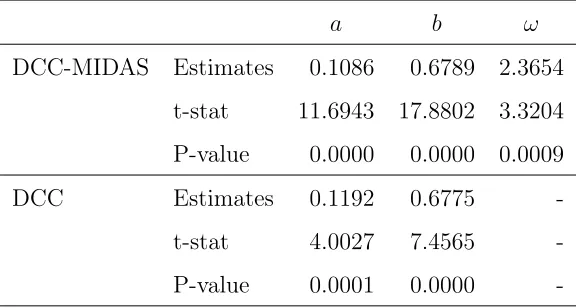
InTable 1we report the coefficients of the DCC-MIDAS and also the resulting estimates
of a DCC. Our estimation is somehow restrictive because we only consider one parameter
(ω) to account for the long run dynamics. For the short run dynamics we use DCC of order
(1,1), which means only one a and one b.
Results inTable 1 show that DCC-MIDAS parameters are very close to the DCC
param-eters as is recurrent feature inEngle et al. (2006), the superiority of DCC-MIDAS over DCC
is the capability of disentangling the short run from the long run correlation which permits
analyzing the behavior of them simultaneously.
Time varying correlations based on the DCC-MIDAS scheme are plotted on Figure 1,
Figure 2 and Figure 3, the black lines in each plot represents the short run correlation
meanwhile the long run correlation is shown in red, the dashed line splits the entire sample
into two subsamples: precrisis period and crisis period as it is conventionally done in the
contagion literature based on correlation. A visual analysis of these figures suggests no
relevant changes in the linkages between countries neither in the general short run correlation
behavior nor in the long run, from this fact we can derive the cautious “conclusion" that the
economies exhibits strong linkages in all states of the world, this situation can be interpreted
as interdependence, nevertheless, in order to formally draw any conclusion about the absence
of contagion during the analyzed period, we perform a statistical hypothesis testing.
3
See details of the procedure in Engle et al.(2006).
Table 1: DCC MIDAS and DCC results.
a b ω
DCC-MIDAS Estimates 0.1086 0.6789 2.3654
t-stat 11.6943 17.8802 3.3204
P-value 0.0000 0.0000 0.0009
DCC Estimates 0.1192 0.6775
-t-stat 4.0027 7.4565
-P-value 0.0001 0.0000
-Note: The top panel reports the estimates of the DCC-MIDAS while the
bottom panel shows the DCC estimates. We setK=N = 528 as suggested by the likelihood profiling.
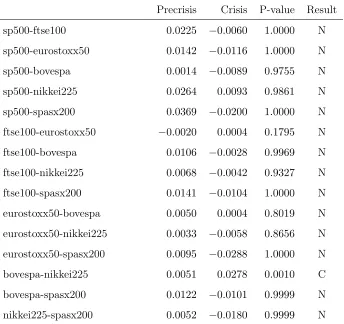
Table 2consists of all the possible combinations of pairwise correlations for the analyzed
sample, since we have 6 countries (stock markets) then we can compute 15 q¯li,j,t andq¯i,j,th and
perform the test specified in subsection 2.4. Hypothesis test suggests no contagion for all
pair of countries except for Brazil and Japan where the p-value confirm the rejection of the
null even at 1% significance level.
The results of the test confirm that transmission of the crisis was due to real linkages,
Table 2: Contagion test results.
Precrisis Crisis P-value Result
sp500-ftse100 0.0225 −0.0060 1.0000 N
sp500-eurostoxx50 0.0142 −0.0116 1.0000 N
sp500-bovespa 0.0014 −0.0089 0.9755 N
sp500-nikkei225 0.0264 0.0093 0.9861 N
sp500-spasx200 0.0369 −0.0200 1.0000 N
ftse100-eurostoxx50 −0.0020 0.0004 0.1795 N
ftse100-bovespa 0.0106 −0.0028 0.9969 N
ftse100-nikkei225 0.0068 −0.0042 0.9327 N
ftse100-spasx200 0.0141 −0.0104 1.0000 N
eurostoxx50-bovespa 0.0050 0.0004 0.8019 N
eurostoxx50-nikkei225 0.0033 −0.0058 0.8656 N
eurostoxx50-spasx200 0.0095 −0.0288 1.0000 N
bovespa-nikkei225 0.0051 0.0278 0.0010 C
bovespa-spasx200 0.0122 −0.0101 0.9999 N
nikkei225-spasx200 0.0052 −0.0180 0.9999 N
footnotesizeNote: column 1 indicates the pairs of countries for which
cor-relation is computed, columns 2 and 3 have the mean of those corcor-relations,
column 4 holds the p values associated to the test and the last column
contains anN when No-contagion and it has aC when there is empirical
evidence of contagion.
0 200 400 600 800 1000 1200 −1.0 −0.5 0.0 0.5 1.0
Dynamic Conditional Correlations
Short run correlations Long run correlations
DCC MIDAS SP500 − FTSE100
0 200 400 600 800 1000 1200 −1.0
−0.5 0.0 0.5 1.0
Dynamic Conditional Correlations
Short run correlations Long run correlations
DCC MIDAS SP500 − EUROSTOXX50
0 200 400 600 800 1000 1200 −1.0
−0.5 0.0 0.5 1.0
Dynamic Conditional Correlations
Short run correlations Long run correlations
DCC MIDAS SP500 − BOVESPA
0 200 400 600 800 1000 1200 −1.0
−0.5 0.0 0.5 1.0
Dynamic Conditional Correlations
Short run correlations Long run correlations
DCC MIDAS SP500 − NIKKEI225
0 200 400 600 800 1000 1200 −1.0
−0.5 0.0 0.5 1.0
Dynamic Conditional Correlations
Short run correlations Long run correlations
[image:14.612.117.484.196.568.2]DCC MIDAS SP500 − SPASX200
0 200 400 600 800 1000 1200 −1.0 −0.5 0.0 0.5 1.0
Dynamic Conditional Correlations
Short run correlations Long run correlations
DCC MIDAS FTSE100 − EUROSTOXX50
0 200 400 600 800 1000 1200 −1.0
−0.5 0.0 0.5 1.0
Dynamic Conditional Correlations
Short run correlations Long run correlations
DCC MIDAS FTSE100 − BOVESPA
0 200 400 600 800 1000 1200 −1.0
−0.5 0.0 0.5 1.0
Dynamic Conditional Correlations
Short run correlations Long run correlations
DCC MIDAS FTSE100 − NIKKEI225
0 200 400 600 800 1000 1200 −1.0
−0.5 0.0 0.5 1.0
Dynamic Conditional Correlations
Short run correlations Long run correlations
DCC MIDAS FTSE100 − SPASX200
0 200 400 600 800 1000 1200 −1.0
−0.5 0.0 0.5 1.0
Dynamic Conditional Correlations
Short run correlations Long run correlations
DCC MIDAS EUROSTOXX50 − BOVESPA
0 200 400 600 800 1000 1200 −1.0
−0.5 0.0 0.5 1.0
Dynamic Conditional Correlations
Short run correlations Long run correlations
[image:15.612.84.652.112.466.2]DCC MIDAS EUROSTOXX50 − NIKKEI225
Figure 2: Long and short correlations for returns.
0 200 400 600 800 1000 1200 −1.0
−0.5 0.0 0.5 1.0
Dynamic Conditional Correlations
Short run correlations Long run correlations
DCC MIDAS EUROSTOXX50 − SPASX200
0 200 400 600 800 1000 1200 −1.0
−0.5 0.0 0.5 1.0
Dynamic Conditional Correlations
Short run correlations Long run correlations
DCC MIDAS BOVESPA − NIKKEI225
0 200 400 600 800 1000 1200 −1.0
−0.5 0.0 0.5 1.0
Dynamic Conditional Correlations
Short run correlations Long run correlations
DCC MIDAS BOVESPA − SPASX200
0 200 400 600 800 1000 1200 −1.0
−0.5 0.0 0.5 1.0
Dynamic Conditional Correlations
Short run correlations Long run correlations
[image:16.612.115.490.107.488.2]DCC MIDAS NIKKEI225 − SPASX200
Figure 3: Long and short correlations for returns.
4
Conclusions
In this paper we analyzed whether the crisis sourced in US is spread over the world by
contagion or just through real linkages known as interdependence. Within this chapter,
contagion is defined as a significant increase in cross-correlations after a crisis hits a country,
we assumed that correlations are not constant over time and also assuming that they evolves
according to a GARCH(1,1)-type structure which give rise to the use of the popular DCC
run and long run component of the total correlation of the portfolio under study.
Our results suggest that linkages between stock markets remains the same before and after
the crisis, there is no evidence of significant increase in correlations, therefore interdependence
is the main channel of transmission of the crisis which is plausible since stock markets are more
and more integrated and the lagged values of the correlation associated to the interdependence
are dominant over the influence of the short run correlations.
Evidence of contagion is only found for Brazil and Japan. It is worthy to say that the
test only identifies the existence/non-existence of contagion but it is not allow to identify the
directionality of such a contagion, for the case of Brazil and Japan we found the correlation
strengthened after the crisis in US providing evidence of contagion but we do not know if
contagion ran from Brazil to Japan or in the other way around.
References
Chiang, T. C., Jeon, B. N., and Li, H. (2007). Dynamic correlation analysis of financial
contagion: Evidence from Asian markets. Journal of International Money and Finance,
26(7):1206–1228.
Colacito, R., Engle, R. F., and Ghysels, E. (2011). A component model for dynamic
corre-lations. Journal of Econometrics, 164(1):45–59.
Corsetti, G., Pericoli, M., and Sbracia, M. (2005). Some contagion, some interdependence?:
More pitfalls in tests of financial contagion. Journal of International Money and Finance,
24(8):1177 – 1199.
Dornbusch, R., Park, Y. C., and Claessens, S. (2000). Contagion: Understanding How It
Spreads. World Bank Research Observer, 15(2):177–97.
Engle, R. (2002). Dynamic Conditional Correlation: A Simple Class of Multivariate
Gen-eralized Autoregressive Conditional Heteroskedasticity Models. Journal of Business &
Economic Statistics, 20(3):339–350.
Engle, R., Gysels, E., and Sohn, B. (2006). On the economic sources of stock market volatility.
NYU and UNC unpublised manuscript.
Forbes, K. and Rigobon, R. (2002). No Contagion, Only Interdependence: Measuring Stock
Market Comovements. The Journal of Finance, 57(5):2223–2261.
Fry, R., Martin, V. L., and Tang, C. (2010). A new class of tests of contagion with
applica-tions. Journal of Business & Economic Statistics, 28(3):423–437.
King, M. A. and Wadhwani, S. (1990). Transmission of Volatility between Stock Markets.
The Review of Financial Studies, 3(1):5–33.
Naoui, K., Khemiri, S., and Liouane, N. (2010a). Crises and Financial Contagion: The
Naoui, K., Liouane, N., and Brahim, S. (2010b). A Dynamic Conditional Correlation Analysis
of Financial Contagion: The Case of the Subprime Credit Crisis. International Journal of
Economics and Finance, 2(3):85–96.
Rigobon, R. (2003). On the measurement of the international propagation of shocks: is the
transmission stable? Journal of International Economics, 61(2):261 – 283.
Wang, K.-M. and Nguyen Thi, T.-B. (2013). Did China avoid the Asian flu? The contagion
effect test with dynamic correlation coefficients. Quantitative Finance, 13(3):471–481.