
Physics and Astronomy Publications
Physics and Astronomy
4-24-2015
Kinetic Monte Carlo Simulation of Statistical
Mechanical Models and Coarse-Grained
Mesoscale Descriptions of Catalytic
Reaction–Diffusion Processes: 1D Nanoporous
and 2D Surface Systems
Da-Jiang Liu
Iowa State University, [email protected]
Andrés Garcia
Iowa State University, [email protected]
Jing Wang
Iowa State UniversityDavid M. Ackerman
Iowa State University, [email protected]
Chi-Jen Wang
Iowa State UniversityThe complete bibliographic information for this item can be found athttp://lib.dr.iastate.edu/physastro_pubs/176. For information on how to cite this item, please visithttp://lib.dr.iastate.edu/howtocite.html.
Follow this and additional works at:
http://lib.dr.iastate.edu/physastro_pubs
Kinetic Monte Carlo Simulation of Statistical Mechanical Models and
Coarse-Grained Mesoscale Descriptions of Catalytic Reaction–Diffusion
Processes: 1D Nanoporous and 2D Surface Systems
Abstract
Traditional mean-field rate equations of chemical kinetics for spatially uniform systems1−3 and the corresponding reaction−diffusion equations describing spatial heterogeneity4−6 have proved immensely useful in elucidating catalytic processes. However, it is well-recognized that standard mean-field rate
expressions neglect spatial correlations in the reactant and/or product distribution. It is less well appreciated that the standard treatment of diffusion is generally applicable only at low concentrations and in unrestricted environments.
Disciplines
Astrophysics and Astronomy | Biological and Chemical Physics | Mathematics | Physics
Comments
Reprinted (adapted) with permission fromChemical Reviews115 (2015): 5979,doi:10.1021/cr500453t. Copyright 2015 American Chemical Society.
Authors
Da-Jiang Liu, Andrés Garcia, Jing Wang, David M. Ackerman, Chi-Jen Wang, and James W. Evans
Kinetic Monte Carlo Simulation of Statistical Mechanical Models and
Coarse-Grained Mesoscale Descriptions of Catalytic Reaction
−
Di
ff
usion Processes: 1D Nanoporous and 2D Surface Systems
Da-Jiang Liu,
†Andres Garcia,
†,‡Jing Wang,
†,§David M. Ackerman,
†Chi-Jen Wang,
†,§,#and James W. Evans
*
,†,‡,§†Ames LaboratoryUSDOE, Division of Chemical and Biological Sciences,‡Department of Physics & Astronomy, and§Department
of Mathematics, Iowa State University, Ames, Iowa 50011, United States
CONTENTS
1. Introduction 5980
2. Catalytic Reaction−Diffusion Systems and
Spa-tially Discrete Stochastic Models 5982
2.1. Catalytic Conversion Reactions in 1D
Nano-porous Materials 5982
2.2. From Spatially Continuous to Discrete Sto-chastic Models for Reactions in 1D
Nano-porous Materials 5983
2.3. Catalytic Reactions on 2D Metal Surfaces
(Low to Moderate Pressure,P) 5985
2.4. Stochastic Multisite Lattice-Gas Models for
2D Surface Reactions (LowP) 5988
2.4.1. Thermodynamic Parameters 5989
2.4.2. Local Environment Dependence of
Acti-vation Barriers for Key Processes 5990
2.4.3. Complex Adsorption Dynamics and
Concerted Mechanisms 5990
2.4.4. KMC Simulation Algorithms for Surface
Reaction Models for LowP 5990
2.5. Reactions on 2D Oxide Surfaces (HighP) and
msLG Models 5991
3. Basic Formalism for Spatially Discrete Stochastic Models and Coarse-Graining to Continuum
(Hydrodynamic) Reaction−Diffusion Equations 5992 3.1. Discrete Hierarchical Reaction−Diffusion
Equations 5992
3.2. Hierarchical Truncation at the Mean-Field
Level 5994
3.3. Higher-Order Hierarchical Truncation and
Conditional Probabilities 5994
3.4. Coarse-Graining: Hydrodynamic Regime and
Generalizations 5995
3.5. Onsager Formulation for Chemical Diffusion
in Mixed Systems 5995
4. Basic Irreversible First-Order Conversion
Reac-tions in 1D Linear Nanopores 5996
4.1. Exact Behavior vs Mean-Field and
Hydro-dynamic Treatments 5998
4.2. Formulation of Generalized Tracer Diffusivity
Dtr(n) 6000
4.3. Further Discussion of Generalized Tracer
DiffusivityDtr(n) 6001
4.4. Generalized Hydrodynamic Formulation and
Analysis 6003
4.5. Detailed Analysis of Spatial Correlations for
Single-File Diffusion (SFD) 6003
5. General Conversion Reactions in 1D Linear
Nano-pores 6005
5.1. Nonuniform Distributions of Catalytic Sites 6005 5.2. Interactions between Reactant and Product
Species 6005
5.3. Reactivity versus Conversion F ≥ 0 for
Reversible Reactions 6006
5.4. Controlling Reactivity by Tuning Reaction
Product−Pore Interior Interactions 6007
5.5. Concentration-Dependent First-Order
Con-version Reactions 6008
5.6. Second-Order Bimolecular Conversion
Reac-tions 6009
5.7. Unequal Mobility of Reactants and Products 6010 6. Realistic msLG Modeling of Catalytic Reactions on
2D fcc Metal Surfaces 6011
6.1. Prelude: LG and msLG Modeling for
Chem-isorbed Adlayers 6012
6.2. msLG Model for CO-oxidation on Metal (100)
Surfaces 6012
6.2.1. CO Adsorption 6012
6.2.2. O2Adsorption 6012
6.2.3. CO Desorption 6013
6.2.4. Diffusion of CO and O 6013
6.2.5. CO + O Reaction 6013
6.3. KMC Simulation Results for CO-oxidation on
Pd(100) and Pt(100) 6013
6.4. msLG Models for CO-oxidation on Metal(111)
Surfaces 6015
Special Issue: Calculations on Large Systems
Received: August 22, 2014
Published: April 24, 2015
6.5. KMC Simulation Results for CO-oxidation on
Pt(111) and Pd(111) 6016
6.6. Other Reactions: NO-oxidation and
Decom-position, Hydrogenation, etc 6017
7. Tailored Models for CO-oxidation on Metal (100)
Surfaces 6019
7.1. Development of a Basic Model for CO + O on
Pd(100) at LowP 6019
7.1.1. Oxygen Sticking on Pure O Adlayers 6020
7.1.2. Oxygen Sticking for Mixed Adlayers
(8 Blocking CO) 6020
7.1.3. Oxygen Sticking for Mixed Adlayers
(10 Blocking CO) 6021
7.1.4. CO Sticking 6021
7.1.5. CO Desorption and CO + O Reaction 6021
7.1.6. Surface Diffusion 6021
7.2. Results for Basic Model for Low-PBistability in
CO + O on Pd(100) 6022
7.3. Refined Model with Reactive Phase
Separa-tion for CO + O on Pd(100) 6023
7.4. Basic Models for CO-oxidation on Other
Metal (100) Surfaces 6024
8. Spatiotemporal Behavior in Catalytic Reactions on
2D Metal Surfaces 6024
8.1. General Theory and Analysis for Realistic
msLG Models 6024
8.2. Stationary Fronts for the Tailored Model for
CO + O on Pd(100) 6026
8.3. Propagating Fronts for the Tailored Model for
CO + O on Pd(100) 6028
9. Catalytic Reactions on 2D Metal Oxide Surfaces at
HighP 6028
9.1. msLG Models for CO-oxidation on RuO2(110) 6029
9.2. Other Reactions on Oxide Surfaces 6032
10. Summary and Prognosis 6032
Appendix A: MD and Langevin Dynamics of Passing
in Narrow Pores 6035
Appendix B: DFT and MD of Adsorption on Metal
Surfaces 6037
Appendix C: Local-Environment-Dependent
Activa-tion Barriers 6038
Appendix D: Analytic Estimation ofFtr(n) from
Short-Time Expansion 6038
Appendix E: Correlations between Reactant
Loca-tions for SFD 6039
Appendix F: Diffusivity for Noninteracting Particles
with Unequal Mobilities 6040
Appendix G: Tailored Environment-Dependent
Model for Oxygen Sticking 6040
Appendix H: Variation of Equistability Points with
Hop Rate 6041
Author Information 6041
Corresponding Author 6041
Present Address 6041
Notes 6041
Biographies 6042
Acknowledgments 6043
References 6043
1. INTRODUCTION
Traditional mean-field rate equations of chemical kinetics for spatially uniform systems1−3and the corresponding reaction−
diffusion equations describing spatial heterogeneity4−6 have proved immensely useful in elucidating catalytic processes. However, it is well-recognized that standard mean-field rate expressions neglect spatial correlations in the reactant and/or product distribution. It is less well appreciated that the standard treatment of diffusion is generally applicable only at low concentrations and in unrestricted environments.7Generically, there are two sources of spatial correlations associated with either: (i) thermodynamics, where the reactant and product distribution is in some sense locally equilibrated and the distribution reflects interactions between molecules, or (ii) kinetics for unequilibrated distributions, where correlations are induced by adsorption−desorption−reaction kinetics. For high-er reactant concentrations, correlations of thhigh-ermodynamic origin should be enhanced due to stronger interactions, and those of kinetic origin might also be amplified due to inhibited mobility. In this review, we focus on scenarios where spatial correlations impact reaction−diffusion behavior. For catalysis in 1D nano-porous systems, such as zeolites8−10 and functionalized meso-porous silica,11,12 severe transport limitations13,14 (in the extreme case leading to single-file diffusion15) induce strong correlations of kinetic origin that invalidate standard mean-field treatments.16−19Forcatalytic reactions on 2D crystalline surfacesin the low-pressure, lower-coverage regime, lateral interactions between reactant species usually induce subtle superlattice ordering or perhaps 2D phase separation.20,21 Associated significant correlations of thermodynamic origin can impact reaction kinetics,7,22 e.g., if reaction occurs predominantly at boundaries between reactant domains.23 For higher pressures and coverages, inhibited mobility can enhance correlations of kinetic origin as demonstrated for both simple Ziff−Gulari− Barshad (ZGB)-type24−27and realistic28−30reaction models.
Spatial correlations of thermodynamic origin in equilibrated Gibbs states have been extensively characterized. Exact Ursell− Mayer cluster expansions, Kirkwood and quasichemical approx-imations, and concepts such as Markovian spatialfields (which are often formulated in terms of conditional probabilities) can be utilized.31−33 Kinetically induced correlations are less well characterized. Reactive nonequilibrium steady states (NESS) in open systems (reactants in, products out) are a natural analogue of equilibrium Gibbs states.34,35 One can make some general observations about their behavior. Clearly, a bimolecular reaction will deplete the population of associated nearby reactant pairs relative to a corresponding equilibrium state. Similarly, for surface reactions, dissociative adsorption of diatomics naturally boosts the population of nearby pairs of adsorbing adatoms, and bimolecular reaction or associative desorption boosts the population of nearby vacancy pairs. These kinetically induced correlations would be erased by sufficient mobility, although there appears to be no systematic perturbation theoretic treatment of high deviations from equilibrium. Also, unfortu-nately, nonequilibrium analogues of cluster expansions and concepts related to Markovian statistics only apply in special cases, such as so-called random sequential adsorption (RSA).36 RSA describes the irreversible dissociative adsorption of diatomics in the absence of thermal diffusion. However, extensions of Kirkwood and analogous higher-order approx-imations have more general applicability and have been used for simple reaction models.26,37,38
on surfaces.7,39For titration reactions, domains of a preadsorbed reactant are eroded by exposure to a second reactant, and the structure of the associated mixed adlayer is clearly out of equilibrium.39
To effectively analyze these nonequilibrium processes, a molecular-level modeling strategy is required which can track evolution of system configurations on the appropriate time-and length scales appropriately accounting for spatial correlations. To this end, one can implement spatially discrete stochastic (Markovian) reaction−diffusion models. For reactions in 1D nanoporous systems, as described in section 2.2, one can divide the pore into cells comparable to reactant size and treat continuous diffusion by hopping and exchange between adjacent cells.16−19,40−42Forreactions on 2D crystalline surfaces, we shall assume that reactants are localized on well-defined adsorption sites possibly of multiple types, and then implement appropriate detailed and realistic single-site or more generally multisite lattice-gas (msLG) models.7,22,43−46Extensive input is required for these models for both system thermodynamics (adsorption energies, adspecies interactions) and kinetics (adsorption and desorption dynamics, reaction pathways and barriers), which is obtained from or by comparing with experiment and increasingly from density functional theory (DFT) analysis.47The behavior of these models is in principle described exactly by master equations.34,48However, given the difficulty of reliable analysis of the master equations, model behavior is usually instead determined precisely by kinetic Monte Carlo (KMC) simulation,49−51as described extensively in recent reviews.7,22,46
More details are provided in section 2.
In the above reaction−diffusion systems, nontrivial spatiotem-poral behaviorgenerally arises from the interplay between the typically nonlinear reaction kinetics and diffusive transport. In the 1D nanoporous catalytic systems, especially with inhibited transport within pores, net reactivity is often localized near pore openings either for catalytic conversion40−42 or polymer-ization52,53reactions. This feature induces strong concentration variations within the nanopores typically on a length scale of tens of nanometers. In 2D surface reaction systems under low-pressure (P) conditions, a rich variety of spatial pattern formation and reaction front propagation with a characteristic length scale of tens of micrometers has been revealed by in situ electron-based microscopy studies.4,6,54,55 It is anticipated that the characteristic length scale should decrease for higher P or lowerTconditions, as the associated higher reactant coverages will inhibit surface mobility. Also,fluctuations should play a more significant role.56,57 A realization of sharp reaction fronts and strong fluctuations is provided by field-emission or field-ion microscopy (FEM/FIM) studies of surface reactions, generally at lowerT.58−60
For both more efficient modeling and a deeper understanding of spatiotemporal behavior in these systems, it is natural to coarse-grain the spatially discrete molecular-level models to obtain a spatially continuous reaction−diffusion equation (RDE) formulation. Typically, this type of analysis is generally associated with the deterministic“hydrodynamic regime”for large mobility and low concentration gradients, and the associated continuum RDE is often referred to as the hydrodynamic RDE.61,62For1D nanoporous catalytic systems, there are particular challenges. Since the concentration gradients are large, significant net reactivity is restricted to near the pore openings, and we argue that behavior is controlled byfluctuations in adsorption−desorption processes at the pore openings. This prompts consideration of a “generalized hydrodynamic”approach,63and recently, such an
approach has been successfully implemented for a simple conversion reaction.19For2D surface reaction systems, observed spatial patterns at lower P are naturally described by deterministic RDEs, although these treatments have mainly been at the heuristic mean-field level.6,55 A natural goal is to develop treatments that incorporate a beyond-mean-field treatment of reaction kinetics and also more accurately treat the complexities of chemical diffusion in mixed reactant adlayers (as discussed further below). Such nontrivial hydrodynamic RDEs62 have been developed and validated for a few simple surface reaction models.64−66 For more complex and realistic model, it is natural to consider a heterogeneous multiscale modeling (HMM) approach.67,68 A version of HMM termed heterogeneous coupled lattice-gas (HCLG) simulation was developed in the mid-1990s specifically for application to surface reaction systems,69,70 and has been more recently applied to realistic reaction models.45,71,72
For accurate description of basic behavior in 1D nanoporous systems and of spatiotemporal behavior in 2D surface systems, an appropriate description of chemical diffusion in mixed multi-component systems is key. This should be based on an appropriate Onsager formulation of transport theory that recognizes the coupling between concentration gradients and diffusionfluxes of different species and thus involves a diffusion tensor.62,73Apart from fundamental statistical mechanical studies of diffusion in multicomponent lattice-gas models,62,74−76there is a general appreciation of the complexity of diffusion for 1D nanoporous systems where additional anomalies appear in the single-file diffusion (SFD) regime.14,77−79 This complexity in treating diffusion is less well appreciated for surface systems, where most consideration has focused on single-component adlayers.80There are, however, a few studies for simple models of mixed component adlayers64,65,81 and also some for realistic models.7,71
The contents of this review are arranged as follows. Section 2 describes the catalytic reaction−diffusion processes in 1D nanoporous materials and on 2D surfaces, which are of interest in this review. The basic features of the spatially discrete stochastic models developed for these systems are also described. Section 3 provides more details on the formulation of these models and of their coarse-graining to obtain continuum reaction−diffusion equations. Again, a nontrivial component of the latter is the appropriate description of chemical diffusion in multicomponent systems.
Section 4 focuses on analysis of a basic irreversiblefirst-order conversion reaction in a 1D linear nanopore, with particular emphasis on the case of SFD. This is a canonical reaction model that has been considered previously by several groups. Section 5 analyzes various extensions of this basic model.
Section 6 reviews previously detailed and realistic multisite lattice-gas (msLG) modeling of oxidation reactions on fcc(100) and fcc(111) metal catalyst surfaces at low (or moderate) pressure. As the complexity of these models can inhibit fundamental understanding of the basic behavior, section 7 considers simplified, tailored models for CO oxidation on fcc(100) surfaces. These models are exploited to develop deeper analytic insight into the key features of the reaction system. Section 8 considers spatiotemporal behavior and, in particular, reaction front propagation for these systems.
2. CATALYTIC REACTION−DIFFUSION SYSTEMS AND SPATIALLY DISCRETE STOCHASTIC MODELS
2.1. Catalytic Conversion Reactions in 1D Nanoporous Materials
Our focus in this section will be on first-order conversion reactions in catalytically functionalized nanoporous materials incorporating arrays of linear pores with diameters of a few nanometers. There has been extensive modeling of behavior for these systems.16−19The basic ingredients are as follows. Reactant molecules from the medium surrounding the catalytic particles adsorb at the pore openings and diffuse into the pores. Upon reaching catalytic sites, they are converted to product that then diffuse out of the pores, possibly subject to significant interference from the reactant, which also shares the confined space within the pores. Catalytic reactions using zeolite materials are often performed using gas-phaseflow reactors but where the reactants are mixed with a carrier gas, which will also populate the pores within the zeolite. Catalysis using functionalized mesoporous silica nanoparticles (MSN) is usually performed in solution-phase batch reactors, so in this case often solvent molecules coexist with reactant and product species inside the pores. Thus, in either case, one might anticipate a stochastic description of reactant and product species dynamics within the pores implicitly accounting for the interaction with the carrier gas or solvent. For this reason, our discussion of modeling strategies in section 2.2 will start with the use Langevin dynamics to describe reactant and product motion but then immediately transition to spatially discrete coarse-grained modeling, which allows more efficient simulation of the entire reaction−diffusion process. Finally, going beyondfirst-order conversion reactions, at the end of section 2.1, we will also briefly describe second-order bimolecular reactions and polymerization reactions for which there have been more limited modeling studies.
We have already mentioned that typical catalytic nanoporous materials include zeolites and MSN, which can both consist of arrays of parallel pores containing catalytic sites (although more complex pore morphologies are also possible). The reader is referred to extensive reviews of zeolite materials and their applications to catalysis.8−10 Here, we just note that pore diameters (dp) are typically in the range dp = 0.5−2 nm. In contrast, for mesoporous silicas in the form of mesoporous silica nanoparticles (MSN), such as MCM-4112,82 and SBA-15,83 nominal pore diameters are typically in the rangedp= 2−10 nm. However, it should be emphasized that effective pore diameters can be reduced below 2 nm by functionalization and also by attachment of reactant species at the pore walls.84 While mesoporous materials offer the advantage of large surface areas, restricted transport within of the pores is potentially both a
disadvantage (reducing reactivity or turnover frequencies), and an additional advantage (producing selectivity).85
Given the importance of transport in these materials for applications to catalysis, separations, and sequestration, there is naturally extensive experimental and theoretical literature on this topic. We refer reader to reviews8,9,13,14 and selected recent papers.86,87There are extensive studies for species like CH4, CF4, and CCl4, with diameters of∼0.4 nm and above which are often described by a spherical united atom model.88Species such as ethane are described by the union of two spherical united atoms.89It is clear that these species should undergo SFD for narrower zeolite pores. Here, however, we emphasize that a relatively poorly characterized aspect of transport is inhibited, passing of reactant and product molecules. This naturally has a strong impact on reactivity, as it limits extrusion of the product. Some MD studies have tagged molecules, from which changes in order (or otherwise) can be tracked.88,90 One particularly instructive study focused on an effective two-molecule passing problem in an effort to more efficiently characterize passing propensity in narrow pores.89The strategy was to assess the free energy profile as a function of center-of-mass separation in the pore direction and to utilize a transition state theory (TST) formulation to assess passing. Most recently, the passing propensity in an effective two-particle problem with strongly damped Langevin dynamics was assessed, revealing deviations from TST predictions for this type of dissipative dynamics.91We discuss this analysis further in section 2.2 and Appendix A.
Our focus is not just on transport, but rather on diff usion-mediated catalytic conversion reactions in 1D nanoporous materials with strongly inhibited passing of reactant and product species within the pores. It is thus instructive to provide specific examples. The first example motivating earlier modeling studies42is theconversion of neopentane to isobutane catalyzed by Pd in L zeolitesaccording to the mechanism92
− − + −
→ + − −
+
+ (CH ) C CH (neopentane) H Pd
CH (methane) CH C Pd
3 3 3
4 3
and
+ − − +
→ − + −
+
+
CH CH C Pd H
CH CH (isobutane) H Pd
4 3 2
3
The diameter of neopentane is about 0.62 nm and that of isobutane is similar (vs methane at∼0.4 nm). All these species might be effectively described by spherical united atom models. Experimental studies of reaction kinetics indicate SFD in zeolite L, a feature which should be expected since this material is composed of linear nanopores with small diameterdp≈0.73 nm
and no cross-connections42,92 (see Figure 1). In contrast, reactivity is significantly higher in zeolite Y, which also has disconnected linear pores with similar narrow diameter,dp≈0.74 nm. However, this difference in reactivity is explained by the feature that the zeolite Y pores include near-spherical supercages, which can act as mixing chambers. In contrast, the pores in zeolite L only have disklike bulges, which apparently cannot facilitate passing or reactant and product species.92
The second example involves aldol condensation in MSN. Specifically, this reaction involves the conversion of p-nitro-benzaldehyde (PNB) to an aldol product by reaction with acetone in amine-functionalized MSN84(see Figure 2 and also refs 93 and 94 for related studies). Significantly, a range of pore-expanded, functionalized MSN were prepared by including a pore-expander agent during synthesis,95 and reactivity was determined for a range of pore diameters. This potentially allows assessment of the transition to the SFD regime. To provide a more detailed description of this system, pore diameters after aminopropyl or methyl(aminopropyl) functionalization ranged fromdp= 2.6 to 3.6 nm. (Nominal diameters before functionalization, dp(pre), were larger as the amine groups with linear size∼0.5 nm attached to the pore walls reduce the effective diameter by ∼1 nm.) Reactivity measured from reaction yield was high for the largest pore diameters, but dropped dramatically for smaller diameters of dp = 2.6−2.8 nm. However, the longest dimensions of the reactant and product species are 0.65 nm for PNB and 1.0 nm for the aldol product (and 0.4 nm for acetone). Thus, might one anticipate that, even in the narrowest pores, there is plenty of room for passing?
However, experimental analysis indicates that the diameter of the pore is significantly further reduced as a result of reaction. It was proposed, and confirmed by NMR studies, that the reactant PNB attaches to the functionalized pore walls in the sense that a Schiffbase is formed between PNB and the aminopropyl group at the walls84(see Figure 2a). One might anticipate that this would further reduce the pore diameter by twice the PNB size to a smaller effective value,dp(eff). However, the size of the Schiff base ofdsch≈1 nm is somewhat smaller than the sum of the above listed PNB and amine dimensions. Thus, fordp= 2.8 nm, wheredp(pre)≈3.8 nm, one estimates thatdp(eff)≈dp(pre)− 2dsch≈1.8 nm. This is close to the directly measured value of
dp(eff) ≈ 2 nm. With this reduced effective diameter, it is reasonable to expect that effects of inhibited passing of reactant and product species could significantly reduce reactivity. One caution is that formation of the Schiffbase also inhibits access of PNB to amine catalytic sites, so this effect can also reduce reactivity.
Finally, we briefly mention other classes of reactions, where restricted passing within pores and additional factors are important in determining reactivity. In bimolecularesterif ication reactions (acid + alchohol ↔ ester + water), there has been considerable interest in exploiting multifunctionalization of MSN to tune“reaction product−pore interior interactions”to enhance yield.96−98 Specifically, multifunctionalizing the pore interior with hydrophobic groups can minimize interaction of the product water with the intrinsically hydrophilic MSN surface groups, potentially shifting the reaction equilibrium toward complete conversion. Multifunctionalization can also impact transport within the pores.99See section 5.4. Finally, polymer-ization reactionsin nanoporous materials will also naturally be impacted by the ability of monomers to pass oligomers that form in catalytically functionalized pores. One example is the oxidatively catalyzed formation of poly(phenylene butadinylene) polymer (PPB) in a Cu2+-functionalized MCM-41 silica.100 Modeling reveals unusual spatial and kinetic features of polymerization in 1D nanoporous materials subject to SFD.52,53
2.2. From Spatially Continuous to Discrete Stochastic Models for Reactions in 1D Nanoporous Materials
Here, we will focus on the case of catalytic conversion reactions for solution-phase batch reactors where the catalytic nano-particles are immersed in a well-stirredfluid initially containing the reactant species. As indicated in section 2.1, a comprehensive modeling description of these many-particle reaction−diffusion processes must include diffusion of reactant species into the nanopores from surrounding well-stirredfluid, reaction in the vicinity of catalytic sites on the interior pore surface, diffusion of both reactant and product species out of the pore, and product reentry when a significant fraction (F) of reactant is converted to product in the surroundingfluid. One might naturally start by considering a comprehensive continuous-space description where the motion of reactant, product, and solvent molecules is described by classical molecular dynamics (MD) simula-tions.88,89Alternatively and more efficiently, just the motion of reactants and products might be described by Langevin dynamics, implicitly accounting for the solvent91 (see Figure 3a). However, even the latter treatment is not computationally viable to describe either the entire reaction or even the attainment of a reactive quasi-steady state for a specificF (as described in more detail below).
As alluded to by the above reference to quasi-steady-state behavior, one significant aspect of these batch reactor processes is a time scale separation. The overall conversion of reactant to product occurs on the time scale of hours. Initially, there is typically only reactant in surrounding fluid (F= 0), and one anticipates that, on the time scale of a few minutes,
state concentration profiles are established in the pore reflecting this F = 0 state of the fluid. As the reaction proceeds, an increasing fraction,F, of reactant outside the pores is converted to product. For each new F, quasi-steady-state concentration profiles are quickly re-established. Thus, by separately analyzing these quasi-steady states for a sequence of increasingFvalues, one can piece together the kinetics of the overall conversion reaction.99
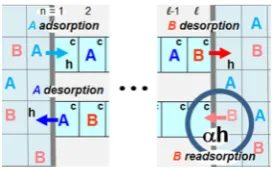
Since many-particle MD or Langevin simulations are prohibitive or impossible on the required time and length scales, there is motivation to apply“local coarse-graining”to map the above continuous-space picture onto a spatially discrete stochastic model. In the simplest scenario, one thus divides the linear pores into cells whose width,a, matches typical reactant or product sizes of a ∼ 1 nm.16−19,40,41 Sometimes, it is also convenient to extend this 1D array of cells to a 3D array outside the pores in the surroundingfluid19(see Figure 3b). Thus, each cell can contain at most one reactant or product molecule. Diffusion within the pores is now described by hopping to adjacent empty cells and also by exchange of (distinct) species between adjacent cells. Adsorption−desorption processes at the pore openings correspond to hopping (or exchange) between the end cell of the linear array within the pore and the adjacent cell in the surroundingfluid. Unimolecular reactions occur at cells within the pore designated as catalytic (c) and convert a reactant species to the appropriate product species within that cell. Bimolecular reactions might involve, for example, distinct reactant species in adjacent cells (see Figure 3c). These stochastic models are described exactly by hierarchical master equations (see section 3), although for precise analysis of behavior, it is typically most convenient to employ KMC simulation. Here, various processes are implemented stochasti-cally with probabilities proportional to the physical rates. However, a nontrivial challenge is to obtain the basic rate parameters for this locally coarse-grained model that are consistent with the full continuous dynamics.
A few relevant observations on connecting spatially con-tinuous to discrete descriptions of the reaction−diffusion process are as follows:
(i) The rate,h, for hopping to adjacent cells would be chosen to match a prescribed continuous diffusion coefficient,D0, in the regime of low reactant and product concentrations, so thatD0=
a2h.101
(ii) Clearly exchange is absent for SFD. However, in general, it is not trivial to appropriately map the extent of inhibited passing, as assessed by MD or Langevin simulations in a narrow pore, onto a numerical value of the exchange probability (pex) in the spatially discrete model91(see Figure 3). Despite its significance in controlling reactivity, targeted quantitative analyses of the passing propensity of reactant and product species are rare.89,91 Even here, many-particle MD or Langevin dynamics is not efficient, so an effective two-particle analysis is preferred89,91(see Appendix A).
(iii) Adsorption−desorption rates, and specifically their ratio, should reflect the possibly different chemical potentials for various species in the surroundingfluid versus within the pore. This issue is particularly relevant in discussion of multi-functionalization to tune the pore interior to enhance reactivity (see section 5.4).
(iv) With regard to interactions between reactant and product species themselves and with the pore walls, the simplest treatment considers just steric (or geometric nonoverlap) constraints. These constraints are incorporated into the feature that a cell can only be occupied by a single species. However, a more sophisticated treatment would account for solvent-mediated interactions between reactants, products, and the pore walls,16,17,40 where these interactions would be suitably coarse-grained to fit our spatially discrete model. While significant recent developments exist in related coarse-graining approaches,102these have not yet been applied to the systems of interest here.
(v) The microscopic reaction rate in the coarse-grained model would reflect not just the activation barrier for reaction but also local entropic factors and diffusion processes within the cell (or within adjacent cells for bimolecular reactions) related to achieving the necessary reaction configuration.
The above level of coarse-grained modeling with one reactant or product species per cell has the simplifying feature that chemical diffusion in a system involving a single species is independent of concentration in the absence of interactions beyond steric blocking.103 This feature, and its extension to multispecies models where distinct species have the same mobilities, is particularly useful in analysis of the more complex reaction−diffusion processes.16−19 However, a more realistic treatment bridging the above “very coarse” spatially discrete model and continuous-space Langevin descriptions would be to choose afiner discrete spatial grid within (and outside) the pores. Now, particle centers reside at grid points, but the grid spacing is finer than the particle linear dimensions, so particles can only approach within a finite threshold distance (of multiple grid spacings) to avoid overlap (see Figure 4). In this case, the description of chemical diffusion is nontrivial even for a single-species problem. This finer level of modeling will not be discussed or developed further in the current review.
Figure 3.(a) Continuous-space Langevin representation the many-particle reactant and product diffusive transport processes in a 1D linear nanopore. (b) Corresponding spatially discrete model formulation. (c) Treatment of unimolecular and bimolecular conversion reaction processes for the spatially discrete model.
2.3. Catalytic Reactions on 2D Metal Surfaces (Low to Moderate Pressure,P)
We will describe selected Langmuir−Hinshelwood (LH) reactions on single-crystal metal catalyst surfaces under low to moderate pressure (P) conditions. More specifically, we will focus on cases where realistic molecular-level modeling has been developed.22These reactions have often been extensively studied in continuous flow reactors under well-controlled ultrahigh vacuum conditions. In the LH scenario, reactants adsorb from the gas phase onto well-defined surface adsorption sites, diffuse across the surface by hopping between nearby sites (rapidly at least for some adspecies), interact and often form ordered domains on the surface, sometimes desorb without reaction, and importantly react if in suitable configurations. The product desorbs and is pumped away, so it does not readsorb. These open systems operate under nonequilibrium steady-state conditions. In contrast to the 1D nanoporous systems, the 2D surface LH reaction systems of interest here are intrinsically spatially discrete in that the locations of the reactant species on the surface are effectively confined to a periodic grid or lattice of adsorption sites (possibly of more than one type). Thus, these systems are naturally described by stochastic lattice-gas modeling wherein it suffices to accurately specify the rates for addition to and removal from adsorption sites (corresponding to adsorption and to nonreactive or reactive desorption, respectively), as well as for transitions between adsorption sites (diffusion). A complication is that there are lateral interactions between adspecies on the surface, which lead to ordering and spatial correlations. The presence of these interactions implies that the rates for various
processes depend on the local environment. Precise analysis of such complex and realistic lattice-gas reaction models is generally only possible via KMC simulation.
Determination of the extensive energetic input required for realistic modeling (adsorption energies, interactions, and barriers) is generally greatly facilitated by DFT analysis. It is increasingly common to obtain all such input from DFT, in which case the modeling is described as ab initio KMC. However, it is well-recognized that there are potential limitations of DFT in predicting adsorption site preference, adlayer ordering (which depends delicately on adspecies interactions), and barriers (e.g., for diffusion and reaction). Thus, often DFT energetics must be adjusted to achieve predictive models. We discuss these issues in more detail in section 2.4. Ideally, the model should be validated by comparison with experimental data for single-component adlayers (for the individual reactants), as well as by comparison against reaction data.
[image:10.625.119.509.66.360.2]Given the above complications and our focus on the influence of ordering and spatial correlations on reaction kinetics, we place most emphasis in the following on simpler CO oxidation and NO oxidation and reduction reactions.3,4,6,55Here, there is extensive data for the relevant single-component systems, CO or NO or O, etc., on metal surfaces, as well as steady-state bifurcation and temperature-programmed reaction data. Also, recent modeling for these systems does address the effect on reaction kinetics of adlayer ordering (through incorporation of extensive adspecies interactions) and surface diffusion, issues of central interest in this review. However, there have also been significant advances in ab initio DFT modeling of more complex catalytic reaction
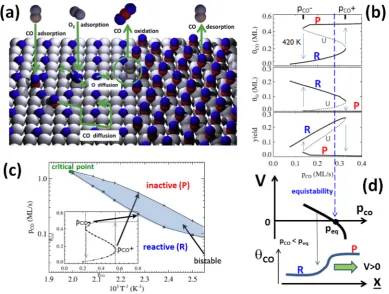
Figure 5.(a) Schematic for CO oxidation on Pd(100). Behavior from KMC simulation of a realistic msLG model withpO2= 1 ML/s for (b) bistability of
a reactive (R) and an inactive near-CO-poisoned (P) state (blue arrows indicate hysteresis upon cyclingpCO) joined by an unstable (U) state for CO
coverge (θCO), O coverage (θO), and reaction yield and (c) bifurcation diagram with the bistable region bordered by upper and lower spinodals including
a nonequilibrium critical point consistent with experiment.106Inset: hysteresis inθCOat 400 K upon scanningpCO. Reprinted with permission from ref 7.
Copyright 2013 Elsevier. (d) Reaction front propagation in the bistable regime forpCO<peqwith the reactive state (R) displacing the CO-poisoned state
processes,22 e.g., hydrogenation of alkenes and alkynes, the water−gas shift reaction, and ethanol synthesis. Thus, such systems, where modeling has been performed, will also be discussed briefly at the end of this subsection.
First, we give a detailed picture of the basic steady-state and related behavior in CO oxidation reactions on metal surface at low to moderateP. An understanding of this behavior will be needed for interpretation and assessment of our modeling, which will be described in detail in sections 6−8. If “g”denotes gas phase,“ads”denotes the adsorbed phase, and*denotes empty surface sites, then thekey steps in CO oxidationare3
+ * ↔ + * →
+ → + *
CO(g) CO(ads), O (g) 2 2O(ads),
and CO(ads) O(ads) CO (g) 2
2
2
considering temperatures where recombinative desorption of oxygen is not active (see Figure 5a). The simplest scenario is to consider this reaction on unreconstructed face-centered cubic (fcc) metal surfaces in the absence of a significant population of subsurface oxygen. Here, the basic behavior for lower T is characterized by “bistability”, i.e., a reactive steady state (with higher O coverage, θO, and lower CO coverage, θCO) coexists with a near-CO-poisoned state (with highθCOand lowθO) over a range of CO partial pressure,PCO−<PCO<PCO+(forfixed O
2 partial pressure,PO2, wherePCO±are upper and lower spinodals) (see Figure 5b). A clear experimental manifestation of this behavior is hysteresis upon sweepingPCOback and forth across the bistability regime. With increasingT, the bistability regime shrinks and disappears at a nonequilibrium critical point, Tc, corresponding to a cusp bifurcation in a mean-field treat-ment3,6,7,55(see Figure 5c).
In the bistable regime, both the reactive and CO-poisoned states are stable (or more precisely, one is stable and the other
strongly metastable). However, typically they are not equally stable.6,55In the absence of a thermodynamic chemical potential, the appropriate criterion to assess relative stability on an extended surface is based on the motion of planar diffusive interfaces separating the states.7,66,104The more stable state will displace the less stable one, resulting in a chemical wave or reaction front traveling with constant velocity. The two states are equally stable at an effectively unique CO partial pressure where the interface is stationary105(see Figure 5d). This equistability criterion replaces the Maxwell construction for thermodynamic systems. We note that equistability depends not just on the details of reaction kinetics, but also on the details of chemical diffusivity, such as its coverage dependence.7,104 Finally, we should also note that for a system in the less stable state within the bistable region, spontaneousfluctuations will eventually lead to a transition to the more stable state by the nucleation and growth of domains of this more stable state. An appropriate nucleation theory for these nonequilibrium steady states is partially developed, a key feature of which is the strong increase in metastability (reflected by an increasing size of the critical droplet of the more stable state) with increasing surface mobility.7
First, we discuss in more detailCO oxidation on fcc metal (100) surfaces.7See sections 6.1 and 6.2, as well as sections 7 and 8, for a detailed description of modeling. Clean Pd(100) and Rh(100) do not reconstruct, so CO oxidation on these fcc(100) surfaces should provide examples of classic bistability. A recent experimental study characterized this behavior for individual Pd(100) grains in a polycrystalline sample, in fact, mapping out a complete bifurcation diagram and revealing thatTc≈513 K for
PO2= 1.3×10⁻⁵mbar.106,107
[image:11.625.117.512.71.303.2]For CO oxidation on both Pd(100) and Rh(100), there exist detailed temperature-programmed reaction (TPR) studies wherein (i) oxygen isfirst deposited at
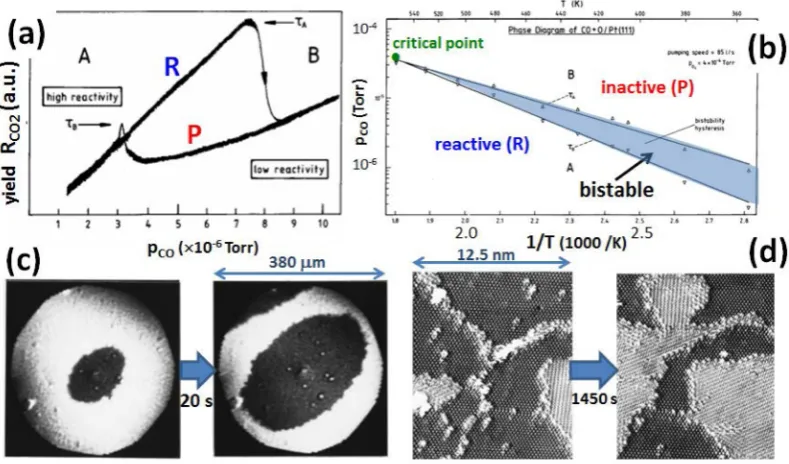
Figure 6.Experimental observations for CO oxidation on Pt(111): (a) hysteresis at 413 K forPO2= 4×10
−5Torr reflecting bistability of reactive (R)
and inactive near-CO-poisoned (P) states; (b) bifurcation diagram including a nonequilibrium critical point; (c) PEEM images at 413 K for expansion of reactive state (dark) into inactive near-CO-poisoned state (bright) upon droppingPCOfrom 5.9 to 2.7×10⁻⁶Torr withPO2= 4×10
−5Torr. Reprinted
with permission from ref 115. Copyright 1999 American Insitute of Physics. (d) Titration of p(2×2)-Oads(bright) by exposure to CO gas withPCO= 5×
10−7Torr at 244 K. Growing c(4×2)-COadsregions image more brightly. Reprinted with permission from ref 43. Copyright 2001 American Insitute of
higher temperature (T) and then (ii)Tis lowered well below the threshold for reaction and CO is deposited, andfinally (iii)Tis increased at a constant rate and one monitors the rate of CO2 production to gain insight into the reaction configurations and kinetics.108,109
Clean Pt(100) and Ir(100) surfaces do reconstruct, which can potentially induce more complicated CO-oxidation kinetics. In fact, CO oxidation on Pt(100) provides a classic example of self-sustained kinetic oscillations under suitably selected condi-tions.3,6,55This behavior was associated with a strong depend-ence of oxygen sticking on the surface state (reconstructed or otherwise). Thus, the coupling to an additional degree of freedom associated with the reconstruction opens the possibility for richer dynamics than simple bistability. We mention that for CO oxidation on both Pt(100) and Ir(100), TPR studies are available.110,111We also note a recent study on polycrystalline Pt that mapped out a local bistability bifurcation diagram for Pt(100) grains givingTc≈575 K forPO2= 1.3×10⁻⁵mbar.106,107 Next, we discuss spatiotemporal behavior and, specifically, reaction front propagation. Photoemission electron microscopy (PEEM) studies have explored reaction front behavior on Pt(100), providing a detailed assessment of front propagation velocities versuspCOfor a range of temperatures.54More recent studies observed complex anisotropic front propagation behavior, which was associated with surface roughening.112 Analogous studies for Pd(100) reveal front propagation confined to single flat grains in a polycrystalline sample.107 Additional techniques have been applied to assess front propagation on Pt(100). Higher-resolution low-energy electron microscopy (LEEM) has explored the structure of“titration waves”formed when a surface with a preadsorbed high-coverage of 0.75 ML of CO is exposed to oxygen. The surface is metastable since oxygen sticking is negligible aboveθCO≈0.5 ML, so oxygen adsorbs only at defect regions, a titration wave expanding about those regions. The structure of the front reflects the influence of adlayer ordering on chemical diffusivity,113a feature not visible in lower-resolution PEEM studies. Finally, a number of studies have used FEM and FIM to examine propagation of sharp fronts, together withfluctuation effects, on Pt field-emitter tips, including the (100) facets, usually at lowerT.58,60,61Another study explored fluctuation effects on supported Pd nanoclusters.114
Now, we more briefly discuss CO oxidation on fcc(111) surfaces. See sections 6.3 and 6.4 for a detailed description of modeling. Clean (111) surfaces of Pt, Pd, Rh, and Ir do not reconstruct, so CO oxidation on these surface should provide examples of classic bistability. For Pt(111), a complete bifurcation diagram characterizing bistable behavior has been provided that showed thatTc≈555 K forPO2= 4×10⁻⁴Torr115 (see Figure 6a,b). For Ir(111), a quite complete study of bistability behavior is also available indicating thatTc≈530 K for
PO2+PCO= 1×10⁻⁴Pa.116
In addition, for Ir(111), a study of the effect of external noise on bistability was also performed.117 There are also a number of titration studies of CO oxidation on oxygen precovered fcc(111) surfaces. Significant earlier studies for Pt(111) utilized scanning tunneling microscopy (STM) to monitor evolution of the shrinking O domains during titration, as well as assessing reaction order with respect to O coverage39,43 (see Figure 6d). Additional titration studies were performed more recently for both Pt(111)118 and Pd(111).119 Detailed TPR studies were also performed for Rh(111).109
With regard to reaction front propagation, we should mention a detailed PEEM study for CO oxidation on Pt(111)115 (see
Figure 6c). Waves of expansion of both the reactive and CO-poisoned state were observed, and their velocity was determined as a function of CO partial pressure. However, a stationary interface was observed for a finite range of pCO, a feature attributed to pinning by surface defects. For CO oxidation on Ir(111), a PEEM study monitored expansion of regions of the more stable state within the less stable state, where these embedded regions were more readily nucleated byfluctuations near the upper and lower spinodal limits of the bistable region.120 Additional insights might also be derived from the PEEM on polycrystalline samples of Pt and Pd mentioned above.106
For comparison with CO oxidation, it is also natural to considerNO oxidation on metal surfaces under strongly oxidizing conditions, i.e., for high oxygen chemical potentials or coverages that inhibit NO dissociation. Here, the mechanistic steps include reversible NO adsorption−desorption, irreversible dissociative adsorption of oxygen, and the oxidation reaction NO(ads) + O(ads)→NO2(g) + 2*. Experiments have been performed for Pt(111),121,122as well as on supported Pt nanoclusters.123The reaction is actually endothermic on a clean Pt(111) surface (in contrast to CO oxidation) but becomes exothermic for higher oxygen coverages. However, NO2can remain on the surface and dissociate, and in fact, NO2dissociation is enhanced over O2 dissociation at higher O coverages.124Thus, the complete picture is somewhat complex since O2and NO2dissociation become competing reactions in NO-oxidation catalysis. Clearly, a key feature of this system is not just the coverage dependence but actually the local environment dependence of the rates relevant for oxidation versus dissociation. Atomistic lattice-gas modeling and KMC simulation incorporating energetics from DFT analysis of relevant energetics on the Pt(111) surface are the ideal vehicles for detailed assessment of this behavior.124−127We will describe this modeling work in more detail in section 6.5.
On the (100) surfaces of such metals as Pt and Rh, the direct
NO-dissociation reaction, NO(ads) +*↔N(ads) + O(ads), is favored relative to NO oxidation in the presence of O.128In addition to this reaction, another pathway for NO decomposition is active producing of N2O and O, as well as numerous other reactions involving N and NO2. Detailed lattice-gas modeling and KMC simulation with DFT input have been performed for these systems, as will also be discussed further in section 6.5.128,129 Experimental studies of NO dissociation are often performed on supported metal nanoparticles where a mixture of (111) and (100) facets are exposed,130and lattice-gas modeling with DFT input has also been implemented recently for this more complex geometry to elucidate the competition between reaction on different facets.131Finally, it is natural to consider the possibility that alloying of the metal surface will enhance the NO-dissociation reaction.132Such effects have been modeled on Pt− Au(100) alloy surfaces in the presence of oxygen.133
enables further more facile NO dissociation and reaction of O with CO and N2desorption. The result is autocatalytic“explosive kinetics”, as observed on Pt(100).134In fact, one anticipates a patch of depopulated surface spreading in a wave of expansion about the initial desorption point, as described by simplified lattice-gas modeling.135Studies of the NO + CO reaction on Rh surfaces have been reviewed in ref 136.
With regard to theoretical analysis of the NO + CO reaction, there exist a number of DFT studies of key energetics for Pt(100) and Pd(100) surfaces.137−139 These are substantial analyses considering barriers for NO dissociation and recombination of two N to form N2, as well as the CO + O reaction step. One significant feature of NO dissociation and NO + CO reactions is that while the barrier for NO dissociation is quite high onflat surfaces, it can be significantly reduced at step edges. DFT analysis has also assessed this feature for steps on both (100) and (111) surfaces.139,140 As a result, the CO + NO reaction is expected to display a strong dependence on surface defects, a feature not so prominent for the CO-oxidation reaction. For comprehensive and realistic lattice-gas modeling of the CO + NO reaction process, more detailed analysis is required of adsorption site energies for all species involved, of the large number of lateral interactions between the various adspecies (NO, CO, N, O), and of adspecies diffusion. Complete energetic information is not currently available, and such realistic modeling has yet to be developed.
Finally, we briefly discuss analyses of other generally more complex reactions with an emphasis on modeling developments. There have been several studies of reactions involving hydro-genation and conversion of unsaturated hydrocarbons, still a rather simple model chemistry. These studies have incorporated DFT energetics into KMC modeling but also including interactions between adspecies.141−143 A particularly important but more complex example is thewater−gas shif t reaction, H2O + CO↔ CO2+ H2, used to generate hydrogen, to adjust the feed ratio in syngas, and in Fischer−Tropsch and methanol synthesis, etc.144 KMC simulations with DFT input including adspecies interactions have been run for a stepped Pt surface assessing the structure sensitivity of the reaction.145 Finally, there is naturally considerable current interest in the synthesis and oxidation of primary alcohols. Primarily DFT analysis exists for methanol synthesis considering CO hydrogenation (CO + 2H2
→ CH3OH) but focusing on CO2 as the primary source of methanol (CO2+3H2→CH3OH + H2O).
146,147
There do exist limited KMC simulations with DFT input for ethanol synthesis on supported nanoclusters.148 Finally, we note one study
implementing KMC simulations with DFT input including limited adspecies interactions for partial oxidation of methanol on an O-covered Cu(110).149
2.4. Stochastic Multisite Lattice-Gas Models for 2D Surface Reactions (LowP)
Here, we describe in detail the requirements and ingredients for development of realistic and predictive stochasticmultisite lattice-gas modeling (msLG) of LH surface reactions under low-P
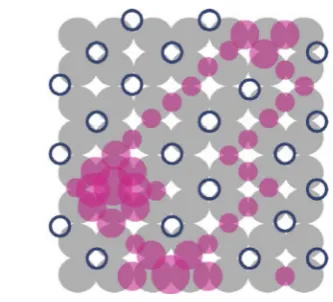
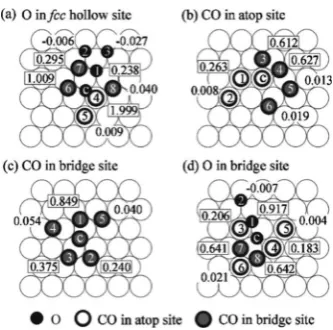
conditions. As indicated in section 2.3, adsorbed reactants often localized at a well-defined periodic array of adsorption sites on single-crystal metal catalyst surfaces. There is at most one molecule at each such site. These sites are usually high-symmetry hollow, bridge (br), or top sites. Thus, these systems are intrinsically spatially discrete. In principle, this spatially localized picture breaks down at high enough temperature. However, we expect catalytic reaction systems to be intrinsically more localized than for, say, noble gases on very smooth substrates such a graphene, where the spatially discrete picture is known to break down. Diffusion barriers for noble gases on graphite can be as low as 5 meV,150but one expects diffusion barriers for chemisorbed species on metals to be at least 100 meV, as found for highly mobile CO on Pd(111).151For some adspecies, effectively only a single adsorption site is populated, e.g., 4-fold hollow (4fh) sites for O on Pd(100) or 3-fold hollow (3fh) sites on Pd(111). However, in general, realistic modeling of the overall reaction process must account for the feature that multiple types of sites can have significant population, particularly for CO or NO and especially for higher coverages. Consequently, while the O distribution can often be effectively described by a standard lattice-gas model with a single type of site (e.g., 4fh sites forming a square lattice or grid), realistic reaction models generally require the development of msLG modeling incorporating multiple site types.7,22 Such modeling has the flexibility to describe more accurately mixed reactant adlayer ordering, particularly at higher coverages, and multiple distinct reaction configurations (see Figure 7).
In our modeling, we will describe extended surfaces as a perfect periodic grid of adsorption sites. This neglects the presence of monotonic steps and possibly step bunches and other defects. This assumption is reasonable for describing the kinetics of reactions that are not strongly sensitive to such defects. However, there are some reactions where this assumption is questionable, particularly those involving dissociation of N2, which can be strongly enhanced at steps, and to some extent for those involving NO dissociation.152,153Certainly the presence of steps
can also impact the propagation of reaction fronts,113an issue on which we will comment further in section 8. We also neglect any reconstruction or restructuring of the metal surface during reaction, which is generally a reasonable assumption, e.g., for CO oxidation on Pd(100) or Rh(100) or on fcc(111) surfaces.3,4,6,7 To describe the adlayer thermodynamics for these mixed reactant adlayers, one must give a complete prescription of isolated adspecies adsorption energies of various possible adsorption sites, as well as lateral interaction energies between adsorbed species. The simplest prescription of interactions assumes pairwise additivity, but it is increasingly common to also incorporate many-body interactions. The adsorption energies and interactions together specify the msLG Hamiltonian.
As also indicated in section 2.3,LH surface reaction processes
involve adsorption from the gas phase at adsorption sites, diffusive hopping between such nearby sites, interaction and possible ordering of mobile adspecies, possible conversion from one species to another by reaction, and removal from such sites by nonreactive desorption or by reaction. All of these processes are regarded as Markovian, which means that they occur with an exponential waiting time distribution with mean waiting time inversely proportional to the relevant rate. Rates for all thermally activated processes (including reaction, desorption, and diffusion) are taken to have an Arrhenius form, k = νexp[−Eact/(kBT)], for activation barrier (Eact) and prefactor or attempt frequency (ν). These rates must satisfy detailed balance, which means that the ratio of rates for forward and reverse microscopic processes is determined from the energy difference (ΔE) between the initial andfinal states (which, in turn, is determined from the msLG Hamiltonian). Thus, for a common prefactor, the difference in barriers matchesΔE. These rates are necessarily influenced by interactions between or with adsorbed species and thus depend on the local environment. Furthermore, it should be emphasized that complete knowledge of adlayer thermodynamics does not imply knowledge of rates, an issue described further below.
One important feature is that behavior of the reaction models depends not just on the adlayer thermodynamics of adsorbed layers (described by the msLG Hamiltonian) but also sensitively on details of adsorption, desorption, and reaction kinetics. For example, nonequilibrium steady-state behavior can depend strongly on the kinetics of adsorption, e.g., on the dependence of the sticking probability on the local composition and arrangement of adspecies in the mixed reactant adlayer, behavior for which there is little detailed analysis. Traditionally, non-dissociative adsorption is described by random addition to single available sites and dissociative adsorption of diatomics by addition to adjacent pairs of empty sites. However, this simple level of description is usually inadequate. Ideally, one should incorporate a more sophisticated mapping of the spatially continuous adsorption dynamics onto the discrete msLG model. For example, sometimes species like CO are steered to specific adsorption sites.7,154 Often dissociative adsorption is activated and requires a larger available adsorption site ensemble with a sticking coefficient depending strongly on the local environ-ment155−157(see Figure 8 and Appendix B for more details). Additional complications with adsorption are associated with the possible presence of a physisorbed precursor.
These stochastic msLG reaction models are described exactly by hierarchical master equations, as will be further discussed in section 3. However, typically precise determination of behavior must utilize KMC simulation where processes are implemented stochastically with probabilities proportional to the physical
rates. Below, wefirst discuss in more detail assessment of adlayer thermodynamics, then prescription of rates or kinetics for relevant processes, and finally KMC simulation algorithms. Determination of a complete and reliable set of input parameters (adsorption energies, adspecies interaction energies, and activation barriers) is a particularly challenging task and is effectively only possible with the aid of extensive DFT analysis. However, given the limitations of DFT, particularly with regard to adsorption energies,158,159utilization of available experimental data is invaluable both to aid refining DFT energetics, if needed, and in validating the model.
2.4.1. Thermodynamic Parameters.Site-specific
adsorp-tion energies for isolated adspecies are readily extracted from DFT and impact relative site populations, as well as desorption barriers. However, given the limitations of DFT predictions, there is motivation to improve these predictions. One possibility is to exploit higher-level quantum chemistry analysis either through embedded cluster approach160,161 or via cluster calculations with a suitable extrapolation of errors versus cluster size.162 With regard to adspecies interactions, an increasingly common approach is to utilize a cluster expansion ap-proach163,164tofit pairwise, trio, etc. interactions to the energies of a substantial set of “training configurations” that include physically important adlayer configurations.7,22,165,166 There is some dependence of results on the selected configurations, but various procedures are available to optimize the selection of configurations and of interactions included in the model.167,168It should also be noted that this formulation neglects relaxation of adspecies from ideal high-symmetry adsorption sites, where the degree of relaxation can depend on the local environment. Unfortunately, there is somewhat limited detailed experimental data for comparison (e.g., broken symmetries in phase diagrams can provide direct insight into trio interactions). However, despite issues with prediction of adsorption energies, one expects that a“cancellation of errors”generally gives quite reliable values for interactions. Nonetheless, given other major uncertainties or approximations in comprehensive reaction modeling (adsorp-tion dynamics, activa(adsorp-tion barriers, and prefactors, as discussed below), there is some appeal to simpler modeling with effective pairwise interactions (and even reduced models with a small number of effective pairwise interactions). Such simpler modeling can facilitate a deeper understanding of various factors impacting catalytic reactivity.7
Figure 8.Complex adsorption dynamics on Pd(100) contrasting the traditional picture. (a) CO is steered to unfavorable top sites and then moves to available br (or 4fh) sites and (b) O2preferentially impinges
2.4.2. Local Environment Dependence of Activation Barriers for Key Processes.Another significant limitation of most current treatments is the adopted dependence of barriers for thermally activated processes on the interaction with nearby adspecies. Often a simple“initial value approximation” (IVA), corresponding to a late transition state (TS), is quite reasonably used for desorption; an early TS approximation for reaction rates (with barrier independent of local environment) has been used with some success for reaction in certain systems, and various choices are used for diffusion.7,22More recent studies have made increasing use of a Bronsted−Evans−Polyani (BEP)-based approach22 (see Appendix C). A more precise approach applicable for geometrically well-defined transition states is to determine two sets of adspecies adsorption energies and interactions: the usual set determining thermodynamics, where all species are at adsorption sites, and a second set where diffusing or reacting species are located at a TS and the others are at adsorption sites. From these two sets, the activation barriers can be precisely constructed as a difference in energies at TS and at the initial state (see again Appendix C). This approach has been at least partially implemented in CO-oxidation models, e.g., by including bridge sites as well as hollow sites in a msLG formulation for oxygen, where the bridge sites correspond to the TS for hopping between hollow sites.7,169,170 As an aside, this approach has also been implemented to describe the diff usion-mediated self-assembly of epitaxial nanoclusters, including trio as well as pairwise interactions when appropriate.171−173
In addition to barrier selection, we also comment briefly on the choice of prefactors, ν in the Arrhenius expression for rates. Typically, a choice ofν = 1012−1013 s−1is effective for most surface processes. However, for desorption, sometimes signifi -cantly higher values are realized when the entropy in the TS is close to that of the gas phase and well above that of the adsorbed state.174−176 This feature must be incorporated into the modeling.
2.4.3. Complex Adsorption Dynamics and Concerted
Mechanisms. We have already mentioned complexity in the
adsorption dynamics beyond the classic picture. Development of a refined picture could be aided by ab initio MD (AIMD) analysis, although most studies consider only adsorption on a clean surface,177,178whereas development of appropriate“ local-environment-dependent” adsorption models with various arrangements of preadsorbed species are needed.179In addition, a major challenge for MD studies is to analyze large enough system sizes to avoid artificial finite-size effects, e.g., due to inadequate treatment of energy dissipation into the bulk substrate. Recently significant advances have been made toward resolving this issue by exploiting an embedded cluster approach, which combines a high-level DFT-based treatment of dynamics in the collision region with a treatment of the extended surface and bulk region at the level of semiempirical potentials180,181(see Appendix B).
Another general challenge is the determination of reaction pathways and barriers. Even for simple reactions the pathway and transition state may not be clear, so analysis based on the nudged elastic band (NEB) method utilizing DFT energetics is often invaluable.182 More complex reactions, such as methonal synthesis, are usually assumed to occur in a stepwise fashion, where a single bond is made or broken in each step. However, DFT analysis again using NEB has recently shown that the barriers for rate-limiting steps may be significantly reduced, accounting for concerted reaction mechanisms.183
2.4.4. KMC Simulation Algorithms for Surface Reaction
Models for Low P.7,22KMC simulation simply implements
processes stochastically with probabilities proportional to their physical rates. There are different algorithms faithful to a specific reaction model.184 Some of these are simpler to code and implement but incorporate a significant degree of failure or rejection for slower processes. Other Bortz-type rejection-free algorithms are potentially more efficient, but are more complicated, requiring significant “book-keeping” to track all possible processes with specific rates. For reaction models at low
P, there exist significant challenges in developing efficient algorithms, as well as some novel variations. First, a significant computational challenge is that diffusive hop rates, especially for adspecies like CO and NO, are typically many orders of magnitude above other rates. A Bortz-type algorithm49 is effective for low concentrations of rapidly hopping adspecies as epitaxial growth,185but this approach is less effective for reaction-limited surface catalysis models given the high density of rapidly hopping atoms. Also, the complexity of fully rejection free Bortz-type codes becomes prohibitive for complex reaction models. Thus, often a mixed approach is taken, allowing some degree of rejection and thereby increasing algorithmic simplicity.7Even in this case, hop rates are typically capped below physical values in simulation. However, for low-P conditions, we find that performing simulations for a range of low hop rates generally allows reliable extrapolation (due to rapid convergence) to the physically relevant regime of much higher rates.7 This is not necessarily the case for moderatePvalues with higher density, strongly interacting adlayers.186
[image:15.625.350.517.540.691.2]Two other variations of standard simulation algorithms and models should be mentioned. First, it may be useful to implement hybrid models and simulation algorithms where some species are regarded as infinitely mobile and thus equilibrated relative to the adlayer configuration of less mobile species.66,69,187−190 For example, CO might be regarded as equilibrated relative an adlayer of coadorbed much less mobile O. In these models, one could explicitly track the possibly nonequilibrium configurations of the less mobile adspecies and treat the site populations of equilibrated adspecies probabilisti-cally (see Figure 9). Significantly, such models exhibit true bistability, like mean-field models, even for immobile O.69 Finally, for either conventional or hybrid models, so-called
![Figure 30. Reactant concentration proconcentration for allParameters were chosen asfiles for A → B conversion withSFD and attractive NN interactions satisfying exp[ϕ/(kBT)] = 0.1](https://thumb-us.123doks.com/thumbv2/123dok_us/8112834.237015/31.625.330.555.263.464/reactant-concentration-proconcentration-allparameters-conversion-attractive-interactions-satisfying.webp)
![2 (3,4 Dimethyl 5,5 dioxo 2H,4H pyrazolo[4,3 c][1,2]benzothiazin 2 yl) N′ (3 methoxybenzylidene)acetohydrazide dimethylformamide hemisolvate](data:image/gif;base64,R0lGODlhAQABAIAAAP///wAAACH5BAEAAAAALAAAAAABAAEAAAICRAEAOw==)