D S Sharma, R Sangal and J D Pawar. Proc. of the 11th Intl. Conference on Natural Language Processing, pages 162–166, Goa, India. December 2014. c2014 NLP Association of India (NLPAI)
PaCMan : Parallel Corpus Management Workbench
Diptesh KanojiaCSE, IIT Bombay
Raj Dabre
GSI, Kyoto University
Manish Shrivastava
CSE, IIIT Hyderabad
Pushpak Bhattacharyya
CSE, IIT Bombay
Abstract
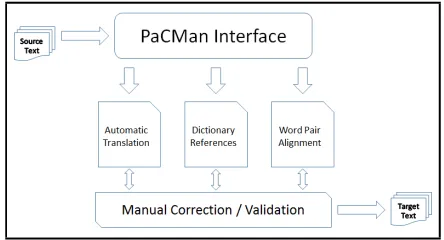
We present a Parallel Corpora Manage-ment tool that aides parallel corpora gen-eration for the task of Machine Translation (MT). It takes source and target text of a corpus for any language pair in text file format, or zip archives containing multi-ple corresponding text files. Then, it pro-vides with a helpful interface to lexicog-raphers for manual translation / validation, and gives out the corrected text files as out-put. It provides various dictionary refer-ences as help within the interface which increase the productivity and efficiency of a lexicographer. It also provides automatic translation of the source sentence using an integrated MT system. The tool interface includes a corpora management system which facilitates maintenance of parallel corpora by assigning roles such as man-ager, lexicographer etc. We have designed a novel tool that provides aides like ref-erences to various dictionary sources such as Wordnets, Shabdkosh, Wikitionary etc. We also provide manual word alignment correction which is visualized in the tool and can lead to its gamification in the fu-ture, thus, providing a valuable source of word / phrase alignments.
1 Introduction
Statistical Machine Translation (SMT) depends primarily on parallel corpora. The quality of par-allel corpora available can make or break a SMT system. The process of creating a parallel corpus is neither easy nor cheap. It is essential to produce good quality parallel corpus efficiently to ensure time and cost effectiveness of the process.
Traditional method of parallel corpus creation involves manual translation of every sentence by
inputting a monolingual corpus and translating its each sentence. But, strict quality checks and skilled translators need to be employed to ensure correctness and, usually, the process of translation is followed by a validation phase to ensure quality and reliability.
The process of parallel corpora generation can be divided into the following phases: translation, validation and sentence alignment. Furthermore, to help SMT tools like Moses (Koehn et al., 2007), it would be desirable to manually correct word alignments generated by an automatic tool such as GIZA++ (Och and Ney, 2003).
We present a comprehensive workbench to streamline the process of corpora creation for SMT. This common workbench allows for corpora generation, validation, evaluation, alignment and management simultaneously. We aim to simplify the laborious manual task of corpora generation for all language pairs, and provide with aides at each step.
2 Related Work
There are a wide class of document management solutions and products which fall under the cate-gory of “corpora and text mining”. We find that though a lot of effort has gone into creating tools to aid in corpora generation for lower level NLP tasks such as POS tagging and chunking, but not much work has gone in the direction of corpora generation aid for Machine Translation (MT). The few similar works that we did find are noted below. PolyPhraZ (Hajlaoui and Boitet, 2004) is one such tool which helps in visualizing, editing and evaluating MT systems on parallel corpora. Ca-sualConc (Imao, 2008) is a parallel concordancer which generates keyword in context concordance lines, word clusters, collocation analysis, and word counts.
Figure 1: Snapshot of PaCMan on validation / translation screen
systems which are commercially available with features like Translation memory, and Term Ex-traction.
Wordfast is CAT system having just one free version “WordFast Anywhere”. We studied and used the system, but found the interface less in-tuitive, and hard to use. “WordFast Anywhere” also has an integrated MT system which provides translations via Microsoft Bing and an integrated MT system.
Another system we came across is a web based text corpora development system (Yablon-sky, 2003) that focuses on the development of UML-specifications, architecture and implemen-tations of DBMS tools.
None of the above mentioned systems provide a word alignment visualization, which can be corrected manually, and saved to provide perfect phrase tables later.
3 Parallel Corpora Management System Parallel Corpora Management System (PaCMan) (Figure: 1) is a platform-independent web-based workbench for managing all the processes in-volved in the generation of good quality parallel corpora. Along with covering the procedural / managerial aspects of the parallel corpora gener-ation process, this tool also provides the means to track and manage the assignment and reporting of tasks in real-time.
As noted earlier, the tasks involved in the gen-eration of a good quality parallel corpora can be broadly classified as follows:
• Translation
• Validation
• Sentence Alignment
[image:2.612.80.300.38.150.2]• Word Alignment
Figure 2: Workflow of the system
Apart from these, there is also a need to manage the complete process. For an on-line tool such as the one we present, following activities need to be considered:
• User Registration for Superusers (Manager), translators / validators and aligners
• Task assignment and Tracking
• User session management
We have developed PaCMan to aid at every step of the process while ensuring high quality assistance. In the following sections we cover the various fea-tures that the tool provides.
3.1 Translation
Manual translation is the first step towards creat-ing a parallel corpus. It is usually done by ex-perienced translators who rely on their knowledge of source and target language to perform the task. But still, it proves a difficult task. From our expe-rience in creating parallel corpus, we have learned that the task of manual translation can be made much easier if some assistances like dictionary aids, automated translations etc. are provided to the translators. We find that translators could do with some help on the following fronts:
• Translation of rare source language words
• Language input for non-standard scripts (De-vanagari in case of Hindi and Marathi)
• Access to automatic translation of source text to speed up the translation process
• Access to previous translations of recurring phrases
In this tool, we have successfully addressed the above mentioned issues.
Figure 3: Snapshot of Right Click context menu
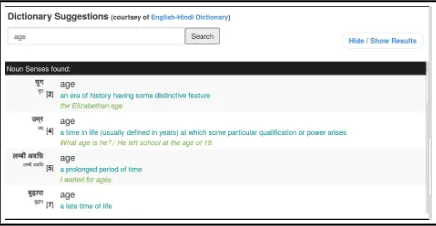
Figure 4: Snapshot of dictionary suggestions
3.1.1 Customized Context Menu Help
It is often the case that the translators, even with their substantial experience, find it hard to re-call the meaning of some rare source language words. PaCMan helps overcome this difficulty by integrating various dictionary resources, and ref-erences. These dictionaries are provided on the translation screen as right-click menu items. Us-ing these dictionaries the translator can get the meaning of a word simply by highlighting the word and choosing the preferred dictionary from the right-click menu (Figure: 3).
We have also integrated the corresponding UNL dictionary (Bhattacharyya, 2006) in the tool so that a user can select a word and can get its mean-ing on the same screen simply at the click of a button (Figure: 4). Further, we have integrated language specific Wordnets (Fellbaum, 1998) and (Dipak Narayan and Bhattacharyya, 2002), Shab-dKosh(a Hindi-English dictionary) (Soni, 2003), Wikipedia and Wiktionary for these languages in the right-click menu. While these dictionaries pro-vide the different meanings of a word, the user can also choose to translate a word or phrase directly by choosing “Google Translate” from the right-click context menu.
[image:3.612.315.531.50.104.2]We found that the requirement of inputting data in Indian langugages can be easily overcome by
Figure 6: Snapshot of Word Alignment Box
integrating a transliteration API, using which the roman script should be converted to the chosed Indian script automatically. Thus, We integrated “Google Transliteration API” in our tool.
Further, if the user wants to see the word’s use in contexts other than the given source language sen-tence, she can choose to fire a Google search query by choosing “Search in Google” option from the right-click menu.
3.1.2 Automatic Translation
It is sometimes easier and faster to correct a trans-lation than to translate from scratch. Also, even if a machine generated translation is syntactically or semantically incorrect, it can give the translator a kernel around which the final correct translation may be built.
Thus, we have integrated Sata-Anuvadak (Anoop Kunchukuttan and Bhattacharyya, 2014), a Moses Decoder based SMT system for multiple Indic languages with our tool which can generate an automatic translation of a given English sen-tence at the click of a button. In the worst case, the translator would still need to manually trans-late but she would have gotten a fair idea of the possible translation, given some words get trans-lated correctly.
3.1.3 Previous Translations
Parallel corpora generation very quickly becomes a repetitive task. A translator at times would like to find previously translated sentences. This has been made easy by introducing at ability to search for a word or a phrase and find the parallel sen-tences with the translations for that particular word or phrase (Figure: 5).
3.2 Validation
[image:3.612.81.299.197.310.2]Figure 5: Snapshot of Search Results
translator are also available to a validator. A val-idator may change a sentence completely or make minor modifications as the need may be.
A validator can also be given fresh parallel cor-pus which is not generated on this work bench. Such corpus may be uploaded by any superuser responsible for a language pair.
3.3 Word Alignment Visualization and Gamification
The accuracy of a SMT system depends on the quality of word alignment produced by an aligner. For free word ordered languages and languages with rich morphology, aligners can often make many mistakes which eventually have dire effect on decoder accuracy. We aim to provide word level alignment for every sentence in the corpus (Figure: 6). It is expected that this will greatly en-hance the performance of an SMT system trained on the alignment data provided by our tool. Cur-rently, we have trained GIZA++ on nearly 48000 sentences.
We provide the means to augment the word alignments to eventually aid in higher accuracy for SMT. We have integrated GIZA++ aligner with our tool to allow a user to correct the alignments provided by it. A user might also choose to do the alignment completely manually using the vi-sual drag and drop interface provided in the tool. Its rich interface lets you align words and phrases with a lot of ease. This can easily be pushed to-wards a crowd sourced word alignment collector with some gamification. We believe it can lead to a very high amount of perfect word / phrase align-ments.
3.4 Administrative Tasks
Corpora Management System provides for vari-ous roles a user might need to play in the process of parallel corpus generation. The system is de-signed to work for multiple language pairs simul-taneously. Each corpus can have its own superuser (manager). The superuser then distributes tasks among other users to work.
3.4.1 Corpora Upload and Download
Superusers can upload corpora to be translated, validated or aligned. Corpora upload is in the form of two plain text files in unicode encoding or two archives containing plain text files. For translation, only a single source file needs to be uploaded whereas for any other task two parallel files are needed. Once the assigned task has been performed the registered user can download com-plete or partial data or can commit the data which the superuser would finally commit to the master database.
3.4.2 Task Assignment
Superusers can assign tasks to different users. A superuser chooses complete or partial corpora and assigns it to a user who can perform the assigned task. At the time of corpora assignment a copy of the data is created specific to the user while the master database remains untouched. The master database can only be changed when the user fin-ishes the task and sends the data back to the supe-ruser. At which point the superuser commits the data back to the master database. A superuser can track the work done by any user who has been as-signed a task by her.
3.4.3 Session Management
The system is equipped with both browser based and internal session management. When a user logs in, she is taken directly to the last sentence that was being validated / translated at the time of previous logout.
While navigating through the sentences a user can choose to skip sentences if she so desires. At any point of time she can choose to “View Skipped” sentences and work with them. When she is finished with the skipped sentences, she can go back to the normal view, landing on the last un-saved sentence.
4 Design
The system is developed in PHP and uses MySQL as backend. Various Javascript and jQuery snip-pets have b een developed along with AJAX to make sure the user stays on the same page. The system has been designed such that user would find every validation aid on the same screen, de-creasing the shuffles between screens thus increas-ing productivity. The advantage of such a design is that the user would not have to change application for different tasks like referring to dictionaries etc.
5 Conclusion and Future Work
We have presented PaCMan, a web-based system that aids parallel corpora generation for the task of machine translation. The system provides an intuitive interface and many valuable features that increase the productivity at every stage of corpora generation process. It provides the user with dic-tionary references, and automatic translations dur-ing translation and validation of parallel corpus. The system also aids word pair alignments. It provides an authentication based corpora manage-ment system where multiple parallel corpora can be maintained. The system is open for use to ev-erybody. We expect further extensions of our sys-tem will support the development of better parallel corpora and aid machine translation further.
We believe gamification of our word pair align-ment feature will help in collecting perfect word / phrase pair alignments which can result in a bet-ter performing Moses decoder, and thus a higher accuracy of an SMT system. We aim at providing such an extension of our system soon.
References
Rajen Chatterjee Ritesh Shah Anoop Kunchukuttan, Abhijit Mishra and Pushpak Bhattacharyya. 2014. Shata-anuvadak: Tackling multiway translation of indian languages. InProceedings of the 9th Edition of its Language Resources and Evaluation Confer-ence., LREC ’14.
Pushpak Bhattacharyya. 2006. English - hindi dic-tionary. http://www.cfilt.iitb.ac.in/
˜hdict/webinterface_user/.
Prabhakar Pande Dipak Narayan, Debasri Chakrabarti and Pushpak Bhattacharyya. 2002. An experience in building the indo wordnet - a wordnet for hindi. In Proceesdings of First International Conference on Global WordNet, Mysore, India.
Christiane Fellbaum. 1998. WordNet: An Electronic Lexical Database. Bradford Books.
Najeh Hajlaoui and Christian Boitet. 2004. Polyphraz: A tool for the management of parallel corpora. In Proceedings of the Workshop on Multilingual Linguistic Ressources, MLR ’04, pages 109–116, Stroudsburg, PA, USA. Association for Computa-tional Linguistics.
Yasu Imao. 2008. Casualconc. http://sites.
google.com/site/casualconc/.
Kilgray. 2006. memoq [computer software]. http:
//kilgray.com/products/memoq.
Philipp Koehn, Hieu Hoang, Alexandra Birch, Chris Callison-Burch, Marcello Federico, Nicola Bertoldi, Brooke Cowan, Wade Shen, Christine Moran, Richard Zens, Chris Dyer, Ondˇrej Bojar, Alexandra Constantin, and Evan Herbst. 2007. Moses: Open source toolkit for statistical machine translation. In Proceedings of the 45th Annual Meeting of the ACL on Interactive Poster and Demonstration Sessions, ACL ’07, pages 177–180, Stroudsburg, PA, USA. Association for Computational Linguistics.
Franz Josef Och and Hermann Ney. 2003. A sys-tematic comparison of various statistical alignment models.Computational Linguistics, 29(1):19–51.
SDL. 2007. Sdl trados studio [computer soft-ware]. http://www.translationzone.
com/products/sdl-trados-studio/.
Manish Soni. 2003. Shabdkosh. http://www.
shabdkosh.com.
Serge Yablonsky. 2003. The corpora management system based on java and oracle technologies. In Proceedings of the Tenth Conference on European Chapter of the Association for Computational Lin-guistics - Volume 2, EACL ’03, pages 179–182, Stroudsburg, PA, USA. Association for Computa-tional Linguistics.