Neural word embeddings with multiplicative feature interactions for
tensor-based compositions
Joo-Kyung Kim†,Marie-Catherine de Marneffe‡,Eric Fosler-Lussier† †Department of Computer Science and Engineering,
‡Department of Linguistics,
The Ohio State University, Columbus, OH 43210, USA
[email protected], [email protected], [email protected]
Abstract
Categorical compositional distributional els unify compositional formal semantic mod-els and distributional modmod-els by composing phrases with tensor-based methods from vec-tor representations. For the tensor-based com-positions, Milajevs et al. (2014) showed that word vectors obtained from the continuous bag-of-words (CBOW) model are competitive with those from co-occurrence based mod-els. However, because word vectors from the CBOW model are trained assuming additive interactions between context words, the word composition used for the training mismatches to the tensor-based methods used for evaluat-ing the actual compositions includevaluat-ing point-wise multiplication and tensor product of con-text vectors. In this work, we show whether the word embeddings from extended CBOW models using multiplication or tensor product between context words, reflecting the actual composition methods, can show better perfor-mance than those from the baseline CBOW model in actual tasks of compositions with multiplication or tensor-based methods.
1 Introduction
In recent years, there has been a surge of inter-est in using word vectors for modeling semantics. Mikolov et al. (2013a,b) introduced word2vec
that includes the continuous bag-of-words (CBOW) model and the skip-gram model.1 These models have been most widely used for generating word vectors to be used for word related tasks because of
1https://code.google.com/p/word2vec
their efficient but still effective architectures. The CBOW model takes the mean vector of projections of the context words and use it to predict the target word as the following objective function:2
1
T
T
∑
t=1
lnp
wt
21c
∑
−c≤j≤c,j̸=0
pt+j
, (1)
whereT is the total number of words in a corpus,wt
is thetth word,ptis thetth word vector, andcis the
half window size.
Milajevs et al. (2014) showed that the word vec-tors generated from the CBOW model are compet-itive with those from co-occurrence based models for both simple arithmetic compositions and tensor-based compositions for categorical compositional distributional models (Coecke et al., 2010).3
Categorical compositional distributional models represent compositional semantics with algebra of Pregroup by representing each grammatical reduc-tion as a linear map in vector spaces (Coecke et al., 2010; Kartsaklis et al., 2012). For example,cats like milkconsists of a subject noun, a transitive verb re-quiring a subject and an object, and an object noun, respectively. In Pregroup grammar, the types of the three words in this example aren,(nrsnl), andn,
respectively, wherenis a noun,nrcan be combined
with an in the left, nl can be combined with a n
in the right, andsis a declarative statement. Then, 2Although sum is used in Mikolov et al. (2013a), the current version ofword2vecimplementation uses mean.
3Although Milajevs et al. (2014) described that the skip-gram model was used to generate the word vectors, the CBOW model was actually used in their work.
they can be reduced to represent the entire phrase with single entity as follows:
n(nrsnl)n→1snln→1s1→s (2)
In the reduction,nr is composed with the leftn
re-sulting in an identity element,1. Then, nl is
com-posed with the right nresulting in another 1. Be-cause1is an identity element,1s1is reduced tos.
Since there is no specification of actual imple-mentation of the composition in categorical compo-sitional distributional models, different composition methods have been introduced; they are reviewed in Section 2. However, there are few studies about the vector representation of single words regarding those compositions.
One issue of using the word vectors from the CBOW model as the constituent vectors for tensor-based composition is that their assumptions of the composition are different. Word embeddings of the CBOW model are trained with an additive context composition, which is the mean of the context pro-jection. However, most tensor-based compositions use point-wise multiplication or tensor product as composition operators. This means that there is a mismatch between the composition method used for the training of the underlying word vectors and the actual composition methods we evaluate.
To alleviate the mismatch, we introduce exten-sions of the CBOW model with multiplicative in-teractions between word projections to obtain word embeddings more suitable for the tensor-based com-positions. For four datasets, evaluating different types of compositions, we show that those exten-sions of the CBOW model improve the performance of the actual composition tasks with multiplication or tensor product operations.
2 Tensor-based compositions
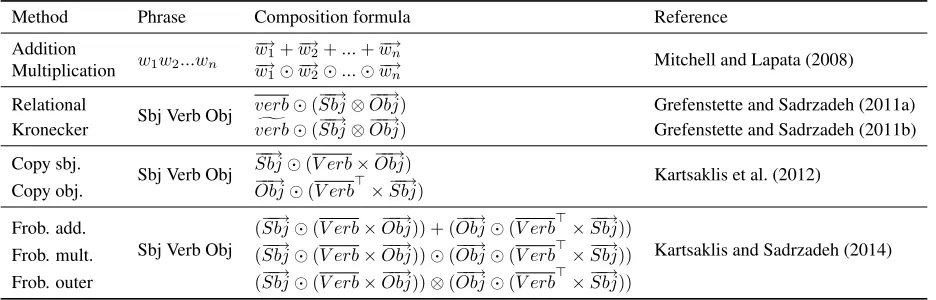
Prior to discussing the modification to the CBOW algorithm, we review different composition methods used in the literature (Table 1).
AdditionandMultiplicationare compositions by point-wise addition and multiplication, respectively (Mitchell and Lapata, 2008). They can be done sim-ply without any other information, but they cannot reflect word orders and grammatical structures.
Mitchell and Lapata (2008, 2009) showed that composition by multiplication can be more effec-tive than composition by addition because addieffec-tive models compose by considering the content alto-gether whereas multiplicative models focus on the content relevant to the composition by scaling each element of one with the strength of the correspond-ing element of the other. Uscorrespond-ing multiplication as the composition method could be unstable in the previ-ous work because multiplication with zero or nega-tive values changes the value abruptly (Mitchell and Lapata, 2009). In our models, however, these in-stability issues could be alleviated since the train-ing model adapt the constituent word vectors to be proper for the composition by multiplication. Mitchell and Lapata (2010) also showed that the tensor product is effective to represent composition because it allows the interactions between different features in different vectors whereas point-wise mul-tiplication can interact with only the same feature in different vectors. Therefore, we also examine an ex-tension of the CBOW model using tensor product for modeling local context.
There are neural network models using multi-plicative interactions in the architectures. Sum-Product Networks use layer-wise multiplicative in-teractions (Poon and Domingos, 2011; Cheng et al., 2014) and multiplicative recurrent neural networks use multiplication of hidden state outputs from pre-vious time step with the current word projections (Sutskever et al., 2011; Irsoy and Cardie, 2014). These approaches capture multiplicative interactions with hidden layer outputs. Our approach instead uti-lizes multiplicative interactions in the training of the CBOW model, making the embedded vector spaces more in tune with the compositions of end tasks.
The third to the last composition methods of Ta-ble 1 shows tensor-based composition methods for representing phrases consist of subjects, transitive verbs, and objects in categorical compositional dis-tributional models. verb = ∑i−−→Sbji⊗ −−→Obji
repre-sents a verb with the subjects and the objects of the verb across the corpus. The subject and the object of each transitive verb required for calculatingverb
Method Phrase Composition formula Reference
Addition w
1w2...wn −→w1+−→w2+...+−→wn Mitchell and Lapata (2008)
Multiplication −→w1⊙ −→w2⊙...⊙ −→wn
Relational Sbj Verb Obj verb⊙(−−→Sbj⊗ −−→Obj) Grefenstette and Sadrzadeh (2011a)
Kronecker verbg ⊙(−−→Sbj⊗ −−→Obj) Grefenstette and Sadrzadeh (2011b)
Copy sbj. Sbj Verb Obj −−→Sbj⊙(V erb× −−→Obj) Kartsaklis et al. (2012)
Copy obj. −−→Obj⊙(V erb⊤× −−→Sbj)
Frob. add.
Sbj Verb Obj ( −−→
Sbj⊙(V erb× −−→Obj)) + (−−→Obj⊙(V erb⊤× −−→Sbj))
Kartsaklis and Sadrzadeh (2014) Frob. mult. (−−→Sbj⊙(V erb× −−→Obj))⊙(−−→Obj⊙(V erb⊤× −−→Sbj))
[image:3.612.74.542.61.211.2]Frob. outer (−−→Sbj⊙(V erb× −−→Obj))⊗(−−→Obj⊙(V erb⊤× −−→Sbj))
Table 1: Tensor-based composition methods (Milajevs et al., 2014).
2007) as the seeds (Baroni et al., 2009; Johansson, 2007). 4 verbg = −−→verb⊗ −−→verbrepresents a verb as the tensor product of the corresponding verb vector. Those methods consider the relations between tran-sitive verbs and their subjects and objects. There-fore, we can represent their compositions more ef-fectively. Recursive neural tensor networks also use tensor product information in the recursive compo-sition (Socher et al., 2013), but they require training labels and only support binary compositions.
Relationaland Kronecker represent each phrase by the multiplication of the verb matrix to the ten-sor product of the subject and the object (Grefen-stette and Sadrzadeh, 2011a,b). Although they can represent interactions between subjects and objects as well as the verbs, it is difficult to compose them with other phrases in a uniform way since the result dimensionality is the square of the original vectors. In addition, dealing with large dimensional tensors is not very scalable.
The fifth to the last composition methods use Frobenius operators for the compositions (Kartsak-lis et al., 2012), which can resolve the dimensional-ity issues by maintaining the original dimensionaldimensional-ity through matrix-vector multiplication. InCopy sub-ject, the verb matrixverbis multiplied with the ob-ject vector and then composed with the subob-ject vec-tor by point-wise multiplication. Copy objectis op-posite in terms of the positions of the subject and the object. These two methods are different ways of di-agonal placement of a plane into a cube (Kartsaklis et al., 2012). The last three methods,Frobenius ad-4Available at http://wacky.sslmit.unibo.it/
doku.php?id=corpora.
dition, multiplication, and outer product, represent different combinations of Copy subject and Copy object(Kartsaklis and Sadrzadeh, 2014).
3 Extending the CBOW model with
multiplicative interactions between word projections
As briefly discussed in the introduction, the CBOW model is an additive model in terms of the composi-tion since the mean of the context word projeccomposi-tions is used to predict the target word. As many com-position methods in Table 1 use multiplication or tensor product as the composition operators, if these operators are used to compose the contexts in the CBOW model, then the training process can opti-mize the model to consider their word embeddings to be composed with those multiplicative operations. Therefore, we can train word embeddings that are more suitable for the composition methods that we are evaluating.
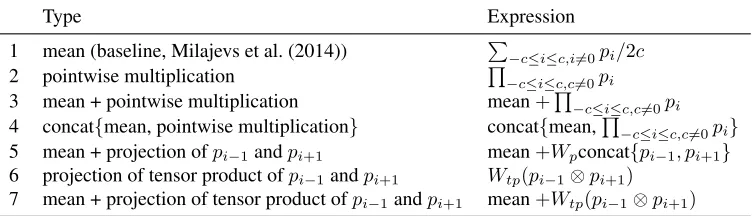
In the CBOW model, the point-wise mean of the word projections is used to predict the target word as shown in Equation 1. In addition to the baseline, we experimented with adding different multiplica-tive terms as shown in Table 2. The added terms are selected to reflect the operations of composition methods in Table 1 and their combinations. In the expressions,piis the projection of theith input
con-text word and cis the size of the context window, which is the number of neighboring words used as the input for each direction.
Type Expression
1 mean (baseline, Milajevs et al. (2014)) ∑−c≤i≤c,i̸=0pi/2c
2 pointwise multiplication ∏−c≤i≤c,c̸=0pi
3 mean + pointwise multiplication mean+∏−c≤i≤c,c̸=0pi
4 concat{mean, pointwise multiplication} concat{mean,∏−c≤i≤c,c̸=0pi}
5 mean + projection ofpi−1andpi+1 mean+Wpconcat{pi−1, pi+1} 6 projection of tensor product ofpi−1andpi+1 Wtp(pi−1⊗pi+1)
[image:4.612.119.495.62.170.2]7 mean + projection of tensor product ofpi−1andpi+1 mean+Wtp(pi−1⊗pi+1)
Table 2: Different outputs of the projection layer.piis the projection of theith input context word,cis the size of the
context window, andWpandWtpare projection matrices.
fourth models evaluate the performance when both the additive and multiplicative interactions are used together since their combination has been shown to be effective (Mitchell and Lapata, 2008). The third model adds the additive terms and multiplicative terms whereas the fourth model concatenates these terms so that they influence the output separately.
In the fifth to the last models, we try to further use the information frompi−1 and pi+1, which are the projections of the nearest neighbor words of theith target word in the training corpus. The fifth model concatenatespi−1 and pi+1 and project to the orig-inal dimension with a projection matrix Wp. This
result is added to the baseline model so that infor-mation from the nearest words considering the order can be used to estimate the target. Wp is also
up-dated during the training.
In the sixth model, since the tensor-based com-positions are used as Table 1 and they can rep-resent multiplicative interactions between different features, we use the tensor product of the projections of (pi−1andpi+1). The tensor product output is also projected to the original dimensionality by multiply-ing a projection matrixWtp, which is also updated
during the training. Although this model can use more powerful interactions of neighbor words, it can only use the information from the nearest neighbor words and it cannot use two word sentences in the training corpus for the training. To deal with these issues, in the last model, we combine the mean with the projection of the tensor product.
4 Experiment results
To evaluate the five different CBOW-based mod-els proposed in Section 3, we use the following datasets: similarity of transitive verbs with
multi-ple senses from Grefenstette and Sadrzadeh (2011a), three-word sentence similarity from Kartsaklis and Sadrzadeh (2014), paraphrase detection from Dolan et al. (2013), and dialog act tagging for the Switch-board corpus (Godfrey et al., 1992) from Stolcke et al. (2000). These are all the datasets evaluated in Milajevs et al. (2014)’s work as well. Each phrase in the first two datasets is fixed as a subject, a tran-sitive verb, and an object whereas the length of each phrase in the last two datasets is arbitrary.
There are several differences between our word vectors and the ones used in Milajevs et al. (2014). First, we use BNC as the training set while Mi-lajevs et al. (2014) use pretrained word vectors fromword2vecthat are trained using GoogleNews dataset. To reduce the size of projection matri-ces, all the words are lower-cased and words occur-ring 20 times or less are converted to the words’ POS tags. Second, instead of negative sampling, our models use hierarchical softmax as the objective function, where each word is represented as a leaf node of Huffman tree since hierarchical softmax is better for training with infrequent words (Mikolov et al., 2013b). Third, we use gradient clipping for more stable training since gradient can be fluctuating when the projections are multiplied. All the other parameters for the training are the same as those used for Milajevs et al. (2014)’s experiments.
Task Method (Milajevs et al., 2014) mean mult mean +mult {mean,multconcat } mean + nbr outer prjnbr prj nbr outer prjmean +
Similarity of tran-sitive verbs
Verb only 0.107 0.130 0.014 0.136 0.204 0.187 0.072 0.250
Addition 0.149 0.066 0.012 0.046 -0.030 0.100 0.111 0.145
Multiplication 0.095 0.160 0.249 0.058 0.219 0.113 0.050 0.204
Kronecker 0.117 0.160 0.160 0.121 0.229 0.168 0.047 0.245
Relational 0.362 0.330 0.276 0.319 0.280 0.344 0.316 0.365
Copy sbj. 0.131 0.249 0.064 0.262 0.209 0.262 0.168 0.290
Copy obj. 0.456 0.302 0.361 0.329 0.382 0.300 0.371 0.322
Frob. add. 0.359 0.337 0.293 0.345 0.288 0.349 0.250 0.355
Frob. mult. 0.239 0.270 0.252 0.255 0.189 0.293 0.196 0.309
Frob. outer. 0.375 0.330 0.275 0.339 0.351 0.329 0.293 0.387
Sentence similarity
Verb only 0.561 0.528 0.360 0.520 0.531 0.527 0.260 0.536
Addition 0.689 0.728 0.572 0.738 0.770 0.722 0.401 0.706
Multiplication 0.341 0.062 0.625 0.178 0.440 0.110 0.269 0.220
Kronecker 0.561 0.206 0.623 0.277 0.501 0.203 0.003 0.457
Relational 0.618 0.505 0.665 0.540 0.527 0.525 0.157 0.574
Copy sbj. 0.405 0.390 0.453 0.353 0.436 0.396 0.139 0.454
Copy obj. 0.655 0.481 0.607 0.487 0.500 0.488 0.190 0.510
Frob. add. 0.585 0.489 0.610 0.407 0.528 0.439 0.210 0.501
Frob. mult. 0.387 0.211 0.608 0.323 0.419 0.335 0.065 0.349
[image:5.612.75.538.61.287.2]Frob. outer. 0.622 0.504 0.664 0.510 0.544 0.524 0.165 0.569
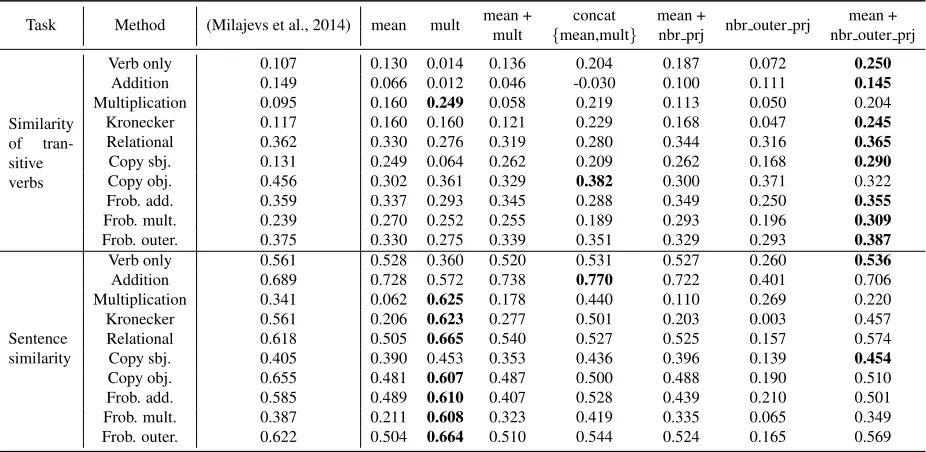
Table 3: Spearman’sρon the similarity of transitive verbs with multiple senses (top) and three-word sentence similarity (bottom). The mean column can be considered an implementation of the Milajevs et al. (2014)’s model on the BNC corpus.
4.1 Fixed phrases (three-word)
Table 3 shows the experiment results for the three-word phrases. The first column represents the two evaluation tasks, the second column is the composi-tion methods described in Table 1, and the third col-umn shows the results of neural word embeddings (NWE) from previous work (Milajevs et al., 2014).5 Bold entries in the table indicate the highest scores among our models.
In the datasets, human annotators rated each phrase pair for semantic similarity (from 1 “no sim-ilarity” to 7 “high simsim-ilarity”). As each unique phrase pair is judged by multiple people, following Milajevs et al. (2014), we took the mean of the rat-ings to set the rating of each unique pair. Scores in the table entries are Spearman’sρs. A high value of Spearman’sρin the table means that the similar-ity of the composed phrases in the vector space is highly correlated with the semantic similarity of the phrases judged by humans. Therefore, if a model shows high scores, it reflects that the model is good at representing the semantics for those short phrases.
5The word vectors are available at
https://drive.google.com/file/d/ 0B7XkCwpI5KDYNlNUTTlSS21pQmM/edit.
4.1.1 Similarity of transitive verbs
The top of Table 3 shows the results for the sim-ilarity of 199 three-word phrase (subject, transitive verb, and object) pairs introduced in Grefenstette and Sadrzadeh (2011a).6 In each phrase pair, the transitive verbs are the same but the subjects and the objects are different for each other. We try to iden-tify the senses of a transitive verb with the different contexts. For example, “meet” is a verb with multi-ple senses. If the given subject is “system” and the object is “specification”, “meet” would be seman-tically closer to “satisfy” than “visit”. Then, given “system meets specification” and “system satisfies specification” as a pair, the judge would give a high rating for the similarity of the verbs.
Our results were not consistently better than Mi-lajevs et al. (2014)’s results. However, considering that the model used for the previous work and our baseline (mean) are similar CBOW models, the per-formance difference would mainly due to the differ-ent training sets (GoogleNews and BNC). Among our models, adding tensor product result to the mean (mean+nb outer prj) showed the best performance in most types of compositions. Interestingly, the
6Available at http://www.cs.ox.ac.uk/
power seems to come from the combination of mean and the tensor product, as both individually perform worse than the combination. For this dataset, as the verbs are the same for both phrases in each pair, the subjects and the objects play important roles for the verb disambiguation. When a transitive verb is an
ith word in a sentence denoted aswi, in many cases,
the subject and the object are wi−1 and wi+1, re-spectively. Since tensor product of thei−1th word projection and thei+ 1th word projection can rep-resent multiplicative interactions between different features of the two words, considering the tensor product of those projections in the model could be helpful to identify the transitive verbs.
4.1.2 Similarity of three-word phrases
The bottom of Table 3 shows the evaluation re-sults on the similarity of 109 three-word phrase pairs with human judged ratings from (Kartsaklis and Sadrzadeh, 2014).7 For example, the similarities of two sentences like “programme offer support” and “service provide help” are evaluated.
In this evaluation, considering the interleaved words with tensor product (mean+nb outer prj) still showed better performance than the baseline (mean) for the most composition methods except addi-tion. However, the multiplication only model,mult, showed the best performance in most cases except when verb only or addition were used as the compo-sition methods.
4.2 Arbitrary length phrases
The three-word phrases in the previous section are useful for the evaluation of the tensor-based compo-sitions since we do not need to care about the struc-tural variations of the phrases. However, we would be more interested in phrases where the lengths are not fixed. As each phrase can have different length, we cannot use the tensor-based compositions used for the fixed-length phrases. Therefore, we evalu-ated the composition of each phrase by only using point-wise addition and multiplication.
Table 4 shows the accuracies of classification tasks given arbitrary length phrases as the inputs. The results evaluate whether composition of arbi-7Available at http://www.cs.ox.ac.uk/
activities/compdistmeaning/emnlp2013_turk. txt.
trary length phrases can be well represented with the word vectors from the proposed models.
4.2.1 Paraphrase detection
The top of Table 4 shows the binary classification accuracies on the Microsoft Research Paraphrase Corpus (Dolan et al., 2013), which consists of arbi-trary length phrase pairs. In this dataset, each phrase pair comes with a binary label: 1 if the phrases were judged to be paraphrases, 0 otherwise. The mini-mum, mean, and maximum lengths of the phrases in the training set are 6, 19.8, and 35, respectively.
With this dataset, we can evaluate if our models work well for representing general phrases. Follow-ing the settFollow-ing of Milajevs et al. (2014)’s work, we trained a linear binary classifier on 2000 phrase pairs and tested on 1726 phrase pairs. The classifier is trained to find the threshold of cosine similarity de-ciding if two phrases are paraphrases or not.
Comparing to the baseline CBOW model, there were no significant gain in the proposed models for the composition by addition. However, using mul-tiplication of the projections (mult) showed signifi-cantly better performance when composed by mul-tiplication, and started to show statistical insignifi-cance to additive composition methods when tested by McNemar’s test withp-value 0.05.
4.2.2 Dialog act tagging
The bottom of Table 4 shows the classification ac-curacies of dialog act tagging (Stolcke et al., 2000) on the Switchboard corpus (Godfrey et al., 1992). Switchboard is a collection of about 2400 telephone dialogs among 543 speakers in the United States. Each utterance is assigned one of 42 dialog-act tags, which summarize syntactic, semantic and pragmatic information about the turns (e.g., yes/no question, yes answer, agree).8 The minimum, mean, and max-imum lengths of the phrases in the training set are 0, 34.1, and 549, respectively. Zero length phrases exist because of the preprocessing, and they are ig-nored.
The task in this section is identifying the dialog act tags from given utterances. Following Milajevs and Purver (2014); Milajevs et al. (2014), we used the first 1115 utterances as the training set and the 8The tags are described in http://web.stanford.
Task Method (Milajevs et al., 2014) mean mult mean +mult {mean,multconcat } mean + nbr outer prjnbr prj nbr outer prjmean +
Paraphrase
detection MultiplicationAddition 0.730.42 0.686 0.6650.393 0.652 0.6900.388 0.6880.587 0.6890.387 0.6840.412 0.6880.371 Dialog act
[image:7.612.74.537.63.134.2]tagging MultiplicationAddition 0.630.58 0.6380.522 0.6060.636 0.6330.593 0.6360.515 0.5810.636 0.5730.565 0.6260.598
Table 4: Accuracies on the paraphrase detection (top) and the dialog act tagging (bottom). The mean column can be considered an implementation of the Milajevs et al. (2014)s model on our training set.
following 19 utterances as the test set. We also con-catenated utterances separated by an interruption by the other person (Webb et al., 2005), and we re-moved disfluency markers and punctuation signs. Once we have the vectors composed by either ad-dition or multiplication for all of the utterances in the training set, the vector dimensionality is reduced to 50 by Singular Value Decomposition (SVD) and ak-nearest-neighbor classifier (k=5) is used to iden-tify the dialog act tags.9The baseline (mean) model showed the best performance for the composition by addition and the mult model was the best for the composition by multiplication, but the differences were insignificant in this case.
The results on both evaluation for arbitrary length phrases support that matching the composition of contexts for the training of constituent word vectors with the actual composition methods shows better or competitive performance.
5 Discussion
We showed the experiment results on seven types of word vectors trained using different composition methods. Overall, we can see that multiplicative in-teractions in the CBOW models can help represent-ing compositions that are multiplicative in nature.
Using only the multiplication of projections showed significant improvement for all the evalu-ated datasets when the phrases are composed with multiplications. Because the composition used for the training of word vectors is matching to the ac-tual evaluated compositions, we can think that the word vectors are trained to represent their multipli-cations properly. One evidence is that the mean of word vectors of themultmodel is around 0.12 while the means of the other models are around 0. Since 9We used scikit-learn (Pedregosa et al., 2011) to run SVD andk-NN classifiers.
there are fewer negative elements in the word vec-tors of themult model, the composition by multi-plication produces relatively more positive values. This possibly gives more stable results when used in multiplication-based compositions since fluctu-ations of the composition by multiplication with negative values is reduced. In the task of transi-tive verb disambiguation, since the interactions be-tween non-adjacent subjects and objects are impor-tant, having their tensor product as a term in the model (mean+nbr outer prj) was noticeably help-ful. In the task of three-word phrase similarity, us-ing the tensor product as a term still showed bet-ter performance than using the models ofmeanand mean+multin most cases except when the phrases are composed with addition. Interestingly, however, the model with only multiplication showed the best performance for most of the compositions by multi-plication and tensor product.
In summary, for better representation of phrase compositions, we showed that it can be helpful to train the word embedding models by composing the input contexts of the model to be similar to the ac-tual composition methods to be used because the word vectors are adjusted to more properly repre-sent the composition by the composition method used. Specifically, using point-wise multiplication in the training model consistently showed better per-formance when the actual composition is also mul-tiplication. Themean+nbr outer prj model, which is with the combination of mean and tensor prod-uct also showed better or similar performance for tensor-based composed phrases compared to the meanmodel and themean+multmodel.
are used as the tensor product terms. As future work, An in-depth analysis of the strengths and weak-nesses of each approach would be helpful to gain more insights about the patterns we see in the re-sults.
References
Marco Baroni, Silvia Bernardini, Adriano Ferraresi, and Eros Zanchetta. The WaCky Wide Web: A collection of very large linguistically processed web-crawled corpora.Language Re-sources and Evaluation, 43(3):209–226, 2009.
Lou Burnard, editor. Reference Guide for the British National Corpus. Research Technologies Service at Oxford Univer-sity Computing Services, 2007.
Wei-Chen Cheng, Stanley Kok, Hoai Vu Pham, Hai Leong Chieu, and Kian Ming A. Chai. Language modeling with sum-product networks. InProceedings of Interspeech, 2014. Bob Coecke, Mehrnoosh Sadrzadeh, and Stephen Clark. Math-ematical foundations for a compositional distributional model of meaning.Linguistic Analysis, 36:345–384, 2010. Bill Dolan, Chris Brockett, and Chris Quirk. Microsoft research
paraphrase corpus, 2013.
John J Godfrey, Edward C Holliman, and Jane McDaniel. Switchboard: Telephone speech corpus for research and de-velopment. InIEEE International Conference on Acoustics, Speech, and Signal Processing (ICASSP), pages 517–520, 1992.
Edward Grefenstette and Mehrnoosh Sadrzadeh. Experimental support for a categorical compositional distributional model of meaning. In Proceedings of the 2011 Conference on Empirical Methods in Natural Language Processing, pages 1394–1404, 2011a.
Edward Grefenstette and Mehrnoosh Sadrzadeh. Experiment-ing with transitive verbs in a discocat. InProceedings of the GEMS 2011 Workshop on Geometrical Models of Natural Language Semantics, EMNLP 2011, pages 62–66, 2011b. Ozan Irsoy and Claire Cardie. Modeling
compositional-ity with multiplicative recurrent neural networks. arXiv, abs/1412.6577, 2014.
Richard Johansson. Dependency Syntax in the CoNLL Shared Task 2008, 2007.
Dimitri Kartsaklis and Mehrnoosh Sadrzadeh. A study of en-tanglement in a categorical framework of natural language. InProceedings of the 11th Workshop on Quantum Physics and Logic (QPL), 2014.
Dimitri Kartsaklis, Mehrnoosh Sadrzadeh, and Stephen Pul-man. A unified sentence space for categorical distributional-compositional semantics: Theory and experiments. In Pro-ceedings of 24th International Conference on Computational Linguistics (COLING), pages 549–558, 2012.
Tomas Mikolov, Greg Corrado, Kai Chen, and Jeffrey Dean. Ef-ficient Estimation of Word Representations in Vector Space. In International Conference on Learning Representations (ICLR) workshop, 2013a.
Tomas Mikolov, Ilya Sutskever, Kai Chen, Greg S Corrado, and Jeffrey Dean. Distributed representations of words and phrases and their compositionality. InAdvances in Neural Information Processing Systems (NIPS), pages 3111–3119, 2013b.
Dmitrijs Milajevs and Matthew Purver. Investigating the con-tribution of discon-tributional semantic information for dialogue act classification. InProceedings of the 2nd Workshop on Continuous Vector Space Models and their Compositional-ity (CVSC), pages 40–47, 2014.
Dmitrijs Milajevs, Dimitri Kartsaklis, Mehrnoosh Sadrzadeh, and Matthew Purver. Evaluating neural word representations in tensor-based compositional settings. InProceedings of the Conference on Empirical Methods in Natural Language Processing (EMNLP), pages 708–719, 2014.
Jeff Mitchell and Mirella Lapata. Vector-based models of se-mantic composition. InProceedings of ACL-08: HLT, pages 236–244, 2008.
Jeff Mitchell and Mirella Lapata. Language models based on semantic compositon. InProceedings of the 2009 Confer-ence on Empirical Methods in Natural Language Processing (EMNLP), pages 430–439, 2009.
Jeff Mitchell and Mirella Lapata. Composition in distribu-tional models of semantics. Cognitive science, 34:1388– 1429, 2010.
F. Pedregosa, G. Varoquaux, A. Gramfort, V. Michel, B. Thirion, O. Grisel, M. Blondel, P. Prettenhofer, R. Weiss, V. Dubourg, J. Vanderplas, A. Passos, D. Cournapeau, M. Brucher, M. Perrot, and E. Duchesnay. Scikit-learn: Ma-chine learning in Python. Journal of Machine Learning Re-search, 12:2825–2830, 2011.
Hoifung Poon and Pedro Domingos. Sum-product networks: A new deep architecture. InProceedings of Uncertainty in Artificial Intelligence (UAI), 2011.
Richard Socher, Alex Perelygin, Jean Wu, Jason Chuang, Chris Manning, Andrew Ng, and Chris Potts. Recursive deep mod-els for semantic compositionality over a sentiment treebank. InProceedings of the 2013 Conference on Empirical Meth-ods in Natural Language Processing (EMNLP), pages 1631– 1642, 2013.
Andreas Stolcke, Klaus Ries, Noah Coccaro, Elizabeth Shriberg, Rebecca Bates, Daniel Jurafsky, Paul Taylor, Carol Van Ess-Dykema, Rachel Martin, and Marie Meteer. Dialogue act modeling for automatic tagging and recogni-tion of conversarecogni-tional speech. Computational Linguistics, 26(3):339–373, 2000.
Ilya Sutskever, James Martens, and Geoffrey E Hinton. Gen-erating text with recurrent neural networks. InProceedings of the 28th International Conference on Machine Learning (ICML), pages 1017–1024, 2011.