Dr. Prakash. V. Diwan, Dean/Director,
School of Pharmacy, Anurag Group of Institutions, Ghatkesar, Hyderabad, Andhra Pradesh, India. Mobile no.: +91-9160266605
Email: [email protected] Address for correspondence
Access this article online www.japer.in
Development and Validation of RP-HPLC method for simultaneous
estimation of Lamivudine and Efavirenz in the Pharmaceutical Dosage Form
INTRODUCTION
Nucleoside reverse transcriptase inhibitors
(NRTIs) were the first class of drugs that were
introduced as antiretroviral agents for the
treatment of infection with human immune
deficiency virus (HIV). Additional drug classes
were developed. They are protease inhibitors
(PIs), non-nucleoside reverse transcriptase
inhibitors (NNRTIs), fusion inhibitors.
Lamivudine ((4-amino-1-[(2R,5S
)-2-(hydroxymethyl)-1,3-oxathiolan-5-yl]-1,2
dihydropyrimidin-2-one) is a nucleoside reverse
transcriptase inhibitors with activity against
human immune deficiency virus (HIV) and
hepatitis B virus (Fig. 1.). Nucleoside reverse
transcriptase inhibitors (NRTIs) are the prodrugs
that require intracellular phosphorylation to
their corresponding triphosphate derivatives,
which are the active inhibitors of HIV reverse
transcriptase. [1- 2]
Efavirenz
((4S)-6-chloro-4-(2-
cyclopropylethynyl)-4-(trifluoromethyl)-2,4-dihydro-1H-3,1-benzoxazin-2-one) is a
non-nucleoside reverse transcriptase inhibitors. It is
used in the treatment of HIV infection (Fig. 2.). It
binds directly and reversibly to the catalytic site
of the reverse transcriptase enzyme and
therefore, interferes with viral RNA to DNA
directed polymerase activities. [3-4]
Literature survey reveals that there are no
isocratic RP-HPLC methods for the simultaneous
estimation of lamivudine and efavirenz in the
bulk drugs and in the formulation. Methods have
been reported for the estimation of lamivudine
and efavirenz individually as well as in
combination with other drugs by UV
Original Article
A simple, specific, accurate and precise reverse phase high performance liquid chromatography (RP-HPLC) method have been developed, which can separate and quantitatively estimate lamivudine and efavirenz in pharmaceutical dosage form. The chromatographic separation for lamivudine and efavirenz was achieved with mobile phase containing 0.1 % triethylamine (pH adjusted to 5.11 with 0.1% orthophosphoric acid) and acetonitrile (30:70 % v/v), reverse phase phenomenex® (Luna 5µ C18(2)
100A (250 × 4.60 mm i.d) column in isocratic mode at room temperature and UV detection at 245 nm. The compounds were eluted at a flow rate of 1.0 ml/min. The retention times of lamivudine and efavirenz were found to be 2.271±0.177 min and 7.267±0.513 min respectively. The above method was validated in terms of linearity, accuracy, precision, Limit of Detection (LOD), Limit of Quantification (LOQ) etc. in accordance with ICH guide lines. The developed method was free from interferences due to excipients present in tablets. The method was rapid, simple and suitable for routine quality control analysis.
Keywords: - Lamivudine; efavirenz; Method development; Validation; HPLC.
ABSTRACT Manikanta Kumar A, B. Naga
Sandhya*, Mahesh Nasare, V. V. L. N Prasad, Prakash V Diwan
Department of Pharmaceutical Analysis and Quality assurance, School of Pharmacy, Anurag Group of Institutions, Venkatapur (V). Ghatkesar (M), Rangareddy (D).
spectrophotometry [5-6] and HPLC [7-14]. To our
knowledge, no study related to the isocratic
analysis of lamivudine and efavirenz have been
reported in literature. Therefore, there is a
challenge to develop RP-HPLC method for the
simultaneous estimation of lamivudine and
efavirenz. The present study was involved in a
research effort aimed at developing and
validating a simple, specific, accurate and precise
RP-HPLC method for the simultaneous
estimation of lamivudine and efavirenz in
pharmaceutical dosage form.
MATERIALS AND METHODS
Acetonitrile (HPLC grade), methanol (HPLC
grade) were obtained from Merck specialties
private limited, Mumbai, India. Water (HPLC
grade) was obtained from Qualigen Fine
chemicals, Mumbai, India. Triethylamine (GR
grade) was obtained from Merck specialties
private limited, Mumbai. Ortho-phosphoric acid
(GR grade) was obtained from S.D. Fine Chemicals
Ltd, Mumbai, India. Pure drugs of lamivudine and
efavirenz were kindly supplied as gratis samples
by Hetero Pharmaceutical limited (Hyderabad,
India). Odivir-250 Kit manufactured by Cipla
Pharmaceutical Limited is used for the analysis.
The label claim states that this formulation
contains lamivudine (300mg), efavirenz (600mg)
per kit. HPLC method development and validation
were done on SHIMADZU (Japan) liquid
chromatograph equipped with LC-20AD pump, LC
20A UV/Vis detector and Rheodyne 7725i
injection with a 20 µL loop. For instrument
control, data acquisition and processing, the
chromatographic system was interfaced to LC
solutions software. Other instruments included
are Shimadzu electronic balance BL-220H
(SHIMADZU corporation, Japan), Value 1 stage
vacuum pump Model: VE115, Fast clean
ultrasonic cleaner.
The column used for chromatographic
separations was reverse phase phenomenex®
Luna 5µ C18 (2) 100A (250 × 4.60 mm i.d). The
analytical wave length was set as 245 nm and
samples of 20 µL were injected. The
chromatographic separations were accomplished
using mobile phase consisting of 0.1%
triethylamine (pH adjusted to 5.11 with 0.1%
orthophosphoric acid) and acetonitrile (30:70 %
v/v), filtered through 0.45 µm filter using Value
1 stage vacuum pump and deaerated in fast clean
ultrasonic cleaner. Mobile phase was pumped in
isocratic mode at a flow rate of 1 ml/min at room
temperature.
Preparation of standard solutions
Stock solutions were prepared by dissolving 10
mg of lamivudine, 10 mg of efavirenz in 50 ml of
acetonitrile separately. Aliquots of the standard
stock solutions of lamivudine and efavirenz were
transferred into 100 ml volumetric flasks and
solution was made up to the volume to yield
required concentrations of lamivudine and
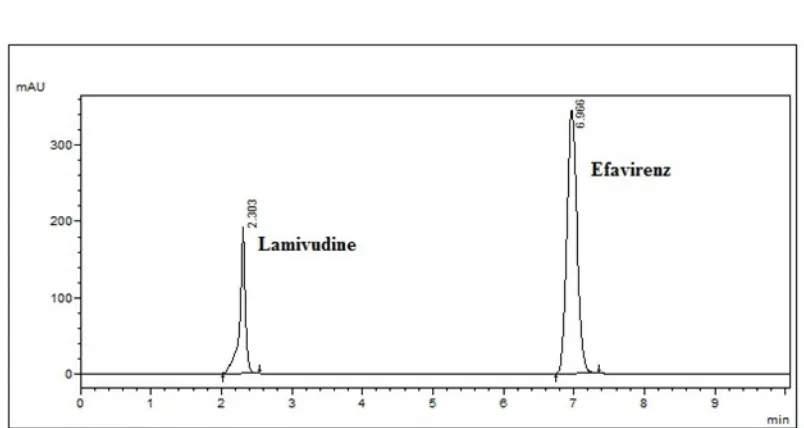
efavirenz. A typical chromatogram obtained from
the analysis of drugs using the developed method
is shown in Fig. 3.
Preparation of sample solution for assay
Twenty Odivir-250 kits each containing 300mg of
lamivudine and 600mg of efavirenz were
weighed, average weight was calculated and
powdered. A quantity equivalent to 300mg of
lamivudine and 600mg of efavirenz was weighed
and transferred into 100 ml volumetric flask. It
flask was sonicated for 20 minutes to affect the
complete dissolution of the drugs and the
solution was made up to the volume with
acetonitrile and filtered. Suitable aliquots of
formulation solution were prepared and injected
to HPLC to obtain concentration in the linearity
range.
RESULTS AND DISCUSSION
For the RP-HPLC, chromatographic conditions
were optimized to get best resolution and peak
shape. The selection of mobile phase was based
on peak parameters like symmetry, theoretical
plates and capacity factor. Symmetrical peaks
with good separation (retention time for
lamivudine was 2.271±0.177 min and efavirenz
was 7.267±0.513 min) were obtained with
reverse phase phenomenex® (Luna 5µ C18(2)
100A (250 × 4.60 mm i.d) column. The mobile
phase containing 0.1 % triethylamine (pH
adjusted to 5.11 with 0.1% orthophosphoric
acid) and acetonitrile (30:70 % v/v) was used at
a flow rate of 1.0 ml/min. The optimum
wavelength for detection and quantification was
at 245 nm, at which good detector response was
obtained for both the drugs. There is no
interference from the diluents, excipients present
in the pharmaceutical formulation.
Method validation:
The proposed method was validated as per
International Conference on Harmonization
(ICH)guidelines.
Linearity and Range
Linearity was established by least squares linear
regression analysis of the calibration curve. The
calibration curves were linear over the
concentration range of 40-100 μg/ml for
lamivudine, 10-80 μg/ml for efavirenz. Peak
areas were plotted versus respective
concentrations and linear regression analysis
was performed on the resultant curves.
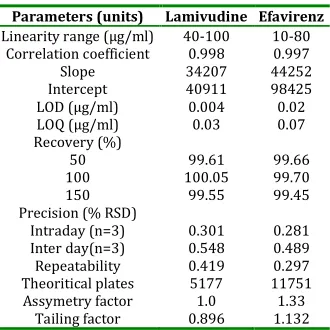
Correlation coefficients were found to be 0.998
and 0.997 for lamivudine and efavirenz
respectively (Fig.4 and Fig.5). The results are
given in Table 1.
Precision
The precision of the analytical method was
studied by multiple sampling of the homogenous
sample. The precision was done at three levels
(intraday, inter day and repeatability). Intraday
precision was done by analyzing the
intermediate concentration of each drugs
(lamivudine 70 µg/ml and efavirenz 40 µg/ml)
for three times. Interday precision was measured
over three consecutive days for the same drug
concentrations. Reproducibility of the method
was determined by performing by the same
analytical procedure at different laboratories.
The %RSD values are calculated for each of them
and the low RSD values indicate that the method
is precise. The results are given in Table 1.
Accuracy
Recovery studies were carried out by applying
the method to drug sample to which known
amount of standard lamivudine and efavirenz
corresponding to 50, 100 and 150 % of label
claim had been added. At each level of the
amount six determinations were performed. The
results are given in Table 1.
Sensitivity and selectivity
LOD and LOQ decide about the sensitivity of the
method. LOD is the lowest detectable
concentration of the analyte by the method while
LOQ is the minimum quantifiable concentration.
given in the ICH guide lines. The LOD with
signal/noise ratio of 3:1 were found to be 0.004
μg/ml for lamivudine and 0.02 μg/ml for
efavirenz. The LOQ with signal/noise ratio of
10:1 were found to be 0.03 μg/mlfor lamivudine
and 0.07 μg/ml for efavirenz. The results are
given in Table 1.
Robustness
The robustness of an analytical procedure is a
measure of its capacity to remain unaffected by
small, but deliberate variations in method
parameters and provides an indication of its
reliability during normal usage. Robustness of
the method was investigated under a variety of
conditions including changes of composition of
buffer in the mobile phase and flow rate. % RSD
of assay was calculated for each condition. The
degree of reproducibility of the results obtained
as a result of small deliberate variations in the
method parameters has proven that the method
is robust.
Ruggedness
The ruggedness of the method was assessed by
comparison of the intra-day and inter-day assay
results for lamivudine and efavirenz that has
been performed by two analysts. The % RSD
values for assays performed in the same
laboratory by two analysts did not exceed 2,
indicating the ruggedness of the method.
System suitability studies
System suitability parameters like number of
theoretical plates (N), peak asymmetry factor
(As), tailing factor etc., were studied. The results
are given in Table 1.
Analysis of marketed formulation
The proposed procedures were successfully
applied for the simultaneous estimation of
lamivudine and efavirenz in the formulation and
the drug contents in each sample were calculated
by comparision with the appropriate standard
solution of the drug. The results obtained were in
agreement with label claim. The results of
analysis are given in Table 2. No interference due
to excipients was detected in the chromatograms
produced (Fig. 6).
CONCLUSION
RP-HPLC methods enable the quantitation of
lamivudine and efavirenz in oral dosage form
with good accuracy and precision, either in
laboratory prepared samples or in
pharmaceutical dosage forms. The good
recoveries were obtained in all cases as well as
the reliable agreement with the reported
procedure proved that the proposed methods
could be applied efficiently for determination of
lamivudine, and efavirenz in oral dosage form
with satisfactory precision. This method is
considered simple, reliable, selective providing
satisfactory accuracy, precision with lower limits
of detection and quantification more specific and
sensitive. More over the shorter duration of
analysis for lamivudine and efavirenz makes the
reported method suitable for routine analysis in
pharmaceutical dosage forms.
Table 1: Summary of validation parameters
Parameters (units) Lamivudine Efavirenz
Linearity range (µg/ml) 40-100 10-80 Correlation coefficient 0.998 0.997
Slope 34207 44252
Intercept 40911 98425
LOD (µg/ml) 0.004 0.02
LOQ (µg/ml) 0.03 0.07
Recovery (%) 50 100 150 99.61 100.05 99.55 99.66 99.70 99.45 Precision (% RSD)
Intraday (n=3) Inter day(n=3) Repeatability 0.301 0.548 0.419 0.281 0.489 0.297 Theoritical plates 5177 11751 Assymetry factor 1.0 1.33
Table 2: Analysis of marketed formulation
Drugs
Labeled amount, mg/tablet
Amount found, mg/
tablet % *RSD
Lamivudine 300 298.923 0.095
Efavirenz 600 598.675 0.715
* mean of six observations
Fig. 1: Structure of lamivudine
Fig. 2: Structure of efavirenz
Fig.3: Chromatogram of standard solution (30 µg/ml Lamivudine and 60 µg/ml Efavirenz)
Fig. 5: Calibration Graph of Efavirenz by RP-HPLC
Fig.6 Chromatogram of formulation (30 µg/ml Lamivudine and 60 µg/ml Efavirenz)
ACKNOWLEDGEMENT
I am very much thankful to School of Pharmacy,
Anurag group of Institutions, Hyderabad, for
giving permission to carry out my work.
REFERENCES
1. en.wikepedia.org/wiki/lamivudine accessed on 1-1-2012.
2. www.drugbank.ca/drugs/DB00709 accessed on 1-1-2012.
3. en.wikipedia.org/wiki/efavirenz accessed on 1-1-2012.
4. www.drugbank.ca/drugs/DB00625 accessed on 1-1-2012.
5. Deepali G., Elvis, M. UV spectrophotometric method for assay of the anti-retroviral agent lamivudine in active pharmaceutical ingredient and in its tablet formulation. Pharm analysis. 2010; 2 (4):417-419.
6. Anand Kumar Y., Rama Rao N. Development of rapid UV Spectrophotometric method for the estimation of efavirenz in formulations. E-Journal of Chemistry. 2010; 7(3):856-860.
lamivudine from pharmaceutical preparation. E-Journal of Chemistry. 2010; 7(1):117-122. 8. Kano E. K., Reis Serra C. H., Koono E. E. M.,
Andrade S. S., Porta V. Determination of lamivudine in human plasma by HPLC and its use in bioequivalence studies. Int. J. Pharm. 2005; 297:73–79.
9. Checa A., Oliver R., Cassou SH., Saurina J. Reversed-phase liquid chromatographic method with spectrophotometric detection for the determination of antiretroviral drugs. analytica chimica acta. 2008: 616:85–94.
10.Bahrami G., Mirzaeei.S., Kiani A., Mohammadi B. High-performance liquid chromatographic determination of lamivudine in human serum using liquid–liquid extraction; application to pharmacokinetic studies. J. Chromat. B, 2005;
823:213–217. 11.Veldkamp A.I., Van Heeswijk R.P.J., Meenhorst
P.L., Mulder J.W., Lange J.M.A., Beijnen J.H., Hoetelmans, R.M.W. Quantitative determination of efavirenz (DMP 266), a novel non-nucleoside reverse transcriptase inhibitor, in human plasma using isocratic reversed-phase high-performance liquid chromatography with ultraviolet detection. J. Chromat. B. 1999; 734:55–61.
12.Matthews C.Z., Woolf E.Z., Mazenko R.S., Haddix wiener H., Chavez Eng C.M., Constanzer M.L., Doss G.A., Matuszewski B.K. Determination of efavirenz, a selective nonnucleoside reverse transcriptase inhibitor, in human plasma using HPLC with post column photochemical derivatization and fluorescence detection. J.Pharm.Biomed.analy. 2002; 28:925–934. 13.Marzolini C., Telenti A., Buclin T., Biollaz J.,
Decosterd L.A. Simultaneous determination of the HIV protease inhibitors indinavir, amprenavir, saquinavir, ritonavir, nelfinavir and the non-nucleoside reverse transcriptase inhibitor efavirenz by high-performance liquid chromatography after solid-phase extraction. J. Chromat. B. 2000; 740:43–58.
14.Proust V., Toth K., Hulin A., Abure A.M., Gimenez F., Singlas E. Simultaneous high-performance liquid chromatographic determination of the antiretroviral agents amprenavir, nelfinavir, ritonavir, saquinavir, delavirdine and efavirenz in human plasma. J. Chromat. B. 2000; 742:453– 458.
Manikanta Kumar. A, B. Naga Sandhya*, Mahesh Nasare, V. V. L. N Prasad, Prakash V Diwan; Development and Validation of RP-HPLC method for simultaneous estimation of Lamivudine and Efavirenz in the Pharmaceutical Dosage Form; J. Adv. Pharm. Edu. & Res. 2012:; 4: 232-238