Volume 3, Issue 3, March 2014
Page 303
Abstract
Thin sandwich panel made of high strength, high stiffness face sheets and light weight core material was envisaged here to replace the sheet metals. That may be frequently subjected to low intensity foreign body impacts. In this paper sandwich panels made of GF face sheets are tested under 6J, 12J and 18J impact energy. Study of the impact behavior and collection of data on impact resistance of the candidate material was considered. The damage area was observed on the front and rear side of the face sheets. Also the space contours plot of sandwich panel was constructed using AUTOCAD software. Result shows that Sandwich panels with GF face sheets can sustain higher impact loads up to18J and No fiber breakage, only de-bonding between face sheet and core over damage area is observed. There was negligible permanent depression in case of sandwich panels as the panel restores its original shape when the load is released.
Keywords: Glass fabric [GF], Polyester Coremat XM foam, Sandwich, Impact.
1.
I
NTRODUCTIONThe impact behavior of a structural material is an important requirement. The structural members are frequently subjected to mild or high intensity impacts such as bird hitting the aircraft, hail, dropping of tools during fabrication or maintenance, etc. In sandwich panels, impact analysis is more critical because the face sheets are likely to separate from the core easily. They can behave in a ductile manner in case of static loading, but may behave in a brittle manner and fail catastrophically when subjected to impact loads. Therefore it is a basic need to predict the impact behavior and to collect data on impact resistance of the candidate material.
Generally, when a sandwich panel is subjected to an impact, a part of the energy associated with impact is used for the elastic deformation of the material and returned back by the system. The energy in excess is dissipated through several mechanisms such as fiber breakage, fiber matrix de-bonding and delamination of the face sheets, crushing and shear-deformation of the core, etc. Both the face sheet configuration and the core structure control the impact behavior. The core in the conventional sandwich panels is generally formed by simple foam whose aim is to increase moment of inertia and flexural stiffness without increasing the weight [1, 4, 7]. Therefore the foam used in the core does not always have high mechanical properties.
In the impact, the main performance of the foam core is limited to cushion the inertial loads, while the composite face sheet performs the energy absorption. In order to determine the impact behavior of the thin sandwich panels, impact tests are conducted using the drop weight test set-up. The impact tests are conducted at different energies 6J, 12J and18J with low velocity in the range of 3.3-5.7 m/s. The impact induced damage areas are reported for the thin sandwich composites developed in the current study.
2.
SPECIMEN
GEOMETRY
AND
FABRICATION
The plates of dimensions 168 mm x 168 mm are used for impact test. The impact loading have been performed on the specimen plate clamped at all edges by the fixture. The unsupported area of the plate is 150 mm x 150 mm. Thickness of the sandwich panel is nearly 3 mm[13].
Fig.1 Thin Sandwich Plate Geometry
Sandwich panels were fabricated by using symmetric hand lay-up process. Glass fibre Reinforced polymer skin will be used as its modulus and strength are high. However, Polyester Coremat XM foam was sandwiched in between two face sheets. Core increases moment of inertia and flexural stiffness without increasing weight.
Impact Behavior of Sandwich Panels Made of
Composite Material
Dipak D.Bari1, Prashant S. Bajaj2
1 PG Student. S.S.G.B.C.O.E. & T; Bhusawal, Maharashtra, India.
Volume 3, Issue 3, March 2014
Page 304
3.
EXPERIMENTAL
SET-UP
The impact drop test set up has been developed so as to perform the test under controlled conditions. Schematic diagram of cylindrical punch is shown in Fig.2.
Fig.2 Schematic Diagram of Cylindrical Punch
A short cylindrical punch with hemispherical head, made of mild steel weighing 1.084kg was dropped through the seamless tube to impact the specimen of size 168 mm x 168 mm clamped at all four edges by the fixture. The cylindrical punch is used for the transverse central loading on small patch of 10 mm diameter rather than point load. The length and diameter of the cylindrical piece used were 200 mm and 30 mm respectively as shown in Fig.2.
The clamping fixture is made of two square shaped clamps. Each clamp is made of square rods of size 25mm x 25 mm, welded together as shown in Fig.3. The specimen is rigidly held between two clamps by 20 numbers of bolts [3].
Fig.3 Clamped Thin Sandwich Plate Specimen.
4.
RESULTS
AND
DISCUSSION
Thin sandwich panels, envisaged to replace the sheet metals, may be frequently subjected to such low intensity foreign body impacts. Therefore, it is of fundamental importance to study the impact behavior and to collect data on impact resistance of the candidate material. Sandwich structures must be designed to allow maximum energy absorption in impact besides the ability to withstand static and dynamic loads.
For the current study, sandwich panels made of GF face sheets are tested under 6J, 12Jand 18J impact energy. Three samples of each kind of sandwich panel are tested at different impact energy. The impacted specimens have a clearly visible damage area on the front as well as on rear sides. The permanent deflection over damage area, indentation depth and failure mechanism are observed at different impact energy and results are compared with the conventionally used 0.8 mm thick MS sheet.
4.1. Damage Area
Volume 3, Issue 3, March 2014
Page 305
Fig.4 Damage area on rear face of sandwich panels made of GF face sheets
Fig.5 Damage area on front face of sandwich panels made of GF face sheets
Table 1 GF/XM/GF Thin Sandwich Panel
Expt. Damage Area (mm2) at Incident Impact Energy
6J 12J 18J
1 683.6 715.8 866.3
2 570.8 782 1067.4
3 649 770 971.5
4 698.3 951.2 1004.5
4.2. Deflection Contour Plot over Damage Area
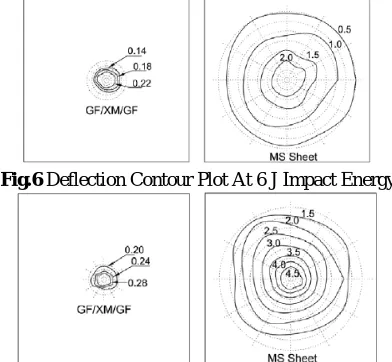
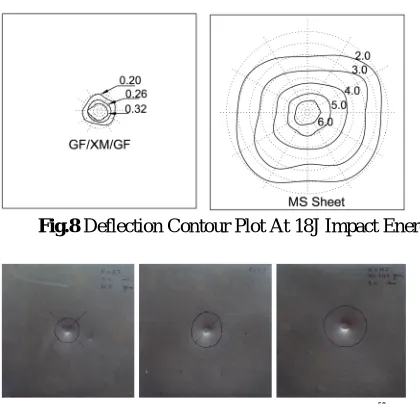
The deflection of sandwich panels at different impact energies is measured over damage area. The number of points is marked over damage area. The normal depth is measured at all the points. The deflection contour plot is constructed by spline command using AUTOCAD software. Fig.6-8 represent the deflection over damage area at different impact energies for sandwich panels and 0.8 mm thick MS Sheet. If an impact load acts on the MS sheet, it would plastically deform the MS sheet on a fairly large area, resulting into an extensive depression.
However, sandwich panel bends and regains its shape; there was not permanent depression as in the case of MS sheet. MS sheets were deformed with a dent at the point of impact due to plastic deformation of the metal as shown in Fig.9the dent spoils the aesthetics of the automobile body. This can often be observed in car bodies that undergo minor impacts or collisions where in a small dent spoils the aesthetic surface finish.
Fig.6 Deflection Contour Plot At 6 J Impact Energy
Volume 3, Issue 3, March 2014
Page 306
Fig.8 Deflection Contour Plot At 18J Impact Energy
Fig.9 0.8 mm thick MS Sheet under Impact Loading
5.
COMPARISON
OF
DAMAGE
AREA
Damage area of sandwich panels with GF face sheets is very less compared with conventional material, 0.8 mm thick MS Sheet. No fiber breakage, only debonding between face sheet and core over damage area is observed in case of sandwich panels with GF face sheets. Also, the sandwich panels with GF face sheets are strong enough to sustain 12J impact energy; hence it was further studied at 18J impact. Sandwich (GF/XM/GF) panel is having maximum impact strength, where no fibers breakage is observed. Damage area of sandwich panels is very less compared with conventional material, 0.8 mm thick MS Sheet shown in Fig. 10.
Fig. 10 Comparison Of Damage Area
6.
CONCLUSION
Sandwich structures are found to be most in case of high specific bending stiffness and strength. From this paper it is observe that there is delamination between core and face sheet, some fibre breakage over the damage area under impact loading. Sandwich panels with GF facesheets (GF/XM/GF) that studied here can sustain higher impact loads up to 18J.There were negligible permanent depression in case of sandwich panels as the panel restores its original shape when the load is released. That means sandwich panels regain its shape after the impact but there is permanent deformation in MS sheet. Damage area and contour plots of sandwich panel are very less compared to 0.8mm thick MS sheet.
REFERENCES
[1] Aymerich F., Pani C., Priolo P, “Damage response of stitched cross-ply laminates under impact loadings”, Engineering Fracture Mechanics,74(2007)500-514.
[2] Apetre N.A., Sankar B. V., Ambur D. R., “Low-velocity impact response of sandwich beams with functionally graded core”, Int. Journal of Solids and Structures,43(2006)2479-2496.
Volume 3, Issue 3, March 2014
Page 307
[4] Dhakal H. N., Zhang Z.Y., Richardson M.O.W. & Errajhi O.A.Z; “The low velocity impact response of non-woven hemp fiber reinforced unsaturated polyester composites”, Composite Structures, 81 (2007) 559-567.
[5] Enboa Wu and Chang L.C; “Woven glass/epoxy laminates subject to projectile impact”, Int. Journal of Impact Engineering, 16(1995) 607-619.
[6] Fujii K., Aoki M., Kiuchi N., Yasuda E., and Tanabe Y., “Impact perforation behavior of CFRPs using high-velocity steel sphere”, Int. Journalof Impact Engineering, 27(2002) 497-508.
[7] Hosur M. V., Abdullah M. and Jeelani S; “Manufacturing and low-velocity impact characterization of hollow integrated core sandwich composites with hybrid face sheets”, Composite Structures, 65 (2004) 103-115.
[8] Jiang D. and Shu D;“Local displacement of core in two-layer sandwich composite structures subjected to low velocity impact”, Composite Structures, 71 (2005) 53-60.
[9] Mines, R.A.W., and Jones N; “Approximate elastic plastic analysis of static an impact behaviour of polymer composite sandwich beams”, Journal of Composites, 26 (1995) 803-814.
[10]Naik N. K. and Nemani B;“Damage in woven fabric composites subjected to low-velocity impact”, Composites Science and Technology, 60 (2000) 731-744.
[11]Ska K.I., Guillaumat L., Wojtyra R. and Castaings M; “Effects of manufacturing and face/core bonding on impact damage in glass/polyester-PVC foam core sandwich panels”, Composites Part B: Engineering, 39 (2008) 1034-1041. [12]Suvorov A.P. and Dvorak G.J; “Enhancement of low velocity impact damage resistance of sandwich plates”, Int.
Journal of Solids and Structures, 42(2005) 2323-2344.
[13]Gaudenzi P., Pascucci A., Barboni R. and Horoschenkoff A; “Analysis of a glass-fibre sandwich panel for car body constructions”, Composite Structures, 38 (1997)421-433.
[14]V B Ugale, KK Singh, NM Mishra, Prashant Kumar.; “Experimental studies on thin sandwich panels under impact and static loading” Journal of Reinforced Palastics and Composites, 32(6), 2013, 420-434 India.
[15]Salih N. Akour, Hussein Z. Maaitah, “Effect of Core Material Stiffness on Sandwich Panel Behavior beyond the Yield Limit” Proceedings of WCE 2010, Vol II, June 30 - July 2, 2010, London, U.K.
[16]Prashant Kumar,K. K. Singh & R. K. Singh; “Experimental study of Damage Area Extension in GFRP Composites at Different Energy Level” ournal of Engineering and Applied Sciences, accepted for publication, 2011.