Promoting Healthy Thyroid Function with Iodine, Bladderwrack, Guggul and Iris
Jill Stansbury, NDa
Paul Saunders, PhDb
David Winston, RH(AHG)c
ABSTRACT
Iodine is an essential component of thyroid hormones and is therefore essential for normal thyroid function. However, the therapeutic use of iodine requires careful evaluation because of its narrow range of intake to support optimal thyroid function. The combination of naturally occurring compounds such as Gum Guggul (Commiphora mukul), Blue Flag root (Iris versicolor) and seaweeds such as Bladderwrack (Fucus vesiculosus) has shown beneficial effects in the treatment of thyroid dysfunction. These compounds have different mechanisms of action and may act synergistically to support thyroid health in conditions such as Hashimoto’s disease and subclinical hypothyroidism. Fucus provides iodine and upregulates the production of iodine-processing hormones, while Commiphora enhances the conversion of T4 to T3, and Iris is a detoxifying agent. These three agents have been used in combination with Nettle leaf (Urtica), Ashwagandha (Withania), Triphala, and Bacopa (Bacopa monnieri), and with supplements supporting basal metabolism and general thyroid function such as L-tyrosine, diiodotyrosine, magnesium, selenium, and iron. Reported side effects include the induction of iodine sensitivity by Bladderwrack and hypersensitivity reactions such as rash and pruritis caused by Guggul. The use of Guggul and Iris is not recommended during pregnancy.
Keywords: Thyroid function, Thyroid hormones, Iodine, Essential nutrient
CliniCal impliCations
Gum Guggul (Commiphora mukul), Blue Flag root (Iris versicolor) and seaweeds such as Bladderwrack (Fucus vesiculosus) are naturally occurring compounds that may aid in the treatment of hypothyroidism. Because these work via different mechanisms, they may be combined to synergistically support the thyroidparticularly in situations of thyroid hypofunction and Hashimoto’s Disease. Fucus provides iodine and upregulates iodine-processing hormones; Commiphora enhances peripheral conversion of T4 to T3; Iris provides gentle glandular stimulation and detoxification. These three herbs nourish the thyroid gland by enhancing its normal metabolic functions. Individuals with high cholesterol, slow digestion, slow metabolism, or low body temperature may benefit from the use of these herbal remedies.
primary indiCations
Hashimoto’s Disease, Low Body Temperature, Subclinical hypothyroidism
adjunCtive or stand-alone treatment Adjunctive
dose of BioaCtive Constituents
Gum Guggul, or Guggul Myrrh extract (Commiphora) 80-900 mg per day; Bladderwwrack (Fucus) 100 mg to 5 grams a day. Blue Flag root (Iris) 400-2400 mg a day
synergistiC HerBal formula
Blue Flag root (Iris), Guggul Myrhh Gum; (Commiphora), and Bladderwrack (Fucus), Nettle leaf (Urtica), Ashwagandha (Withania), Triphala, and Bacopa (B. monnieri) combine well together due to varied and complementary mechanisms of action. Other supplements that support basal metabolism and general thyroid function include L-tyrosine, diiodotyrosine, magnesium, selenium, and iron (for anemic patients).
side effeCts (and Cautions)
Bladderwrack showed no toxicity on acute and subacute (4 weeks) testing.1 Bladderwrack has induced iodine sensitivity in some patients. Guggul
can cause hypersensitivity reactions including rash and pruritis. Guggul and Iris are not recommended in pregnancy.
unsuBstantiated tHeoretiCal side effeCts
Bladderwrack contains mucopolysaccharides which may inhibit the absorption of pharmaceutical medications, including strontium. It may also increase the risk of bleeding when used in combination with anticoagulants and anti-platelet medications. Guggul may increase the risk of bruising and bleeding if taken with anticoagulants or antiplatelet medications. Guggul may be additive or antagonistic with other herbs that have estrogenic activity.
©2012, Jill Stansbury, ND Journal Compilation ©2012, AARM
DOI 10.14200/jrm.2012.1.1008
a Corresponding author: Battle Ground Healing Arts, 408 E Main Street , Battle Ground, WA 98604, USA
processing equipment, but this has significantly diminished due to changes in both cattle feed and a phase-out of iodine dairy sanitizers. The iodine content of cow’s milk can be increased by adding seaweed to the bovine diet.2 Of note, strict vegans
practitioners are at particular risk for iodine defi-ciency because of limited dietary sources.3
The thyroid gland actively absorbs iodine; it combines iodine with tyrosine in enzymatic reac-tions to synthesize thyroxine and triodothyronine, the active thyroid hormone. While small doses of iodinein the range of micrograms appear to stimulate thyroid function and induce the iodinase and thyroxine synthesis enzymes, large doses of iodine (in the range of 500 mg/day) will suppress thyroid function.
Even minute, physiologic doses of iodine should be administered with caution if a thyroid dysfunction is not well understood. Some people (especially peri-menopausal women) can develop a complex situation of ‘on/off’ hyperfunction/hypofunction thyroid disorder, where the use of therapeutic iodine must be carefully evaluated. Some individu-als may individu-also display a reaction to iodides such as KI solution, where tiny doses suppress and larger doses stimulate. Thus, administration of iodine in a hyperthyroid patient could produce a dangerous thyroid storm—not the desired result.
High doses of iodine may be effective in treating hypothyroidism if caused by iodine deficiency. However it can potentially exacerbate the autoim-mune response in some patients. In these patients, iodine should be removed from the Complementary Alternative Medicine (CAM) treatment protocol. Herbal and nutritional medicine is not a substitute for thyroid hormone replacement therapy, although it may be complementary and used in tandem.
The RelATIONShIp Of IODINe INTAke AND GOITeR
Ongoing iodine deficiency will typically result in goiter and low thyroid function. Endemic goiter is defined as 10% or more of a given local popu-lation having enlarged thyroid glands. Enlarged
DISCuSSION
Centuries before the discovery of iodine in 1811 by Bernard Courtois (a French chemist and saltpeter manufacturer), seaweed was used to treat enlarged thyroid glands. K.E. Hung—a Chinese physician (A.D. 281-361)—used seaweed in the treatment of goiter. Five-hundred years later, Wang Tao had 36 formulas for the treatment of goiters, and 27 con-tained seaweed. In the nineteenth century, iodine was often called “the universal medicine”, and considered a panacea for all human ills. It was in-cluded in the treatment of every infectious disease, and the common motto was “if nothing else works, try iodine”.
In 1813, Gay-Lussac (who discovered chloride) named it ‘iode’, from two Greek words mean-ing violet-colored; it was changed in the 1930s to “iodin” which evolved into ‘iodine’. J.F. Coindet, in 1819, discovered iodine to be the active ingredi-ent in seaweed. In 1820, he first used tincture of iodine to treat simple goiters. In 1829, Jean Lugol added iodine to potassium and Lugol’s iodine solu-tion (potassium iodide [KI]) became the standard treatment for goiters. In 1850, the French physi-cian, G.A. Chatin, demonstrated an association between low iodine intake and the prevalence of a goiter. In 1920, iodized salt became the norm for the treatment of goiters instead of Lugol’s solution. Hungarian Nobel Laureate Szent-Gyorgyi ingested one gram of KI/day to stay fit. He stated:
“Nobody knew what it did, but it did something and did something good. We students used to sum up the situation in the little rhyme: If ye don’t know where, what or why, prescribe ye then, K and I.”
IODINe AS AN eSSeNTIAl NuTRIeNT
zoneespecially the Pacific Ocean. Bladderwrack has been used as food and medicine for centuries, particularly in Asian cultures. Fucus was termed “Bladderwrack” because little air-filled bladders (or flotation devices) keep it in the upper regions of the sea (i.e., close to the ocean surface). Fucus is often known as kelp, the name given to the alkaline ashes that were used as an alkali agent to make soap.
Fucus vesiculosus contains the flavonoid
fucoxan-thin 9 and is reported to have the highest antioxidant
activity of the edible seaweeds.10
Seaweed, being high in numerous minerals and halides including iodine, may enhance thyroid function when consumed in appropriate amounts; however, it may suppress thyroid function when consumed daily and in large amounts. In Japan, where seaweed is a dietary staple, the daily average intake of iodine has been estimated between 2 to 12 mg per day9,12 which is well above the US
Recom-mended Daily Allowance (RDA).
In seaweeds tested, iodine content was highest in young, freshly-cut blades and lowest in sun-dried form.13 In the 12 species tested, iodine levels varied
from 16 µg per gram in nori (Porphyra tenera) to 8165 µg per gram in processed kelp granules made from Laminaria digitata. Because of the variable and sometimes large doses of iodine in these natu-ral products, physicians should ask patients with hyper/hypothyroidism about seaweed consumption in their diet and or taken as supplements.
Fucus also has the ability to decrease
transsiali-dase activity in the blood, an enzyme associated with cholesterol accumulation.14 This may benefit
patients with low thyroid function as decreased metabolism is associated with hyperlipidemia.
GuGGul exTRACTS TO SuppORT ThyROID fuNCTION
Commiphora mukul or Guggul may support thyroid
function. Commiphora mukul (a relative of the myrrh gum tree in the Burseraceae family) is noted for its content of aromatic gummy resins that have many medicinal, culinary, aromatic, and spiritual uses. Guggul from Commiphora mukul is currently at risk of being endangered due to overharvesting in India and Pakistan.
thyroid glands are typically associated with iodine deficiency in the local soil composition. Human populations in industrialized nations no longer eat locally; therefore, the occurrence of goiter may be more of an individual deficiency rather than a local deficiency in many parts of the world. However, in some parts of the world, endemic goiter may result from excessive iodine intake where seaweed is a staple part of the diet. The World Health Organi-zation uses the term ‘iodine deficiency disorder’ and estimates that more than 800 million people are affected and at risk of health problems from inadequate iodine intake.4 Goiter is only one sign
of iodine deficiency. Iodine deficiency can produce systemic symptoms in adults but is particularly problematic during gestation and infancy, where iodine deficiency can lead to cretinism, other forms of mental retardation, congenital heart disease, re-productive problems, and a myriad of birth defects. Iodine deficiency can also cause oxidative stress in the body.5 When iodine is not present to produce
thyroid hormones, high levels of TSH result and lead to free radical formation. This oxidative stress is particularly likely when selenium deficiency is also present. All of the iodinase and peroxidase enzymes are selenium-dependent; selenium and iodine work synergistically. Selenium can affect io-dine metabolism, homeostasis, and bioavailability, and thereby play a role in thyroid function.6
Iodine deficiency during gestation can cause abnor-mal brain and endocrine development. In known iodine deficient areas of the world, iodine supple-mentation during pregnancy is recommended. On the other hand, excessive intake of iodine during pregnancy is known to lead to transient hypothy-roidism in newborns due to suppressive effects on the thyroid. Maternal consumption of over 2 to 3 grams of iodine per day is associated with severe thyroid suppression.7 Therefore, the current
recom-mendation for pregnant women is 300 µg per day.8
However CAM practitioners will often safely pre-scribe 12 mg a day.
BlADDeRwRACk AS A SOuRCe Of IODINe
Bladderwrack (Fucus vesiculosus [a member of the
Fucaceae family]) is a genus of brown algae found
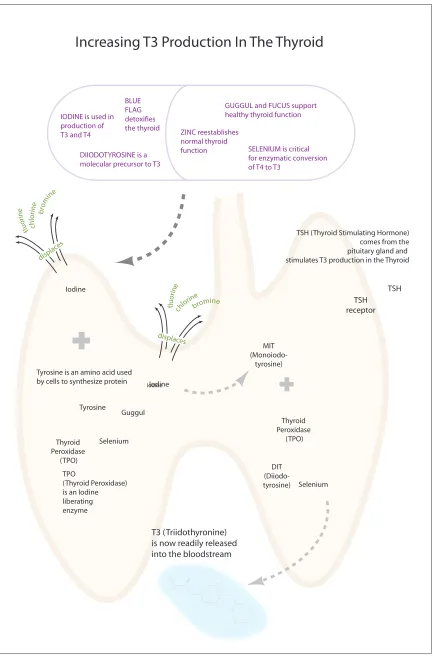
Increasing T3 Production In The Thyroid
TSH (Thyroid Stimulating Hormone) comes from the pituitary gland and stimulates T3 production in the Thyroid
Guggul
MIT
(Monoiodo-tyrosine)
Thyroid Peroxidase
(TPO) Tyrosine
Selenium
Thyroid Peroxidase
(TPO)
DIT (Diiodo-tyrosine) TPO
(Thyroid Peroxidase) is an Iodine liberating enzyme
Tyrosine is an amino acid used by cells to synthesize protein
T3 (Triidothyronine) is now readily released into the bloodstream
Selenium
Iodine
Iodine
bro
min e
ch
lori
ne
flu
or
in
e
Iodine
TSH TSH
receptor IODINE is used in
production of
T3 and T4 ZINC reestablishes
normal thyroid
function SELENIUM is critical
for enzymatic conversion of T4 to T3
BLUE FLAG detoxifies the thyroid
GUGGUL and FUCUS support healthy thyroid function
displac es
bromine
chlor ine
flu
orin
e
displac es DIIODOTYROSINE is a
molecular precursor to T3
io din
e &
diiodotyrosine
sele
nium
an
d zinc
se len
ium
an
d zinc SUPPORTS & STIMULATES:
the
thyroid
increases iodine uptake and increases T4 and T3 productionthe
kidneys
use selenium and zinc to convert T4 to the more active hormone T3the
liver
usesselenium and zinc to convert T4 to the more active hormone T3
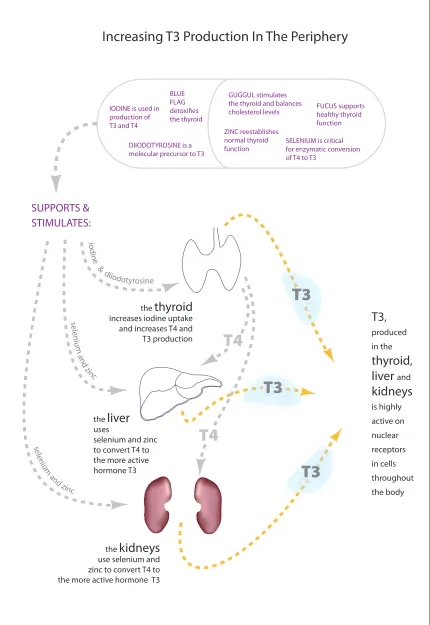
T3
, produced in thethyroid,
liver and
kidneys
is highly active on nuclear receptors in cells throughout the bodyT4
T4
Increasing T3 Production In The Periphery
DIIODOTYROSINE is a molecular precursor to T3 IODINE is used in
production of T3 and T4
ZINC reestablishes normal thyroid function BLUE
FLAG detoxifies the thyroid
FUCUS supports healthy thyroid function GUGGUL stimulates
the thyroid and balances cholesterol levels
T3
T3
T3
SELENIUM is critical for enzymatic conversion of T4 to T3
Germacrene (a volatile hydrocarbon found in the
Burseraceae family) is a building block in the
formation of resins.15 Commiphora mukul a
tradi-tional Ayruvedic medicinal herb, has shown thyroid stimulating effects in animals16 and is used to treat
high cholesterol, obesity and sluggish metabolic functioning.
Commiphora mukul contains sterols (known as
guggulsterones,) that act on bile acid receptors to process lipids and contribute to a its hypolipidemic effect.17 In a randomized, double-blinded,
placebo-controlled study in patients with moderate hyper-lipidemia, supplementation significantly reduced total cholesterol after 12 weeks.18 However, it
should be mentioned that HDL cholesterol was sig-nificantly lower, while LDL cholesterol and triglyc-erides were unchanged. This finding of decreases in total cholesterol is of questionable clinical useful-ness since most cases of dyslipidemia include LDL and triglycerides that are too high, and HDL levels that are too low. Importantly, Commiphora mukul inhibited LDL oxidation, which is a key mechanism of atherogenesis and atherosclerosis.19 Thus, while
LDL levels may be unchanged with Commiphora supplementation, the pro-plaque oxidation of LDL may be reduced.
Commiphora mukul may also lower lipid levels by
supporting the thyroid’s basic metabolic functions. Animal studies have shown Commiphora mukul to reduce the effects of thyroid suppressive medica-tions, indicating a thyroid hormone-enhancing ef-fect and utility in the treatment of hypothyroidism.20
Ketosteroids in Commiphora, found in the oleo-resin, are reported to increase the uptake of iodine by the thyroid gland and enhance the activity of thyroid peroxidase enzymes.16 T3 production was
increased along with a healthy alteration in the ratio of T3 to T4 indicating a thyroid support effect.21
Re-cent research found that guggulsterones may inhibit nuclear receptors involved with basic metabolic functions and cholesterol metabolism, contributing to the plant’s hypolipidemic effect.18 Hypoglycemic
and hypolipidemic effects may occur following the consumption of guggulsterones. Animal studies
have shown guggulsterones to inhibit maturation of adipocyte precursor cells.22 In addition to
slow-ing their formation adipocyte maturation, gug-gulsterones have also been shown to exert direct inhibitory effects on adipocytes by inducing apop-tosis of individual fat cells and decreasing lipid ac-cumulation. Interestingly, this effect is potentiated by xanthohumol a constituent of the hops (Humulus
lupulus) plant.23 Specific proteins associated with
adipocyte functions are also down-regulated under the influence of Commiphora while lipolysis is also promoted. Animal studies have found that choles-terol is decreased in part due to enhanced uptake of LDL by the liver via a mechanism involving en-hanced membrane receptor-mediated endocytosis. Binding sites for LDL may increase significantly under the influence of Commiphora mukul. While guggulsterones have posess several favorable and plausible mechanisms to reduce cholesterol, results of clinical trials have been inconclusive.24-25
IrIs VersIcolor TO SuppORT ThyROID
fuNCTION
Iris was utilized and written about extensively by
an organized group of physicians (members of the American eclectic physician movement) who from the 1830s to the 1940s heavily relied on the use of carefully prepared botanical medicines. Iris
versi-color (also called “Blue Flag”), is a small wild Iris
found in the marshy areas of North America. The plant contains volatile oils, resins, alkaloids, and the oleoresin iridin, but little molecular, cellular, or clinical research has been conducted on this plant. Nonetheless, this plant has a long history of me-dicinal use targeted to “moving the sluggish bodily fluids” (i.e., saliva, lymph, bile, digestive secre-tions, bowels, congested tissues) and has been used to treat hepatomegaly, splenomegaly and thyroid dysfunction.
CONCluSION
Optimal thyroid function requires sufficient amounts of bioavailable iodine. Humans depend on dietary sources for of iodine including animal prod-ucts, seaweed, and iodized salt. Iodine deficiency can cause a number of negative health consequenc-es, especially during infancy. Fucus vesiculosus promotes thyroid function as an excellent source of iodine. Commiphora mukul increases uptake of iodine in the thyroid. Iris versicolor is less well studied than the other herbs but has historically been utilized in the treatment of goiter. Given their varied mechanisms of action, these naturally occur-ring compounds may provide benefits to promote thyroid function, and prevent the onset of adult thy-roid dysfunctions (Figures 1 and 2). Further study is needed to determine the benefits of these herbal remedies to patients with Hashimoto’s Disease and hypothyroidism.
DISClOSuRe Of INTeReSTS
Dr. Saunders reports personal fees related to employment or seeing patients from CCNM, the Dundas Naturopathic Centre, and from Beaumont Health Systems, Troy Hospital, MI, outside the submitted work. Dr. Winston reports personal fees from Herbalist & Alchemist, Inc, outside the submitted work. Dr. Stansbury has nothing to disclose.
RevIew eSSAy
Many nutrients and herbs that have not been the subject of randomized controlled studies are used regularly by clinicians. They have also been used tra-ditionally for hundreds, sometimes thousands of years.
Iris versicolor of the Iridaceae family © Steven Foster Group, Inc. All rights reserved.
14. Aksenov DV, Kaplun VV, Tertov VV, Sobenin IA, Orekhov AN. Effect of plant extracts on trans-sialidase activity in human blood plasma. Bull Exp Biol Med 2007;143(1):46-50.
15. Noge K, Becerra JX. Germacrene D, a common sesqui-terpene in the genus Bursera (Burseraceae). Molecules 2009;14(12):5289-5297.
16. Tripathi YB, Malhotra OP, Tripathi SN. Thyroid Stimu-lating Action of Z-Guggulsterone Obtained from Com-miphora mukul. Planta Med 1984;50(1):78-80.
17. Wu J, Xia C, Meier J, Li S, Hu X, Lala DS. The hypolipidemic natural product guggulsterone acts as an antagonist of the bile acid receptor. Mol Endocrinol 2002;16(7):1590-1597.
18. Nohr LA, Rasmussen LB, Straand J. Resin from the mukul myrrh tree, guggul, can it be used for treating hypercholesterolemia? A randomized, controlled study. Complement Ther Med 2009;17(1):16-22.
19. Wang X, Greilberger J, Ledinski G, Kager G, Paigen B, Jurgens G. The hypolipidemic natural product Commiphora mukul and its component guggulsterone inhibit oxidative modification of LDL. Atherosclerosis 2004;172(2):239-246.
20. Panda S, Kar A. Guggulu (Commiphora mukul) po-tentially ameliorates hypothyroidism in female mice. Phytother Res 2005;19(1):78-80.
21. Panda S, Kar A. Gugulu (Commiphora mukul) induces triiodothyronine production: possible involvement of lipid peroxidation. Life Sci 1999;65(12):L137-L141.
22. Sharma B, Salunke R, Srivastava S, Majumder C, Roy P. Effects of guggulsterone isolated from Commiphora mukul in high fat diet induced diabetic rats. Food Chem Toxicol 2009;47(10):2631-2639.
23. Rayalam S, Yang JY, Della-Fera MA, Park HJ, Ambati S, Baile CA. Anti-obesity effects of xanthohumol plus guggulsterone in 3T3-L1 adipocytes. J Med Food 2009;12(4):846-853.
24. Szapary PO, Wolfe ML, Bloedon LT et al. Guggulipid for the treatment of hypercholesterolemia: a randomized controlled trial. JAMA 2003;290(6):765-772.
25. Ulbricht C, Basch E, Szapary P et al. Guggul for hyper-lipidemia: a review by the Natural Standard Research Collaboration. Complement Ther Med 2005;13(4):279-290.
RefeReNCeS
1. Zaragoza MC, Lopez D, Saiz P et al. Toxicity and anti-oxidant activity in vitro and in vivo of two Fucus vesicu-losus extracts. J Agric Food Chem 2008;56(17):7773-7780.
2. Teodoru V, Nicolau GY. Iodine-enriched milk in goiter endemics. Rom J Endocrinol 1992;30(3-4):165-167.
3. Lightowler HJ, Davies GJ. Iodine intake and iodine deficiency in vegans as assessed by the duplicate-portion technique and urinary iodine excretion. Br J Nutr 1998;80(6):529-535.
4. Lamberg BA. Endemic goitre--iodine deficiency disor-ders. Ann Med 1991;23(4):367-372.
5. Chanoine JP. Selenium and thyroid function in infants, children and adolescents. Biofactors 2003;19(3-4):137-143.
6. Kohrle J. Selenium and the control of thyroid hormone metabolism. Thyroid 2005;15(8):841-853.
7. Nishiyama S, Mikeda T, Okada T, Nakamura K, Kotani T, Hishinuma A. Transient hypothyroidism or persistent hyperthyrotropinemia in neonates born to mothers with excessive iodine intake. Thyroid 2004;14(12):1077- 1083.
8. Zimmermann M, Delange F. Iodine supplementation of pregnant women in Europe: a review and recommenda-tions. Eur J Clin Nutr 2004;58(7):979-984.
9. Yan X, Chuda Y, Suzuki M, Nagata T. Fucoxanthin as the major antioxidant in Hijikia fusiformis, a com-mon edible seaweed. Biosci Biotechnol Biochem 1999;63(3):605-607.
10. Jimenez-Escrig A, Jimenez-Jimenez I, Pulido R, Saura-Calixto F. Antioxidant activity of fresh and processed edible seaweeds. J Sci Food Agric 2001;81(5):530-534.
11. Deme D, Fimiani E, Pommier J, Nunez J. Free diio-dotyrosine effects on protein iodination and thyroid hormone synthesis catalyzed by thyroid peroxidase. Eur J Biochem 1975;51(2):329-336.
12. Nagataki S. The average of dietary iodine intake due to the ingestion of seaweeds is 1.2 mg/day in Japan. Thyroid 2008;18(6):667-668.