
www.astesj.com 82
Singular Integral Equations in Electromagnetic Waves Reflection Modeling
A. S. Ilinskiy1, T. N. Galishnikova*,1
1 Faculty of Computational Mathematics and Cybernetics, Lomonosov Moscow State University, 119991, Russia
A R T I C L E I N F O A B S T R A C T
Article history:
Received: 01 March, 2017 Accepted: 29 March, 2017 Online: 11 April, 2017
The processes of reflection of three-dimensional electromagnetic waves by locally irregular media interfaces are investigated. The problem under study is mathematically reduced to the solution of a boundary value problem for the Maxwell equations in an infinite space with an irregular boundary. In order to develop a numerical algorithm, the potential theory and a special Green’s function are applied to reduce the addressed boundary problem to an equivalent system of two hypersingular integral equations. This system is solved with the use of the approximation and collocation method. Special attention is focused on calculation of the kernels of these equations. Results of simulation of the currents induced on the irregularity and reflected field patterns in the resonance frequency range are presented.
Keywords:
Reflection of electromagnetic waves
Inhomogeneous medium Singular integral equations
1. Introduction
This paper is an extension of the work originally presented at the URSI Commission B International Symposium on Electromagnetic Theory (EMTS 2016) [1]. In this article we model the scattering of three-dimensional electromagnetic waves on a finite impedance section of a wavy surface separating two media. The scattering of electromagnetic waves by a wavy interface between two different media is an important problem for various applications. In this article we investigate the incidence of an arbitrary plane wave on a local inhomogeneity of the interface assuming sufficiently high conductivity of the underlying medium. The mathematical formulation of such problems reduces to that of solving a system of Maxwell equations in non-regular infinite regions. Depending on the polarization of the incident field, the boundary-value problems are reduced to independent systems of hypersingular integral equations solved by specially developed numerical algorithms utilizing a singularity isolating algorithm.
2. Mathematical model and numerical algorithm
2.1.Mathematical formulation of wave scattering problems
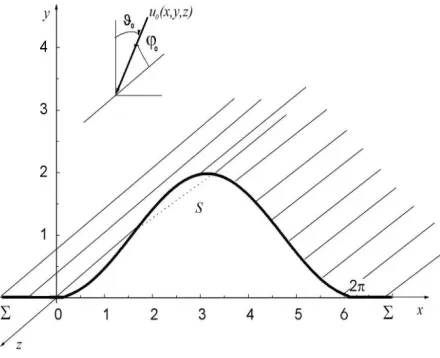
Let us assume that an interface between two media is situated in Cartesian coordinates x, y, z. The interface consists of two half planes
that are specified by the equation y0 and joined by an impedance cylindrical wavy section S that stretches along the z axis. The entire wavy section is located in the half-space. 0
y The surface S is specified by the equation y=f(x),
,
0xa f(0) f(a)0, where ais the x length of irregularity S. Let
a
2
.
The reflecting surfaceS
does not depend on z coordinate. Denote by D1 the region over interfaceS
where the 3D incident electromagnetic field propagates. This region D1 is characterized by permittivity 1, permeability 1, and the k1 wave number 1 1
2 2
1
k , where
is the circular frequency (Figure 1). The time dependence is exp
it
.Figure 1:Geometry of perfecting surface
ASTESJ
ISSN: 2415-6698
*Corresponding Author: T. N. Galishnikova, Faculty CMC,LomonosovMoscow
State University, 119991, Russia. Email: [email protected]
www.astesj.com
Special Issue on Recent Advances in Engineering Systems
A. S. Ilinskiyet. al. / Advances in Science, Technology and Engineering Systems Journal Vol. 2, No. 3, 82-87 (2017)
The field of the plane wave
), exp( ) , , ( ), exp( ) , , ( 0 0 0 0 0 0 0 0 0 0 z i y i x i H z y x H z i y i x i E z y x E 0 0 1
0 sin
sin
k
0 k1cos
0sin
0, and 0k1cos0is incident on the surface
S
in region D1. Here,
0 is theangle between axis z and the direction of the incident wave propagation. When
0
/2, we obtain a plane reflection two-dimensional problem. If 0 0, we have the case of the normal incidence in the plane problem.In region
D
1 we seek for a solution to the homogeneous system of Maxwell equations, 0 ) , , ( ) , , ( , 0 ) , , ( ) , , ( 1 1 z y x H i z y x E curl z y x E i z y x H curl
which satisfies on the plane section the condition of perfect conduction
nE(x,y,z)
0,Leontovich condition on local section S with a finite conductance
nE(x,y,z)
W2
n
nH(x,y,z)
, ./ 2
2
2
W Here, 2 and 2 are the characteristics of the section S, n
nx,ny,0
is the outward normal to region D1. The reflected field satisfies the radiation conditions at infinity.We look for the total electromagnetic field in D1 that has the
same dependence on z as the incident field, that is
x,y,z
E x,y exp
i 0z
,E H
x,y,z
H
x,y exp
i0z
. Then, the boundary condition on S can be represented as follows:
y x E i n y x H i k W y x H n y x E i y x H i k W y x E z z z z z z , , 1 , , , , 0 1 2 0 2 1 2 1 0 2 0 2 1 2,
, / //nnx xny y
/
nx/yny/x arethe normal and tangent derivatives, respectively. Accordingly, boundary conditions on plane section
take the form
, 0,
, 0. n y x H y x
Ez z
We denote u
x,y Ez
x,y ,v
x
,
y
H
z
x
,
y
,
. 2 0 2 1 2 1 k Then the considered boundary value problem can
be reduced to solving in region D1 of the 2D homogeneous
Helmholtz wave equation
0 ) , ( ) , ( 2 1 2 2 2 2 y x v y x u y x
with appropriate boundary conditions on
andS
.2.2.Reduction of the boundary problem for Helmholtz equations to the system of singular equations in case of E-polarization
In order to obtain a system of hypersingular integral equations equivalent to the boundary value problem for Helmholtz equation, we introduce Green’s function gE
M,P
, satisfying in region1
D the inhomogeneous Helmholtz equation
,
2
,
,2 1 2 2 2 2 P M P M g y x
E
the boundary condition for perfect conductor on half-plane
M,P
0, gEthat have the form
ˆ
.2 ) ,
( 0(1) 1 M,P 0(1) 1 M,Pˆ E r H r H i P M
g
Here, H0(1)(x) is the zero-order Hankel function of the first kind;
2
2,,P M P M P
M x x y y
r where
xM,P,yM,P
arecoordinates of M and P points;
P M
rˆ ,ˆ
xM xP
2 yM yP
2,
x
P,
y
P
are the coordinatesof the Pˆ point.
Applying in region
D
1 the Green’s formula successively to functions u
M , gE
M,P
, taking into account the radiation conditions and the properties of surface potentials, we obtain a system of two integral equations for unknown functions
P nu
/ and v
P / on finite section S for E- polarization case: M M M v W i n M u W W ik
) ( 2 ) (2 12
2 0 2 1 1 2 1
P S P E E n P u n P M g W W ik P Mg ( , ) ( , ) ( )
2 1 2 1 1 2 1
(1)
), ( ) ( ) , ( 0 2 2
0 v P ds u M
A. S. Ilinskiyet. al. / Advances in Science, Technology and Engineering Systems Journal Vol. 2, No. 3, 82-87 (2017)
PS M P
E
M E
M n
P u n n
P M g W
W ik n
P M g n
M
u ( , ) ( , ) ( )
2 1 2
1 2
2 1 1
2 1
, , ) ( )
( ) ,
( 0
2
2 1 2
0 M S
n M u ds P v n n
P M g W i
M E
P P P M E
(2)
where u0E(x,y)exp
i0xi0y
exp
i0xi0y
. In the case of the H- polarization we can obtain a system of two integral equations for unknown functions v
P and u
P / on finite section S.2.3.The numerical algorithm for the solution of singular integral equations for the E-polarization
The systems of integral equations are singular and can be solved through reducing them to the complex system of linear algebraic equation by means of the collocation and approximation method.
To this end, we divide the interval
0,a, on which the equation y f(x) of the irregular cylindrical surfaceS
is defined, by points xi ia/N, x0 0, xN a, intoN
equal parts. The points dividing the curveS
have the coordinates
xi,f(xi)
. Then we replace the integrals entering into the systems of equations (1), (2) with the sums of the integrals overthe subintervals and set ,
2 1 Mi
M i1,...,N, 2 1 i
M are
collocation points. The sought solution on the section
,
1
, j
jP
P
S
, 1 ,...,
0
N
j is approximated by a zero-order spline. As a result, we obtain a complex system of linear algebraic equations. When calculating the integrals over a section
,
1
, j
jP
P
S
in whichthe integrand depends on either gE
M,P
or
,
, P En P M g
we
replace the integration with respect to
s
with the integration with respect tox
by setting dsP 1
f
x
2dxP.Note that the terms that enter the kernels of integral equations and depend on gE(M,P) have a logarithmic singularity when the arguments coincide. Therefore, when developing the numerical algorithm, this singularity is separated in an explicit form and the integrals containing it are calculated analytically.
The normal derivatives of the function gE(M,P) have no singularity when the arguments are equal, and
), ( 2 1 ) , (
lim 0 M
n P M g
p E
M P
where
0(M)is the curvature of the contourS
at the pointM
.The kernels of the system depending on
P ME
n n
P M g
2 ,
have a strong singularity. In order to calculate the matrix elements that are integrals of the functions with a hypersingularity, it is necessary to develop a numerical algorithm. To this end, we preserve the integration over the arc
s
in these integrals. We defined the surfaceS
in the form xx
s, yy
s . The outward normal to the domain D1 we write in the form nysixs j, wherei
and
j
are thex
andy
unit vectors. Note that if the boundary of S is specified in the form y f
x , the relationship between the directional cosinesn
x;
n
y of the outer normal n to D1 is given by
21 f x
n
yS x , xS ny 1
f
x
2 ,
21
/ f x
x f
nx , ny 1/ 1
f
x
2 .We have
1 ,
,
2 / 1 2
j P j P
S
P i
E
P M
ds P M g n n
(3)
1 ,
2 / 1 ,
1 ) 1 ( 0 2
2 j P j P
i
S
P P M P
M
ds r
H n n
i
1 ,
2 /
1 .
ˆ
2 1 ,
) 1 ( 0 2
j P j P
i
S
P P M P
M
ds r
H n n
i
To develop a special computing algorithm, every integrands is represented by a sum of two terms: the first one is the total differential of some function has been calculated analytically; the function in the second term has a logarithmic singularity and is integrated by separating this singularity in the explicit form, thereafter the corresponding integrals are calculated analytically.
In the first term /nM let us consider the component /xM (without the multiplier
i
/
2
):
M P PS M P
ds r
H n
x i
j P j P
, 1 1 0 2
2 1
1 ,
M P PP
S P
ds r
H x
n i
j P j P
, 1 1 0
2 1
1 ,
1 ,
2 1,
1 1 0
j P j P
i
S
P M P
r H y
A. S. Ilinskiyet. al. / Advances in Science, Technology and Engineering Systems Journal Vol. 2, No. 3, 82-87 (2017)
1 , 2 1 , 1 1 0 2 1 j P j P P i S P S PM y ds
r H
P S S ds y P M i j P j P P 1 , , 4 (4)
j i j
i M P
P P M P r H y r H
y 1 ,
1 0 , 1 1 0 2 1 1 2 1
P S S PM y ds
r H j P j P P i 1 , 2 1, 1 1 0 2 1
,
. 4 1 , P S S ds y P M i j P j P P
The points
M
andP
can coincide, hence, there is an integral of the Dirac delta-function.Similarly let us consider the component/yM in the first term /nM:
M P PS M P
ds r H n y i j P j P , 1 1 0 2 2 1 1 ,
M P PP S P ds r H y n i j P j P , 1 1 0 2 1 1 ,
1 , 2 1, 1 1 0 j P j P i S P M P r H x d
P S S PM x ds
r H j P j P P i 1 , 2 1 , 1 1 0 2 1
1 , , 4 j P j P P S P S ds x P M i (5) j i j
i M P
P P M P r H x r H
x 1 ,
1 0 , 1 1 0 2 1 1 2 1
P S S PM x ds
r H j P j P P i 1 , 2 1 , 1 1 0 2 1
,
.4i
M P x dsUsing (4)-(5) and the recurrence relations for Hankel functions
; , , 1 1 1 1 , 1 1 0 P M P M P M P M P r x x r H r H x
, , , 1 1 1 1 , 1 1 0 P M P M P M P M P r y y r H r H y
we obtain the final formula for the calculation of the second normal derivative of the Green function [2].
2.4.Calculation of the reflected field pattern for the E-polarization
Using the solution to the system of integral equations (1)-( 2) and taking into account the boundary conditions on the section
S
, we can obtain the integral representation for the field u1
M u
M u0E
M:
S P P
E E n P u n P M g W W k i P M g M
u , ,
2 1 1 2 1 2 1
1
1 2
1 2
0 , vP ds , M D
n P M g W i P P P E
.
(6)We introduce spherical coordinate frame r,,, where angle
/2 /2
is measured from the y axis and angle
0 /2
is measured from the z axis. We seek for a representation of the scattered field for rM rP, k1 rM 1. Following that, we introduce the notation rM . It can be shown that the following asymptotic relationships
P M
MP r e
r , and
MP P
M r e
r
, ˆ
ˆ ˆ
ˆ
are valid. Here,e
M isa unit vector oriented in the direction to point M; i.e.
M / M r
e
sinsin,cossin,cos
. Taking into account the above relationships and asymptotic behavior of the Hankel function, we can obtain the asymptotic representations for) , (M P
gE ,
P E n P M g ( , )
in the form
4 exp 2 , 1 1 i P M gE
i rP eM i rP eM
, ˆ exp ,
exp
1
1 ˆ;
4 exp 2 , 1 1 i n P M g P E
i nP eM i rP eM , exp , 1 1
nP eM
i
rP eM
i , ˆ exp
, 1 ˆ
ˆ
1
A. S. Ilinskiyet. al. / Advances in Science, Technology and Engineering Systems Journal Vol. 2, No. 3, 82-87 (2017)
We call quantity FE
, that equals
, EF
S
M P e
r
i ,
exp 1
1 1
i
rP eM
, ˆ
exp
1 ˆ
nP eM i rP eM WW
k
, exp
, 1
1 1
2
1
P M
P M
P n
P u e
r i e
nˆ, exp 1 ˆˆ, ( )
nP eM i rP eM W
, exp
, 1
1 2
0
PP M P M
P ds
P v e r i e
n
ˆ , ( )
exp
, 1 ˆ
ˆ
the pattern of scattering field u1
M . Knowing the solution of the system of singular integral equations (1)-(2), we calculate the currents induced on the irregular surface and far-field pattern for the scattered field in the far zone [4].3. Numerical results
The induced currents and reflected electromagnetic field patterns are calculated for E- polarization,2 504i, contour
S
specified in theXOY
plane by the equation f
x 1cosx,
2
0
x
,a
2
.Figure 2 shows the distribution of the calculated function of the induced current
I
(
x
)
u
P
/
n
on the boundaryS
along the x axis for ak13 , a
1.5, where
is the wavelength of the incident field. The results are obtained for various angles
0 and
0 of the electromagnetic wave incidence:(
curve1
)
0
0
,
00
85
; (
curve2
)
0 30,
00 60
;
(
curve3
)
0 45,
0 0 45
; (
curve4
)
0 60,
0 0 30
.
Figures 3-4 show for ak1 3 , a
1.5 reflected fieldpattern
F
E
,
in polar coordinates for the range
85
85
and fixed values of
. Curves 1-5correspond to 85,60,45,30,5. Figures 3-4 represent the results of calculations for the reflected field when a plane wave incident at the angles 0 0,0 85 (Figure 3) and
, 45
45 0
0
(Figure 4).
Figure 2
Figure 3
Figure 4
A. S. Ilinskiyet. al. / Advances in Science, Technology and Engineering Systems Journal Vol. 2, No. 3, 82-87 (2017)
Figure 5
Figure 7
4. Conclusion
1. The exact model of plane electromagneticwave incident on inhomogeneous conductive surface is investigated. 2. The problem is reduced to the system of singular integral
equations. The analytic solution is provided for a singularity in the kernels of integral equations.
3. The numerical algorithm for calculation of scattering characteristics of incident electromagnetic field was
5. References
[1] A. S. Ilinskiy, T. N. Galishnikova, “Singular Integral Equations in the Wave Scattering Problems”. Proc. Of URSI Commission B International Symposium on Electromagnetic Theory (EMTS 2016), 14-18 August, 2016, Espoo, Finland. Pp. 635-637 (electronic publication).
[2] A. S. Il’inskii and T. N. Galishnikova, “The Integral Equation Method in Problems of Diffraction by a Finite Impedance Section of a Medium Interface”, Moscow University Computational Mathematics and Cybernetics (Allerton Press), vol. 32, no. 4, pp.187-193, 2008.
[3] A. S. Il’inskii and T. N. Galishnikova, “Investigation of Diffraction of an Electromagnetic Wave Arbitrarily Incident on a Locally Inhomogeneous Medium Interface”, Journal of Communications Technology and Electronics, vol. 58, no. 1, pp. 40-47, 2013.
[4] A. S. Il’inskii and T. N. Galishnikova, “Integral Equation Method in Problems of Electromagnetic-Wave Reflection from Inhomogeneous Interfaces between Media”, Journal of Communications Technology and Electronics, vol. 61, no. 9, pp. 981-994, 2016.
![Figure 5 [4] A. S. Il’inskii and T. N. Galishnikova, “Integral Equation Method in Problems of Electromagnetic-Wave Reflection from Inhomogeneous Interfaces between Media”, Journal of Communications Technology](https://thumb-us.123doks.com/thumbv2/123dok_us/10072897.1993716/6.612.56.273.61.552/galishnikova-problems-electromagnetic-reflection-inhomogeneous-interfaces-communications-technology.webp)
