Page 90
THE MOTIVATION POTENTIAL OF THE STUDENTS´ WRITTEN WORKS AND OTHER MOTIVATIONAL FACTORS
Kralova Eva
Institute of Medical Physics, Biophysics, Informatics and Telemedicine, Comenius University, Faculty of Medicine in Bratislava, Slovak Republic
Abstract
The contribution describes the main items of scientific project „Motivating factors of medical students for better understanding the fundamental science knowledge in relation to medical diagnostic and therapeutic methods.“ Project has the ambition to develop a functional model of feedback algorithm to streamline the learning process of science in medical schools, which will support the improvement of educational level and international competitiveness of graduates. The project is focused on the identification and subsequent application of motivating approaches in the natural sciences teaching and learning. The aim is to specify students´ attitudes and motivation towards sciences after 1st semester of medicine study. [Kralova 2015]
Key challenge is to find incentive approaches, strategies and resources in teaching process and change negative attitudes of medical students to the science in a positive way. [Vasutova 2002]
To realize the purpose of the project it is necessary to develop a joint effort of teachers providing science teaching in medical schools with the teachers of preclinical and clinical teaching subjects. Only by such cooperation can be specified necessary core of knowledge of the science needed for further study in medical schools, but also in medical practice. The fulfilment of this goal requires further training of university teachers of natural sciences in higher education pedagogy and psychology.
Pedagogical investigation using anonymous questionnaire was used with the aim to specify respondents´ (1st year students of Faculty of Medicine Comenius University in Bratislava) attitudes and motivation towards study medicine, teaching of natural sciences and their ideas how to increase motivation to their study after 1st semester of medicine study.
Keywords: university medical education, students´ motivation, attitudes, natural sciences
INTRODUCTION
The characteristics of study programs General Medicine and Dentistry are based on valid documents of World Health Organization (WHO), World Federation for Medical Education (WFME), European Union and legislation of the SR (WHO Office in the Slovak Republic, WFME 1998, Acreditation Commission of the Slovak Republic).
The aim of the Bologna Declaration is to achieve full compatibility with similar universities in the world and to ensure that graduates of medical faculties are equivalent partners throughout the world as well. [Bernadic et al. 2006]
Medical studies and medical practice put high demands on the analytical and synthetic thinking of students and health professionals. These skills can be developed at the medical faculties by the study of science and can provide a solid foundation for further study and medical practice. However, a strict specification of the necessary knowledge and skills is required for the medical practice of future graduates.
Page 91
current requirements for the education of medical graduates so that undergraduate studies are considered as basis of the necessary training also in the context of lifelong learning. The daily work of physicians requires knowledge supporting their independent ability to provide the individual health care with emphasis on quality, which necessarily involves general orientation in natural sciences and their applications in medical practice.
Applications of the natural sciences in medicine (medical biophysics, medical chemistry, and medical biology) represent inevitable part of medical curriculum as supporting teaching subjects. Both teaching and learning of them are difficult. Among medical students and the medical community, however, they are also less popular. They are often negatively evaluated by medical students and lack of motivation to their study is observed. Attitudes of medical students towards natural sciences are influenced by their negative experience from the previous study. Nevertheless, the fundamental knowledge of the natural sciences represents the necessary basis for better understanding the basic principles of medical diagnostic and therapeutic methods. Therefore, the indispensable role of natural sciences teachers is to achieve positive attitudes and motivate students to study them. Teachers are obliged to search and apply motivating approaches and strategies with the aim to influence negative attitudes of students to the sciences in a positive way. For this purpose, teachers of the natural sciences require students´ feedback in order to improve quality and content of teaching. [Kralova & Kukurova 2008]
When looking at the teaching process, it is clear that if a student has negative attitudes towards a particular subject, he does not have an interest in the subject, so his success in this subject also decreases. The student probably does not understand the meaning, so he considers it unnecessary to learn a subject and not to get on.
In order to achieve quality results in the learning process, it is important for a teacher to seek and make full use of effective motivational approaches. This means that there is a need for lifelong education of natural science teachers in the pedagogical field as well.
Our project is aimed to support the effectiveness of the teaching of natural sciences at the faculties of medicine in General Medicine and Dentistry study programs (Slovak and English) and the solution of continuity content on preclinical and clinical subjects, especially their use in medical practice. Research of this kind in Slovak medical faculties has not yet been realized. Its aims are:
• To realize pedagogical research in the form of an anonymous questionnaire and to summarize the opinions and suggestions of medical students and practitioners on the connecting possibilities of science and preclinical and clinical teaching subjects.
• To identify motivational factors that influence the positive attitudes of students towards the study of natural sciences applications, with the prerequisite for achieving better study results in preclinical and clinical subjects.
This should be reflected in better learning outcomes not only natural sciences but also from other preclinical and clinical subjects, which would help to solve the issues of horizontal and vertical continuity content of theoretical, preclinical and clinical disciplines in the field of medical studies (General Medicine and Dentistry), and thus to solve the internal continuity of the 1st and 2nd level of the mentioned study programs, in which the first and the second level are connected.
How to motivate university students and support their study activity?
If university teachers want good educational results, they should ask the following questions: • how to motivate students to learn
• how to change students´ attitudes towards statement “we only learn what is necessary for the exam” • how to engage students in planning teaching process
Page 92
• how to get students to engage in activities during the lessons (i.e. individual written works) • by what specific teaching methods students can be motivated to learn the subject
• which appropriate feedback method to use
• how to change or, by what means, to mitigate any tense atmosphere in the lesson, etc.
Teacher tools to achieve these goals:
• is consistent (insists on fulfilling each task)
• commend the student for additional work (if the student completes the task moreover, he / she should follow the praise or reward)
• give volunteer tasks - incentives for students (short papers, video presentations, presentations, recitals of articles from periodicals, professional articles, simple aids - always appreciate) use playful forms in teaching, repeating, practicing content of the curriculum (group work, didactic games, etc.)
• regularly evaluates students: official (mark, points), verbal evaluation, auxiliary points
• consistently differentiates students according to their capabilities, assigns different tasks to different students, differentiates in assessment (adequacy of claims)
• enables students to express themselves verbally - to present their own knowledge • discussing with students - motivational conversation, student experiences
• evaluates students if they want to fix a bad mark (failure) and want to prove that they have already taught the substance, respectively. They want to show their own initiative
• evaluates not only theoretical knowledge but also practical skills (laboratory work with laboratory technique)
• uses activation forms of teaching, supports independent student work, project teaching, seminar and other projects ...)
The specificity of medical study is based on several facts: • historically conditioned (Hippocratic oath)
• the humanity of the physician´s mission, which is related to the necessary interaction with the patient • maintaining the quality of life
• a complex curriculum of undergraduate medical education, which is embedded in national legislation, takes into account the EU Strategic Documents, the Code of Ethics of the Doctor and the Health Officer, WHO recommendations, WFME, AMEE ...)
• fixed study plan for daily studies of general and dental medicine • the specific interdisciplinary nature of teaching and learning
• the need to keeping prerequisites (theoretical, preclinical and clinical subjects) • study of general and dental medicine only in daily form
• high time management requirements (about 5600 teaching hours / 6 years) • high demands on analytical and synthetic thinking
Page 93
specify the core needs of knowledge from science necessary not only for further study at medical faculties but also for future medical practice.
MATERIALS AND METHODS
Anonymous questionnaires were prepared and distributed at the end of the first semester of university study at the Faculty of Medicine Comenius University in Bratislava in the acad. years 2016/2017 and 2017/2018 (128 and 105 respondents, respectively). The aim was to map current state of the respondents´ attitudes, level of respondents´ motivation concerning natural sciences (medical biophysics, medical chemistry and medical biology) and identify the main motivating and demotivating factors.
Respondents rated their attitudes on the scale from 0 (negative) to 10 (positive). All obtained data were saved in the electronic database in the MS Excel. Subsequently they were categorized into five categories (negative, slightly negative, neutral, slightly positive and positive attitudes or motivation), expressed in percentage and analyzed in dependence on age, sex, demographic factors and type of completed secondary school.
The content analysis of written works form medical biophysics was done with the aim to evaluate their motivational potential to study medical biophysics.
Semestral project elaboration by student and its acceptance by teacher represents significant condition of successful completion of practical training and in the same time significant motivational factor. Student identify the topic of semester project and work on it according to the timetable designated by teacher. Final stage involves both the presentation it in front of students´ auditorium followed by discussion and finally submission it in written form.
RESULTS
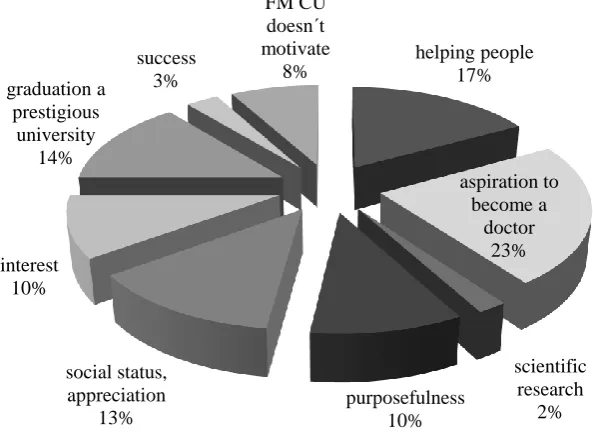
In the first step we analyzed respondent´s answers about their motivation to study medicine at Faculty of Medicine Comenius University in Bratislava. [Bernadicova et al. 2007]
Figure 1. Motivation of students to study medicine at FM CU in Bratislava
helping people 17%
aspiration to become a
doctor 23%
scientific research
2% purposefulness
10% social status,
appreciation 13% interest
10% graduation a
prestigious university
14%
success 3%
FM CU doesn´t motivate
Page 94
Figure 2. Actual attitudes of the respondents to the sciences after 1st semester of medicine study
(mean values in acad. years 2016/2017 and 2017/2018).
Figure 3. Level of motivation for the study of the sciences as an inevitable part of medicine study (mean values in acad. years 2016/2017 and 2017/2018).
The lowest level of motivation to study medical biophysics and the higher motivation to study medical chemistry and medical biology as integral part of medicine study was found.
In average it was observed negative or slightly negative motivation – 29.0%, 8.0%, 45%; neutral – 44.0%, 35.1%, 31.5%; slightly positive – 22.5%, 45.9%, 51.0%, positive – 4.3%, 11.0%, 13.0% (respectively by subjects: medical biophysics, medical chemistry, medical biology). (Figure 2, Figure 3)
Respondents identified the main motivating and demotivating factors in the teaching and learning of the sciences.
As main motivating factors were identified:
Page 95
Figure 4. The main motivating factors (mean in acad. years 2016/2017 and 2017/2018).
In contrary, as main demotivating factors were identified:
A lot of theory without practical application (17.7%/17.1%), high time and content demands (15.6%/15.7%), insufficient continuity to the medical practice (15.9%/15.0%), memorizing (14.8%/15.1%), insufficient continuity to the other teaching subjects (14.4%/13.6%), followed by a lot of practicals and continuous assessment of knowledge (acad. years 2016/2017 and 2017/2018, respectively). (Figure 5)
Figure 5. The main demotivating factors (mean in acad. years 2016/2017 and 2017/2018).
The content of 76 semester projects (acad. year 2017/2018) was done, the percentage of different biophysical topics (optics, bioenergetics, biomechanics, acoustics, biosignals, radioactivity, transport processes and modern methods in medicine) was analyzed and compared with those in previous academic years. The highest percentage was found by biosignals (60.5%) and the other topics were represented in a lower percentage – radioactivity (10.5%) and transport processes (10.5%).
The spectrum of science applications in medical diagnostics and therapy and safety problems related to physical principles of medical equipment in medical practice were summarized.
DISCUSSION
Page 96
should master the full range of approaches, strategies, and resources that motivate students to do. They should also know their students and know what patterns are strong in a given group or individuals. Natural sciences are not an easy teaching subjects. The main task of teaching it is to prepare students to understand their applications in medicine. Students get knowledge on basic principles of methods and devices using in medical practice. This knowledge can be applied and improved in other medical sciences as physiology, pathophysiology, internal medicine, neurology, dermatovenerology, ophthalmology, otorhinolaryngology, internal medicine, pneumophtisiology and other related subjects. In the same time the training of working with modern computer-based devices that nowadays are inevitable part of basic equipment of any more or less specialized medical workplace is important. [Kralova, Ferencova & Trnka 2017]
This is a stringent requirement but with the application of proper learning methods it is a soluble problem. Up-to-date demands in medical knowledge represent important education aim and cannot be imagined without thorough study of applications of physical sciences in medicine and their methods. Obtained results show students attitudes concerning teaching process and the main important factors of their motivation to study sciences that create the base for special subjects in medicine study (e.g. anatomy, physiology, pathophysiology, radiology, neurology, imaging methods in medicine) and improve methodical and technological literacy of students and absolvents.
The most difficult situation in the teaching and learning of medical biophysics was indicated in our research. There were revealed negative and very negative attitudes and motivation of the medical students to medical biophysics. Better situation, but not optimal, was find concerning medical chemistry and medical biology.
Content analysis of written works in medical biophysics correspond with our previous findings, weaknesses and importance of project teaching and learning were identified. There are problems by semestral projects processing by 1st year students. Their ability to elaborate written works are not
adequate and their presentation is often limited to reading the text only and students´ auditory is often not sufficiently prepared to discussion. [Kralova 2008; Kralova 2017]
Sometimes students made copies of projects and the same topics are repeatedly presented without the knowledge promotion. This phenomenon is enhanced by new possibilities offered by internet, today.
Based on obtained results we have confirmed the relevance of project-based teaching and learning in medical biophysics. It facilitates cognitive and other key competencies developed by physically oriented teaching subjects, supports both individual and team study activities, improve study results and play important role in students´ motivation. It represents an effective teaching tool that is positively evaluated by students and we believe that project teaching and learning can positively influence students´ attitudes to the science as inevitable component of medicine curriculum.
The role of the teacher is to overcome these problems. It is necessary to find new motivating approaches and strategies in teaching process of the sciences and apply them to improve motivation of medical students. Therefore, university teachers, especially teachers of sciences at the medical faculty, should master the full spectrum of approaches, strategies, and resources that motivate students to study sciences. They should also know their students and know what patterns are significant in a given group or individuals. The lifelong learning of sciences´ teachers in the pedagogical field is required as well. [Kralova & Svetlikova-Martauzova 2017]
Teaching and learning of the sciences at medical faculties should support the improvement of educational level. It is required to optimize teaching techniques, methods and thus to improve educational quality and international competitiveness of graduates.
Page 97 ACKNOWLEDGEMENTS
Contribution was supported by GP KEGA Ministry of Education, Science, Research and Sport of the Slovak Republic № 003UK–4/2016.
REFERENCES
[1] Kralova, E 2015, Application of grant project KEGA MŠVVaŠ SR 003UK-4/2016. Bratislava : LFUK, 31 p.
[2] Vašutova, J 2002, The strategy of teaching in higher education. Prague : Faculty of Education CU, 282 p. ISBN 80-7290-100-1. Prague, ČR.
[3] Bernadic, M, Traubner, P, Kukurova, E & Bernadicova, H 2006, Asserting Bologna declaration in restructuring of school system at Comenius University Medical School. Bratisl Med J, 107(4): 123:125. ISSN 0006-9248.
[4] Kralova, E & Kukurova, E 2008, ´Use the questionnaire to receive feedback information on the teaching´, Research in Didactics of the Sciences (Eds. M. Nodzynska, J. R. Pasko), Krakow : Uniwersytet pedagogiczny im. Komisji Edukacji Narodowej, p. 219-222.
[5] Bernadicova, H, Benedekova, M, Babal, P & Bernadic, M, 2007, Prieskum názorov absolventov Lekárskej fakulty UK v Bratislave (A survey of graduate opinions of the Faculty of Medicine of the Comenius University in Bratislava), Revue ošetrovateľstva, sociálnej práce a laboratórnych metodík, XIII/2007, N. 1, p. 24-26.
[6] Kralova, E 2008, ´Physical education in the professional preparation of future physician at the faculties of medicine´, Dissertation Thesis. Nitra: Constantine the Philosopher University in Nitra, 103 p.
[7] Kralova, E, 2017, ´Motivation of medical students to study physical, chemical and biological sciences – survey results´, EDULEARN 17 Proceedings. Valencia : IATED Academy, p. 9220-9223.
[8] Kralova, E, Ferencova, E & M. Trnka, 2017, ´Semester projects in medical biophysics promote active learning´, EDULEARN17 Proceedings. Valencia : IATED Academy, 2017. p. 9302-9306. ISBN 978-84-697-3777-4.